Do you ever read back your writing and realize you used the word “say” ten times in a single paragraph? You are not alone. This happens to students writing essays, professionals drafting emails, and bloggers creating content.
Repeating “say” makes your writing feel flat and uninspired. But finding the right alternative can transform your sentences from dull to dynamic. This guide will teach you how to choose the perfect synonym for every situation.
What Does “Say” Mean?
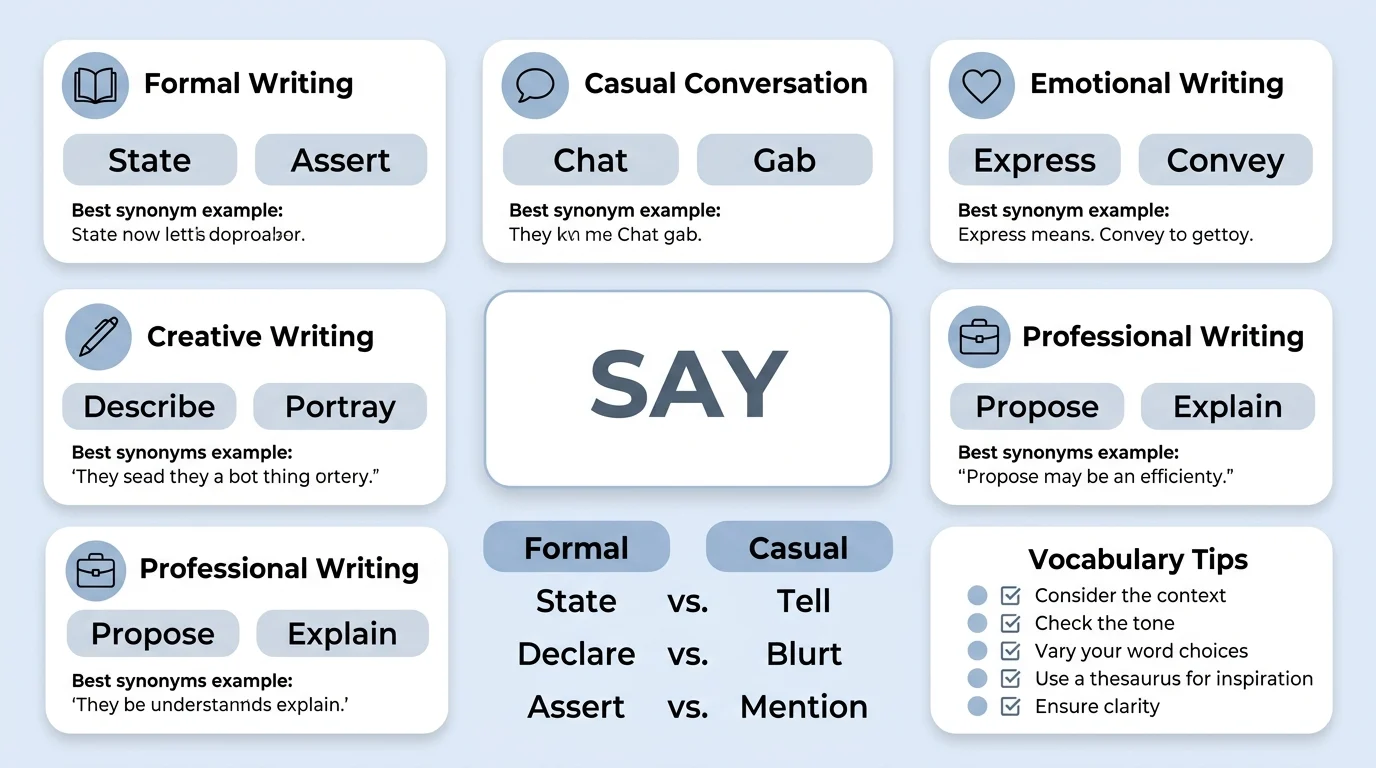
“Say” means to utter words or express thoughts verbally. The best synonyms depend on your context. For formal writing, use “state” or “declare.” casual conversation, try “mention” or “add.” emotional scenes, choose “exclaim” or “whisper.” For professional settings, “advise” or “communicate” work well. Creative writers often prefer “murmur” or “announce” for descriptive impact.
Meaning, Tone and Context
Simple Definition
“Say” is a verb that means to speak, utter, or express something in words. It is one of the most common words in the English language.
Part of Speech
Verb. The past tense is “said,” and the present participle is “saying.”
Tone
Neutral. “Say” carries no emotional weight on its own. It simply reports speech.
Formality Level
Neutral and versatile. It works in every setting from casual chats to formal speeches.
Common Use Cases
Reporting dialogue in stories. Quoting someone in an article. Sharing information in conversation. Expressing opinions in discussions. Delivering announcements or messages.
Important Word Forms
Noun form: saying (a well known expression or proverb). Adjective form: unsaid (not expressed verbally). Related form: so to speak (an idiomatic expression meaning figuratively speaking).
When and How to Use “Say”
You should use “say” when you want a neutral, straightforward way to report speech. It is the safest choice when you do not need to add emotional or descriptive meaning. However, overusing it weakens your writing. Use “say” as your baseline, then replace it with stronger synonyms when you want more precision.
Professional Example
The manager said the project deadline has been extended by two weeks. This works in a simple workplace update.
Academic Example
The researcher said the results support the initial hypothesis. This is acceptable but could be stronger with “asserted.”
Personal Example
My grandmother said she remembers the day the war ended. This conveys a personal memory effectively.
Emotional Example
He said he loved me for the first time. The simplicity works because the emotion comes from the content.
Creative Example
The wind said nothing as it swept through the empty streets. This personification is poetic and effective.
Social Media Example
She said she would post the video later today. Casual and clear for social platforms.
Email Example
I said in my previous message that the invoice was due Friday. Direct and professional for email communication.
Another Word for “Say”
Professional Writing
“State” is the best replacement. It sounds authoritative and clear in reports, proposals, and business documents.
Academic Writing
“Assert” works well for presenting claims. “Maintain” is good for defending positions in research papers.
Casual Conversation
“Mention” feels natural and light. “Add” keeps the flow casual when sharing extra information.
Emotional Writing
“Whisper” suggests intimacy. “Exclaim” shows excitement or surprise. “Mutter” conveys frustration.
Creative Writing
“Murmur” adds softness. “Declare” brings power. “Mumble” creates confusion or shyness.
Resume or Workplace Use
“Communicate” shows strong soft skills. “Advise” positions you as an expert. “Present” suggests formal delivery.
Social Media Captions
“Share” feels personal and engaging. “Post” is direct and modern.
Stronger Meaning
“Declare” is more forceful. “Proclaim” adds drama. “Announce” carries official weight.
Softer Meaning
“Mumble” is quiet and unclear. “Mutter” is low and often complaining. “Murmur” is gentle and soothing.
When Not to Use “Say”
Do not use “say” when you need to describe how something was spoken. It lacks emotional and descriptive power.
Example of Overuse
She said she was angry. He said he was sorry. They said they would leave.
Improved Version
She snapped that she was angry. He whispered his apology. They announced their departure.
Do not use “say” in creative writing when you want to paint a vivid picture. Readers need to hear the tone, volume, and emotion.
Example of Vague Writing
The teacher said the students should study harder.
Improved Version
The teacher insisted that the students should study harder.
Avoid “say” in resumes and cover letters. Stronger action verbs make you sound more capable.
Example of Weak Resume Language
I said the team should try a new approach.
Improved Version
I recommended a new approach to the team.
Do not use “say” in formal speeches or presentations. Words like “assert,” “declare,” and “proclaim” command more attention.
Words Commonly Confused With “Say”
Say vs. Tell
The main difference is structure. You say something. You tell someone something. “Tell” always needs an object or listener.
Say vs. Speak
“Speak” focuses on the act of producing words. “Say” focuses on the content being expressed. “Speak” is often more formal.
Say vs. Talk
“Talk” implies conversation between two or more people. “Say” can be a single statement or remark.
“State” is more formal and precise. It suggests a clear, definite expression of facts or positions.
“Claim” suggests something might be disputed or unproven. “Say” is neutral without this implication.
Say vs. Mention
“Mention” is brief and casual. It suggests the information is not the main focus.
Best Synonym by Context for “Say”
| Context | Best Synonym | Why It Works | Example |
|---|---|---|---|
| Formal writing | State | Precise and authoritative | The report states the findings clearly. |
| Academic writing | Assert | Confident and research based | The study asserts a strong correlation. |
| Professional or business | Advise | Expert and helpful | I advise reviewing the contract. |
| Resume | Communicate | Shows professional soft skills | Communicate project updates effectively. |
| Casual conversation | Mention | Light and natural | She mentioned she might be late. |
| Creative writing | Murmur | Adds texture and mood | He murmured a soft goodbye. |
| Emotional tone | Exclaim | Shows excitement or shock | She exclaimed with pure joy. |
| Strong intensity | Declare | Bold and unmistakable | The judge declared the verdict. |
| Soft or moderate | Whisper | Quiet and intimate | He whispered a secret to her. |
| Social media captions | Share | Conversational and modern | Share your favorite moment below. |
Which Synonym Should You Choose?
Consider Your Meaning
What do you want to convey? Do you want to report facts, share opinions, or describe emotions? Your meaning guides your word choice.
Consider Your Audience
Formal writing requires formal words like “state.” Casual conversations work with “mention.” Know who is reading or listening.
Consider Emotional Intensity
Do you want to show excitement, sadness, anger, or calmness? Choose words like “exclaim,” “whisper,” “snap,” or “murmur” to match the emotion.
Consider Professional Impact
Resumes and cover letters need strong action verbs. “Communicate,” “advise,” and “present” sound more professional than “say.”
Consider Sentence Flow
Read your sentence aloud. Does the synonym sound natural? If it feels forced, choose a more natural alternative.
Consider Variety
If you have used “say” many times, replace it with different synonyms. This keeps your writing fresh and engaging.
Real Life Examples of “Say” in Sentences
School
The principal announced that Friday would be a half day. Students cheered at the news.
Workplace
The director emphasized the importance of meeting quarterly goals. Her team nodded in agreement.
Writing
The author describes the scene with vivid detail. She describes the sunset as a blazing fire.
Conversation
He mentioned that he saw the movie last week. I was surprised he had not shared this earlier.
Social Media
She posted a photo with the caption “Living my best life.” Her followers responded with supportive comments.
Resume
Presented quarterly reports to senior leadership. The presentations received positive feedback.
Email
I confirmed the meeting time in my previous message. Please let me know if this works.
Storytelling
The old man whispered a warning to the young traveler. The words echoed in the darkness.
25 Synonyms for “Say”
| Synonym | Simple Meaning | Best Used For | Example Sentence |
|---|---|---|---|
| State | Express clearly and formally | Formal reports and official statements | The witness stated the facts without hesitation. |
| Mention | Refer to briefly | Casual conversation and quick references | Please mention the new policy in your email. |
| Declare | Announce officially or emphatically | Proclamations and bold statements | The president declared a state of emergency. |
| Announce | Make publicly known | News, events, and official updates | The company announced its quarterly earnings. |
| Assert | State confidently as fact | Academic writing and debates | The professor asserted the theory is flawed. |
| Claim | Say something is true without proof | Contentious statements and opinions | The politician claimed victory on election night. |
| Explain | Make something clear | Teaching, clarifying, and detailing | The instructor explained the complex equation. |
| Suggest | Propose an idea or possibility | Recommendations and brainstorming | I suggest we try a different approach. |
| Advise | Offer guidance or recommendations | Professional and expert opinions | The lawyer advised her client to settle. |
| Communicate | Share information effectively | Workplace and professional settings | Managers must communicate clearly with staff. |
| Exclaim | Cry out with emotion | Surprise, excitement, or shock | The child exclaimed with glee at the gift. |
| Whisper | Speak softly | Secrets, intimacy, and quiet settings | She whispered a prayer before the exam. |
| Murmur | Speak in a low gentle voice | Romance and soothing tones | The wind murmured through the pine trees. |
| Mumble | Speak unclearly and quietly | Confusion or embarrassment | He mumbled something about being sorry. |
| Mutter | Speak in a low complaining voice | Frustration or irritation | The customer muttered about the poor service. |
| Shout | Call out loudly | Emergencies and loud environments | He shouted for help across the empty street. |
| Yell | Shout with strong emotion | Anger or excitement | The coach yelled encouragement from the sideline. |
| Scream | Cry out in fear or pain | Extreme emotions and emergencies | She screamed when she saw the spider. |
| Utter | Say something aloud | Formal and literary use | He uttered a single word of warning. |
| Voice | Express opinions or feelings | Professional and personal expression | Employees voiced their concerns at the meeting. |
| Convey | Communicate a message or feeling | Creative and professional writing | The artist conveys emotion through color. |
| Express | Show or describe emotions | Personal and creative writing | She expressed her gratitude to the team. |
| Add | Say something extra | Ongoing conversations | He added that he would arrive late. |
| Respond | Reply to something said | Conversations and correspondence | She responded with a thoughtful question. |
| Reply | Answer a question or statement | Direct communication | The customer replied to the survey request. |
Synonym Groups and Usage Differences
Professional vs. Personal Synonyms
Professional synonyms focus on clarity and authority. Words like “state,” “advise,” and “communicate” work well in workplace settings. They show competence and expertise. Personal synonyms feel warmer and more intimate. “Whisper,” “murmur,” and “share” create emotional connections. Choose professional words for resumes and business emails. Choose personal words for letters to friends or family.
Formal vs. Conversational Synonyms
Formal synonyms belong in reports, essays, and speeches. “Assert,” “declare,” and “pronounce” add weight to important statements. Conversational synonyms feel natural in daily chat. “Mention,” “add,” and “say” are safe for casual settings. Formal writing requires more precision and authority. Casual writing allows for simpler, more direct language.
Academic Synonyms
Academic writing needs precise and confident language. “Assert” suggests a claim backed by evidence. “Hypothesize” proposes an unproven idea for testing. “Postulate” builds on theoretical frameworks. “Maintain” defends a position against criticism. These words show scholarly rigor. Avoid casual words like “mention” in research papers. Use “state” for presenting established facts.
Professional and Business Synonyms
Business communication values clarity and professionalism. “Advise” shows expertise and helpfulness. “Communicate” highlights teamwork and collaboration. “Present” suggests formal delivery of information. “Report” implies sharing findings or updates. “Recommend” offers solutions to problems. These words make you sound capable and professional.
Creative or Literary Synonyms
Creative writing thrives on descriptive language. “Murmur” suggests secrecy or intimacy. “Whisper” adds quiet drama. “Exclaim” creates energy and surprise. “Declare” brings boldness and conviction. “Mumble” and “mutter” show confusion or annoyance. These words paint pictures in readers’ minds. Use them to bring characters and scenes to life.
Slang or Modern Synonyms
Modern English has many casual ways to say “say.” “Chat” means to talk informally. “Spill” encourages someone to share secrets. “Blab” is negative and means revealing secrets carelessly. “Talk” is neutral and common. These words are acceptable in texts and social media. Avoid them in formal or professional writing. They are too casual for serious contexts.
Strongest vs. Weaker Synonyms
Intensity scale from mild to strongest:
Mild: mention, add, say
Medium: state, assert, declare
Strong: proclaim, pronounce, avow
Strongest: swear, vow, insist
Choose mild words for simple sharing. Choose medium words for formal statements. strong words for passionate or authoritative declarations. the strongest words for promises and solemn oaths.
Emotional vs. Neutral Synonyms
Neutral synonyms simply report speech. “Say,” “state,” and “mention” carry no emotion. Emotional synonyms add feeling and tone. “Whisper” suggests intimacy. “Exclaim” shows excitement. “Mutter” reveals annoyance. “Shout” communicates anger or urgency. Use neutral words for facts and neutral reports. Use emotional words to create mood and depth.
Antonyms of “Say”
| Antonym | Meaning | Example Sentence |
|---|---|---|
| Silence | Complete absence of sound | The room fell into complete silence. |
| Hush | Become quiet or still | The crowd hushed as the speaker approached. |
| Muteness | Inability or refusal to speak | His muteness frustrated the audience. |
| Quiet | Little or no noise | The library remains quiet during exams. |
| Stillness | Absence of movement or sound | The stillness of the night was unsettling. |
| Shush | Tell someone to be quiet | She shushed the noisy children. |
| Shut up | Stop speaking rudely | He told his friend to shut up briefly. |
| Stop talking | Cease verbal communication | Please stop talking during the movie. |
| Listen | Pay attention to sound | Listen carefully to the instructions. |
| Hear | Perceive sound with ears | She could hear the birds outside. |
| Refrain | Choose not to speak | He refrained from making a comment. |
| Withhold | Keep back from expression | She withheld her true feelings. |
| Suppress | Prevent expression | He suppressed his urge to argue. |
| Conceal | Hide from knowledge | The witness concealed the truth. |
| Keep quiet | Remain silent | Please keep quiet during the presentation. |
Comparison: Say vs. Similar Words
Say vs. Tell
The main difference is who receives the information. With “say,” you do not always mention the listener. “He said hello” is complete. With “tell,” you must mention the listener. “He told me hello” is correct. “Tell” also shares instructions or information more directly. “Say” focuses on the words themselves. Choose “tell” when you want to show communication with someone specific. Choose “say” when you want to focus on the message.
Say example: She said the meeting was canceled.
Tell example: She told us the meeting was canceled.
Say vs. Speak
“Speak” focuses on the act of talking rather than the specific words. It is often more formal than “say.” “Speak” suggests delivering a message or expressing an opinion. “Say” is simpler and more direct. Use “speak” when you want to emphasize the delivery. Use “say” when you want to emphasize the content.
Say example: He said he would arrive at noon.
Speak example: The CEO spoke about company values.
Say vs. Talk
“Talk” implies conversation between people. It suggests two way communication. “Say” can be one sided. “Talk” often means discussing a topic at length. “Say” is usually brief. Use “talk” for ongoing exchanges. Use “say” for single remarks.
Say example: She said one word before leaving.
Talk example: We talked for hours about the future.
Say vs. State
“State” is more formal and precise. It suggests a clear declaration of facts or positions. “State” often appears in legal, academic, and business contexts. “Say” is broader and more casual. Use “state” for official and formal statements. Use “say” for general communication.
Say example: He said his opinion on the matter.
State example: The policy states clear guidelines.
Say vs. Claim
“Claim” implies that something may be disputed or unproven. It carries an element of doubt. “Say” is neutral without this implication. Use “claim” when you want to question or challenge the statement. Use “say” when you simply report.
Say example: She said she completed the project.
Claim example: He claimed he completed the project.
Say vs. Mention
“Mention” is brief and casual. It suggests the information is not the main focus. “Say” can be brief or detailed. Use “mention” when you bring up a small point. Use “say” for more substantial statements.
Say example: He said everything he knew.
Mention example: She mentioned the date in passing.
Common Phrases and Expressions with “Say”
1. You can say that again
Meaning: You strongly agree with what someone just said.
Example sentence: This has been the best vacation ever. You can say that again.
2. Let’s say
Meaning: Used to introduce an example or hypothetical situation.
Example sentence: Let’s say you win the lottery. What would you do first?
3. Say what you will
Meaning: Used to acknowledge that others may disagree with your opinion.
Example sentence: Say what you will about him, he always delivers results.
4. Have a say
Meaning: Have the right or opportunity to express your opinion.
Example sentence: Everyone should have a say in decisions that affect them.
5. So to speak
Meaning: Used to indicate you are speaking figuratively.
Example sentence: The project is a ship sailing through rough waters, so to speak.
6. Need I say more
Meaning: Used when something is completely obvious.
Example sentence: The results speak for themselves. Need I say more.
7. Say the word
Meaning: Tell me what you want me to do.
Example sentence: Just say the word and I will help you move.
8. To say the least
Meaning: Used to understate a situation that is actually extreme.
Example sentence: The traffic was terrible, to say the least.
Common Mistakes to Avoid
Using “Say” When a More Precise Synonym Is Better
Simple sentences often need stronger verbs. “He said no” could become “He refused.” “She said yes” could become “She agreed.” More precise words improve your writing.
Confusing “Say” with “Tell”
Remember the structure difference. You say something. You tell someone something. Incorrect: “He said me to wait.” Correct: “He told me to wait.” Correct: “He said he would wait.”
Using a Casual Synonym in Formal Writing
Words like “mention” and “add” are too casual for academic papers. Use “state,” “assert,” or “maintain” for formal work. These words show scholarly seriousness.
Using an Overly Dramatic Synonym for a Simple Situation
Do not use “exclaim” when someone is speaking calmly. Do not use “declare” when someone is making a casual comment. Match the word to the situation.
Repeating the Same Word Too Often
Variety keeps writing fresh. If you use “said” ten times, replace some with “stated,” “mentioned,” or “explained.” This improves readability and engagement.
Choosing a Synonym with the Wrong Emotional Tone
Be careful with emotional words. “Muttered” suggests complaint. “Whispered” suggests secrecy. “Shouted” suggests anger. Choose words that match the feeling you want to express.
Using Slang in Academic or Professional Writing
Avoid words like “blab,” “spill,” and “talk” in formal settings. These are too casual. Stick with “state,” “communicate,” and “advise” for professional documents.
FAQs
What is the best synonym for “say”?
“State” is excellent for formal contexts. “Mention” works well in casual settings. The best choice depends on your audience and purpose.
What is a formal synonym for “say”?
“State,” “assert,” “declare,” and “proclaim” are formal alternatives. They add authority and precision to your writing.
What is an informal synonym for “say”?
“Mention,” “add,” and “share” are informal synonyms. They work well in texts, casual emails, and social media posts.
What is another word for “say” in professional writing?
“Advise,” “communicate,” “present,” and “report” are professional alternatives. They show expertise and workplace competence.
What is the difference between “say” and “tell”?
“Say” focuses on the words spoken. “Tell” always requires a listener object. You say something. You tell someone something.
What is the opposite of “say”?
“Silence,” “quiet,” “hush,” and “stillness” are opposites. They represent the absence of speech or sound.
Conclusion
The word “say” is simple and useful, but it lacks power and variety. By choosing precise synonyms, you can improve your writing, speaking, and professional communication. Consider your audience, emotional tone, and level of formality. Match your word to the situation. Start with neutral words like “state” for formal writing. Use “mention” for casual conversation. Add emotional words like “whisper” or “exclaim” for creative work. Practice using these synonyms every day. Your vocabulary will grow stronger, and your communication will become more effective.