Have you ever found yourself writing an email, an essay, or a social media caption and realized you have used the word “care” three times in two sentences? You are not alone. Many writers, students, and professionals struggle with repetitive vocabulary. Finding the right synonyms of care can transform your writing from dull to dynamic.
The word “care” appears everywhere. We talk about caring for family members, showing care in our work, handling tasks with care, and even taking care of ourselves. But repeating the same word makes your writing feel flat and uninspired. Choosing the right synonym adds precision, emotional depth, and professional polish to your communication.
This guide will help you understand the meaning of care, explore the best synonyms for every situation, and avoid common vocabulary mistakes. Whether you are writing a business email, a college essay, a resume, or a creative story, you will find the perfect alternative here.
What Are the Best Synonyms of “Care”?
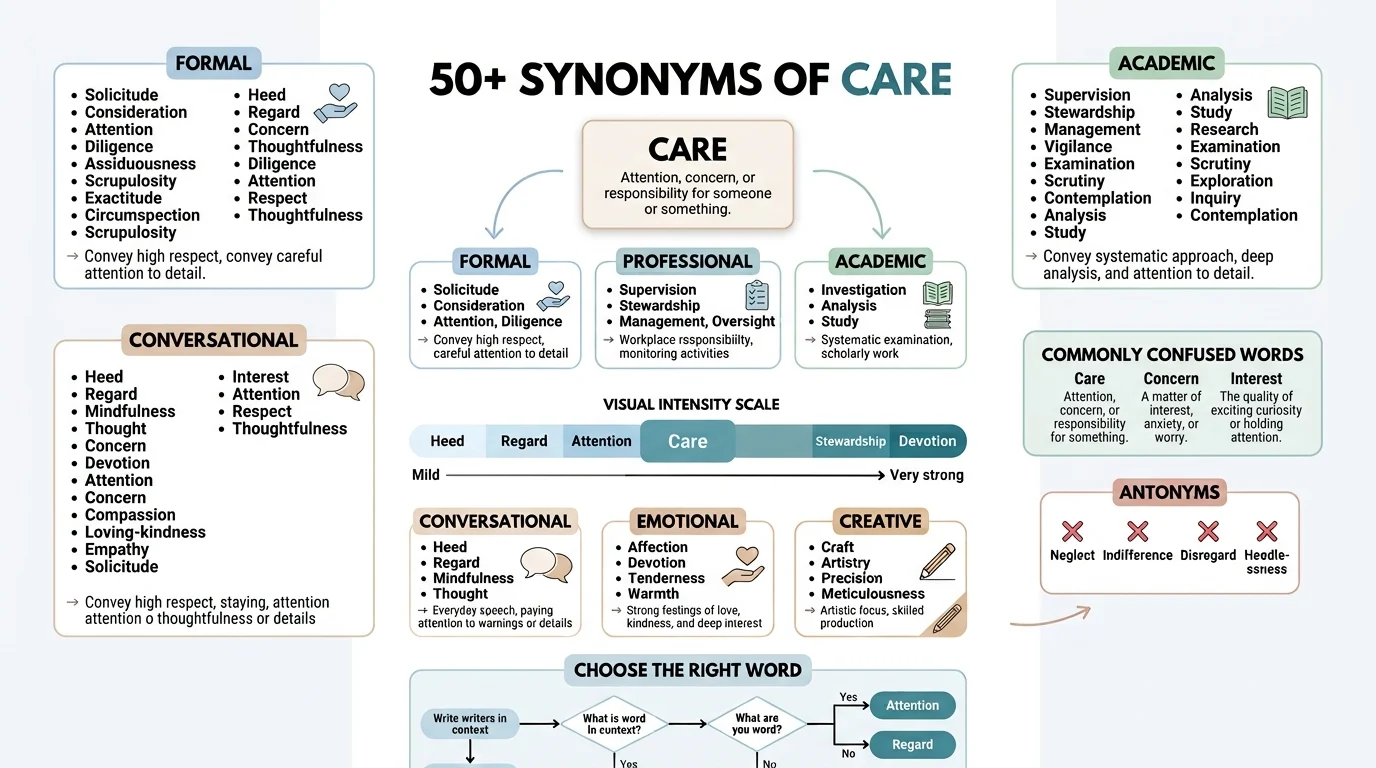
Care means showing concern, attention, or responsibility toward someone or something. Its tone ranges from neutral to deeply emotional depending on context. Formal writing, use “regard” or “consideration.” For professional communication, choose “attention” or “diligence.” Emotional writing, “compassion” or “tenderness” work best. For casual conversation, “concern” or “thoughtfulness” sound natural and clear.
Meaning, Tone, and Context
Simple Definition
Care means paying attention to someone or something. It can mean feeling concern for another person’s wellbeing, handling something with caution and precision, or taking responsibility for a person, animal, or task. Care involves both emotional investment and practical actions.
Part of Speech
Care functions as both a noun and a verb. As a noun, it refers to the feeling of concern or the act of paying attention. As a verb, it means to feel concern or to look after someone or something.
Overall Tone
Care carries a neutral to positive tone. The emotional weight depends entirely on how you use it. In some contexts, it sounds warm and gentle. In others, it sounds serious and responsible. The tone shifts based on the situation and the synonyms you choose.
Formality Level
Care is a neutral word. It works in almost every situation. You can use it in formal reports, academic essays, workplace conversations, and casual texts. However, some synonyms are more formal or more casual than the original word.
Common Uses
Native English speakers use care in many everyday situations. Talk about health care, customer care, and self care. They express care for family members and close friends. Handle fragile items with care. They show care in their work by being thorough and accurate. The word appears in instructions, emotional conversations, professional settings, and personal relationships.
Word Forms
- Noun: care
- Verb: care (cares, caring, cared)
- Adjective: careful, careless
- Adverb: carefully, carelessly
- Noun (person): caregiver
When and How to Use “Care”
Care is the safe, reliable choice when you want to express concern, attention, or responsibility. It works in almost every situation. However, it often sounds too general. Stronger synonyms usually communicate your message more clearly.
7 Realistic Examples of Care in Context
Professional Context:
“We must handle client data with care to maintain trust and security.”
Academic Context:
“The researcher approached the sensitive topic with care, ensuring all participants felt respected.”
Workplace Context:
“She takes great care in reviewing every report before submission.”
Personal Context:
“He showed genuine care when he noticed I was having a difficult day.”
Email Context:
“Thank you for your care in addressing my concerns so thoroughly.”
Resume Context:
“Managed patient care schedules for a team of 12 healthcare providers.”
Social Media Context:
“Spread care, not negativity. A little kindness goes a long way.”
Best Synonyms of Care
No synonym perfectly replaces care in every situation. Each alternative carries its own emotional weight, formality level, and specific meaning. The best choice depends entirely on your audience and purpose.
Professional Writing
Use “attention” or “diligence.” These words sound capable and responsible. They suggest you take your work seriously and handle tasks thoroughly. Employers and clients respond well to these terms.
Academic Writing
Choose “consideration” or “scrutiny.” These words signal intellectual rigor and thoughtful analysis. They fit research papers, essays, and scholarly discussions well.
Business Communication
Select “regard” or “concern.” These words maintain a professional tone while showing you value people and outcomes. They work perfectly in client emails and internal communications.
Casual Conversation
Go with “concern” or “thoughtfulness.” These words sound natural and approachable. They fit everyday discussions with friends, family, and colleagues.
Emotional Writing
Pick “compassion” or “tenderness.” These words carry warmth and genuine feeling. They work beautifully in personal letters, speeches, and heartfelt messages.
Creative Writing
Use “solicitude” or “tenderness.” These words add depth and elegance to descriptive passages. They help create emotional resonance in fiction and poetry.
Resume Writing
Choose “responsibility” or “management.” These words emphasize your professional capabilities and reliability. They impress hiring managers and recruiters.
Workplace Communication
Select “diligence” or “thoroughness.” These words highlight your work ethic and attention to detail. They strengthen performance reviews and project updates.
Stronger Meaning
Use “vigilance” or “diligence.” These words suggest intense focus and serious commitment. They convey that you are paying extremely close attention.
Softer Meaning
Choose “kindness” or “warmth.” These words reduce intensity while keeping the core meaning. They sound gentle and approachable.
When Not to Use Care
Care is not always the right choice. Sometimes it sounds too vague, too casual, or too weak. In these situations, a more precise synonym will communicate your message better.
When Care Sounds Too General
The word care often fails to capture specific actions or feelings. If you are describing precise medical monitoring or detailed financial oversight, care sounds vague and inadequate.
Weak Example:
“The nurse provided care to the patient.”
Stronger Choice:
“The nurse provided attentive monitoring to the patient.”
The word “monitoring” specifies exactly what the nurse did. It communicates precision and competence.
When Care Sounds Too Informal
In formal legal documents, academic papers, or executive reports, care may sound too casual. These contexts require vocabulary that matches their serious tone.
Weak Example:
“The committee handled the confidential information with care.”
Stronger Choice:
“The committee handled the confidential information with discretion.”
Discretion suggests judgment, trustworthiness, and professional responsibility at a higher level.
When Care Sounds Too Weak
Sometimes you need a word that conveys urgency, intensity, or deep commitment. Care may not feel strong enough for these situations.
Weak Example:
“She cares about her team’s success.”
Stronger Choice:
“She is deeply committed to her team’s success.”
Commitment suggests long-term dedication and serious investment in the outcome.
When Care Sounds Too Formal
In friendly conversations, texts, or social media posts, care can feel stiff or overly serious. More casual alternatives sound warmer and more natural.
Weak Example:
“I care about your happiness.”
Stronger Choice:
“I want you to be happy.”
The casual version sounds more genuine and less like a scripted line.
Words Commonly Confused With Care
Care vs Concern
Difference: Concern focuses on worry or interest about a specific issue. Care focuses on responsibility or affection for a person or thing.
When to Use Concern: Use it when you want to express worry about a situation or interest in a particular matter.
Example: “I have some concern about the project timeline.”
Care vs Compassion
Difference: Compassion specifically means feeling sympathy for someone’s suffering and wanting to help. Care has a broader meaning that includes attention, responsibility, and affection.
When to Use Compassion: Use it when you want to emphasize empathy and kindness toward someone in difficulty.
Example: “She showed great compassion for the struggling families.”
Care vs Attention
Difference: Attention focuses on focused awareness and observation. Care includes both attention and emotional investment or responsibility.
When to Use Attention: Use it when precision and focus matter more than emotional connection.
Example: “Please give this document your full attention.”
Care vs Worry
Difference: Worry implies anxiety and distress. Care does not necessarily include negative emotions. You can care about someone without worrying about them.
When to Use Worry: Use it when you want to express actual anxiety or fear about a negative outcome.
Example: “I worry about my children during their long commute.”
Care vs Diligence
Difference: Diligence means persistent effort and careful attention to detail. Care can be less intense and less focused on sustained effort.
When to Use Diligence: Use it when you want to emphasize hard work, thoroughness, and commitment to quality.
Example: “His diligence in checking every number prevented errors.”
Care vs Regard
Difference: Regard means respect, esteem, or consideration. It often feels more formal and less personal than care.
When to Use Regard: Use it in formal writing when you want to show respect or consideration without emotional warmth.
Example: “We hold your contributions in high regard.”
Best Synonyms of Care by Context
| Context | Best Synonym | Why It Works | Example |
|---|---|---|---|
| Formal Writing | Regard | Communicates respect and consideration in a professional, sophisticated tone | “The committee holds these values in high regard.” |
| Academic Writing | Consideration | Shows thoughtful analysis and intellectual rigor | “The study requires careful consideration of ethical factors.” |
| Professional Communication | Attention | Highlights focus, precision, and responsibility | “We appreciate your attention to this matter.” |
| Business Emails | Diligence | Emphasizes thoroughness and work ethic | “His diligence on this project has been exceptional.” |
| Resume Writing | Management | Demonstrates responsibility and leadership | “Managed care coordination for 200+ patients.” |
| Workplace Communication | Thoroughness | Signals reliability and attention to detail | “Her thoroughness in reviews prevents costly errors.” |
| Casual Conversation | Thoughtfulness | Sounds warm, personal, and considerate | “I appreciate your thoughtfulness in remembering my birthday.” |
| Everyday Speaking | Interest | Feels natural and approachable in casual settings | “She takes an interest in everyone she meets.” |
| Creative Writing | Solicitude | Adds elegance and emotional depth | “He treated her with gentle solicitude.” |
| Storytelling | Tenderness | Creates emotional resonance and intimacy | “Her tenderness with the child touched everyone.” |
| Emotional Writing | Compassion | Expresses deep empathy and kindness | “His compassion for the injured animals moved us all.” |
| Strong Emphasis | Vigilance | Conveys intense awareness and protection | “The guard maintained constant vigilance over the premises.” |
| Mild Tone | Kindness | Softens the message while maintaining warmth | “A little kindness makes every workplace better.” |
| Social Media Captions | Warmth | Creates approachable, friendly content | “Sending warmth to everyone reading this today.” |
| American English | Concern | Widely used and understood across all contexts | “I have genuine concern for your wellbeing.” |
| British English | Solicitude | Carries an elegant, slightly formal British feel | “He treated her with great solicitude throughout her illness.” |
How to Choose the Best Synonym of Care
Choosing the right synonym starts with understanding your message and audience. Follow these practical guidelines to make confident choices every time.
Consider Your Meaning
Think about what you actually want to communicate. Are you talking about emotional connection, practical responsibility, focused attention, or professional dedication? Different synonyms match different meanings.
Evaluate Your Tone
The emotional weight of your word matters. Do you want to sound warm and caring, professional and capable, or gentle and tender? Match the tone to your purpose.
Know Your Audience
A synonym that works perfectly in a casual text message may sound completely wrong in a business presentation. Consider who will read your words and what they expect.
Assess Emotional Strength
Some synonyms carry stronger emotions than others. Vigilance suggests intense watchfulness. Kindness suggests gentle warmth. Choose the intensity that fits your situation.
Consider Your Writing Purpose
Are you writing to inform, persuade, comfort, or impress? Your purpose should guide your word choice. Academic papers demand precision. Personal letters call for warmth. Business communications require professionalism.
Trust Natural Usage
The best synonym often feels natural in the sentence. Read your choices aloud. If a word sounds forced or awkward, choose a different one. Natural language always communicates more effectively.
Real Life Examples of Care
School Example
“Students must handle lab equipment with care.” Better: “Students must handle lab equipment with caution.” Caution emphasizes safety and prevents accidents more clearly.
College Example
“The professor shows real care for his students.” Better: “The professor shows genuine interest in his students.” Interest suggests active engagement and concern.
Workplace Example
“She carries out her duties with care.” Better: “She carries out her duties with diligence.” Diligence highlights her work ethic and commitment to quality.
Business Example
“Our company values customer care.” Better: “Our company values customer satisfaction.” Satisfaction focuses on results and outcomes.
Email Example
“I will handle this matter with care.” Better: “I will handle this matter with attention.” Attention sounds more active and focused.
Resume Example
“Provided care to patients.” Better: “Provided compassionate support to patients.” Support and compassion communicate more about your approach.
Conversation Example
“I care about what happens to you.” Better: “I genuinely care about what happens to you.” Genuinely adds authenticity and emotional weight.
Storytelling Example
“She cared for the wounded bird.” Better: “She nurtured the wounded bird back to health.” Nurtured creates a more vivid, caring image.
Blogging Example
“Take care of your mental health.” Better: “Prioritize your mental health.” Prioritize sounds more actionable and important.
Social Media Example
“Sending care to everyone struggling today.” Better: “Sending compassion to everyone struggling today.” Compassion feels more specific and heartfelt.
18 Best Synonyms of Care
| Synonym | Simple Meaning | Best Used For | Example Sentence |
|---|---|---|---|
| Attention | Focused awareness and observation | Professional and academic writing | “The surgeon paid close attention to every detail during the procedure.” |
| Concern | Interest or worry about someone or something | Everyday conversation and emotional writing | “I have genuine concern about your health after hearing the news.” |
| Consideration | Thoughtful regard for others or factors | Academic writing and formal communication | “The committee showed consideration for all affected parties.” |
| Compassion | Sympathetic concern for others’ suffering | Emotional writing and personal messages | “Her compassion for the homeless inspired her volunteer work.” |
| Diligence | Persistent effort and careful attention | Professional and business writing | “His diligence in completing the project ahead of schedule impressed everyone.” |
| Regard | Respect and consideration | Formal and professional communication | “We hold your opinions in high regard.” |
| Thoughtfulness | Considerate attention to others’ needs | Personal communication and casual writing | “Your thoughtfulness in sending flowers meant the world to me.” |
| Tenderness | Gentle affection and concern | Emotional and creative writing | “She spoke with tenderness that calmed his fears.” |
| Vigilance | Alert watchfulness and caution | Safety and security contexts | “Border patrol agents maintain constant vigilance.” |
| Solicitude | Anxious or concerned care | Formal and literary writing | “His solicitude for his aging parents was evident.” |
| Management | Responsibility for handling something | Resume and professional writing | “Her management of the department has been outstanding.” |
| Concernment | Interest or involvement | Formal and older writing styles | “His concernment in the matter was appropriate.” |
| Heed | Careful attention | Formal writing and warnings | “The driver paid no heed to the warning signs.” |
| Interest | Curiosity or concern about something | Casual conversation and personal writing | “She takes an active interest in her employees’ development.” |
| Kindness | Gentle and caring behavior | Personal and social media writing | “His kindness made everyone feel welcome.” |
| Warmth | Genuine and friendly care | Emotional and conversational writing | “The warmth in her voice reassured him.” |
| Scrutiny | Close and careful examination | Academic and analytical writing | “The proposal requires careful scrutiny before approval.” |
| Mindfulness | Conscious and deliberate attention | Health and wellness contexts | “Practicing mindfulness improves mental health.” |
Synonyms of Care by Usage
Professional vs Personal Synonyms
Professional Synonyms: Attention, diligence, management, scrutiny, vigilance
These words work best in workplaces, business communications, and professional settings. They emphasize competence, reliability, and results. Use them in emails, reports, performance reviews, and resumes.
Personal Synonyms: Concern, kindness, tenderness, thoughtfulness, warmth
These words sound more natural in everyday conversations and personal relationships. They emphasize emotion, connection, and genuine feeling. Use them with friends, family, and in personal messages.
Formal vs Conversational Synonyms
Formal Synonyms: Consideration, heed, regard, solicitude, vigilance
Use these in academic papers, legal documents, formal speeches, and official correspondence. They create a sophisticated tone and demonstrate vocabulary precision.
Conversational Synonyms: Concern, interest, kindness, warmth
Use these in texts, casual emails, social media, and everyday speech. They sound natural and approachable while still communicating clearly.
Academic Synonyms
Consideration, scrutiny, diligence, regard, heed
These words carry intellectual weight and precision. They signal thoughtful analysis and careful reasoning. Academic audiences expect this vocabulary in research papers, essays, and scholarly discussions.
Professional and Business Synonyms
Attention, diligence, management, vigilance, thoroughness
These words impress employers, clients, and colleagues. They communicate competence, reliability, and commitment to quality. Use them in resumes, interviews, presentations, and professional correspondence.
Creative and Literary Synonyms
Solicitude, tenderness, compassion, warmth, regard
These words add depth, emotion, and elegance to creative writing. They help you create memorable characters, vivid scenes, and moving moments in fiction, poetry, and storytelling.
Slang or Modern Synonyms
None exist for care that are widely accepted as standard synonyms. Some people use “vibe” to mean showing care or concern in casual conversation, as in “I’m getting good vibes from her.” However, this usage is limited to very informal contexts and should never appear in professional or academic writing.
Strongest to Mildest Synonyms
Mild: Kindness, warmth, interest
These words convey gentle, positive feelings without intense emotions.
Moderate: Concern, thoughtfulness, regard
These words show genuine interest without being overwhelming or dramatic.
Strong: Compassion, diligence, vigilance
These words carry significant emotional weight or intense focus.
Very Strong: Solicitude, devotion, dedication
These words suggest deep commitment and serious emotional investment.
Emotional vs Neutral Synonyms
Emotional Synonyms: Compassion, tenderness, warmth, solicitude, kindness
These words express feelings and create emotional connections. Use them when you want to show genuine care, comfort someone, or write heartfelt messages.
Neutral Synonyms: Attention, consideration, heed, scrutiny, diligence
These words communicate information without emotional weight. Use them in professional contexts, instructions, and situations where emotional expression is inappropriate or unnecessary.
Antonyms of Care
| Antonym | Meaning | Example Sentence |
|---|---|---|
| Neglect | Failure to care for or pay attention to | “The neglect of safety protocols caused the accident.” |
| Indifference | Lack of interest or concern | “His indifference to her feelings hurt her deeply.” |
| Disregard | Ignoring or paying no attention | “Their disregard for the rules led to consequences.” |
| Carelessness | Lack of attention or caution | “Carelessness with confidential data put everyone at risk.” |
| Inattention | Failure to pay attention | “Inattention during the meeting caused missed deadlines.” |
| Apathy | Complete lack of emotion or interest | “Voter apathy threatens democratic processes.” |
| Negligence | Failure to provide proper care or attention | “Medical negligence resulted in serious harm.” |
| Ignorance | Lack of knowledge or awareness | “Ignorance of the law does not excuse breaking it.” |
| Heedlessness | Acting without care or caution | “His heedlessness endangered everyone in the lab.” |
| Thoughtlessness | Lack of consideration for others | “Her thoughtlessness at the meeting offended her colleagues.” |
| Unconcern | Lack of worry or interest | “His unconcern about the budget issues worried his manager.” |
| Coldness | Lack of warmth or emotion | “The coldness in her voice suggested she did not care.” |
| Detachment | Emotional distance and lack of involvement | “His detachment from the team hurt collaboration.” |
| Remissness | Lack of attention or care in duties | “The remissness of the supervisor caused quality issues.” |
| Disinterest | Lack of curiosity or concern | “His disinterest in the project slowed progress.” |
Comparison: Care vs Similar Words
Care vs Concern
Main Difference: Care encompasses attention, responsibility, and affection. Concern focuses specifically on interest or worry about a particular situation or person.
Which Is Stronger: Care often feels stronger because it includes actions, responsibility, and emotional investment. Concern can feel more passive.
Which Is More Formal: Both are neutral, but concern is slightly more formal in academic and professional contexts.
When to Use Each: Use care when you mean taking responsibility or showing affection. Use concern when you want to express worry or interest.
Examples:
Care: “She takes care of her mother.”
Concern: “She expressed concern about her mother’s health.”
Care vs Compassion
Main Difference: Compassion specifically means feeling sympathy for suffering and wanting to help. Care has a broader meaning that includes attention, responsibility, and affection.
Which Is Stronger: Compassion is stronger emotionally because it focuses on suffering and helping.
Which Is More Formal: Both are appropriate in formal and informal contexts.
When to Use Each: Use compassion when you want to emphasize empathy and kindness toward someone who is suffering. Use care for general responsibility or attention.
Examples:
Care: “The teacher cares about her students’ learning.”
Compassion: “The teacher shows compassion for struggling students.”
Care vs Attention
Main Difference: Attention focuses on observation and focus. Care includes emotional investment or responsibility in addition to focus.
Which Is Stronger: Care is stronger because it includes emotional elements. Attention is more neutral.
Which Is More Formal: Attention is more formal in professional contexts.
When to Use Each: Use attention when precision and focus matter most. Use care when you want to include emotional or responsible involvement.
Examples:
Care: “The nanny cares for the children.”
Attention: “The mechanic gave special attention to the engine.”
Care vs Diligence
Main Difference: Diligence specifically means persistent effort and careful attention over time. Care can be a single action or a general attitude.
Which Is Stronger: Diligence is stronger because it emphasizes sustained effort.
Which Is More Formal: Diligence is more formal and professional.
When to Use Each: Use diligence when you want to emphasize hard work, persistence, and thoroughness. Use care for general responsibility or attention.
Examples:
Care: “She cares about the quality of her work.”
Diligence: “Her diligence in checking every detail prevents errors.”
Care vs Regard
Main Difference: Regard means respect, esteem, or consideration. It feels more formal and less personal than care.
Which Is Stronger: Care is stronger emotionally. Regard is stronger in terms of respect and esteem.
Which Is More Formal: Regard is more formal.
When to Use Each: Use regard in formal writing when you want to show respect. Use care when you want to show personal concern or responsibility.
Examples:
Care: “He cares about his reputation.”
Regard: “He holds his mentors in high regard.”
Care vs Solicitude
Main Difference: Solicitude means anxious or concerned care, often with a sense of worry. Care can be more neutral and broader.
Which Is Stronger: Solicitude is stronger because it includes anxiety and worry.
Which Is More Formal: Solicitude is more formal and literary.
When to Use Each: Use solicitude in formal or literary writing when you want to convey anxious concern. Use care for more general situations.
Examples:
Care: “She showed care for her plants.”
Solicitude: “His solicitude for her safety was touching.”
Common Phrases and Expressions with Care
Take Care of
Meaning: To look after someone or something responsibly.
Example Sentence: “Please take care of my plants while I am on vacation.”
Care For
Meaning: To like or want someone or something. Also means to look after someone.
Example Sentence: “Would you care for another cup of coffee?”
With Care
Meaning: Carefully or cautiously.
Example Sentence: “The fragile glasses must be handled with care.”
Care About
Meaning: To be interested or concerned about someone or something.
Example Sentence: “She truly cares about the environment.”
In the Care Of
Meaning: Under someone’s protection or responsibility.
Example Sentence: “The documents are in the care of the legal department.”
Health Care
Meaning: Services provided by medical professionals.
Example Sentence: “Affordable health care remains a national concern.”
Self Care
Meaning: Activities and practices to maintain personal wellbeing.
Example Sentence: “Practicing self care is essential for mental health.”
Common Mistakes to Avoid
1: Using Care When You Need a More Precise Word
Incorrect: “The surgeon handled the operation with care.”
Better: “The surgeon handled the operation with precision.”
Why Better: Precision communicates specific skill and exactness. Care is too vague for a medical context.
2: Using Concern When You Mean Care
Incorrect: “She shows concern for her children’s education by helping with homework.”
Better: “She shows commitment to her children’s education by helping with homework.”
Why Better: Concern suggests worry. Commitment suggests active participation and dedication.
3: Using Compassion in a Professional Setting
Incorrect: “The manager showed compassion in her budget review.”
Better: “The manager showed fairness in her budget review.”
Why Better: Compassion is emotionally heavy for professional settings. Fairness is more appropriate and specific.
4: Overusing Care in Personal Writing
Incorrect: “I care about you. I care about your feelings. I care about what you think.”
Better: “I care about you. Your feelings matter to me. I value your perspective.”
Why Better: Repeating care sounds uncreative. Varying vocabulary adds depth and sincerity.
5: Using Vigilance When You Mean Attention
Incorrect: “Please show vigilance when proofreading this document.”
Better: “Please show careful attention when proofreading this document.”
Why Better: Vigilance suggests guarding against threats. Attention is appropriate for proofreading.
6: Choosing the Wrong Formality Level
Incorrect: “I have solicitude for your situation.”
Better: “I have concern for your situation.”
Why Better: Solicitude is too formal for most personal conversations. Concern sounds natural.
7: Using Careless Synonyms in Formal Writing
Incorrect: “We must handle these matters with kindness.”
Better: “We must handle these matters with diligence.”
Why Better: Kindness is too casual and emotional for formal reports. Diligence sounds professional.
Frequently Asked Questions
What are the best synonyms of care?
The best synonyms depend on context. Professional writing, use attention or diligence. For academic writing, use consideration or scrutiny. Emotional writing, use compassion or tenderness. For casual conversation, use concern or thoughtfulness.
What are the best formal synonyms of care?
The best formal synonyms include consideration, regard, heed, solicitude, and vigilance. These words maintain a sophisticated tone appropriate for academic papers, legal documents, and official correspondence.
What are common informal synonyms of care?
Common informal synonyms include concern, thoughtfulness, kindness, interest, and warmth. These words sound natural in everyday conversations, texts, and social media posts.
What is another word for care in professional writing?
In professional writing, consider using attention, diligence, management, thoroughness, or vigilance. These words emphasize competence, reliability, and attention to detail.
What is the difference between care and concern?
Care includes attention, responsibility, and emotional investment. Concern focuses more on worry or interest about a specific situation. Care often implies action, while concern implies feeling or thought.
What is the opposite of care?
The main antonyms of care include neglect, indifference, disregard, carelessness, apathy, negligence, and thoughtlessness. These words describe a lack of attention, responsibility, or emotional investment.
Conclusion
Care is a versatile word that communicates attention, concern, responsibility, and affection. Its flexibility makes it useful in almost every context. However, its very versatility often makes it too general for effective writing.
The best synonyms replace vague language with precise meaning. Attention when you want to emphasize focus. Choose compassion when you want to show empathy. Choose diligence when you want to highlight effort and thoroughness. Thoughtfulness when you want to sound warm and considerate.
No synonym works perfectly in every situation. Always consider your audience, your purpose, and the emotional weight you want to convey. The right word choice transforms your writing from acceptable to exceptional.
Remember that vocabulary improvement takes practice. Each time you replace a weak synonym with a precise one, you strengthen your communication skills. Keep this guide handy. Refer to it when you write emails, essays, resumes, or creative pieces. Your readers will notice the difference.