Have you ever caught yourself writing the word “extremely” over and over again in an email, essay, or social media post? You are not alone. This common adverb appears in countless sentences, but relying on it too often can make your writing feel repetitive and uninspired.
The good news is that English offers a rich collection of synonyms for extremely that can add precision, emotion, and variety to your language. Whether you are a student polishing an essay, a professional crafting a compelling report, or a writer searching for the perfect word, this guide will help you choose the right alternative for every situation.
What Does “Extremely” Mean?
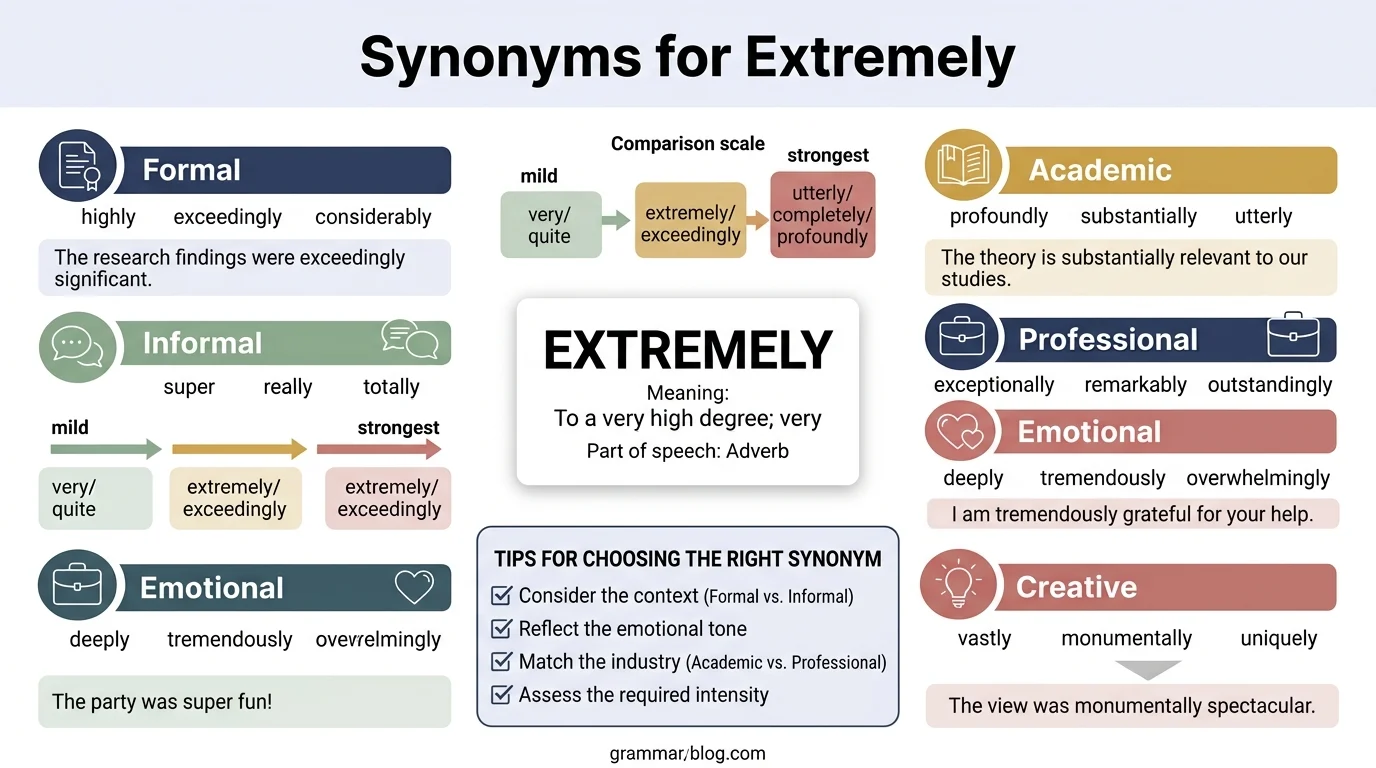
Extremely means to a very high degree or beyond the usual range of intensity. The best synonyms depend on your context. For formal writing, try exceptionally or exceedingly. casual conversation, use super or really. For emotional emphasis, choose incredibly or unbelievably. academic precision, consider remarkably or notably. Each alternative carries a unique shade of meaning that can strengthen your message.
Meaning, Tone and Context
Simple Definition
Extremely is an adverb that modifies adjectives or other adverbs to express a high level of intensity. It indicates that something goes far beyond what is normal, expected, or average.
Part of Speech
Adverb
Tone
Neutral. The word itself does not carry strong positive or negative weight. The tone depends entirely on the words it modifies.
Formality Level
Moderate. Extremely works in most contexts from casual conversation to professional writing. It is rarely inappropriate, but it can feel overused or generic.
Common Use Cases
You will find extremely used in everyday speech, workplace emails, academic writing, news articles, and creative works. It appears whenever someone wants to emphasize a quality, condition, or action.
Important Word Forms
The adjective form is extreme. The noun form is extremity. The verb form is not commonly used, but the phrase “go to extremes” appears frequently.
When and How to Use “Extremely”
You should use extremely when you need to convey a strong degree of something without adding specific emotional or descriptive nuance. It works well as a general intensifier. However, you should replace it with more precise synonyms when you want to add clarity, emotion, or stylistic flair.
Professional example
The quarterly results were extremely positive, exceeding our revenue projections by 12 percent.
Personal example
I felt extremely grateful for the support my friends offered during that difficult time.
Academic example
The study found that the new teaching method was extremely effective for students with learning differences.
Emotional example
She was extremely moved by the kindness of strangers who helped her during the storm.
Creative example
The landscape stretched out before them, extremely vast and impossibly beautiful under the golden light.
Social media example
This new coffee shop is extremely good. You absolutely have to try their caramel latte.
Email example
Thank you for your extremely thorough explanation of the project requirements.
Resume example
Developed an extremely efficient inventory system that reduced waste by 30 percent.
Another Word for “Extremely”
The best single replacement for extremely is exceptionally. This word captures the same level of intensity while sounding more polished and precise. It works across most contexts and avoids the generic feel that extremely can sometimes carry.
Professional writing
Use notably or considerably to sound objective and measured.
Academic writing
Choose remarkably or significantly for research backed statements.
Casual conversation
Say super or really for natural, everyday speech.
Emotional writing
Select incredibly or unbelievably to convey strong feelings.
Creative writing
Try extraordinarily or phenomenally for descriptive richness.
Resume and workplace use
Opt for highly or exceptionally to emphasize your achievements.
Social media captions
Use amazingly or wildly for playful, modern emphasis.
Stronger meaning
Choose profoundly for deep, impactful intensity.
Softer meaning
Select fairly or quite for a more moderate tone.
When Not to Use “Extremely”
You should avoid extremely when it does not add meaningful emphasis to your sentence. This word can sound vague and overused in professional writing where precision matters more than generic intensity.
Too vague example
The presentation was extremely good.
Improved example
The presentation was exceptionally clear and well structured.
Too casual example
I am extremely tired.
Improved example
I am completely exhausted after that long flight.
Too weak example
The results were extremely interesting.
Improved example
The results were remarkably compelling and worth further investigation.
Too overused example
She is extremely smart.
Improved example
She is exceptionally intelligent and quick to solve complex problems.
Too generic example
The food was extremely delicious.
Improved example
The food was absolutely exquisite and beautifully presented.
Words Commonly Confused With “Extremely”
Very
Very is a general intensifier that sounds weaker than extremely. Use very for moderate emphasis and extremely for stronger emphasis. Example: “The movie was very good” versus “The movie was extremely good.”
Really
Really adds a conversational tone that extremely lacks. Use really in casual speech and extremely in more formal writing. Example: “I really enjoyed the concert” versus “I extremely enjoyed the concert” which sounds unnatural.
Quite
Quite has different meanings in American and British English. In American English, it means moderately or somewhat. In British English, it can mean completely. Extremely is more straightforward and universal. Example: “She is quite talented” versus “She is extremely talented.”
Too
Too indicates excessiveness or a problem with the degree of something. Extremely does not carry this negative implication. Example: “The coffee is too hot to drink” versus “The coffee is extremely hot.”
Truly
Truly emphasizes authenticity or genuineness rather than intensity. Extremely focuses only on degree. Example: “I am truly grateful” versus “I am extremely grateful” where the first suggests sincerity and the second suggests intensity.
Highly
Highly often pairs with specific adjectives like skilled, intelligent, or recommended. Extremely is more versatile. Example: “She is highly qualified” versus “She is extremely qualified.”
Best Synonym by Context for “Extremely”
| Context | Best Synonym | Why It Works | Example |
|---|---|---|---|
| Formal writing | Exceptionally | Sounds polished and professional | The board was exceptionally satisfied with the quarterly performance |
| Academic writing | Notably | Adds scholarly precision | The results were notably different from previous studies |
| Professional business | Considerably | Suggests measurable impact | Sales increased considerably after the marketing campaign |
| Resume writing | Highly | Emphasizes qualifications clearly | Highly skilled in data analysis and project management |
| Casual conversation | Super | Feels natural and friendly | That movie was super entertaining |
| Creative writing | Extraordinarily | Adds literary richness | The garden was extraordinarily beautiful in spring |
| Emotional tone | Incredibly | Conveys genuine feeling | We were incredibly relieved to hear the good news |
| Strong intensity | Profoundly | Suggests deep, lasting impact | The experience affected her profoundly |
| Soft or moderate | Fairly | Reduces intensity appropriately | The drive was fairly long but manageable |
| Social media captions | Amazingly | Creates modern, positive emphasis | This pizza is amazingly delicious |
| American English | Awfully | Casual and distinctly American | The weather has been awfully hot lately |
| British English | Jolly | Informal and distinctly British | That was a jolly good show |
| Professional email | Particularly | Adds nuance to workplace communication | I am particularly interested in your proposal |
| Speeches and presentations | Tremendously | Adds rhetorical power | We have grown tremendously as a community |
| Descriptive writing | Uncommonly | Suggests rarity and specialness | She possessed an uncommonly gentle voice |
Which Synonym Should You Choose?
Start with your audience.
For formal reports, academic papers, and professional correspondence, choose exceptionally, notably, or considerably. These words signal precision and careful word choice.
Consider your emotional goal.
If you want to express strong feelings, use incredibly, unbelievably, or profoundly. These words connect with readers on an emotional level and make your writing more memorable.
Match your medium.
For social media, blogs, and casual emails, choose super, really, or amazingly. These words sound natural and relatable in informal spaces.
Think about intensity.
If you need maximum emphasis, choose profoundly or extraordinarily. If you want moderate emphasis, choose quite or fairly.
Check your sentence flow.
Sometimes the best synonym is the one that sounds most natural in your specific sentence. Read your options aloud and trust your ear.
Avoid overusing any synonym.
Even the best alternatives lose their impact when repeated too often. Vary your word choice throughout any piece of writing.
Real Life Examples of “Extremely” in Sentences
School context
The exam was extremely challenging, but my preparation paid off with a high score.
Workplace context
Our team worked extremely hard to meet the deadline and delivered excellent results.
Writing context
The author’s descriptions were extremely vivid, bringing each character to life on the page.
Conversation context
I found that documentary extremely moving and thought provoking.
Social media context
This sunset is extremely beautiful. Nature always knows how to put on a show.
Resume context
Managed an extremely complex budget across multiple departments.
Email context
Your assistance during this project has been extremely valuable to our success.
Storytelling context
The castle stood extremely tall against the stormy sky, a silent witness to centuries of history.
25 Synonyms for “Extremely”
| Synonym | Simple Meaning | Best Used For | Example Sentence |
|---|---|---|---|
| Exceptionally | Beyond the usual standard | Professional and academic writing | The candidate was exceptionally well prepared for the interview |
| Exceedingly | To a very great degree | Formal writing and official documents | The court found the evidence exceedingly compelling |
| Remarkably | Worthy of attention or notice | Academic and descriptive writing | The patient recovered remarkably quickly after surgery |
| Notably | Particularly or especially | Research and analytical writing | The new policy affected notably different demographic groups |
| Considerably | To a significant extent | Business and professional contexts | Housing prices have increased considerably in this area |
| Extraordinarily | Beyond what is ordinary | Creative and literary writing | The landscape was extraordinarily beautiful at dawn |
| Incredibly | Hard to believe in intensity | Emotional and conversational use | We were incredibly proud of our daughter’s achievement |
| Unbelievably | Astonishingly strong | Informal and modern contexts | The food at that restaurant is unbelievably good |
| Profoundly | Deeply and intensely | Emotional and philosophical writing | The speech moved the audience profoundly |
| Highly | To a great degree | Resumes and professional recommendations | She is highly regarded in her field |
| Terribly | Very strongly, sometimes negative | Casual and British English | I feel terribly sorry for what happened |
| Awfully | Very, often informally | American casual conversation | That test was awfully difficult |
| Quite | To a moderate or complete degree | Versatile use across contexts | The solution is quite elegant in its simplicity |
| Fairly | Moderately or reasonably | Softening intensity in writing | The project is fairly straightforward to complete |
| Pretty | Somewhat or moderately | Casual American English | The movie was pretty entertaining |
| Rather | To a certain extent | British English and formal writing | The results were rather surprising to the research team |
| Really | Truly or genuinely | Everyday conversation | I really appreciate your help |
| Super | Very, informally | Casual and modern speech | That new cafe is super cozy |
| Mega | Extremely, modern slang | Social media and youthful contexts | This concert is mega exciting |
| Ultra | Beyond the usual | Marketing and descriptive writing | The new phone has an ultra clear display |
| Particularly | Especially or specifically | Precise writing and speaking | I am particularly interested in your research methods |
| Especially | Above all others | General emphasis in writing | The children were especially excited about the trip |
| Very | To a high degree | General use, slightly weaker than extremely | She was very happy with the outcome |
| Jolly | Very, informal British | British casual conversation | We had a jolly good time at the party |
| Ever so | Very, somewhat old fashioned | Charming or nostalgic writing | She was ever so kind to help us |
Synonym Groups and Usage Differences
Professional vs. Personal Synonyms
Professional synonyms like considerably, notably, and highly work best in workplace settings where objectivity and precision matter. Personal synonyms like incredibly, super, and really add warmth and emotion to conversations and personal writing. Choose professional words for reports, proposals, and formal correspondence. Choose personal words for emails to friends, social media posts, and casual storytelling.
Formal vs. Conversational Synonyms
Formal synonyms include exceptionally, exceedingly, and notably. These words appear in academic papers, legal documents, and official speeches. Conversational synonyms include super, pretty, and really. These words sound natural in everyday speech and informal writing. Match your formality level to your audience and purpose.
Academic Synonyms
Academic writing demands precision and measured language. Use remarkably, notably, and considerably to describe research findings and scholarly observations. These words suggest careful analysis rather than emotional reaction. Avoid overly dramatic synonyms like unbelievably or amazingly in academic contexts.
Professional and Business Synonyms
Business communication benefits from words like highly, considerably, and particularly. These terms sound professional without being overly formal. They work well in emails, presentations, and performance reviews. Use them to emphasize achievements, describe results, and highlight qualifications.
Creative or Literary Synonyms
Creative writers should embrace extraordinarily, profoundly, and exceptionally. These words add depth and imagery to descriptive passages. They help create mood and atmosphere without sounding generic. Use them to paint vivid pictures and evoke strong emotions in your readers.
Slang or Modern Synonyms
Words like mega, amazingly, and ridiculously have entered modern English through casual speech and social media. They add energy and personality to informal writing. However, they are not appropriate for professional, academic, or formal contexts. Save these words for social media captions, blog posts, and conversations with friends.
Strongest vs. Weaker Synonyms
Mild intensity: fairly, quite, pretty, rather
Moderate intensity: very, really, highly, particularly
Strong intensity: extremely, remarkably, considerably, notably
Very strong intensity: exceptionally, exceedingly, extraordinarily, profoundly
Maximum intensity: unbelievably, incredibly, amazingly
Emotional vs. Neutral Synonyms
Emotional synonyms like incredibly, profoundly, and unbelievably carry strong feelings and personal reactions. These words connect with readers on an emotional level. Neutral synonyms like notably, considerably, and highly stay factual and objective. Choose based on whether you want to inform or persuade.
Antonyms of “Extremely”
| Antonym | Meaning | Example Sentence |
|---|---|---|
| Slightly | To a small degree | The temperature dropped slightly overnight |
| Barely | Only just, hardly | We barely made it to the airport on time |
| Moderately | Within reasonable limits | The food was moderately priced for the area |
| Somewhat | To some extent but not fully | I am somewhat concerned about the results |
| Marginally | To a very small extent | Sales increased marginally this quarter |
| Minimally | To the least possible degree | The changes affected the budget minimally |
| Insignificantly | Not enough to matter | The error impacted the data insignificantly |
| Hardly | Almost not at all | She could hardly believe the news |
| Scarcely | Only just, almost not | He scarcely had time to eat lunch |
| Faintly | Very slightly or weakly | The music played faintly in the distance |
| Mildly | Not intensely or severely | She was mildly annoyed by the delay |
| Negligibly | So small as to be unimportant | The cost difference was negligibly small |
| Imperceptibly | So slight as to be unnoticed | The light faded imperceptibly as evening approached |
| Unnoticeably | Not attracting attention | The changes occurred unnoticeably over time |
| Trivially | Of little importance or value | The issue affected the outcome trivially |
Comparison: Extremely vs. Similar Words
Extremely vs. Exceptionally
Both words express high intensity, but exceptionally often implies that something stands out from what is usual or expected. Extremely is more general. Exceptionally is stronger and more evaluative.
Exceptionally example: “She delivered an exceptionally strong performance.”
Extremely example: “The performance was extremely long.”
Extremely vs. Remarkably
Remarkably suggests that something is worthy of notice or comment. Extremely focuses only on degree. Remarkably implies surprise or interest, while extremely stays neutral.
Remarkably example: “The team recovered remarkably from their early losses.”
Extremely example: “The team worked extremely hard all season.”
Extremely vs. Exceedingly
Exceedingly sounds more formal and old fashioned than extremely. It appears more often in legal and official writing. Extremely is more common in everyday language.
Exceedingly example: “The judge found the defendant exceedingly credible.”
Extremely example: “The judge was extremely fair to both sides.”
Extremely vs. Profoundly
Profoundly carries emotional and philosophical weight that extremely lacks. Use profoundly for deep, lasting impacts on people or ideas. Use extremely for more general intensity.
Profoundly example: “The experience affected him profoundly.”
Extremely example: “He was extremely tired after the experience.”
Extremely vs. Considerably
Considerably often suggests measurable or quantifiable intensity. Extremely can apply to both measurable and nonmeasurable qualities. Considerably works well in business and research contexts.
Considerably example: “Profits increased considerably this year.”
Extremely example: “The profits were extremely welcome.”
Extremely vs. Unbelievably
Unbelievably adds an element of surprise or skepticism to the intensity. It suggests that something is so intense that it seems hard to believe. Extremely is more straightforward.
Unbelievably example: “The view from the top was unbelievably beautiful.”
Extremely example: “The view from the top was extremely clear.”
Common Phrases and Expressions with “Extremely”
1. Extremely grateful
Meaning: Feeling very thankful or appreciative.
Example sentence: We are extremely grateful for all the support you have given us.
2. Extremely difficult
Meaning: Very hard to do or understand.
Example sentence: The final exam was extremely difficult, even for advanced students.
3. Extremely important
Meaning: Of the greatest significance.
Example sentence: It is extremely important to submit your application before the deadline.
4. Extremely helpful
Meaning: Providing a great deal of assistance.
Example sentence: The customer service team was extremely helpful in resolving my issue.
5. Extremely popular
Meaning: Liked or admired by many people.
Example sentence: That new restaurant has become extremely popular in just a few months.
6. Extremely limited
Meaning: Very restricted in quantity or availability.
Example sentence: Tickets for the concert are extremely limited, so you should buy yours soon.
7. Extremely urgent
Meaning: Requiring immediate action or attention.
Example sentence: This matter is extremely urgent and cannot be delayed any further.
Common Mistakes to Avoid
1. Using extremely with weak adjectives
Some adjectives already carry strong meaning and do not need extra intensification. Saying “extremely perfect” sounds odd because perfect already means flawless. Instead say “nearly perfect” or “absolutely perfect.”
2. Overusing extremely in professional writing
Repeating extremely throughout a document weakens its impact and makes your writing feel repetitive. Vary your word choice with synonyms like notably, particularly, and considerably.
3. Confusing extremely with very
Very is weaker than extremely. Use very for moderate emphasis and extremely for strong emphasis. Do not use them interchangeably without considering your intended intensity.
4. Using extremely in overly formal contexts
Some formal writing favors more precise intensifiers. In academic papers, use notably or remarkably instead of extremely. In legal documents, use exceedingly or exceptionally.
5. Using extremely with negative adjectives in positive contexts
Saying “extremely terrible” sounds contradictory. Instead use “absolutely terrible” or “completely terrible” for negative qualities. Reserve extremely for neutral or positive intensification.
6. Using extremely when a more precise word exists
Instead of “extremely happy,” consider “ecstatic” or “overjoyed.” Instead of “extremely sad,” use “devastated” or “heartbroken.” Precise vocabulary often eliminates the need for intensifiers.
7. Using slang synonyms in formal writing
Words like super, mega, and ridiculously have no place in academic papers, business reports, or professional correspondence. Save these for casual speech and social media.
FAQs
What is the best synonym for extremely?
Exceptionally is the best synonym for extremely because it works across most contexts and sounds polished without being overly dramatic or informal.
What is a formal synonym for extremely?
Exceedingly and notably are excellent formal synonyms for extremely. They appear in academic papers, legal documents, and official correspondence where precision matters.
What is an informal synonym for extremely?
Super and really are the most common informal synonyms for extremely. They sound natural in casual conversation and friendly emails.
What is another word for extremely in professional writing?
Considerably and highly work best in professional writing. These words sound objective and measured while still providing strong emphasis.
What is the difference between extremely and exceptionally?
Exceptionally implies that something stands out from what is usual or expected. Extremely focuses only on degree without suggesting comparison to a standard.
What is the opposite of extremely?
Slightly is the direct opposite of extremely. It indicates a very small degree rather than a very large one.
Conclusion
Extremely is a useful adverb that helps you emphasize qualities and actions in your writing and speech. However, relying on it too often can make your language feel generic and repetitive. By learning its synonyms, you gain the ability to match your word choice to your context, audience, and emotional goal. Use exceptionally for professional polish, super for casual warmth, remarkably for academic precision, and profoundly for emotional depth. The best writers know that variety and precision make language memorable. Choose your intensifiers with care, and your communication will become stronger, clearer, and more engaging.