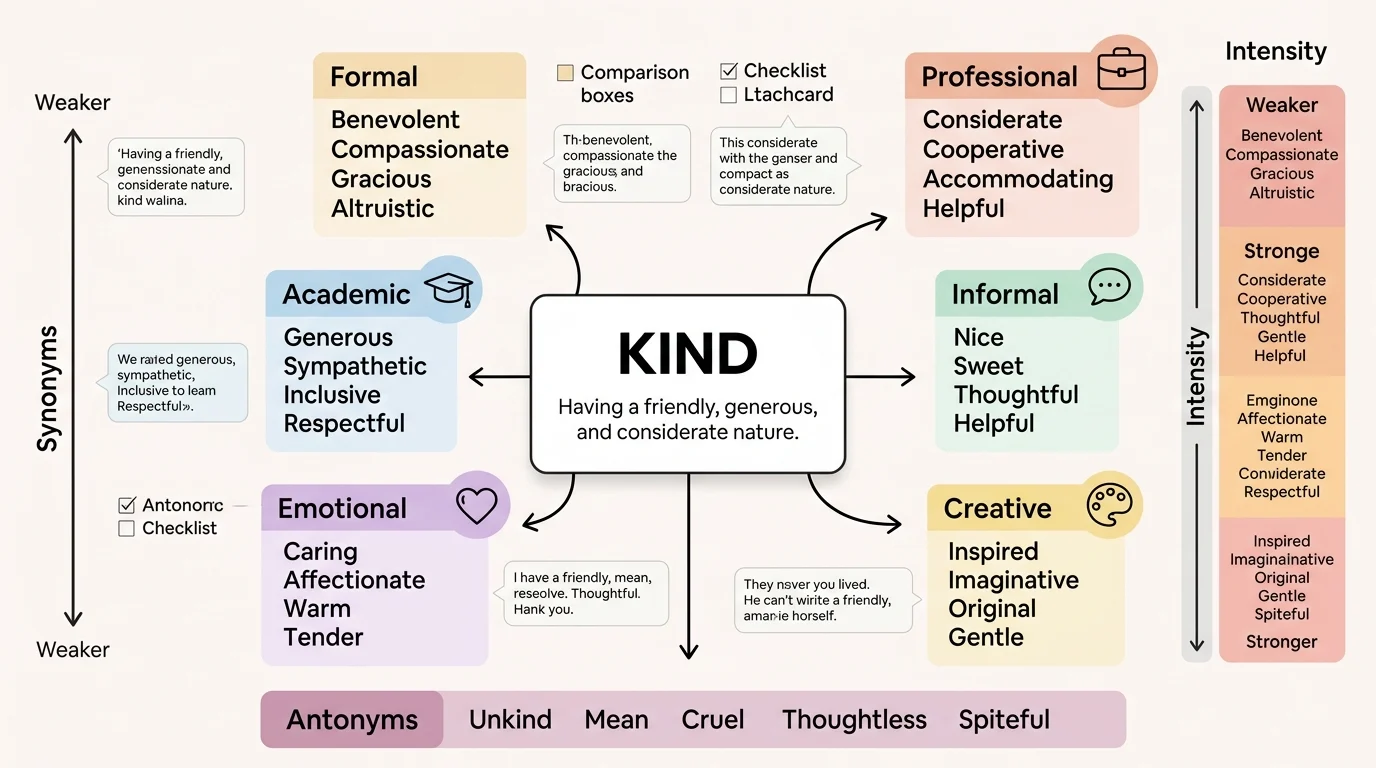
Have you ever found yourself writing an email, an essay, or a social media caption and realized you have used the word “kind” three times in two sentences? It happens to everyone. You want to describe someone positively, but the same word keeps appearing. Repeating the same vocabulary makes your writing feel flat and uninspired. Choosing the right synonym of kind can transform your communication. It adds precision, emotional depth, and clarity to your message. This guide will help you understand what “kind” truly means and show you exactly which synonym fits every situation you encounter.
What Are the Best Synonyms of “Kind”?
The word “kind” means having a friendly, generous, and considerate nature. For formal writing, choose “benevolent” or “charitable.” For casual conversation, use “nice” or “sweet.” In professional settings, “considerate” and “thoughtful” work best. For emotional writing, “compassionate” and “kindhearted” add warmth. Each synonym carries a slightly different tone, so select the one that matches your audience and purpose.
Meaning, Tone, and Context
Simple Definition
As an adjective, “kind” describes someone who shows sympathy, generosity, and a helpful nature toward others. It can also describe actions, words, or gestures that reflect this warmth. As a noun, “kind” refers to a category or type of something. This guide focuses primarily on the adjective form.
Part of Speech
- Adjective: kind, kinder, kindest
- Noun: kind, kinds
Overall Tone
“Kind” carries a positive tone. It is a word of praise and appreciation.
Formality Level
The adjective “kind” is neutral. It works well in both formal and informal contexts. However, it is somewhat general. More precise synonyms can elevate your writing in professional or academic settings.
Common Uses
Native English speakers use “kind” constantly. You hear it in everyday conversation, workplace feedback, thank-you notes, and even formal requests like “Would you be kind enough to…”. It describes people, actions, and even environments, such as “a climate kind to asthmatics”.
Word Forms
- Adverb: kindly
- Noun: kindness
- Adjective (comparative): kinder
- Adjective (superlative): kindest
- Opposite: unkind, cruel, harsh
When and How to Use “Kind”
Choose “kind” when you want a safe, universally understood word to describe someone’s good nature. It is appropriate in almost any context. However, because it is so common, it can feel vague. Use it when simplicity and clarity matter more than precision.
Here are seven realistic examples showing how “kind” fits different situations.
Professional
“Our manager is kind to everyone on the team and always listens to our concerns.”
Academic
“The study suggests that kind behavior in early childhood predicts positive social outcomes later in life.”
Workplace
“She left a kind note on my desk congratulating me on the project completion.”
Personal
“My grandmother is the kindest person I have ever known.”
“Thank you for your kind response to my inquiry about the position.”
Resume
“Recognized for maintaining a kind and supportive attitude during high-pressure deadlines.”
“So grateful for the kind words and encouragement from this community today.”
Best Synonyms of “Kind”
No synonym is identical in every situation. The best choice depends on your audience, tone, and the specific message you want to convey. Here are the top recommendations for different contexts.
Professional Writing: Considerate. This word emphasizes thoughtfulness and respect for others’ feelings. It sounds polished and workplace-appropriate.
Academic Writing: Benevolent. This term carries a formal, scholarly tone. It suggests a disposition to do good and is often used in research or philosophical discussions.
Business Communication: Thoughtful. This synonym highlights careful consideration of others’ needs. It works well in client emails and team feedback.
Casual Conversation: Nice or Sweet. These are simple, friendly words that feel natural in everyday speech.
Emotional Writing: Compassionate. This word conveys deep empathy and a genuine desire to help others who are suffering.
Creative Writing: Good-hearted. This synonym feels warm and narrative-friendly. It paints a vivid picture of a character’s inner goodness.
Resume Writing: Supportive or Helpful. These words show you are a team player who contributes positively to the workplace.
Workplace Communication: Courteous. This word emphasizes politeness and good manners in a professional environment.
Stronger Meaning: Altruistic. This word suggests selfless concern for others, often at a personal cost.
Softer Meaning: Gentle. This synonym implies a mild, tender nature without the active connotation of helping.
When Not to Use “Kind”
“Kind” is not always the best choice. Here are situations where you should consider a stronger, more precise synonym.
When the word sounds too general. “Kind” is a broad term. If you want to highlight a specific quality, choose a more descriptive word.
- Incorrect: “She is a kind person.”
- Better: “She is a compassionate person who volunteers at the animal shelter every weekend.”
The word sounds too vague in a professional context. In a performance review, “kind” may not carry enough weight.
- Incorrect: “He is kind to clients.”
- Better: “He is consistently courteous and attentive to client needs.”
When the word sounds too informal in academic writing. Research papers require precise, formal vocabulary.
- Incorrect: “The kind teacher helped the students.”
- Better: “The benevolent educator provided additional resources to support student learning.”
The word sounds too weak for a resume. Employers look for action-oriented language.
- Incorrect: “I am a kind team member.”
- Better: “I am a supportive team member who actively helps colleagues meet project deadlines.”
When the word sounds outdated. In some contexts, “kind” can feel old-fashioned, especially when describing modern professional dynamics.
- Incorrect: “Our kind office manager…”
- Better: “Our thoughtful office manager anticipated our needs and prepared everything in advance.”
Words Commonly Confused With “Kind”
Kind vs. Nice
Difference: “Nice” is often passive and surface-level. “Kind” implies active benevolence and genuine care. You can be nice without being kind, but kindness usually includes niceness.
When to Use It: Use “kind” when describing genuine goodwill. Use “nice” for pleasant but potentially superficial interactions.
Example: “She was nice to me at the party, but she wasn’t kind enough to help when I needed it.”
Kind vs. Gentle
Difference: “Gentle” focuses on a mild, soft, or tender manner. “Kind” emphasizes helpfulness and consideration. A person can be gentle without actively helping others.
When to Use It: Use “gentle” when describing a soft touch or quiet demeanor. Use “kind” when describing helpful actions.
Example: “The nurse was gentle with the patient and kind to the worried family.”
Kind vs. Considerate
Difference: “Considerate” is more specific. It means thinking about others’ feelings and needs before acting. “Kind” is broader.
When to Use It: Use “considerate” when you want to highlight thoughtfulness and awareness of others.
Example: “It was considerate of him to save me a seat at the crowded meeting.”
Kind vs. Benevolent
Difference: “Benevolent” is more formal and often implies a position of power or authority, like a ruler or employer. “Kind” is more personal and everyday.
When to Use It: Use “benevolent” in formal, academic, or historical contexts.
Example: “The benevolent founder established a scholarship fund for underprivileged students.”
Kind vs. Compassionate
Difference: “Compassionate” specifically involves empathy for suffering and a desire to relieve it. “Kind” is more general.
When to Use It: Use “compassionate” when describing someone who helps those in distress.
Example: “The compassionate counselor listened to my struggles without judgment.”
Kind vs. Charitable
Difference: “Charitable” often relates to giving money or resources to those in need. It can also mean being lenient in judgment. “Kind” is broader.
When to Use It: Use “charitable” when describing generosity or a forgiving attitude.
Example: “She made a charitable donation to the local food bank.”
Best Synonyms of “Kind” by Context
| Context | Best Synonym | Why It Works | Example |
|---|---|---|---|
| Formal Writing | Benevolent | Sounds scholarly and precise. | “The benevolent philanthropist funded the new library.” |
| Academic Writing | Altruistic | Conveys selfless concern for others. | “Altruistic behavior is a key topic in evolutionary psychology.” |
| Professional Communication | Considerate | Highlights respect and thoughtfulness. | “Please be considerate of your colleagues’ time during meetings.” |
| Business Emails | Thoughtful | Shows careful attention to detail. | “Thank you for your thoughtful feedback on the proposal.” |
| Resume Writing | Supportive | Emphasizes teamwork and collaboration. | “Known for being a supportive mentor to junior staff.” |
| Workplace Communication | Courteous | Stresses politeness and good manners. | “He is always courteous to clients and coworkers alike.” |
| Casual Conversation | Nice | Simple and natural in everyday speech. | “He is a really nice guy.” |
| Everyday Speaking | Sweet | Warm and affectionate. | “That was so sweet of you to bring me coffee.” |
| Creative Writing | Good-hearted | Narrative-friendly and vivid. | “The good-hearted innkeeper offered them a free room for the night.” |
| Storytelling | Kindhearted | Emphasizes innate goodness. | “The kindhearted princess freed the captive birds.” |
| Emotional Writing | Compassionate | Conveys deep empathy. | “Her compassionate words brought me to tears.” |
| Strong Emphasis | Charitable | Suggests active generosity. | “His charitable nature extended beyond writing checks.” |
| Mild Tone | Gentle | Soft and tender. | “She has a gentle way of correcting mistakes.” |
| Social Media Captions | Kind | Short and universally understood. | “Grateful for all the kind souls in my life.” |
| American English | Kind | Standard usage in the US. | “She is one of the kindest people I know.” |
How to Choose the Best Synonym of “Kind”
Choosing the right synonym depends on several factors. Consider your meaning: do you want to emphasize empathy, generosity, or mere pleasantness? Think about your tone: are you writing a formal report or a casual text? Know your audience: a professor expects different language than a friend. Assess the emotional strength you need: do you want a mild compliment or a powerful statement of admiration? Consider your writing purpose: are you persuading, describing, or informing? Finally, evaluate the level of formality: academic and business contexts require more precise vocabulary.
The best synonym is the one that communicates your intended message most clearly. When in doubt, read your sentence aloud with each option. The one that sounds most natural is usually the right choice.
Real Life Examples of “Kind”
School
“My teacher is kind and always explains things until everyone understands.”
College
“The professor was kind enough to extend the deadline for our research papers.”
Workplace
“Our team lead is not just kind; she is genuinely considerate of our work-life balance.”
Business
“The CEO’s kind words at the town hall meeting boosted employee morale significantly.”
“Thank you for your kind assistance with the contract negotiations.”
Resume
“Recognized for creating a supportive and inclusive team environment.”
Conversation
“He is one of the kindest people I have ever met. He always puts others first.”
Storytelling
“The old man had a kind face and a gentle voice that calmed everyone around him.”
Blogging
“In a world that can be harsh, choosing to be kind is a revolutionary act.”
“Feeling blessed by the kind messages from my followers today. You all are the best.”
18 Best Synonyms of “Kind”
| Synonym | Simple Meaning | Best Used For | Example Sentence |
|---|---|---|---|
| Benevolent | Wanting to help others; generous | Formal writing, philanthropy | “The benevolent organization provided clean water to the village.” |
| Compassionate | Feeling empathy for others’ suffering | Emotional, healthcare, counseling | “The compassionate nurse held the patient’s hand during the procedure.” |
| Considerate | Thinking about others’ feelings | Professional, workplace | “It was considerate of you to save me a seat at the conference.” |
| Thoughtful | Showing careful consideration | Business, personal gestures | “She sent a thoughtful gift to cheer me up after a tough week.” |
| Kindhearted | Having a naturally kind disposition | Storytelling, personal descriptions | “Our kindhearted neighbor takes care of the stray cats in the area.” |
| Good-hearted | Having a good, kind nature | Creative writing, conversation | “He is a good-hearted soul who would give you the shirt off his back.” |
| Charitable | Generous in giving; lenient in judgment | Philanthropy, forgiving contexts | “The judge took a charitable view of the first-time offender.” |
| Altruistic | Selflessly concerned for others | Academic, psychology | “Altruistic behavior is often rewarded in social species.” |
| Gentle | Mild, tender, soft in manner | Softer tone, describing touch or voice | “She spoke in a gentle voice to calm the frightened child.” |
| Sympathetic | Showing understanding of others’ feelings | Emotional support | “My boss was sympathetic when I explained my family emergency.” |
| Gracious | Courteous, kind, and pleasant | Formal politeness | “The gracious host made sure every guest felt welcome.” |
| Courteous | Polite and respectful in behavior | Professional, customer service | “The courteous staff resolved my complaint quickly and efficiently.” |
| Helpful | Giving assistance and support | Workplace, everyday | “The helpful librarian guided me to the right section.” |
| Caring | Showing concern for others | Personal, healthcare | “She is a caring mother who always puts her children first.” |
| Friendly | Pleasant and kind toward others | Casual, social | “The friendly barista remembered my usual order.” |
| Loving | Showing deep affection | Personal, family | “He is a loving husband and devoted father.” |
| Nice | Pleasant, agreeable | Casual conversation | “It was nice of you to help me move the furniture.” |
| Sweet | Very kind and charming | Affectionate, casual | “That was so sweet of you to remember my birthday.” |
Synonyms of “Kind” by Usage
Professional vs Personal Synonyms
In professional settings, words like considerate, thoughtful, courteous, and supportive sound appropriate and polished. They show respect without being overly emotional. In personal conversations, nice, sweet, good-hearted, and kindhearted feel more natural and affectionate. Choose supportive for a performance review and sweet for a compliment to a friend.
Formal vs Conversational Synonyms
For reports, essays, and business writing, use benevolent, altruistic, charitable, or gracious. These words carry authority and precision. For casual conversations and texting, use nice, sweet, friendly, or kind. These words are simple and widely understood. Avoid overly formal synonyms in casual settings, as they can sound pretentious.
Academic Synonyms
In research papers and academic discussions, choose altruistic, benevolent, or compassionate. These terms are precise and widely recognized in scholarly literature. For example, “The study examined altruistic behavior in children” sounds more authoritative than “The study looked at kind behavior in children.”
Professional and Business Synonyms
For resumes, interviews, and client communication, use considerate, thoughtful, courteous, and supportive. These words demonstrate emotional intelligence and professionalism. For example, “Recognized for providing considerate and timely support to clients” is stronger than “Known for being kind to clients.”
Creative and Literary Synonyms
For storytelling, fiction, and poetry, choose good-hearted, kindhearted, gentle, and compassionate. These words add emotion and imagery. For example, “The kindhearted giant befriended the lonely child” paints a vivid picture.
Slang or Modern Synonyms
“Kind” does not have widely recognized slang synonyms. In informal speech, people sometimes use cool or chill to describe someone pleasant, but these are not direct synonyms. Avoid using slang in professional or academic writing.
Strongest to Mildest Synonyms
Mild: Nice, Sweet, Friendly
Moderate: Kind, Considerate, Thoughtful
Strong: Compassionate, Charitable, Benevolent
Very Strong: Altruistic, Kindhearted, Good-hearted
The emotional intensity increases as you move down the scale. Choose milder words for everyday compliments. Choose stronger words for profound statements about someone’s character.
Emotional vs Neutral Synonyms
Emotional Synonyms: Compassionate, Loving, Kindhearted, Good-hearted, Sweet. These words express strong feelings and personal warmth. Use them in personal letters, creative writing, and emotional speeches.
Neutral Synonyms: Considerate, Thoughtful, Courteous, Helpful. These words simply communicate positive behavior without adding strong emotion. Use them in professional reports, business emails, and academic papers.
Antonyms of “Kind”
| Antonym | Meaning | Example Sentence |
|---|---|---|
| Unkind | Lacking kindness; cruel | “It was unkind of you to ignore her when she was clearly upset.” |
| Cruel | Willfully causing pain or suffering | “The cruel treatment of animals is unacceptable.” |
| Mean | Unkind or spiteful | “He made a mean comment about her appearance.” |
| Harsh | Rough, severe, or cruel | “The harsh criticism destroyed his confidence.” |
| Selfish | Lacking concern for others | “His selfish behavior alienated all his friends.” |
| Inconsiderate | Not thinking of others’ feelings | “It was inconsiderate to play loud music so late at night.” |
| Malicious | Intending to do harm | “The malicious rumor spread quickly through the office.” |
| Nasty | Very unpleasant or unkind | “She gave me a nasty look when I walked in.” |
| Hostile | Unfriendly and aggressive | “The hostile response from the manager surprised everyone.” |
| Cold | Lacking warmth or emotion | “Her cold demeanor made it hard to approach her.” |
| Indifferent | Showing no interest or concern | “He seemed indifferent to the struggles of his team.” |
| Unsympathetic | Not showing understanding or care | “The unsympathetic landlord refused to fix the heating.” |
| Spiteful | Showing malicious ill will | “Her spiteful remarks ruined the celebration.” |
| Hard-hearted | Lacking compassion | “The hard-hearted dictator ignored the suffering of his people.” |
| Brutal | Extremely cruel and violent | “The brutal regime oppressed its citizens for decades.” |
Comparison: “Kind” vs Similar Words
Kind vs Nice
Main Difference: “Nice” is often passive and surface-level. “Kind” implies active goodwill and genuine care.
Which Is Stronger? “Kind” is stronger because it suggests action and empathy.
Which Is More Formal? Both are neutral, but “kind” is slightly more formal in professional contexts.
When to Use Each: Use “nice” for casual, simple compliments. Use “kind” when you want to convey deeper goodness.
Examples:
- Kind: “She is kind enough to volunteer at the shelter every weekend.”
- Nice: “He is a nice guy, but he doesn’t go out of his way to help.”
Kind vs Gentle
Main Difference: “Gentle” focuses on a mild, soft, or tender manner. “Kind” emphasizes helpfulness and consideration.
Which Is Stronger? “Kind” is stronger in terms of active goodwill.
Which Is More Formal? Both are neutral.
When to Use Each: Use “gentle” for describing touch, voice, or demeanor. Use “kind” for describing actions and character.
Examples:
- Kind: “The kind teacher stayed after class to help me understand the lesson.”
- Gentle: “The gentle breeze cooled us on the hot day.”
Kind vs Considerate
Main Difference: “Considerate” is more specific. It means thinking about others’ feelings and needs before acting. “Kind” is broader.
Which Is Stronger? “Considerate” can be stronger in professional contexts because it implies active thought.
Which Is More Formal? “Considerate” is more formal.
When to Use Each: Use “considerate” when you want to highlight thoughtfulness. Use “kind” for general descriptions.
Examples:
- Kind: “She is a kind person who always helps others.”
- Considerate: “He was considerate enough to turn down the music when I was studying.”
Kind vs Benevolent
Main Difference: “Benevolent” is more formal and often implies a position of power or authority. “Kind” is more personal.
Which Is Stronger? “Benevolent” is stronger in formal contexts.
Which Is More Formal? “Benevolent” is much more formal.
When to Use Each: Use “benevolent” in academic, historical, or formal writing. Use “kind” in everyday conversation.
Examples:
- Kind: “My grandmother is a kind woman.”
- Benevolent: “The benevolent ruler established schools for all children.”
Kind vs Compassionate
Main Difference: “Compassionate” specifically involves empathy for suffering and a desire to relieve it. “Kind” is more general.
Which Is Stronger? “Compassionate” is stronger and more emotionally charged.
Which Is More Formal? Both can be formal, but “compassionate” is often used in healthcare and counseling.
When to Use Each: Use “compassionate” when describing someone who helps those in distress. Use “kind” for general positive descriptions.
Examples:
- Kind: “He is a kind neighbor who always waves hello.”
- Compassionate: “The compassionate doctor volunteered in disaster zones.”
Kind vs Charitable
Main Difference: “Charitable” often relates to giving money or resources. It can also mean being lenient in judgment. “Kind” is broader.
Which Is Stronger? “Charitable” is stronger in contexts involving generosity.
Which Is More Formal? “Charitable” is more formal.
When to Use Each: Use “charitable” when describing donations or a forgiving attitude. Use “kind” for general descriptions.
Examples:
- Kind: “She is a kind person who always listens to my problems.”
- Charitable: “He made a charitable donation to the local food bank.”
Common Phrases and Expressions with “Kind”
Phrase: Kind of
Meaning: Somewhat; to some extent. Used informally.
Example Sentence: “I am kind of tired after that long meeting.”
Phrase: All kinds of
Meaning: Many; plenty of.
Example Sentence: “The store sells all kinds of books.”
Phrase: In kind
Meaning: In the same way; with something similar.
Example Sentence: “She helped me, and I returned the favor in kind.”
Phrase: One of a kind
Meaning: Unique; unlike anything else.
Example Sentence: “That vintage car is truly one of a kind.”
Phrase: Kind to
Meaning: Beneficial or not harmful to.
Example Sentence: “This gentle soap is kind to sensitive skin.”
Phrase: Would you be kind enough to…
Meaning: A polite way to make a request.
Example Sentence: “Would you be kind enough to pass me the salt?”
Phrase: Be so kind as to…
Meaning: A formal and polite way to ask for something.
Example Sentence: “Please be so kind as to close the door behind you.”
Common Mistakes to Avoid
1: Choosing a vague synonym instead of a precise one.
- Incorrect: “She is a nice person.” (Too vague.)
- Better: “She is a compassionate person who volunteers at the hospital.”
- Why: The second sentence gives specific evidence of her character.
2: Confusing “kind” with “nice” in professional writing.
- Incorrect: “Our CEO is very nice to employees.” (Too casual.)
- Better: “Our CEO is considerate of employee needs and concerns.”
- Why: “Considerate” sounds more professional and specific.
3: Using an informal synonym in formal writing.
- Incorrect: “The professor was really sweet to give us an extension.” (Too casual.)
- Better: “The professor was generous in granting us an extension.”
- Why: “Generous” maintains a formal tone.
4: Selecting an overly dramatic synonym.
- Incorrect: “He is an altruistic hero for holding the door open.” (Overstated.)
- Better: “He is a considerate person who holds the door for others.”
- Why: “Altruistic” is too strong for a simple action.
5: Repeating the same word too often.
- Incorrect: “She is kind. Her kind words helped me. I appreciate her kind nature.” (Repetitive.)
- Better: “She is compassionate. Her thoughtful words helped me. I appreciate her kindhearted nature.”
- Why: Varying synonyms improves readability and flow.
6: Choosing a synonym with the wrong emotional tone.
- Incorrect: “The sympathetic manager fired me.” (Wrong tone.)
- Better: “The understanding manager gave me a second chance.”
- Why: “Sympathetic” implies empathy, but firing contradicts that. “Understanding” fits better.
7: Using slang in academic or professional writing.
- Incorrect: “The professor was totally chill about the late paper.” (Slang.)
- Better: “The professor was lenient about the late paper.”
- Why: “Lenient” is formal and appropriate.
Frequently Asked Questions
1. What are the best synonyms of “kind”?
The best synonyms depend on context. Formal writing, use “benevolent” or “charitable.” For casual conversation, use “nice” or “sweet.” For professional settings, use “considerate” or “thoughtful.”
2. What are the best formal synonyms of “kind”?
The best formal synonyms include “benevolent,” “altruistic,” “charitable,” and “gracious.” These words sound authoritative and precise in academic, business, and professional writing.
3. What are common informal synonyms of “kind”?
Common informal synonyms include “nice,” “sweet,” “friendly,” and “good-hearted.” These words are natural in everyday conversation, texts, and social media posts.
4. What is another word for “kind” in professional writing?
In professional writing, use “considerate,” “thoughtful,” “courteous,” or “supportive.” These words convey respect and emotional intelligence without being overly casual.
5. What is the difference between “kind” and “nice”?
“Kind” implies active goodwill and genuine care, while “nice” is often passive and surface-level. You can be nice without being kind, but kindness usually includes niceness.
6. What is the opposite of “kind”?
The opposite of “kind” is “unkind.” Other antonyms include “cruel,” “mean,” “harsh,” “selfish,” and “inconsiderate.” These words describe behaviors lacking warmth or concern for others.
Conclusion
“Kind” is a simple yet powerful word. It describes a friendly, generous, and considerate nature. However, using the same word repeatedly can weaken your writing. The best synonyms of kind depend on your audience, tone, and purpose. Formal writing, choose “benevolent” or “charitable.” For casual conversation, use “nice” or “sweet.” For professional settings, “considerate” and “thoughtful” work best. No single synonym works perfectly in every situation. The key is to choose the word that communicates your intended message most clearly. One practical tip: before you write, think about the specific quality you want to highlight. Is it empathy, generosity, or simple pleasantness? Choose your synonym accordingly. Your writing will become clearer, stronger, and more engaging.
3 thoughts on “50+ Synonyms of Kind | Meanings, Uses, Examples, and Best Alternatives”