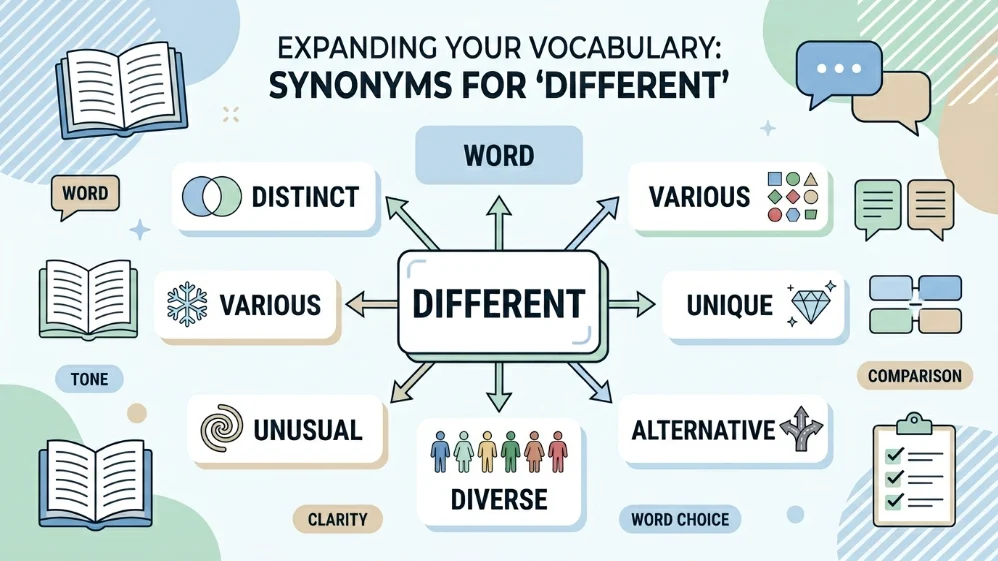
If you are looking for synonyms for different, the best choices are distinct, dissimilar, unlike, various, and unusual. The right word depends on what you mean. Are two things not the same? Are you talking about variety? Do you mean something feels unusual, special, or strange? “Different” is a flexible word, so the best synonym depends on meaning, tone, context, and intensity.
Best Synonyms for Different
The best synonyms for different are distinct, dissimilar, unlike, various, and unusual. The right choice depends on tone, context, and intensity.
Here is a quick guide:
| Meaning You WantBest Synonyms | |
|---|---|
| Not the same | distinct, dissimilar, unlike |
| Many kinds | various, diverse, assorted |
| Separate or other | another, separate, alternative |
| Unusual or special | unusual, unique, distinctive |
| Strong contrast | opposite, contrasting, divergent |
What Does Different Mean?
Different means not the same as another person, thing, idea, place, or situation. It is usually used as an adjective.
The core idea is contrast. When something is different, it has qualities that separate it from something else.
Examples:
- This design looks different from the first version.
- We need a different plan for this project.
In simple terms, different can mean “not the same,” “another,” “various,” or “unusual,” depending on the sentence.
Core Meaning of Different
The word different is used when something does not match, repeat, or share the same qualities as something else.
It can describe a small change:
- The color is slightly different.
Can describe a major contrast:
- Their opinions are completely different.
It can also describe variety:
- The store sells different types of coffee.
Sometimes, “different” means unusual or not typical:
- His writing style is different, but interesting.
Because the word has several meanings, not every synonym works in every sentence. For example, various works when you mean “several kinds,” but it does not work well when you mean “unlike.”
Grammar and Usage Notes
Different is an adjective. It usually comes before a noun or after a linking verb.
Common sentence patterns include:
- different from something
- different than something
- a different type of something
- a different way to do something
- completely different
- slightly different
- very different
- totally different
Examples:
- This answer is different from mine.
- The result was different than we expected.
- They tried a different method.
In formal writing, different from is often the safest choice. Merriam-Webster notes that both “different from” and “different than” are standard, while “different from” is more common overall.
A synonym may work better when “different” feels too plain. For example, use distinct when you want a polished word, various when you mean many kinds, and unusual when you mean not typical.
Best Synonyms for Different
| Synonym | Meaning | Tone | Best Use Case | Example Sentence |
|---|---|---|---|---|
| Distinct | Clearly separate or not the same | Formal/neutral | Clear differences | The two brands have distinct styles. |
| Dissimilar | Not alike | Formal | Direct comparison | The results were dissimilar in several ways. |
| Unlike | Not similar to | Neutral | Simple contrast | Her approach is unlike his. |
| Various | Several different kinds | Neutral | Variety | The team tested various solutions. |
| Diverse | Showing variety | Formal/positive | People, ideas, groups, options | The program welcomes diverse viewpoints. |
| Separate | Not joined or not the same | Neutral | Dividing things or ideas | These are separate issues. |
| Alternative | Another possible choice | Formal/neutral | Options and decisions | We need an alternative plan. |
| Unusual | Not common or expected | Neutral | Something not typical | That is an unusual design choice. |
| Distinctive | Easy to recognize as different | Positive/formal | Style, voice, features | The restaurant has a distinctive flavor. |
| Contrasting | Clearly different when compared | Formal | Visuals, ideas, opinions | The report compares two contrasting views. |
Common Synonyms for Different
Distinct
Distinct means clearly different or easy to tell apart. It works well when the difference is noticeable.
Best context: writing, design, features, opinions, categories.
Example:
The two products have distinct benefits.
Unlike
Unlike means not similar to someone or something else. It is simple and useful in everyday writing.
Best context: comparisons.
Example:
Unlike the old model, this one is easier to use.
Various
Various means several different kinds. It does not usually mean “not the same” in a direct comparison.
Best context: groups, lists, options, examples.
Example:
The guide explains various ways to save money.
Other
Other means not the same one already mentioned. It is useful when choosing between options.
Best context: choices, alternatives, separate items.
Example:
Do you have any other ideas?
Separate
Separate means not joined, not shared, or not part of the same thing.
Best context: issues, rooms, accounts, categories, tasks.
Example:
Customer service and billing are separate departments.
Unusual
Unusual means not common or not expected. It often describes something that feels rare, surprising, or uncommon.
Best context: behavior, events, styles, ideas.
Example:
She has an unusual way of solving problems.
Formal Synonyms for Different
Formal synonyms are useful in academic writing, reports, essays, business documents, and professional communication.
Distinct
Use distinct when you want to show that two things are clearly separate.
Example:
The study found three distinct patterns in customer behavior.
Dissimilar
Use dissimilar when comparing things that are not alike.
Example:
The two markets are dissimilar in size, demand, and pricing.
Divergent
Divergent means moving in different directions or becoming less similar over time.
Example:
The two departments developed divergent strategies.
Disparate
Disparate means very different in kind or character. It often suggests that the things being compared do not naturally fit together.
Example:
The report combines data from disparate sources.
Varied
Varied means having different types, forms, or parts.
Example:
The course includes varied reading materials.
Diverse
Diverse means showing a wide range of different people, things, views, or qualities.
Example:
The company serves a diverse customer base.
Alternative
Alternative means another possible option.
Example:
The committee proposed an alternative solution.
Contrasting
Contrasting means clearly different when compared side by side.
Example:
The article presents contrasting views on the policy.
Informal Synonyms for Different
Informal synonyms work better in conversation, social media, friendly writing, and personal messages.
Not the Same
Not the same is simple and natural.
Example:
This version is not the same as the one I saw yesterday.
Other
Other is casual and common when talking about choices.
Example:
Let’s try the other place this time.
New
New can mean different when you are talking about a change from the old way.
Example:
We need a new plan.
Fresh
Fresh means new, different, and not boring. It often has a positive tone.
Example:
That’s a fresh idea for the campaign.
Weird
Weird means strange or unusual. It is informal and can sound negative, so use it carefully.
Example:
The app made a weird sound.
Odd
Odd means strange or not expected. It is softer than “weird” in many sentences.
Example:
That was an odd choice for the final scene.
Strong Synonyms for Different
Strong synonyms add more emotion, contrast, or intensity. Use them when the difference is clear, important, or extreme.
Opposite
Opposite means completely different in nature, direction, opinion, or meaning.
Example:
They had opposite reactions to the news.
Contrasting
Contrasting shows a strong side-by-side difference.
Example:
The room used contrasting colors to create energy.
Divergent
Divergent suggests that two ideas, paths, or opinions move away from each other.
Example:
The leaders had divergent views on the future of the company.
Disparate
Disparate is strong and formal. It suggests a deep difference between things.
Example:
The project brought together disparate fields of research.
Poles Apart
Poles apart is an idiom that means extremely different.
Example:
Their personalities are poles apart.
Radically Different
Radically different means very different in a major or complete way.
Example:
The new design is radically different from the old one.
Mild Synonyms for Different
Mild synonyms are useful when you do not want to sound too strong, harsh, or dramatic.
Other
Other is simple and soft.
Example:
We can look at other options.
Another
Another means one more or a different one.
Example:
Let’s choose another date.
Separate
Separate is clear but not emotional.
Example:
That is a separate issue.
Slightly Different
Slightly different shows a small difference.
Example:
The final version is slightly different from the draft.
Varied
Varied suggests difference without sounding negative.
Example:
The menu offers varied choices.
Alternative
Alternative sounds practical and neutral.
Example:
We found an alternative route.
Synonyms for Different by Context
Everyday Conversation
In everyday conversation, simple words sound most natural. Use other, another, not the same, new, or unusual.
Examples:
- Let’s try another restaurant.
- This one feels different.
- That answer is not the same as mine.
Avoid overly formal words like disparate or divergent in casual speech unless the situation calls for them.
Professional Writing
In business writing, use words that sound clear and polished. Good choices include distinct, alternative, separate, varied, and contrasting.
Examples:
- We reviewed alternative pricing models.
- These are separate business goals.
- The two teams have distinct responsibilities.
Academic Writing
Academic writing often needs precision. Use distinct, dissimilar, divergent, disparate, varied, or heterogeneous when appropriate.
Examples:
- The study compares two distinct populations.
- The findings reveal divergent trends.
- The data came from heterogeneous groups.
Use advanced words only when they improve clarity.
Creative Writing
Creative writing allows more style and emotion. Useful synonyms include unusual, distinctive, strange, peculiar, rare, and unconventional.
Examples:
- Her voice had a distinctive warmth.
- The house had a strange beauty.
- He followed an unconventional path.
Marketing Copy
In marketing, “different” often needs a positive tone. Use fresh, unique, distinctive, innovative, or new.
Examples:
- Discover a fresh approach to home organization.
- Our formula has a distinctive finish.
- Try a new way to plan your week.
Be careful with unique. It means one of a kind, so do not use it if something is only slightly different.
Emotional Expression
When describing feelings or personal reactions, use strange, unusual, odd, new, or unfamiliar.
Examples:
- It felt strange to return after so many years.
- This new routine feels unfamiliar.
- His reaction seemed unusual.
Another Word for Different in a Sentence
Here are natural examples using different synonyms:
- The two paintings have distinct styles.
- Her answer was unlike anything I expected.
- We tested various methods before choosing one.
- The company needs an alternative plan.
- These are separate problems and should be handled one at a time.
- His voice has a distinctive sound.
- The results were dissimilar across the two groups.
- The students came from diverse backgrounds.
- That is an unusual way to start a meeting.
- The two reports show contrasting opinions.
- We need another solution.
- The new layout gives the page a fresh look.
- Their goals are divergent, so compromise may be difficult.
- The project joined disparate ideas into one plan.
- Her style is unconventional, but it works.
Different Synonyms Compared
| Word | Meaning | Tone | Intensity | Best Use |
|---|---|---|---|---|
| Different | Not the same | Neutral | Mild to strong | General use |
| Distinct | Clearly separate | Formal/neutral | Medium | Clear categories or features |
| Dissimilar | Not alike | Formal | Medium | Direct comparison |
| Unlike | Not similar | Neutral | Medium | Simple contrast |
| Various | Several kinds | Neutral | Mild | Variety |
| Diverse | Wide range | Positive/formal | Medium | Groups, views, options |
| Disparate | Very different in kind | Formal | Strong | Deep differences |
| Unusual | Not common | Neutral | Medium | Rare or unexpected things |
| Unique | One of a kind | Strong/positive | Strong | Truly singular things |
| Odd | Strange or unexpected | Informal | Mild to medium | Casual descriptions |
Distinct vs. Different
Different is broad. Distinct is more precise and means clearly separate.
- The two ideas are different.
- The two ideas are distinct.
Use distinct when the difference is easy to notice.
Various vs. Different
Different can compare two things. Various means several kinds.
- They chose different colors.
- They chose various colors.
Use various when you are talking about a range or group.
Unusual vs. Different
Different is neutral. Unusual means not common or not expected.
- Her style is different.
- Her style is unusual.
Use unusual when the difference feels rare or surprising.
Unique vs. Different
Unique means one of a kind. It is stronger than different.
- This design is different.
- This design is unique.
Use unique only when something is truly special or unlike anything else.
Words Similar to Different
Some words are related to different, but they are not always exact synonyms.
Unique
Unique is related because it describes something unlike others. But it means one of a kind, so it is stronger than “different.”
Use it when something is truly special or singular.
Special
Special can mean different in a positive way, but it also means important, meaningful, or valuable.
Use it when the difference has emotional or practical value.
Strange
Strange means unusual, unfamiliar, or surprising. It can sound negative.
Use it when something feels odd, not just different.
Peculiar
Peculiar means strange or distinctive. It can sound formal, old-fashioned, or slightly negative.
Use it carefully in modern writing.
Unfamiliar
Unfamiliar means not known or not recognized. It is related to “different” because unfamiliar things may feel different.
Use it when the person has not seen, heard, or experienced something before.
New
New can mean different from before, but it mainly means recent or not used before.
Use it when talking about change, updates, or fresh options.
Original
Original means creative, new, or not copied. It is related to “different” when the difference comes from creativity.
Use it for ideas, art, writing, or design.
Antonyms of Different
| Antonym | Short Meaning | Example Sentence |
|---|---|---|
| Same | Not different | We chose the same answer. |
| Similar | Almost the same | The two houses look similar. |
| Alike | Similar in appearance or nature | The twins look alike. |
| Identical | Exactly the same | The files are identical. |
| Matching | Going well together or looking the same | She wore matching shoes and a bag. |
| Uniform | Consistent or the same throughout | The company uses a uniform design. |
| Common | Usual or shared | They have a common goal. |
| Standard | Normal or usual | This is the standard size. |
| Typical | Expected or normal | That is a typical response. |
| Ordinary | Normal, not special | It was an ordinary day. |
How to Choose the Right Synonym for Different
Start by asking what different means in your sentence.
- If you mean “not the same,” use distinct, dissimilar, or unlike.
- If you mean “several kinds,” use various, diverse, or assorted.
- If you mean “another option,” use alternative, other, or separate.
- If you mean “not normal,” use unusual, odd, strange, or unconventional.
Then check the tone. A word like disparate may work in a report, but it can sound too heavy in a text message. A word like weird may work with friends, but it can sound too casual in business writing.
Also check the intensity. Slightly different is soft. Radically different is strong. Opposite is stronger than both.
Most of the time, the best synonym is the one that keeps the sentence clear and natural.
Common Mistakes When Using Synonyms for Different
Choosing a Word With the Wrong Tone
Some synonyms sound formal, while others sound casual. Dissimilar works in a report, but it may sound stiff in normal conversation.
Better casual sentence:
These two designs are not the same.
Better formal sentence:
The two designs are dissimilar in structure.
Using a Synonym That Is Too Strong
Do not use opposite when two things are only slightly different.
Weak example:
The two shirts are opposite colors.
Better example:
The two shirts are different colors.
Using Formal Words in Casual Writing
Words like disparate, divergent, and heterogeneous can sound unnatural in casual writing.
Too formal:
We tried disparate snacks at the party.
Natural:
We tried different snacks at the party.
Using Casual Words in Professional Writing
Words like weird and odd may sound too informal in reports or business emails.
Too casual:
The numbers look weird.
Better:
The numbers appear unusual.
Treating Related Words as Exact Synonyms
Unique, special, and strange are related to “different,” but they do not always mean the same thing.
For example, “unique” means one of a kind. Something can be different without being unique.
Making the Sentence Sound Unnatural
Sometimes “different” is already the best word. Do not replace it only to sound smarter.
Awkward:
We need a disparate color for the button.
Natural:
We need a different color for the button.
Quick Synonym List for Different
Common synonyms:
distinct, unlike, other, separate, various, new, unusual
Formal synonyms:
distinct, dissimilar, divergent, disparate, varied, diverse, alternative, contrasting
Informal synonyms:
not the same, other, new, fresh, odd, weird
Strong synonyms:
opposite, contrasting, divergent, disparate, poles apart, radically different
Mild synonyms:
other, another, separate, varied, alternative, slightly different
Related words:
unique, special, strange, peculiar, unfamiliar, original, unconventional, rare
FAQs About Synonyms for Different
What is the best synonym for different?
The best synonym for different is distinct when you mean clearly not the same. Other strong choices include unlike, dissimilar, various, and unusual, depending on the sentence.
What is another word for different?
Another word for different is distinct. You can also use unlike, other, separate, various, diverse, or unusual based on the meaning.
What is a formal synonym for different?
A formal synonym for different is distinct. Other formal options include dissimilar, divergent, disparate, varied, and alternative.
What is an informal synonym for different?
An informal synonym for different is not the same. In casual writing, you can also use other, new, fresh, odd, or weird, depending on tone.
What is a stronger word for different?
A stronger word for different is opposite when two things are completely unlike each other. Other strong choices include contrasting, divergent, disparate, and radically different.
What is a milder word for different?
A milder word for different is other or another. These words are simple and neutral, especially when you are talking about options or choices.
What words are similar to different?
Words similar to different include unique, special, strange, peculiar, unfamiliar, original, and unconventional. These words are related, but they do not always replace “different” exactly.
What is the opposite of different?
The opposite of different is same. Other antonyms include similar, alike, identical, matching, uniform, typical, and ordinary.
How do I choose the right synonym for different?
Choose the right synonym by checking meaning, tone, and intensity. Use distinct for clear difference, various for several kinds, alternative for another option, and unusual for something not common.
Conclusion
Different is a useful word, but it can mean more than one thing. It may mean not the same, separate, another, varied, or unusual. That is why the best synonym depends on context.
Use distinct for a clear difference, various for variety, alternative for another option, unusual for something not common, and disparate or divergent for stronger formal contrast. The best word is the one that matches your meaning, tone, context, and intensity without making the sentence sound forced.