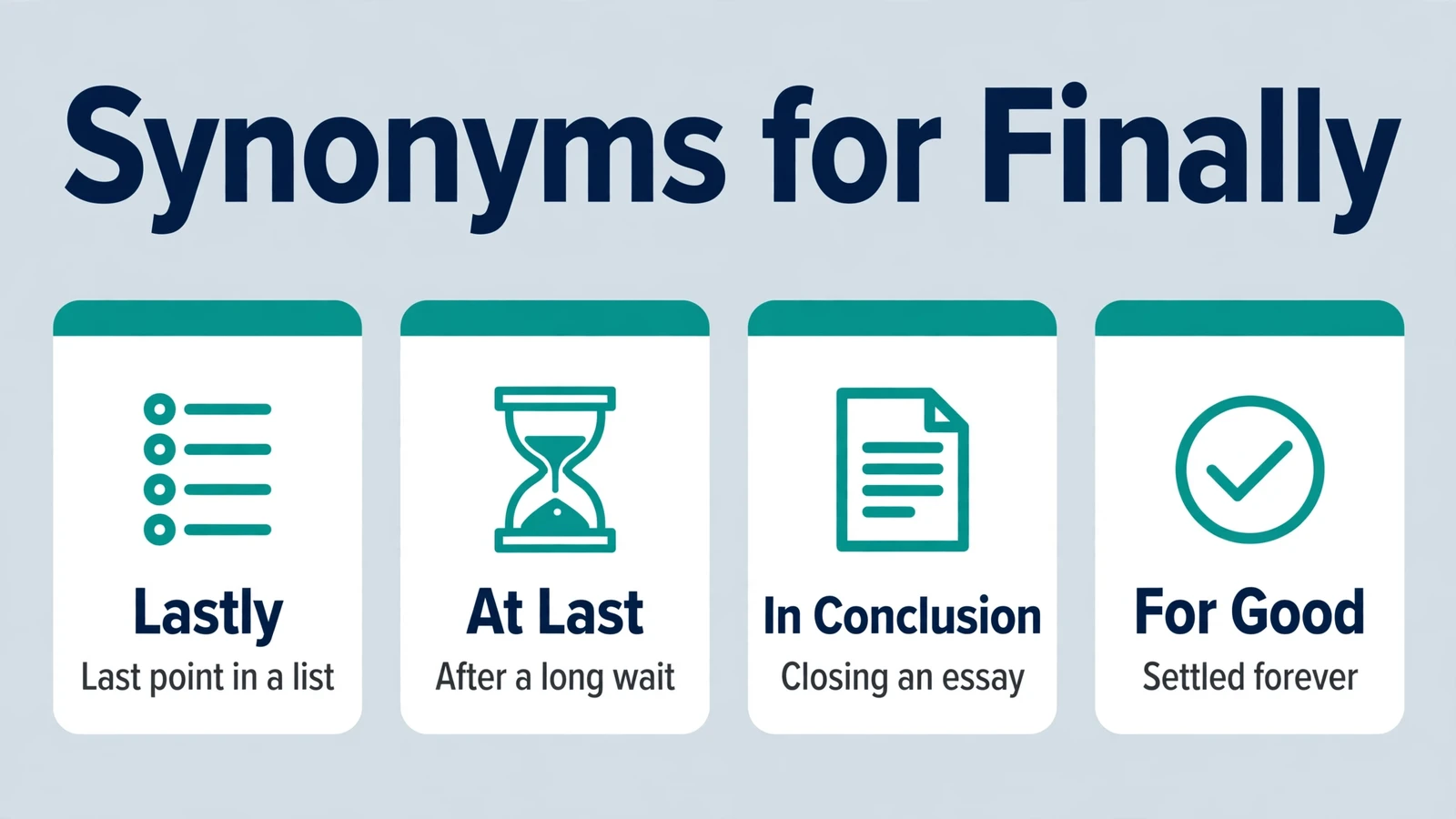
Few small words work as hard as finally. It closes your essays, ends your lists, and announces that the long wait is over. No wonder it starts to feel worn out fast.
The safest replacements depend on which finally you mean. For a last point, use lastly, in conclusion, to sum up or in summary. For the relief of a long wait, reach for at last, at long last, in the end or eventually. For a decision that cannot change, older English used finally to mean for good or irrevocably.
This guide groups 45+ dictionary-checked synonyms by sense, so you can pick the one that truly fits. Every word below is backed by major thesaurus sources. The tricky near-misses get their own warning section, too.
Quick Reference: Top Synonyms for Finally
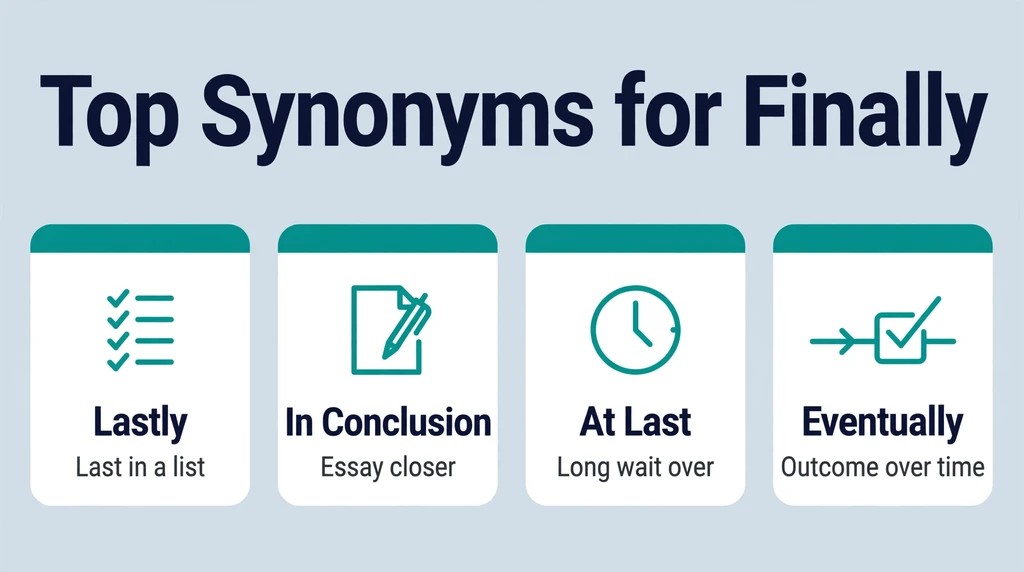
Start here if you need a fast swap. The table below holds the 24 most useful replacements, each with its core meaning and the tone it carries. Later sections explain the shades that a table cannot show.
| Word | Meaning in one line | Best for / tone |
|---|---|---|
| Lastly | Last in a list or series | Essays, speeches; neutral |
| In conclusion | Signals the closing point | Essays; formal |
| In closing | Marks the final remark | Speeches, letters; formal |
| To conclude | Opens a closing statement | Essays; formal |
| To sum up | Sums up what came before | Essays, talks; neutral |
| In summary | Brief restatement of main points | Reports; formal |
| Ultimately | In the end, as the final outcome | Analysis; formal |
| In the end | After everything, as the final result | Both senses; neutral |
| At last | After a long wait, with relief | Stories, speech; warm |
| At long last | After a very long wait | Stories; emphatic |
| At length | After a long interval | Literary; formal |
| Eventually | At some later point, as things unfold | Neutral; no relief |
| At the end of the day | When everything is considered | Figurative; conversational |
| When all is said and done | After all is considered | Conversational; reflective |
| At the last moment | Just before it was too late | Stories; dramatic |
| Sooner or later | At some unspecified future time | Neutral; patient |
| In time | After enough time has passed | Calm; reassuring |
| Someday | On some future day, hoped for | Hopeful; informal |
| Before long | Fairly soon | Neutral; forward looking |
| By and by | After a while, in due course | Old-fashioned; gentle |
| In the fullness of time | When the moment is fully ripe | Formal; deliberate |
| For good | Permanently, never to be undone | Decisions; firm |
| Irrevocably | In a way that cannot be reversed | Legal; formal |
| Forthwith | Without delay, immediately | Official; very formal |
One caution before you grab a word and go. A synonym from the wrong row can quietly change your meaning. “Lastly” cannot carry relief, and “at last” cannot close an essay list. The sections below sort every option by the job it actually does.
What Does Finally Mean? The Senses Behind the Word
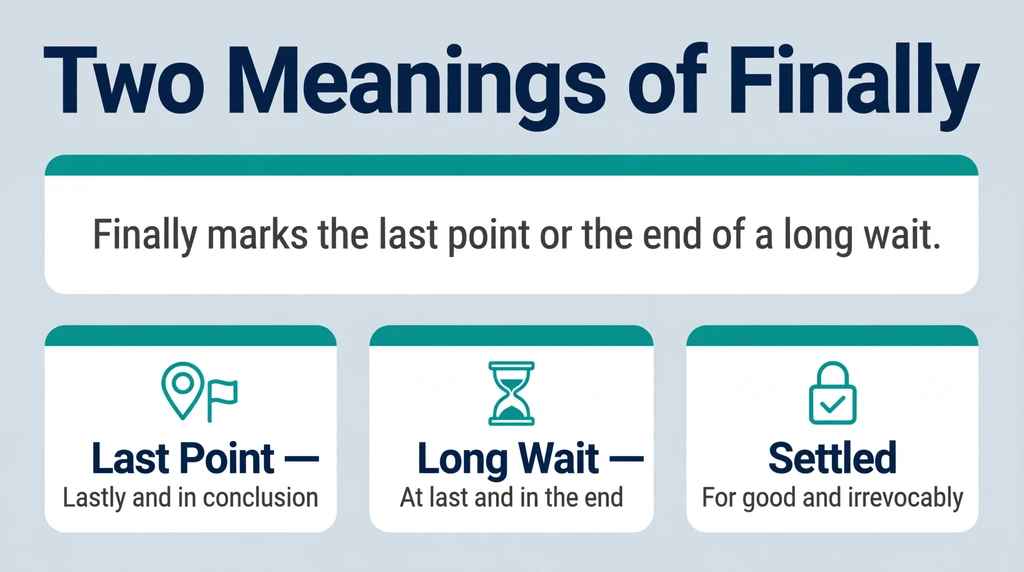
Finally looks simple, yet dictionaries split it into distinct senses. Merriam-Webster lists the waiting sense, the list sense, and an older conclusive sense. Collins sorts the same ground into four groups. Knowing the senses first makes every later choice easy.
Sense 1: The Last Point in a Series
In this sense, finally means “as the last act or occurrence in a series.” It simply marks the end of a sequence. Merriam-Webster gives this as one of the core meanings, and it is also the oldest one. The dictionary traces the first known use of finally to the 14th century, in exactly this list sense.
Example: “We toured the labs, met the team, and finally saw the prototype.”
A close relative closes arguments instead of lists. Used this way, finally means “by way of conclusion,” as in a speaker’s last point. Sports quotes and speeches use it constantly: “Finally, I would like to thank the fans.”
Sense 2: After a Long Wait
Here, finally means “after a prolonged time.” The word carries feeling, because the wait usually involved delay, effort, or frustration. Merriam-Webster illustrates it with a train that arrives two hours late. That emotional charge is what most casual uses rely on.
Example: “After three delays, the flight finally boarded.”
This is the sense behind everyday cries of relief. “Finally, Friday.” “We finally meet.” The word works like a small celebration, and good synonyms must keep that warmth.
It can even stand alone as an exclamation. A single “Finally!” after good news needs no verb at all. The hearer supplies the whole story: the wait, the worry, and the release. None of the list words can do this trick. Only at last comes close, in the cry “At last!” That is why finally stays so popular in speech even when writers replace it on the page.
Sense 3: Settled for Good, in a Way That Allows No Change
Older English also used finally to mean “in a final manner,” with no room for change. Merriam-Webster marks this sense old-fashioned, and Dickens used it in that spirit. Collins calls the same idea “conclusively.” Modern readers rarely meet it outside legal or literary texts.
Example from older usage: a decision delivered “finally and conclusively” cannot be reopened. Today, writers say “for good” or “irrevocably” instead, and Section 8 covers those words fully.
Where Finally Sits in a Sentence
Position changes the flavor of the word. At the front, finally acts like a signpost: “Finally, we reached the harbor” announces the last stage. In the middle, tucked before the verb, it leans toward relief: “We finally reached the harbor.” At the end it is rare and usually needs support, as in “they arrived, finally, at midnight.”
Front position also takes a comma in the list and conclusion senses. Middle position takes none. This small punctuation habit helps readers sort the senses before they even finish the sentence.
Synonyms for Finally as the Last Point: Lastly and In Conclusion
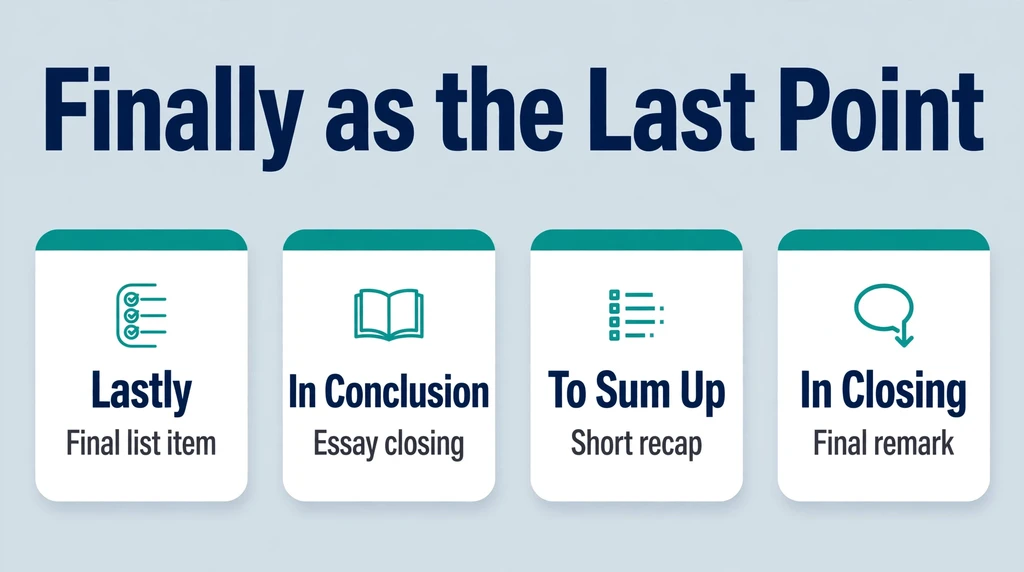
This is the finally of lists, steps, and closing arguments. Your sentence is not about waiting at all. It is about order: first, next, and then the last item. Collins files these words under two labels, “lastly” and “in conclusion,” and both groups appear below.
Plain Sequence Words
Lastly is the closest one-word match. It introduces the final item in a series and nothing more. “Lastly, check the spelling.” Because it stays neutral, lastly suits instructions, essays, and presentations alike.
Ultimately also closes a sequence, but it adds weight. It points to the final outcome after a process, not just the last step. “The talks dragged on, but ultimately both sides signed.” If you want depth on this word alone, our guide to synonyms for ultimately compares it with lastly and eventually.
In the end can serve here too. It closes a series by reporting how things turned out. “In the end, the committee chose the cheaper plan.” Notice the outcome flavor: the phrase looks back over the whole story.
Conclusion Phrases
In conclusion is the classic essay closer. It tells the reader that the argument is complete and the verdict is coming. “In conclusion, the evidence supports the ban.”
To conclude does the same job as a verb phrase. It sounds slightly more active than in conclusion. “To conclude, I recommend the second option.”
In closing belongs to speeches and letters. It marks the final remark before a goodbye or a thank-you. “In closing, let me thank everyone who helped.”
To sum up and in summary promise a compressed recap. Use them when the closing lines restate earlier points in shorter form. “To sum up, the plan saves money and time.” Reach for them in reports, talks, and study notes.
Two quick models show the range of this group. A teacher closing a lesson might say, “Lastly, your homework is chapter four.” A debater ending a case needs more ceremony: “In conclusion, the motion protects both fairness and cost.” Same job, different weight. The plain word serves plain sequences, while the formal phrases serve verdicts. When the last point carries your whole argument, dress it accordingly.
Synonyms for Finally After a Long Wait: At Last and At Long Last
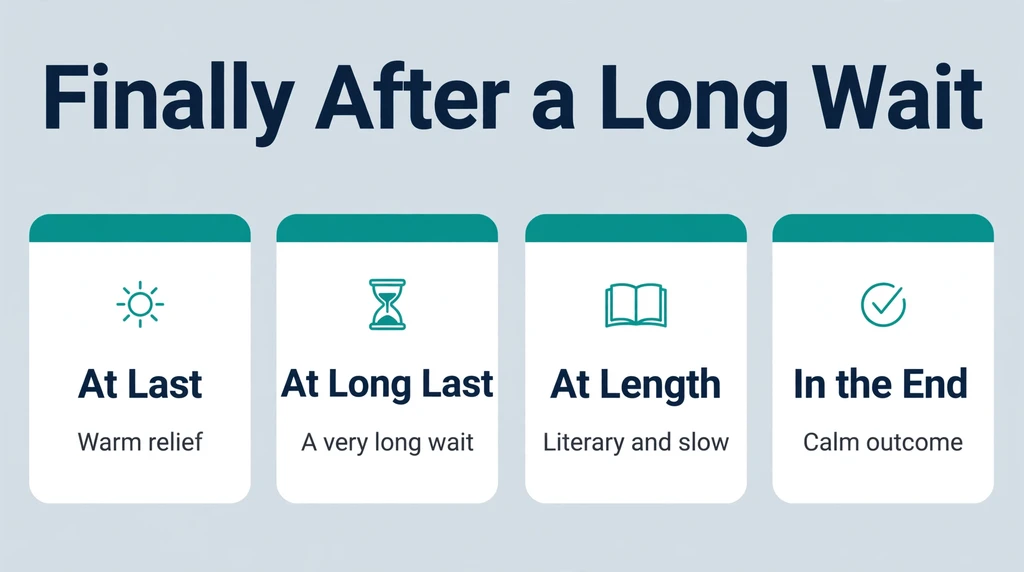
This is the finally of train platforms and long projects. Something took far longer than hoped, and now it has arrived. Collins groups these words under “eventually,” but the best of them carry real relief. The word you pick decides how much feeling the sentence holds.
Warm, Everyday Relief
At last is the warmest replacement. It celebrates the end of a wait in just two words. “At last, the results were posted.” It fits stories, speeches, and everyday speech equally well.
At long last stretches the wait even further. The doubled “long” signals that the delay was remarkable. “At long last, the bridge reopened to traffic.” Save it for waits that truly dragged on.
In the end works here as well, with a calmer tone. It reports that matters resolved after difficulty. “The repairs took months, but in the end the house felt new.”
After a long time is the plainest option of all. Collins lists this simple phrase for the same sense. It carries no drama, which makes it safe for factual writing. “After a long time, the two friends spoke again.”
Formal and Literary Relief
At length means after a long interval, and it sounds bookish. Novelists love it for slow scenes. “At length, the rain stopped and the road dried.” Modern reports rarely use it, so save it for storytelling.
At the last is a compressed cousin of at last. It appears in older and more formal prose. “At the last, he agreed to sign.” Most writers today choose at last instead.
At the last moment adds a near-miss thrill. The thing happened just before it was too late. “At the last moment, she caught the train.” Use it when timing, not just relief, drives the sentence.
Synonyms for Finally About Time Passing: Eventually and Sooner or Later
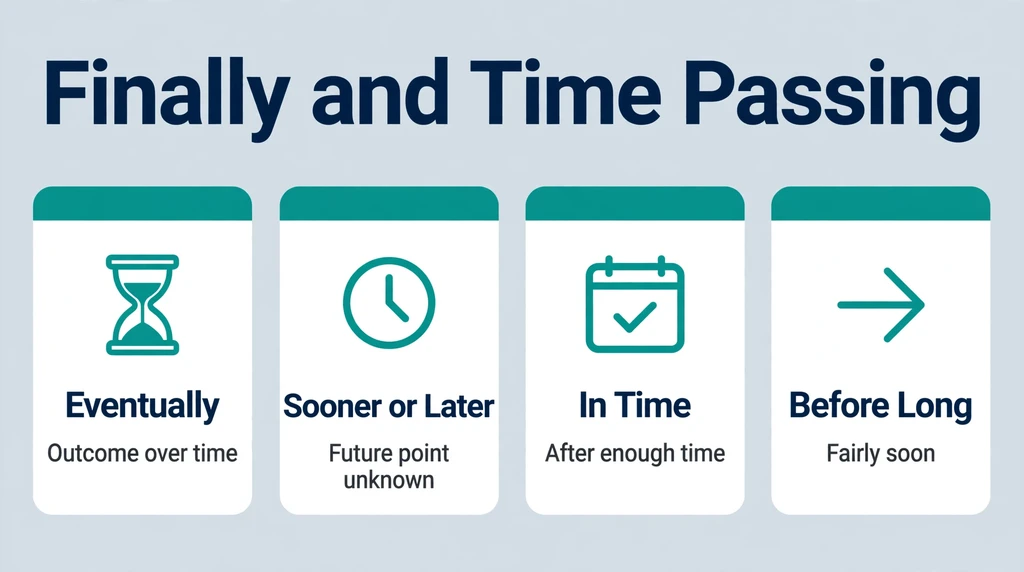
Sometimes finally is not about lists or relief at all. It simply places an event at a later time. Merriam-Webster’s thesaurus gathers its finally synonyms under exactly this idea: “at a later time.” The words in this section share that calm, clock-watching sense.
Neutral Words About Outcomes Over Time
Eventually is the headline word here, and it needs care. It says an outcome arrived after time passed and events unfolded. Crucially, it carries no relief and makes no promise. “The package eventually arrived” reports a result. It does not cheer. Compare that with “the package finally arrived,” which grumbles about the wait. Swap in eventually when you want the fact without the feeling.
Sooner or later names a future point without fixing it. It often carries quiet confidence that something will happen. “Sooner or later, the truth comes out.”
In time means after enough time has passed. It reassures rather than complains. “In time, the pain faded.” A close form, yet, works in negative and question frames: “The results are not out yet.”
Someday and sometime point to an unnamed future day. Someday leans hopeful, as in “Someday, I will visit Kyoto.” Sometime stays flatter and more casual.
Soon Rather Than Late
A smaller set stresses nearness. Soon, shortly, and before long all place the event a short distance ahead. “The store will open before long.” Presently and imminently raise the formality, while momentarily, in American use, means in a moment. These words suit schedules and announcements better than stories about long waits.
Watch how the tone shifts across one scene. A station screen can promise a train “shortly,” which sounds official. A friend texting “see you soon” sounds warm. A novel saying the truth would emerge “before long” sounds patient and sure. The distance in time is similar each time. What changes is the voice, and the voice is what your reader hears.
Words That Stress Speed, Not Waiting
Merriam-Webster also lists a quick-action set under finally: promptly, immediately, right away, right off, right now, forthwith, directly, straightaway, and the more old-fashioned straightway. Treat these with caution. They belong to the broad “at a later time” family, yet they stress speed and drop the waiting sense entirely. “Reply forthwith” orders instant action. It says nothing about a long delay finally ending.
Old-Fashioned and Playful Time Words
By and by means after a while, in a gentle, unhurried way. It now sounds old-fashioned or regional. In the fullness of time is slower still: it means when the moment is fully ripe, and writers often use it with mild irony. Anon is an archaic “soon,” best left to Shakespeare. Finally, pronto is an informal, borrowed flourish meaning right away, handy for light dialogue.
Synonyms for Finally in Essays and Formal Writing
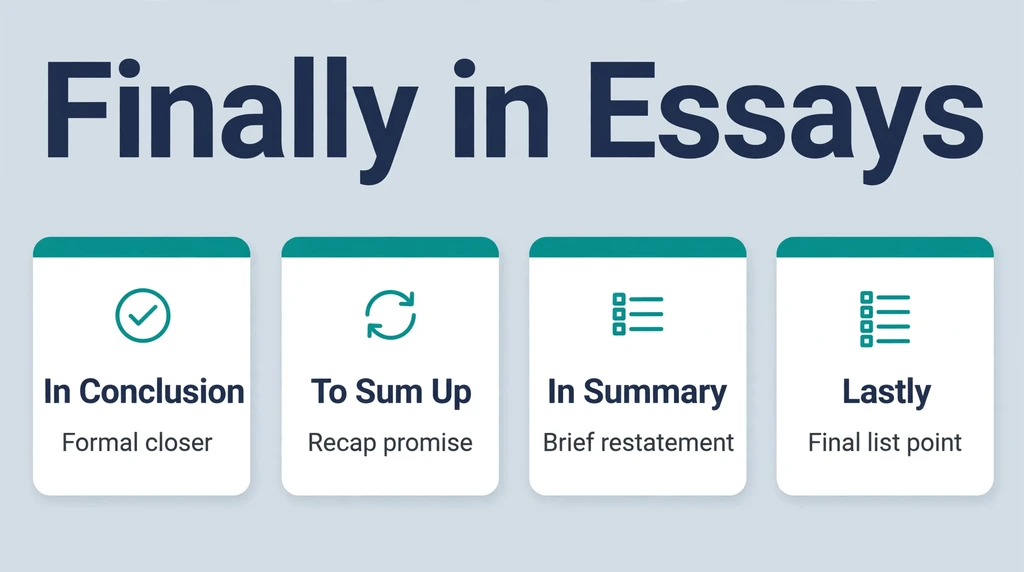
Teachers and editors flag finally more than almost any other closer. The problem is not grammar. The problem is vagueness: readers cannot tell whether you mean “last in my list” or “the end of my argument.” Precise closers fix that. This section gathers the formal options and shows them at work.
The Safest Formal Swaps
For a final list item, lastly is clean and safe. For the closing move of an essay, prefer in conclusion, to conclude, or in summary. These phrases announce that the whole argument is wrapping up, not just one more point. Our dedicated guide to synonyms for in conclusion compares the full set of essay closers.
Formal writing also rewards variety across a long paper. You might order points with moreover in the body, then close with to sum up. If you need options for the body, see our list of synonyms for moreover as well.
A Before and After Example
Weak closer: “Finally, social media has changed how students read.”
Stronger closer: “In conclusion, social media has shortened the texts students choose, but it has also widened what they can find.”
The second version does two things the first cannot. It signals a true conclusion, and it states the claim in full. The word swap forces the clearer thinking.
A Full Conclusion, Before and After
Weak ending: “Finally, exercise is good for people of all ages, and everyone should do it.”
Stronger ending: “To sum up, regular exercise protects the heart, steadies mood, and costs little to start. The evidence leaves one clear duty: move daily.”
The weak version leans on finally to sound finished, but it adds nothing new. The stronger version recaps three findings, then lands a verdict. Notice that “to sum up” earns its place because a real summary follows it. A closing phrase is a promise, and the sentences after it must keep that promise.
Two Habits to Avoid
First, do not stack closers. “Finally, in conclusion, the answer is clear” uses two signals for one job. Pick one and let it stand alone.
Second, do not use finally as padding at the end of a speech. A flat “finally” before your last point can make an audience check the time. “In closing” or a short thank-you line lands better.
Finally in Emails and Reports
Workplace writing sits between speech and essays, and it has its own habits. In an email listing action points, lastly is tidy and safe: “Lastly, please confirm by Friday.” When a long project closes, in the end keeps the tone professional without blame: “In the end, the vendor met every deadline.”
Avoid at last in client mail, because its relief can read as a complaint about the wait. Avoid forthwith as well, unless you write contracts or official notices. It reads as an order, and it can sound stern in an ordinary inbox, where “right away” does the job more kindly.
How to Choose the Right Synonym for Finally
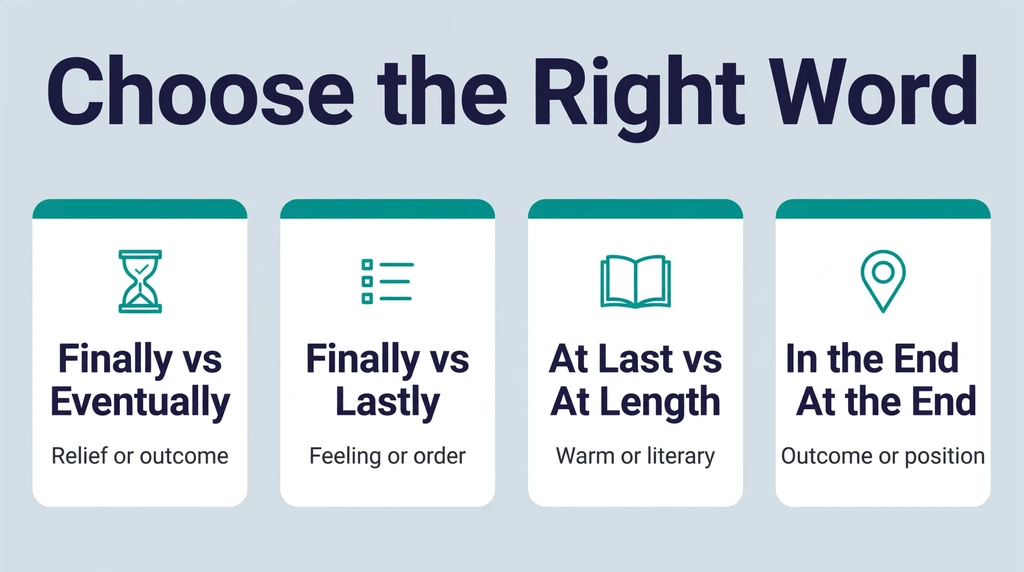
Most wrong choices come from five look-alike pairs. Each pair below shows the real difference, then proves it with matched examples. Read the pair that matches your sentence, and the choice will make itself.
Finally vs Eventually
Finally can carry relief; eventually never does. Eventually only reports that something happened after time passed. “She finally passed the exam” hints at struggle and celebration. “She eventually passed the exam” stays neutral about the journey. Choose finally when the wait matters to your reader. Choose eventually when only the outcome matters.
Finally vs Lastly
Lastly only marks order. It cannot express relief, delay, or outcome. “Lastly, add the salt” works because the sentence lists steps. But “The train lastly arrived” fails, because arrivals are not list items. If your sentence would still make sense with “at last” in place, lastly is the wrong pick.
Finally vs Ultimately
Ultimately looks past the steps to the final result or the deepest cause. “Ultimately, the cheaper design won.” Finally, by contrast, can simply end a sequence. In careful writing, ultimately also introduces the point that matters most. Use it for outcomes and verdicts, not for routine list endings.
At Last vs At Length
Both phrases suggest a long stretch of time, but they end it differently. At last delivers relief and emotion: “At last, the baby slept.” At length is cooler and more literary, and it can also mean “in detail” elsewhere: “At length, the road reached the sea.” If your sentence celebrates, choose at last. If it narrates slowly, at length may fit.
In the End vs At the End
In the end stands alone and reports an outcome. “In the end, we stayed home.” At the end needs a partner noun and marks a position: “at the end of the film.” Swapping them breaks the grammar, so this pair is the easiest to police. Outcome alone: in the end. Position in something: at the end of it.
To Sum Up vs In Conclusion
Both phrases close arguments, but they promise different content. To sum up promises a recap of points already made. In conclusion promises a final judgment drawn from those points. If your last lines repeat earlier claims in brief, choose to sum up. If they deliver a verdict or a call to action, choose in conclusion. Mixing the promise confuses readers, because a “summary” that suddenly argues feels like a trick.
Synonyms for Finally in Sentences: Examples for Every Sense
Reading glosses is one thing; seeing the words at work is another. The twelve sentences below cover every sense in this guide. Each note names the sense and the reason the word fits, so you can copy the pattern into your own writing.
List and Conclusion Examples
1. “Firstly, gather the tools; lastly, check your work.” Lastly keeps the steps in clean order, with no hint of waiting.
2. “In conclusion, the city should fund the library.” The phrase closes the whole argument and introduces a verdict.
3. “To sum up, the trip cost less than planned.” The recap promise is kept in a single, shorter restatement.
4. “In closing, thank you for your patience today.” A speech ends politely, with the remark clearly marked as final.
Long Wait Examples
5. “At last, the plumber arrived with the right part.” Relief leads the sentence, and the wait clearly frustrated someone. 6. “At long last, the two rivals shook hands.” The stretched phrase matches a feud that lasted for years. 7. “The fog lifted at length, and the boats moved out.” The literary phrase suits a slow scene with no cheering. 8. “After a long time, the old house sold.” The plain phrase reports the delay without any drama at all.
Time and Outcome Examples
9. “She trained daily and eventually won a regional title.” Eventually reports the outcome and stays silent about her feelings. 10. “Sooner or later, every password leaks.” The phrase predicts a future event without naming a date. 11. “In time, the new team settled into its routine.” Enough time passed, and the result arrived calmly. 12. “He left the firm for good in March.” The conclusive sense appears in modern dress: the departure cannot be undone.
Finally as Conclusively: For Good, Irrevocably and For All Time
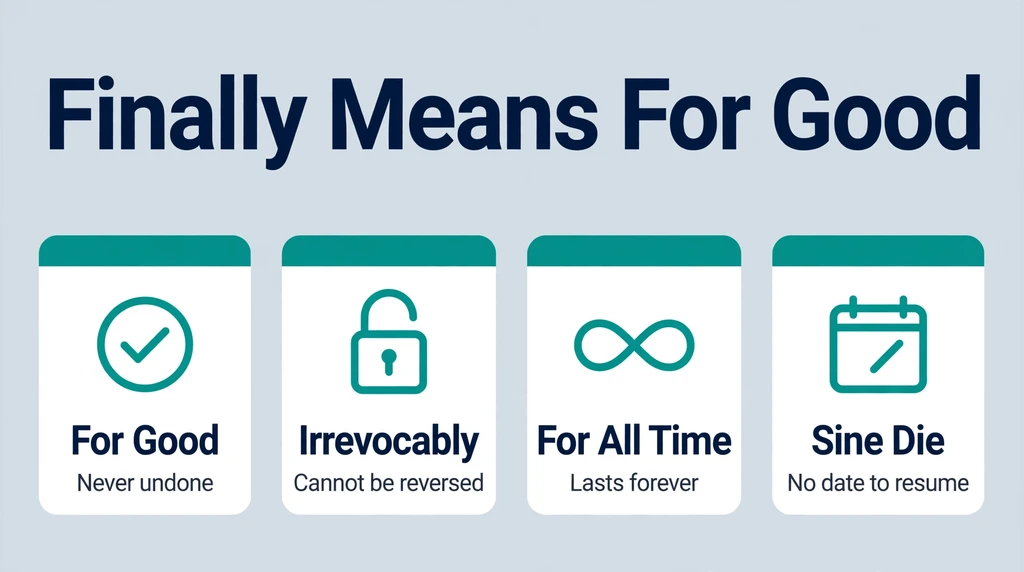
One older sense of finally survives at the edges of modern English. It means settled in a way that allows no change. Merriam-Webster flags this sense as old-fashioned, and Collins labels it “conclusively.” You will meet it in legal writing, formal decisions, and older novels. These are its living replacements.
For good is the everyday survivor. It means permanently, never to be undone. “She left the city for good.” It keeps the finality without any archaism.
Irrevocably states that a step cannot be reversed. Lawyers and officials use it for decisions with binding force. “The license was irrevocably withdrawn.”
For ever and for all time stretch the same permanence across time itself. They suit vows, inscriptions, and solemn prose. “The names are carved there for all time.”
Beyond the shadow of a doubt proves something conclusively rather than ending it. Collins lists it in this group because it shares the note of total certainty. Use it for verdicts, not for schedules.
Never to return is the poetic member of the set. It fits departures and lost eras. Sine die, a Latin term, belongs to formal procedure: a meeting adjourned sine die has no date set to resume. Finally, conclusively itself pairs with verbs of deciding and proving, exactly as in the old phrase “decided finally and conclusively.”
Antonyms for Finally
Finally is an awkward word to oppose, and honesty helps here. Dictionaries offer no clean one-word opposite for the waiting sense, because few single words mean “not after a long time.” Thesaurus.com gives inconclusively as its leading antonym, which fits the conclusive sense: a matter left open instead of settled.
Inside real sentences, two small words do the opposite work. Never cancels the awaited event entirely: “The letter never arrived.” Not yet keeps the event pending: “The results are not out yet.” And if finally closes a list, its natural counterpart opens one: firstly, or to begin with. Treat these as working opposites in context, not as dictionary antonyms.
That gap in the dictionary is itself a clue. English treats endings as events worth marking, while beginnings and non-events get plain words. So when you need an opposite, build it from the sentence rather than hunting for a single magic word. State what did not happen, or what is still pending, and the contrast with finally will be clear.
Common Mistakes: Words That Are Not True Synonyms for Finally
Using lastly for relief. Lastly marks list order only. “The bus lastly arrived” is wrong, because the bus is not an item in a list. You need at last or finally itself.
Using eventually when you feel relief. Eventually reports outcomes without emotion. It also traps learners from several European languages, where its look-alike word means “possibly.” If the sentence celebrates, eventually is too cold.
Confusing finally with finely. The spelling twins mean unrelated things. Finely means in a fine, precise, or delicate way: “finely chopped herbs.” A spellchecker will not save you, because both words are real.
Reading “at the end of the day” as a clock phrase. The idiom is figurative. It means “when everything is considered,” not “by tonight.” Collins files it with the long-wait synonyms for that settled, summing-up feeling.
Reaching for “last but not least” as a conclusion. The phrase spotlights a final item; it does not sum up an argument. It opens your last point with a flourish, but your essay still needs a real closer after it.
Using at last in a formal report. At last carries open relief, which can sound like a complaint about colleagues or clients. A report that says “the data at last arrived” quietly blames someone. Neutral reports should choose “in the end” or a plain date instead.
Repeating finally in one paragraph. Two uses in a few lines make the prose stumble, and readers feel the repetition even if they cannot name it. Keep one, then switch the other to the precise word for its sense. The fix takes seconds and lifts the whole paragraph.
Frequently Asked Questions
What is the best synonym for finally?
There is no single best choice, because finally does several jobs. For a last list item, lastly is the safest swap. For a long wait ending in relief, at last wins. For an essay conclusion, in conclusion or to sum up sounds strongest. Match the word to the sense, and you will rarely go wrong.
What is a formal synonym for finally in an essay?
In conclusion and to conclude are the most formal closers for a whole essay. In summary suits a closing recap, and lastly works for the final point in a list. Ultimately is the formal pick when you state a final outcome or verdict.
Is eventually the same as finally?
They overlap, but they are not twins. Eventually says only that something happened after time passed, with no feeling attached. Finally can add relief after a long or hard wait. “The rain eventually stopped” is a plain report. “The rain finally stopped” sounds like someone had been waiting under a leaking roof.
What is another word for finally after a long wait?
At last is the classic answer, and at long last stretches the wait further. In the end gives the same outcome in a calmer voice. For a literary tone, at length works well. Collins groups all of these under the same sense of finally.
What is the difference between finally and lastly?
Lastly only orders a list: first, second, lastly. Finally can do that job too, but it also covers waiting, relief, and final outcomes. If the sentence involves time or feeling, lastly cannot replace finally. “The train finally arrived” is right; “the train lastly arrived” is not.
What is the opposite of finally?
For the conclusive sense, Thesaurus.com lists inconclusively as the leading antonym. Everyday English also opposes finally with never, when the awaited thing does not happen at all, and with not yet, when it is still pending. In a list, firstly or to begin with forms the opening counterpart.
Can finally start a sentence?
Yes. Sentence-initial finally is fully standard in both main senses. Add a comma when it introduces a conclusion or a list item: “Finally, remember to save your work.” The relief use also works at the front: “Finally, the rain stopped.” No comma is needed when finally sits inside the verb phrase, as in “the rain finally stopped.”
Is it “in the end” or “at the end”?
Use in the end for an outcome that stands alone: “In the end, we stayed.” Use at the end for a position inside something, and give it its partner noun: “at the end of the film.” The first phrase judges the result; the second one points at a place or moment.
Final Thoughts
Finally earns its keep because it does three jobs at once. It ends lists, it celebrates the close of a long wait, and it once sealed decisions for good. The synonyms in this guide keep those jobs separate, so your sentence says exactly what you mean. When in doubt, ask one question: is this about order, about waiting, or about outcome? The answer points straight to the right group.
Keep the habit small and steady. The next time finally appears twice in one draft, pause at each one. Name its sense, pick its group, and swap in the precise word. Two quiet edits like that can lift a whole page, and your readers will feel the difference without ever noticing the change.
For the dictionary’s own full list, see the Merriam-Webster thesaurus entry for finally, which groups its synonyms under the idea of a later time. Keep this page nearby, and finally will never wear out its welcome again.