You’re writing a performance review, and the word “impact” appears four times in two paragraphs. Or maybe you’re crafting a grant proposal, trying to describe the effect of your community program without sounding repetitive.
The word “impact” does heavy lifting in English. It works in boardrooms, classrooms, newsrooms, and casual chats. But relying on it too often can make your writing feel flat or vague. This guide gives you precise, context driven synonyms for impact.
You’ll learn exactly when to use words like influence, repercussion, impression, or brunt, and more importantly, when to avoid them. Think of this as your practical word choice map.
What Does “Impact” Mean?
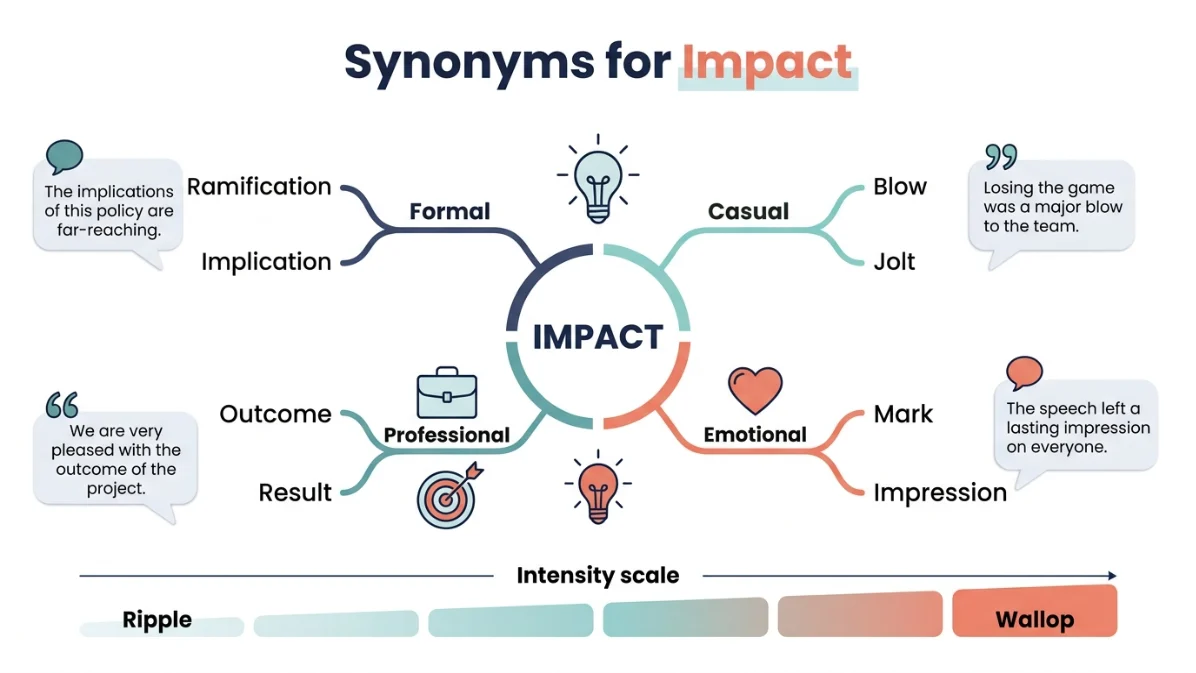
Impact refers to a strong effect, influence, or collision. In formal contexts, use effect, influence, or consequence. In business, choose outcome or result.
For emotional depth, impression works well. In casual speech, blow, jolt, or wallop add color. The right synonym for impact depends entirely on tone and setting.
Meaning, Tone and Context
The word “impact” carries a sense of force. Originally linked to physical collision, it now spans emotional, social, and professional effects. As a noun, it means a marked influence or powerful effect. As a verb, it means to affect something or press firmly against it.
The tone is generally neutral, though context can tilt it positive or negative. Formality lands in the middle range. It fits professional emails and casual conversations equally well. Common use cases include business reports, news articles, personal stories, and academic writing.
Related forms include the adjective impactful, the verb impacting, and the opposite form lack of impact.
When and How to Use “Impact”
Use “impact” when describing a noticeable effect, change, or influence. It works best when the result is significant, not trivial.
- Professional: The policy had a direct impact on employee retention.
- Academic: The study examined the environmental impact of urban sprawl.
- Emotional: Her speech left a deep impact on everyone in the room.
- Social media caption: Small habits create big impact over time.
- Email: Thanks for your input. It really shaped the final impact of the project.
- Casual: That movie hit me hard. I didn’t expect that kind of impact.
- Resume: Led a rebranding initiative that generated measurable impact on market share.
Another Word for Impact
The best single replacement for impact depends heavily on your sentence. For professional writing, choose effect or influence. In academic work, ramification or implication often fits better. Casual conversation allows for words like bump, kick, or bang.
Emotional writing benefits from impression, mark, or stir. Creative work welcomes brunt, shockwave, or footprint. On a resume, result, outcome, or contribution sound stronger. For social media captions, spark or ripple feel fresh.
When you need a stronger meaning, pick blow, jolt, or wallop. You want a softer meaning, choose touch, stir, or trace.
When Not to Use “Impact”
Impact becomes a problem when it feels lazy. In business writing, impact often appears where affect or result would be more precise. A sentence like “The new software impacted productivity” sounds vague.
“The new software increased productivity by 18%” communicates clearly. In formal academic prose, impact sometimes feels too colloquial. “The impact of the treaty” sounds less scholarly than “The ramifications of the treaty.” Overusing impact in creative writing flattens emotional depth.
“The impact of his words” feels generic compared to “The sting of his words.” Choose impact when you mean broad, forceful effect. Choose a sharper synonym when you mean a specific type of effect.
Words Commonly Confused With Impact
Impact and effect are close but not identical. Effect is the general result, while impact suggests force or significance. Every policy has an effect, but not every effect qualifies as an impact.
Impact and influence differ in tangibility. Influence often refers to indirect or persuasive power. Impact implies a more direct, measurable hit. Social media influence shapes opinions gradually. A data breach has immediate impact.
Impact and affect trip up many writers. Affect is a verb meaning to influence. Impact as a verb often sounds jargony. “The weather affected travel” reads cleaner than “The weather impacted travel.”
Impact and impression diverge in emotional register. Impression leans toward mental or emotional marking. Impact can be physical, emotional, or statistical. A speech leaves an impression. A car crash delivers impact.
Impact and repercussion carry different weights. Repercussion usually signals negative, often indirect consequences. Impact remains neutral. Downsizing has business impact. Downsizing also has human repercussions.
Best Synonym by Context for Impact
| Context | Best Synonym | Why It Works | Example |
|---|---|---|---|
| Formal writing | Ramification | Suggests complex, branching consequences | The ramification of the court ruling extended far beyond the state. |
| Academic writing | Implication | Indicates logical or research based consequence | The implication of this finding challenges decades of prior research. |
| Professional use | Outcome | Focuses on measurable, business relevant results | We tracked the outcome of every marketing dollar spent. |
| Resume | Result | Demonstrates direct, quantifiable achievement | Delivered a 40% increase as a direct result of process changes. |
| Casual conversation | Blow | Communicates sudden, often negative force | The news came as a real blow to the team. |
| Creative writing | Brunt | Evokes bearing the main force of something difficult | The coastal towns bore the brunt of the storm. |
| Emotional tone | Mark | Suggests a lasting personal or emotional trace | Her kindness left a permanent mark on my life. |
| Strong intensity | Wallop | Packs an informal but unmistakably powerful punch | That final scene delivered an emotional wallop. |
| Soft intensity | Ripple | Suggests a gentle, spreading effect | His small act of generosity created a ripple through the neighborhood. |
| Social media | Spark | Feels energetic, brief, and viral friendly | One idea can be the spark that changes everything. |
Which Synonym Should You Choose?
Start by asking what kind of effect you’re describing. Is it emotional, financial, physical, or social? Next, check the formality of your medium. A resume demands result or contribution, never wallop. A text to a friend welcomes blow or jolt.
Then measure intensity. Use ramification for serious, branching consequences. Use ripple for gentle, spreading influence. Finally, read the sentence aloud with your chosen synonym.
Does it fit the rhythm and tone? Trust your ear. If influence sounds too soft and shockwave sounds too dramatic, effect or mark might be your Goldilocks word. Precision builds credibility.
Real Life Examples of Impact in Sentences
- School: The new curriculum had a measurable effect on reading scores.
- Workplace: Her presentation swayed the entire executive team toward the merger.
- Conversation: That podcast really shook up how I think about productivity.
- Social media: One post can spark a movement when the timing is right.
- Resume: Generated annual savings of $2M through a targeted efficiency overhaul.
- Email: Your feedback directly shaped the final deliverable. Thank you.
- Storytelling: The verdict landed like a sledgehammer in the silent courtroom.
25 Synonyms for Impact
| Synonym | Simple Meaning | Best Used For | Example Sentence |
|---|---|---|---|
| Effect | A result or consequence | General writing | The new law took effect immediately. |
| Influence | The power to shape outcomes indirectly | Leadership, social dynamics | Her mentoring influence shaped dozens of careers. |
| Consequence | Something that follows an action | Formal, often cautionary contexts | Every choice carries a consequence. |
| Outcome | A final product or end result | Business, goal setting | We celebrated the successful outcome of the campaign. |
| Repercussion | An unintended, usually negative result | Serious news, formal analysis | The scandal had political repercussions for years. |
| Ramification | A complex, branching consequence | Academic, legal, strategic writing | They debated the ethical ramifications of artificial intelligence. |
| Implication | A likely consequence or underlying meaning | Research, investigative writing | The implication was clear: costs would rise. |
| Impression | A mental or emotional mark left behind | Personal essays, reviews | The novel left a haunting impression on its readers. |
| Mark | A noticeable and lasting effect | Emotional storytelling, legacy | The teacher left a gentle mark on thousands of students. |
| Blow | A sudden, painful shock or hit | News, personal hardship | Losing the contract was a severe financial blow. |
| Jolt | A sudden shock that prompts change | Wake up calls, motivation | The diagnosis served as a serious jolt to his lifestyle. |
| Wallop | A forceful, dramatic effect | Very informal, entertainment reviews | The film’s twist packs a genuine wallop. |
| Brunt | The main force of something unpleasant | Disaster reports, hardship narratives | Small businesses bore the brunt of the economic downturn. |
| Shockwave | A sudden disturbance spreading outward | Dramatic news, systemic change | The resignation sent shockwaves through the industry. |
| Stir | A mild emotional reaction or excitement | Social events, light emotional writing | Her surprise arrival caused quite a stir. |
| Ripple | A small, spreading, often indirect effect | Community, kindness, systemic change | The donation created a ripple of goodwill across town. |
| Footprint | The environmental or physical space occupied | Sustainability, digital presence | We aim to reduce our carbon footprint by 30%. |
| Clout | Influence or power, especially in politics | Journalism, informal business | The senator has significant clout on the committee. |
| Sway | Persuasive power over a decision | Arguments, sales, leadership | Her logical argument held great sway with the jury. |
| Trace | A barely noticeable mark or effect | Delicate descriptions, forensic details | Only a trace of her former accent remained. |
| Dent | A small reduction or visible effect | Progress on large tasks, budgets | The extra payment made a small dent in our debt. |
| Bump | A small, temporary increase or push | Social media stats, casual metrics | The promotion gave our page views a nice bump. |
| Kick | A strong stimulating effect | Taste, energy, informal reviews | The chili sauce adds a real kick. |
| Punch | A powerful, concentrated effect | Creative advertising, bold statements | The slogan needs more emotional punch. |
| Aftermath | The period following a destructive event | Historical, disaster, and trauma narratives | The town rebuilt slowly in the aftermath of the flood. |
Synonym Groups and Usage Differences
Professional vs. Personal Synonyms
In professional settings, stick to measurable words: outcome, result, effect. These imply accountability and data. In personal writing, choose emotionally resonant words: mark, impression, blow. Saying “Your support left a lasting mark” feels intimate. Saying “Your support produced a positive outcome” feels clinical. Match the warmth of the word to the relationship.
Formal vs. Conversational Synonyms
Formal writing thrives on ramification, implication, and consequence. These words signal careful analysis. Conversational English prefers short, punchy words like blow, jolt, kick, or bump. In a text message, “That news hit hard” lands better than “That news had a significant emotional consequence.” Reserve multi syllable Latinate words for reports and essays.
Academic Synonyms
Academic writing demands precision and caution. Use implication when discussing what findings suggest. Use ramification when discussing broader, often unintended results. Effect in cause and effect chains. Avoid impact as a verb in APA style. Instead, write affect, influence, or alter. Scholarly tone values understatement, so choose significant effect over massive impact.
Professional and Business Synonyms
Business writing rewards clarity and results. Outcome, result, and ROI (return on investment) are your core words. In presentations, speak about gains, traction, and momentum. In performance reviews, describe the outcome of an employee’s action, not just the impact. “Your presentation influenced the client’s decision” pinpoints the action. “Your presentation had an impact” stays vague.
Creative or Literary Synonyms
Creative writing needs sensory and metaphorical weight. Use brunt to describe bearing hardship. Shockwave for dramatic, widespread change. Use stir for quiet emotional movement. Aftermath to conjure the heavy silence following disaster. Instead of “the impact of her grief,” try “the aftermath of her grief settled over the house like dust.” Let the synonym paint a picture.
Slang or Modern Synonyms
Wallop and kick sit firmly in informal, modern territory. They add energy to reviews, captions, and lively conversation. “This espresso has a serious kick” works at brunch. “The espresso delivers a significant physiological effect” does not. Stay aware of your reader. These words can energize a blog post but will undermine a white paper or grant proposal.
Strongest vs. Weaker Synonyms
Imagine an intensity scale. Start mild: trace, ripple, stir, bump. Move to moderate: effect, influence, impression, mark. Step to strong: blow, jolt, shockwave, consequence. End with intense: wallop, brunt, aftermath, ramification. Choosing the right intensity prevents exaggeration and understatement. A canceled lunch is a bump, not a blow. A natural disaster is an aftermath, not a ripple.
Emotional vs. Neutral Synonyms
Neutral synonyms include effect, outcome, result, and implication. They state fact without feeling. Emotional synonyms include blow, stir, mark, wallop, and aftermath. They convey pain, excitement, nostalgia, or shock. Use neutral words for reports and data. Use emotional words for personal narratives, opinion pieces, and advocacy. The phrase “economic impact” informs. The phrase “economic blow” empathizes.
Antonyms of Impact
| Antonym | Meaning | Example Sentence |
|---|---|---|
| Cause | The reason something happens | The investigation focused on the cause of the power outage. |
| Origin | The starting point | The origin of the rumor remained unknown. |
| Source | The supplier or beginning | A leaking pipe was the source of the damage. |
| Root | The fundamental cause | Financial stress was the root of their conflict. |
| Catalyst | A trigger that speeds a reaction | The controversial article became a catalyst for protest. |
| Inaction | Lack of action or effect | The committee’s inaction frustrated the community. |
| Indifference | Lack of interest or effect | Her indifference to the outcome surprised everyone. |
| Nullity | State of having no effect | The contract was declared a legal nullity. |
| Non effect | Absence of any result | The warning had virtually a non effect on behavior. |
| Impotence | Lack of power to produce effect | The task force felt a sense of impotence against the bureaucracy. |
| Triviality | Something unimportant | The rest of the meeting dissolved into triviality. |
| Byproduct | Secondary, often unintended, minor result | The profit was a happy byproduct of doing good work. |
| Precondition | Something required beforehand | Trust is a precondition for effective teamwork. |
| Prevention | The act of stopping something | Prevention of disease is better than treatment. |
| Negligibility | The quality of being insignificant | The statistical negligibility of the error reassured the team. |
Comparison: Impact vs. Similar Words
Impact vs. Effect
Main difference: Impact suggests force and significance; effect is the broader, neutral term for any result.
Which one is stronger: Impact feels stronger and more concentrated.
Which one is more formal: Effect is slightly more formal and safer for academic writing.
Example: The policy had an effect on enrollment. The policy had a dramatic impact on enrollment.
Impact vs. Influence
Main difference: Impact implies direct force; influence implies indirect, often persuasive power over time.
Which one is stronger: Impact is more immediate and forceful.
Which one is more formal: Both are standard, but influence is preferred in social science contexts.
Example: Peer pressure influences teen behavior. A traumatic event impacts a child’s development.
Impact vs. Consequence
Main difference: Consequence typically implies a logical or negative result; impact is broader in tone.
Which one is stronger: Consequence often carries more weight in terms of accountability.
Which one is more formal: Consequence fits formal, cautionary, or legal contexts better.
Example: The consequence of the breach was a massive fine. The impact of the breach affected customer trust.
Impact vs. Repercussion
Main difference: Repercussion almost always signals a negative, echoing, often indirect result.
Which one is stronger: Repercussion suggests long lasting, spreading trouble.
Which one is more formal: Repercussion is formal and common in journalism.
Example: The policy had a positive impact on sales. The policy had serious political repercussions.
Impact vs. Impression
Main difference: Impression focuses on the mental or emotional mark left behind; impact can be physical or abstract.
Which one is stronger: Impact is stronger in terms of force; impression is stronger in terms of personal meaning.
Which one is more formal: Both are standard, but impression suits personal and artistic analysis.
Example: The training had a measurable impact on performance. The artwork left a lasting impression on the viewer.
Impact vs. Implication
Main difference: Implication refers to something hinted, suggested, or logically entailed; impact refers to direct effect.
Which one is stronger: Impact is more direct; implication is more subtle and academic.
Which one is more formal: Implication is more formal and common in research.
Example: The result had an immediate impact on the procedure. The implication of the data suggests a new theory.
Common Phrases and Expressions with “Impact”
1. Impact assessment
Meaning: An evaluation of potential effects, especially environmental or social.
Example sentence: The city required an environmental impact assessment before construction began.
2. High impact
Meaning: Producing a notably strong effect or result.
Example sentence: We focused on high impact activities that drove the most sales.
3. Impact statement
Meaning: A formal account describing the effects of an event or action, often in legal or victim advocacy.
Example sentence: She bravely read her victim impact statement in court.
4. Have an impact on
Meaning: To affect or influence someone or something.
Example sentence: Your mentorship truly had a lasting impact on my career path.
5. Impact investor
Meaning: An investor who seeks positive social or environmental change alongside financial return.
Example sentence: The fund attracted impact investors focused on clean water initiatives.
6. Make an impact
Meaning: To create a noticeable, positive effect or strong impression.
Example sentence: She’s determined to make an impact in her new community role.
7. Soften the impact
Meaning: To reduce the negative force or severity of something.
Example sentence: Savings can soften the impact of an unexpected job loss.
8. Full impact
Meaning: The complete, often unforgiving effect of something, usually negative.
Example sentence: Residents felt the full impact of the hurricane at dawn.
Common Mistakes to Avoid
- Using “impact” when a more precise synonym fits better. “We impacted sales” is vague. “We boosted sales by 15%” is clear and credible.
- Confusing “impact” with “affect.” Use “affect” as the verb for general influence. Reserve “impact” as a verb for forceful, often physical collisions or in informal business contexts.
- Using a casual synonym like “wallop” or “kick” in formal writing. A medical report should describe “significant effect,” not “emotional wallop.”
- Choosing an overly dramatic synonym for a simple situation. Missing one workout is a “minor setback,” not a “personal shockwave.”
- Repeating “impact” three times in a single paragraph. Alternate with “effect,” “result,” or “influence” to maintain reader engagement.
- Choosing a synonym with the wrong emotional tone. “The bonus had a pleasant ripple” might sound odd. “The bonus had a positive effect on morale” fits better.
- Using “repercussion” when the outcome is positive. “Repercussion” implies a negative echo, so pair it with negative events only.
FAQs
What is the best synonym for impact?
The best synonym depends on context. “Effect” works generally, “outcome” suits business, and “impression” fits emotional or personal writing.
What is a formal synonym for impact?
“Ramification” and “implication” are strong formal synonyms. “Consequence” also works well in serious, academic, or legal writing.
What is an informal synonym for impact?
“Blow,” “jolt,” “kick,” and “wallop” are informal. They fit casual conversation, lively reviews, and social media captions.
What is another word for impact in professional writing?
“Outcome” and “result” are ideal. They signal measurability and clarity in business reports, emails, and presentations.
What is the difference between impact and effect?
Effect is a general result, while impact suggests a powerful, direct force. All impacts are effects, but not all effects are impacts.
What is the opposite of impact?
Common opposites include “cause,” “origin,” and “source.” These point to the beginning of an action, not its result.
Conclusion
The word impact communicates forceful effect, but its power fades through repetition. Choosing a precise synonym sharpens your meaning instantly. Formal writing, rely on ramification, implication, or consequence. In business, anchor your message with outcome and result.
In creative work, reach for brunt, shockwave, or aftermath to stir emotion. Always let context and tone guide your choice. A thesaurus offers options, but this guide gives you the judgment to choose wisely. Build the habit of asking, “What kind of effect do I really mean?” Answer that question, and your vocabulary will leave the impact you intend.