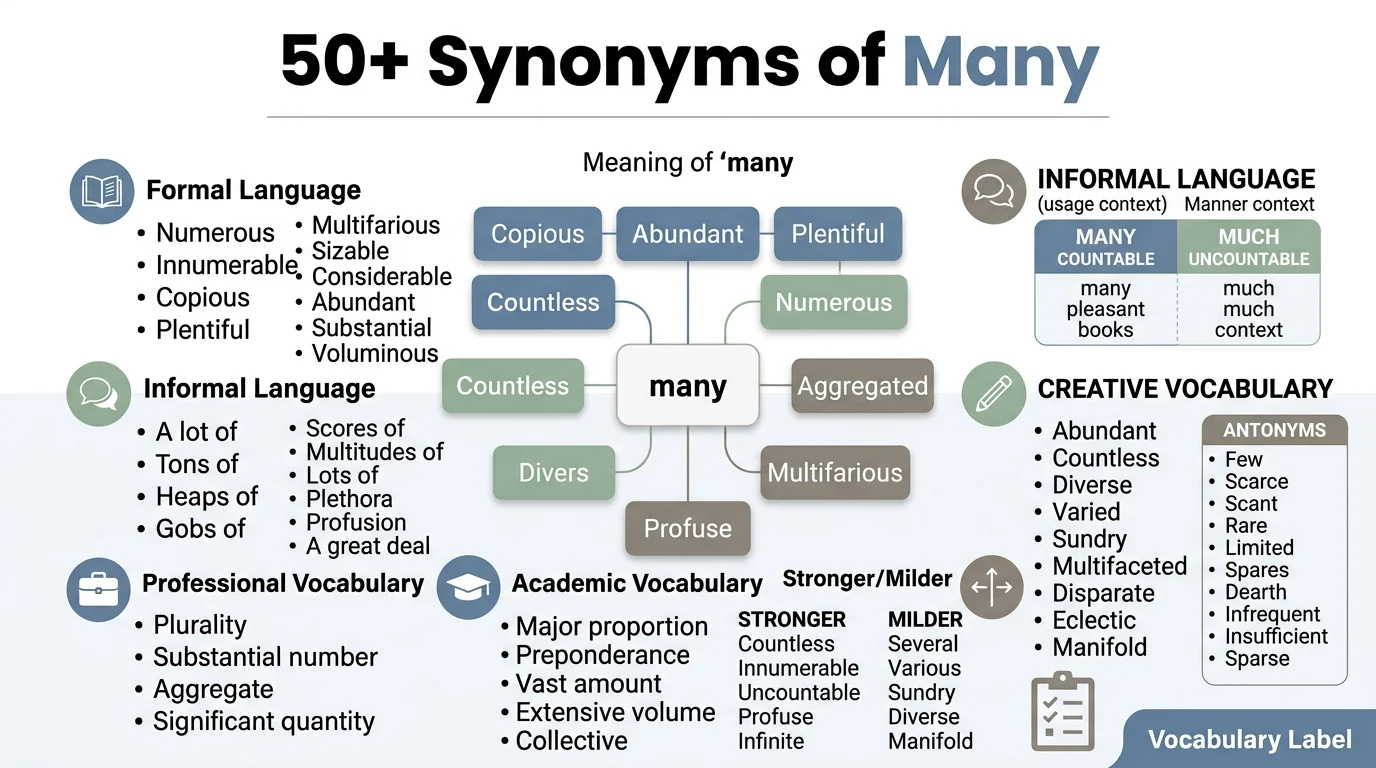
Have you ever found yourself writing an email, an essay, or a social media caption and realized you have used the word “many” three times in two sentences? It happens to everyone. You know there must be a better way to express a large quantity, but your mind goes blank. Repeating the same word can make your writing feel flat and uninspired. This is exactly why exploring the synonyms of many is so valuable for anyone who wants to communicate with clarity and impact. Choosing the right word for the right moment does more than just vary your vocabulary; it sharpens your message and shows your reader that you have command over your language.
What Are the Best Synonyms of “Many”?
“Many” means a large but indefinite number of countable things or people. It is a neutral, everyday word. For formal writing, use numerous or a multitude of. For casual conversation, try a lot of or loads of. In academic contexts, choose myriad or considerable. For professional communication, substantial and multiple work well. For emotional emphasis, countless and innumerable are excellent choices.
Meaning, Tone, and Context
Simple Definition
The word “many” is used to refer to a large number of people or things. It always describes countable nouns, meaning you can physically count the items, even if the number is too big to count easily.
Part of Speech
“Many” primarily functions as a determiner (or adjective) placed before a plural noun, as in “many books.” It can also be used as a pronoun, standing alone to represent a large group, such as “Many were called”.
Overall Tone
The tone of “many” is neutral. It does not carry a strong positive or negative emotional charge. It simply states a fact about quantity.
Formality Level
“Many” is considered slightly formal in positive statements, which is why native speakers often choose the more conversational “a lot of” in everyday speech.
Common Uses
You will hear “many” used in countless situations. It appears in questions like “How many?” and in statements describing everything from people at a party to years of experience.
Word Forms
- Adjective/Determiner: many (e.g., many people)
- Pronoun: many (e.g., Many have tried)
- Noun: the many (refers to the majority of people)
When and How to Use “Many”
Choosing “many” is a safe and correct option in most situations where you need to describe a large, countable quantity. It is a foundational word that everyone understands. Here are seven realistic examples showing how “many” is used in different contexts.
- Professional: The project required many revisions before it was finally approved.
- Academic: Many researchers have attempted to replicate these findings.
- Workplace: We have received many requests for additional training sessions.
- Personal: I have many fond memories of summer vacations at the lake.
- Email: Thank you for providing many helpful resources in your last message.
- Resume: Managed many cross-functional teams to deliver products on schedule.
- Social Media: So many beautiful moments from this weekend! #grateful
Best Synonyms of “Many”
No two synonyms are perfectly identical. Each alternative brings a slightly different shade of meaning, tone, or level of formality. Here are the best recommendations for specific contexts.
- Professional writing: Numerous is your best choice. It is more formal than “many” and sounds authoritative in reports and business documents.
- Academic writing: Myriad is excellent for emphasizing both a large number and a great variety of things.
- Business communication: Substantial works well to highlight the significance of a large quantity.
- Casual conversation: A lot of is the most natural and common choice for everyday speech.
- Emotional writing: Countless adds a touch of drama, suggesting the number is too large to even try counting.
- Creative writing: Manifold is a beautiful, literary word that implies variety and complexity.
- Resume writing: Extensive suggests broad experience or a large scope of work.
- Workplace communication: Multiple is a practical and clear choice for referring to several items or instances.
- Stronger meaning: Innumerable is very strong and suggests a number beyond counting.
- Softer meaning: Several is milder and indicates more than two but not a vast amount.
When Not to Use “Many”
Understanding when not to use a word is just as important as knowing when to use it.
When it sounds too vague: If you can provide a specific number, do that instead.
- Weak: We have many customers.
- Stronger: We have over 5,000 active customers.
It sounds too informal: In very formal academic papers, “many” can feel a bit weak.
- Weak: Many studies support this theory.
- Better: Numerous studies support this theory.
It sounds too formal in conversation: In casual chat, “many” can sound stiff.
- Stiff: I have many things to do today.
- Natural: I have a lot of things to do today.
When it is too weak for the situation: If you want to emphasize an overwhelming amount, “many” is not strong enough.
- Weak: There are many stars in the sky.
- Stronger: There are countless stars in the sky.
It is used with uncountable nouns: This is a common grammatical error. “Many” can only be used with countable nouns.
- Incorrect: I have many information to share.
- Correct: I have a lot of information to share.
Words Commonly Confused With “Many”
Much
- Difference: “Many” is for countable nouns (e.g., many cars), while “much” is for uncountable nouns (e.g., much water).
- When to Use It: Use “many” when you can count the items. Use “much” for abstract concepts or substances you cannot count.
- Example: How many apples do you have? vs. How much juice is left?
Several
- Difference: “Several” means more than two but not a very large number. “Many” implies a significantly larger quantity.
- When to Use It: Use “several” for a small, indefinite number (like three to five). Use “many” for a large number.
- Example: I have several ideas for the project. vs. I have many ideas for the project.
Numerous
- Difference: “Numerous” is a more formal synonym for “many”.
- Which Is More Formal? “Numerous” is significantly more formal.
- When to Use Each: Use “numerous” in professional reports, academic papers, and formal speeches. Use “many” in everyday writing and conversation.
- Example: Numerous factors contributed to the success.
Many vs A Lot Of
- Difference: “A lot of” is more informal and conversational than “many”.
- Which Is More Formal? “Many” is more formal.
- When to Use Each: Use “a lot of” in emails to friends, social media posts, and casual conversation. Use “many” in professional and academic contexts.
- Example: There are a lot of people here. vs. There are many people in attendance.
Many vs Myriad
- Difference: “Myriad” implies a vast, almost countless number, often with a sense of variety.
- Which Is Stronger? “Myriad” is much stronger and more evocative.
- When to Use Each: Use “myriad” when you want to emphasize both the large number and the diversity of the items.
- Example: The city offers a myriad of cultural experiences.
Best Synonyms of “Many” by Context
| Context | Best Synonym | Why It Works | Example |
|---|---|---|---|
| Formal writing | Numerous | Sounds authoritative and precise. | The report cited numerous sources. |
| Academic writing | Myriad | Implies vast quantity and variety. | The study faced a myriad of challenges. |
| Professional communication | Substantial | Highlights the significance of the quantity. | We made a substantial investment. |
| Business emails | Multiple | Clear and practical for everyday use. | Please address the multiple issues raised. |
| Resume writing | Extensive | Suggests broad and deep experience. | Possess extensive knowledge of the field. |
| Workplace communication | A number of | A safe and formal alternative. | We have a number of options to consider. |
| Casual conversation | A lot of | The most natural and common choice. | I have a lot of work to do. |
| Everyday speaking | Lots of | Very informal and friendly. | We have lots of food. |
| Creative writing | Manifold | Literary and implies complexity. | The story had manifold layers of meaning. |
| Storytelling | Countless | Adds drama and wonder. | Countless stars filled the night sky. |
| Emotional writing | Innumerable | Suggests a number beyond counting. | I have innumerable reasons to be grateful. |
| Strong emphasis | A multitude of | Very formal and emphatic. | A multitude of fans cheered. |
| Mild tone | Several | Indicates a moderate amount. | I have several questions. |
| Social media captions | So many | Casual and expressive. | So many good vibes today! |
How to Choose the Best Synonym of “Many”
Choosing the perfect word is like picking the right tool for a job. Here is a simple decision guide.
- Consider Your Audience: Are you writing for a professor, a boss, or a friend? For formal audiences, choose words like numerous or myriad. For friends, a lot of or loads of are perfect.
- Think About Your Purpose: Are you trying to inform, persuade, or entertain? If you are writing a persuasive essay, a strong word like countless can add emotional weight. If you are writing a report, clarity and precision are key, making numerous a good choice.
- Evaluate the Emotional Strength: Do you want to be neutral or dramatic? Words like numerous and several are neutral. Words like innumerable and countless are dramatic and emotional.
- Match the Level of Formality: Your word choice sets the tone. Using a lot of in a business proposal can sound unprofessional. Using numerous in a text to a friend can sound stiff and strange.
- Consider the Specific Meaning: Do you want to emphasize the number, the variety, or the significance? Myriad emphasizes variety. Substantial emphasizes significance. Numerous simply emphasizes the number.
- Read It Aloud: The best test for a word is how it sounds in a sentence. If it feels clunky or out of place, try a different synonym.
Real Life Examples of “Many”
Seeing words in action is the best way to understand them. Here are examples of “many” and its synonyms used in various real-life situations.
- School: “There are many students in the library studying for finals.”
- College: “The professor assigned numerous readings for the semester.”
- Workplace: “We have received multiple requests for the new software.”
- Business: “The company made a substantial profit this quarter.”
- Email: “Thank you for your extensive feedback on the proposal.”
- Resume: “Managed a multitude of projects from conception to launch.”
- Conversation: “I have a lot of errands to run this weekend.”
- Storytelling: “She had countless adventures during her travels.”
- Blogging: “Here are several tips for improving your productivity.”
- Social Media: “So many amazing memories from this trip!”
18 Best Synonyms of “Many”
Synonyms of “Many” by Usage
Professional vs Personal Synonyms
In the workplace, you want to sound competent and precise. Numerous, substantial, and extensive are excellent choices. In personal conversations, you can be more relaxed and use a lot of, lots of, or plenty of.
Formal vs Conversational Synonyms
- Formal (for reports, essays, presentations): numerous, myriad, considerable, a multitude of.
- Conversational (for texts, casual emails, chatting): a lot of, lots of, loads of, tons of.
Academic Synonyms
In academic writing, precision and authority are paramount. Words like myriad, numerous, considerable, and manifold sound more scholarly than “many”. They demonstrate a more sophisticated vocabulary.
Professional and Business Synonyms
For resumes, interviews, and client communication, choose words that convey impact. Extensive (for experience), substantial (for growth or investment), and multiple (for projects or responsibilities) are strong and professional choices.
Creative and Literary Synonyms
If you are a writer, you have a beautiful toolkit of alternatives. Manifold, countless, innumerable, and myriad can add poetry and depth to your prose. Galore is a fun, slightly old-fashioned word that can add a charming touch.
Slang or Modern Synonyms
While there is no direct slang synonym for “many,” phrases like heaps of, loads of, and tons of are very common in casual, modern American English. They are perfectly acceptable in informal settings but should be avoided in professional writing.
Strongest to Mildest Synonyms
Understanding the intensity of a word helps you choose the right one for the right moment.
- Mild: several, a few (these indicate a smaller quantity)
- Moderate: various, a number of, multiple
- Strong: numerous, a lot of, lots of, plenty of
- Very Strong: myriad, countless, innumerable, a multitude of, legion
Emotional vs Neutral Synonyms
- Neutral Synonyms (Just the facts): numerous, multiple, several, various. These words simply communicate a large quantity without adding feeling.
- Emotional Synonyms (Adds feeling): countless, innumerable, myriad, manifold. These words evoke a sense of wonder, amazement, or overwhelming quantity.
Antonyms of “Many”
Comparison: “Many” vs Similar Words
Numerous
- Main Difference: “Numerous” is a more formal and academic alternative for “many”.
- Which Is Stronger? “Numerous” can feel slightly stronger because of its formal weight, but the core meaning is the same.
- Which Is More Formal? “Numerous” is significantly more formal.
- When to Use Each: Use “numerous” in formal reports and academic papers. Use “many” in everyday writing.
- Examples:
- Many: There are many reasons to learn a new language.
- Numerous: There are numerous benefits to a balanced diet.
vs A Lot Of
- Main Difference: “A lot of” is the informal, conversational equivalent of “many”.
- Which Is Stronger? Neither is stronger; they differ in formality.
- Which Is More Formal? “Many” is more formal.
- When to Use Each: Use “a lot of” in casual conversation and informal writing. Use “many” in professional and academic contexts.
- Examples:
- Many: Many people attended the conference.
- A lot of: A lot of people came to the party.
Many vs Much
- Main Difference: “Many” is for countable nouns (books, people, cars). “Much” is for uncountable nouns (water, time, information).
- Which Is Stronger? Neither; they are used for different types of nouns.
- Which Is More Formal? Both are neutral, but “much” is often used in questions and negative statements.
- When to Use Each: Use “many” with things you can count. Use “much” with things you cannot.
- Examples:
- Many: How many apples do you have?
- Much: How much water do you need?
vs Several
- Main Difference: “Several” means more than two but not a large number. “Many” implies a significantly larger quantity.
- Which Is Stronger? “Many” is much stronger.
- Which Is More Formal? Both are neutral.
- When to Use Each: Use “several” for a small, indefinite number (e.g., three to five). Use “many” for a large number.
- Examples:
- Many: I have many friends.
- Several: I have several close friends.
Many vs Myriad
- Main Difference: “Myriad” suggests an extremely large and varied number, often with a sense of wonder.
- Which Is Stronger? “Myriad” is much stronger and more evocative.
- Which Is More Formal? “Myriad” is more formal and literary.
- When to Use Each: Use “myriad” when you want to emphasize both a vast number and great diversity.
- Examples:
- Many: The city has many restaurants.
- Myriad: The city offers a myriad of culinary experiences.
vs Countless
- Main Difference: “Countless” means too many to be counted, which is a stronger and more dramatic claim.
- Which Is Stronger? “Countless” is much stronger and more emotional.
- Which Is More Formal? Both can be formal, but “countless” is more dramatic.
- When to Use Each: Use “countless” to emphasize an overwhelming, uncountable number.
- Examples:
- Many: She has many memories of her childhood.
- Countless: She has countless memories of her childhood.
Common Phrases and Expressions with “Many”
Common Mistakes to Avoid
1: Using “many” with uncountable nouns.
- Incorrect: I have many luggage.
- Better: I have a lot of luggage.
- Why: “Luggage” is uncountable, so it cannot be used with “many.”
2: Using “many” when a more precise word is better.
- Incorrect: The report had many errors.
- Better: The report had numerous errors.
- Why: “Numerous” is more formal and professional for a report.
3: Using “many” in casual conversation when “a lot of” sounds more natural.
- Stiff: I have many things to do.
- Natural: I have a lot of things to do.
- Why: “A lot of” is the standard choice for everyday spoken English.
4: Overusing “many” in a single piece of writing.
- Weak: We have many customers. Many of them are from the US. Many are from Europe.
- Better: We have a large customer base. Many of them are from the US, and numerous others are from Europe.
- Why: Varying your vocabulary makes your writing more engaging.
5: Using an informal synonym in a formal document.
- Incorrect: We have lots of experience in this field. (In a cover letter)
- Better: We have extensive experience in this field.
- Why: “Lots of” is too casual for a professional document.
Frequently Asked Questions
1. What are the best synonyms of “many”?
The best synonyms depend on the context. Formal writing, use numerous or myriad. For casual conversation, use a lot of or lots of. For strong emphasis, use countless or innumerable.
2. What are the best formal synonyms of “many”?
The best formal synonyms are numerous, myriad, a multitude of, considerable, and manifold. These words are appropriate for academic papers, professional reports, and formal speeches.
3. What are common informal synonyms of “many”?
Common informal synonyms are a lot of, lots of, loads of, tons of, and plenty of. These are perfect for everyday conversations, text messages, and social media posts.
4. What is another word for “many” in professional writing?
In professional writing, strong alternatives include numerous, substantial, extensive, and multiple. These words convey professionalism and precision.
5. What is the difference between “many” and “much”?
The main difference is that “many” is used with countable nouns (e.g., many books), while “much” is used with uncountable nouns (e.g., much water). This is a fundamental rule of English grammar.
6. What is the opposite of “many”?
The most direct opposite of “many” is few. Other antonyms include several, some, scarce, and sparse, depending on the context.
Conclusion
The word “many” is a workhorse of the English language, a simple and effective way to describe a large quantity. However, by exploring the rich tapestry of synonyms of many, you can elevate your writing and speaking to new levels. Choosing the right synonym allows you to match your tone to your audience, add emotional depth, and communicate with greater precision. Remember that the best word is the one that fits the context perfectly. As you continue to build your vocabulary, think of each new word as a tool that helps you paint a more vivid and accurate picture for your reader. For your next writing project, challenge yourself to replace at least one instance of “many” with a more precise alternative. Your readers will notice the difference.