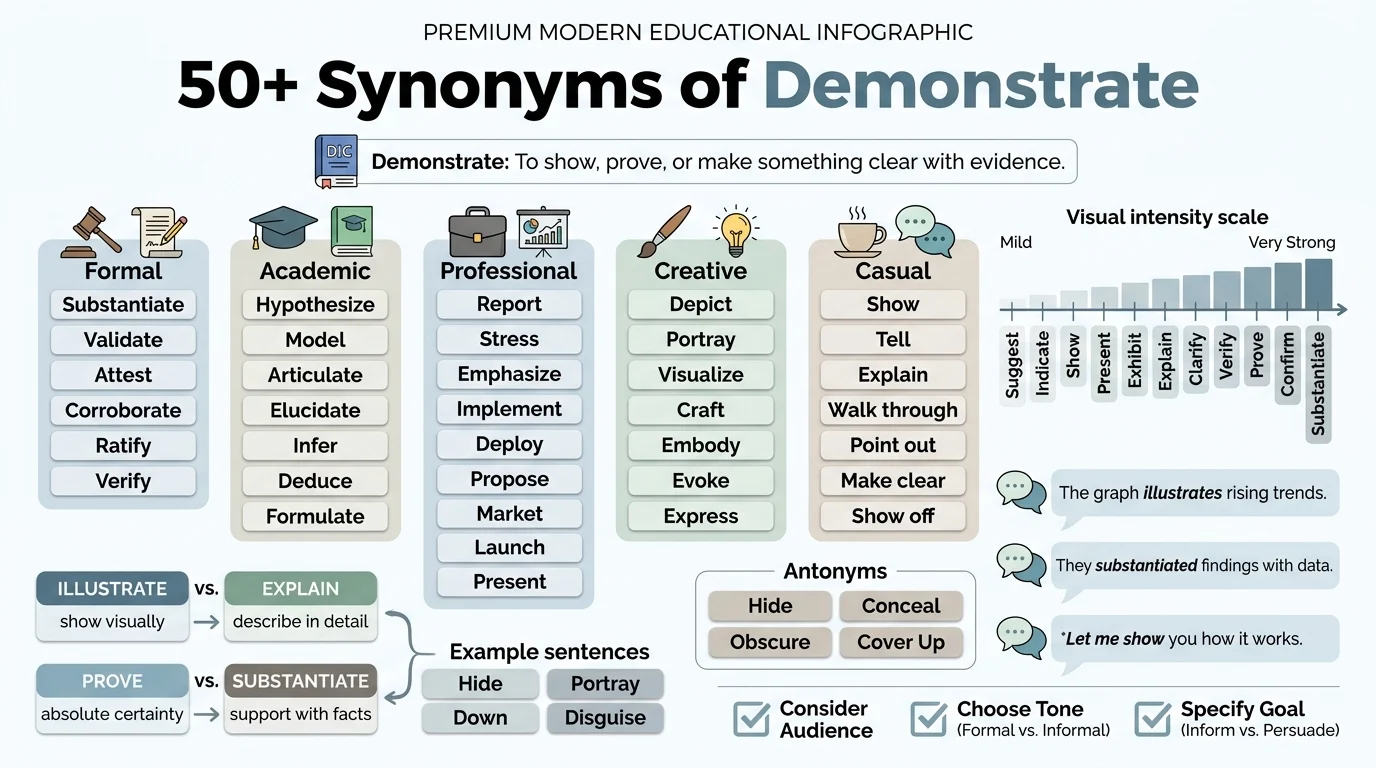
The good news is that English offers dozens of powerful synonyms of demonstrate that can transform your communication. Each alternative carries its own tone, emotional weight, and level of formality. Choosing the right synonym helps you express your ideas with greater precision and impact.
This comprehensive guide will help you understand what demonstrate really means, explore the best synonyms for every context, and avoid common mistakes. By the end, you will confidently select the perfect word for any situation.
What Are the Best Synonyms of “Demonstrate”?
The word demonstrate means to show clearly, prove, or explain through evidence, action, or example. It carries a neutral to positive tone and works across many contexts.
For formal writing, the best synonyms of demonstrate include “prove,” “establish,” and “substantiate.” For casual conversation, try “show,” “point out,” or “make clear.” In academic writing, “illustrate,” “indicate,” and “exemplify” work well. For professional communication, “present,” “highlight,” and “display” are excellent choices.
Meaning, Tone, and Context
Simple Definition
To demonstrate means to clearly show, explain, or prove something using evidence, actions, examples, or logical reasoning. It involves making an idea, process, or truth visible and understandable to others.
Part of Speech
Verb (transitive and intransitive)
Overall Tone
Neutral to positive. The word itself does not carry strong emotional weight. It simply indicates the act of showing or proving something.
Formality Level
Semi-formal to formal. Demonstrate is appropriate in academic, professional, and business contexts.
Common Uses
Native English speakers use demonstrate in these typical situations:
- Explaining how something works
- Providing proof or evidence
- Showing a skill or ability
- Teaching or instructing others
- Making an argument or case
- Highlighting results or findings
Word Forms
- Verb: demonstrate (I will demonstrate the process.)
- Noun: demonstration (The demonstration was very helpful.)
- Adjective: demonstrable (This is a demonstrable fact.)
- Adverb: demonstrably (The results are demonstrably better.)
When and How to Use “Demonstrate”
Choose demonstrate when you want to communicate clarity, evidence, and intentional showing. It works best when you have something specific to show or prove.
Here are seven realistic examples of demonstrate in action:
- Professional: “The data demonstrates a clear increase in customer satisfaction over the past quarter.”
- Academic: “This study demonstrates the relationship between sleep quality and academic performance.”
- Workplace: “Please demonstrate how to operate the new software during the team meeting.”
- Personal: “She demonstrated incredible patience while teaching her children to read.”
- Email: “I would like to demonstrate the value our service can bring to your organization.”
- Resume: “Demonstrated ability to lead cross-functional teams and deliver projects on time.”
- Social Media: “Today’s post will demonstrate how to create the perfect sourdough starter at home.”
Best Synonyms of “Demonstrate”
No synonym works perfectly in every situation. The best alternative depends on your audience, purpose, and desired tone. Here are the best synonyms of demonstrate for specific contexts.
Professional Writing
Present is the strongest professional synonym. It conveys a polished, prepared delivery of information. Use it when sharing findings, proposals, or recommendations in business settings. “Present” sounds confident and organized.
Academic Writing
Illustrate works exceptionally well in academic contexts. It suggests providing clarifying examples or visual explanations. Use it when you want to make abstract concepts concrete through specific cases or data.
Business Communication
Highlight is ideal for drawing attention to important information. It emphasizes key points without overwhelming the reader. Use it in reports, presentations, and internal communications.
Casual Conversation
Show remains the most natural and widely used synonym for everyday speech. It is direct, simple, and universally understood. Use it in personal conversations, texts, and informal writing.
Emotional Writing
Reveal carries emotional weight and suggests uncovering something significant. Use it when discussing personal discoveries, hidden truths, or meaningful insights.
Creative Writing
Manifest adds a poetic, almost mystical quality to your writing. It suggests something becoming visible or real. Use it in fiction, poetry, and descriptive prose.
Resume Writing
Exhibit works well on resumes because it suggests displaying qualities or achievements. It sounds professional without being overly formal.
Workplace Communication
Showcase is excellent for highlighting accomplishments or features. It suggests presenting something in its best light.
Stronger Meaning
Prove provides the strongest sense of certainty and evidence. Use it when you have definitive, irrefutable support for your claim.
Softer Meaning
Suggest offers a gentler alternative. Use it when you want to indicate something without claiming absolute certainty.
When Not to Use “Demonstrate”
When the Word Sounds Too General
Using demonstrate for every act of showing makes your writing sound repetitive and lazy. Instead of relying on this single word, choose more precise alternatives.
Example:
- Weak: “The report demonstrates our progress.”
- Better: “The report details our progress.” (More specific)
When the Word Sounds Too Formal
Demonstrate can sound overly academic or stiff in everyday situations. For casual conversations, texts, or informal emails, choose a simpler word.
Example:
- Awkward: “Can you demonstrate how to use this app?”
- Natural: “Can you show me how to use this app?”
When the Word Sounds Too Weak
Sometimes you need stronger language to convey certainty or significance. Demonstrate may not carry enough weight for your message.
Example:
- Weak: “The evidence demonstrates his guilt.”
- Stronger: “The evidence proves his guilt.”
When the Word Sounds Too Strong
In other situations, demonstrate may sound too definitive. Use milder alternatives when you are speculating or suggesting rather than proving.
Example:
- Too Strong: “The data demonstrates a problem.”
- Gentler: “The data suggests a possible problem.”
When the Word Sounds Outdated
Demonstrate remains current, but some alternatives feel fresher in modern writing. For social media or contemporary content, consider more engaging options like “break down” or “walk through.”
Words Commonly Confused With “Demonstrate”
Demonstrate vs. Show
Difference: Demonstrate implies a more intentional, systematic act of showing with evidence or explanation. Show is more general and can be passive or accidental.
When to Use It: Use demonstrate when you are deliberately proving or explaining something with care. Use show for everyday situations.
Example: “The teacher demonstrated the experiment step by step.”
Demonstrate vs. Prove
Difference: Prove requires establishing something as true beyond doubt. Demonstrate can simply mean showing how something works without definitively establishing truth.
When to Use It: Use prove when you have conclusive evidence. Use demonstrate when you are showing or explaining without necessarily ending debate.
Example: “This experiment proves the hypothesis is correct.”
Demonstrate vs. Illustrate
Difference: Illustrate specifically involves providing examples or visual representations. Demonstrate covers a broader range of showing, including actions and logical arguments.
When to Use It: Use illustrate when you are clarifying with specific cases or visual aids. Use demonstrate for broader acts of showing or proving.
Example: “The graph illustrates the relationship between the two variables.”
Demonstrate vs. Indicate
Difference: Indicate suggests a sign or clue pointing toward something. Demonstrate provides stronger, more direct evidence or showing.
When to Use It: Use indicate when you are pointing to evidence that suggests something. Use demonstrate when you have clear proof.
Example: “The survey indicates a preference for online shopping.”
Demonstrate vs. Evidence
Difference: Evidence is a noun, not a verb. The verb form is “evince,” which means to show or reveal clearly. Evince sounds more formal and literary.
When to Use It: Use evince in formal or literary writing when you want to suggest revealing through signs or behavior. Use demonstrate for most other situations.
Example: “Her work evinces a deep understanding of the subject.”
Demonstrate vs. Display
Difference: Display emphasizes showing something prominently or visibly. Demonstrate emphasizes the act of explaining or proving.
When to Use It: Use display when you want to emphasize visual prominence. Use demonstrate when you focus on explanation or proof.
Example: “The museum displays artifacts from ancient Egypt.”
Best Synonyms of “Demonstrate” by Context
| Context | Best Synonym | Why It Works | Example |
|---|---|---|---|
| Formal Writing | Prove | Conveys certainty and definitive evidence | “The study proves the effectiveness of the treatment.” |
| Academic Writing | Illustrate | Provides clarifying examples for complex concepts | “The researcher illustrates the theory using case studies.” |
| Professional Communication | Present | Suggests polished, organized delivery of information | “I will present the quarterly findings at the meeting.” |
| Business Emails | Highlight | Draws attention to important points clearly | “I want to highlight the key benefits of our proposal.” |
| Resume Writing | Exhibit | Shows professional qualities and achievements | “Exhibited strong leadership skills in managing the team.” |
| Workplace Communication | Showcase | Presents accomplishments in the best possible light | “The presentation showcases our team’s innovative solutions.” |
| Casual Conversation | Show | Simple, natural, and universally understood | “Let me show you how to fix this problem.” |
| Everyday Speaking | Point Out | Direct and conversational for daily use | “I want to point out one important detail.” |
| Creative Writing | Manifest | Adds poetic quality and suggests becoming visible | “Her vision manifested in the beautiful design.” |
| Storytelling | Evince | Literary word suggesting subtle revelation | “His actions evinced a quiet courage.” |
| Emotional Writing | Reveal | Carries emotional weight and suggests uncovering truth | “The conversation revealed her deepest fears.” |
| Strong Emphasis | Establish | Creates a sense of permanence and certainty | “The research establishes a clear connection.” |
| Mild Tone | Suggest | Gentle alternative for speculation or probability | “The evidence suggests a different conclusion.” |
| Social Media Captions | Break Down | Modern, engaging, and easy to understand | “Let me break down this recipe step by step.” |
| American English | Show | The most natural and commonly used synonym | “Let me show you what I mean.” |
How to Choose the Best Synonym of “Demonstrate”
Choosing the right synonym of demonstrate depends on several key factors. Consider these questions before making your choice.
Consider your audience. Are you writing for colleagues, professors, friends, or the general public? Formal audiences appreciate words like “prove” and “establish.” Casual audiences prefer “show” and “point out.”
Think about your purpose. Are you trying to prove something definitively, suggest a possibility, or simply explain a process? Your purpose determines the strength and specificity you need.
Evaluate emotional strength. Some synonyms carry significant emotional weight, while others remain neutral. Choose “reveal” for emotional moments and “show” for neutral explanations.
Assess formality requirements. Academic papers and professional reports demand formal vocabulary. Emails and social media allow more conversational language.
Consider clarity. The best synonym is the one your audience understands immediately. Never choose a complex word when a simple one communicates better.
Read your sentence aloud. Does the synonym sound natural in context? If it feels awkward or forced, try a different word.
Avoid repetition. Even the best synonym loses power when overused. Vary your word choice throughout your writing.
Real Life Examples of “Demonstrate”
School
“The science fair project demonstrated the principles of renewable energy using a small wind turbine.”
College
“The professor demonstrated the mathematical formula step by step until every student understood.”
Workplace
“During the training session, the manager demonstrated the correct way to handle customer complaints.”
Business
“Our quarterly report demonstrates consistent growth across all major markets.”
“I would appreciate the opportunity to demonstrate how our platform can streamline your workflow.”
Resume
“Successfully demonstrated the ability to manage multiple projects simultaneously while maintaining quality standards.”
Conversation
“Let me demonstrate what I mean by showing you this before and after photo.”
Storytelling
“The old photograph demonstrated how much the neighborhood had changed over fifty years.”
Blogging
“This post will demonstrate five simple ways to improve your morning routine.”
Social Media
“Week one of our fitness challenge demonstrates that small changes lead to big results.”
18 Best Synonyms of “Demonstrate”
| Synonym | Simple Meaning | Best Used For | Example Sentence |
|---|---|---|---|
| Show | To make something visible or clear | Everyday conversation, casual writing | “Let me show you how this works.” |
| Prove | To establish truth beyond doubt | Academic, legal, or scientific contexts | “The data proves our hypothesis is correct.” |
| Illustrate | To clarify with examples or visuals | Academic writing, teaching | “The diagram illustrates the process clearly.” |
| Present | To offer information formally | Professional, business, or academic settings | “I will present the findings at the conference.” |
| Highlight | To emphasize important points | Business communication, reports | “This report highlights the key challenges we face.” |
| Display | To show prominently or visibly | Visual presentations, exhibitions | “The museum displays artifacts from ancient Rome.” |
| Exhibit | To show outwardly or publicly | Resume writing, formal descriptions | “She exhibited exceptional problem-solving skills.” |
| Reveal | To uncover or make known | Emotional writing, storytelling | “The interview revealed her true motivations.” |
| Manifest | To become apparent or visible | Creative writing, literary contexts | “His confidence manifested in every speech.” |
| Indicate | To point to or suggest | Technical, scientific, or analytical writing | “The survey indicates a shift in consumer behavior.” |
| Evince | To show clearly or reveal | Formal, literary, or academic writing | “Her research evinces a deep understanding of the subject.” |
| Establish | To set firmly or prove conclusively | Scientific, legal, or formal contexts | “The study establishes a link between diet and health.” |
| Showcase | To display in a favorable way | Marketing, presentations, professional contexts | “The portfolio showcases her best work.” |
| Substantiate | To provide evidence or support | Legal, academic, or formal writing | “You must substantiate your claims with evidence.” |
| Validate | To confirm or prove worth | Scientific, business, or professional contexts | “The results validate our original hypothesis.” |
| Clarify | To make something clear or understandable | Teaching, writing, explanation | “Let me clarify what I mean by that statement.” |
| Announce | To make known publicly | Formal communication, announcements | “The company announced its new sustainability goals.” |
| Point Out | To draw attention to something | Everyday conversation, teaching | “I want to point out one important detail.” |
Synonyms of “Demonstrate” by Usage
Professional vs Personal Synonyms
Professional contexts demand words that sound polished and authoritative. “Present,” “highlight,” and “showcase” work well in business settings. Personal conversations allow simpler, more natural words like “show,” “point out,” and “let me show you.” Choose your synonym based on whether you are addressing colleagues or friends.
Formal vs Conversational Synonyms
Formal writing benefits from words like “substantiate,” “establish,” and “evince.” These words appear frequently in academic papers, legal documents, and professional reports. Conversational writing prefers “show,” “point out,” and “make clear.” These sound natural in emails, texts, and everyday speech.
Academic Synonyms
Academic contexts require precise vocabulary that demonstrates intellectual rigor. “Illustrate,” “indicate,” “establish,” and “substantiate” are excellent academic synonyms of demonstrate. They sound authoritative and convey a serious commitment to evidence and clarity. Use these words in research papers, essays, and scholarly discussions.
Professional and Business Synonyms
The business world values clear, confident communication. “Present,” “showcase,” “highlight,” and “exhibit” are strong professional choices. They suggest competence, organization, and the ability to communicate value effectively. Use these synonyms in resumes, interviews, meetings, and client communications.
Creative and Literary Synonyms
Creative writers need words that evoke imagery and emotion. “Manifest,” “reveal,” “evince,” and “unveil” add depth to descriptive writing. These words suggest discovery, transformation, and deeper meaning. Use them in fiction, poetry, speeches, and creative nonfiction.
Slang or Modern Synonyms
English does not have widely accepted slang alternatives for demonstrate. Modern speakers sometimes use “break down,” “walk through,” or “run through” to explain processes. These phrases are acceptable in casual contexts but should be avoided in formal writing. For most situations, standard synonyms work better than slang.
Strongest to Mildest Synonyms
The intensity of demonstrate-related words varies significantly.
Mild: suggest, indicate, point out
Moderate: show, illustrate, present
Strong: prove, establish, substantiate
Very Strong: confirm, validate, demonstrate conclusively
Choose your synonym based on how much certainty and emphasis you need to convey.
Emotional vs Neutral Synonyms
Emotional Synonyms: reveal, unveil, manifest, evince. These words carry weight and suggest discovery, significance, or revelation. Use them when you want to create an emotional impact or draw attention to meaningful truths.
Neutral Synonyms: show, illustrate, present, indicate. These words simply communicate information without adding emotional coloring. Use them when you want to stay objective and factual.
Antonyms of “Demonstrate”
| Antonym | Meaning | Example Sentence |
|---|---|---|
| Conceal | To keep hidden or secret | “She tried to conceal her disappointment.” |
| Hide | To put out of sight | “The clouds hid the stars completely.” |
| Mask | To cover or disguise | “His smile masked his true feelings.” |
| Obscure | To make unclear or hidden | “The details were obscured by poor lighting.” |
| Withhold | To refrain from giving or showing | “He withheld important information from the team.” |
| Suppress | To stop something from being known | “The government attempted to suppress the report.” |
| Deny | To refuse to acknowledge | “The politician denied all accusations.” |
| Disprove | To show something is false | “New evidence disproved the original theory.” |
| Refute | To prove something wrong | “The scientist refuted the competing hypothesis.” |
| Contradict | To assert the opposite | “The witness contradicted the defendant’s story.” |
| Discredit | To cast doubt on or damage reputation | “The scandal discredited the entire organization.” |
| Disguise | To alter appearance to hide identity | “The spy disguised himself to avoid detection.” |
| Mislead | To lead in the wrong direction | “The advertisement mislead consumers about the product.” |
| Confuse | To make unclear or bewildering | “The complicated instructions confused everyone.” |
| Negate | To nullify or make ineffective | “These new facts negate our previous conclusions.” |
Comparison: “Demonstrate” vs Similar Words
Demonstrate vs Show
Main Difference: Demonstrate implies intentional, systematic showing with explanation or evidence. Show is broader and includes accidental or passive acts of making something visible.
Which Is Stronger? Demonstrate carries more weight and suggests greater effort and purpose.
Which Is More Formal? Demonstrate is more formal and academic than show.
When to Use Each: Use demonstrate when you are teaching, proving, or explaining with care. Use show for everyday situations and casual communication.
Examples:
- Demonstrate: “The instructor demonstrated the proper technique for the exercise.”
- Show: “Let me show you where I keep the extra supplies.”
Demonstrate vs Prove
Main Difference: Prove requires establishing something as undeniably true. Demonstrate can simply mean showing how something works without definitively settling the matter.
Which Is Stronger? Prove is significantly stronger and more definitive.
Which Is More Formal? Both are formal, but prove is more common in legal and scientific contexts.
When to Use Each: Use prove when you have irrefutable evidence. Use demonstrate when you are showing or explaining without necessarily claiming absolute truth.
Examples:
- Demonstrate: “This experiment demonstrates the principles of physics.”
- Prove: “This experiment proves that the theory is correct.”
Demonstrate vs Illustrate
Main Difference: Illustrate specifically involves clarifying through examples or visual representation. Demonstrate includes a broader range of showing activities.
Which Is Stronger? Demonstrate is stronger because it encompasses more ways of showing.
Which Is More Formal? Both are formal, but illustrate appears more frequently in academic writing.
When to Use Each: Use illustrate when providing specific cases or visual aids. Use demonstrate for general acts of showing or proving.
Examples:
- Demonstrate: “The coach demonstrated the proper stance for batting.”
- Illustrate: “These case studies illustrate the impact of the policy.”
Demonstrate vs Indicate
Main Difference: Indicate suggests pointing toward a possibility or clue. Demonstrate provides stronger, more direct evidence.
Which Is Stronger? Demonstrate is stronger and more conclusive.
Which Is More Formal? Indicate is very common in scientific and technical writing.
When to Use Each: Use indicate when you have suggestive evidence. Use demonstrate when you have clear proof.
Examples:
- Demonstrate: “The test results demonstrate that the drug is effective.”
- Indicate: “The test results indicate that the drug may be effective.”
Demonstrate vs Display
Main Difference: Display emphasizes visual prominence and showing. Demonstrate emphasizes explanation and proof.
Which Is Stronger? Demonstrate is stronger in terms of proving or explaining.
Which Is More Formal? Both are neutral to formal.
When to Use Each: Use display when you want to emphasize visual presentation. Use demonstrate when you focus on explanation or proof.
Examples:
- Demonstrate: “The chef demonstrated how to properly fillet a fish.”
- Display: “The chef displayed the finished dish on a beautiful platter.”
Demonstrate vs Evince
Main Difference: Evince is more formal and literary. It suggests revealing something through subtle signs or behavior.
Which Is Stronger? Evince is more sophisticated but not necessarily stronger.
Which Is More Formal? Evince is highly formal and somewhat archaic.
When to Use Each: Use evince in formal literary or academic writing. Use demonstrate for most everyday situations.
Examples:
- Demonstrate: “The child demonstrated his knowledge during the test.”
- Evince: “His calm demeanor evinced a deep inner confidence.”
Common Phrases and Expressions with “Demonstrate”
Demonstrate a Point
Meaning: To show or prove that a statement or argument is correct.
Example Sentence: “The lawyer used evidence to demonstrate his point to the jury.”
Demonstrate Skill
Meaning: To show that you have a particular ability or competence.
Example Sentence: “The interview gave her a chance to demonstrate her leadership skills.”
Demonstrate Understanding
Meaning: To show that you comprehend something clearly.
Example Sentence: “Students must demonstrate understanding of the material through written essays.”
Demonstrate Commitment
Meaning: To show dedication or loyalty through actions.
Example Sentence: “He demonstrated his commitment to the project by working through the weekend.”
Demonstrate Value
Meaning: To show that something is useful or important.
Example Sentence: “We need to demonstrate the value of our service to potential clients.”
Demonstrate Effectiveness
Meaning: To show that something works well.
Example Sentence: “The study demonstrates the effectiveness of the new teaching method.”
Demonstrate Ability
Meaning: To show that you can do something.
Example Sentence: “The candidate demonstrated strong problem-solving abilities during the interview.”
Common Mistakes to Avoid
1: Choosing a Vague Synonym
Choosing a vague synonym weakens your message. “Show” may not carry enough weight when you need to prove something definitively.
Incorrect: “The data shows the treatment works.”
Better: “The data proves the treatment works.”
Why: The improved version conveys certainty and confidence.
2: Confusing “Demonstrate” with “Display”
These words are not interchangeable. Display emphasizes visual prominence. Demonstrate emphasizes explanation and proof.
Incorrect: “The report displays the importance of customer service.”
Better: “The report demonstrates the importance of customer service.”
Why: Reports explain and prove, not just visually show.
3: Using an Informal Synonym in Formal Writing
Some synonyms work well in conversation but sound unprofessional in formal documents.
Incorrect: “This study shows how the economy works.”
Better: “This study demonstrates how the economy functions.”
Why: “Demonstrates” sounds more authoritative and academic.
4: Selecting an Overly Dramatic Synonym
Not every situation calls for strong language. Using “reveal” when “show” would suffice can sound excessive.
Incorrect: “The memo reveals the new office hours.”
Better: “The memo announces the new office hours.”
Why: The correction matches the formality and importance of the announcement.
5: Repeating the Same Word Too Often
Overusing demonstrate or any synonym makes your writing repetitive and boring.
Incorrect: “The report demonstrates growth. The data demonstrates progress. The findings demonstrate success.”
Better: “The report demonstrates growth. The data indicates progress. The findings confirm success.”
Why: Varying synonyms keeps writing fresh and engaging.
6: Choosing a Synonym with the Wrong Emotional Tone
Using emotional synonyms in neutral contexts can confuse your audience.
Incorrect: “The meeting minutes reveal the team’s decision.”
Better: “The meeting minutes document the team’s decision.”
Why: Reveal suggests secrecy or discovery, which minutes do not imply.
7: Using Slang in Professional Writing
Modern or casual phrases have no place in formal documents.
Incorrect: “Let’s break down the quarterly results.”
Better: “Let’s analyze the quarterly results.”
Why: The correction is more professional and appropriate for business communication.
Frequently Asked Questions
1. What are the best synonyms of demonstrate?
The best synonyms of demonstrate depend on your context. “Show” works well for casual situations. “Prove” is ideal for establishing certainty. “Illustrate” and “indicate” are excellent for academic writing. “Present” and “highlight” are strong professional choices.
2. What are the best formal synonyms of demonstrate?
The best formal synonyms of demonstrate include “prove,” “establish,” “substantiate,” and “evince.” These words appear frequently in academic papers, legal documents, and professional reports. They convey authority, precision, and careful attention to evidence.
3. What are common informal synonyms of demonstrate?
Common informal synonyms of demonstrate include “show,” “point out,” “make clear,” and “let someone see.” These are widely used in everyday conversation, texts, and casual emails. They sound natural and are easily understood by any audience.
4. What is another word for demonstrate in professional writing?
In professional writing, strong alternatives include “present,” “highlight,” “showcase,” and “exhibit.” These words suggest competence, organization, and the ability to communicate value. They work well in resumes, business emails, presentations, and client communications.
5. What is the difference between demonstrate and show?
The main difference between demonstrate and show lies in intentionality and purpose. Demonstrate implies a deliberate, systematic act of showing with explanation or evidence. Show is more general and can be passive or accidental. Demonstrate also carries a more formal tone.
6. What is the opposite of demonstrate?
The opposite of demonstrate includes words like “conceal,” “hide,” “mask,” “obscure,” and “withhold.” These antonyms suggest keeping something from being seen, known, or understood. The best choice depends on whether you are hiding physical objects, emotions, or information.
Conclusion
The word demonstrate means to show clearly, prove, or explain through evidence, action, or example.The best synonyms of demonstrate depend on your audience, context, and desired tone.
For formal and professional writing, choose words like “prove,” “establish,” “present,” and “highlight.” For casual conversation, stick with “show” and “point out.” Academic contexts benefit from “illustrate,” “indicate,” and “substantiate.” Creative writing comes alive with “reveal,” “manifest,” and “evince.”
No single synonym works perfectly in every situation. The best word is the one that communicates your meaning most clearly to your specific audience. Experiment with different synonyms, read your writing aloud, and always prioritize clarity over complexity.Remember this vocabulary tip: Before using any synonym, ask yourself what you are trying to accomplish. Are you proving, suggesting, explaining, or displaying? The answer will point you toward the right word every time.
For additional vocabulary guidance, Merriam-Webster and Cambridge Dictionary remain excellent resources for checking definitions and usage examples.