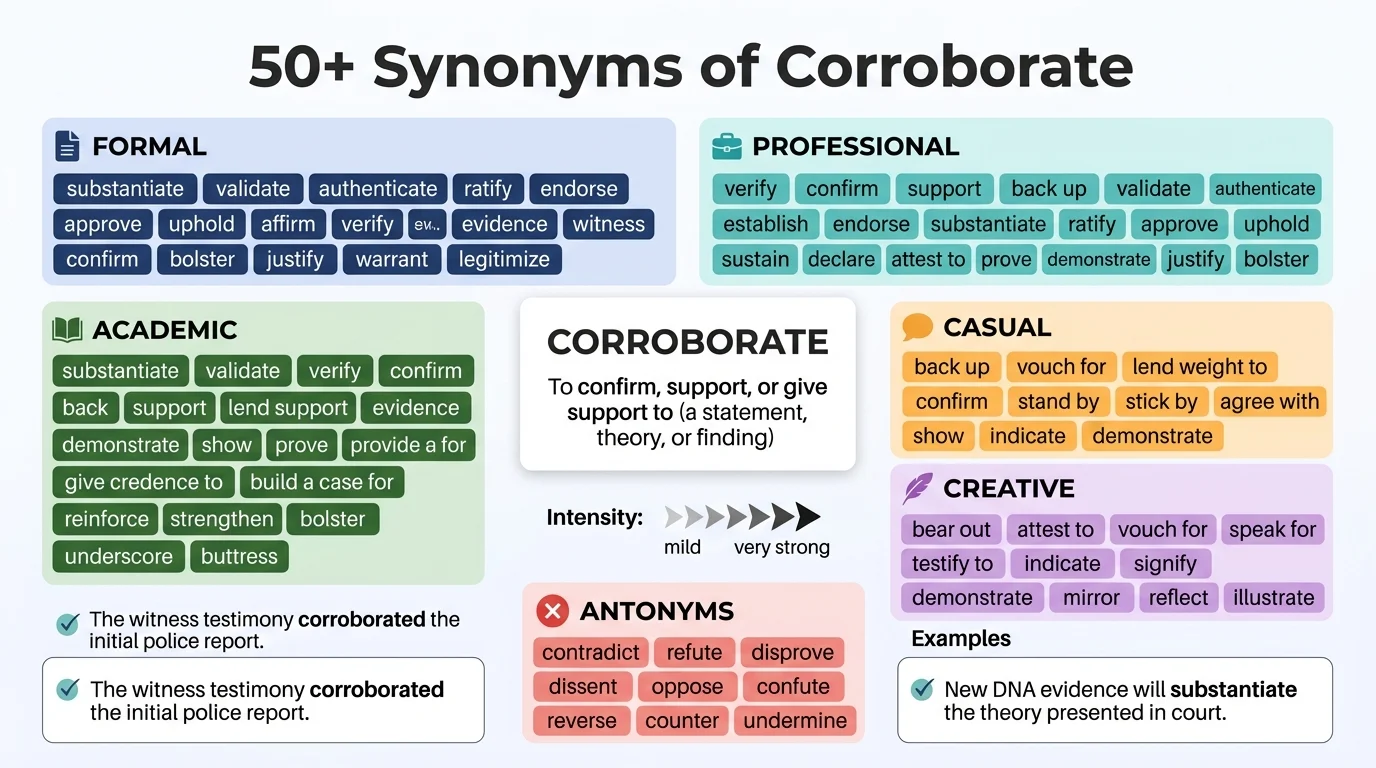
Have you ever found yourself writing an important email, essay, or report and realized you have used the word “confirm” five times in two paragraphs? You know there has to be a better way to say it, but the right word does not come to mind. This happens to everyone from students to professionals. Finding the precise synonym of corroborate can elevate your writing from repetitive to refined. The word “corroborate” carries a specific weight that many common alternatives lack. Understanding its exact meaning and knowing which synonym fits each situation will make your communication clearer and more impressive.
What Are the Best Synonyms of “Corroborate”?
Corroborate means to support a statement, theory, or finding with evidence or additional information. For formal writing, choose “substantiate” or “verify.” For casual conversation, use “back up” or “support.” In academic contexts, “validate” and “authenticate” work best.
Meaning, Tone, and Context
Simple Definition
Corroborate is a verb that means to confirm or give support to a statement, theory, or finding by providing evidence or new information.
Part of Speech
Verb (transitive). The word requires an object. You corroborate something, such as a story, claim, or theory.
Overall Tone
Neutral to formal. Corroborate does not carry strong positive or negative emotions. It simply indicates the act of supporting with evidence.
Formality Level
Formal. Corroborate appears most often in legal, academic, journalistic, and professional writing. It is rarely used in casual conversation unless the topic is serious or technical.
Common Uses
Native English speakers use corroborate primarily in three settings:
- Legal contexts: Witnesses corroborate testimony or alibis.
- Academic and scientific writing: Researchers corroborate findings or hypotheses.
- Journalism: Reporters corroborate facts or stories with multiple sources.
Word Forms
| Form | Word |
|---|---|
| Verb | Corroborate |
| Noun | Corroboration |
| Adjective | Corroborative / Corroborating |
| Adverb | Corroboratively |
| Opposite | Contradict |
When and How to Use “Corroborate”
You should choose corroborate when you need to emphasize that new evidence or information strengthens an existing claim. The word works best when independent sources confirm the same thing.
Here are seven realistic examples showing how corroborate fits different contexts.
Professional: The financial records corroborate the manager’s explanation for the budget variance.
Academic: Several independent studies corroborate the hypothesis that sleep improves memory consolidation.
Workplace: Employee testimonials corroborated the supervisor’s account of the incident.
Personal: My friends can corroborate my story about being at the library all evening.
Email: Please provide any documents that might corroborate your expense report.
Resume: Collaborated with cross-functional teams to gather data that corroborated market trends.
Social Media: Security footage from three different cameras corroborates what happened.
Best Synonyms of “Corroborate”
No synonym is identical in every situation. The best choice depends on your audience, purpose, and the strength of the evidence you are describing.
Professional writing: “Substantiate” works best because it implies offering solid evidence that supports a claim.
Academic writing: “Validate” fits perfectly since it suggests establishing validity through research or experiments.
Business communication: “Verify” is the strongest choice because it implies checking facts against reliable sources.
Casual conversation: “Back up” sounds natural and relaxed while still conveying support.
Emotional writing: “Bear out” adds a slight dramatic weight without sounding overdramatic.
Creative writing: “Attest to” gives a literary, almost testimonial quality to the support.
Resume writing: “Authenticate” demonstrates attention to detail and precision.
Workplace communication: “Confirm” remains clear and professional without being overly formal.
Stronger meaning: “Substantiate” carries more weight because it requires evidence, not just agreement.
Softer meaning: “Support” is gentler and implies general backing rather than definitive proof.
When Not to Use “Corroborate”
Using corroborate in the wrong context can make your writing sound forced or overly formal.
Too general: Corroborate is too specific when you only mean to agree with someone. If no evidence is involved, choose “support” or “agree with.”
Weaker choice: I corroborate your opinion on the new policy.
Better choice: I support your opinion on the new policy.
Too vague: Corroborate is too vague when you need to describe a specific action like checking facts. Choose “verify” instead.
Weaker choice: Please corroborate these numbers.
Better choice: Please verify these numbers against the original invoices.
Too formal: Corroborate sounds out of place in casual conversations about everyday topics.
Weaker choice: Can you corroborate that you saw my keys?
Better choice: Can you confirm that you saw my keys?
Too strong: Corroborate implies evidence. If you only have a hunch or opinion, use “support” or “suggest.”
Weaker choice: My intuition corroborates your theory.
Better choice: My intuition supports your theory.
Words Commonly Confused With “Corroborate”
Corroborate vs Confirm
Difference: Confirm removes doubts through an authoritative statement or indisputable fact. Corroborate strengthens something already partially established with additional evidence.
When to Use It: Use “confirm” when you have final, definitive proof. Use “corroborate” when you are adding supporting evidence to something already believed.
Example: The DNA test confirmed his identity. The witness testimony corroborated his alibi.
Corroborate vs Verify
Difference: Verify establishes that facts or details match what was proposed. Corroborate adds weight to an existing claim.
When to Use It: Use “verify” when checking accuracy. Use “corroborate” when supporting a story or theory.
Example: Please verify the dates on this document. The security footage corroborates his account.
Corroborate vs Substantiate
Difference: Substantiate offers evidence that sustains a contention. Corroborate adds support to something already partly established.
When to Use It: Use “substantiate” when you need to prove a claim from scratch. Use “corroborate” when you are strengthening an existing claim.
Example: The researcher could not substantiate her radical theory. However, later studies corroborated her initial findings.
Corroborate vs Authenticate
Difference: Authenticate proves genuineness through official documents or expert opinion. Corroborate supports truthfulness with evidence.
When to Use It: Use “authenticate” for verifying origin or authorship. Use “corroborate” for supporting facts or stories.
Example: Experts authenticated the painting as a genuine Picasso. Historical records corroborated the artist’s travel dates.
Corroborate vs Validate
Difference: Validate establishes validity through authoritative affirmation or factual proof. Corroborate supports with additional evidence.
When to Use It: Use “validate” when confirming that something is legitimate or effective. Use “corroborate” when supporting a claim with evidence.
Example: The clinical trial validated the new treatment. Patient testimonials corroborated the positive results.
Corroborate vs Collaborate
Difference: These words sound similar but mean completely different things. Corroborate means to support with evidence. Collaborate means to work together on a project.
When to Use It: Use “collaborate” when describing teamwork. Use “corroborate” when describing evidence.
Example: We will collaborate on the research paper. Our combined data will corroborate the hypothesis.
Best Synonyms of “Corroborate” by Context
| Context | Best Synonym | Why It Works | Example |
|---|---|---|---|
| Formal writing | Substantiate | Implies offering solid, credible evidence | The study substantiates the need for policy reform. |
| Academic writing | Validate | Suggests research-backed confirmation | The experiment validated the theoretical model. |
| Professional communication | Verify | Implies careful fact-checking | Please verify these figures before the meeting. |
| Business emails | Confirm | Clear, professional, and widely understood | Kindly confirm your attendance by Friday. |
| Resume writing | Authenticate | Demonstrates precision and thoroughness | Authenticated financial records for annual audit. |
| Workplace communication | Support | General enough for everyday use | The data supports your recommendation. |
| Casual conversation | Back up | Natural and relaxed | Can you back up what you just said? |
| Everyday speaking | Prove | Direct and simple when evidence is clear | The photos prove he was there. |
| Creative writing | Attest to | Literary and testimonial quality | The ruins attest to a once-great civilization. |
| Storytelling | Bear out | Adds dramatic weight | The events bore out his darkest fears. |
| Emotional writing | Bolster | Suggests strengthening with support | The news bolstered her confidence. |
| Strong emphasis | Substantiate | Carries the most evidentiary weight | The defense could not substantiate the claim. |
| Mild tone | Support | Gentle and non-assertive | I support your interpretation. |
| Social media captions | Confirm | Short and clear | Confirmed: we are officially open! |
How to Choose the Best Synonym of “Corroborate”
Choosing the right synonym comes down to asking yourself a few simple questions.
What is your purpose? Are you proving something new or strengthening something already known? Use “substantiate” for new claims. Use “corroborate” or “verify” for existing ones.
Who is your audience? For academic readers, choose “validate” or “substantiate.” For business colleagues, choose “confirm” or “verify.” For friends, choose “back up” or “support.”
How much evidence do you have? If you have definitive proof, use “confirm” or “prove.” If you have supporting but not conclusive evidence, use “corroborate” or “support.”
What tone do you want? For a formal tone, choose “substantiate” or “authenticate.” For a neutral tone, choose “verify” or “confirm.” For a casual tone, choose “back up” or “support.”
Does emotion matter? If you want to convey strength or reassurance, choose “bolster” or “reinforce.” If you want to stay neutral, choose “confirm” or “verify.”
The best synonym is the one that communicates your intended meaning most clearly to your specific audience.
Real Life Examples of “Corroborate”
School: The student used three sources to corroborate her argument in the history paper.
College: The biology professor asked students to design experiments that would corroborate or refute their hypotheses.
Workplace: The HR department collected employee statements to corroborate the harassment complaint.
Business: The quarterly earnings report corroborated the CFO’s optimistic forecast.
Email: “I have attached the signed contracts to corroborate our verbal agreement.”
Resume: “Gathered and analyzed customer feedback to corroborate product improvement recommendations.”
Conversation: “Everyone at the party can corroborate that I was there the whole time.”
Storytelling: “The old letters corroborated everything her grandmother had told her about the family history.”
Blogging: “Multiple user reviews corroborate the effectiveness of this skincare routine.”
Social media: “Three eyewitnesses corroborate the version of events shared in this post.”
18 Best Synonyms of “Corroborate”
Synonyms of “Corroborate” by Usage
Professional vs Personal Synonyms
In professional settings, choose words that sound credible and precise. “Substantiate,” “verify,” and “authenticate” work well in reports, presentations, and official communications. These words signal that you have done your homework and can back up your statements.
In personal conversations, simpler words sound more natural. “Back up,” “support,” and “confirm” fit everyday speech without sounding stiff or overly formal. Your friends will appreciate clarity over complexity.
Formal vs Conversational Synonyms
Formal synonyms for reports, essays, and business writing:
- Substantiate
- Validate
- Authenticate
- Verify
- Certify
- Sustain
Conversational synonyms for casual talks, texts, and social media:
- Back up
- Support
- Confirm
- Prove
Academic Synonyms
Academic writing demands precision and authority. These synonyms carry the weight needed for research papers, dissertations, and scholarly articles.
- Substantiate: Implies providing substantial evidence
- Validate: Suggests rigorous testing and confirmation
- Verify: Indicates careful fact-checking against sources
- Authenticate: Implies establishing genuineness through expert means
- Document: Suggests thorough recording of evidence
These words sound authoritative because they come from Latin roots and appear frequently in peer-reviewed literature.
Professional and Business Synonyms
In the workplace, you need words that are clear, confident, and appropriate for emails, meetings, and presentations.
- Verify: Perfect for checking facts, figures, and details
- Confirm: The go-to word for agreements, appointments, and decisions
- Substantiate: Ideal for justifying recommendations or decisions
- Authenticate: Excellent for compliance, security, and legal contexts
- Support: Works well for general backing without overpromising
Creative and Literary Synonyms
Writers and storytellers need words that paint pictures and evoke emotions. These synonyms add flair to descriptive writing.
- Bear out: Creates a sense of destiny or inevitability
- Attest to: Gives a testimonial, almost sacred quality
- Bolster: Suggests emotional or moral strengthening
- Reinforce: Implies making something stronger and more durable
- Uphold: Carries a sense of honor and principle
Slang or Modern Synonyms
Corroborate does not have widely used slang equivalents. In very casual contexts, you might hear:
- Back up: The most common informal alternative
- Cosign: Popular in hip-hop culture, meaning to agree with or support someone
- Vouch for: Informal but widely understood
Avoid these in formal, academic, or professional writing.
Strongest to Mildest Synonyms
Mild:
- Support
- Agree with
Moderate:
- Confirm
- Verify
- Back up
Strong:
- Substantiate
- Validate
- Authenticate
Very Strong:
- Prove
- Certify
- Establish
The intensity increases with the amount of evidence required and the definitiveness of the conclusion.
Emotional vs Neutral Synonyms
Emotional Synonyms (carry feeling or weight):
- Bolster (suggests encouragement and strength)
- Reinforce (suggests making something unshakeable)
- Uphold (suggests moral principle)
- Bear out (suggests fate or destiny)
Neutral Synonyms (simply communicate information):
- Confirm
- Verify
- Support
- Substantiate
Use emotional synonyms when you want to persuade or inspire. Use neutral synonyms when you need to state facts objectively.
Antonyms of “Corroborate”
| Antonym | Meaning | Example Sentence |
|---|---|---|
| Contradict | Deny the truth of something | The new evidence contradicts his earlier statement. |
| Refute | Prove something is false | The defense team refuted every accusation. |
| Disprove | Show that something is not true | The experiment disproved the long-held theory. |
| Deny | Declare that something is not true | She denied all involvement in the incident. |
| Discredit | Damage the reputation or credibility of something | The scandal discredited the entire organization. |
| Invalidate | Make something no longer valid or acceptable | The error invalidated the study’s conclusions. |
| Challenge | Question the truth or validity of something | The findings challenge conventional wisdom. |
| Oppose | Disagree with or resist something | The committee opposed the proposed changes. |
| Reject | Refuse to accept or believe something | The jury rejected his alibi. |
| Dispute | Argue about the truth of something | The witnesses disputed each other’s accounts. |
| Undermine | Weaken or damage gradually | The new evidence undermined his credibility. |
| Negate | Make something ineffective or invalid | One error negated all his previous work. |
| Repudiate | Refuse to accept or be associated with something | He repudiated the claims made by his former partner. |
| Gainsay | Deny or contradict a fact or statement | No one could gainsay the evidence presented. |
| Disaffirm | Refuse to confirm or support | The court disaffirmed the lower court’s ruling. |
Comparison: “Corroborate” vs Similar Words
Corroborate vs Substantiate
Main Difference: Corroborate strengthens something already partly established. Substantiate offers evidence to prove a claim from scratch.
Which Is Stronger? Substantiate carries slightly more weight because it implies proving something new.
Which Is More Formal? Both are formal, but substantiate appears more often in legal and academic writing.
When to Use Each:
- Use corroborate when adding evidence to an existing claim.
- Use substantiate when proving a claim for the first time.
Examples:
- Corroborate: The witness corroborated the victim’s account.
- Substantiate: The researcher could not substantiate her hypothesis.
Corroborate vs Verify
Main Difference: Verify checks facts against known standards. Corroborate adds support to a claim with independent evidence.
Which Is Stronger? Verify is more definitive because it implies conclusive checking.
Which Is More Formal? Both are formal, but verify is more common in business and technical contexts.
When to Use Each:
- Use verify when checking accuracy.
- Use corroborate when supporting a story or theory.
Examples:
- Verify: Please verify the customer’s address before shipping.
- Corroborate: The security footage corroborates his alibi.
Corroborate vs Confirm
Main Difference: Confirm removes doubts with authoritative proof. Corroborate strengthens with additional evidence.
Which Is Stronger? Confirm is stronger because it implies finality.
Which Is More Formal? Confirm is slightly less formal and more widely used.
When to Use Each:
- Use confirm when you have final, definitive information.
- Use corroborate when adding supporting evidence.
Examples:
- Confirm: The CEO confirmed the merger.
- Corroborate: Employee reports corroborated the manager’s explanation.
Corroborate vs Validate
Main Difference: Validate establishes legitimacy or effectiveness. Corroborate supports truthfulness with evidence.
Which Is Stronger? Validate is stronger in contexts of legitimacy and approval.
Which Is More Formal? Both are formal, but validate is more common in scientific and technical writing.
When to Use Each:
- Use validate when confirming that something works or is legitimate.
- Use corroborate when supporting a claim with evidence.
Examples:
- Validate: The clinical trial validated the treatment’s effectiveness.
- Corroborate: Patient testimonials corroborated the positive results.
Corroborate vs Authenticate
Main Difference: Authenticate proves genuineness. Corroborate supports truthfulness.
Which Is Stronger? Authenticate is stronger in contexts involving origin and authorship.
Which Is More Formal? Authenticate is highly formal and technical.
When to Use Each:
- Use authenticate when verifying origin or authorship.
- Use corroborate when supporting facts or stories.
Examples:
- Authenticate: Experts authenticated the painting as a genuine Rembrandt.
- Corroborate: Historical records corroborated the artist’s travel dates.
Corroborate vs Support
Main Difference: Support means general backing. Corroborate specifically means backing with evidence.
Which Is Stronger? Corroborate is stronger because it implies evidence.
Which Is More Formal? Corroborate is more formal.
When to Use Each:
- Use support for general agreement or backing.
- Use corroborate when evidence is involved.
Examples:
- Support: I support your decision.
- Corroborate: The data corroborates your conclusion.
Common Phrases and Expressions with “Corroborate”
Corroborate a story
Meaning: To provide evidence that confirms someone’s account of events.
Example: The witness was able to corroborate the victim’s story about what happened that night.
Corroborate evidence
Meaning: To provide additional proof that supports existing evidence.
Example: The detective needed more evidence to corroborate what he already had.
Corroborate a claim
Meaning: To support or confirm a statement or assertion.
Example: The documents corroborate the claim that the company knew about the defect.
Corroborate findings
Meaning: To confirm research results with additional data.
Example: Several other studies corroborate our findings about the link between diet and health.
Corroborate testimony
Meaning: To support or confirm what a witness has said in court.
Example: The physical evidence corroborated the witness’s testimony.
Corroborate a theory
Meaning: To provide evidence that supports a scientific or academic theory.
Example: Recent experiments have corroborated the theory of climate change.
Common Mistakes to Avoid
1: Choosing “support” when you need “corroborate”
“Support” is too vague when evidence is involved. Corroborate specifically implies evidence.
- Incorrect: The data supports my theory. (Too vague)
- Better: The data corroborates my theory. (More precise)
2: Using “corroborate” with people instead of evidence
You corroborate a statement, story, or claim, not a person.
- Incorrect: I will corroborate you.
- Better: I will corroborate your story.
3: Confusing “corroborate” with “collaborate”
These sound similar but mean different things. Corroborate = support with evidence. Collaborate = work together.
- Incorrect: We need to corroborate on this project.
- Better: We need to collaborate on this project.
4: Using “corroborate” in casual conversation
Corroborate sounds too formal for everyday talk about routine matters.
- Incorrect: Can you corroborate that you saw my wallet?
- Better: Can you confirm that you saw my wallet?
5: Using “corroborate” when you mean “prove”
Corroborate adds support but does not necessarily prove something conclusively.
- Incorrect: The evidence corroborates his guilt. (If it proves guilt, use “proves”)
- Better: The evidence supports his guilt. (Or “proves” if conclusive)
6: Repeating “corroborate” too often
Even a good word becomes tiresome with overuse. Vary your vocabulary.
- Incorrect: The study corroborates earlier research. The data corroborates the hypothesis. The results corroborate the conclusion.
- Better: The study corroborates earlier research. The data validates the hypothesis. The results confirm the conclusion.
7: Using “corroborate” without evidence
Corroborate implies evidence. Do not use it when you only have an opinion.
- Incorrect: My intuition corroborates your theory.
- Better: My intuition supports your theory.
Frequently Asked Questions
What are the best synonyms of “corroborate”?
The best synonyms depend on context: “substantiate” for formal writing, “verify” for business, “validate” for academic work, and “back up” for casual conversation.
What are the best formal synonyms of “corroborate”?
The best formal synonyms are “substantiate,” “validate,” “authenticate,” and “verify.” These words appear frequently in legal, academic, and professional writing.
What are common informal synonyms of “corroborate”?
Common informal synonyms include “back up,” “support,” and “confirm.” These words work well in everyday conversation and casual writing.
What is another word for “corroborate” in professional writing?
In professional writing, “verify” and “substantiate” are excellent choices. “Verify” works for checking facts. “Substantiate” works for supporting claims with evidence.
What is the difference between “corroborate” and “confirm”?
Confirm removes doubts with authoritative proof. Corroborate strengthens an existing claim with additional evidence. Confirm is more definitive.
What is the opposite of “corroborate”?
The main opposites are “contradict,” “refute,” “disprove,” and “deny.” These words indicate rejecting or opposing a claim rather than supporting it.
Conclusion
Corroborate is a formal verb that means to support a statement, theory, or finding with evidence or additional information. The best synonyms of corroborate depend entirely on your context. Use “substantiate” for formal and academic writing. “Verify” for business and professional communication. Use “back up” for casual conversation. Remember that no synonym works perfectly in every situation. Choose your words based on your audience, your purpose, and the strength of the evidence you are describing. A practical tip for improving your vocabulary is to keep a list of synonyms for words you overuse. When you catch yourself writing “confirm” for the third time in one paragraph, consult your list and choose a more precise alternative.
Definitions, meanings, and usage recommendations should be verified with trusted language references before publication. Recommended sources include Cambridge Dictionary, Oxford English Dictionary, Merriam Webster, Collins Dictionary, and Britannica.