Have you ever written an email, an essay, or a social media caption and realized you used the word “show” four times in three sentences? It happens to everyone. You are describing data, explaining an idea, or telling a story, and that one little verb keeps reappearing. The English language offers a wealth of alternatives, and finding the right synonym of show can instantly upgrade your writing from repetitive to precise.
Choosing the right word is not just about avoiding repetition. It is about clarity, tone, and making sure your audience understands exactly what you mean. A word that works perfectly in a casual conversation might sound weak in a business report. A word that adds emotional weight to a story might feel out of place in an academic paper. This guide will help you understand the meaning of “show,” explore its best synonyms, and confidently choose the most accurate word for every situation.
What Are the Best Synonyms of “Show”?
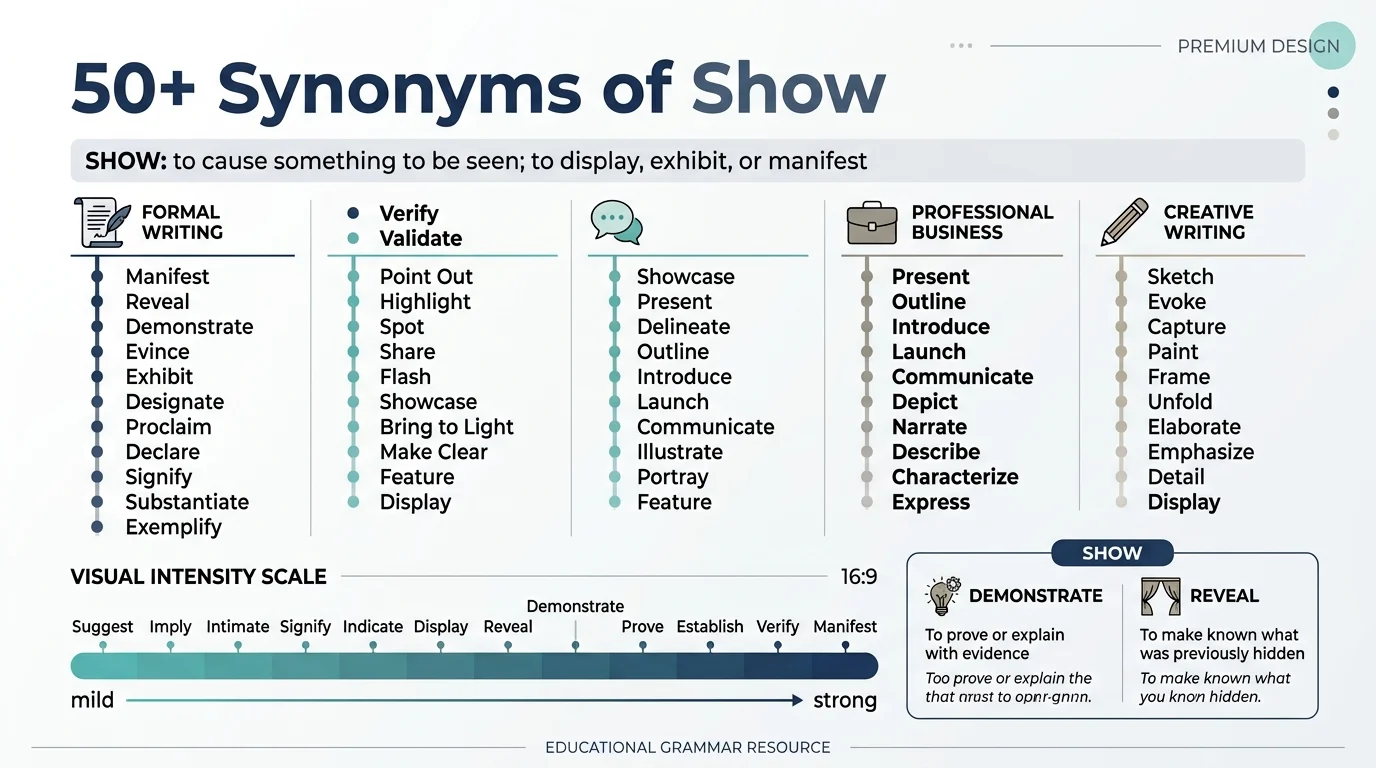
“Show” means to make something visible, to demonstrate, or to present information. The best synonym depends on your context. Formal writing, use demonstrate or indicate. For casual conversation, try point out or let someone see. For professional settings, present or display work well. Emotional or creative writing, reveal or unveil add impact.
Meaning, Tone, and Context
Simple Definition: To make something visible, known, or understood; to present or display information, objects, or feelings to others.
Part of Speech: Verb (primarily) and Noun.
Overall Tone: Neutral. “Show” is a versatile, everyday word that does not carry strong positive or negative emotional weight on its own.
Formality Level: Neutral to Informal. While “show” is acceptable in most settings, formal academic and professional writing often benefit from more precise alternatives.
Common Uses: Native English speakers use “show” constantly. You show someone a photo, show data on a graph, show a friend how to cook a recipe, or show up at a meeting. It is one of the most common verbs in the language, which is exactly why it is so easy to overuse.
Word Forms:
- Verb: show (present), showed (past), shown (past participle), showing (present participle)
- Noun: show (a performance, exhibition, or display)
When and How to Use “Show”
“Show” is your default choice when you need a simple, clear verb that everyone understands. It works well in everyday conversation, basic instructions, and informal writing. However, in professional, academic, or creative contexts, a more specific synonym often communicates your meaning more effectively.
Here are seven realistic examples showing how “show” is used in different contexts:
Professional:
“The quarterly report shows a 15% increase in customer engagement.”
Academic:
“The researcher’s findings show a correlation between sleep quality and academic performance.”
Workplace:
“Could you show me how to use the new project management software?”
Personal:
“I want to show you the pictures from our vacation.”
Email:
“The attached document shows the revised budget figures.”
Resume:
“Managed a team of 12 and showed consistent improvement in project delivery times.”
“This video shows you exactly how to style the new collection.”
Best Synonyms of “Show”
No synonym is identical in every situation. The best choice depends on your audience, your purpose, and the tone you want to convey. Here are the top recommendations for specific contexts.
Professional Writing: Present. This word suggests a formal, organized delivery of information. It works well in business reports and presentations because it implies preparation and professionalism.
Academic Writing: Demonstrate. This is the gold standard for academic work. It implies proof through evidence and reasoning, which is exactly what academic writing requires.
Business Communication: Display. This word works well when you are presenting data, products, or visual information in a clear, organized way.
Casual Conversation: Point out. This phrase feels natural and friendly. It suggests drawing attention to something without formality.
Emotional Writing: Reveal. This word suggests uncovering something that was hidden or unknown. It adds a layer of discovery and emotional weight.
Creative Writing: Unveil. This word carries a sense of ceremony and importance. It is perfect for revealing something significant in a story.
Resume Writing: Highlight. This word suggests emphasizing your most important achievements and skills. It sounds active and confident.
Workplace Communication: Illustrate. This word works well when you are explaining something with examples or visual aids.
Stronger Meaning: Prove. When you need to show something with absolute certainty, “prove” is the strongest choice.
Softer Meaning: Suggest. When you want to show something indirectly or tentatively, “suggest” is a milder, more cautious alternative.
When Not to Use “Show”
Even though “show” is a useful word, there are many situations where a more precise synonym will serve you better.
When the word sounds too general: In academic writing, “show” often lacks the specificity that readers expect. Saying “the data shows” does not tell the reader how the data shows something. Recommendation: Use demonstrate or indicate to add precision. Rewrite: “The data demonstrates a clear pattern” sounds more authoritative.
When the word sounds too vague: In professional communication, vague language can undermine your message. If you say “the report shows problems,” you are not being specific about what the report actually does. Recommendation: Use reveal or expose to suggest discovery of important information. Rewrite: “The report reveals significant operational challenges” is more direct.
The word sounds too informal: In formal essays, legal documents, or official correspondence, “show” can feel too casual. Recommendation: Use exhibit or manifest for a more formal tone. Rewrite: “The patient exhibited symptoms of the condition” sounds more clinical and precise.
When the word sounds too weak: In persuasive writing or marketing, “show” does not convey enough conviction. Recommendation: Use prove or establish to make a stronger claim. Rewrite: “The results prove our solution is effective” is more compelling.
When the word sounds too strong: In some situations, “show” might imply certainty when you only have suggestive evidence. Recommendation: Use suggest or indicate to express a more tentative relationship. Rewrite: “The preliminary data suggests a potential link” is more accurate.
The word feels outdated: While “show” itself is not outdated, some of its uses can feel old-fashioned. For example, “shew” is an archaic spelling you should avoid entirely.
Words Commonly Confused With “Show”
Vs Demonstrate
- Difference: “Demonstrate” implies a deliberate, often educational act of showing how something works or proving a point through evidence. “Show” is more general.
- When to Use It: Use “demonstrate” in academic writing, technical explanations, or when you want to emphasize proof.
- Example: “The teacher demonstrated the experiment to the class.”
Show vs Display
- Difference: “Display” emphasizes arranging things so they can be seen clearly, often in a public or organized way. “Show” is broader and can be more casual.
- When to Use It: Use “display” when talking about exhibitions, visual presentations, or showcasing products.
- Example: “The museum displays ancient artifacts in glass cases.”
Vs Reveal
- Difference: “Reveal” suggests making something known that was previously hidden, secret, or unknown. “Show” does not carry this implication.
- When to Use It: Use “reveal” when there is an element of surprise, discovery, or disclosure.
- Example: “The investigation revealed corruption at the highest levels.”
Show vs Indicate
- Difference: “Indicate” suggests pointing to or suggesting something indirectly, often through signs or data. “Show” can be more direct.
- When to Use It: Use “indicate” in data analysis, research, or when the evidence is suggestive rather than conclusive.
- Example: “The survey indicates a growing preference for remote work.”
Vs Present
- Difference: “Present” implies a formal or organized delivery of information to an audience. “Show” is more casual.
- When to Use It: Use “present” in business meetings, conferences, or any situation where you are formally sharing information.
- Example: “She presented her findings at the annual conference.”
Vs Exhibit
- Difference: “Exhibit” is a formal word that often refers to displaying art, objects, or behavior in a public or professional setting.
- When to Use It: Use “exhibit” in museums, galleries, or when describing observable behavior in a clinical or formal context.
- Example: “The gallery exhibits works by contemporary artists.”
Best Synonyms of “Show” by Context
| Context | Best Synonym | Why It Works | Example |
|---|---|---|---|
| Formal writing | Demonstrate | Adds authority and implies proof through evidence | “The study demonstrates a clear link between diet and health.” |
| Academic writing | Indicate | Suggests data-driven conclusions with appropriate caution | “The results indicate a significant trend.” |
| Professional communication | Present | Suggests organized, formal delivery of information | “I will present the quarterly results on Friday.” |
| Business emails | Attach | Specifically refers to including documents or files | “I have attached the revised proposal for your review.” |
| Resume writing | Highlight | Emphasizes key achievements and skills effectively | “Highlighted a 20% increase in sales over six months.” |
| Workplace communication | Illustrate | Works well for explaining concepts with examples | “Let me illustrate this point with a case study.” |
| Casual conversation | Point out | Sounds natural and friendly in everyday speech | “I just wanted to point out the new coffee shop.” |
| Everyday speaking | Let someone see | Simple and direct for showing physical objects | “Let me see your new phone.” |
| Creative writing | Unveil | Adds drama and a sense of discovery | “The detective unveiled the killer’s identity.” |
| Storytelling | Reveal | Suggests uncovering secrets or important information | “The final chapter reveals the protagonist’s true motives.” |
| Emotional writing | Expose | Suggests revealing something hidden, often with vulnerability | “The memoir exposes the author’s deepest fears.” |
| Strong emphasis | Prove | Conveys absolute certainty and conviction | “The evidence proves his theory correct.” |
| Mild tone | Suggest | Indicates a tentative or indirect connection | “The data suggests a possible correlation.” |
| Social media captions | Showcase | Highlights products, talents, or experiences attractively | “Showcasing our new summer collection.” |
How to Choose the Best Synonym of “Show”
Choosing the right synonym is about matching your word to your purpose, audience, and tone. Here is a practical decision guide.
Start with your meaning. Are you trying to prove something, display something, or simply point something out? If you are proving a point, choose demonstrate or prove.You are displaying visual information, choose display or present. You are simply pointing something out, show or point out might be all you need.
Consider your audience. Who are you writing for? A formal academic audience expects precise, evidence-based language. A casual audience on social media responds better to simple, direct words. Adjust your vocabulary accordingly.
Think about emotional strength. Do you want to add drama, urgency, or emotion? Words like reveal, unveil, and expose carry emotional weight. Words like indicate, suggest, and display are more neutral. Choose the level of emotional intensity that fits your message.
Match the formality level. Formal writing demands formal vocabulary. Use demonstrate, exhibit, or manifest. Informal writing allows for more casual choices like point out or show up.
Trust what sounds natural. The best word is the one that sounds right in the sentence. Read your sentence aloud. If it feels forced or awkward, try a different synonym. Natural-sounding writing is always more effective.
Real Life Examples of “Show”
Here are realistic examples showing how “show” and its synonyms can transform your writing.
School:
“The teacher showed the class how to solve the equation.” → “The teacher demonstrated the equation-solving process step by step.”
College:
“My essay shows my understanding of the topic.” → “My essay demonstrates a comprehensive understanding of the topic.”
Workplace:
“The report shows we need to cut costs.” → “The report reveals an urgent need for cost reduction.”
Business:
“We showed our new product at the trade show.” → “We showcased our new product at the trade show.”
Email:
“The attachment shows the updated schedule.” → “The attachment presents the updated schedule for your review.”
Resume:
“Showed ability to lead teams effectively.” → “Demonstrated strong leadership skills by managing cross-functional teams.”
Conversation:
“Let me show you my garden.” → “Let me show you my garden.” (Sometimes the simplest word is the best choice.)
Storytelling:
“The story shows the hero’s journey.” → “The story reveals the hero’s inner transformation.”
Blogging:
“This post shows you how to bake bread.” → “This post walks you through the art of baking sourdough.”
“This photo shows my new haircut.” → “Debuting my new haircut!”
18 Best Synonyms of “Show”
| Synonym | Simple Meaning | Best Used For | Example Sentence |
|---|---|---|---|
| Demonstrate | To prove or explain clearly | Academic writing, technical explanations | “The experiment demonstrates the effectiveness of the new drug.” |
| Display | To arrange and show clearly | Visual presentations, exhibitions | “The museum displays a stunning collection of Impressionist paintings.” |
| Reveal | To make known something hidden | Storytelling, investigative writing | “The investigation revealed a shocking cover-up.” |
| Present | To formally introduce or deliver | Business meetings, conferences | “He presented the annual report to the board of directors.” |
| Indicate | To point out or suggest indirectly | Data analysis, research papers | “The statistics indicate a growing trend toward online shopping.” |
| Illustrate | To explain with examples or visuals | Educational content, presentations | “The diagram illustrates the water cycle perfectly.” |
| Exhibit | To display publicly or demonstrate behavior | Museums, clinical descriptions | “The patient exhibited signs of fatigue and confusion.” |
| Prove | To establish truth with evidence | Legal arguments, scientific claims | “The DNA evidence proved his innocence.” |
| Unveil | To reveal something new with ceremony | Product launches, major announcements | “The company unveiled its latest smartphone model.” |
| Highlight | To emphasize important points | Resumes, key takeaways | “The report highlights the need for better cybersecurity.” |
| Expose | To reveal something negative or hidden | Journalism, investigative reports | “The article exposed corruption within the organization.” |
| Manifest | To show clearly through visible signs | Psychology, descriptive writing | “Her anxiety manifested in sweaty palms and rapid breathing.” |
| Showcase | To display in an attractive way | Portfolios, social media, marketing | “The gallery showcases emerging local artists.” |
| Point out | To draw attention to something | Casual conversation, teaching | “I want to point out an error in the report.” |
| Suggest | To imply or indicate indirectly | Tentative conclusions, hypotheses | “The data suggests a possible link between the two variables.” |
| Evidence | To serve as proof of something | Formal writing, legal contexts | “The documents evidence a pattern of fraudulent activity.” |
| Portray | To depict or describe in a particular way | Creative writing, character descriptions | “The novel portrays the struggles of immigrant families.” |
| Clarify | To make something clear and understandable | Explanations, instructions | “The additional notes clarify the company’s position on the issue.” |
Synonyms of “Show” by Usage
Professional vs Personal Synonyms
In professional settings, choose words that sound competent and authoritative. Present, demonstrate, and highlight are excellent choices for meetings, reports, and emails. They suggest you have organized your thoughts and are sharing information deliberately.
In personal conversations, simpler words work better. Point out, let someone see, or simply show feel natural and friendly. You do not need formal vocabulary when talking to friends or family.
Formal vs Conversational Synonyms
Formal (for reports, essays, business writing, presentations, and professional emails):
- Demonstrate
- Indicate
- Exhibit
- Manifest
- Evidence
Conversational (for casual conversations, texting, and informal writing):
- Point out
- Let someone see
- Show up
- Turn up
- Come across
Academic Synonyms
Academic writing demands precision and authority. These words will elevate your essays and research papers:
- Demonstrate: Use when you have strong evidence.
- Indicate: Use when data suggests a trend.
- Illustrate: Use when providing examples.
- Reveal: Use when presenting new findings.
- Establish: Use when confirming a fact or theory.
Professional and Business Synonyms
These words will strengthen your resumes, interviews, and business communications:
- Present: For formal delivery of information.
- Highlight: For emphasizing key achievements.
- Showcase: For displaying products or skills attractively.
- Demonstrate: For proving capability or explaining processes.
- Attest: For confirming or bearing witness to something.
Creative and Literary Synonyms
For storytelling, fiction, and descriptive writing, these words add emotion and imagery:
- Reveal: Uncover secrets or truths.
- Unveil: Introduce something with ceremony.
- Portray: Describe or depict in a particular way.
- Expose: Reveal something hidden, often with vulnerability.
- Evince: Reveal the presence of a quality or feeling.
Slang or Modern Synonyms
Show up and turn up are common informal phrasal verbs meaning to arrive or appear. They are acceptable in casual conversation and social media but should be avoided in formal writing.
Strongest to Mildest Synonyms
Mild → Moderate → Strong → Very Strong
- Suggest (mildest)
- Indicate
- Point out
- Show
- Display
- Present
- Illustrate
- Demonstrate
- Reveal
- Unveil
- Expose
- Prove (strongest)
Emotional vs Neutral Synonyms
Emotional Synonyms (express stronger feelings):
- Reveal (suggests discovery and surprise)
- Unveil (suggests ceremony and importance)
- Expose (suggests vulnerability or negative revelation)
- Portray (suggests artistic or emotional depiction)
Neutral Synonyms (communicate information without emotion):
- Indicate
- Display
- Present
- Demonstrate
- Illustrate
Antonyms of “Show”
| Antonym | Meaning | Example Sentence |
|---|---|---|
| Hide | To keep out of sight | “She tried to hide her disappointment.” |
| Conceal | To deliberately keep something secret | “He concealed the documents in a safe.” |
| Cover | To place something over to hide | “The fog covered the entire valley.” |
| Mask | To hide or disguise | “He masked his true feelings with a smile.” |
| Disguise | To change appearance to hide identity | “The spy disguised himself as a waiter.” |
| Obscure | To make unclear or difficult to see | “The smoke obscured the view of the stage.” |
| Suppress | To prevent something from being known | “The government suppressed the report.” |
| Withhold | To refuse to give or reveal | “She withheld the information from the police.” |
| Veil | To cover or conceal | “The darkness veiled the mountain range.” |
| Shroud | To cover or envelop so as to conceal | “Mystery shrouded the ancient artifact.” |
| Bury | To hide from view or knowledge | “He buried the secret deep in his memory.” |
| Camouflage | To hide by blending in with surroundings | “The soldiers camouflaged their vehicles.” |
| Screen | To protect or conceal from view | “The fence screened the backyard from the street.” |
| Blanket | To cover completely | “Snow blanketed the entire city.” |
| Eclipse | To obscure or surpass | “His achievements eclipsed those of his predecessors.” |
Comparison: “Show” vs Similar Words
Show vs Demonstrate
Main Difference: “Show” is a general term for making something visible or known. “Demonstrate” specifically implies proving something through evidence, reasoning, or a practical exhibition.
Which Is Stronger? Demonstrate is stronger because it implies a deliberate act of proof.
Which Is More Formal? Demonstrate is more formal and is the preferred choice in academic and professional writing.
When to Use Each: Use show for everyday situations. Use demonstrate when you need to prove a point or explain a process.
Examples:
- Show: “Let me show you my new car.”
- Demonstrate: “The scientist demonstrated the experiment to the class.”
Show vs Display
Main Difference: “Show” is broad and can refer to any act of making something visible. “Display” specifically suggests arranging things in an organized, often attractive way for others to see.
Which Is Stronger? Neither is inherently stronger, but display suggests more intentional arrangement.
Which Is More Formal? Display is slightly more formal and is often used in professional or commercial contexts.
When to Use Each: Use show for general visibility. Use display for exhibitions, showcases, or visual presentations.
Examples:
- Show: “Show your ID at the door.”
- Display: “The store displays its products in the front window.”
Show vs Reveal
Main Difference: “Show” simply makes something visible. “Reveal” implies uncovering something that was previously hidden, secret, or unknown.
Which Is Stronger? Reveal is stronger because it carries an element of discovery and surprise.
Which Is More Formal? Both are acceptable in formal writing, but reveal is often used in journalism and storytelling.
When to Use Each: Use show for routine visibility. Use reveal when there is an element of secrecy or discovery.
Examples:
- Show: “The map shows the location of the park.”
- Reveal: “The investigation revealed the truth about the accident.”
Show vs Indicate
Main Difference: “Show” can be direct and definitive. “Indicate” suggests a sign, clue, or suggestion rather than direct proof.
Which Is Stronger? Show is stronger because it implies more certainty.
Which Is More Formal? Indicate is highly formal and commonly used in academic and technical writing.
When to Use Each: Use show when you are certain. Use indicate when the evidence is suggestive rather than conclusive.
Examples:
- Show: “The clock shows the correct time.”
- Indicate: “The survey indicates a preference for remote work.”
Show vs Present
Main Difference: “Show” is casual and direct. “Present” implies a formal, organized delivery of information to an audience.
Which Is Stronger? Present suggests more preparation and formality.
Which Is More Formal? Present is more formal and is the standard choice for business and academic presentations.
When to Use Each: Use show in everyday situations. Use present when you are formally sharing information with an audience.
Examples:
- Show: “Let me show you how to do this.”
- Present: “She presented her findings at the conference.”
Show vs Exhibit
Main Difference: “Show” is a general term. “Exhibit” is a formal word that often refers to displaying art, objects, or behavior in a public or professional setting.
Which Is Stronger? Exhibit is more formal and carries a sense of public display.
Which Is More Formal? Exhibit is highly formal and is used in museums, galleries, and clinical descriptions.
When to Use Each: Use show for general situations. Use exhibit for formal displays of art, objects, or observable behavior.
Examples:
- Show: “Show your ticket to the attendant.”
- Exhibit: “The gallery exhibits works by local artists.”
Common Phrases and Expressions with “Show”
| Phrase | Meaning | Example Sentence |
|---|---|---|
| Show up | To arrive or appear | “He said he would come, but he never showed up.” |
| Show off | To display one’s abilities or possessions proudly | “She loves to show off her new car.” |
| Show someone around | To guide someone through a place | “Let me show you around the office.” |
| Show the way | To lead or guide | “The tour guide showed the way through the museum.” |
| Show your hand | To reveal your intentions or plans | “He didn’t show his hand until the final negotiations.” |
| Steal the show | To attract the most attention and praise | “The young actor stole the show with his performance.” |
| For show | Done for appearance rather than genuine purpose | “The elaborate decorations were just for show.” |
Common Mistakes to Avoid
1: Choosing a vague synonym instead of a precise one.
- Incorrect: “The results show a difference.”
- Better: “The results demonstrate a statistically significant difference.”
- Why: “Demonstrate” adds authority and precision.
2: Confusing “show” with “prove” when the evidence is not conclusive.
- Incorrect: “The data proves that coffee causes headaches.”
- Better: “The data suggests a link between coffee and headaches.”
- Why: “Prove” implies certainty. Use “suggest” or “indicate” when the evidence is not definitive.
3: Using an informal synonym in formal writing.
- Incorrect: “The study points out that exercise improves health.”
- Better: “The study indicates that exercise improves health.”
- Why: “Point out” is too casual for academic writing.
4: Selecting an overly dramatic synonym for a neutral situation.
- Incorrect: “The menu unveils our daily specials.”
- Better: “The menu lists our daily specials.”
- Why: “Unveil” is too dramatic for a routine menu.
5: Repeating the same word too often.
- Incorrect: “The report shows an increase. The graph shows the trend. The data shows improvement.”
- Better: “The report demonstrates an increase. The graph illustrates the trend. The data indicates improvement.”
- Why: Variety keeps your writing engaging and precise.
6: Choosing a synonym with the wrong emotional tone.
- Incorrect: “The brochure reveals our vacation packages.”
- Better: “The brochure showcases our vacation packages.”
- Why: “Reveal” suggests secrecy. “Showcase” suggests attractive presentation.
7: Using slang in academic or professional writing.
- Incorrect: “The research showed up some interesting results.”
- Better: “The research revealed some interesting results.”
- Why: “Show up” is slang for arriving, not for presenting findings.
Frequently Asked Questions
1. What are the best synonyms of “show”?
The best synonyms depend on your context. Formal writing, use demonstrate or indicate. For casual conversation, try point out. For professional settings, present or display work well.
2. What are the best formal synonyms of “show”?
The best formal synonyms include demonstrate, indicate, exhibit, manifest, and present. These words add authority and precision to academic and professional writing.
3. What are common informal synonyms of “show”?
Common informal synonyms include point out, let someone see, show up, and turn up. These are best for casual conversations, texting, and social media.
4. What is another word for “show” in professional writing?
In professional writing, use present, highlight, demonstrate, or showcase. These words convey competence and help you communicate clearly in business contexts.
5. What is the difference between “show” and “demonstrate”?
“Show” is a general term for making something visible. “Demonstrate” implies proving something through evidence or a practical exhibition. Use “demonstrate” when you need to prove a point or explain a process.
6. What is the opposite of “show”?
The most common opposite of “show” is hide. Other antonyms include conceal, cover, mask, disguise, obscure, and suppress.
Conclusion
“Show” is one of the most versatile and frequently used words in the English language. It helps us share information, express ideas, and connect with others. But using the same word repeatedly can make your writing feel dull and imprecise. The best synonym of show depends entirely on your context, audience, and purpose. Formal writing, choose demonstrate or indicate. For casual conversation, point out works beautifully. For professional settings, present or highlight will serve you well. Creative writing, reveal or unveil add drama and emotion.
No single synonym works perfectly in every situation. The key is to think about what you are trying to communicate and choose the word that expresses your meaning most clearly. The next time you reach for “show,” pause and consider whether a more precise synonym might make your writing stronger, clearer, and more engaging.