Have you ever found yourself writing an email, a social media caption, or a personal essay and realized you have used the word “nostalgic” three times in two paragraphs? It happens to everyone. The feeling is specific, but the word can become repetitive.
You might describe a photo album as nostalgic, a song as nostalgic, and a conversation with an old friend as nostalgic. After a while, the word loses its impact. That is exactly when you need a strong set of synonyms of nostalgic to keep your writing fresh and precise.
Choosing the right alternative does more than avoid repetition. It sharpens your meaning and helps your reader understand exactly what you feel.
What Are the Best Synonyms of “Nostalgic”?
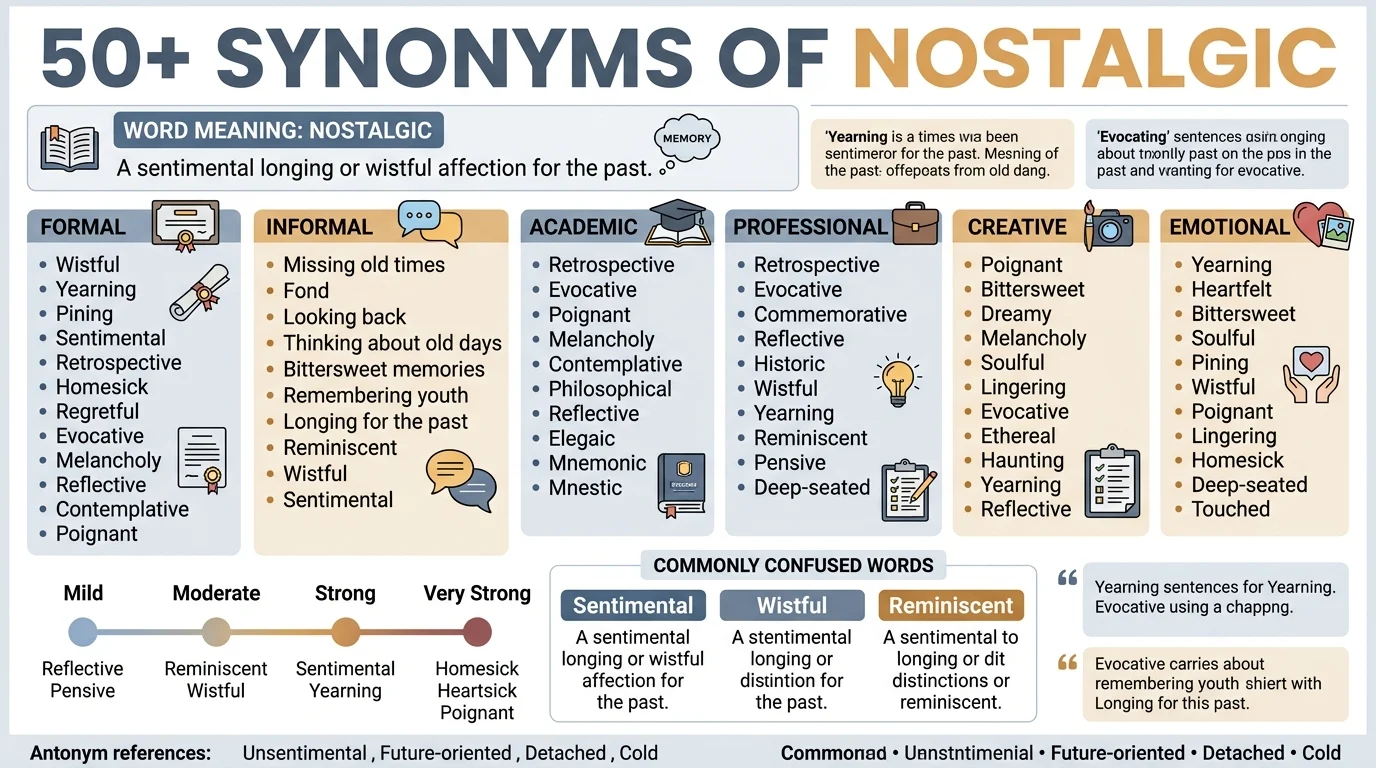
The word “nostalgic” describes a sentimental longing or wistful affection for the past, often triggered by memories, places, or objects. Formal writing, choose “reminiscent” or “reflective.” For casual conversation, use “wistful” or “sentimental.” Emotional or creative writing, “yearning” or “evocative” work well. The best choice always depends on your tone and audience.
Meaning, Tone, and Context
Simple Definition
Nostalgic is an adjective that describes a bittersweet feeling of longing for a past time, place, or experience. The feeling often includes both happiness and sadness because the past is remembered fondly but cannot be relived.
Part of Speech
Adjective
Overall Tone
Nostalgic is generally neutral to positive. It can carry warmth and affection, but it also includes a hint of sadness or loss. The word is rarely negative unless the context emphasizes regret or an inability to move forward.
Formality Level
Neutral. Nostalgic works well in both formal and informal settings. You can use it in academic essays, business emails, personal letters, and casual conversations without sounding out of place.
Common Uses
Native English speakers use nostalgic most often when discussing:
- Memories of childhood or youth
- Old photographs, music, or films
- Places they used to live or visit
- Relationships with people from their past
- Cultural moments from earlier decades
Word Forms
- Noun: nostalgia
- Adjective: nostalgic
- Adverb: nostalgically
- Related noun: nostalgist (a person who feels nostalgia)
When and How to Use “Nostalgic”
Choose “nostalgic” when you want to describe a feeling that mixes fondness with a gentle sadness about something from the past. It works best when the memory is personal and emotionally meaningful. Here are seven realistic examples showing how to use the word in different contexts.
Professional
The team felt nostalgic as they reviewed the company’s early marketing materials from a decade ago.
Academic
The novel explores how aging populations experience nostalgic reflections on their youth.
Workplace
She became nostalgic when she walked past the cubicle where she started her career fifteen years earlier.
Personal
Looking through my grandmother’s recipe box made me feel nostalgic for Sunday dinners at her house.
Email
I came across our old project files today and felt a bit nostalgic about the early days of our collaboration.
Resume
Avoid using nostalgic in a resume. Instead, describe your experience with words like “seasoned” or “experienced.
Social Media
This song takes me right back to high school. Feeling so nostalgic right now.
Best Synonyms of “Nostalgic”
No synonym is identical in every situation. The best choice depends on your audience, your purpose, and the emotional weight you want to carry. Here are the top recommendations for specific contexts.
Professional writing: “Reminiscent” is the best choice. It sounds polished and suggests thoughtful reflection without excessive emotion.
Academic writing: “Reflective” works well because it implies careful consideration of the past rather than pure sentiment.
Business communication: “Nostalgic” itself is acceptable, but “reminiscent” or “evocative” sound more controlled and professional.
Casual conversation: “Wistful” is natural and conversational. It captures the longing without sounding overly dramatic.
Emotional writing: “Yearning” conveys a stronger, more passionate desire for the past.
Creative writing: “Evocative” is excellent for describing things that bring the past to life.
Resume writing: Do not use nostalgic. Choose “experienced,” “seasoned,” or “established” instead.
Workplace communication: “Reflective” or “thoughtful” sound more appropriate than “sentimental.”
Stronger meaning: “Pining” or “longing” express a more intense emotional pull.
Softer meaning: “Fond” or “tender” are gentler and less heavy.
When Not to Use “Nostalgic”
There are several situations where “nostalgic” is not the best word choice.
When the word sounds too vague
If you are describing a specific memory but the reader cannot tell whether you feel happy or sad, nostalgic may be too unclear. Instead, use a more precise word like “bittersweet” or “fond.”
When the word sounds too informal
In a formal report or academic paper, nostalgic can feel slightly informal. Use “reminiscent” or “reflective” instead.
Original: The data showed a nostalgic view of previous economic policies.
Better: The data showed a reflective view of previous economic policies.
When the word sounds too weak
If you want to express deep, aching longing, nostalgic may not be strong enough. Use “yearning” or “pining.”
Original: She felt nostalgic for the life she left behind.
Better: She felt a deep yearning for the life she left behind.
When the word sounds too strong
If you only want to mention the past lightly, nostalgic can feel overly emotional. Use “fond” or “pleasant.”
Original: I have nostalgic memories of that summer.
Better: I have fond memories of that summer.
When the word is outdated
Nostalgic is not outdated. However, in very modern or forward-looking contexts, it can sound backward-looking. Use “retro” or “vintage-inspired” if you are describing style rather than emotion.
Words Commonly Confused With “Nostalgic”
Sentimental
Difference: Sentimental describes being easily influenced by emotions, while nostalgic specifically refers to longing for the past.
When to use it: Use sentimental when someone is emotionally responsive in general, not just about the past.
Example: She keeps every birthday card because she is sentimental.
Wistful
Difference: Wistful is slightly more passive and dreamy. Nostalgic often includes a stronger sense of personal memory.
When to use it: Use wistful when someone looks back with quiet, gentle sadness.
Example: He gave a wistful sigh when he mentioned his college days.
Homesick
Difference: Homesick is specifically about missing home or family. Nostalgic can refer to any past time or place.
When to use it: Use homesick when someone is physically away from home and longs to return.
Example: After two months abroad, she started feeling homesick.
Reminiscent
Difference: Reminiscent means “suggestive of” or “bringing to mind.” It is less emotional than nostalgic.
When to use it: Use reminiscent when something reminds you of the past without necessarily causing strong feelings.
Example: The architecture was reminiscent of 1920s Paris.
Evocative
Difference: Evocative means “bringing strong images or feelings to mind.” It focuses on the power of the trigger rather than the feeling itself.
When to use it: Use evocative to describe something that powerfully calls up memories.
Example: The perfume was evocative of her grandmother’s garden.
Maudlin
Difference: Maudlin means overly or tearfully sentimental, often in a weak or foolish way.
When to use it: Use maudlin only when you want to criticize excessive sentimentality.
Example: After a few drinks, he became maudlin about his lost youth.
Best Synonyms of “Nostalgic” by Context
| Context | Best Synonym | Why It Works | Example |
|---|---|---|---|
| Formal writing | Reminiscent | Sounds polished and controlled | The speech was reminiscent of earlier presidential addresses. |
| Academic writing | Reflective | Implies thoughtful analysis | The study offered a reflective analysis of postwar culture. |
| Professional communication | Evocative | Highlights the power of memory without overemotion | The campaign used evocative imagery from the 1990s. |
| Business emails | Nostalgic | Neutral and widely understood | Seeing our first office made me feel nostalgic. |
| Resume writing | Experienced | Focuses on capability rather than emotion | Experienced leader with fifteen years in the industry. |
| Workplace communication | Reflective | Sounds measured and professional | We took a reflective look at our early company values. |
| Casual conversation | Wistful | Natural and conversational | I felt wistful looking at my old yearbook. |
| Everyday speaking | Sentimental | Widely understood and casual | I get sentimental about my childhood home. |
| Creative writing | Evocative | Adds richness and sensory depth | The music was evocative of a forgotten era. |
| Storytelling | Yearning | Adds emotional weight and desire | She felt a yearning for the simplicity of her youth. |
| Emotional writing | Pining | Conveys deep, aching loss | He spent years pining for the life he once knew. |
| Strong emphasis | Longing | Direct and powerful | A longing for the past consumed her. |
| Mild tone | Fond | Gentle and understated | I have fond memories of that place. |
| Social media captions | Nostalgic | Short, relatable, and widely used | Feeling nostalgic about this throwback. |
| American English | Nostalgic | Standard and universally understood | The movie gave me a nostalgic feeling. |
How to Choose the Best Synonym of “Nostalgic”
Choosing the right synonym of nostalgic comes down to four key factors.
Consider your audience. Are you writing for a professor, a boss, a friend, or social media followers? Formal audiences expect precise, measured language. Casual audiences appreciate warmer, more emotional words.
Consider your purpose. Are you describing a feeling, evoking an image, or analyzing a cultural trend? Descriptive writing benefits from evocative language. Analytical writing benefits from reflective language.
Consider emotional strength. Do you want to express mild fondness, deep longing, or something in between? Match the intensity of your word to the intensity of your feeling.
Consider naturalness. The best synonym is the one that sounds most natural in your sentence. Read your sentence aloud. If it sounds forced or awkward, try a different word.
The goal is not to use the most impressive word. The goal is to communicate your meaning as clearly as possible.
Real Life Examples of “Nostalgic”
School
The sixth-grade class project made the teacher nostalgic for her own elementary school days.
College
Walking across campus during homecoming weekend, alumni felt nostalgic about their college years.
Workplace
The retirement party turned nostalgic as colleagues shared stories from the past three decades.
Business
The brand’s retro packaging design made longtime customers feel nostalgic for the company’s early products.
Email
I found our old meeting notes from 2015 and felt nostalgic about how much our team has grown.
Resume
Instead of “nostalgic,” write: “Seasoned professional with a decade of progressive leadership experience.”
Conversation
“Do you ever feel nostalgic for the days before smartphones?” she asked.
Storytelling
The old lighthouse stood as a nostalgic reminder of the fishing village’s prosperous past.
Blogging
There is something deeply nostalgic about the smell of rain on hot pavement in summer.
Social Media
Throwback to the best summer of my life. Feeling all the nostalgic vibes today.
18 Best Synonyms of “Nostalgic”
Synonyms of “Nostalgic” by Usage
Professional vs Personal Synonyms
In professional settings, choose words that sound controlled and measured. “Reminiscent,” “reflective,” and “evocative” are excellent choices because they describe the past without excessive emotion. In personal settings, you have more freedom. “Sentimental,” “wistful,” and “yearning” feel warmer and more intimate.
Formal vs Conversational Synonyms
Formal writing favors words like “reflective,” “contemplative,” and “melancholy.” These words appear in academic papers, reports, and official correspondence. Conversational English favors “sentimental,” “wistful,” and “nostalgic” itself. These words sound natural in emails, text messages, and everyday speech.
Academic Synonyms
For research papers, essays, and academic discussions, use precise vocabulary. “Reflective” implies thoughtful analysis. “Contemplative” suggests deep consideration. “Retrospective” is excellent for describing studies that look backward. These words sound authoritative and demonstrate vocabulary sophistication.
Professional and Business Synonyms
In resumes, interviews, and business communication, avoid emotional language. Instead of “nostalgic,” describe yourself as “experienced,” “seasoned,” or “established.” For describing products or campaigns, use “evocative” or “reminiscent.” These words sound professional while still acknowledging the past.
Creative and Literary Synonyms
Writers and storytellers can choose from a rich palette. “Yearning,” “pining,” and “longing” add emotional depth. “Evocative” and “bittersweet” create sensory and emotional complexity. “Melancholy” and “wistful” establish mood. These words help readers feel what characters feel.
Slang or Modern Synonyms
“Nostalgic” does not have widely used slang equivalents. However, “throwback” is commonly used as an adjective in informal contexts. “That outfit is so throwback.” “Retro” describes style rather than emotion. Use these words casually but avoid them in formal writing.
Strongest to Mildest Synonyms
Mild → Moderate → Strong → Very Strong
- Fond (mild)
- Sentimental (mild to moderate)
- Reminiscent (moderate)
- Wistful (moderate)
- Reflective (moderate)
- Emotional (moderate to strong)
- Longing (strong)
- Yearning (strong)
- Pining (very strong)
- Maudlin (very strong, often negative)
Emotional intensity changes how readers perceive your message. Mild words suit professional and casual contexts. Strong words suit creative and personal writing.
Emotional vs Neutral Synonyms
Emotional Synonyms
“Yearning,” “pining,” “longing,” “sentimental,” “wistful,” and “melancholy” all carry strong emotional weight. Use these when you want readers to feel the depth of your feeling. They work well in personal essays, fiction, and emotional storytelling.
Neutral Synonyms
“Reminiscent,” “reflective,” “contemplative,” and “evocative” are more neutral. They describe the past without overwhelming emotion. Use these in academic writing, professional communication, and analytical pieces where objectivity matters.
Antonyms of “Nostalgic”
| Antonym | Meaning | Example Sentence |
|---|---|---|
| Indifferent | Having no interest or concern | She was indifferent to the old photographs. |
| Unsentimental | Not influenced by emotion | He took an unsentimental approach to clearing out the attic. |
| Forward-looking | Focused on the future | The company maintained a forward-looking strategy. |
| Modern | Belonging to the present time | The modern design ignored all historical references. |
| Contemporary | Current and up to date | She preferred contemporary art over classical pieces. |
| Unemotional | Not showing strong feelings | His unemotional response surprised everyone. |
| Practical | Concerned with actual use rather than sentiment | She made a practical decision to sell the family home. |
| Detached | Emotionally disconnected | He viewed his childhood with detached curiosity. |
| Objective | Based on facts rather than feelings | The historian provided an objective account. |
| Dispassionate | Not influenced by strong emotion | Her dispassionate analysis impressed the committee. |
| Unconcerned | Not worried or interested | He seemed unconcerned about the old family traditions. |
| Unreflective | Not thinking deeply about the past | Her unreflective attitude annoyed the nostalgic members. |
| Present-minded | Focused on the current moment | The team was entirely present-minded during the crisis. |
| Future-oriented | Directed toward what is to come | The startup had a strongly future-oriented culture. |
| Apathetic | Showing no interest or emotion | He was apathetic about the historical preservation effort. |
Comparison: “Nostalgic” vs Similar Words
Nostalgic vs Sentimental
Main Difference
Nostalgic is specifically about longing for the past. Sentimental describes being easily moved by emotions in general.
Which Is Stronger?
Sentimental can be stronger because it implies a general emotional responsiveness, but nostalgic is more specific.
Which Is More Formal?
Both are neutral, but nostalgic is slightly more precise and therefore more formal in academic contexts.
When to Use Each
Use nostalgic when you mean “longing for the past.” Use sentimental when you mean “easily emotional.”
Examples
Nostalgic: The old songs made her nostalgic for high school.
Sentimental: He is sentimental about everything, even old receipts.
Nostalgic vs Wistful
Main Difference
Wistful implies a gentle, passive sadness. Nostalgic often includes warmth and fondness alongside the sadness.
Which Is Stronger?
Nostalgic is usually stronger because it involves personal memories and emotional attachment.
Which Is More Formal?
Both are neutral, but wistful is slightly more literary.
When to Use Each
Use wistful for quiet, reflective moments. Use nostalgic for memories that feel personal and meaningful.
Examples
Nostalgic: Looking at her wedding photos made her nostalgic.
Wistful: He gave a wistful glance at the closed-down diner.
Nostalgic vs Homesick
Main Difference
Homesick specifically means missing home or family. Nostalgic can refer to any past time, place, or experience.
Which Is Stronger?
Homesick often feels more acute and uncomfortable. Nostalgic is usually more bittersweet.
Which Is More Formal?
Nostalgic is more formal. Homesick is conversational and personal.
When to Use Each
Use homesick when someone is physically away from home. Use nostalgic when someone is remembering any part of the past.
Examples
Nostalgic: The exhibit made him nostalgic for his childhood.
Homesick: She felt homesick after moving to a new country.
Nostalgic vs Reminiscent
Main Difference
Reminiscent means “suggestive of” or “bringing to mind.” It is less emotional than nostalgic.
Which Is Stronger?
Nostalgic is much stronger emotionally.
Which Is More Formal?
Reminiscent is more formal and academic.
When to Use Each
Use reminiscent to describe objects or experiences that trigger memories. Use nostalgic to describe the feeling itself.
Examples
Nostalgic: I felt nostalgic when I saw my old school.
Reminiscent: The architecture was reminiscent of colonial times.
Nostalgic vs Evocative
Main Difference
Evocative describes the power of something to call up memories. Nostalgic describes the feeling itself.
Which Is Stronger?
Both can be strong, but evocative emphasizes the trigger while nostalgic emphasizes the emotion.
Which Is More Formal?
Evocative is more formal and often appears in literary criticism and marketing.
When to Use Each
Use evocative to describe art, music, or writing. Use nostalgic to describe personal feelings.
Examples
Nostalgic: She felt nostalgic about her first job.
Evocative: The film’s soundtrack was evocative of 1980s New York.
Nostalgic vs Maudlin
Main Difference
Maudlin means overly or tearfully sentimental, often in a weak or foolish way. Nostalgic is neutral and does not carry this negative judgment.
Which Is Stronger?
Maudlin is stronger but in a negative sense.
Which Is More Formal?
Both are neutral, but maudlin is often used critically.
When to Use Each
Use nostalgic for genuine, warm memories. Use maudlin when you want to criticize excessive sentimentality.
Examples
Nostalgic: He felt nostalgic about his college years.
Maudlin: The movie’s maudlin ending made the audience cringe.
Common Phrases and Expressions with “Nostalgic”
Feeling
Meaning: A sense of sentimental longing for the past.
Example: That old photograph gave me a nostalgic feeling.
Memories
Meaning: Memories that are tinged with sentimental longing.
Example: The reunion brought back many nostalgic memories.
About the past
Meaning: Feeling sentimental longing when thinking about earlier times.
Example: She gets nostalgic about the past whenever she visits her hometown.
For home
Meaning: Missing one’s home or family.
Example: After a month away, he felt nostalgic for home.
Deeply nostalgic
Meaning: Feeling intense nostalgia.
Example: The old songs made him deeply nostalgic.
Nostalgic smile
Meaning: A smile that reflects sentimental memories.
Example: She wore a nostalgic smile as she flipped through the album.
Nostalgic mood
Meaning: A temporary state of feeling sentimental about the past.
Example: The rainy afternoon put him in a nostalgic mood.
Common Mistakes to Avoid
Choosing a vague synonym instead of a precise one
Using “emotional” when you really mean “nostalgic” can confuse readers. Emotional is too broad. Nostalgic is specific to the past.
Incorrect: The old house made her emotional.
Better: The old house made her nostalgic.
Why: Emotional could mean anything. Nostalgic tells the reader exactly what she felt.
Confusing nostalgic with sentimental
These words are not interchangeable. Sentimental describes a general tendency to be emotional. Nostalgic describes a specific longing for the past.
Incorrect: He felt sentimental for his childhood.
Better: He felt nostalgic for his childhood.
Why: Nostalgic is the correct word for longing for a past time.
Using an informal synonym in formal writing
“Sentimental” and “wistful” can sound too casual in academic papers. Choose “reflective” or “reminiscent” instead.
Incorrect: The study showed a sentimental view of postwar culture.
Better: The study showed a reflective view of postwar culture.
Why: Reflective sounds more academic and precise.
Selecting an overly dramatic synonym
“Pining” and “yearning” are very strong words. Use them only when the feeling is intense.
Incorrect: I am pining for last Tuesday.
Better: I feel nostalgic about last Tuesday.
Why: Pining suggests deep, aching loss, not a mild fondness.
Repeating the same word too often
Using “nostalgic” three times in one paragraph weakens your writing. Vary your vocabulary.
Incorrect: The nostalgic music made me nostalgic. I felt nostalgic all evening.
Better: The music stirred up fond memories. I felt wistful all evening.
Why: Variety keeps your writing engaging.
Choosing a synonym with the wrong emotional tone
“Melancholy” is sadder than “nostalgic.” “Fond” is happier. Choose the word that matches your actual feeling.
Incorrect: I felt melancholy about my happy childhood.
Better: I felt nostalgic about my happy childhood.
Why: Melancholy implies sadness. Nostalgic includes both happiness and sadness.
Using slang in academic or professional writing
“Throwback” and “retro” are informal. They do not belong in formal contexts.
Incorrect: The data showed a throwback attitude.
Better: The data showed a nostalgic attitude.
Why: Throwback is too casual for professional writing.
Frequently Asked Questions
What are the best synonyms of “nostalgic”?
The best synonyms depend on context. Formal writing, use “reminiscent” or “reflective.” For casual conversation, use “wistful” or “sentimental.” For emotional writing, use “yearning” or “longing.”
What are the best formal synonyms of “nostalgic”?
“Reflective,” “contemplative,” and “reminiscent” are the strongest formal alternatives. They sound professional and appear in academic papers, business reports, and formal correspondence.
What are common informal synonyms of “nostalgic”?
“Sentimental,” “wistful,” and “homesick” are common in everyday conversation. “Throwback” is also used informally to describe nostalgic things.
What is another word for “nostalgic” in professional writing?
“Reminiscent” and “evocative” are excellent choices for professional contexts. They describe the past without excessive emotion. “Reflective” works well in analytical business writing.
What is the difference between “nostalgic” and “sentimental”?
Nostalgic specifically means longing for the past. Sentimental means being easily moved by emotions in general. Nostalgic is about time. Sentimental is about emotional responsiveness.
What is the opposite of “nostalgic”?
“Indifferent,” “unsentimental,” and “forward-looking” are strong antonyms. These words describe people who do not dwell on the past or who focus on the present and future.
Conclusion
Nostalgic is a beautiful word that captures the bittersweet feeling of longing for the past. It combines warmth and sadness in a way that few other words can match. But no single word works perfectly in every situation. The best synonyms of nostalgic depend on your audience, your purpose, and the emotional weight you want to carry. For professional and academic writing, choose “reminiscent” or “reflective.” For casual conversation, choose “wistful” or “sentimental.” Creative and emotional writing, choose “yearning” or “longing.” The key to strong vocabulary is not knowing many words. It is knowing which word fits each situation. The next time you feel nostalgic, take a moment to choose the word that truly captures what you feel. Your readers will notice the difference.