You just finished walking your colleague through a process. You need to clarify a point in your essay. Your manager asks you to break down the quarterly results. A friend wants you to elaborate on your weekend story.
And every single time, the word “explain” steps forward first.
It is a solid, dependable word. But relying on it over and over drains energy from your writing and speaking. This guide gives you precise synonyms for explain, organized by tone and situation, so you always sound clear, professional, and engaging.
What Does “Explain” Mean?
“Explain” means to make something clear or easy to understand by describing it in more detail. The best synonyms depend on your audience: clarify works for professional writing, elucidate suits academic contexts, break down fits casual conversation, and interpret captures emotional or creative meaning.
Meaning, Tone and Context
The word “explain” carries a neutral and helpful tone. It signals a transfer of understanding from someone who knows to someone who wants to learn.
Part of speech: Verb
Tone: Neutral, instructive, or helpful
Formality level: Neutral, appropriate for most settings
Common use cases: Teaching, reporting, clarifying confusion, describing processes, defending positions
Related forms: Explanation (noun), explanatory (adjective), explicable (adjective)
In professional life, “explain” implies responsibility and clarity. In personal conversations, it shows patience and willingness to connect. The word does honest work, but more specific synonyms sharpen your meaning and match your exact situation.
When and How to Use “Explain”
Use “explain” when you want to make something understandable in a direct and uncomplicated way. It fits whenever information needs to travel clearly from one person to another.
Here are realistic examples using “explain” across everyday situations.
The supervisor asked her to explain the delay to the client. (professional)
Please explain the significance of the control group in your methodology. (academic)
Can you explain how you made this incredible pasta? (casual)
He tried to explain the overwhelming relief he felt after the call. (emotional)
The narrator pauses to explain the magical rules of the world. (creative)
Caption this photo and explain the story behind it. (social media)
I will explain the updated workflow during today’s standup meeting. (email)
Another Word for “Explain”
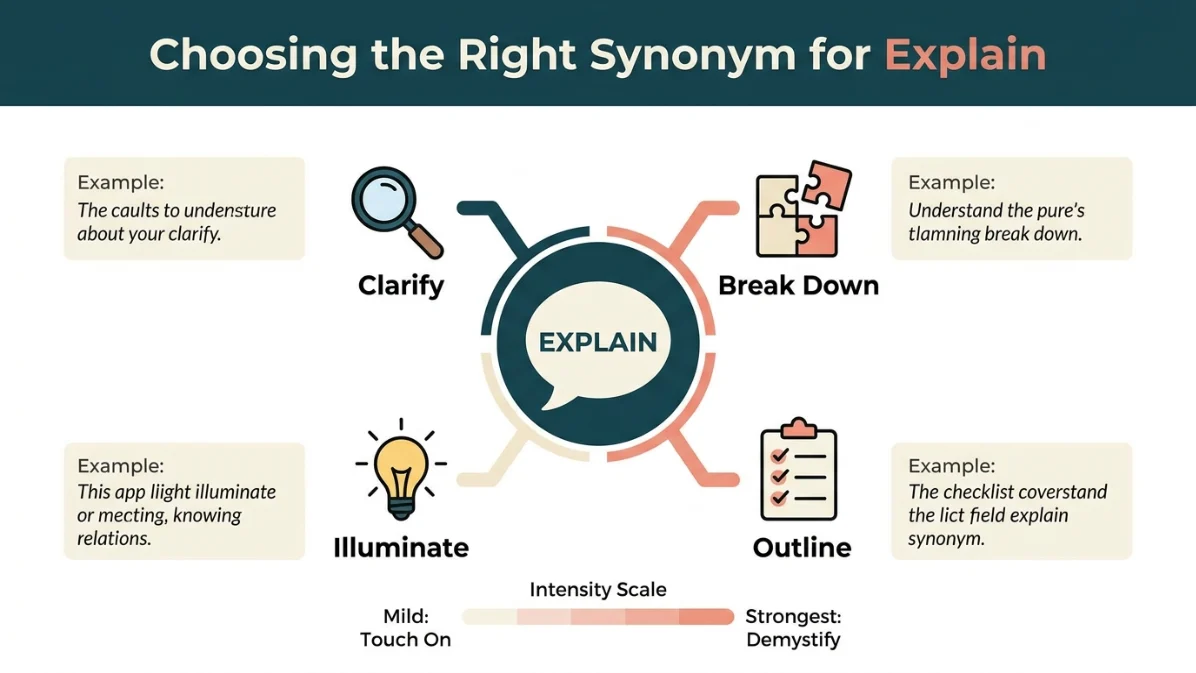
If you need one versatile replacement, “clarify” is often your safest and strongest choice. It works across professional, academic, and casual settings without sounding forced.
For professional writing, choose “outline” or “detail.” For academic writing, “elucidate” and “expound” carry scholarly weight. In casual conversation, “break down” or “spell out” feel natural. For emotional writing, “articulate” or “express” capture personal depth. In creative writing, “unfold” or “unravel” add texture. On resumes, “communicate” or “present” highlight strong soft skills. Choose “illuminate” for deeper insight and “touch on” for brief mentions.
When Not to Use “Explain”
Sometimes “explain” sounds defensive, overly broad, or simply vague. Telling a colleague you will “explain the issue” when you actually plan to provide a quick update can feel heavier than intended.
The teacher explained the new grading system.
The teacher outlined the new grading system.
If you are giving a summary, “outline” or “summarize” fits better. If you are justifying a decision, “account for” or “rationalize” captures the real action. Choose the word that matches what you are actually doing.
Words Commonly Confused With “Explain”
Several words seem interchangeable with “explain” but carry distinct meanings and expectations.
Explain vs. Describe
Describe means to give a detailed account of what something looks, sounds, or feels like. Explain goes deeper into why or how something works. You describe a painting’s colors. You explain the artist’s technique.
Explain vs. Instruct
Instruct means to tell someone how to do something step by step. Explain focuses on building understanding, not necessarily directing action. A cooking instructor instructs on knife skills but explains why a dull blade is dangerous.
Explain vs. Define
Define means to state the precise meaning of a word or concept. Explain provides surrounding context and broader understanding. You define “photosynthesis” with a textbook sentence. You explain how photosynthesis sustains the ecosystem.
Explain vs. Justify
Justify means to show something is right or reasonable. Explain remains neutral. You explain a policy change. You justify a budget increase by showing its return on investment.
Explain vs. Summarize
Summarize means to condense key points. Explain means to make those points understandable. A movie trailer summarizes. A film critic explains themes and character motivations.
Explain vs. Interpret
Interpret means to explain the meaning of something by offering your own understanding, often applied to art, data, or language. Explain stays closer to objective facts. An analyst interprets market trends. A spokesperson explains the company’s position.
Best Synonym by Context for “Explain”
| Context | Best Synonym | Why It Works | Example |
|---|---|---|---|
| Formal writing | Elucidate | Precise and authoritative | The report elucidates the relationship between policy and growth. |
| Academic writing | Expound | Shows depth of knowledge | The scholar expounded on the theory’s historical roots. |
| Professional or business use | Outline | Clear and efficient | She outlined the project timeline for the stakeholders. |
| Resume | Articulate | Highlights communication skill | Articulated complex technical concepts for non-technical audiences. |
| Casual conversation | Break down | Friendly and accessible | Can you break down how the app works? |
| Creative writing | Unravel | Adds narrative tension | The detective began to unravel the mystery piece by piece. |
| Emotional tone | Articulate | Suggests personal expression | He struggled to articulate the depth of his gratitude. |
| Strong intensity | Illuminate | Implies deep revelation | The documentary illuminates a hidden chapter of history. |
| Soft or moderate tone | Touch on | Indicates a brief mention | I will touch on the budget updates later in the call. |
| Social media captions | Walk through | Engaging and instructive | Let me walk you through my morning routine. |
| US and UK usage | Spell out | Universally clear | Do I need to spell out the instructions again? |
Which Synonym Should You Choose?
Start with three questions. First, what is the purpose? Are you teaching, reporting, justifying, or summarizing? Second, how formal is the environment? “Elucidate” suits academic papers, while “break down” fits team chats. Third, how deep should the explanation go? “Illuminate” promises insight, while “touch on” signals brevity. Let your answers guide your word selection naturally.
Real Life Examples of “Explain” in Sentences
Seeing alternatives in action reveals how a single word shift changes clarity and tone.
School: The professor used a simple analogy to illustrate the principle.
Workplace: She detailed the new compliance requirements for the team.
Writing: The author takes time to unfold the protagonist’s motivations.
Conversation: He walked me through the recipe step by step.
Social media: I am going to break down my entire editing process here.
Resume: Presented quarterly performance insights to senior leadership.
Email: I have outlined the next steps for your review.
Storytelling: The old journal revealed the truth no one expected.
25 Synonyms for “Explain”
| Synonym | Simple Meaning | Best Used For | Example Sentence |
|---|---|---|---|
| Clarify | Remove confusion | Professional and everyday use | Let me clarify the deadline for submissions. |
| Elucidate | Make clear through detail | Academic and formal writing | The professor elucidated the complex theorem. |
| Illustrate | Explain using examples | Teaching and presentations | She illustrated her point with a real case study. |
| Outline | Give main points briefly | Business and meetings | He outlined the agenda for the afternoon session. |
| Detail | Provide full information | Reports and instructions | The document details every step of the process. |
| Interpret | Explain meaning or significance | Art, data, and analysis | We need someone to interpret the survey results. |
| Expound | Present and explain thoroughly | Academic and intellectual | The author expounds upon the theme of identity. |
| Break down | Separate into simple parts | Casual and instructional | She broke down the math problem for the class. |
| Spell out | Explain very clearly | Direct instructions | The contract spells out your rights and obligations. |
| Define | State the exact meaning | Technical and academic | Please define the term as used in this context. |
| Demystify | Make less mysterious | Educational and approachable | The course aims to demystify personal finance. |
| Shed light on | Reveal new information | Journalism and investigation | The report sheds light on undocumented working conditions. |
| Unravel | Explain something complex | Narrative and creative | The protagonist slowly unravels the family secret. |
| Account for | Explain the reason for | Professional justification | She accounted for the budget discrepancy immediately. |
| Rationalize | Explain with logical reasons | Defensive or analytical | He tried to rationalize the unexpected outcome. |
| Set forth | State clearly and formally | Legal and official | The declaration sets forth the principles of the agreement. |
| Put across | Communicate successfully | Interpersonal and persuasion | She knows how to put across difficult feedback kindly. |
| Get across | Make understood | Casual and teaching | I struggled to get my point across during the debate. |
| Walk through | Explain step by step | Training and support | Let me walk you through the installation process. |
| Enlighten | Give deeper knowledge | Inspirational and learning | The mentor enlightened him about industry realities. |
| Explicate | Analyze and explain in detail | Literary and academic | The essay explicates the poem’s central metaphor. |
| Present | Offer for consideration | Formal and professional | She presented her findings to the review board. |
| Communicate | Share information clearly | General and interpersonal | He communicates complex ideas with remarkable ease. |
| Demonstrate | Show how something works | Practical and hands on | The technician demonstrated the safety procedure. |
| Describe | Give a detailed verbal account | Observation and reporting | The witness described the scene to the officer. |
Synonym Groups and Usage Differences
Professional vs. Personal Synonyms
In professional settings, words like “outline,” “detail,” “present,” and “communicate” signal structure and reliability. In personal conversations, “break down,” “walk through,” and “spell out” feel warm and collaborative.
Telling a colleague you will “detail the changes” sounds responsible. Telling a friend you will “break it down” sounds supportive.
Formal vs. Conversational Synonyms
Formal writing demands precision. Use “elucidate,” “expound,” “explicate,” and “set forth” in essays, research papers, and official documents.
Conversational English values ease. “Break down,” “spell out,” “walk through,” and “get across” keep dialogue flowing naturally. A team message might say “I’ll walk through the updates,” while a board report uses “The following section elucidates the strategic shift.”
Academic Synonyms
Academic writing rewards intellectual depth. “Elucidate,” “expound,” and “explicate” demonstrate rigorous thinking. “Illustrate” works well when connecting theory to examples. Avoid casual alternatives like “break down” or “spell out” entirely in scholarly work.
Professional and Business Synonyms
Business communication favors clarity and efficiency. “Outline” shows organized thinking. “Detail” conveys thoroughness. “Present” and “communicate” highlight valuable workplace skills. On resumes, “articulated,” “presented,” and “communicated” pair effectively with measurable outcomes.
Creative or Literary Synonyms
Creative writing benefits from verbs that add texture and mood. “Unravel” suggests a slow, suspenseful reveal. “Illuminate” brings light to hidden truths. “Shed light on” feels journalistic and investigative. “Enlighten” carries a transformative, almost spiritual weight.
Slang or Modern Synonyms
Casual expressions like “break it down,” “put it out there,” and “give the lowdown” energize social media and informal conversation. They work well in captions, friendly emails, and relaxed presentations. Avoid them in academic papers, formal reports, and professional proposals where they diminish authority.
Strongest vs. Weaker Synonyms
Think of explain synonyms on an intensity scale.
Mild: Touch on, summarize, outline
Moderate: Clarify, describe, define
Strong: Elucidate, expound, illuminate
Strongest: Demystify, enlighten, unravel
Match the intensity to how completely you intend to make something understood.
Emotional vs. Neutral Synonyms
“Articulate,” “enlighten,” and “unravel” carry emotional resonance, suggesting personal discovery and connection. “Outline,” “detail,” and “define” stay strictly factual and neutral. Choose emotional synonyms when you want readers to feel the weight of understanding. Choose neutral synonyms when you simply need to transfer information.
Antonyms of “Explain”
| Antonym | Meaning | Example Sentence |
|---|---|---|
| Confuse | Make unclear or difficult to understand | The contradictory instructions only confused the team. |
| Obscure | Keep from being seen or understood | The technical jargon obscured the main point. |
| Mystify | Make mysterious or puzzling | His vague response mystified the entire committee. |
| Misrepresent | Give a false account of | The article misrepresented the study’s actual findings. |
| Distort | Twist out of shape or misstate | He distorted the facts to support his argument. |
| Conceal | Keep from sight or knowledge | The report conceals more than it reveals. |
| Complicate | Make more complex than necessary | Adding unnecessary details will complicate the message. |
| Mislead | Cause someone to have the wrong idea | The advertisement misled consumers about the pricing. |
| Befuddle | Make utterly confused | The rapid fire questions befuddled the witness. |
| Garble | Mix up or distort a message | The poor connection garbled her explanation. |
| Obfuscate | Deliberately make unclear | The document seems designed to obfuscate rather than inform. |
| Withhold | Refuse to give information | The official withheld critical safety data. |
| Muddle | Bring into a disordered state | Too many voices muddled the decision making process. |
| Perplex | Cause to feel completely puzzled | His reasoning perplexed even the experts. |
| Suppress | Prevent the disclosure of | The administration suppressed the internal audit report. |
Comparison: Explain vs. Similar Words
Explain vs. Describe
Main difference: Describe gives sensory details. Explain gives reasons and causes.
Which one is stronger: Explain goes deeper into understanding.
Which one is more formal: Both are neutral.
Example: She described the sunset in vivid detail. She explained why the sky turns orange at dusk.
Explain vs. Clarify
Main difference: Clarify focuses on removing existing confusion. Explain assumes no prior misunderstanding.
Which one is stronger: Clarify implies you are fixing a problem.
Which one is more formal: Clarify is slightly more professional.
Example: The professor explained the theory. The professor clarified a point that several students found confusing.
Explain vs. Define
Main difference: Define gives the exact boundaries of a term. Explain gives context and understanding.
Which one is stronger: Explain offers more depth.
Which one is more formal: Define is more technical.
Example: The glossary defines each term. The speaker explains how each term applies to real situations.
Explain vs. Elaborate
Main difference: Elaborate means to add more detail to something already mentioned. Explain can start from zero.
Which one is stronger: Elaborate expands existing information.
Which one is more formal: Elaborate is slightly more formal.
Example: She explained the new policy. Could you elaborate on the second bullet point?
Explain vs. Interpret
Main difference: Interpret adds personal understanding and perspective. Explain aims for objectivity.
Which one is stronger: Interpret carries more creative and analytical weight.
Which one is more formal: Interpret suits academic and artistic contexts.
Example: The guide explained the historical site’s layout. The art historian interpreted the painter’s symbolism.
Explain vs. Justify
Main difference: Justify aims to prove correctness. Explain aims to create understanding.
Which one is stronger: Justify is more defensive and persuasive.
Which one is more formal: Both are widely used in formal contexts.
Example: The CFO explained the spending pattern. The CFO justified the spending to the audit committee.
Common Phrases and Expressions with “Explain”
1. Explain yourself
Meaning: Give reasons for your behavior, often after something wrong.
Example sentence: The principal asked the student to explain himself.
2. Explain away
Meaning: Minimize or dismiss something with an excuse.
Example sentence: He tried to explain away the mistake, but no one was convinced.
3. Let me explain
Meaning: A polite request for attention before clarifying something.
Example sentence: Let me explain before you jump to conclusions.
4. How do you explain that?
Meaning: A challenge asking for justification of something surprising.
Example sentence: Profits dropped sharply. How do you explain that?
5. I can’t explain it
Meaning: A phrase expressing that something feels important but hard to put into words.
Example sentence: I can’t explain it, but I knew the news would be good.
6. Explain the reasoning
Meaning: Share the thought process behind a decision.
Example sentence: The memo explains the reasoning behind the organizational changes.
7. Need I explain?
Meaning: A rhetorical question suggesting something is obvious.
Example sentence: The policy clearly states the rules. Need I explain further?
8. Explain at length
Meaning: To explain in great detail over a long time.
Example sentence: The guide explained the cathedral’s history at length.
Common Mistakes to Avoid
Using “explain” when you only mean “mention” or “name” overstates your action. If you are listing points briefly, use “outline” or “list” instead.
Choosing “elucidate” in a casual team chat sounds stiff and unnatural. Reserve elevated vocabulary for formal and academic writing.
Using “justify” when you should remain neutral can make you sound defensive. “Explain” reports. “Justify” defends.
Applying “break down” to deeply emotional or sensitive topics can feel too mechanical. Gentle alternatives like “talk through” or “share” sometimes fit better.
Repeating the same synonym across a document defeats the purpose of varying your word choice. Rotate between suitable alternatives.
Selecting a weak synonym for a powerful revelation undersells your message. “Illuminated” hits harder than “described” when the insight is genuinely profound.
Using classroom-style words like “spell out” with senior executives may seem condescending. Match your language to your listener’s experience level.
FAQs
What is the best synonym for explain?
The best synonym depends on context. “Clarify” works broadly, “elucidate” fits academic use, and “break down” suits casual and instructional settings perfectly.
What is a formal synonym for explain?
“Elucidate,” “expound,” and “set forth” are strong formal synonyms. Choose “elucidate” for academic papers and “outline” for professional reports and presentations.
What is an informal synonym for explain?
“Break down,” “spell out,” “walk through,” and “get across” are effective informal synonyms. They fit naturally in conversations, texts, and instructional content.
What is another word for explain in professional writing?
“Outline,” “detail,” “present,” and “communicate” work well in professional writing. They emphasize structure, clarity, and transferable communication skills.
What is the difference between explain and describe?
Describe focuses on sensory and surface details. Explain focuses on causes, reasons, and deeper understanding of how or why something works.
What is the opposite of explain?
“Confuse,” “obscure,” and “misrepresent” are common opposites. “Obfuscate” specifically means to deliberately make something unclear or difficult to understand.
Conclusion
“Explain” is a reliable, essential word in every communicator’s toolkit. But your clarity becomes sharper and your credibility grows stronger when you select synonyms that match your exact intention, audience, and context.
Build a short mental list of go-to alternatives: “clarify” for everyday precision, “outline” for professional efficiency, “elucidate” for academic depth, and “illuminate” for revealing insight. Ask yourself whether you are summarizing, teaching, defending, or revealing. The right word is always waiting.