Have you ever found yourself writing an email, an essay, or a social media caption and realized you have used the word “advocate” three times in two sentences? It happens to everyone. You know what you want to say, but repeating the same word makes your writing feel flat and uninspired. Choosing the right synonym of advocate can transform a dull sentence into something clear, powerful, and perfectly suited to your audience.
What Are the Best Synonyms of “Advocate”?
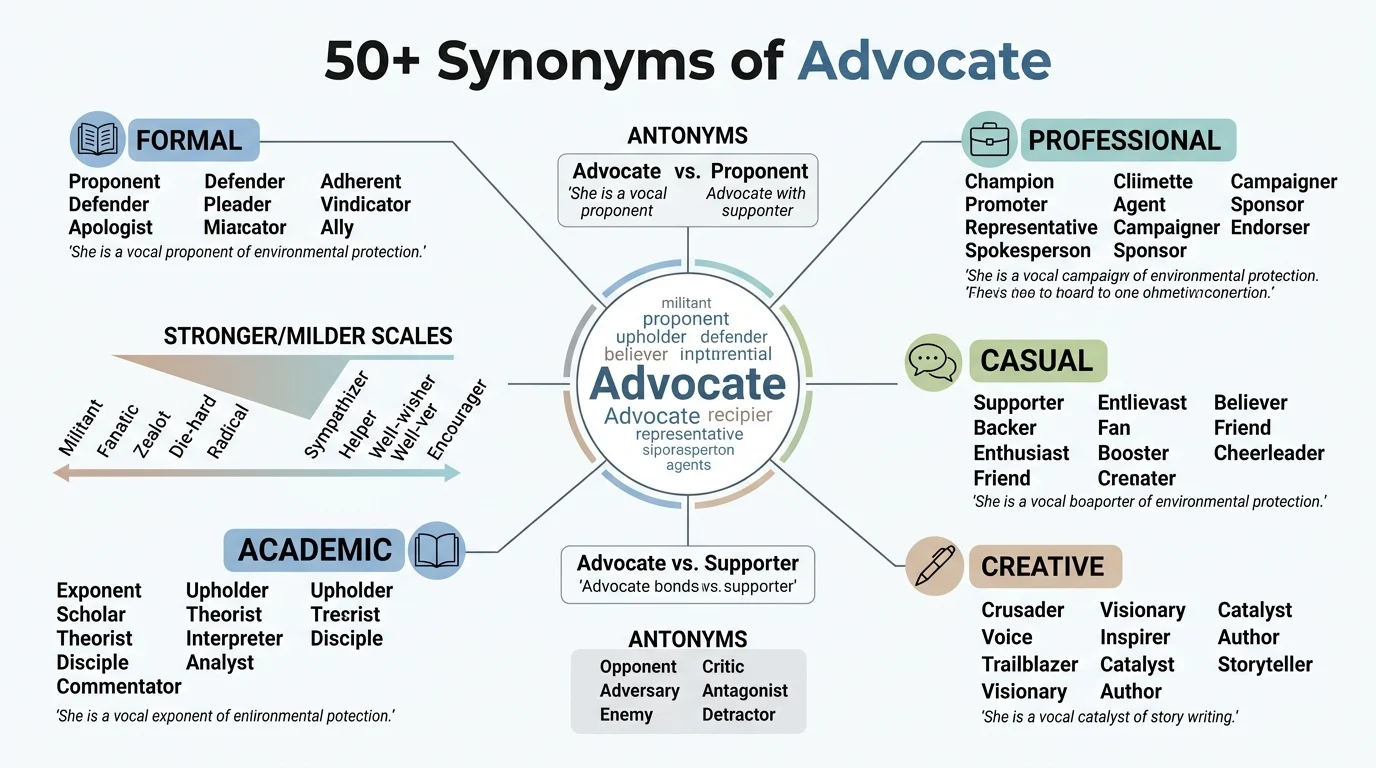
“Advocate” means to publicly support or recommend a cause, policy, or person. As a noun, it refers to someone who actively supports or defends a cause. The best synonyms depend on your context. For formal and professional writing, use “proponent” or “champion.” For casual conversation, “supporter” or “backer” work well. In academic contexts, “proponent” and “defender” are excellent choices. For emotional or creative writing, “voice” or “crusader” adds impact.
Meaning, Tone, and Context
Simple Definition
As a verb, “advocate” means to speak or write in favor of something, to support or urge by argument, or to recommend publicly. As a noun, it refers to a person who speaks or writes in support or defense of a cause, person, or policy.
Part of Speech
“Advocate” functions as both a noun and a verb. The pronunciation changes slightly depending on usage. As a noun, it is pronounced AD-vuh-kit. As a verb, it is pronounced AD-vuh-kate.
Overall Tone
The word “advocate” is generally positive. It implies active, vocal support for something the speaker believes in. It carries a sense of commitment and sometimes urgency.
Formality Level
“Advocate” is neutral to formal. It is appropriate in professional, academic, and legal settings. It is less common in very casual conversation, though it is still understood and used.
Common Uses
Native English speakers use “advocate” in a variety of contexts. In legal settings, an advocate is a lawyer who pleads a case in court. In everyday language, people advocate for social causes, policy changes, or specific ideas. You might hear someone described as a “patient advocate” or a “consumer advocate”.
Word Forms
- Noun: advocate (one who supports)
- Verb: advocate (to support publicly)
- Adjective: advocative (relating to advocacy)
- Related Noun: advocacy (the act of supporting)
- Related Noun: advocator (one who advocates)
When and How to Use “Advocate”
Choosing when to use “advocate” depends on your message and your audience. Use it when you want to convey active, public support for an idea or cause. It is stronger than simply “supporting” something because it implies speaking out and taking action.
Here are seven realistic examples showing how “advocate” fits different contexts.
Professional Context
Our team will advocate for a more flexible remote work policy during the next quarterly review.
Academic Context
The researcher advocates for a complete reassessment of the traditional grading system in higher education.
Workplace Context
She consistently advocates for better diversity and inclusion training across all departments.
Personal Context
I advocate for regular mental health checkups just as we do for physical health.
Email Context
I want to advocate for extending the project deadline to ensure we deliver a high quality product.
Resume Context
Advocated for process improvements that reduced operational costs by 15 percent.
Social Media Context
We need to advocate for cleaner public transportation options in our city.
Best Synonyms of “Advocate”
No two synonyms are perfectly identical. Each alternative carries its own shade of meaning, emotional weight, and level of formality. Choosing the right one makes your writing more precise and effective.
Professional Writing
Best Synonym: Proponent
Why: “Proponent” sounds measured, serious, and authoritative. It is the standard choice in policy documents, business reports, and professional proposals.
Academic Writing
Best Synonym: Defender
Why: “Defender” implies protecting an idea or position against criticism. It works well in research papers, essays, and academic discussions.
Business Communication
Best Synonym: Champion
Why: “Champion” conveys strength, leadership, and active engagement. It suggests someone who fights for a cause rather than passively supporting it.
Casual Conversation
Best Synonym: Supporter
Why: “Supporter” is simple, clear, and neutral. It is the most natural choice for everyday speech and informal writing.
Emotional Writing
Best Synonym: Voice
Why: “Voice” is poetic and powerful. It works well in opinion pieces, personal essays, and emotional appeals.
Creative Writing
Best Synonym: Crusader
Why: “Crusader” adds drama and imagery. It is perfect for storytelling, fiction, and descriptive writing when you want to evoke passion and determination.
Resume Writing
Best Synonym: Championed
Why: Using “championed” as a verb on a resume shows leadership and initiative. It sounds more impactful than “advocated”.
Workplace Communication
Best Synonym: Backer
Why: “Backer” is practical and often implies financial or logistical support. It is common in business journalism and internal communications.
Stronger Meaning
Best Synonym: Crusader or Champion
Why: These words convey intense commitment and active fighting for a cause.
Softer Meaning
Best Synonym: Supporter or Endorser
Why: These words suggest agreement and backing without the same level of active, vocal engagement.
When Not to Use “Advocate”
There are situations where using “advocate” is not the best choice. Recognizing these moments will improve your writing significantly.
When the Word Sounds Too General
If you are describing someone who merely agrees with an idea but does not actively speak out, “advocate” is too strong.
Ineffective: He is an advocate of healthy eating.
Better: He follows a healthy diet.
Why: The second sentence is more accurate if the person is not publicly promoting healthy eating.
When the Word Sounds Too Vague
“Advocate” can feel vague when you need to specify the type of support.
Ineffective: She advocated for the new policy.
Better: She lobbied for the new policy.
Why: “Lobbied” specifies that she actively tried to influence decision makers.
When the Word Sounds Too Formal
In casual conversation, “advocate” can sound stiff or overly serious.
Ineffective: I advocate for pizza for dinner.
Better: I vote for pizza for dinner.
Why: “Vote for” is more natural and conversational in this context.
When the Word Sounds Too Weak
If you need to convey passionate, unwavering support, “advocate” may not be strong enough.
Ineffective: She advocates for human rights.
Better: She champions human rights.
Why: “Champions” conveys a stronger, more heroic level of commitment.
When the Word Sounds Outdated
In some legal contexts outside the United States, “advocate” refers specifically to a type of lawyer. In American English, this usage is less common, and “attorney” or “lawyer” is more typical.
Words Commonly Confused With “Advocate”
Many words are similar to “advocate” but have distinct meanings. Understanding these differences will help you choose the right word every time.
Advocate vs Support
Difference: “Support” is a general term that can mean anything from passive agreement to active assistance. “Advocate” specifically means speaking or writing in favor of something.
When to Use It: Use “support” when the action is general. Use “advocate” when you are explicitly urging others to adopt a position.
Example (Support): I support your decision.
Example (Advocate): I advocate for your proposal at every meeting.
Advocate vs Champion
Difference: A champion actively fights for a cause and often leads the effort. An advocate supports and speaks for a cause but may not be the primary leader.
When to Use It: Use “champion” when someone is the leading figure in a movement. Use “advocate” for someone who is a vocal supporter.
Example (Champion): She championed the cause for over twenty years.
Example (Advocate): He is an advocate for renewable energy.
Advocate vs Proponent
Difference: “Proponent” and “advocate” are very similar. “Proponent” is often used in more formal, academic, or policy contexts. It sounds slightly more neutral and measured.
When to Use It: Use “proponent” in formal writing, research, and policy discussions. Use “advocate” more broadly.
Example (Proponent): She is a proponent of evidence based medicine.
Example (Advocate): He is an advocate for patient rights.
Advocate vs Defender
Difference: “Defender” implies protecting something or someone from attack or criticism. “Advocate” is more about promoting and recommending.
When to Use It: Use “defender” when the focus is on protection against opposition. Use “advocate” for general promotion.
Example (Defender): He is a fierce defender of free speech.
Example (Advocate): She advocates for free speech in all forums.
Advocate vs Backer
Difference: “Backer” often implies financial or practical support, especially for a project or venture. “Advocate” is about vocal, public support.
When to Use It: Use “backer” in business or financial contexts. Use “advocate” for causes and policies.
Example (Backer): The startup found a major backer.
Example (Advocate): The senator is an advocate for small businesses.
Advocate vs Endorse
Difference: “Endorse” means to publicly declare support for something, often a product, candidate, or policy. It can be a one time act. “Advocate” implies ongoing, active support.
When to Use It: Use “endorse” for a formal declaration of support. Use “advocate” for sustained, active promotion.
Example (Endorse): The union endorsed the mayoral candidate.
Example (Advocate): The union advocates for better working conditions.
Best Synonyms of “Advocate” by Context
| Context | Best Synonym | Why It Works | Example |
|---|---|---|---|
| Formal Writing | Proponent | Sounds measured, serious, and authoritative | She is a leading proponent of financial reform. |
| Academic Writing | Defender | Implies protecting an idea against criticism | The paper defends the theory against recent challenges. |
| Professional Communication | Champion | Conveys leadership and active engagement | He championed the new software implementation. |
| Business Emails | Promote | Direct and action oriented | I want to promote the benefits of this approach. |
| Resume Writing | Championed | Shows leadership and strong results | Championed a company wide sustainability initiative. |
| Workplace Communication | Backer | Practical, often implies support | She is a key backer of the new mentorship program. |
| Casual Conversation | Supporter | Simple, clear, and neutral | I am a big supporter of local farmers’ markets. |
| Everyday Speaking | For | Very casual and natural | I am for adding more bike lanes. |
| Creative Writing | Crusader | Adds drama and imagery | The crusader for justice never backed down. |
| Storytelling | Advocate | Familiar and easy to understand | The hero was an advocate for the oppressed. |
| Emotional Writing | Voice | Poetic and powerful | She became a voice for the voiceless. |
| Strong Emphasis | Crusader | Conveys intense commitment | He is a crusader against corruption. |
| Mild Tone | Supporter | Neutral and gentle | She is a supporter of the local arts. |
| Social Media Captions | Stand for | Short, punchy, and engaging | I stand for equality and justice. |
How to Choose the Best Synonym of “Advocate”
Choosing the right synonym does not have to be complicated. Ask yourself these questions to find the perfect word.
What is your meaning? Are you describing active, vocal support or simple agreement? If you mean active support, choose “advocate,” “champion,” or “proponent.” If you mean simple agreement, choose “supporter” or “endorser.”
What is your tone? Are you writing formally or casually? For formal writing, choose “proponent” or “defender.” For casual writing, choose “supporter” or “backer.”
Who is your audience? Are you writing for academics, business professionals, or a general audience? Academics appreciate “proponent.” Business professionals respond to “champion.” A general audience understands “supporter.”
What emotional strength do you need? Do you want to sound passionate or neutral? For passion, choose “crusader” or “champion.” For neutrality, choose “supporter” or “advocate.”
What is your writing purpose? Are you persuading, informing, or telling a story? Persuasive writing benefits from strong words like “champion.” Informative writing benefits from neutral words like “proponent.” Storytelling benefits from vivid words like “crusader.”
Does it sound natural? Read your sentence aloud. If the synonym feels forced or awkward, try a different one. The best word is the one that sounds most natural in context.
Real Life Examples of “Advocate”
Seeing “advocate” and its synonyms in action helps you understand how to use them effectively. Here are realistic examples from various situations.
School
The student council advocated for healthier lunch options in the cafeteria.
College
The professor is a strong proponent of interdisciplinary studies.
Workplace
Our manager champions flexible work schedules to improve team morale.
Business
The CEO is a vocal advocate for corporate social responsibility.
I want to advocate for a more streamlined approval process.
Resume
Championed a customer feedback system that increased satisfaction scores.
Conversation
I am a big supporter of local businesses.
Storytelling
The old man was a tireless crusader for the forgotten villagers.
Blogging
As an advocate for sustainable living, I share tips for reducing waste.
I stand for equal rights for everyone.
18 Best Synonyms of “Advocate”
Synonyms of “Advocate” by Usage
Professional vs Personal Synonyms
In professional settings, words like “champion,” “proponent,” and “promoter” are common. They sound serious and competent. In personal conversations, “supporter,” “backer,” and “for” are more natural. They are less formal and easier to understand.
Professional: The board championed the new diversity initiative.
Personal: I am a supporter of the new park plan.
Formal vs Conversational Synonyms
Formal writing favors “proponent,” “defender,” and “exponent.” These words sound authoritative and measured. Conversational speech favors “supporter,” “backer,” and “for.” These words are simple and direct.
Formal: The scholar is a proponent of constructivist learning theory.
Conversational: I am for changing the meeting time.
Academic Synonyms
In academic writing, precision is key. “Proponent,” “defender,” “exponent,” and “upholder” are excellent choices. They convey intellectual rigor and authority. “Advocate” itself is also widely used in academic contexts.
Example: The article defends the hypothesis against recent criticisms.
Professional and Business Synonyms
In resumes and business communications, action verbs are essential. “Championed,” “promoted,” “lobbied,” and “spearheaded” are powerful alternatives. They show initiative and results.
Resume Example: Championed a new client retention strategy that increased renewals by 20 percent.
Creative and Literary Synonyms
For storytelling and creative writing, vivid synonyms add color and emotion. “Crusader,” “voice,” “champion,” and “defender” work well. They create strong images and emotional connections.
Example: The crusader rode into town, determined to fight for justice.
Slang or Modern Synonyms
“Advocate” does not have widely used slang equivalents. In very casual speech, people might say “I am all for that” or “I am behind that.” These phrases convey support without using the word “advocate.”
Strongest to Mildest Synonyms
Mild: Supporter, endorser, backer
Moderate: Advocate, proponent, promoter
Strong: Champion, defender, campaigner
Very Strong: Crusader, fighter, warrior
Emotional vs Neutral Synonyms
Emotional Synonyms: Crusader, champion, voice, fighter. These words express passion and strong feelings.
Neutral Synonyms: Supporter, proponent, backer, endorser. These words simply communicate support without strong emotion.
Emotional: She was a crusader for the rights.
Neutral: She was a proponent of the new policy.
Antonyms of “Advocate”
| Antonym | Meaning | Example Sentence |
|---|---|---|
| Opponent | A person who is against something | He is a vocal opponent of the new tax plan. |
| Critic | A person who expresses disapproval | She is a harsh critic of the government’s policy. |
| Detractor | A person who disparages or criticizes | The project has many detractors. |
| Adversary | An opponent or enemy | He faced a formidable adversary in the debate. |
| Antagonist | A person who actively opposes | The antagonist in the story fought against the hero. |
| Opposer | A person who resists or opposes | The opposers of the bill gathered outside. |
| Challenger | A person who questions or disputes | The challenger questioned the validity of the claim. |
| Dissenter | A person who disagrees with an opinion | The dissenter voiced his objections loudly. |
| Cynic | A person who believes people are selfish | The cynic dismissed the proposal as self-serving. |
| Naysayer | A person who habitually says no | The naysayers predicted the project would fail. |
| Pessimist | A person who expects the worst | The pessimist saw no hope in the new plan. |
| Foe | An enemy or opponent | He was a foe of the new legislation. |
| Rival | A person competing for the same goal | The rival campaign attacked the proposal. |
| Objector | A person who raises an objection | The objector cited several legal problems. |
| Protestor | A person who publicly demonstrates opposition | The protestors marched against the policy. |
Comparison: “Advocate” vs Similar Words
Advocate vs Support
Main Difference: “Support” is a broad term that can mean anything from passive agreement to active assistance. “Advocate” specifically means speaking or writing in favor of something.
Which Is Stronger? “Advocate” is stronger because it implies active, public engagement.
Which Is More Formal? Both are used in formal and informal contexts, but “advocate” has a more formal feel.
When to Use Each: Use “support” for general backing. Use “advocate” for active, vocal promotion.
Examples:
- Support: I support your decision to change careers.
- Advocate: I advocate for your promotion at every board meeting.
Advocate vs Champion
Main Difference: A champion actively fights for a cause and often leads the effort. An advocate supports and speaks for a cause but may not be the primary leader.
Which Is Stronger? “Champion” is stronger. It implies leadership and heroic effort.
Which Is More Formal? Both are formal, but “champion” is often used in business and motivational contexts.
When to Use Each: Use “champion” when someone is the leading figure in a movement. Use “advocate” for a vocal supporter.
Examples:
- Advocate: She is an advocate for renewable energy.
- Champion: She championed the cause for over twenty years.
Advocate vs Proponent
Main Difference: “Proponent” and “advocate” are very similar. “Proponent” is often used in more formal, academic, or policy contexts.
Which Is Stronger? They are similar in strength.
Which Is More Formal? “Proponent” is slightly more formal and academic.
When to Use Each: Use “proponent” in formal writing and policy discussions. Use “advocate” more broadly.
Examples:
- Advocate: He is an advocate for patient rights.
- Proponent: She is a proponent of evidence based medicine.
Advocate vs Defender
Main Difference: “Defender” implies protecting something or someone from attack. “Advocate” is about promoting and recommending.
Which Is Stronger? They are similar in strength.
Which Is More Formal? Both are formal.
When to Use Each: Use “defender” when the focus is on protection. Use “advocate” for general promotion.
Examples:
- Advocate: She advocates for free speech in all forums.
- Defender: He is a fierce defender of free speech.
Advocate vs Backer
Main Difference: “Backer” often implies financial or practical support. “Advocate” is about vocal, public support.
Which Is Stronger? “Advocate” is stronger in terms of vocal commitment.
Which Is More Formal? “Backer” is slightly more casual and business oriented.
When to Use Each: Use “backer” in business contexts. Use “advocate” for causes and policies.
Examples:
- Advocate: The senator is an advocate for small businesses.
- Backer: The startup found a major backer.
Advocate vs Endorse
Main Difference: “Endorse” means to publicly declare support, often once. “Advocate” implies ongoing, active support.
Which Is Stronger? “Advocate” is stronger because it implies sustained effort.
Which Is More Formal? Both are formal.
When to Use Each: Use “endorse” for a formal declaration. Use “advocate” for sustained promotion.
Examples:
- Advocate: The union advocates for better working conditions.
- Endorse: The union endorsed the mayoral candidate.
Common Phrases and Expressions with “Advocate”
Common Mistakes to Avoid
Mistake 1: Choosing a Vague Synonym
Using “supporter” when you mean active, vocal support can weaken your writing.
Incorrect: He is a supporter of the new policy.
Better: He is a champion of the new policy.
Why: “Champion” conveys active leadership and commitment.
Mistake 2: Confusing “Advocate” with “Support”
Using “support” when you mean “advocate” misses the nuance of active, public engagement.
Incorrect: I support for the new law.
Better: I advocate for the new law.
Why: “Advocate for” is the correct verb phrase. “Support” does not take “for” in this way.
Mistake 3: Using an Informal Synonym in Formal Writing
Using “backer” in an academic paper can sound too casual.
Incorrect: The study’s backers argue for a new approach.
Better: The study’s proponents argue for a new approach.
Why: “Proponent” is more appropriate for academic writing.
Mistake 4: Selecting an Overly Dramatic Synonym
Using “crusader” in a business report can sound exaggerated.
Incorrect: Our team crusaded for a new software system.
Better: Our team championed a new software system.
Why: “Championed” is strong but professional. “Crusaded” sounds like a holy war.
Mistake 5: Repeating the Same Word Too Often
Repeating “advocate” multiple times in a paragraph makes your writing repetitive.
Incorrect: She advocates for better schools. She also advocates for more funding.
Better: She advocates for better schools. She also champions more funding.
Why: Using a synonym adds variety and keeps the reader engaged.
Mistake 6: Choosing a Synonym with the Wrong Emotional Tone
Using “defender” when you mean “promoter” changes the meaning.
Incorrect: He is a defender of the new technology.
Better: He is a promoter of the new technology.
Why: “Defender” implies protection from attack. “Promoter” implies active encouragement.
Mistake 7: Using Slang in Academic or Professional Writing
Avoid very casual phrases like “I am all for that” in formal contexts.
Incorrect: I am all for the new curriculum.
Better: I advocate for the new curriculum.
Why: The formal context requires more precise language.
Frequently Asked Questions
1. What are the best synonyms of “advocate”?
The best synonyms of advocate depend on your context. Formal writing, use “proponent” or “champion.” For casual conversation, use “supporter” or “backer.” For academic writing, use “defender” or “exponent.” Each synonym carries a slightly different shade of meaning.
2. What are the best formal synonyms of “advocate”?
The best formal synonyms of advocate include “proponent,” “defender,” “champion,” and “exponent.” These words sound authoritative and are appropriate for academic papers, business reports, and professional correspondence.
3. What are common informal synonyms of “advocate”?
Common informal synonyms of advocate include “supporter,” “backer,” and “for.” These words are simple, clear, and natural in everyday conversation. “I am for that” is a very casual way to express support.
4. What is another word for “advocate” in professional writing?
In professional writing, “champion” and “proponent” are excellent alternatives. “Championed” works well as a verb on resumes to show leadership and initiative. “Proponent” is ideal for policy documents and business proposals.
5. What is the difference between “advocate” and “champion”?
“Advocate” means to speak or write in support of a cause. “Champion” means to actively fight for a cause and often implies leadership. A champion is typically more engaged and heroic than an advocate.
6. What is the opposite of “advocate”?
The opposite of advocate is “opponent,” “critic,” or “detractor”. An opponent is someone who is against a cause or policy. A critic expresses disapproval. A detractor disparages or criticizes.
Conclusion
“Advocate” is a powerful word that conveys active, public support for a cause, policy, or person. Whether you are writing a formal report, a casual email, or a creative story, choosing the right synonym of advocate will make your communication clearer and more effective. Remember that no synonym works perfectly in every situation. Consider your audience, your tone, and your purpose. Formal writing, choose “proponent” or “champion.” For casual conversation, choose “supporter” or “backer.” For emotional impact, choose “voice” or “crusader.” The best writers are those who choose their words with intention. Keep this guide handy, and you will never struggle to find the perfect synonym of advocate again.