Do you find yourself repeating the word “despite” too often in your writing or conversations? This common transition word appears everywhere from academic essays to professional emails. But relying on it too heavily can make your language feel repetitive and flat.
Many English learners and writers struggle with finding fresh alternatives for this useful word. You might be working on an important report, crafting a compelling cover letter, or simply trying to express contrast in everyday conversation.
The good news is that English offers many excellent synonyms for despite that can add variety and precision to your language. This guide will help you master these alternatives so you can communicate more effectively in any situation.
What Does “Despite” Mean?
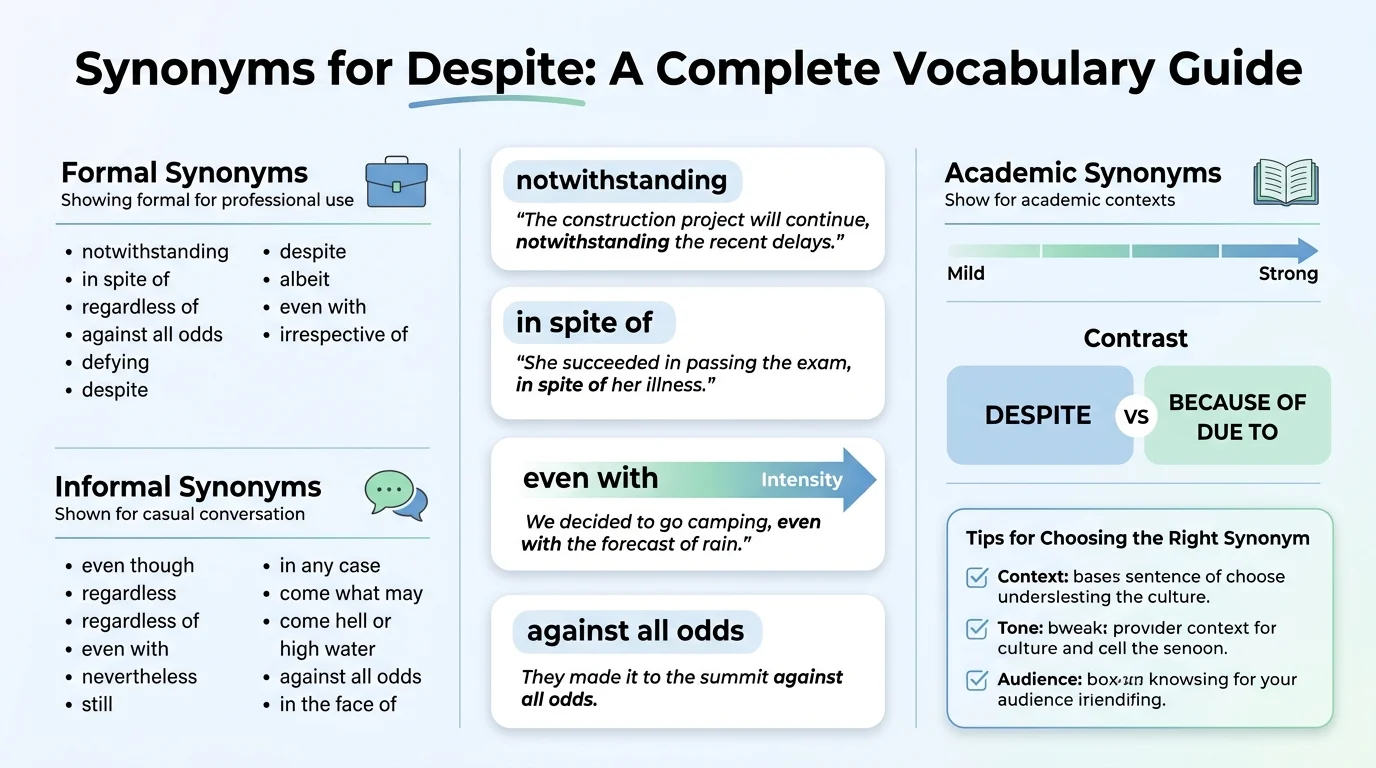
Despite is a preposition that shows contrast between two ideas. It means “without being affected by” or “even though something happened.” For formal writing, try “notwithstanding.” For casual conversation, use “in spite of” or “even with.” Academic writing often prefers “regardless of” or “irrespective of.”
Meaning, Tone and Context
The word “despite” helps you connect two opposing ideas in a single sentence. It signals that one thing happened or is true even when another factor might have prevented it.
Part of speech: Preposition
Tone: Neutral
Formality level: Standard English, suitable for most contexts
Common use cases:
- Academic writing to show research findings that contradict expectations
- Professional communication to acknowledge obstacles while stating results
- Personal stories about overcoming challenges
- News reporting about unexpected outcomes
- Everyday conversation to express surprising situations
Important forms:
Despite is the most common form. “In spite of” means the same thing and is equally correct. Some people mistakenly use “despite of,” which is grammatically incorrect. Always use “despite” alone or “in spite of” with the “of.”
When and How to Use “Despite”
The word “despite” works best when you need to show that one fact does not prevent another fact from being true. Use it to connect a counteracting factor with an outcome that still occurred.
Professional context:
Despite the economic downturn, our company maintained steady growth throughout the fiscal year.
Academic context:
Despite conflicting evidence from earlier studies, the new research clearly demonstrates the link between sleep quality and cognitive performance.
Personal context:
Despite my fear of public speaking, I delivered the presentation without any major issues.
Emotional context:
Despite everything we went through, she remained my closest friend and strongest supporter.
Creative context:
Despite the storm raging outside, the little cafe felt warm and peaceful inside.
Social media context:
Despite the chaos of parenting three young children, we managed to capture this perfect family photo.
Email context:
Despite the tight deadline, our team is confident we can deliver the project on time.
Resume context:
Despite managing a budget reduction of twenty percent, successfully increased departmental efficiency by fifteen percent.
Another Word for “Despite”
The best single replacement depends entirely on your context and audience. Here are the most effective alternatives for different situations.
Professional writing: Notwithstanding
Academic writing: Regardless of
Casual conversation: Even with
Emotional writing: In defiance of
Creative writing: Against all odds
Resume or workplace: In the face of
Social media captions: Even though
Stronger meaning: In spite of everything
Softer meaning: Even considering
When Not to Use “Despite”
Sometimes “despite” sounds too vague or too formal for your intended message. You should avoid it when a more specific word would communicate your meaning more clearly.
Consider this weak sentence:
Despite the rain, we went to the park.
Now compare it with a more descriptive version:
The rain poured down, but we went to the park anyway.
The second version feels more natural and vivid. The first version sounds like a basic vocabulary exercise.
Additional examples of weak “despite” usage:
The team finished the project despite the problems.
Better alternative:
The team finished the project even with technical difficulties and tight deadlines.
She succeeded despite the obstacles.
Better alternative:
She succeeded against considerable odds and fierce competition.
Words Commonly Confused With “Despite”
Many English learners mix up “despite” with similar words. Understanding these differences will improve your accuracy and confidence.
Despite vs. Although
“Despite” is a preposition followed by a noun or noun phrase. “Although” is a conjunction followed by a complete clause with a subject and verb.
Correct with despite: Despite the rain, we walked home.
Correct with although: Although it rained, we walked home.
Despite vs. However
“Despite” connects two ideas within one sentence. “However” starts a new sentence or clause to show contrast.
Despite the high cost, we bought the house.
The house was expensive. However, we bought it anyway.
Despite vs. Nevertheless
“Nevertheless” shows contrast but feels more formal and emphasizes determination.
Despite the criticism, she continued her work.
The criticism was harsh. Nevertheless, she continued her work.
Despite vs. But
“But” is a coordinating conjunction that joins equal parts of a sentence. “Despite” shows stronger contrast with an obstacle.
The car was old but reliable.
Despite its age, the car remained reliable.
Despite vs. In spite of
These mean exactly the same thing. “In spite of” has three words while “despite” is shorter. Both are equally correct in all contexts.
Despite vs. Regardless of
“Regardless of” emphasizes that something is unaffected by any conditions. It suggests a stronger disregard for obstacles.
Despite the weather, we enjoyed our vacation.
Regardless of the weather, we will hold the event outdoors.
Best Synonym by Context for “Despite”
| Context | Best Synonym | Why It Works | Example |
|---|---|---|---|
| Formal writing | Notwithstanding | Adds sophistication and legal precision | Notwithstanding the defendant’s arguments, the jury reached a guilty verdict |
| Academic writing | Regardless of | Emphasizes objective analysis without bias | Regardless of socioeconomic background, all students showed improvement |
| Professional business | In the face of | Highlights resilience and problem solving | In the face of supply chain disruptions, our logistics team found creative solutions |
| Resume building | Against | Shows determination and achievement | Managed to increase sales against a declining market |
| Casual conversation | Even with | Sounds natural and conversational | Even with all that traffic, we still made it on time |
| Creative writing | In defiance of | Adds dramatic and literary quality | In defiance of all reason, she followed her heart |
| Emotional tone | Against all odds | Conveys struggle and triumph | Against all odds, their marriage survived the crisis |
| Strong intensity | In spite of everything | Emphasizes significant obstacles | In spite of everything they said about him, he proved them wrong |
| Soft or moderate | Even considering | Acknowledges factors without strong contrast | Even considering the delays, the project was a success |
| Social media captions | Even though | Creates engaging, relatable content | Even though Mondays are tough, this view makes it all worth it |
Which Synonym Should You Choose?
Selecting the right synonym for despite depends on several factors. Start by considering your audience. Are you writing for professors, coworkers, friends, or social media followers?
Next, think about tone. Formal synonyms like “notwithstanding” work well in legal documents and academic papers. Casual alternatives like “even with” feel natural in emails and conversations.
Consider the emotional weight you want to convey. “Against all odds” adds drama and inspiration. “Regardless of” sounds objective and neutral. “In defiance of” suggests rebellion or strong will.
Pay attention to your sentence structure. Some synonyms work best with nouns, while others need clauses with verbs. Always check that your chosen word fits grammatically.
Finally, read your sentence aloud. Does it sound natural? Does it capture your intended meaning? Trust your ear for what feels right in context.
Real Life Examples of “Despite” in Sentences
School context:
Despite studying for weeks, Maria felt nervous before her final exam.
Workplace context:
Despite the budget cuts, our department exceeded its quarterly targets.
Writing context:
Despite the novel’s slow beginning, readers praised its powerful ending.
Conversation context:
Despite what everyone thinks, I actually enjoy rainy days.
Social media context:
Despite the long hours, we somehow still find time to laugh together.
Email context:
Despite our scheduling conflicts, I believe we can find a time to meet next week.
Storytelling context:
Despite warnings from the villagers, the explorer ventured into the dense forest.
Personal achievement:
Despite my limited experience, I was offered the management position.
Daily life:
Despite the late start, we arrived at the airport with time to spare.
Health and wellness:
Despite her injury, she completed the marathon and inspired everyone.
25 Synonyms for “Despite”
| Synonym | Simple Meaning | Best Used For | Example Sentence |
|---|---|---|---|
| In spite of | Without being affected by | All contexts, interchangeable with despite | In spite of the heavy rain, the parade continued as scheduled |
| Notwithstanding | In spite of something | Formal writing, legal documents | Notwithstanding the evidence, the jury remained undecided |
| Regardless of | Without considering factors | Academic writing, research papers | Regardless of age, all participants showed improvement |
| Even with | Despite having something | Casual conversation, everyday use | Even with his busy schedule, he finds time to exercise |
| Against | In opposition to | Resume writing, achievement statements | Against strong competition, our startup secured funding |
| In the face of | Confronted by challenges | Professional communication, business writing | In the face of criticism, she defended her innovative approach |
| In defiance of | Openly resisting or challenging | Creative writing, dramatic contexts | In defiance of tradition, she wore pants to the formal ceremony |
| Against all odds | Despite very unlikely circumstances | Inspirational writing, personal stories | Against all odds, the small team created a revolutionary product |
| Even considering | Taking factors into account | Balanced analysis, objective discussion | Even considering the risks, the investment proved worthwhile |
| For all | Despite having or showing | Slightly formal, literary use | For all his experience, he still made basic mistakes |
| Without regard to | Not paying attention to something | Formal writing, policy documents | Decisions were made without regard to personal connections |
| Apart from | Except for, not including | Comparing exceptions, academic use | Apart from a few errors, the student’s thesis was excellent |
| Excepting | With the exception of | Formal, legal, or academic | Excepting weather delays, all flights arrived on time |
| Irrespective of | Without being affected by something | Formal writing, professional reports | Irrespective of nationality, all employees receive equal treatment |
| Even after | Following something that might prevent | Narrative writing, personal stories | Even after losing everything, she maintained her optimism |
Synonym Groups and Usage Differences
Professional vs. Personal Synonyms
Professional contexts demand more formal alternatives. “Notwithstanding” and “in the face of” show sophistication in business writing. Personal contexts welcome simpler options like “even with” or “against all odds.” The difference lies in audience expectation and relationship dynamics.
In professional settings, precision matters. Your choice of synonym signals your communication skills. Personal settings prioritize clarity and emotional connection over formality.
Formal vs. Conversational Synonyms
Formal synonyms include “notwithstanding,” “regardless of,” and “irrespective of.” These words appear in reports, academic papers, and formal speeches. They create distance between the speaker and the subject.
Conversational synonyms like “even with,” “even though,” and “for all” feel friendly and approachable. They work well in texts, personal emails, and everyday discussions. The formality level affects how your message is received.
Academic Synonyms
Academic writing requires precise, objective language. “Regardless of” and “irrespective of” appear frequently in research papers. They suggest careful analysis without emotional bias.
“Notwithstanding” is common in academic legal writing. “Even considering” works well when acknowledging counterarguments. These synonyms help maintain an analytical tone in scholarly work.
Professional and Business Synonyms
Business communication often needs words that show resilience and problem solving. “In the face of” suggests overcoming obstacles. “Against” demonstrates competitive achievement.
“Even with” works in internal communications and less formal business contexts. “Without regard to” appears in policy statements and formal procedures. Choose based on your specific business writing needs.
Creative or Literary Synonyms
Creative writing benefits from vivid alternatives. “In defiance of” adds drama and personality. “Against all odds” creates inspiring imagery. “For all” offers a poetic quality.
These synonyms help writers paint pictures with words. They add depth to characters and situations. Literary synonyms elevate ordinary sentences into memorable prose.
Strongest vs. Weaker Synonyms
Mild alternatives: even with, even considering, apart from
Moderate alternatives: in spite of, regardless of, against
Strong alternatives: in defiance of, against all odds, notwithstanding
The intensity of your synonym should match your message. Mild words work for everyday observations. Strong words emphasize significant obstacles and remarkable achievements.
Emotional vs. Neutral Synonyms
Emotional synonyms carry weight and feeling. “Against all odds” inspires hope. “In defiance of” suggests courage. “In the face of” implies struggle.
Neutral synonyms stay factual and objective. “Regardless of” and “irrespective of” remove emotional color. These work best in scientific writing, business reports, and formal documents where feelings should not interfere with facts.
Antonyms of “Despite”
| Antonym | Meaning | Example Sentence |
|---|---|---|
| Because of | As a result of something | Because of her hard work, she received a promotion |
| Due to | Caused by something | Due to the weather, the event was postponed |
| Thanks to | As a result of something positive | Thanks to his guidance, we completed the project |
| Owing to | Because of something | Owing to recent changes, the policy was updated |
| As a result of | Following from something | As a result of the decision, many employees were affected |
| In view of | Considering something | In view of the evidence, the case was dismissed |
| On account of | Because of something | On account of the delays, we missed our connection |
| Given | Taking into consideration | Given the circumstances, we made the right choice |
| Considering | Thinking about a particular fact | Considering the traffic, we arrived early |
| Through | By means of something | Through her connections, she found a new job |
| From | Originating or caused by | From his experience, he learned valuable lessons |
| With | Having or showing something | With your support, we can achieve our goals |
| By means of | Using or through something | By means of technology, we solved the problem |
| In response to | As an answer to something | In response to concerns, changes were implemented |
| Following | After or as a result of | Following the meeting, decisions were made quickly |
Comparison: Despite vs. Similar Words
Despite vs. Although
Main difference: Despite is a preposition followed by a noun. Although is a conjunction followed by a complete clause.
Which is stronger: Both are equally strong for showing contrast.
Which is more formal: Both are standard English. Despite appears slightly more formal in written work.
Example with despite: Despite the rain, we walked to the store.
Example with although: Although it rained, we walked to the store.
Despite vs. However
Main difference: Despite shows contrast within one sentence. However starts a new sentence or clause.
Which is stronger: However creates a stronger break between ideas.
Which is more formal: However is more formal and academic.
Example with despite: Despite the evidence, the jury was uncertain.
Example with however: The evidence was clear. However, the jury remained uncertain.
Despite vs. Nonetheless
Main difference: Despite introduces an obstacle. Nonetheless emphasizes action continuing despite that obstacle.
Which is stronger: Nonetheless shows stronger determination.
Which is more formal: Both are formal, but nonetheless is more literary.
Example with despite: Despite the danger, she entered the building.
Example with nonetheless: The building was dangerous. Nonetheless, she entered.
Despite vs. In Spite Of
Main difference: No difference in meaning. Despite is shorter and often preferred in modern writing.
Which is stronger: Neither is stronger. They are exactly the same.
Which is more formal: Both are equally correct in all contexts.
Example with despite: Despite the cost, we bought it.
Example with in spite of: In spite of the cost, we bought it.
Despite vs. Regardless Of
Main difference: Regardless of suggests that factors do not matter at all. Despite acknowledges they might matter but didn’t prevent the outcome.
Which is stronger: Regardless of shows stronger disregard.
Which is more formal: Both are used in formal writing.
Example with despite: Despite the budget, we finished the project.
Example with regardless of: Regardless of the budget, we finished the project.
Despite vs. Notwithstanding
Main difference: Notwithstanding means “in spite of” but is more formal and often appears in legal writing.
Which is stronger: Both are strong, but notwithstanding sounds more authoritative.
Which is more formal: Notwithstanding is extremely formal and legalistic.
Example with despite: Despite the objections, the plan was approved.
Example with notwithstanding: Notwithstanding the objections, the plan was approved.
Common Phrases and Expressions with “Despite”
1. Despite everything
Meaning: In spite of all difficulties or opposition
Example sentence: Despite everything, she never lost her sense of humor.
2. Despite the fact that
Meaning: Even though something is true
Example sentence: Despite the fact that he was exhausted, he continued working.
3. Despite all odds
Meaning: Even when success seemed impossible
Example sentence: Despite all odds, the small company became an industry leader.
4. Despite appearances
Meaning: Even though things look a certain way
Example sentence: Despite appearances, she was actually very happy with her life.
5. Despite the evidence
Meaning: Even though clear proof exists
Example sentence: Despite the evidence against him, he maintained his innocence.
6. Despite our differences
Meaning: Even though we disagree on some things
Example sentence: Despite our differences, we remain close friends.
7. Despite the challenges
Meaning: Even with many difficulties
Example sentence: Despite the challenges, the team completed the project ahead of schedule.
8. Despite popular belief
Meaning: Even though most people think something
Example sentence: Despite popular belief, not all sharks are dangerous to humans.
Common Mistakes to Avoid
1. Using “despite” when a more precise synonym improves clarity
The sentence “Despite the economy, we grew” is vague. Use “In the face of economic uncertainty, we achieved growth” for stronger impact.
2. Confusing “despite” with “although”
Incorrect: Despite he was tired, he worked late.
Correct: Although he was tired, he worked late.
Also correct: Despite his tiredness, he worked late.
3. Using “despite of”
Incorrect: Despite of the rain, we went outside.
Correct: Despite the rain, we went outside.
Also correct: In spite of the rain, we went outside.
4. Using a casual synonym in formal writing
Incorrect for an academic paper: Even with all that stuff, the results were clear.
Better: Notwithstanding these variables, the results remained consistent.
5. Using an overly dramatic synonym for a simple situation
Overly dramatic: Against all odds, she made her morning coffee.
Better: Even with a broken coffee maker, she managed to brew her morning coffee.
6. Repeating the same word too often
Avoid saying “despite” multiple times in a single paragraph. Vary your vocabulary with different synonyms.
7. Choosing a synonym with the wrong emotional tone
“Despite the positive feedback” suggests surprising contrast. “Notwithstanding the positive feedback” sounds neutral and professional.
8. Using slang in academic or professional writing
Avoid “even though” in formal documents. Save casual synonyms for everyday communication.
FAQs
What is the best synonym for despite?
The best synonym depends on your context. For most situations, “in spite of” works perfectly. For formal writing, use “notwithstanding.”
What is a formal synonym for despite?
“Notwithstanding” is the most formal synonym. “Regardless of” and “irrespective of” also work well in formal writing.
What is an informal synonym for despite?
“Even with” and “even though” are excellent informal alternatives. They sound natural in conversation and casual writing.
What is another word for despite in professional writing?
“In the face of” and “against” work well in professional contexts. They suggest active problem solving and achievement.
What is the difference between despite and although?
Despite is a preposition followed by a noun. Although is a conjunction followed by a complete clause with a subject and verb.
What is the opposite of despite?
“Because of,” “due to,” and “thanks to” are common antonyms. They show cause and effect rather than contrast.
Conclusion
The word “despite” is a valuable tool for expressing contrast in English. It helps you connect opposing ideas and show unexpected outcomes. But using it too often makes your writing feel repetitive and predictable.
Master the synonyms in this guide to add variety and precision to your language. Choose “notwithstanding” for formal documents. Use “even with” for casual conversations. Select “against all odds” when you want to inspire and motivate.
Remember that context matters more than any single word. Consider your audience, your purpose, and your tone before selecting a synonym. Read your sentence aloud to ensure it sounds natural and conveys your intended meaning.
Building a rich vocabulary takes time and practice. Start by replacing one or two repeated uses of “despite” in your next piece of writing. Experiment with different synonyms and notice how they change the feel of your sentences.
If you need to verify definitions or usage examples, consult trusted dictionaries such as Cambridge, Oxford, Merriam Webster, Collins, or Britannica before publishing any work that requires accuracy.