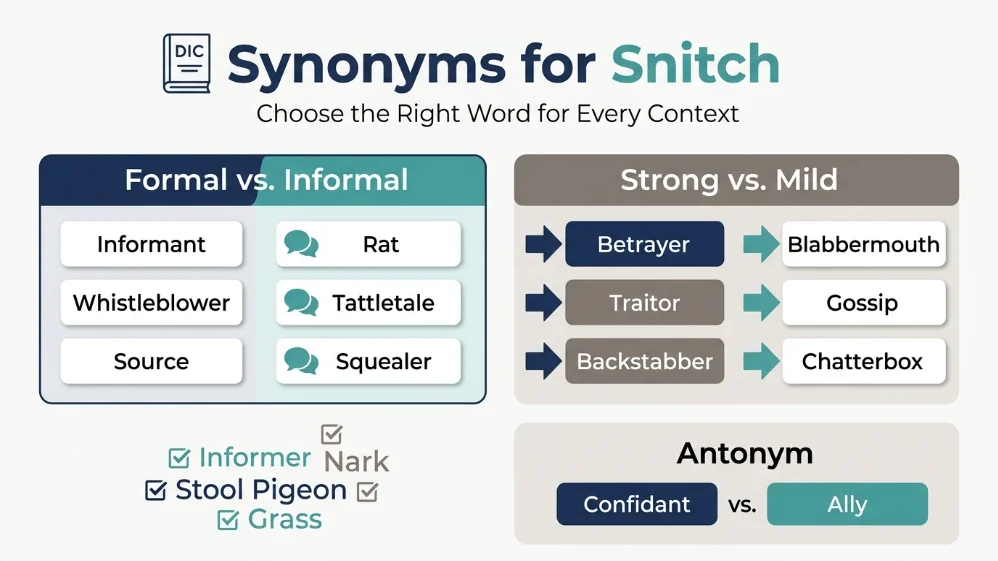
If you’re looking for synonyms for snitch, you’ve come to the right place. The best alternatives depend on whether you mean someone who informs on others, someone who steals, or the act of revealing secrets.
For the most common meaning a person who reports wrongdoing the top synonyms are informant, tattletale, rat, and informer. But the right word for your sentence depends on tone, context, and how serious the situation really is.
This guide covers everything you need to know: what snitch means, when to use each synonym, and how to avoid common mistakes. You’ll find formal options for professional writing, casual words for everyday conversation, and stronger alternatives for serious betrayal.
Best Synonyms for Snitch
The best synonyms for snitch are informant, tattletale, rat, informer, and whistleblower. Choose informant for formal contexts, tattletale for childlike tattling, rat for strong disapproval, and whistleblower for exposing wrongdoing in the public interest. The right choice depends on tone, context, and intensity.
What Does Snitch Mean?
Snitch has two main meanings, both informal:
- As a noun: A person who informs on someone else, often to an authority figure, or someone who steals.
- As a verb: To inform against someone, or to steal something.
The most common usage describes someone who reveals secrets or reports wrongdoing often with a negative connotation of disloyalty. The word carries cultural weight, especially in communities where “snitching” is seen as a serious violation of trust.
The oldest meaning of snitch comes from 18th-century underworld slang, where it meant “nose” possibly because a snitch is nosy. A newer meaning, “to steal,” emerged around the turn of the 20th century as a variation on snatch.
Example sentences:
- “Don’t be a snitch—keep what I told you to yourself.”
- “Someone snitched my wallet right off the table.”
Core Meaning of Snitch
At its heart, snitch is about revealing information that someone wanted kept secret. The word implies a breach of trust, loyalty, or an unspoken code of silence. It’s not neutral like report or inform it carries judgment.
When you call someone a snitch, you’re saying they betrayed confidence for personal gain, to avoid trouble, or simply because they couldn’t keep their mouth shut. The word is almost always negative, though the severity varies widely. A child calling a sibling a snitch for telling on them is very different from a criminal calling someone a snitch for talking to the police.
Grammar and Usage Notes
Part of speech: Noun and verb
Noun: “He’s such a snitch.”
Verb: “She snitched on her coworker.”
Verb (stealing): “Who snitched my pen?”
Common patterns:
- Snitch on [someone] “He snitched on his partner.”
- Snitch to [authority] “She snitched to the teacher.”
- Snitch about [something] “They snitched about the plan.”
Common collocations:
- “Stop snitching” (a well-known anti-snitching phrase)
- “Snitch culture”
- “Snitch line” (anonymous tip hotline)
When snitch sounds natural:
- Casual conversation
- Informal writing
- Dialogue in fiction
- Discussions about loyalty and betrayal
When a synonym may work better:
- Formal or professional writing
- Legal or official contexts
- When you want to avoid the negative judgment
- When the situation involves serious public wrongdoing (use whistleblower)
Best Synonyms for Snitch
| Synonym | Meaning | Tone | Best Use Case | Example Sentence |
|---|---|---|---|---|
| Informant | Someone who gives information to authorities | Neutral to negative | Formal, legal, police contexts | “The informant helped the FBI build its case.” |
| Tattletale | A child who tells on others | Childish, mild | Kids, minor rule-breaking | “My little sister is such a tattletale.” |
| Rat | A betrayer who informs on associates | Strongly negative | Criminal or street contexts | “He ratted out his crew to save himself.” |
| Informer | Someone who gives information, often secretly | Neutral | Journalistic or historical contexts | “The informer revealed the organization’s secrets.” |
| Whistleblower | Someone who exposes wrongdoing in the public interest | Positive to neutral | Corporate, government, ethical contexts | “The whistleblower exposed the company’s fraud.” |
| Squealer | Someone who informs or complains loudly | Negative, informal | Disapproving contexts | “Nobody trusts a squealer.” |
| Telltale | Someone who reveals secrets | Mild, slightly negative | General use, somewhat old-fashioned | “Don’t be a telltale—keep it between us.” |
| Sneak | Someone who informs secretly | Negative | British English, informal | “He’s a sneak who can’t be trusted.” |
| Narc | A police informant or undercover officer | Negative | Street, drug, or criminal contexts | “They thought he was a narc.” |
| Blabbermouth | Someone who can’t keep secrets | Mild, informal | Casual, gossip contexts | “Don’t tell her—she’s a total blabbermouth.” |
Common Synonyms for Snitch
These everyday synonyms work well in normal conversation and writing.
Tattletale
Meaning: Someone who tells on others, especially for minor infractions.
Best context: Children, siblings, school settings, minor rule-breaking.
Example: “Mom, he took my toy without asking!” — “Stop being such a tattletale.”
Rat
Meaning: A person who betrays associates by informing authorities.
Best context: Strong disapproval, criminal or street contexts, serious betrayals.
Example: “He ratted on his partners to get a lighter sentence.”
Squealer
Meaning: Someone who informs on others, often with the implication of complaining or making noise about it.
Best context: Informal, disapproving contexts.
Example: “Nobody in the unit trusts a squealer.”
Telltale
Meaning: A person who reveals secrets or reports others’ wrongdoing.
Best context: General use, slightly old-fashioned but still understood.
Example: “I didn’t want to be a telltale, so I kept quiet about what I saw.”
Sneak
Meaning: A person who acts in a secretive or underhanded way, often by informing.
Best context: British English, informal, disapproving.
Example: “He’s a disloyal sneak who can’t be trusted.”
Formal Synonyms for Snitch
When you’re writing professionally, academically, or legally, these alternatives are more appropriate than snitch.
Informant
Meaning: Someone who gives information to authorities, often secretly.
Tone: Neutral to slightly negative, depending on context.
Best use: Police reports, legal documents, journalism, official communications.
Example: “The informant provided crucial evidence that led to the arrest.”
Informer
Meaning: Someone who informs on others, often in a political or criminal context.
Tone: Neutral, slightly old-fashioned.
Best use: Historical writing, journalism, formal narratives.
Example: “The informer’s testimony was critical to the prosecution’s case.”
Whistleblower
Meaning: Someone who exposes wrongdoing, fraud, or misconduct in an organization.
Tone: Positive to neutral—implies ethical courage.
Best use: Corporate, government, nonprofit, and ethical contexts.
Example: “The whistleblower risked their career to expose the corruption.”
Source
Meaning: Someone who provides information, often to journalists or investigators.
Tone: Neutral, professional.
Best use: Journalism, research, intelligence contexts.
Example: “The journalist protected her source’s identity.”
Confidential Informant
Meaning: An informant whose identity is kept secret.
Tone: Neutral, official.
Best use: Legal, police, and intelligence contexts.
Example: “The FBI relied on a confidential informant to infiltrate the group.”
Witness
Meaning: Someone who provides testimony about what they saw or know.
Tone: Neutral, official.
Best use: Legal proceedings, investigations.
Example: “The witness testified before the grand jury.”
Informal Synonyms for Snitch
These casual alternatives are perfect for conversation, social media, friendly writing, and personal messages.
Rat
Meaning: A betrayer who informs on associates.
Tone: Strongly negative, street-level.
Example: “I can’t believe he ratted us out.”
Narc
Meaning: A police informant or undercover officer.
Tone: Negative, street slang.
Example: “They’ve been acting like narcs all week.”
Squealer
Meaning: Someone who informs or complains.
Tone: Negative, informal.
Example: “Keep your mouth shut unless you want to be called a squealer.”
Blabbermouth
Meaning: Someone who can’t keep secrets.
Tone: Mild, playful or annoyed.
Example: “Don’t tell Rachel—she’s a total blabbermouth.”
Tattletale
Meaning: Someone who tells on others for minor things.
Tone: Childish, mild.
Example: “Quit being a tattletale and mind your own business.”
Stoolie / Stool Pigeon
Meaning: A police informant.
Tone: Negative, old-fashioned slang.
Example: “The gang suspected he was a stoolie.”
Fink
Meaning: A strikebreaker or informant.
Tone: Negative, somewhat dated.
Example: “They called him a fink for talking to management.”
Strong Synonyms for Snitch
These words carry more emotional weight, intensity, or moral judgment. Use them when the betrayal is serious.
Betrayer
Meaning: Someone who breaks trust or loyalty.
Tone: Strongly negative, moral judgment.
Best use: Serious betrayals, emotional contexts.
Example: “He was seen as a betrayer of everything the group stood for.”
Double-crosser
Meaning: Someone who deceives or betrays a partner or associate.
Tone: Strongly negative.
Best use: Crime, business, personal relationships.
Example: “She double-crossed her business partner and walked away with everything.”
Turncoat
Meaning: Someone who switches sides or betrays their group.
Tone: Strongly negative.
Best use: Political, ideological, or group loyalty contexts.
Example: “The turncoat revealed classified information to the enemy.”
Judas
Meaning: A betrayer, from the biblical figure who betrayed Jesus.
Tone: Extremely strong, literary.
Best use: Dramatic or literary contexts.
Example: “He was a Judas to his own family.”
Traitor
Meaning: Someone who betrays their country, cause, or group.
Tone: Extremely strong, serious.
Best use: National security, military, political contexts.
Example: “The traitor sold state secrets to a foreign power.”
Backstabber
Meaning: Someone who betrays you while pretending to be your friend.
Tone: Strong, personal.
Best use: Personal relationships, workplace.
Example: “I thought he was my friend, but he’s a backstabber.”
Mild Synonyms for Snitch
These softer alternatives carry less judgment and are better for minor situations or when you want to avoid sounding harsh.
Tattletale
Meaning: Someone who tells on others for minor things.
Tone: Mild, childish.
Best use: Kids, siblings, minor rule-breaking.
Example: “Don’t be a tattletale—just let it go.”
Telltale
Meaning: Someone who reveals secrets.
Tone: Mild, slightly old-fashioned.
Best use: General use, neutral contexts.
Example: “I didn’t want to be the telltale, but I had to say something.”
Blabbermouth
Meaning: Someone who can’t keep secrets.
Tone: Playful or mildly annoyed.
Best use: Gossip, casual contexts.
Example: “My mom is a blabbermouth—she tells everyone everything.”
Gossip
Meaning: Someone who spreads rumors or personal information.
Tone: Mildly negative.
Best use: Social contexts.
Example: “She’s such a gossip—nothing is safe with her.”
Chatterbox
Meaning: Someone who talks a lot, often revealing things unintentionally.
Tone: Playful, mild.
Best use: Casual contexts.
Example: “My little brother is a chatterbox who can’t keep a secret.”
Synonyms for Snitch by Context
Everyday Conversation
In casual talk, stick with tattletale, rat, squealer, or blabbermouth. These words are widely understood and match the informal tone of most conversations.
Example: “I’m not going to be a tattletale, but you should know what he said.”
Professional Writing
For work-related communication, choose informant, source, or whistleblower. These terms sound professional and avoid the negative judgment of snitch.
Example: “The informant provided the compliance team with the necessary documentation.”
Academic Writing
In essays or research papers, use informer, informant, or whistleblower. These terms are neutral and appropriate for scholarly work.
Example: “Whistleblowers play a crucial role in exposing corporate malfeasance.”
Creative Writing
In fiction, you have more freedom. Use rat, squealer, Judas, or turncoat to create vivid characters and dramatic tension.
Example: “The detective knew his informant was a rat, but he needed the information.”
Marketing Copy
Avoid snitch and its negative synonyms unless you’re targeting a specific edgy audience. Stick with insider, source, or expert for positive connotations.
Example: “Our insider source reveals the secrets behind the industry’s biggest success.”
Emotional Expression
When expressing hurt or betrayal, use backstabber, betrayer, or traitor. These words convey the emotional weight of the situation.
Example: “After everything we’ve been through, you’re going to be a backstabber?”
Technical Writing
In technical or official documents, use confidential informant, source, or witness. Precision and neutrality matter most.
Example: “The confidential informant’s testimony was corroborated by physical evidence.”
Personal Communication
In texts, emails, or personal messages, choose based on your relationship and the seriousness of the situation. Tattletale works for minor issues; rat or squealer for more serious betrayals.
Example: “I can’t believe you’d rat me out like that.”
Another Word for Snitch in a Sentence
Here are 15 natural example sentences using different synonyms for snitch:
- “The informant wore a wire for six months before the operation went down.”
- “My little brother is such a tattletale—he told Mom I ate the last cookie.”
- “He ratted on his partners to avoid going to prison.”
- “The whistleblower risked everything to expose the company’s illegal practices.”
- “Nobody in the neighborhood trusted the known informer.”
- “Don’t be a squealer—keep what I told you to yourself.”
- “She’s a blabbermouth who can’t keep a secret for more than an hour.”
- “The narc infiltrated the drug ring and gathered enough evidence for arrests.”
- “He was called a turncoat for switching sides in the middle of the conflict.”
- “I thought we were friends, but he turned out to be a backstabber.”
- “The stool pigeon testified against the crime family in exchange for protection.”
- “She squealed to the principal about the prank.”
- “The double-crosser took the money and disappeared.”
- “He’s a sneak who can’t be trusted with anything important.”
- “The source requested anonymity but provided valuable information to the reporter.”
Snitch Synonyms Compared
| Synonym | Meaning | Intensity | Formality | Best Used When |
|---|---|---|---|---|
| Informant | Gives information to authorities | Neutral | Formal | Professional, legal contexts |
| Tattletale | Tells on others for minor things | Mild | Informal | Kids, minor issues |
| Rat | Betrays associates to authorities | Strong | Informal | Serious betrayals, disapproval |
| Whistleblower | Exposes wrongdoing | Neutral to positive | Formal | Ethical, corporate, government contexts |
| Squealer | Informs or complains | Moderate | Informal | Disapproving contexts |
| Blabbermouth | Can’t keep secrets | Mild | Informal | Gossip, casual contexts |
| Betrayer | Breaks trust | Strong | Formal | Emotional, serious betrayals |
| Narc | Police informant | Strong | Slang | Street, drug contexts |
The key difference is intensity and context. Tattletale is for playground tattling; rat is for serious criminal betrayal. Whistleblower carries a positive connotation of ethical courage; snitch is almost always negative.
Words Similar to Snitch
These words belong to the same semantic field but aren’t always exact synonyms. Use them carefully.
Gossip
Related because: Both involve sharing information that might be secret.
Why it’s not a direct synonym: Gossip is about spreading rumors or personal details, not necessarily reporting to authority.
When it works: “She’s a gossip who can’t keep anything to herself.”
Spy
Related because: Both involve gathering and reporting information secretly.
Why it’s not a direct synonym: Spies work for a government or organization; snitches usually work for themselves or to avoid trouble.
When it works: “He was accused of being a spy for the competition.”
Mole
Related because: Both involve being inside an organization and reporting information.
Why it’s not a direct synonym: Moles are planted spies who work undercover long-term; snitches are often opportunists.
When it works: “The mole had been feeding information to the rival company for years.”
Leaker
Related because: Both involve revealing confidential information.
Why it’s not a direct synonym: Leakers reveal information to the public or media; snitches often report to authorities.
When it works: “The leaker released classified documents to the press.”
Confidant
Related because: Both involve secrets.
Why it’s not a direct synonym: A confidant is trusted with secrets; a snitch betrays that trust.
When it works: “She was my confidant—I told her everything.”
Antonyms of Snitch
| Antonym | Meaning | Example Sentence |
|---|---|---|
| Confidant | Someone trusted with secrets | “She was my confidant for over a decade.” |
| Ally | A trusted partner or friend | “He remained a loyal ally through the crisis.” |
| Loyalist | Someone who stays faithful | “The loyalist refused to betray his comrades.” |
| Protector | Someone who shields or defends | “She protected her friends by keeping quiet.” |
| Accomplice | A partner in wrongdoing | “The accomplice kept silent to protect the others.” |
| Supporter | Someone who backs or defends | “He was a steadfast supporter through everything.” |
Opposite actions:
- Conceal vs. reveal — “He concealed the truth to protect his friend.”
- Protect vs. inform — “She protected her brother by not telling Mom.”
- Withhold vs. divulge — “They withheld information from the investigators.”
How to Choose the Right Synonym for Snitch
Choosing the right word isn’t complicated if you follow these practical guidelines:
1. Match the context. Are you writing a legal report, a text message, or a novel? Formal contexts need formal words (informant, whistleblower). Casual contexts allow casual words (tattletale, rat).
2. Match the tone. Do you want to sound neutral, negative, or positive? Snitch is negative. Whistleblower can be positive. Informant is neutral.
3. Check the intensity. Is this a minor childhood tattle or a serious criminal betrayal? Use mild words (tattletale) for minor issues and strong words (traitor, betrayer) for serious ones.
4. Think about your reader. Will they understand the word? Will they be offended? Choose words that fit your audience’s expectations.
5. Check if the synonym is exact or only related. Gossip and snitch overlap but aren’t the same. Make sure the word you choose actually means what you want to say.
6. Keep the sentence natural. Read it aloud. If it sounds forced or awkward, try a different word.
7. When clarity matters, use the simplest word. Sometimes snitch is the clearest, most direct choice—especially in informal writing.
Common Mistakes When Using Synonyms for Snitch
Mistake 1: Using “whistleblower” for petty tattling.
Whistleblower implies exposing serious wrongdoing in the public interest. Don’t use it for a child telling on their sibling. Use tattletale instead.
Mistake 2: Using “rat” in formal writing.
Rat is too informal and strongly negative for professional or academic contexts. Use informant or source.
Mistake 3: Using “tattletale” for serious betrayals.
Tattletale sounds childish. For serious betrayals, use betrayer, traitor, or double-crosser.
Mistake 4: Treating “gossip” as a direct synonym.
Gossip spreads rumors; a snitch reports to authority. They’re different actions.
Mistake 5: Using a synonym that’s too strong.
Calling someone a traitor for a minor infraction is overkill. Match the intensity to the situation.
Mistake 6: Making the sentence sound unnatural.
If the synonym feels forced, it probably is. Choose a word that flows naturally in your sentence.
Quick Synonym List for Snitch
Common synonyms:
tattletale, rat, squealer, telltale, sneak, blabbermouth
Formal synonyms:
informant, informer, whistleblower, source, confidential informant, witness
Informal synonyms:
rat, narc, squealer, blabbermouth, tattletale, stoolie, fink
Strong synonyms:
betrayer, double-crosser, turncoat, Judas, traitor, backstabber
Mild synonyms:
tattletale, telltale, blabbermouth, gossip, chatterbox
Related words:
gossip, spy, mole, leaker, confidant, source
FAQs About Synonyms for Snitch
What is the best synonym for snitch?
The best synonym depends on your context. For formal writing, use informant. For casual conversation, use tattletale or rat. Exposing wrongdoing in the public interest, use whistleblower.
What is another word for snitch?
Another word for snitch is informer, tattletale, rat, squealer, or whistleblower. The best choice depends on tone, context, and the seriousness of the situation.
What is a formal synonym for snitch?
Formal synonyms include informant, informer, whistleblower, source, confidential informant, and witness. These are appropriate for legal, academic, and professional contexts.
What is an informal synonym for snitch?
Informal synonyms include rat, narc, squealer, blabbermouth, tattletale, stoolie, and fink. These work well in conversation and casual writing.
What is a stronger word for snitch?
Stronger words include betrayer, double-crosser, turncoat, Judas, traitor, and backstabber. These carry more emotional weight and moral judgment.
What is a milder word for snitch?
Milder words include tattletale, telltale, blabbermouth, gossip, and chatterbox. These are less harsh and better for minor situations.
What words are similar to snitch?
Related words include gossip, spy, mole, leaker, and confidant. These share the idea of secrets and information but aren’t exact synonyms.
What is the opposite of snitch?
The opposite of a snitch is a confidant, ally, loyalist, protector, or accomplice—someone who keeps secrets rather than revealing them.
How do I choose the right synonym for snitch?
Match your word to your context, tone, and intensity. Use formal words for professional writing, informal words for conversation, mild words for minor issues, and strong words for serious betrayals.
Conclusion
Finding the right synonyms for snitch comes down to understanding what you’re really trying to say. Are you describing a child telling on a sibling? Use tattletale. A criminal betraying their crew? Use rat or betrayer. A courageous employee exposing corporate fraud? Use whistleblower. A police informant in an official report? Use informant.
The best word isn’t always the first one that comes to mind. Take a moment to consider your context, your tone, and your reader. The right choice will make your writing clearer, more precise, and more effective. And when in doubt, keep it simple sometimes snitch is exactly the word you need.