Have you ever found yourself writing an essay, a business email, or a social media post and realized you keep using the same word over and over? You know the meaning you want to convey, but the word counterclaim just keeps appearing in every sentence. Whether you are drafting a legal argument, structuring a persuasive essay, or responding to a colleague’s proposal, finding the right synonyms of counterclaim can transform your writing from repetitive to remarkable. Choosing the right alternative improves clarity, adjusts tone, and makes your communication more precise. This guide will help you understand the word deeply and select the perfect synonym for every situation.
What Are the Best Synonyms of “Counterclaim”?
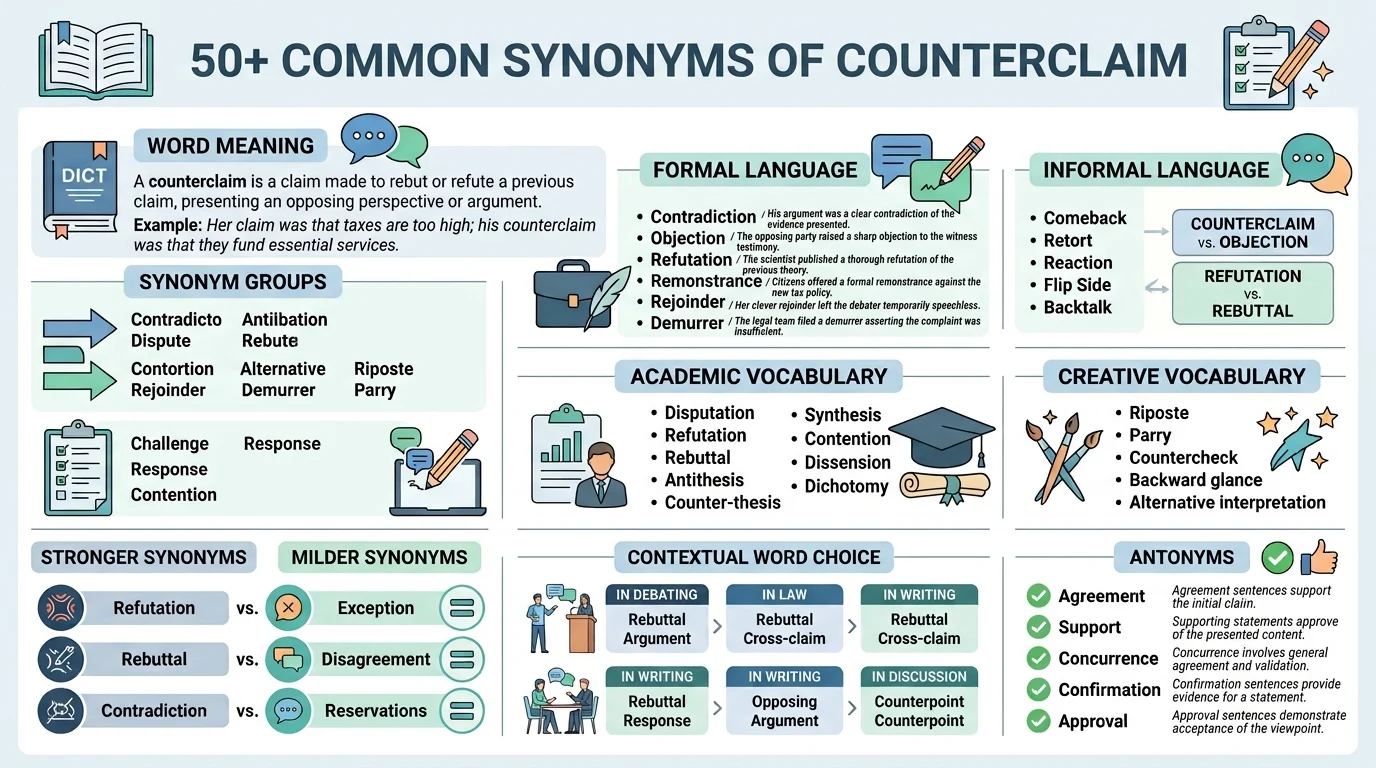
A counterclaim is an opposing claim or argument made in response to another claim. For formal writing, use rebuttal or refutation. For professional settings, choose counterargument or response. In casual conversation, comeback or reply work well. The best synonym depends on your audience and purpose.
Meaning, Tone, and Context
Simple Definition
A counterclaim is a claim made to oppose or offset another claim. It can be a legal action filed by a defendant against a plaintiff, or simply an opposing argument in a debate or discussion.
Part of Speech
- Noun: A claim filed in opposition to another claim
- Verb: To set up a claim in opposition to a previous claim
Overall Tone
Neutral. The word itself does not carry strong positive or negative emotion. Its tone depends entirely on the context in which it is used.
Formality Level
Semi‑formal to formal. Counterclaim is commonly used in legal, academic, and professional writing. It is less common in casual conversation, though it can appear in debates and discussions.
Common Uses
Native English speakers use counterclaim in three main situations:
- Legal contexts: When a defendant files a claim against a plaintiff in response to a lawsuit
- Academic writing: When presenting an opposing argument in an essay or research paper
- Debates and discussions: When offering a contrasting viewpoint in a structured argument
Word Forms
- Noun: counterclaim (plural: counterclaims)
- Verb: counterclaim (past tense: counterclaimed; present participle: counterclaiming)
- Related forms: counterclaimant (noun, one who brings a counterclaim)
- Opposite form: claim, assertion, admission
When and How to Use “Counterclaim”
Choose counterclaim when you need to describe a response that directly opposes a previous claim, especially in formal or structured contexts. Here are seven realistic examples:
Professional (Legal)
The defendant filed a counterclaim against the plaintiff, alleging breach of contract.
Academic
In her research paper, Maria presented a counterclaim to challenge the prevailing theory.
Workplace
During the meeting, James offered a counterclaim to the proposed budget cuts.
Personal
When my friend accused me of being late, I made a counterclaim about her own tardiness.
Please review the attached counterclaim and provide your feedback before the hearing.
Resume
Successfully drafted and filed a counterclaim that resulted in a favorable settlement.
The debate was filled with claims and counterclaims from both sides.
Best Synonyms of “Counterclaim”
No synonym is identical in every situation. The right choice depends on your audience, purpose, and tone. Here are the best recommendations for specific contexts:
Professional writing: Use counterargument or response. These terms sound polished and appropriate for business communication.
Academic writing: Choose rebuttal or refutation. These words carry intellectual weight and show you have considered opposing views.
Business communication: Countercharge works well when addressing accusations in a professional setting.
Casual conversation: Comeback or reply feel natural and conversational.
Emotional writing: Retort adds a sharp, emotional edge to a response.
Creative writing: Riposte brings a literary, elegant quality to dialogue.
Resume writing: Cross-claim or countersuit demonstrate legal expertise.
Workplace communication: Response or answer are safe, neutral choices.
Stronger meaning: Confutation or refutation show definitive opposition.
Softer meaning: Reply or response soften the confrontational tone.
When Not to Use “Counterclaim”
When the Word Sounds Too Formal
Counterclaim is formal and may feel out of place in casual writing. If you are texting a friend or writing a lighthearted blog post, choose reply or comeback instead.
- Too formal: I have a counterclaim to your suggestion about dinner.
- Better: I have a response to your suggestion about dinner.
When the Word Sounds Too Vague
Counterclaim specifically means an opposing claim. If you simply mean a general answer, use reply or response.
- Too vague: Please send your counterclaim by Friday. (if no opposing claim exists)
- Better: Please send your response by Friday.
When the Word Sounds Too Legal
Outside of legal contexts, counterclaim can sound overly technical. In everyday conversation, objection or challenge may be more appropriate.
- Too legal: I have a counterclaim about your opinion.
- Better: I have an objection to your opinion.
When the Word Sounds Too Weak
If you need to express strong opposition, counterclaim may not carry enough weight. Use refutation or confutation instead.
- Too weak: Her counterclaim was not convincing.
- Better: Her refutation was thorough and convincing.
When the Word Sounds Too Strong
If you simply want to acknowledge a different perspective without confrontation, counterclaim feels too aggressive. Use alternative view or different perspective.
- Too strong: Let me present a counterclaim to your idea.
- Better: Let me present an alternative view.
Words Commonly Confused With “Counterclaim”
Counterclaim vs Counterargument
Difference: Counterargument is broader and refers to any opposing argument in a discussion. Counterclaim is more specific and often implies a formal or legal setting.
When to Use It: Use counterargument in essays and debates. Use counterclaim in legal documents and formal responses.
Example (counterargument): The author presents a strong counterargument to the prevailing theory.
Example (counterclaim): The defendant filed a counterclaim against the plaintiff.
Counterclaim vs Rebuttal
Difference: A rebuttal is the act of disproving or contradicting a claim. A counterclaim is the claim itself that opposes another claim.
When to Use It: Use rebuttal when focusing on the act of disproving. Use counterclaim when referring to the opposing claim itself.
Example (rebuttal): Her rebuttal effectively dismantled his argument.
Example (counterclaim): His counterclaim presented a completely different version of events.
Counterclaim vs Refutation
Difference: Refutation means proving a claim to be false. Counterclaim simply offers an opposing claim without necessarily disproving the original.
When to Use It: Use refutation when you have evidence that disproves the original claim. Use counterclaim when you are presenting an alternative claim.
Example (refutation): The evidence provided a clear refutation of the accusation.
Example (counterclaim): The defense offered a counterclaim alleging misconduct by the plaintiff.
Counterclaim vs Cross‑claim
Difference: A counterclaim is brought by a defendant against a plaintiff. A cross‑claim is brought by one party against a co‑party on the same side of a case.
When to Use It: Use counterclaim when the defendant is suing the plaintiff. Use cross‑claim when one defendant is suing another defendant.
Example (counterclaim): The defendant filed a counterclaim against the original plaintiff.
Example (cross‑claim): One defendant filed a cross‑claim against the other defendant.
Counterclaim vs Countersuit
Difference: Countersuit is a specific legal term meaning a lawsuit filed in response to another lawsuit. Counterclaim is broader and can refer to any opposing claim, not just lawsuits.
When to Use It: Use countersuit exclusively in legal contexts. Use counterclaim in both legal and non‑legal situations.
Example (countersuit): The company filed a countersuit for defamation.
Example (counterclaim): In the debate, each side presented counterclaims.
Counterclaim vs Reply
Difference: Reply is a general term for any response. Counterclaim specifically means an opposing response that challenges the original claim.
When to Use It: Use reply for any response. Use counterclaim when the response directly opposes a previous claim.
Example (reply): I sent a reply to her email within an hour.
Example (counterclaim): His reply included a counterclaim that shifted the entire argument.
Best Synonyms of “Counterclaim” by Context
| Context | Best Synonym | Why It Works | Example |
|---|---|---|---|
| Formal writing | Rebuttal | Sounds authoritative and precise | The scholar offered a detailed rebuttal to the theory. |
| Academic writing | Refutation | Shows intellectual rigor | Her refutation of the hypothesis was well supported. |
| Professional communication | Counterargument | Balanced and respectful | We should consider the counterargument before deciding. |
| Business emails | Response | Neutral and professional | Please provide your response to the proposal. |
| Resume writing | Countersuit | Demonstrates legal expertise | Managed a countersuit that resulted in a settlement. |
| Workplace communication | Answer | Clear and direct | His answer addressed all the concerns raised. |
| Casual conversation | Comeback | Natural and conversational | She had a quick comeback to his teasing. |
| Everyday speaking | Reply | Simple and versatile | I gave a simple reply to her question. |
| Creative writing | Riposte | Elegant and literary | His riposte was as sharp as it was witty. |
| Storytelling | Retort | Adds dramatic tension | Her retort silenced the room. |
| Emotional writing | Countercharge | Carries emotional weight | The countercharge added fuel to the fire. |
| Strong emphasis | Confutation | Definitively opposes | His confutation left no room for doubt. |
| Mild tone | Response | Gentle and non‑confrontational | I offered a mild response to her comment. |
| Social media captions | Reply | Short and engaging | His reply went viral within hours. |
| American English | Counterclaim | Standard spelling | The attorney filed a counterclaim. |
How to Choose the Best Synonym of “Counterclaim”
Choosing the right synonym requires considering several factors:
Consider your audience: Are you writing for a legal professional, a professor, or a friend? Formal audiences expect formal language. Casual audiences appreciate simpler words.
Your tone: Do you want to sound aggressive, neutral, or polite? Retort and riposte sound sharp. Response and reply sound neutral. Alternative view sounds polite.
Your purpose: Are you disproving a claim, offering a different perspective, or simply responding? Refutation disproves. Counterargument offers a different perspective. Reply simply responds.
Consider emotional strength: Confutation is very strong. Rebuttal is moderately strong. Response is mild.
Consider formality: Counterclaim and refutation are formal. Comeback and reply are informal.
Trust what sounds natural: Read your sentence aloud with each synonym. The one that feels most natural is usually the right choice.
Real Life Examples of “Counterclaim”
School
In my history essay, I presented a counterclaim to challenge the textbook’s interpretation.
College
The professor asked us to include at least one counterclaim in our research papers.
Workplace
During the strategy meeting, David offered a counterclaim that made everyone reconsider their position.
Business
The company’s legal team prepared a counterclaim to protect their intellectual property.
I have attached the counterclaim for your review before we submit it to the court.
Resume
Drafted and filed counterclaims in multiple civil litigation cases.
Conversation
When my brother said I was lazy, my counterclaim was that I had worked twice as hard as he had.
Storytelling
The villain’s counterclaim caught the hero completely off guard.
Blogging
In my post about remote work, I included a counterclaim from a manager who opposed the trend.
The comment section was filled with claims and counterclaims about the new policy.
18 Best Synonyms of “Counterclaim”
| Synonym | Simple Meaning | Best Used For | Example Sentence |
|---|---|---|---|
| Rebuttal | An argument that disproves another | Formal debates and academic writing | His rebuttal effectively challenged every point she made. |
| Refutation | Evidence that proves a claim false | Academic papers and research | The study provided a clear refutation of the hypothesis. |
| Counterargument | An argument that opposes another | Essays and professional discussions | We need to address the counterargument in our proposal. |
| Reply | A simple response to something | Everyday conversation and emails | I sent a quick reply to her question. |
| Response | An answer or reaction | Professional and casual settings | Her response was thoughtful and well reasoned. |
| Rejoinder | A clever or sharp reply | Formal writing and speeches | His rejoinder left the audience laughing. |
| Retort | A sharp, often angry reply | Emotional or dramatic situations | Her retort made him regret his comment. |
| Riposte | A quick, witty reply | Creative and literary writing | The character’s riposte was both clever and cutting. |
| Comeback | A quick reply, often in a debate | Casual conversation and social media | She always has a good comeback ready. |
| Countercharge | An accusation made in response to another | Legal and professional disputes | The countercharge shifted the focus of the trial. |
| Countersuit | A lawsuit filed in response to another | Legal contexts | The company filed a countersuit for damages. |
| Cross‑claim | A claim against a co‑party | Legal proceedings | The defendant filed a cross‑claim against the co‑defendant. |
| Confutation | The act of proving something false | Academic and formal writing | His confutation was based on solid evidence. |
| Objection | A statement of disagreement | Meetings and legal settings | I have an objection to that proposal. |
| Challenge | A call to question or dispute | Professional and casual contexts | Her challenge forced us to rethink our approach. |
| Opposition | The act of resisting or disagreeing | Formal and political writing | The opposition to the plan was overwhelming. |
| Pushback | Resistance or criticism in response | Business and workplace contexts | We received significant pushback from the team. |
| Counterstatement | A statement that opposes another | Formal writing | Her counterstatement clarified her position. |
Synonyms of “Counterclaim” by Usage
Professional vs Personal Synonyms
Professional settings: Use rebuttal, refutation, counterargument, response, and countercharge. These words sound competent and appropriate for workplace communication.
Personal settings: Use comeback, reply, retort, and pushback. These words feel natural in conversations with friends and family.
Formal vs Conversational Synonyms
Formal synonyms: Counterclaim, rebuttal, refutation, confutation, rejoinder, and counterstatement are suitable for reports, essays, business writing, and presentations.
Conversational synonyms: Comeback, reply, response, and pushback work well in casual conversations, texting, and social media.
Academic Synonyms
For research, essays, reports, and academic discussions, choose refutation, rebuttal, counterargument, and confutation. These words sound authoritative and demonstrate intellectual engagement with opposing views.
Professional and Business Synonyms
For resumes, interviews, meetings, presentations, performance reviews, client communication, and business emails, choose counterargument, response, countercharge, and countersuit. These words project competence and professionalism.
Creative and Literary Synonyms
For storytelling, fiction, poetry, descriptive writing, and speeches, choose riposte, retort, rejoinder, and comeback. These words add emotion, imagery, and dramatic tension to your writing.
Slang or Modern Synonyms
Pushback is a modern, informal term meaning resistance or criticism in response to an idea or proposal. It is acceptable in business and casual contexts but should be avoided in formal academic or legal writing.
Strongest to Mildest Synonyms
| Intensity | Synonyms |
|---|---|
| Mild | Reply, response, answer |
| Moderate | Counterargument, counterstatement, objection |
| Strong | Rebuttal, refutation, countercharge, pushback |
| Very Strong | Confutation, countersuit, retort (emotionally sharp) |
Emotional vs Neutral Synonyms
Emotional Synonyms: Retort, riposte, rejoinder, and comeback carry emotional weight and are often used in charged or dramatic situations.
Neutral Synonyms: Reply, response, answer, counterargument, and counterstatement simply communicate information without adding emotion. Use these when you want to remain objective and professional.
Antonyms of “Counterclaim”
| Antonym | Meaning | Example Sentence |
|---|---|---|
| Claim | A statement asserting something as true | The plaintiff’s claim was supported by evidence. |
| Assertion | A confident statement of fact | His assertion went unchallenged. |
| Admission | Acknowledgment that something is true | Her admission of guilt ended the debate. |
| Concession | Yielding to an opposing argument | The concession allowed the discussion to move forward. |
| Acceptance | Agreement with a claim or idea | His acceptance of the proposal was immediate. |
| Agreement | Harmony of opinion | We reached an agreement after hours of discussion. |
| Confirmation | Evidence that supports a claim | The data provided confirmation of the theory. |
| Affirmation | Emotional support or agreement | Her affirmation gave him confidence. |
| Approval | Formal agreement or consent | The board gave its approval to the plan. |
| Endorsement | Public support for a claim | The endorsement strengthened his argument. |
| Support | Evidence that backs a claim | The research offered strong support for the hypothesis. |
| Ratification | Formal approval | The ratification of the treaty was unanimous. |
| Corroboration | Confirmation by additional evidence | The witness provided corroboration of the events. |
| Verification | Proof that something is true | The verification confirmed the accuracy of the report. |
| Acquiescence | Passive acceptance | His acquiescence surprised everyone. |
Comparison: “Counterclaim” vs Similar Words
Counterclaim vs Rebuttal
Main Difference: Counterclaim is the opposing claim itself. Rebuttal is the act or argument that disproves or contradicts another claim.
Which Is Stronger?: Rebuttal is stronger because it implies successful opposition.
Which Is More Formal?: Both are formal, but rebuttal is more common in academic and legal writing.
When to Use Each: Use counterclaim when presenting an opposing claim. Use rebuttal when actively disproving a claim.
Examples:
- Counterclaim: The defense filed a counterclaim against the plaintiff.
- Rebuttal: Her rebuttal dismantled his entire argument.
Counterclaim vs Refutation
Main Difference: Counterclaim offers an opposing claim. Refutation proves the original claim false.
Which Is Stronger?: Refutation is stronger because it invalidates the original claim.
Which Is More Formal?: Refutation is more formal and academic.
When to Use Each: Use counterclaim when presenting an alternative. Use refutation when you have evidence that disproves the original.
Examples:
- Counterclaim: The defendant’s counterclaim alleged fraud.
- Refutation: The evidence provided a complete refutation of the accusation.
Counterclaim vs Counterargument
Main Difference: Counterargument is a general term for any opposing argument. Counterclaim is more specific and often legal or formal.
Which Is Stronger?: Counterclaim can be stronger in legal contexts.
Which Is More Formal?: Counterclaim is more formal.
When to Use Each: Use counterargument in essays and discussions. Use counterclaim in legal documents.
Examples:
- Counterargument: The essay presented a strong counterargument.
- Counterclaim: The attorney filed a counterclaim.
Counterclaim vs Objection
Main Difference: Counterclaim is a full opposing claim. Objection is a specific statement of disagreement.
Which Is Stronger?: Counterclaim is stronger because it presents a complete alternative.
Which Is More Formal?: Both are formal, but objection is common in legal and meeting contexts.
When to Use Each: Use counterclaim when presenting a full opposing argument. Use objection when raising a specific point of disagreement.
Examples:
- Counterclaim: The defendant filed a counterclaim for damages.
- Objection: I have an objection to that clause in the contract.
Counterclaim vs Response
Main Difference: Response is any answer or reaction. Counterclaim is a specific type of response that opposes a claim.
Which Is Stronger?: Counterclaim is stronger because it actively opposes.
Which Is More Formal?: Counterclaim is more formal.
When to Use Each: Use response for any reply. Use counterclaim when the reply directly opposes a previous claim.
Examples:
- Response: Her response to the email was prompt.
- Counterclaim: His response included a counterclaim that changed the direction of the discussion.
Counterclaim vs Countersuit
Main Difference: Countersuit is exclusively a legal term meaning a lawsuit filed in response to another lawsuit. Counterclaim can be legal or non‑legal.
Which Is Stronger?: Countersuit is stronger in legal contexts.
Which Is More Formal?: Both are formal, but countersuit is more specialized.
When to Use Each: Use countersuit only in legal writing. Use counterclaim in both legal and general contexts.
Examples:
- Countersuit: The company filed a countersuit for defamation.
- Counterclaim: In the debate, each side presented counterclaims.
Common Phrases and Expressions with “Counterclaim”
File a counterclaim
Meaning: To formally submit an opposing claim, especially in a legal context.
Example: The defendant decided to file a counterclaim against the plaintiff.
Claims and counterclaims
Meaning: A situation where both sides are making opposing claims.
Example: The negotiation was filled with claims and counterclaims from both parties.
Make a counterclaim
Meaning: To present an opposing claim or argument.
Example: She made a counterclaim that challenged the entire premise of his argument.
Respond with a counterclaim
Meaning: To reply to an accusation or claim by presenting an opposing claim.
Example: The company responded with a counterclaim alleging unfair competition.
Counterclaim for damages
Meaning: A counterclaim that seeks financial compensation.
Example: The defendant filed a counterclaim for damages resulting from the plaintiff’s negligence.
Pursue counterclaims
Meaning: To actively seek to advance or win a counterclaim.
Example: The company is actively evaluating its legal strategy including pursuing counterclaims.
Bring a counterclaim
Meaning: To initiate a counterclaim in a legal or formal setting.
Example: The attorney advised his client to bring a counterclaim against the accuser.
Common Mistakes to Avoid
1: Choosing a Vague Synonym Instead of a Precise One
Using “reply” when you mean a formal opposing claim weakens your writing.
- Incorrect: The defendant’s reply was submitted to the court.
- Better: The defendant’s counterclaim was submitted to the court.
Why: Reply is too vague in a legal context. Counterclaim specifies the type of response.
2: Confusing Counterclaim with Cross‑claim
These terms have specific legal meanings and are not interchangeable.
- Incorrect: The defendant filed a cross‑claim against the plaintiff.
- Better: The defendant filed a counterclaim against the plaintiff.
Why: A cross‑claim is against a co‑party, not the plaintiff.
3: Using an Informal Synonym in Formal Writing
“Comeback” has no place in a legal document or academic paper.
- Incorrect: The lawyer’s comeback was filed with the court.
- Better: The lawyer’s counterclaim was filed with the court.
Why: Comeback is conversational and lacks the gravitas required in formal writing.
4: Selecting an Overly Dramatic Synonym
“Retort” adds emotional sharpness that may be inappropriate in neutral professional communication.
- Incorrect: Her retort to the proposal was well received.
- Better: Her response to the proposal was well received.
Why: Retort implies a sharp or angry reply, which may not fit a neutral professional setting.
5: Repeating the Same Word Too Often
Using “counterclaim” repeatedly in a single paragraph makes your writing feel repetitive.
- Incorrect: The counterclaim was strong. The counterclaim included new evidence. The counterclaim surprised everyone.
- Better: The counterclaim was strong. It included new evidence. The rebuttal surprised everyone.
Why: Varying your word choice keeps your writing engaging and dynamic.
6: Choosing a Synonym with the Wrong Emotional Tone
Using “confutation” when you simply mean a polite alternative perspective sounds aggressive.
- Incorrect: I would like to offer a confutation of your idea.
- Better: I would like to offer an alternative perspective on your idea.
Why: Confutation implies you are proving the idea false, which may be too strong for a collaborative setting.
7: Using Slang in Academic or Professional Writing
“Pushback” is modern and casual. It does not belong in formal academic papers or legal documents.
- Incorrect: The pushback to the theory was significant.
- Better: The opposition to the theory was significant.
Why: Pushback is acceptable in business settings but too informal for academic writing.
Frequently Asked Questions
1. What are the best synonyms of “counterclaim”?
The best synonyms depend on context. Formal writing, use rebuttal or refutation. For professional settings, choose counterargument or response. For casual conversation, comeback or reply work well.
2. What are the best formal synonyms of “counterclaim”?
The best formal synonyms are rebuttal, refutation, confutation, rejoinder, and counterstatement. These words are appropriate for academic papers, legal documents, and professional presentations.
3. What are common informal synonyms of “counterclaim”?
Common informal synonyms include comeback, reply, response, and pushback. These words are suitable for casual conversations, social media, and everyday writing.
4. What is another word for “counterclaim” in professional writing?
In professional writing, use counterargument, response, or countercharge. These words sound polished and appropriate for business communication, emails, and workplace discussions.
5. What is the difference between “counterclaim” and “rebuttal”?
A counterclaim is an opposing claim itself. A rebuttal is the argument or evidence that disproves or contradicts another claim. Counterclaim presents an alternative; rebuttal actively opposes and seeks to invalidate.
6. What is the opposite of “counterclaim”?
The opposite of counterclaim includes claim, assertion, admission, concession, and acceptance. These words represent agreement, acknowledgment, or the original claim rather than an opposing response.
Conclusion
A counterclaim is an opposing claim made in response to another claim, whether in a courtroom, a classroom, or a casual conversation. The best synonyms of counterclaim depend entirely on your audience, tone, and purpose. Formal and academic writing, choose rebuttal or refutation. For professional settings, counterargument or response work well. For casual conversations, comeback or reply feel natural. No synonym works perfectly in every situation, so always consider who you are writing for and what you want to communicate. The next time you reach for the word counterclaim, pause and ask yourself whether a more precise, more appropriate synonym might serve you better. Your readers will notice the difference.