Have you ever stared at a sentence and realized you’ve used the word conversely three times in one paragraph? Whether you’re writing an academic essay, a business email, or a social media caption, repeating the same transition word weakens your message. Finding the right synonyms of conversely can transform your writing from repetitive to refined.
The word conversely is a powerful tool for showing contrast and reversal. But using it too often makes your writing sound mechanical. By learning the best synonyms of conversely, you can match your word choice to your audience, tone, and purpose. This guide will help you understand exactly what conversely means, when to use it, and which alternatives work best in every situation.
What Are the Best Synonyms of “Conversely”?
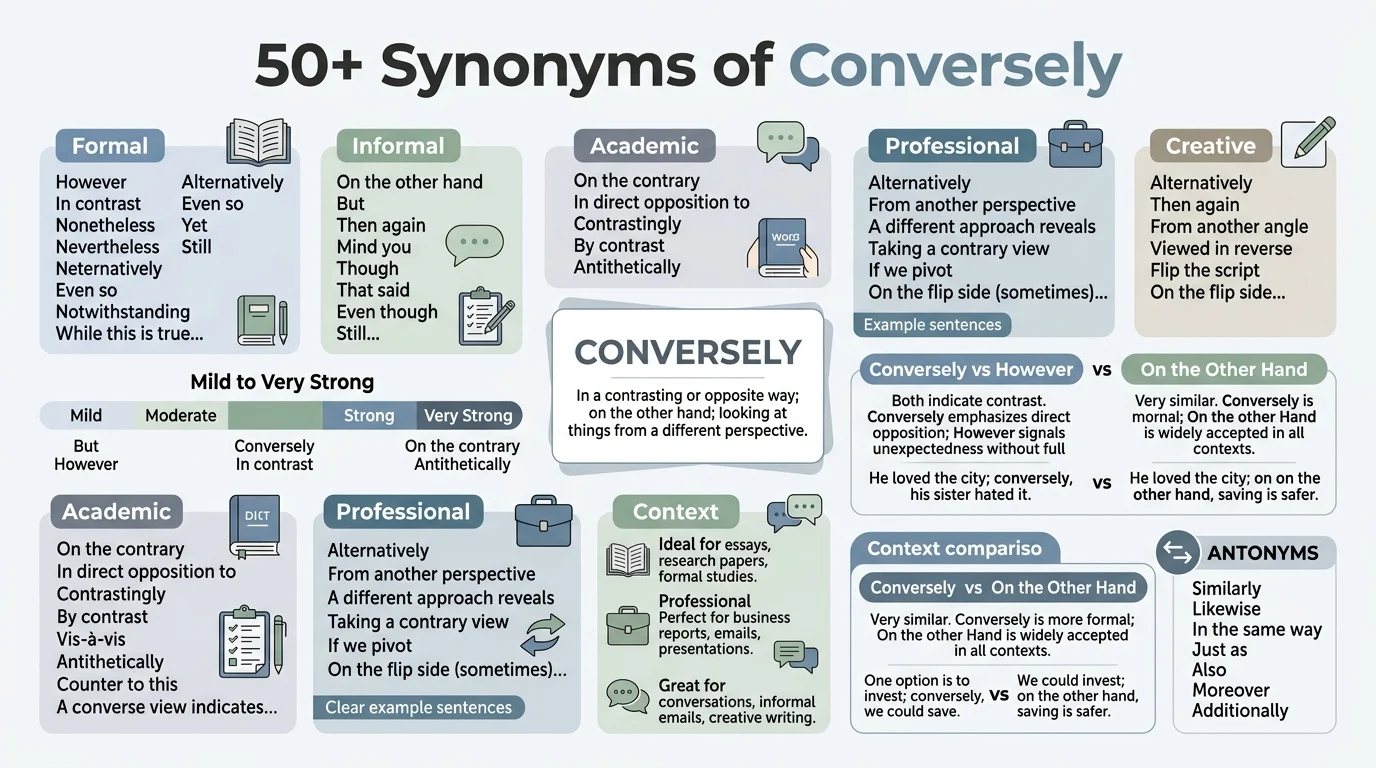
Conversely means introducing a statement that is the opposite or reverse of what was just said. It signals a contrast or reversal. Formal writing, use in contrast or by contrast. For casual conversation, try on the other hand or the flip side. For academic work, contrarily and inversely work well. Creative writing, consider conversely sparingly and use yet or but instead.
Meaning, Tone, and Context
Simple Definition
Conversely is an adverb used to introduce a statement that reverses or contrasts with a previous statement. It signals that what follows is the opposite or a different perspective on the same situation.
Part of Speech
Adverb
Overall Tone
Neutral. Conversely simply presents information without adding emotional weight. It is factual and logical rather than expressive.
Formality Level
Formal to semi-formal. Conversely appears frequently in academic writing, professional reports, and formal speeches. It is less common in everyday conversation, where shorter phrases like on the other hand are preferred.
Common Uses
Native English speakers use conversely in:
- Academic essays and research papers
- Business reports and professional presentations
- Analytical writing that compares two opposing ideas
- Formal speeches and debates
- Logical arguments that require precise contrast
Word Forms
- Noun: converse (the opposite or reverse)
- Adjective: converse (opposite or reversed)
- Adverb: conversely
- Related term: vice versa (with the order reversed)
When and How to Use “Conversely”
Use conversely when you need to show a clear reversal or opposite relationship between two ideas. It works best when the second statement directly mirrors or contradicts the first in a logical way.
Here are seven realistic examples:
Professional:
“Our Q3 sales increased by 15 percent. Conversely, our operating costs decreased by 8 percent.”
Academic:
“The experiment succeeded under controlled conditions. Conversely, it failed when variables were not regulated.”
Workplace:
Some employees prefer working from home for better focus. Conversely, others thrive in the office environment.”
Personal:
“My sister loves spicy food. Conversely, I cannot handle even mild heat.”
Email:
“We expected the project to finish early. Conversely, we encountered unexpected delays.”
Resume:
“I excel at independent work. Conversely, I also collaborate effectively with large teams.”
“Social media connects us globally. Conversely, it can also make us feel more isolated.”
Best Synonyms of “Conversely”
No synonym works perfectly in every situation. Each alternative carries a slightly different tone, formality level, and emotional weight. Here are the best choices for specific contexts:
Professional Writing
In contrast – This phrase clearly signals a difference between two points without implying a strict logical reversal. It sounds polished and professional.
Academic Writing
By contrast – This is slightly more formal than in contrast and is preferred in research papers and scholarly articles. It emphasizes the difference between two subjects being compared.
Business Communication
On the other hand – While slightly less formal, this phrase is direct and widely understood in business settings. It introduces an alternative perspective without sounding overly academic.
Casual Conversation
On the flip side – This informal phrase is perfect for everyday talk. It acknowledges the other side of an issue in a relaxed, approachable way.
Emotional Writing
Yet – This short conjunction carries emotional weight. It shows contrast while maintaining a flowing, expressive tone.
Creative Writing
But – Simple and powerful. In creative writing, but often works better than longer transition phrases because it keeps the pace moving.
Resume Writing
While – Use while to show contrasting skills or experiences in a single sentence. It creates a balanced, professional tone.
Workplace Communication
Alternatively – This word suggests choice rather than strict opposition. It works well when presenting options or different approaches.
Stronger Meaning
Contrarily – This word emphasizes active opposition. Use it when you want to stress that the second point directly contradicts the first.
Softer Meaning
On the other hand – This phrase softens the contrast. It suggests a different perspective rather than a direct contradiction.
When Not to Use “Conversely”
When the Contrast Is Too General
Conversely implies a specific reversal or mirroring relationship. If you are simply noting a difference without a clear opposite, the word sounds forced.
Weak: “I like coffee. Conversely, I also enjoy tea.”
Better: “I like coffee. I also enjoy tea.”
Conversely suggests opposition, not mere addition. In the better version, removing conversely makes the sentence more natural.
When the Contrast Is Too Weak
Using conversely for minor differences makes your writing sound exaggerated.
Weak: “The weather was warm today. Conversely, it was slightly cooler yesterday.”
Better: “The weather was warm today but slightly cooler yesterday.”
The contrast is too small to justify conversely. A simple but works better.
When the Tone Is Too Informal
Conversely sounds out of place in casual texts or social media posts.
Weak: “I love pizza. Conversely, my friend hates it.”
Better: “I love pizza, but my friend hates it.”
In casual contexts, shorter words sound more natural.
When You’ve Already Used It Too Often
Repeating conversely multiple times in one piece of writing makes your work feel repetitive and mechanical.
Weak: “The first group succeeded. Conversely, the second group failed. Conversely, the third group showed mixed results.”
Better: “The first group succeeded. The second group failed. By contrast, the third group showed mixed results.”
Varying your transition words keeps your writing fresh and engaging.
When You Need a Simpler Word
Sometimes a simple but or yet communicates the contrast more clearly than a formal adverb.
Overly formal: “The restaurant was crowded. Conversely, the service was fast.”
Better: “The restaurant was crowded, yet the service was fast.”
Words Commonly Confused With “Conversely”
Conversely vs However
Difference: However introduces an exception or contradiction. Conversely introduces a reversal or opposite relationship.
When to Use It: Use however when you are adding a point that seems to contradict the previous one. Use conversely when the second point is the exact reverse of the first.
Example (however): “I wanted to attend the meeting. However, I had a conflicting appointment.”
Example (conversely): “Men are generally taller than women. Conversely, women tend to live longer.”
Conversely vs On the Other Hand
Difference: On the other hand introduces a different perspective or alternative. Conversely implies a strict reversal or mirror image.
When to Use It: Use on the other hand when presenting an alternative viewpoint. Use conversely when the second point is the logical opposite of the first.
Example (on the other hand): “I enjoy action movies. On the other hand, my wife prefers romantic comedies.”
Example (conversely): “Successful people often work long hours. Conversely, working long hours does not guarantee success.”
Conversely vs In Contrast
Difference: In contrast highlights differences between two things. Conversely highlights a reversal or opposite relationship.
When to Use It: Use in contrast when comparing two different subjects. Use conversely when the second statement reverses the first.
Example (in contrast): “The north side of the city is wealthy. In contrast, the south side is impoverished.”
Example (conversely): “Wealth does not guarantee happiness. Conversely, poverty does not guarantee unhappiness.”
Conversely vs Vice Versa
Difference: Vice versa means the reverse is also true, with the order of elements swapped. Conversely introduces a contrasting statement.
When to Use It: Use vice versa when you mean “the other way around.” Use conversely when introducing an opposite idea.
Example (vice versa): “Students learn from teachers, and vice versa.”
Example (conversely): “Teachers influence students. Conversely, students also influence teachers.”
Conversely vs Contrarily
Difference: Contrarily emphasizes active opposition or contradiction. Conversely emphasizes a logical reversal.
When to Use It: Use contrarily when you want to stress that something is the opposite of what was expected. Use conversely for neutral logical reversals.
Example (contrarily): “Contrarily to popular belief, not all sharks are dangerous.”
Example (conversely): “All squares are rectangles. Conversely, not all rectangles are squares.”
Conversely vs Alternatively
Difference: Alternatively presents a choice or option. Conversely presents an opposite or reversal.
When to Use It: Use alternatively when offering a different option. Use conversely when showing the reverse situation.
Example (alternatively): “We could drive to the airport. Alternatively, we could take a taxi.”
Example (conversely): “Taking a taxi is faster. Conversely, driving yourself is cheaper.”
Best Synonyms of “Conversely” by Context
| Context | Best Synonym | Why It Works | Example |
|---|---|---|---|
| Formal writing | In contrast | Clear, professional, widely accepted | “The first proposal was costly. In contrast, the second was more affordable.” |
| Academic writing | By contrast | Preferred in scholarly work; emphasizes comparison | “By contrast, the control group showed no improvement.” |
| Professional communication | On the other hand | Direct and business-appropriate | “We could expand domestically. On the other hand, international markets offer more growth.” |
| Business emails | Alternatively | Suggests choice rather than conflict | “We could proceed with the original plan. Alternatively, we could delay and gather more data.” |
| Resume writing | While | Creates balanced, professional contrast in one sentence | “While I excel in independent work, I also thrive in collaborative teams.” |
| Workplace communication | Inversely | Technical but clear for data and analysis | “As prices increased, demand fell. Inversely, lower prices boosted sales.” |
| Casual conversation | On the flip side | Relaxed and conversational | “I love the city life. On the flip side, it’s expensive.” |
| Everyday speaking | But | Simple, natural, and direct | “I wanted to go, but I was too tired.” |
| Creative writing | Yet | Adds emotional flow and contrast | “The sun was shining, yet the air felt cold.” |
| Storytelling | Still | Maintains narrative flow while showing contrast | “The hero was outnumbered. Still, he refused to surrender.” |
| Emotional writing | Though | Softens contrast while adding feeling | “She was exhausted, though she kept working.” |
| Strong emphasis | Contrarily | Emphasizes active opposition | “Contrarily to what you might think, the data supports our conclusion.” |
| Mild tone | On the other hand | Gentle contrast without confrontation | “I prefer mornings. On the other hand, I can work late when needed.” |
| Social media captions | But | Short, punchy, and engaging | “Loved the view, but the hike was brutal.” |
How to Choose the Best Synonym of “Conversely”
Choosing the right synonym depends on four key factors:
1. Your Audience
Consider who is reading your work. Academic readers expect formal transitions like by contrast and contrarily. Business readers appreciate clarity and professionalism with phrases like on the other hand or in contrast. Casual readers respond better to simple words like but or yet.
2. Your Tone
Match your word to your emotional intent. Neutral, factual writing, choose in contrast or by contrast. For stronger opposition, choose contrarily. For softer, more conversational contrast, choose on the other hand or on the flip side.
3. The Strength of the Contrast
Ask yourself how strong the opposition is. Is it a complete reversal? Use conversely or contrarily. Is it a simple difference? Use in contrast or on the other hand. Is it a minor exception? Use however or but.
4. Natural Sounding Usage
Read your sentence aloud. Does the transition word sound natural? If it feels forced or overly formal, choose a simpler alternative. The best word is the one that communicates your message clearly without drawing attention to itself.
Real Life Examples of “Conversely”
School
“Some students learn best through reading. Conversely, others retain information better through hands-on activities.”
College
“The lecture was well organized. Conversely, the discussion section felt chaotic and unstructured.”
Workplace
“Our team values creativity. Conversely, we also need to meet strict deadlines.”
Business
“Investing in new technology requires significant capital. Conversely, failing to innovate can cost a company its market position.”
“We appreciate your proposal. Conversely, we have concerns about the timeline.”
Resume
“I am detail oriented. Conversely, I can also see the bigger picture.” (Better: “While I am detail oriented, I also see the bigger picture.”)
Conversation
“I thought the movie was fantastic. Conversely, my friend walked out after twenty minutes.” (Better: “I thought the movie was fantastic, but my friend walked out after twenty minutes.”)
Storytelling
“The kingdom prospered under the king’s rule. Conversely, the neighboring kingdom fell into ruin.” (Better: “The kingdom prospered under the king’s rule, while the neighboring kingdom fell into ruin.”)
Blogging
“Social media connects us with people worldwide. Conversely, it can also create echo chambers.”
“Working from home saves commuting time. Conversely, it can blur the line between work and personal life.” (Better: “Working from home saves commuting time but can blur the line between work and personal life.”)
18 Best Synonyms of “Conversely”
| Synonym | Simple Meaning | Best Used For | Example Sentence |
|---|---|---|---|
| In contrast | Shows a clear difference between two things | Formal writing, business reports | “The east coast is humid. In contrast, the west coast has dry heat.” |
| By contrast | Emphasizes comparison between opposing subjects | Academic writing, research papers | “By contrast, the experimental group showed significant improvement.” |
| On the other hand | Presents an alternative perspective | Professional communication, everyday writing | “We could hire more staff. On the other hand, we could automate the process.” |
| Contrarily | Emphasizes active opposition or contradiction | Strong emphasis, persuasive writing | “Contrarily to what many believe, the economy is actually growing.” |
| Inversely | Shows a direct opposite relationship, often in data | Technical writing, data analysis | “As the temperature rose, sales of hot chocolate fell inversely.” |
| Alternatively | Offers a different choice or option | Business emails, decision making | “We could meet in person. Alternatively, we could schedule a video call.” |
| Vice versa | Indicates the reverse is also true | Logical statements, explanations | “Students learn from teachers, and vice versa.” |
| On the flip side | Presents the other side of an issue informally | Casual conversation, social media | “I love the new job. On the flip side, the commute is terrible.” |
| Yet | Adds contrast with emotional flow | Creative writing, storytelling | “The night was dark, yet the stars shone brightly.” |
| Though | Softens contrast while adding feeling | Emotional writing, personal narratives | “She was nervous, though she hid it well.” |
| Still | Maintains narrative flow while showing contrast | Storytelling, persuasive writing | “The evidence was weak. Still, the jury reached a verdict.” |
| However | Introduces an exception or contradiction | General writing, professional communication | “I wanted to help. However, I was too busy.” |
| But | Simple, direct contrast | Everyday writing, social media | “I tried my best, but I failed.” |
| While | Shows contrast within a single sentence | Resume writing, professional communication | “While I enjoy research, I also love teaching.” |
| Whereas | Highlights a clear difference between two things | Formal writing, comparative analysis | “Whereas the first group succeeded, the second group failed.” |
| Oppositely | Directly indicates the opposite | Clear opposition, logical writing | “He acted kindly. Oppositely, she was cruel.” |
| The converse | Refers to the opposite situation | Formal writing, logical arguments | “The theory may be true, but the converse could also be possible.” |
| To the contrary | Indicates the opposite is true | Formal writing, rebuttals | “The evidence suggests otherwise. To the contrary, the data shows improvement.” |
Synonyms of “Conversely” by Usage
Professional vs Personal Synonyms
Professional (Workplaces, Business, Formal Settings):
In contrast, by contrast, on the other hand, alternatively, while, whereas
These words sound polished and appropriate for emails, reports, and presentations. They communicate contrast clearly without being overly casual.
Personal (Everyday Conversations, Texting, Social Media):
On the flip side, but, yet, though, still
These words feel natural in casual settings. They are shorter, more conversational, and less formal.
Formal vs Conversational Synonyms
Formal (Reports, Essays, Business Writing, Presentations):
In contrast, by contrast, contrarily, inversely, whereas, to the contrary
These words are precise and authoritative. They belong in academic papers, professional reports, and formal speeches.
Conversational (Emails, Casual Conversations, Texting):
On the other hand, on the flip side, but, yet, though
These words are approachable and easy to understand. They work well in everyday communication.
Academic Synonyms
For research papers, essays, and academic discussions, these synonyms sound more authoritative:
- By contrast – Preferred in scholarly writing for comparing subjects
- In contrast – Clear and widely accepted in academic work
- Contrarily – Emphasizes opposition in a scholarly way
- Inversely – Useful for scientific and mathematical relationships
- Whereas – Highlights differences in comparative analysis
Professional and Business Synonyms
For resumes, interviews, meetings, and client communication:
- While – Creates balanced contrast in a single sentence
- On the other hand – Direct and professional
- Alternatively – Suggests options rather than conflict
- In contrast – Clear and business appropriate
- However – Introduces exceptions professionally
Creative and Literary Synonyms
For storytelling, fiction, poetry, and descriptive writing:
- Yet – Adds emotional depth and contrast
- Though – Softens contrast with feeling
- Still – Maintains narrative momentum
- But – Simple and powerful for creative pacing
Slang or Modern Synonyms
Conversely does not have widely recognized slang equivalents. In very casual settings, people might say:
- On the flip side – Casual and modern
- Other way around – Informal and direct
Avoid these in formal or professional writing.
Strongest to Mildest Synonyms
Mild:
On the other hand, on the flip side, but
Moderate:
In contrast, by contrast, however, yet
Strong:
Contrarily, oppositely, to the contrary
Very Strong:
Inversely, whereas (when used to highlight direct opposition)
Emotional vs Neutral Synonyms
Emotional Synonyms (Express stronger feelings):
Yet, though, still, but
These words add emotional weight and flow to writing. They are excellent for creative and personal writing.
Neutral Synonyms (Simply communicate information):
In contrast, by contrast, on the other hand, alternatively, contrarily
These words present facts without emotional coloring. They are ideal for academic, professional, and business writing.
Antonyms of “Conversely”
| Antonym | Meaning | Example Sentence |
|---|---|---|
| Similarly | In a like manner | “The first experiment succeeded. Similarly, the second experiment produced positive results.” |
| Likewise | In the same way | “She enjoyed the movie. Likewise, her friends found it entertaining.” |
| In the same way | Indicating identical or parallel situations | “The first group performed well. In the same way, the second group excelled.” |
| Correspondingly | In a matching or proportional manner | “As prices increased, demand decreased correspondingly.” |
| Equally | To the same degree | “Both candidates are qualified. Equally, they share similar weaknesses.” |
| Accordingly | In a way that is appropriate or consistent | “The rules changed, and we acted accordingly.” |
| Consistently | In a way that does not vary | “The data consistently supports the hypothesis.” |
| Uniformly | In the same way throughout | “The results were uniformly positive across all groups.” |
| Analogously | In a comparable way | “The two systems function analogously.” |
| Comparably | In a way that can be compared | “The two products are comparably priced.” |
| Identically | In exactly the same way | “The twins dressed identically.” |
| Alike | In the same or similar way | “The two proposals are alike in their approach.” |
| In tandem | Working together or simultaneously | “The two departments worked in tandem to complete the project.” |
| Concurrently | Happening at the same time | “The two events occurred concurrently.” |
| Mutually | In a way that is shared or reciprocal | “The two parties agreed mutually on the terms.” |
Comparison: “Conversely” vs Similar Words
Conversely vs In Contrast
Main Difference: In contrast highlights differences between two subjects. Conversely introduces a reversal of the previous statement.
Which Is Stronger? Conversely implies a stronger logical relationship. In contrast simply notes differences.
Which Is More Formal? Both are formal, but in contrast is slightly more common in everyday professional writing.
When to Use Each:
- Use in contrast when comparing two different things.
- Use conversely when the second statement reverses the first.
Examples:
Conversely: “All mothers are women. Conversely, not all women are mothers.”
In Contrast: “The first proposal was expensive. In contrast, the second was affordable.”
Conversely vs On the Other Hand
Main Difference: On the other hand introduces a different perspective. Conversely introduces a logical opposite.
Which Is Stronger? Conversely is stronger and more precise.
Which Is More Formal? Conversely is more formal.
When to Use Each:
- Use on the other hand for everyday contrast and alternative viewpoints.
- Use conversely for strict logical reversals.
Examples:
Conversely: “Some people thrive under pressure. Conversely, others crumble.”
On the Other Hand: “I love the city. On the other hand, the noise is exhausting.”
Conversely vs However
Main Difference: However introduces an exception or contradiction. Conversely introduces a reversal.
Which Is Stronger? Conversely implies a more direct opposite relationship.
Which Is More Formal? Both are formal, but however is more versatile.
When to Use Each:
- Use however when adding a point that seems to contradict.
- Use conversely when the second point is the exact reverse.
Examples:
Conversely: “Wealth does not guarantee happiness. Conversely, poverty does not guarantee misery.”
However: “I wanted to attend. However, I had another commitment.”
Conversely vs Vice Versa
Main Difference: Vice versa means the reverse order is also true. Conversely introduces an opposite statement.
Which Is Stronger? Neither is stronger; they have different functions.
Which Is More Formal? Both are formal.
When to Use Each:
- Use vice versa when you mean “the other way around.”
- Use conversely when introducing an opposite idea.
Examples:
Conversely: “Teachers influence students. Conversely, students influence teachers.”
Vice Versa: “Students learn from teachers, and vice versa.”
Conversely vs Contrarily
Main Difference: Contrarily emphasizes active opposition. Conversely emphasizes logical reversal.
Which Is Stronger? Contrarily is stronger and more confrontational.
Which Is More Formal? Both are formal.
When to Use Each:
- Use contrarily to challenge a belief or expectation.
- Use conversely for neutral logical reversals.
Examples:
Conversely: “All squares are rectangles. Conversely, not all rectangles are squares.”
Contrarily: “Contrarily to popular belief, most sharks are not dangerous.”
Conversely vs Alternatively
Main Difference: Alternatively presents a choice. Conversely presents an opposite.
Which Is Stronger? Conversely implies a stronger relationship between the two points.
Which Is More Formal? Both are formal.
When to Use Each:
- Use alternatively when offering a different option.
- Use conversely when showing the reverse situation.
Examples:
Conversely: “Raising prices reduces demand. Conversely, lowering prices increases demand.”
Alternatively: “We could fly. Alternatively, we could take the train.”
Common Phrases and Expressions with “Conversely”
| Phrase | Meaning | Example Sentence |
|---|---|---|
| Conversely, … | Introduces an opposite statement | “The north is wealthy. Conversely, the south is poor.” |
| And conversely | Adds a reverse point to the previous statement | “Exercise improves health, and conversely, poor health limits exercise.” |
| Or conversely | Presents an opposite possibility | “We could expand, or conversely, we could consolidate.” |
| Conversely speaking | A slightly more formal way to introduce a reversal | “Conversely speaking, the same logic applies to the other side.” |
| The converse is also true | Indicates that the opposite statement is equally valid | “Money doesn’t buy happiness. The converse is also true: happiness doesn’t always bring money.” |
Common Mistakes to Avoid
1: Using “Conversely” for Simple Differences
Conversely implies a reversal, not just any difference.
Incorrect: “I like apples. Conversely, I also enjoy oranges.”
Better: “I like apples. I also enjoy oranges.”
Why: There is no opposition or reversal here. You are simply adding information.
2: Confusing “Conversely” with “However”
These words are not interchangeable. However introduces exceptions. Conversely introduces reversals.
Incorrect: “The weather was nice. Conversely, we decided to stay inside.”
Better: “The weather was nice. However, we decided to stay inside.”
Why: Staying inside despite nice weather is an exception, not a reversal.
3: Using “Conversely” in Casual Conversation
Conversely sounds overly formal in everyday speech.
Incorrect: “I love pizza. Conversely, my brother hates it.”
Better: “I love pizza, but my brother hates it.”
Why: But is more natural in casual conversation.
4: Overusing “Conversely” in One Piece of Writing
Repeating the same transition word makes your writing feel repetitive.
Incorrect: “The first group succeeded. Conversely, the second failed. Conversely, the third showed mixed results.”
Better: “The first group succeeded. The second failed. By contrast, the third showed mixed results.”
Why: Varying your transitions keeps your writing fresh and engaging.
5: Using “Conversely” When a Simpler Word Works Better
Sometimes a short word communicates the contrast more clearly.
Incorrect: “The restaurant was crowded. Conversely, the food was excellent.”
Better: “The restaurant was crowded, yet the food was excellent.”
Why: Yet flows better and sounds more natural.
6: Using “Conversely” When You Mean “On the Other Hand”
On the other hand presents a different perspective. Conversely presents a strict reversal.
Incorrect: “I enjoy hiking. Conversely, I also like swimming.”
Better: “I enjoy hiking. On the other hand, I also like swimming.”
Why: There is no logical reversal here, just two different activities.
7: Forgetting That “Conversely” Requires a Clear Opposite
If the second point does not directly reverse the first, conversely is the wrong choice.
Incorrect: “The movie was long. Conversely, it was also boring.”
Better: “The movie was long and boring.”
Why: Long and boring are not opposites. They are related criticisms.
Frequently Asked Questions
1. What are the best synonyms of “conversely”?
The best synonyms depend on your context. Formal writing, use in contrast or by contrast. For casual conversation, use on the other hand or on the flip side. For academic work, use contrarily or inversely.
2. What are the best formal synonyms of “conversely”?
The best formal synonyms include in contrast, by contrast, contrarily, inversely, and whereas. These words are appropriate for academic papers, business reports, and professional presentations.
3. What are common informal synonyms of “conversely”?
Common informal synonyms include on the flip side, but, yet, though, and still. These words work well in casual conversation, social media, and personal writing.
4. What is another word for “conversely” in professional writing?
In professional writing, use in contrast, on the other hand, or alternatively. These words are clear, direct, and appropriate for business emails, reports, and workplace communication.
5. What is the difference between “conversely” and “however”?
Conversely introduces a reversal or opposite statement. However introduces an exception or contradiction. Use conversely when the second point is the exact reverse of the first. Use however when adding a point that seems to contradict.
6. What is the opposite of “conversely”?
The opposites of conversely include similarly, likewise, in the same way, and correspondingly. These words indicate that two things are alike rather than opposite.
Conclusion
Conversely is a valuable word for showing logical reversals and contrasts. It signals to your reader that what follows is the opposite of what came before. But no single word works perfectly in every situation. The best writers know when to use conversely and when to choose a synonym that better fits their audience, tone, and purpose.
Formal and academic writing, reach for in contrast, by contrast, or contrarily. For professional communication, on the other hand and alternatively are excellent choices. For creative and casual writing, simple words like but, yet, and though often work best.
Remember that the goal is clear communication. Choose the word that expresses your meaning most naturally. When you find yourself reaching for conversely too often, pause and consider whether a synonym might serve you better. Your writing will become more varied, more precise, and more engaging.