Do you ever catch yourself using the word “perspective” over and over again? Perhaps you are writing an important email, crafting a social media caption, or explaining your point of view in a meeting. Repeating the same word can make your communication feel flat and uninspired.
The good news is that English offers many rich alternatives. This guide explores a wide range of synonyms for perspective to help you express yourself with greater precision. Whether you are a student, a writer, a professional, or someone who simply loves language, you will find the perfect word for every situation here.
What Does “Perspective” Mean?
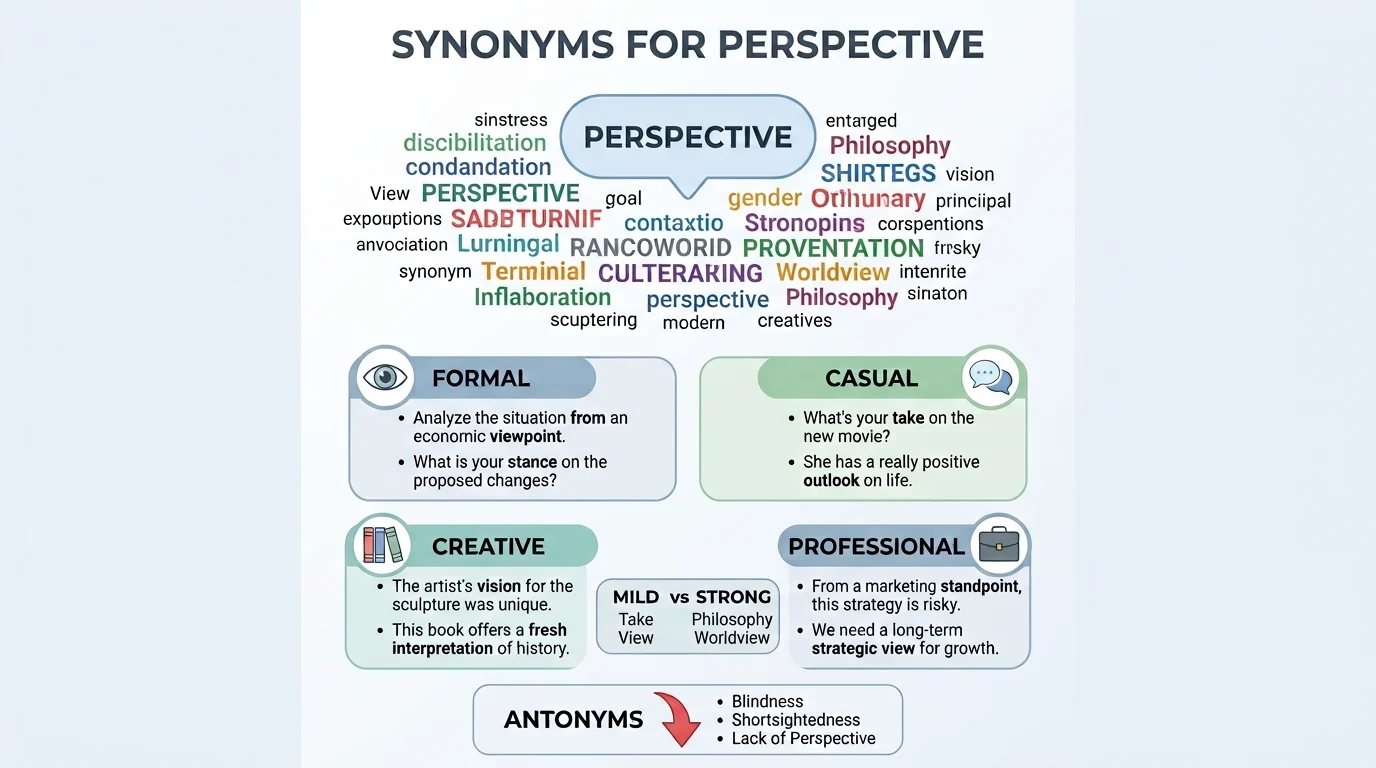
Perspective refers to a particular way of viewing or thinking about something. It can describe a mental outlook, a physical viewpoint, or a specific frame of reference. Best synonyms include viewpoint for general use, outlook for attitude, standpoint for formal arguments, and angle for creative or strategic thinking. The right word depends entirely on your context and tone.
Meaning, Tone and Context
Perspective is a noun that carries a neutral to slightly formal tone. The word describes how someone sees or understands a situation. It often relates to personal experience, knowledge, or position. Common contexts include personal opinions, artistic representation, professional analysis, and emotional understanding. The adjective form is “perspectival.” The adverb form is “perspectively.” Related verbs include “perceive” and “view.” The opposite is “myopia” or “narrowness.” When you use this word, you acknowledge that different people may see the same thing differently.
When and How to Use “Perspective”
You should use perspective when you want to acknowledge different ways of seeing a situation. It works well in discussions about opinions, strategies, and personal growth. The word helps create a sense of openness and understanding. It shows that you recognize multiple sides of an issue. Use it when you want to sound thoughtful and reflective.
Examples of Perspective in Sentences
Professional Context:
Our marketing team needs a fresh perspective on this campaign to attract a younger audience.
Academic Context:
The historian offered a unique perspective on the causes of the economic crisis.
Personal Context:
Traveling abroad gave me a new perspective on my own culture and values.
Emotional Context:
After the difficult conversation, she gained a more compassionate perspective on her friend’s choices.
Creative Context:
The artist’s perspective on urban life transformed ordinary street scenes into powerful visual stories.
Social Media Caption:
Sometimes you just need to step back and gain a new perspective on what truly matters.
Resume Context:
Successfully managed cross functional teams by bringing a collaborative perspective to complex projects.
Another Word for “Perspective”
Finding the right alternative depends heavily on your situation. Different contexts call for different levels of formality and specific shades of meaning. Here are the best single replacements organized by where you will use them most.
For Professional Writing: Viewpoint works well in business settings. It sounds clear and objective. It does not carry emotional weight.
For Academic Writing: Standpoint is excellent for scholarly work. It implies a carefully considered position based on evidence.
For Casual Conversation: Take works perfectly in everyday talk. It feels natural and unpretentious. You might ask, “What is your take on this?”
For Emotional Writing: Outlook captures a person’s emotional lens. It suggests how someone feels about their life or circumstances.
For Creative Writing: Angle adds a strategic or storytelling flavor. It suggests a deliberate choice in presenting information.
For Resume and Workplace: Approach shows how you handle tasks. It highlights your methodology and problem solving skills.
For Social Media Captions: Lens has become popular in modern writing. It feels fresh and slightly intellectual.
For Stronger Meaning: Vantage point suggests a position of advantage. It implies greater clarity.
For Softer Meaning: Sense is gentler. It suggests a feeling rather than a firm opinion.
When Not to Use “Perspective”
Perspective can sound too vague when you need a specific word. It might feel too formal in casual text messages or too abstract in practical instructions. Consider using a more precise alternative when describing concrete actions.
Example of Vague Writing:
From my perspective, the project is behind schedule.
Better Alternative:
In my assessment, the project is behind schedule.
Example of Overly Formal Writing:
I would like to get your perspective on dinner plans.
Better Alternative:
What do you think about dinner plans?
Example of Weak Writing:
The data requires a new perspective.
Better Alternative:
The data requires a new interpretation.
Example of Confusing Writing:
Her perspective on the painting was interesting.
Better Alternative:
Her interpretation of the painting was interesting.
Words Commonly Confused With “Perspective”
Several words share meaning with perspective but carry distinct nuances. Understanding these differences will help you choose the right word every time.
Perspective vs. Opinion:
Opinion is a personal belief that may not be based on facts. Perspective often involves a broader view that considers multiple factors. Use opinion when you want to share a personal view. Use perspective when you want to show thoughtful analysis.
Perspective vs. Viewpoint:
These words are very close in meaning. Viewpoint is slightly more concrete. It suggests a specific position or angle.often implies a deeper understanding.
Perspective vs. Outlook:
Outlook focuses on future expectations and attitudes. Perspective is more about how you currently see a situation. Use outlook when discussing hopes, plans, or attitudes.
Perspective vs. Attitude:
Attitude refers to a settled way of thinking or feeling. It often carries an emotional component. Perspective is more neutral. Use attitude when discussing behavior or disposition.
Perspective vs. Stance:
Stance implies a definite position taken on an issue. It is often used in debates or arguments. Perspective is broader and more flexible.
Perspective vs. Frame of Reference:
Frame of reference is a more technical term. It describes the set of criteria used to understand something. Perspective is the view that emerges from that frame.
Best Synonym by Context for “Perspective”
| Context | Best Synonym | Why It Works | Example |
|---|---|---|---|
| Formal Writing | Standpoint | It sounds precise and scholarly | The author examines the issue from a historical standpoint |
| Academic Writing | Framework | It suggests a structured approach | The study uses a theoretical framework to analyze the data |
| Professional Use | Viewpoint | It remains neutral and clear | The report presents the viewpoint of all stakeholders |
| Resume Writing | Approach | It highlights active methodology | Implemented a new approach to client relationship management |
| Casual Conversation | Take | It is natural and easy to understand | What is your take on the new policy changes? |
| Creative Writing | Angle | It adds strategic depth | The novel explores the war from a child’s angle |
| Emotional Tone | Outlook | It captures emotional state | Her positive outlook helped the team stay motivated |
| Strong Intensity | Vantage Point | It implies superior clarity | From his vantage point, the solution was obvious |
| Soft Tone | Sense | It feels gentle and intuitive | She has a good sense of what the team needs |
| Social Media | Lens | It feels modern and thoughtful | Viewing challenges through a growth lens changes everything |
Which Synonym Should You Choose?
Choosing the right synonym requires thinking about your audience, purpose, and tone. Start by considering the formality of your situation. Use standpoint or framework for academic papers. viewpoint or approach for professional emails. Use take or sense for casual conversations. Next think about emotional intensity. Use outlook when feelings matter. Use angle when you need strategy. Finally consider clarity. Sometimes the simplest word is the best choice. When in doubt, viewpoint works in almost any situation.
Real Life Examples of “Perspective” in Sentences
School Context:
The teacher encouraged students to consider the historical perspective before forming their opinions.
Workplace Context:
During the meeting, she offered a valuable perspective that changed how we approached the problem.
Writing Context:
A good writer knows that shifting perspective can make a story more compelling and engaging.
Conversation Context:
You see things differently when you have lived in another country. That perspective changes everything.
Social Media Context:
Take a moment to appreciate a new perspective today. Life looks different when you change your focus.
Email Context:
I would appreciate your perspective on the proposed budget changes before we finalize the document.
Storytelling Context:
The narrator’s perspective colored every event with a sense of impending doom and mystery.
25 Synonyms for “Perspective”
| Synonym | Simple Meaning | Best Used For | Example Sentence |
|---|---|---|---|
| Viewpoint | A specific way of seeing something | General use in any context | The manager asked for everyone’s viewpoint on the new policy |
| Standpoint | A position based on specific factors | Formal and academic writing | From an economic standpoint, the investment makes sense |
| Outlook | An attitude toward the future | Personal and emotional contexts | Her optimistic outlook inspired the entire department |
| Angle | A strategic or creative approach | Creative work and problem solving | The photographer found a unique angle to capture the building |
| Stance | A clear position taken on an issue | Debates and arguments | The candidate’s stance on healthcare attracted many voters |
| View | A simple way of seeing something | Everyday conversation | In my view, we should postpone the event |
| Slant | A biased or particular interpretation | Journalism and opinion pieces | The article had a political slant that was hard to ignore |
| Frame | A structure for understanding | Analytical and academic use | This frame helps us understand the social dynamics at play |
| Lens | A personal filter for seeing things | Modern and reflective writing | Through a cultural lens, the tradition makes perfect sense |
| Position | An official or considered opinion | Professional and formal contexts | The company’s position on the matter is clearly stated |
| Interpretation | A personal understanding of meaning | Art, literature, and analysis | Her interpretation of the poem was quite different from mine |
| Observation | A comment based on careful watching | Professional and analytical use | His observation about the market trends proved accurate |
| Perception | The way something is understood | Psychological and personal contexts | Public perception of the brand has improved significantly |
| Take | A personal opinion or reaction | Casual conversation | What is your take on the latest episode? |
| Appraisal | A careful judgment or assessment | Professional evaluations | The board completed its appraisal of the situation |
| Estimation | A judgment about value or nature | Personal or professional opinions | In my estimation, we need more time |
| Sentiment | A feeling based opinion | Emotional and social contexts | Public sentiment has shifted in recent months |
| Approach | A way of dealing with something | Professional and practical use | His approach to the problem was innovative |
| Mindset | A habitual way of thinking | Personal development contexts | A growth mindset changes how you handle challenges |
| Thought | A considered opinion or idea | General use | I would like to hear your thoughts on this |
| Judgment | A decision based on reasoning | Formal and professional contexts | The committee exercised good judgment |
| Feeling | An intuitive sense | Informal and emotional contexts | My feeling is that we should wait |
| Reasoning | The process of logical thinking | Academic and analytical contexts | The reasoning behind the decision was sound |
| Understanding | The ability to grasp meaning | General and professional use | She has a deep understanding of the issues |
| Insight | A clear and deep understanding | Creative and professional contexts | The consultant provided valuable insight |
Synonym Groups and Usage Differences
Professional vs. Personal Synonyms
Professional synonyms tend to be neutral and focused on analysis. Terms like standpoint, position, and approach work well in business settings. Personal synonyms often include emotional undertones. Words like outlook, feeling, and sense reflect individual experience.
Formal vs. Conversational Synonyms
Formal synonyms belong in reports, essays, and official documents. Standpoint, framework, and appraisal are excellent choices. Conversational synonyms are short and easy to use. Take, view, and thought feel natural in everyday talk.
Academic Synonyms
Academic writing demands precision and clarity. Framework provides a structured way to analyze topics. Interpretation works well for literature and arts. Reasoning suits philosophical or scientific discussions. These words signal careful thinking.
Professional and Business Synonyms
Business communication values clarity and action. Approach shows methodology. Position conveys official policy. Viewpoint remains neutral and professional. Assessment works well for evaluations. These words build credibility.
Creative or Literary Synonyms
Creative writing thrives on imagery and emotion. Angle adds strategic depth to storytelling. Lens provides a reflective quality. Insight offers a moment of clarity. Slant creates a sense of bias or perspective. These words enrich descriptive language.
Strongest vs. Weaker Synonyms
The intensity scale ranges from mild to powerful. Sense and feeling represent mild viewpoints. View and thought are moderate. Standpoint and position are stronger. Vantage point suggests superior clarity and is the most powerful.
Emotional vs. Neutral Synonyms
Emotional synonyms include outlook, sentiment, and feeling. These words carry personal weight. Neutral synonyms include viewpoint, standpoint, and position. These words stay factual. Choose based on whether you want to evoke feeling or simply inform.
Antonyms of “Perspective”
| Antonym | Meaning | Example Sentence |
|---|---|---|
| Narrowness | A limited view | His narrowness prevented him from seeing other solutions |
| Myopia | Short sightedness in thinking | The company’s myopia led to poor decisions |
| Bias | A prejudiced view | The bias in the report was obvious to everyone |
| Blindness | Lack of awareness | His blindness to the problem caused further issues |
| Unawareness | Lack of knowledge | Her unawareness of the context made her comment inappropriate |
| Prejudice | Preconceived opinion | The prejudice clouded his judgment |
| Partisanship | Strong support for one side | The partisanship made any discussion difficult |
| Ignorance | Lack of information | His ignorance of the facts was surprising |
| Disinterest | Lack of concern | The disinterest of the group was discouraging |
| Indifference | Lack of importance | Her indifference to the issue was frustrating |
| Closed mindedness | Unwillingness to consider new ideas | His closed mindedness hurt the project |
| Superficiality | Lack of depth | The superficiality of the analysis was disappointing |
| Inexperience | Lack of practical knowledge | Her inexperience limited her understanding |
| Naivety | Lack of wisdom or judgment | His naivety was evident in his assumptions |
| Distortion | A twisted or inaccurate view | The distortion of facts misled the audience |
Comparison: Perspective vs. Similar Words
Perspective vs. Opinion
The main difference is depth. Perspective involves thoughtful consideration. Opinion is a personal belief that may be less reasoned. Perspective is more formal and reflective. Opinion is casual and direct. Use perspective when you want to show understanding. Use opinion when you want to share a personal view.
Example for Perspective: The historian offered a unique perspective on the war.
Example for Opinion: In my opinion, the movie was excellent.
Perspective vs. Viewpoint
These words are nearly identical in meaning. Viewpoint is slightly more concrete. Perspective often implies greater depth. Viewpoint is excellent for business and professional use. Perspective works well in personal and reflective writing.
Example for Viewpoint: The board considered every viewpoint before deciding.
Example for Perspective: His difficult childhood gave him a unique perspective.
Perspective vs. Outlook
Outlook focuses on the future. Perspective focuses on the present view. Outlook is about how you expect things to go. Perspective is about how you understand things now. Use outlook when discussing future expectations.
Example for Outlook: The economic outlook remains positive.
Example for Perspective: We need a fresh perspective on this problem.
Perspective vs. Attitude
Attitude includes behavior and disposition. Perspective is purely about understanding. Attitude can be positive or negative. Perspective is more neutral. Use attitude when discussing how someone acts.
Example for Attitude: Her positive attitude made her a great leader.
Example for Perspective: His perspective on failure is different from most people.
Perspective vs. Stance
Stance implies a definite position. Perspective is more flexible. Stance is often defensive or argumentative. Perspective is open and thoughtful. Use stance in debates or when taking a firm position.
Example for Stance: The senator’s stance on taxes is well known.
Example for Perspective: The article offers an interesting perspective on education reform.
Perspective vs. Frame of Reference
Frame of reference is a technical term. It describes the background used for understanding. Perspective is the view that results from that frame. Use frame of reference in academic or technical writing.
Example for Frame of Reference: The study uses a psychological frame of reference.
Example for Perspective: The therapist helped him gain a new perspective on his relationships.
Common Phrases and Expressions with “Perspective”
1. Put something in perspective
Meaning: To view something in a balanced way.
Example sentence: The news of the accident put our minor problems into perspective.
2. Gain perspective
Meaning: To achieve a broader understanding.
Example sentence: Taking a walk helps me gain perspective on difficult decisions.
3. Broaden your perspective
Meaning: To expand your understanding by considering different views.
Example sentence: Reading diverse authors can broaden your perspective significantly.
4. Change your perspective
Meaning: To alter how you view something.
Example sentence: The documentary changed my perspective on environmental issues.
5. Shift perspective
Meaning: To move to a different viewpoint.
Example sentence: The coach encouraged the team to shift their perspective on losing.
6. From a certain perspective
Meaning: Viewed in a particular way.
Example sentence: From a certain perspective, the decision made perfect sense.
7. Broader perspective
Meaning: A wider, more inclusive view.
Example sentence: The manager encouraged everyone to consider the broader perspective.
8. Fresh perspective
Meaning: A new or different way of seeing things.
Example sentence: The new consultant brought a fresh perspective to the company.
Common Mistakes to Avoid
1. Using perspective when a simpler word works better
Many people overuse perspective in everyday conversation. Using “view” or “take” can sound more natural. Save perspective for situations that need thoughtful consideration.
2. Confusing perspective with opinion in professional writing
Perspective suggests careful analysis. Opinion sounds personal and unsubstantiated. Use perspective to show you have thought things through.
3. Using casual synonyms in formal reports
Words like “take” and “feeling” are too informal for academic papers. Use standpoint or framework for scholarly writing. Always match your word to the formality of your document.
4. Using overly dramatic words for simple situations
Words like “vantage point” and “standpoint” can sound pretentious. Use them only when you truly need strong language. Simple words are often more effective.
5. Repeating perspective too often in one document
This guide exists because overuse is common. Vary your word choices. Use different synonyms to keep your writing fresh and engaging.
6. Choosing a synonym with the wrong emotional tone
Remember that outlook is positive or negative. Standpoint is neutral. Angle is strategic. Think about the feeling you want to convey. Choose accordingly.
7. Using modern words like lens in academic writing
Words like “lens” are popular but may not be accepted in formal academic contexts. Stick to traditional terms like viewpoint or framework in these cases.
FAQs
1. What is the best synonym for perspective?
Viewpoint is the most versatile synonym. It works in almost any context, from casual conversation to professional writing.
2. What is a formal synonym for perspective?
Standpoint works well in formal settings. It sounds precise and scholarly. Framework is excellent for academic contexts.
3. What is an informal synonym for perspective?
Take is the best informal option. It is short, natural, and easy to use in everyday conversation.
4. What is another word for perspective in professional writing?
Approach is a strong professional choice. It suggests practical methodology. Viewpoint also works well in business settings.
5. What is the difference between perspective and standpoint?
Perspective is broader. Standpoint is a specific position based on particular factors. Use standpoint when you want to emphasize the basis of your view.
6. What is the opposite of perspective?
Narrowness and myopia are common antonyms. They describe limited or short sighted views.
Conclusion
Perspective is a powerful word that helps us understand how different people see the world. Its synonyms offer even more ways to express your thoughts with precision and clarity. Choosing the right word depends on your context, tone, and audience. Use viewpoint for general situations. standpoint for formal writing. Use take for casual conversation. outlook for emotional depth. angle for creative thinking. The best vocabulary tip is to vary your word choices. This keeps your writing engaging and shows your command of the language. The more alternatives you know, the more effectively you can communicate in any situation.