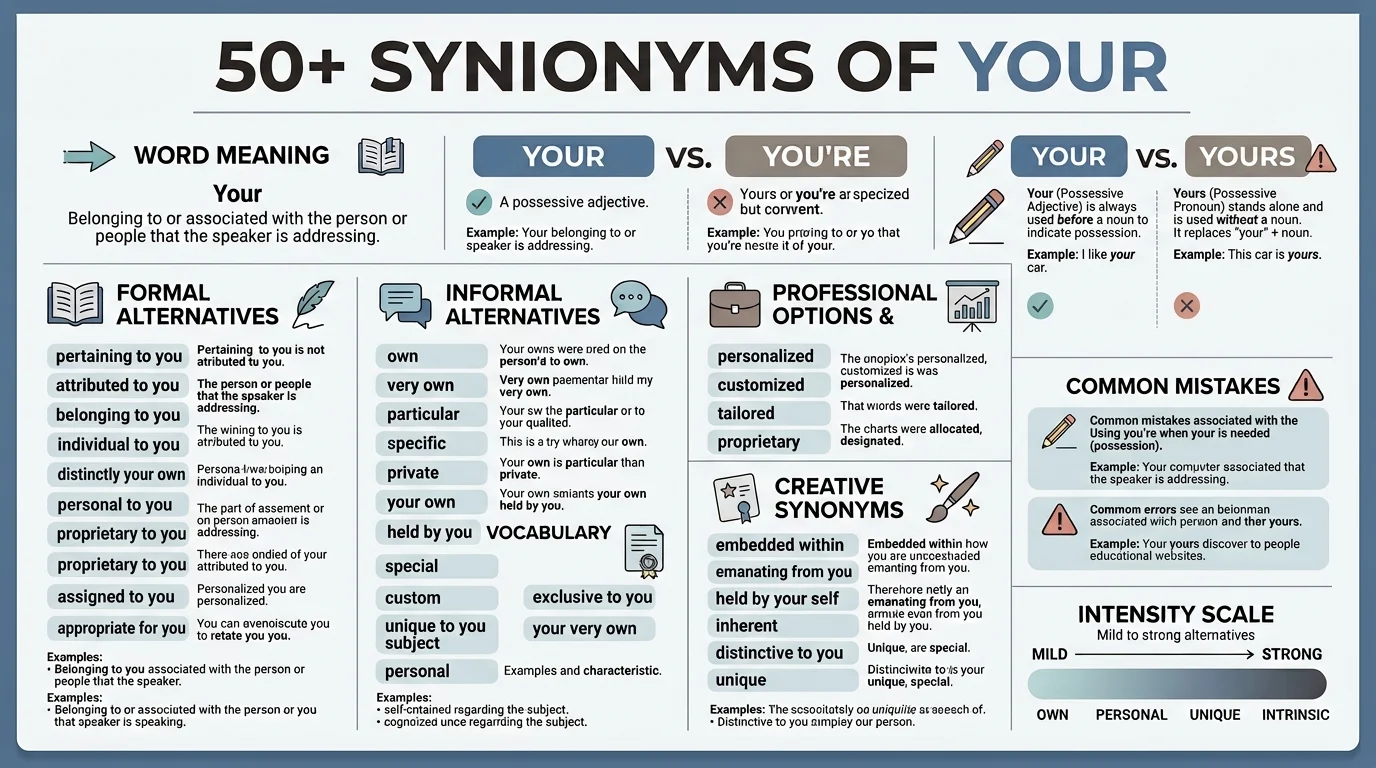
Finding the right words can make your writing sound clearer and more natural. The word “your” is simple, but repeating it too often can make an essay, email, or article feel dull. That is why many writers look for synonyms of your when they want more variety. However, there is an important point to know: “your” is a possessive determiner, so it does not always have a direct synonym. The best alternative depends on the sentence and what you are trying to say.
In this guide, we will explore your synonym options for different situations. You will also learn how to define your synonym, find another word for your, and choose your synonyms formal enough for academic writing.
If you are searching for synonyms for your, a synonym for your, or another word for your in an essay, this guide will help you choose the most natural option. We will also explain synonyms of your person and when each alternative works best.
What Are the Best Synonyms of “Your”?
“Your” is a possessive adjective that shows ownership or association with the person being addressed. The best alternatives depend heavily on context. For formal and professional writing, try “one’s.” For casual conversation, “ya” works in some dialects. However, in most cases, rephrasing the sentence to avoid the possessive entirely often produces the clearest and most natural writing.
Meaning, Tone, and Context
Simple Definition
“Your” is a possessive adjective. It indicates that something belongs to or is connected with the person you are speaking or writing to.
Part of Speech
Possessive adjective (determiner).
Overall Tone
Neutral. “Your” does not carry emotional weight on its own. It simply connects an object or idea to the person being addressed.
Formality Level
Neutral. “Your” works in every level of formality from academic journals to text messages. However, excessive use can make writing feel repetitive.
Common Uses
Native speakers use “your” constantly in:
- Everyday conversation
- Professional emails and letters
- Academic writing
- Instructions and directions
- Marketing and advertising copy
- Social media posts
- Customer service communications
Word Forms
- Possessive adjective: your (singular and plural)
- Possessive pronoun: yours
- Reflexive: yourself (singular), yourselves (plural)
When and How to Use “Your”
Use “your” when you need to show possession or connection to the person you are addressing. It is appropriate in all contexts but should not be overused.
Examples by Context
Professional:
Your proposal clearly demonstrates the team’s commitment to innovation.
Academic:
Your thesis argument requires additional supporting evidence from primary sources.
Workplace:
Your presentation slides need minor formatting adjustments before the meeting.
Personal:
Your kindness during that difficult week meant more than you realize.
Email:
Please review your schedule and confirm availability for Thursday’s session.
Resume:
Your attention to detail and project management skills align perfectly with this role.
Your support over the past year has been absolutely incredible. Thank you.
Best Synonyms of “Your”
No perfect synonym exists for “your” because it is a fundamental grammatical word. However, you have several options depending on what you want to achieve.
Professional Writing
One’s is your best choice for formal and professional contexts. It removes the direct address and creates a more general, authoritative tone.
Academic Writing
One’s also dominates academic writing. It sounds more formal and less personal than “your.”
Business Communication
Our works well when you want to include yourself or your organization. Your remains the standard choice for addressing clients directly.
Casual Conversation
Ya appears in casual speech and informal writing in some dialects. However, it is not standard English and should only be used in very informal contexts.
Emotional Writing
Rephrasing the sentence to avoid the possessive altogether often creates stronger emotional impact. For example, “I appreciate your honesty” becomes “I appreciate the honesty you showed.”
Creative Writing
Thy and thine work for historical or poetic contexts. Her, his, their, and our help you shift perspective and create variety.
Stronger Meaning
No stronger version of “your” exists. Instead, strengthen the noun that follows it.
Softer Meaning
No softer version exists. Use “your” neutrally or rephrase.
When Not to Use “Your”
Too General
When you want to address a general audience rather than a specific person, “your” can feel too direct and personal.
Better alternative: Use “one’s” or “our.”
Original: Your first step is to research the market thoroughly.
Improved: One’s first step is to research the market thoroughly.
Too Vague
If you do not actually mean the person you are addressing, “your” becomes confusing. For example, in academic writing, “your argument” might refer to a specific reader’s argument, which does not exist.
Better alternative: Use “the” or rephrase.
Original: Your argument overlooks historical context.
Improved: The argument overlooks historical context.
Too Informal
“Your” is neutral. However, alternatives like “ya” are too informal for professional settings.
Better alternative: Use “your” or “one’s.”
Original: Ya gotta check ya sources.
Improved: You should check your sources.
Words Commonly Confused With “Your”
You’re vs Your
Difference: “You’re” is a contraction of “you are.” “Your” shows possession.
When to Use It: Use “you’re” when you mean “you are.” Use “your” for ownership.
Example for You’re: You’re going to love this recipe.
Example for Your: Your recipe is absolutely delicious.
Yours vs Your
Difference: “Yours” is a possessive pronoun that stands alone. “Your” is an adjective that must be followed by a noun.
When to Use It: Use “yours” when the noun is already understood. Use “your” before a noun.
Example for Yours: This book is yours.
Example for Your: This is your book.
One’s vs Your
Difference: “One’s” is impersonal and general. “Your” directly addresses the reader or listener.
When to Use It: Use “one’s” in formal or academic writing for general statements. Use “your” for direct address.
Example for One’s: One’s personal beliefs should not influence this decision.
Example for Your: Your personal beliefs should not influence this decision.
Our vs Your
Difference: “Our” includes the speaker. “Your” addresses only the listener.
When to Use It: Use “our” when you want to include yourself. Use “your” for exclusive address.
Example for Our: Our team will complete the project by Friday.
Example for Your: Your team should complete the project by Friday.
Their vs Your
Difference: “Their” refers to a third party. “Your” directly addresses the listener.
When to Use It: Use “their” when referring to someone else. Use “your” when addressing the reader directly.
Example for Their: Their research supports this conclusion.
Example for Your: Your research supports this conclusion.
Thy vs Your
Difference: “Thy” is archaic English used historically for singular “you.” “Your” is modern English.
When to Use It: Use “thy” only in historical, poetic, or religious contexts. Use “your” everywhere else.
Example for Thy: Thy kindness has no equal.
Example for Your: Your kindness has no equal.
Best Synonyms of “Your” by Context
| Context | Best Alternative | Why It Works | Example |
|---|---|---|---|
| Formal writing | One’s | Creates impersonal, authoritative tone | One’s responsibility is to verify all sources. |
| Academic writing | One’s | Sounds scholarly and objective | One’s methodology must be clearly explained. |
| Professional communication | Your or One’s | Your is direct; one’s is formal | Your attention to this matter is appreciated. |
| Business emails | Your | Standard and professional | Please confirm your attendance by Friday. |
| Resume writing | Your | Direct and personal | Your leadership increased sales by 30 percent. |
| Workplace communication | Your | Clear and efficient | Your report is due by 3 PM. |
| Casual conversation | Your | Natural and neutral | Your car looks amazing. |
| Everyday speaking | Your | Standard in modern English | Your coffee is getting cold. |
| Creative writing | Thy, Her, His, Our | Adds variety and perspective | Thy words echo through the ages. |
| Storytelling | His, Her, Their, Our | Shifts perspective | Her journey changed everything. |
| Emotional writing | Rephrase to avoid possessive | Creates stronger emotional impact | I appreciate the effort you put into this. |
| Strong emphasis | Emphasize the noun instead | Strengthens the message | This is your moment. |
| Mild tone | Your | Neutral and simple | Your input would be helpful. |
| Social media captions | Your | Direct and engaging | Your feedback shapes our future. |
| American English | Your | Standard usage | Your package will arrive tomorrow. |
How to Choose the Best Alternative to “Your”
Follow this decision guide when you want to replace “your” in your writing.
Ask yourself who you are addressing.
If you are addressing a specific person or group in a professional context, “your” is almost always the right choice. Do not force a synonym when the direct possessive is most natural.
Consider your audience’s expectations.
Academic audiences expect “one’s” for general statements. Business audiences expect direct “your” when addressed personally.
Think about the level of formality.
Formal writing benefits from “one’s.” Most other writing works well with “your.” Attempting to replace “your” with an unnatural alternative often creates awkwardness.
Decide if you want to include yourself.
If you want to include yourself, use “our.” If you want to address only the reader, use “your.”
Check if the possessive is necessary.
Sometimes you can rephrase the entire sentence to avoid the possessive. This often produces stronger writing.
Test the natural sound.
Read the alternative aloud. If it sounds forced or unnatural, choose “your” instead.
Real Life Examples of “Your”
School
Original: Your homework assignment is due tomorrow.
Improved: The homework assignment is due tomorrow.
College
Original: Your research paper needs more primary sources.
Improved: This research paper needs more primary sources.
Workplace
Original: Your report contains several errors.
Improved: The report contains several errors that need correction.
Business
Original: Your company’s reputation depends on customer satisfaction.
Improved: Company reputation depends on customer satisfaction.
Original: Your response to this inquiry is requested.
Improved: A response to this inquiry is requested.
Resume
Original: Your achievements in this role demonstrate leadership.
Improved: Achievements in this role demonstrate leadership.
Conversation
Original: Your idea makes perfect sense.
Improved: That idea makes perfect sense.
Storytelling
Original: Your journey began in a small village.
Improved: The journey began in a small village.
Blogging
Original: Your first step is to choose a topic.
Improved: The first step is to choose a topic.
Social Media
Original: Your opinion matters to us.
Improved: Opinions matter to us.
18 Best Synonyms and Alternatives to “Your”
| Alternative | Simple Meaning | Best Used For | Example Sentence |
|---|---|---|---|
| One’s | Belonging to any person | Formal and academic writing | One’s personal experiences shape their perspective. |
| Our | Belonging to us | Inclusive communication | Our team has completed the initial assessment. |
| His | Belonging to a male | Specific third person reference | His argument relies on outdated data. |
| Her | Belonging to a female | Specific third person reference | Her presentation captivated the audience. |
| Their | Belonging to a group or singular generic | General third person reference | Their research supports this hypothesis. |
| Thy | Belonging to you (archaic) | Poetry, historical writing, religious texts | Thy wisdom guides our path. |
| Thine | Belonging to you before vowel sounds (archaic) | Poetry, historical writing | Thine eyes shine like stars. |
| Yours | Belonging to you (pronoun form) | When the noun is understood | This success is yours. |
| My | Belonging to me | First person perspective | My work here is complete. |
| Your own | Emphasizes personal possession | Adding emphasis | Your own experience is the best teacher. |
| Self | A person’s own | Reflexive emphasis | Your self is your greatest asset. |
| Appropriate | Suitable or proper | Formal writing about ownership | The appropriate action is clearly defined. |
| Respective | Belonging separately to each | Formal or legal writing | The respective parties signed the agreement. |
| Individual | Belonging to one person | Formal writing emphasizing individuality | Individual contributions matter to the final result. |
| Personal | Belonging to a particular person | Formal writing about private matters | Personal responsibility is essential. |
| Proper | Belonging specifically to something | Formal and technical writing | The proper forms require signatures. |
| Own | Belonging to oneself | Emphasizing possession | Your own judgment is what matters most. |
| Himself / Herself | Emphasizing personal action | Reflexive emphasis | He completed the project himself. |
Synonyms of “Your” by Usage
Professional vs Personal Synonyms
In professional contexts, “your” remains the standard direct address. However, “one’s” works well in formal reports and official documents. “Our” is excellent for collaborative professional contexts.
In personal contexts, “your” is the default. “Ya” appears in very casual texting but should never be used professionally.
Formal vs Conversational Synonyms
Formal: One’s, respective, appropriate, proper
Conversational: Your, ya (very informal)
Academic Synonyms
One’s” is the most common academic alternative to “your.” It sounds objective and scholarly. “A person’s” works in less formal academic writing.
Academic example: One’s methodology must be clearly justified in the literature review.
Professional and Business Synonyms
“Your” works perfectly in most business communication. “Our” works for collaborative projects. “The team’s” or “the company’s” works when you want to avoid direct personal address.
Professional example: Your signature is required on this document.
Creative and Literary Synonyms
“Thy” and “thine” are excellent for historical and poetic writing. “Her,” “his,” and “their” help you shift perspective. “Our” creates a sense of shared experience.
Creative example: Thy spirit walks these ancient halls.
Slang or Modern Synonyms
“Ya” appears in casual speech, texting, and social media. It is not standard English and should only be used in very informal contexts.
Slang example: Ya car is parked outside.
Where to avoid it: Professional emails, academic papers, business meetings, resumes, and formal writing.
Strongest to Mildest Synonyms
Mild: Your (neutral default)
Moderate: Our (inclusive), One’s (impersonal)
Strong: Your own (emphatic), Self (reflexive emphasis)
Very Strong: Thy (poetic and intense), Your very own (maximum emphasis)
Emotional vs Neutral Synonyms
Emotional Synonyms: Thy (poetic), Your own (personal emphasis), Herself/himself (reflexive intensity)
Neutral Synonyms: Your, One’s, Our, Their, His, Her
Recommendation: Use neutral synonyms for professional and academic writing. Use emotional synonyms only in creative, personal, or poetic contexts.
Antonyms of “Your”
“Your” does not have direct antonyms because it is a grammatical possessive. However, here are words that represent the opposite concepts.
| Antonym | Meaning | Example Sentence |
|---|---|---|
| My | Belonging to me | This is my book, not yours. |
| Our | Belonging to us (including me) | Our team works differently from yours. |
| Their | Belonging to them | Their success does not diminish your achievement. |
| His | Belonging to a male | His opinion differs from your opinion. |
| Her | Belonging to a female | Her approach contrasts with your approach. |
| Someone else’s | Belonging to another person | That is someone else’s responsibility. |
| Another’s | Belonging to another | Another’s success does not prevent your success. |
| Others’ | Belonging to other people | Others’ perspectives differ from yours. |
| The | Definite article, not possessive | The report is on the desk. (No possession) |
| A | Indefinite article, not possessive | A solution exists for every problem. |
| Their own | Belonging to themselves | They solved their own problems. |
| No one’s | Belonging to no one | This is no one’s fault. |
| Everybody’s | Belonging to everyone | Everybody’s contribution matters. |
| Nobody’s | Belonging to nobody | This responsibility is nobody’s priority. |
| An | Indefinite article, not possessive | An answer will present itself. |
Comparison: “Your” vs Similar Words
Your vs One’s
Main Difference: “Your” directly addresses a specific person. “One’s” refers to any person in general.
Which Is Stronger? Neither is stronger. They serve different purposes.
Which Is More Formal? One’s is more formal and academic.
When to Use Each: Use “your” for direct address. Use “one’s” for general statements in formal writing.
Examples:
Your: Your research must be thorough.
One’s: One’s research must be thorough.
Your vs Our
Main Difference: “Your” excludes the speaker. “Our” includes the speaker with the audience.
Which Is Stronger? Neither. They serve different contexts.
Which Is More Formal? Both are neutral.
When to Use Each: Use “your” when addressing someone separately. Use “our” for inclusive, collaborative communication.
Examples:
Your: Your contribution is valuable.
Our: Our contribution is valuable.
Your vs Their
Main Difference: “Your” addresses the listener. “Their” refers to a third party.
Which Is Stronger? Neither. They have different referents.
Which Is More Formal? Both are neutral.
When to Use Each: Use “your” when speaking to someone directly. Use “their” when referring to other people.
Examples:
Your: Your accomplishments speak for themselves.
Their: Their accomplishments speak for themselves.
Your vs His/Her
Main Difference: “Your” addresses the listener. “His” or “her” refers to a specific third party.
Which Is Stronger? Neither. They refer to different people.
Which Is More Formal? All are neutral.
When to Use Each: Use “your” for direct address. Use “his” or “her” when the gender is known and you are referring to someone else.
Examples:
Your: Your work is excellent.
His: His work is excellent.
Your vs Thy
Main Difference: “Your” is modern English. “Thy” is archaic English.
Which Is Stronger? “Thy” sounds more poetic and intense in appropriate contexts.
Which Is More Formal? “Your” is standard. “Thy” is archaic and rare.
When to Use Each: Use “your” in all modern contexts. Use “thy” only for historical writing, poetry, or religious texts.
Examples:
Your: Your kindness is appreciated.
Thy: Thy kindness is appreciated.
Your vs Yours
Main Difference: “Your” must be followed by a noun. “Yours” stands alone.
Which Is Stronger? Neither. They are different forms of the same word.
Which Is More Formal? Both are neutral.
When to Use Each: Use “your” before a noun. Use “yours” when the noun is understood from context.
Examples:
Your: Your book is on the table.
Yours: Is this book yours?
Common Phrases and Expressions with “Your”
Your call
Meaning: It is your decision to make.
Example Sentence: I have no preference. Your call on where we eat dinner.
Your move
Meaning: It is your turn to act or respond.
Example Sentence: I have explained my position. Now your move.
Your guess is as good as mine
Meaning: I do not know the answer either.
Example Sentence: I have no idea why the system crashed. Your guess is as good as mine.
Your heart’s desire
Meaning: The thing you want most.
Example Sentence: The scholarship offered everything your heart’s desire.
Your own worst enemy
Meaning: You cause your own problems.
Example Sentence: She is brilliant but your own worst enemy when it comes to deadlines.
At your service
Meaning: Ready to help you.
Example Sentence: If you need assistance, I am at your service.
In your shoes
Meaning: In your situation or position.
Example Sentence: If I were in your shoes, I would accept the offer.
Common Mistakes to Avoid
1: Confusing Your and You’re
Incorrect: Your going to love this movie.
Better: You’re going to love this movie.
Why: “Your” shows possession. “You’re” means “you are.” This is the most common grammar error in English.
2: Using “Your” When You Mean “Yours”
Incorrect: Is this your?
Better: Is this yours?
Why: “Your” must be followed by a noun. “Yours” stands alone as a pronoun.
3: Overusing “Your” in a Single Sentence or Paragraph
Incorrect: Your resume should highlight your skills, your experience, and your education.
Better: Your resume should highlight skills, experience, and education.
Why: Repeating “your” sounds repetitive and lazy.
4: Using “Your” When “One’s” Is More Appropriate
Incorrect: Your first step in research is to define your question.
Better: One’s first step in research is to define one’s question.
Why: In academic writing, “your” feels too personal and direct for general statements.
5: Using “Ya” in Professional Writing
Incorrect: Ya proposal needs revision.
Better: Your proposal needs revision.
Why: “Ya” is not standard English and sounds unprofessional in formal contexts.
6: Using “Your” When the Possessive Is Unnecessary
Incorrect: Please submit your application by Friday.
Better: Please submit the application by Friday.
Why: The possessive is unnecessary and sometimes awkward.
7: Choosing an Overly Formal Alternative When “Your” Is Natural
Incorrect: One’s package will arrive tomorrow.
Better: Your package will arrive tomorrow.
Why: “One’s” sounds unnatural and stiff in everyday conversation.
Frequently Asked Questions
What are the best synonyms of “your”?
The best synonyms depend on context. Formal writing, “one’s” is excellent. For inclusive writing, “our” works well. For poetic writing, “thy” is appropriate. However, in most modern writing, “your” remains the standard and most natural choice.
What are the best formal synonyms of “your”?
“One’s” is the best formal synonym. “A person’s” and “the appropriate” also work in formal contexts. “Respective” and “proper” are excellent for legal and technical writing. Avoid informal alternatives like “ya” in formal settings.
What are common informal synonyms of “your”?
“Ya” is the primary informal synonym in casual speech and texting. It appears in social media and very relaxed conversation. However, “ya” is not standard English. Use “your” in all professional, academic, and formal writing contexts.
What is another word for “your” in professional writing?
“One’s” works best in professional writing when addressing a general audience. “Our” works for collaborative professional contexts. “The team’s” and “the company’s” also work well. “Your” remains the standard for direct client or employee communication.
What is the difference between “your” and “yours”?
“Your” is a possessive adjective that must be followed by a noun. “Yours” is a possessive pronoun that stands alone. For example, “Is this your book?” versus “Is this book yours?” The meaning is the same, but the grammar differs.
What is the opposite of “your”?
“Your” does not have a direct opposite because it is a grammatical possessive. However, “my,” “our,” and “their” represent different possessives. “No one’s” and “nobody’s” indicate absence of possession. In context, “someone else’s” often serves as a contrast to “your.”
Conclusion
“Your” is a fundamental possessive adjective that connects ownership to the person you are addressing. While its direct synonyms of your are limited, you have many alternatives depending on context, formality, and audience.
For professional and academic writing, “one’s” provides an excellent formal alternative. Inclusive communication, “our” includes everyone. For creative writing, “thy” offers poetic variety. But remember, no single alternative works perfectly in every situation.
The most important lesson is that sometimes the best choice is not to replace “your” at all. It works well in most contexts. Instead of forcing a synonym, consider whether rephrasing the sentence produces stronger, clearer writing.
Choose your words based on your audience, your purpose, and the natural flow of your writing. That is the path to clearer, more effective communication.