Are you tired of describing chilly weather, distant personalities, or physical illnesses with the same overused word? Many writers, students, and professionals find themselves repeating “cold” in emails, essays, and conversations.
This synonym guide will help you expand your vocabulary with precise alternatives for every situation. You will discover the perfect word to express exactly what you mean, whether you are writing a formal report, a creative story, or a casual text message.
What Does “Cold” Mean?
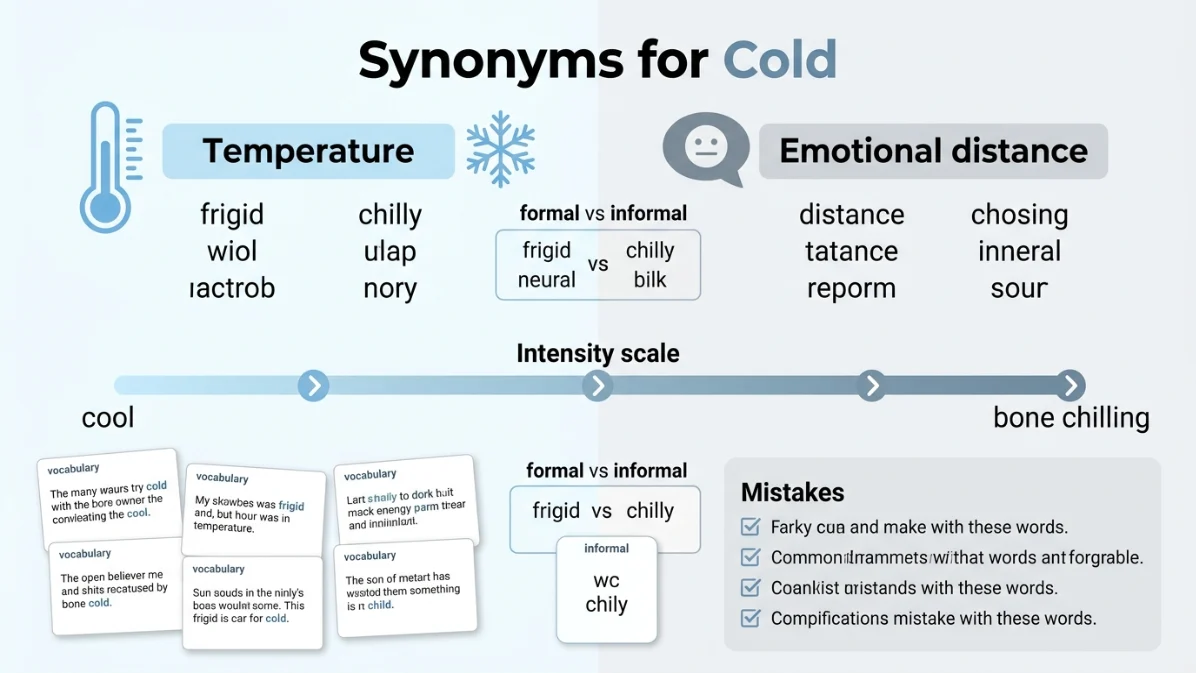
Cold means having a low temperature or lacking warmth in emotion, friendliness, or enthusiasm. The best synonyms depend on context. Use “frigid” for extreme cold, “chilly” for mild cold, “aloof” for emotional distance, and “unfeeling” for lack of empathy.
Formal writing prefers “frigid” or “arctic,” while casual conversation uses “chilly” or “nippy.”
Meaning, Tone and Context
The word “cold” serves as an adjective with multiple meanings. Its simplest definition refers to a low temperature that makes you reach for a sweater. The tone ranges from neutral when describing weather to negative when describing a person’s behavior.
Cold carries a neutral to negative tone depending on how you use it. Describing a drink as cold is perfectly neutral and acceptable. Calling someone cold suggests they lack warmth, empathy, or emotional connection.
The formality level of “cold” sits at a neutral level. You can use it in almost any context without sounding too casual or too formal. However, the word does lack precision when you need to describe specific degrees of temperature or types of emotional distance.
Common use cases include weather descriptions, physical sensations, emotional states, personality traits, and health conditions. You might say “cold weather,” “cold hands,” “a cold response,” “a cold person,” or “I have a cold.”
Important word forms include the noun “coldness,” the adverb “coldly,” the comparative “colder,” and the superlative “coldest.” The opposite form is “warm” with its variations “warmth,” “warmly,” and “warmer.
When and How to Use “Cold”
Use “cold” when you need a straightforward, understandable word that most people will recognize immediately. It works best in everyday conversation and general writing where precision is not critical.
- Professional context: The conference room felt cold, so we adjusted the thermostat before the meeting began.
- Personal context: She gave me a cold look when I arrived late to her birthday dinner.
- Academic context: The researchers recorded cold water temperatures throughout the winter months.
- Emotional context: His cold response to her news showed he did not care about her achievement.
- Creative writing context: The cold wind whipped through the abandoned house, rattling every window.
- Social media context: This cold weather makes me want to stay in bed all day.
- Casual conversation: I am too cold to go outside right now.
- Email context: Please let me know if the office feels too cold for our guests.
Another Word for “Cold”
The best single replacement for “cold” depends on your specific meaning and context.
- Professional writing: Use “frigid” when describing temperatures in a formal report. This word sounds more precise and technical.
- Academic writing: Choose “arctic” for scientific descriptions of extremely low temperatures. It adds authority to your research.
- Casual conversation: Use “chilly” when you want to sound natural and approachable. It feels less dramatic than other alternatives.
- Emotional writing: Select “aloof” to describe someone who seems emotionally distant or uninterested.
- Creative writing: Choose “gelid” for descriptive prose. This word creates vivid imagery of extreme cold.
- Resume or workplace use: Use “reserved” instead of “cold” to describe a professional demeanor. This sounds more diplomatic.
- Social media captions: Pick “brisk” for a fresh, energetic way to describe cool weather.
- Stronger meaning: Use “glacial” to emphasize extreme cold or emotional distance.
- Softer meaning: Choose “cool” to describe mild cold without negative emotional associations.
When Not to Use “Cold”
Avoid using “cold” when you need to describe specific degrees of temperature. Saying “the weather is cold” tells your reader very little compared to “the weather is frigid” or “the weather is nippy.”
Do not use “cold” in formal academic writing when a more precise synonym exists. A scientific paper about climate patterns should use “frigid” or “arctic” instead of the vague “cold.”
Avoid “cold” when describing a person’s behavior in a professional context. Calling a colleague cold sounds unprofessional and harsh. Use “reserved” or “formal” instead.
The word “cold” becomes too weak when you need to describe extreme conditions. If temperatures drop dangerously low, use “bitter” or “freezing” to convey the severity.
Consider this sentence: “The manager gave a cold reply to my question.” Now compare: “The manager gave a curt reply to my question.” The second version sounds more professional and precise.
Words Commonly Confused With “Cold”
Cold vs. Cool: Cold describes a lower temperature that causes discomfort. Cool describes a moderate temperature that feels pleasant or refreshing. Use “cool” for comfortable weather and “cold” for uncomfortable weather.
Cold vs. Chilly: Chilly describes mild cold that makes you slightly uncomfortable. Cold describes a more intense temperature drop. Use “chilly” for early autumn weather and “cold” for winter temperatures.
Cold vs. Freezing: Freezing describes extreme cold that causes ice to form. Cold is a general term for low temperatures. Use “freezing” for dangerous weather conditions and “cold” for ordinary winter days.
Cold vs. Frigid: Frigid suggests an intense, harsh cold that feels aggressive. Cold is more neutral. Use “frigid” for dramatic descriptions and “cold” for everyday use.
Cold vs. Aloof: Aloof specifically describes emotional distance and detachment. Cold can describe both temperature and emotions. Use “aloof” when you want to focus on someone’s behavior.
Cold vs. Reserved: Reserved describes a person who is restrained or formal in a neutral way. Cold has a negative judgment attached. Use “reserved” in professional settings and “cold” in personal criticism.
Best Synonym by Context for “Cold”
| Context | Best Synonym | Why It Works | Example |
|---|---|---|---|
| Formal writing | Frigid | Sounds technical and precise | The frigid conditions delayed the research expedition. |
| Academic writing | Arctic | Adds scientific authority | Arctic temperatures affected the study results. |
| Professional writing | Brisk | Sounds energetic and neutral | The brisk office temperature kept everyone alert. |
| Resume writing | Reserved | Sounds diplomatic and professional | Maintained a reserved demeanor during client negotiations. |
| Casual conversation | Chilly | Feels natural and approachable | It feels chilly outside today. |
| Creative writing | Gelid | Creates vivid imagery | The gelid air pierced through his coat. |
| Emotional tone | Aloof | Specifically describes social distance | Her aloof attitude made everyone uncomfortable. |
| Strong intensity | Glacial | Emphasizes extreme cold or distance | His glacial stare made her shiver. |
| Soft or moderate | Cool | Describes mild cold without judgment | A cool breeze came through the window. |
| Social media | Nippy | Sounds playful and engaging | Getting nippy out there. Time for hot cocoa. |
| US usage | Icy | Commonly used in American English | The icy roads made driving dangerous. |
| UK usage | Biting | Often used in British weather reports | A biting wind swept across the moors. |
Which Synonym Should You Choose?
Consider your meaning first. Are you describing temperature, emotion, or personality? Temperature descriptions need weather related words like “frigid” or “chilly.” Emotional descriptions need human behavior words like “aloof” or “unfeeling.”
Think about your formality level. Formal writing requires “frigid,” “arctic,” or “gelid.” Casual conversation welcomes “chilly,” “nippy,” or “brisk.” Professional communication prefers “reserved” or “restrained.”
Consider emotional intensity. Use “glacial,” “icy,” or “frosty” to describe severe emotional distance. Use “cool” or “reserved” for mild emotional restraint.
Think about professional value. Business writing should avoid negative judgments. Say “restrained” instead of “cold” to maintain a professional tone.
Match the sentence context. Descriptive writing needs vivid words like “gelid” or “biting.” Conversational writing needs accessible words like “chilly” or “cool.”
Real Life Examples of “Cold” in Sentences
School context: The teacher noticed the cold classroom and asked maintenance to fix the heating system.
Workplace context: His cold email response suggested he did not appreciate her innovative proposal.
Writing context: The author used cold imagery to create a sense of isolation in the opening chapter.
Conversation context: She gave a cold reply when he asked about her weekend plans.
Social media context: This cold weather is making me crave soup and warm blankets.
Resume context: Remained composed during cold negotiations with difficult clients.
Email context: The conference room feels cold, so we have moved the meeting to the larger office.
Storytelling context: The cold night air carried the sound of distant wolves across the frozen lake.
15 Synonyms for “Cold”
| Synonym | Simple Meaning | Best Used For | Example Sentence |
|---|---|---|---|
| Chilly | Moderately cold | Casual weather talk | I need a jacket; it feels chilly today. |
| Frigid | Extremely cold | Formal or dramatic descriptions | The frigid wind made walking impossible. |
| Freezing | Very cold, ice forming | Intense weather warnings | Temperatures are freezing tonight. |
| Icy | Covered with ice or very cold | Road conditions and emotional distance | She gave him an icy glare. |
| Bitter | Harsh and unpleasant cold | Negative weather descriptions | The bitter cold kept everyone indoors. |
| Brisk | Cool and refreshing | Positive weather descriptions | A brisk morning walk energizes me. |
| Nippy | Slightly cold, sharp | Informal weather talk | It is nippy outside this morning. |
| Gelid | Extremely cold, frozen | Creative and literary writing | The gelid water shocked his system. |
| Arctic | Like the Arctic region | Scientific or extreme descriptions | Arctic winds swept through the valley. |
| Frosty | Covered with frost | Weather and cold attitudes | She received a frosty reception. |
| Bleak | Cold and dreary | Atmospheric descriptions | The bleak winter landscape looked desolate. |
| Raw | Damp and cold | Unpleasant weather | A raw wind came off the ocean. |
| Cutting | Sharp and cold | Wind or emotional coldness | A cutting wind sliced through the city. |
| Glacial | Extremely cold, like a glacier | Emphasizing severity | His glacial tone ended the argument. |
| Wintry | Typical of winter | Descriptive writing | The wintry scene looked beautiful. |
Synonym Groups and Usage Differences
Professional vs. Personal Synonyms
Professional settings call for neutral synonyms like “brisk,” “cool,” or “restrained.” These words describe situations without negative judgment. Personal settings allow more emotional words like “cold,” “icy,” or “frosty” to describe relationships. Use “reserved” at work and “cold” with friends or family when discussing personal conflicts.
Formal vs. Conversational Synonyms
Formal reports, academic papers, and professional documents need words like “frigid,” “arctic,” and “gelid.” These synonyms sound precise and authoritative. Casual writing, texts, and everyday conversations welcome words like “chilly,” “nippy,” and “cool.” These words feel natural and approachable.
Academic Synonyms
Academic writing benefits from precise vocabulary. “Frigid” and “arctic” describe specific temperature conditions in scientific research. “Gelid” appears in literary analysis and environmental studies. These synonyms help scholars communicate exact conditions without vague language.
Professional and Business Synonyms
Business communication requires neutral language that avoids negative judgments. “Reserved” describes a person who maintains professional distance. “Brisk” describes an energetic atmosphere. “Restrained” describes controlled behavior. These words help professionals sound diplomatic and constructive.
Creative or Literary Synonyms
Creative writers choose vivid words to paint pictures in readers’ minds. “Gelid” creates images of frozen landscapes. “Bleak” conveys emotional emptiness alongside cold weather. “Wintry” sets a seasonal scene. These synonyms add depth and atmosphere to descriptive passages.
Strongest vs. Weaker Synonyms
Mildest: Cool, brisk, refreshing
Moderate: Chilly, nippy, crisp
Strong: Cold, icy, frosty
Very Strong: Freezing, bitter, raw
Extreme: Frigid, arctic, gelid, glacial
Emotional vs. Neutral Synonyms
Neutral synonyms describe temperature without emotional judgment. Examples include “cool,” “chilly,” and “brisk.” Emotional synonyms describe personalities, attitudes, and relationships. Examples include “cold,” “icy,” “frosty,” and “aloof.” Choose neutral words for facts and emotional words for personal descriptions.
Antonyms of “Cold”
| Antonym | Meaning | Example Sentence |
|---|---|---|
| Warm | Moderately high temperature | A warm fire made the room comfortable. |
| Hot | Very high temperature | The hot sun beat down on the beach. |
| Heated | Warmed or emotionally intense | The heated debate lasted for hours. |
| Balmy | Pleasantly warm | A balmy breeze came from the south. |
| Mild | Gentle and not extreme | The mild weather was perfect for a walk. |
| Temperate | Moderate climate | Temperate regions have four distinct seasons. |
| Scorching | Extremely hot | Scorching temperatures forced school closures. |
| Sweltering | Uncomfortably hot | The sweltering heat made everyone tired. |
| Torrid | Very hot and dry | Torrid conditions affected the crops. |
| Blazing | Very hot with fire | The blazing sun warmed the entire valley. |
| Warmhearted | Kind and caring | Her warmhearted nature made her popular. |
| Affectionate | Showing gentle love | The affectionate puppy cuddled with everyone. |
| Friendly | Kind and pleasant | The friendly cashier smiled at each customer. |
| Cordial | Warm and sincere | They shared a cordial greeting. |
| Genial | Cheerful and friendly | The genial host welcomed all guests. |
Comparison: Cold vs. Similar Words
Cold vs. Chilly
Main difference: Cold describes a lower temperature that causes discomfort. Chilly describes a mild cold that feels slightly uncomfortable.
Which one is stronger: Cold is stronger than chilly.
Which one is more formal: Both are equally neutral in formality.
Example sentence for cold: The cold weather made the children come inside.
Example sentence for chilly: A chilly breeze came through the window.
Cold vs. Cool
Main difference: Cold suggests discomfort or extreme temperature. Cool suggests a pleasant, refreshing temperature.
Which one is stronger: Cold is stronger and more uncomfortable than cool.
Which one is more formal: Both are neutral, but cool appears more often in casual conversation.
Example sentence for cold: His cold hands made her flinch.
Example sentence for cool: A cool drink refreshed them on the hot day.
Cold vs. Frigid
Main difference: Cold is a general term for low temperature. Frigid describes extreme, harsh cold that feels intense.
Which one is stronger: Frigid is much stronger than cold.
Which one is more formal: Frigid is more formal than cold.
Example sentence for cold: The cold water felt refreshing.
Example sentence for frigid: The frigid water made his skin burn.
Cold vs. Aloof
Main difference: Cold describes emotional distance or lack of warmth. Aloof specifically describes someone who is emotionally detached or uninvolved.
Which one is stronger: Both have similar emotional intensity.
Which one is more formal: Aloof sounds more formal than cold.
Example sentence for cold: She gave him a cold stare.
Example sentence for aloof: He remained aloof from the office drama.
Cold vs. Reserved
Main difference: Cold has a negative judgment attached to it. Reserved describes controlled behavior without negative judgment.
Which one is stronger: Cold carries stronger negative meaning.
Which one is more formal: Reserved sounds more professional and diplomatic.
Example sentence for cold: The cold boss never praised employees.
Example sentence for reserved: The reserved manager maintained professional boundaries.
Cold vs. Icy
Main difference: Cold is general and neutral. Icy specifically suggests a coldness that feels slippery or dangerous.
Which one is stronger: Icy is stronger and more dramatic than cold.
Which one is more formal: Both are neutral, but icy appears more in creative writing.
Example sentence for cold: The cold road required careful driving.
Example sentence for icy: The icy road caused several accidents.
Common Phrases and Expressions with “Cold”
1. Cold shoulder
Meaning: To ignore or show rejection to someone.
Example sentence: She gave her coworker the cold shoulder after their argument.
2. Cold feet
Meaning: To feel nervous or hesitant before a big event.
Example sentence: He got cold feet before his wedding and needed encouragement.
3. Cold call
Meaning: To contact someone without prior arrangement.
Example sentence: Sales representatives often make cold calls to potential clients.
4. Cold turkey
Meaning: To stop a habit suddenly and completely.
Example sentence: She quit caffeine cold turkey and suffered headaches for a week.
5. Cold blooded
Meaning: Showing no emotion or mercy.
Example sentence: The cold blooded killer showed no remorse for his actions.
6. Catch a cold
Meaning: To become ill with a common virus.
Example sentence: She caught a cold after walking in the rain without a coat.
7. Cold hard cash
Meaning: Physical money or immediate payment.
Example sentence: He wanted cold hard cash instead of a check.
8. Out in the cold
Meaning: Excluded from a group or situation.
Example sentence: New employees often feel left out in the cold during their first week.
Common Mistakes to Avoid
1. Using cold when a more precise synonym is better
Many people say “cold weather” when they could use “frigid” or “arctic” to be more specific. A vague description weakens your writing. Be precise about the level of cold you describe.
2. Confusing cold with cool in emotional contexts
Calling someone “cool” means they are impressive or composed. Calling someone “cold” means they are unfriendly or unkind. These words have very different emotional meanings.
3. Using a casual synonym in formal writing
Words like “nippy” and “chilly” sound informal and conversational. Academic papers and professional reports need “frigid” or “arctic” to maintain authority.
4. Using an overly dramatic synonym for a simple situation
Describing room temperature as “gelid” sounds ridiculous. Save powerful words like “gelid” and “glacial” for severe conditions or dramatic writing.
5. Repeating the same word too often
Alternating between “cold,” “chilly,” “frigid,” and “icy” keeps your writing interesting and varied. Avoid using the same word multiple times in one paragraph.
6. Choosing a synonym with the wrong emotional tone
Saying someone has a “frosty” personality suggests mild coldness. Saying they have a “glacial” personality suggests extreme coldness. Choose words that match the intensity you mean.
7. Using slang in academic or professional writing
Words like “nippy” and “brisk” work well in casual conversation. Academic writing requires “frigid” and “arctic.” Use the appropriate register for your audience.
FAQs
What is the best synonym for cold?
The best synonym depends on your context. “Frigid” works for formal writing, “chilly” works for casual conversation, and “aloof” works for emotional descriptions.
What is a formal synonym for cold?
“Frigid” and “arctic” are the best formal synonyms for cold. These words sound precise and authoritative in professional and academic writing.
What is an informal synonym for cold?
“Chilly” and “nippy” are excellent informal synonyms for cold. These words feel natural and approachable in everyday conversation.
What is another word for cold in professional writing?
“Reserved” and “restrained” are professional alternatives to cold. These words sound diplomatic and avoid negative judgments.
What is the difference between cold and frigid?
Cold describes general low temperature. Frigid describes extreme, harsh cold that feels intense and uncomfortable. Frigid is stronger than cold.
What is the opposite of cold?
Warm is the most direct opposite of cold. Other antonyms include hot, balmy, and mild depending on the specific meaning.
Conclusion
Cold is a versatile word with multiple meanings and many excellent synonyms. Temperature descriptions benefit from words like “frigid,” “chilly,” and “brisk.” Emotional situations call for words like “aloof,” “reserved,” and “icy.” The best word choice depends on your audience, formality level, and intended meaning.
Keep this vocabulary guide handy when you write emails, essays, stories, or social media posts. Choosing the right synonym will make your communication more precise and engaging. Remember to verify definitions using trusted dictionaries like Cambridge, Oxford, Merriam Webster, Collins, or Britannica before publishing important documents.