Have you ever described someone as stoic but felt the word didn’t quite capture what you meant? Maybe you were writing a character description, crafting a professional email, or trying to explain a colleague’s reaction to a stressful situation. Many writers and speakers rely on the same word repeatedly. This happens because finding the perfect alternative requires more than just opening a thesaurus.
Understanding the synonyms of stoic can transform your writing and speaking. When you choose the right word, your message becomes clearer and more impactful. This guide will help you understand the meaning of stoic, discover the best synonyms for different contexts, and avoid common mistakes that weaken your communication.
What Are the Best Synonyms of “Stoic”?
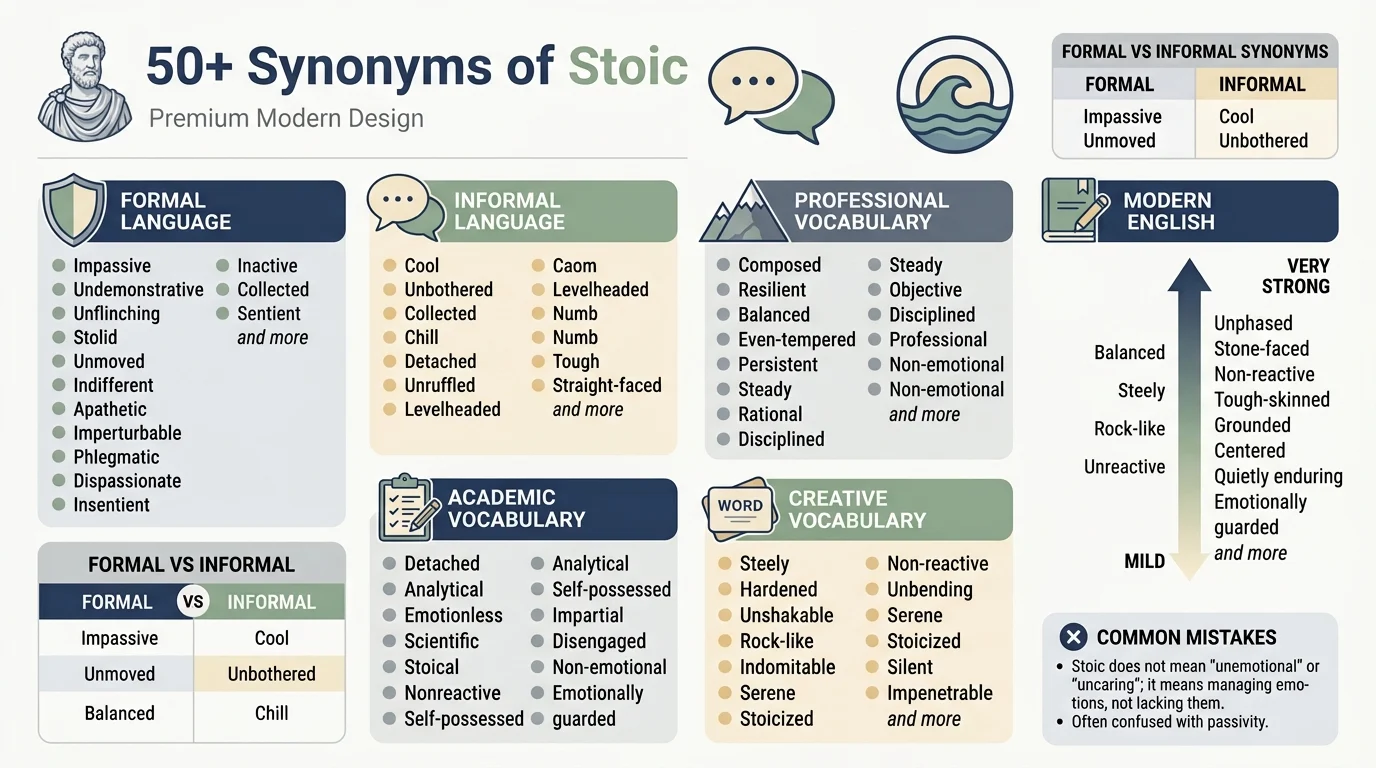
Stoic means showing little emotion or enduring hardship without complaint. The best synonyms depend on your context. For professional writing, use “unflappable” or “composed.” Academic writing, choose “resolute” or “impassive.” Casual conversation, use “unbothered” or “laid back.” For creative writing, consider “unflinching” or “unmoved.”
Meaning, Tone, and Context
Simple Definition
Stoic describes a person who remains calm and controlled in difficult situations without showing their feelings. It can also refer to the ancient Greek philosophy that teaches virtue and reason over emotional reaction.
Part of Speech
Stoic functions as both an adjective and a noun. As an adjective, it describes a person’s behavior or attitude. As a noun, it refers to a person who practices stoicism or displays these characteristics.
Overall Tone
Stoic is generally neutral with a slightly positive connotation. It suggests emotional strength, self control, and resilience. However, it can also imply emotional coldness or detachment depending on the context.
Formality Level
Stoic sits at a semi formal level. It appears frequently in academic writing, literature, journalism, and professional communication. It is not overly casual but not rigidly formal either.
Common Uses
Native English speakers commonly use stoic when describing:
- Reactions to hardship or bad news
- Military personnel or first responders
- Characters in literature and film
- Professional behavior under pressure
- Personal resilience during difficult times
- Emotional restraint in challenging situations
Word Forms
Noun: Stoic (a person who shows emotional restraint)
Adjective: Stoic (describing the quality of emotional restraint)
Adverb: Stoically (in a manner showing emotional restraint)
Related Forms: Stoicism (the philosophy or quality), stoical (a variant adjective)
Opposite Form: Emotional, expressive, demonstrative
When and How to Use “Stoic”
You should choose stoic when you want to describe someone who handles pressure without visible distress. The word works best when the person maintains composure despite genuine difficulty.
Professional Context
“The CEO remained stoic throughout the shareholder meeting, even when facing difficult questions about quarterly losses.”
Academic Context
“Marcus Aurelius wrote extensively about the stoic philosophy of accepting what cannot be changed.”
Workplace Context
“Her stoic response to the project cancellation impressed the entire team.”
Personal Context
“Grandpa always seemed stoic about his wartime experiences, but we knew he carried those memories privately.”
Email Context
“I appreciate your stoic approach to these challenges. Your calm leadership is making a real difference.”
Resume Context
“Maintained a stoic, solution focused demeanor during high pressure client negotiations.”
Social Media Context
“Stoic vibes only. Some things are better handled without public commentary.”
Best Synonyms of “Stoic”
No synonym perfectly matches stoic in every situation. The best choice depends on your specific context, audience, and intended tone.
Professional Writing
Composed is the best professional synonym for stoic. It suggests self control and emotional regulation without implying complete emotional suppression. Professionals want to appear steady, not robotic.
Academic Writing
Resolute works best in academic contexts. It conveys determination and firmness of purpose while maintaining an intellectual tone appropriate for scholarly work.
Business Communication
Unflappable serves business communication well. It suggests remaining calm under pressure and maintaining performance despite challenges. This word carries a modern, confident energy.
Casual Conversation
Unbothered fits casual conversations naturally. It conveys the same emotional detachment without sounding formal or pretentious. Friends understand this word immediately.
Emotional Writing
Unmoved works well when describing someone who remains unaffected by emotional appeals. It suggests emotional strength without complete coldness.
Creative Writing
Unflinching adds dramatic power to creative writing. It suggests facing difficulty without showing fear or discomfort. This word creates vivid imagery for readers.
Resume Writing
Composed appears most frequently on effective resumes. It communicates emotional intelligence and professional self control in a single word.
Workplace Communication
Level headed works well in workplace discussions. It suggests practical, calm thinking during challenging situations without sounding overly philosophical.
Stronger Meaning
Impassive carries a stronger meaning than stoic. It suggests complete emotional blankness, often with a hint of coldness or lack of empathy.
Softer Meaning
Patient offers a softer alternative. It suggests endurance without emphasizing emotional suppression.
When Not to Use “Stoic”
Situations Where Stoic Sounds Too Vague
Stoic sometimes sounds too general when you need to describe a specific response. If someone remains calm but still shows concern, stoic does not capture that nuance.
Instead of: “He was stoic during the meeting.”
Try: “He remained composed during the meeting while clearly showing his interest.”
Situations Where Stoic Sounds Too Formal
Conversations with friends or family often feel stilted with formal vocabulary. Stoic may sound out of place in casual settings.
Instead of: “She was stoic about the breakup.”
Try: “She seemed unbothered about the breakup.”
Situations Where Stoic Sounds Too Weak
If someone faces extreme hardship with exceptional courage, stoic may understate their strength. A stronger word fits better.
Instead of: “The soldier remained stoic under enemy fire.”
Try: “The soldier remained unflinching under enemy fire.”
Situations Where Stoic Sounds Too Strong
Using stoic to describe everyday situations can exaggerate the emotional weight. Minor frustrations do not require such dramatic language.
Instead of: “He was stoic when his coffee spilled.”
Try: “He remained calm when his coffee spilled.”
Situations Where Stoic Sounds Cold
Describing a friend’s response to good news as stoic suggests inappropriate emotional distance. Positive situations call for warmer language.
Instead of: “She was stoic when she won the award.”
Try: “She remained modest when she won the award.”
Words Commonly Confused With “Stoic”
Stoic vs Apathetic
Difference: Stoic involves emotional restraint through choice and strength. Apathetic involves emotional absence through indifference or lack of interest.
When to Use It: Use stoic for someone who feels emotions but controls them. Use apathetic for someone who simply does not care.
Example: “She remained stoic while her colleague lost his temper.” vs “She remained apathetic while her colleague lost his temper because she did not care about the outcome.
Stoic vs Unemotional
Difference: Unemotional simply describes a lack of emotions. Stoic implies a conscious decision to suppress or control emotions.
When to Use It: Use unemotional for clinical descriptions. Use stoic for descriptions involving strength and endurance.
Example: “The doctor’s unemotional delivery helped the patient process the news.” vs “The doctor’s stoic delivery helped the patient feel reassured.”
Stoic vs Emotionless
Difference: Emotionless suggests complete absence of feelings. Stoic suggests the presence of feelings that are deliberately not shown.
When to Use It: Use emotionless for characters or situations where emotional capacity seems absent. Use stoic for people who simply choose not to express feelings.
Example: “The emotionless robot followed its programming.” vs “The stoic soldier followed orders despite his fear.”
Stoic vs Stolid
Difference: Stolid describes a dull, slow, or unemotional quality. Stoic suggests strength and philosophy rather than dullness.
When to Use It: Use stolid when describing someone who appears slow or unmoved due to temperament. Use stoic when describing someone who actively practices emotional control.
Example: “The stolid farmer rarely showed enthusiasm for anything.” vs “The stoic farmer worked through the drought without complaint.”
Stoic vs Phlegmatic
Difference: Phlegmatic describes a temperament that is naturally calm and unexcitable. Stoic describes a chosen or practiced response to difficulty.
When to Use It: Use phlegmatic for personality descriptions in psychology or character analysis. Use stoic for behavioral descriptions in challenging situations.
Example: “His phlegmatic temperament made him an excellent crisis manager.” vs “His stoic response to the crisis inspired the entire team.”
Stoic vs Spartan
Difference: Spartan describes simplicity, austerity, and discipline in lifestyle. Stoic describes emotional attitude and philosophical approach.
When to Use It: Use spartan for descriptions of physical conditions or lifestyle choices. Use stoic for descriptions of psychological or emotional responses.
Example: “The monks maintained a spartan existence in the mountains.” vs “The monks maintained a stoic attitude despite their hardships.”
Best Synonyms of “Stoic” by Context
| Context | Best Synonym | Why It Works | Example |
|---|---|---|---|
| Formal writing | Composed | Conveys control without suggesting coldness | The ambassador remained composed throughout the tense negotiation. |
| Academic writing | Resolute | Emphasizes determination and philosophical strength | The resolute researcher continued despite multiple setbacks. |
| Professional communication | Unflappable | Suggests reliable performance under pressure | Her unflappable demeanor calmed the anxious clients. |
| Business emails | Steady | Clear and direct without emotional overstatement | We appreciate your steady leadership during this transition. |
| Resume writing | Poised | Highlights professional presence and emotional intelligence | Maintained a poised presence while managing difficult stakeholder relationships. |
| Workplace communication | Level headed | Sounds practical and relatable for team settings | Our level headed manager kept the team focused on solutions. |
| Casual conversation | Unbothered | Natural and relatable for everyday speech | He seemed completely unbothered by the criticism. |
| Everyday speaking | Even tempered | Describes personality without dramatic language | My even tempered grandmother never raised her voice. |
| Creative writing | Unflinching | Adds dramatic intensity to descriptions | The unflinching hero faced the dragon without hesitation. |
| Storytelling | Imperturbable | Creates a sense of unshakeable calm | The imperturbable detective calmly solved the impossible case. |
| Emotional writing | Unmoved | Suggests strength against emotional appeals | She remained unmoved by their desperate pleas. |
| Strong emphasis | Impassive | Emphasizes complete emotional blankness | His impassive expression gave nothing away. |
| Mild tone | Patient | Softens the intensity while maintaining endurance | She remained patient through the long delays. |
| Social media captions | Chill | Modern and relatable for younger audiences | Staying chill even when things get complicated. |
| American English | Composed | Widely understood and professionally accepted | He stayed composed during the entire presentation. |
How to Choose the Best Synonym of “Stoic”
Choosing the right synonym requires careful consideration of several factors. Start by identifying your audience. Professionals and academics expect formal vocabulary. Friends and family respond better to conversational language.
Consider your emotional strength. You want to emphasize the absence of emotion, choose “impassive.” If you want to emphasize endurance, choose “resolute.” If you want to emphasize calmness, choose “composed.”
Think about your writing purpose. Resumes and cover letters benefit from words like “composed” or “poised.” Creative writing benefits from vivid words like “unflinching.” Business emails benefit from practical words like “steady.”
Most importantly, read your sentence aloud. The right synonym should sound natural and communicate your intended message clearly. If it sounds awkward or forced, try a different word.
Real Life Examples of “Stoic”
School
Original: “Sarah was stoic about her low test score.”
Improved: “Sarah remained composed about her low test score and immediately asked her teacher for help.”
College
Original: “The professor remained stoic during the student’s emotional outburst.”
Improved: “The professor remained unflappable during the student’s emotional outburst and calmly addressed each concern.”
Workplace
Original: “James was stoic about losing his biggest client.”
Improved: “James remained resolute about losing his biggest client and immediately began searching for new opportunities.”
Business
Original: “The CEO’s stoic announcement surprised everyone.”
Improved: “The CEO’s composed announcement about layoffs provided reassurance despite the difficult news.”
Original: “I appreciate your stoic approach to these problems.”
Improved: “I appreciate your steady approach to these problems. Your calm perspective is invaluable.”
Resume
Original: “Stoic under pressure.”
Improved: “Maintained composed and professional demeanor during high stress situations.”
Conversation
Original: “He was so stoic about his injury.”
Improved: “He seemed completely unbothered about his injury, which was surprising given how bad it looked.”
Storytelling
Original: “The stoic warrior faced the army alone.”
Improved: “The unflinching warrior faced the army alone, his expression revealing nothing.”
Blogging
Original: “Stoic people handle criticism without reacting.”
Improved: “Emotionally composed people handle criticism without reacting defensively.”
Social Media
Original: “Stoic vibes today.”
Improved: “Unbothered and focused. Today is about solutions, not complaints.”
18 Best Synonyms of “Stoic”
| Synonym | Simple Meaning | Best Used For | Example Sentence |
|---|---|---|---|
| Composed | Calm and controlled | Professional writing and workplace situations | The pilot remained composed during the emergency landing. |
| Resolute | Determined and firm | Academic and leadership contexts | Her resolute commitment to justice inspired her colleagues. |
| Unflappable | Remains calm in all situations | Business and high pressure environments | The unflappable nurse managed the chaos in the emergency room. |
| Impassive | Shows no emotion or reaction | Formal and descriptive writing | The judge’s impassive expression revealed nothing about her decision. |
| Unmoved | Not affected emotionally | Emotional and philosophical writing | He remained unmoved by the angry accusations. |
| Unflinching | Shows no fear or hesitation | Creative and dramatic writing | The unflinching activist continued speaking despite threats. |
| Level headed | Practical and calm | Workplace and everyday situations | Our level headed supervisor resolved the conflict peacefully. |
| Poised | Gracefully controlled | Resume and professional descriptions | The poised candidate impressed everyone during the interview. |
| Steady | Reliable and stable | Business emails and routine communication | We need steady leadership during this uncertain time. |
| Unbothered | Not worried or affected | Casual conversation and social media | She seemed unbothered by the negative comments. |
| Even tempered | Calm by nature | Personality descriptions | My even tempered father rarely lost his patience. |
| Patient | Able to endure without complaint | Soft and mild contexts | The patient teacher explained the concept multiple times. |
| Imperturbable | Cannot be disturbed | Literary and formal writing | The imperturbable captain steered through the storm. |
| Cool headed | Calm in stressful situations | Casual and professional contexts | Stay cool headed when negotiations become difficult. |
| Self contained | Emotionally independent | Personal and psychological descriptions | His self contained nature made him an excellent observer. |
| Controlled | Carefully restrained | Formal and professional writing | Her controlled response prevented further conflict. |
| Disciplined | Trained to control emotions | Leadership and military contexts | The disciplined soldier followed orders without complaint. |
| Stoical | A variant form of stoic | Academic and formal writing | The stoical farmer accepted the crop failure with dignity. |
Synonyms of “Stoic” by Usage
Professional vs Personal Synonyms
Professional settings benefit from words that imply competence and reliability. “Composed,” “unflappable,” and “steady” work well in workplace communication. These words suggest emotional control without creating distance.
Personal conversations allow for warmer language. “Unbothered,” “chill,” and “level headed” sound natural among friends and family. These words maintain the meaning without sounding formal or distant.
Formal vs Conversational Synonyms
Formal writing includes academic papers, reports, and official documents. “Resolute,” “imperturbable,” and “impassive” fit these contexts well. These words carry intellectual weight and precision.
Conversational speech includes texting, casual emails, and everyday discussion. “Unbothered,” “cool headed,” and “chill” work better here. These words sound natural and relatable.
Academic Synonyms
Academic writing requires precision and authority. “Resolute” emphasizes philosophical determination. “Imperturbable” suggests unshakeable calm. “Stoical” acknowledges the philosophical roots of the word. These synonyms sound authoritative in research and scholarly work.
Professional and Business Synonyms
Resumes, interviews, and client meetings require polished vocabulary. “Composed” suggests emotional intelligence. “Poised” implies grace under pressure. “Unflappable” communicates reliability. “Steady” projects stability. These choices build confidence in professional relationships.
Creative and Literary Synonyms
Storytelling benefits from vivid, dramatic language. “Unflinching” creates visual impact. “Impassive” builds mystery. “Unmoved” adds emotional weight. These synonyms help create memorable characters and powerful descriptions.
Slang or Modern Synonyms
Slang synonyms should be used carefully. “Chill” works in casual contexts but fails in professional settings. “Unbothered” has become popular in social media but lacks formality. “Shook” (the opposite) sometimes appears in modern slang discussions but is not a genuine synonym. Avoid slang in formal writing.
Strongest to Mildest Synonyms
Mild: Patient, even tempered, steady
Moderate: Composed, level headed, cool headed
Strong: Resolute, unbothered, controlled
Very Strong: Impassive, unflinching, imperturbable
Emotional vs Neutral Synonyms
Emotional Synonyms: Unmoved, unflinching, impassive. These words carry emotional weight and suggest response to emotional situations.
Neutral Synonyms: Composed, steady, resolute. These words simply describe behavior without suggesting emotional content.
Antonyms of “Stoic”
| Antonym | Meaning | Example Sentence |
|---|---|---|
| Emotional | Shows strong feelings | The emotional speaker moved the audience to tears. |
| Expressive | Clearly shows feelings | Her expressive face revealed every thought. |
| Demonstrative | Shows affection openly | The demonstrative family hugged and cried together. |
| Sensitive | Easily affected by feelings | The sensitive child cried at the sad movie. |
| Passionate | Driven by strong emotion | The passionate activist inspired the crowd. |
| Anxious | Worried and nervous | He became anxious before every presentation. |
| Agitated | Disturbed and upset | The agitated employee demanded immediate answers. |
| Dramatic | Reacts with strong emotion | Her dramatic response surprised everyone. |
| Volatile | Prone to sudden emotional changes | The volatile situation required careful handling. |
| Reactive | Responds emotionally to events | His reactive personality led to frequent arguments. |
| Vulnerable | Open to emotional hurt | The vulnerable team member needed extra support. |
| Excitable | Easily excited or agitated | The excitable puppy barked at every sound. |
| Unstable | Lacking emotional consistency | His unstable mood made working with him challenging. |
| Temperamental | Prone to mood changes | The temperamental actor stormed off the set. |
| Fervent | Intensely passionate | The fervent supporters cheered for hours. |
Comparison: “Stoic” vs Similar Words
Stoic vs Composed
Main Difference: Stoic emphasizes endurance without complaint. Composed emphasizes calmness and self control in any situation.
Which Is Stronger: Stoic suggests more endurance through difficulty. Composed suggests more general emotional regulation.
Which Is More Formal: Both are formal, but composed appears more frequently in professional contexts.
When to Use Each: Use stoic when describing someone enduring hardship. Use composed when describing someone maintaining calm in any situation.
Examples:
Stoic: “The stoic parents accepted the difficult diagnosis without breaking down.”
Composed: “The composed executive maintained her schedule despite the crisis.”
Stoic vs Resolute
Main Difference: Stoic emphasizes emotional restraint. Resolute emphasizes determination and firmness of purpose.
Which Is Stronger: Resolute suggests more active determination. Stoic suggests more passive endurance.
Which Is More Formal: Both work well in formal contexts. Resolute appears frequently in political and academic writing.
When to Use Each: Use stoic for emotional endurance. Use resolute for determined action.
Examples:
Stoic: “His stoic acceptance of defeat impressed his competitors.”
Resolute: “Her resolute determination carried the project through every obstacle.”
Stoic vs Impassive
Main Difference: Stoic suggests controlled emotions with philosophical strength. Impassive suggests complete emotional blankness.
Which Is Stronger: Impassive is stronger and suggests more emotional distance.
Which Is More Formal: Impassive is more formal and clinical.
When to Use Each: Use stoic for admirable emotional control. Use impassive for cold, unrevealing behavior.
Examples:
Stoic: “The stoic soldier remained calm despite the danger.”
Impassive: “The impassive guard revealed nothing to the prisoners.”
Stoic vs Unflappable
Main Difference: Stoic emphasizes endurance and emotional restraint. Unflappable emphasizes ability to handle pressure without losing effectiveness.
Which Is Stronger: Unflappable suggests more active competence under pressure.
Which Is More Formal: Unflappable is slightly less formal and more modern.
When to Use Each: Use stoic for emotional endurance. Use unflappable for professional competence.
Examples:
Stoic: “The stoic grandmother never complained about her pain.”
Unflappable: “The unflappable nurse handled emergencies with perfect efficiency.”
Stoic vs Unmoved
Main Difference: Stoic describes a general quality or attitude. Unmoved describes a specific response to emotional appeal.
Which Is Stronger: Unmoved suggests stronger resistance to emotional influence.
Which Is More Formal: Both are formal, but unmoved is more descriptive.
When to Use Each: Use stoic for consistent personality traits. Use unmoved for specific situations.
Examples:
Stoic: “His stoic nature protected him from workplace drama.”
Unmoved: “She remained unmoved by her opponent’s emotional argument.”
Stoic vs Unbothered
Main Difference: Stoic has philosophical weight. Unbothered has casual, modern energy.
Which Is Stronger: Stoic is stronger in philosophical and literary contexts. Unbothered is more relatable.
Which Is More Formal: Stoic is formal. Unbothered is informal.
When to Use Each: Use stoic for serious discussions. Use unbothered for casual conversations.
Examples:
Stoic: “The stoic prisoners accepted their fate with dignity.”
Unbothered: “He seemed completely unbothered by the delay.”
Common Phrases and Expressions with “Stoic”
Stoic Silence
Meaning: A refusal to speak about something difficult or emotional, often from strength rather than avoidance.
Example Sentence: His stoic silence about the accident worried his friends more than if he had spoken.
Stoic Acceptance
Meaning: Accepting a difficult situation without complaint or emotional display.
Example Sentence: The family showed stoic acceptance when they received the terrible news.
Stoic Endurance
Meaning: Continuing through hardship without showing suffering.
Example Sentence: The explorer’s stoic endurance through the Arctic winter became legendary.
Stoic Philosophy
Meaning: The ancient Greek and Roman school of thought that teaches emotional control and virtue.
Example Sentence: Stoic philosophy influenced many Roman emperors and modern thinkers.
Stoic Resolve
Meaning: Firm determination shown without emotional display.
Example Sentence: Her stoic resolve helped her overcome every obstacle in her path.
Stoic Demeanor
Meaning: A consistent outward appearance of calm and emotional control.
Example Sentence: The judge’s stoic demeanor maintained order in the courtroom.
Stoic Face
Meaning: A facial expression that reveals no emotion.
Example Sentence: He kept a stoic face throughout the intense negotiation.
Common Mistakes to Avoid
1: Choosing “Apathetic” When You Mean “Stoic”
Incorrect: “His apathetic response to the layoffs showed his strength.”
Better: “His stoic response to the layoffs showed his strength.”
Why: Apathetic means not caring. Stoic means caring but not showing it. The difference changes the entire meaning.
2: Using “Stoic” for Everyday Minor Frustrations
Incorrect: “She remained stoic when her internet connection slowed down.”
Better: “She remained patient when her internet connection slowed down.”
Why: Stoic carries too much weight for minor problems. Save it for genuinely challenging situations.
3: Confusing “Stoic” with “Emotionless”
Incorrect: “His emotionless expression during the wedding showed his stoic nature.”
Better: “His composed expression during the wedding showed his stoic nature.”
Why: Emotionless suggests inability to feel. Stoic suggests choosing not to show feelings. Weddings should evoke positive emotions.
4: Using “Stoic” to Describe Positive Emotional Restraint
Incorrect: “She was stoic when she received her promotion.”
Better: “She remained modest when she received her promotion.”
Why: Positive situations call for positive language. Stoic suggests emotional suppression, not celebration.
5: Using “Stolid” as a Direct Synonym
Incorrect: “The stolid firefighter calmly entered the burning building.”
Better: “The stoic firefighter calmly entered the burning building.”
Why: Stolid suggests dullness, not strength. Firefighters deserve words that suggest courage, not lethargy.
6: Overusing “Stoic” in Professional Documents
Incorrect: In a resume: “Stoic team leader with excellent communication skills.”
Better: “Composed team leader with excellent communication skills.”
Why: Stoic sounds odd in resumes. Composed sounds professional and relatable.
7: Using Slang Synonyms in Formal Writing
Incorrect: “The unbothered CEO addressed the shareholders.”
Better: “The composed CEO addressed the shareholders.”
Why: Unbothered lacks the professionalism required for business communication.
Frequently Asked Questions
What are the best synonyms of stoic?
The best synonyms of stoic depend on your context. “Composed” works for professional settings. “Resolute” fits academic writing. “Unbothered” suits casual conversation. “Unflinching” adds drama to creative writing.
What are the best formal synonyms of stoic?
The best formal synonyms of stoic are “resolute,” “imperturbable,” “composed,” and “impassive.” These words carry appropriate weight for academic papers, professional reports, and formal correspondence.
What are common informal synonyms of stoic?
Common informal synonyms include “unbothered,” “chill,” “cool headed,” and “level headed.” These words work well in everyday conversation, social media, and casual emails.
What is another word for stoic in professional writing?
In professional writing, “composed” serves as the strongest synonym. “Unflappable” works well for high pressure situations. “Steady” communicates reliability. “Poised” suggests grace under pressure.
What is the difference between stoic and apathetic?
Stoic involves emotional restraint through strength and choice. Apathetic involves emotional absence through indifference. A stoic person feels emotions but controls them. An apathetic person simply does not care.
What is the opposite of stoic?
The opposite of stoic is “emotional.” Other antonyms include “expressive,” “demonstrative,” “sensitive,” and “passionate.” These words describe people who show their feelings openly.
Conclusion
Stoic describes a person who shows little emotion and endures hardship without complaint. The word carries connotations of strength, self control, and philosophical wisdom. However, no single synonym works perfectly in every situation.
Choosing the right synonym requires understanding your audience, context, and purpose. Professional settings call for “composed” or “unflappable.” Academic writing benefits from “resolute” or “imperturbable.” Casual conversations welcome “unbothered” or “level headed.” Creative writing comes alive with “unflinching” or “impassive.”
Remember that synonyms of stoic vary in strength, formality, and emotional weight. The best word communicates your intended meaning clearly and naturally. Experiment with different synonyms and trust your ear for what sounds right.
Definitions, meanings, and usage recommendations should be verified with trusted language references before publication. Recommended sources include Cambridge Dictionary, Oxford English Dictionary, Merriam Webster, Collins Dictionary, and Britannica.