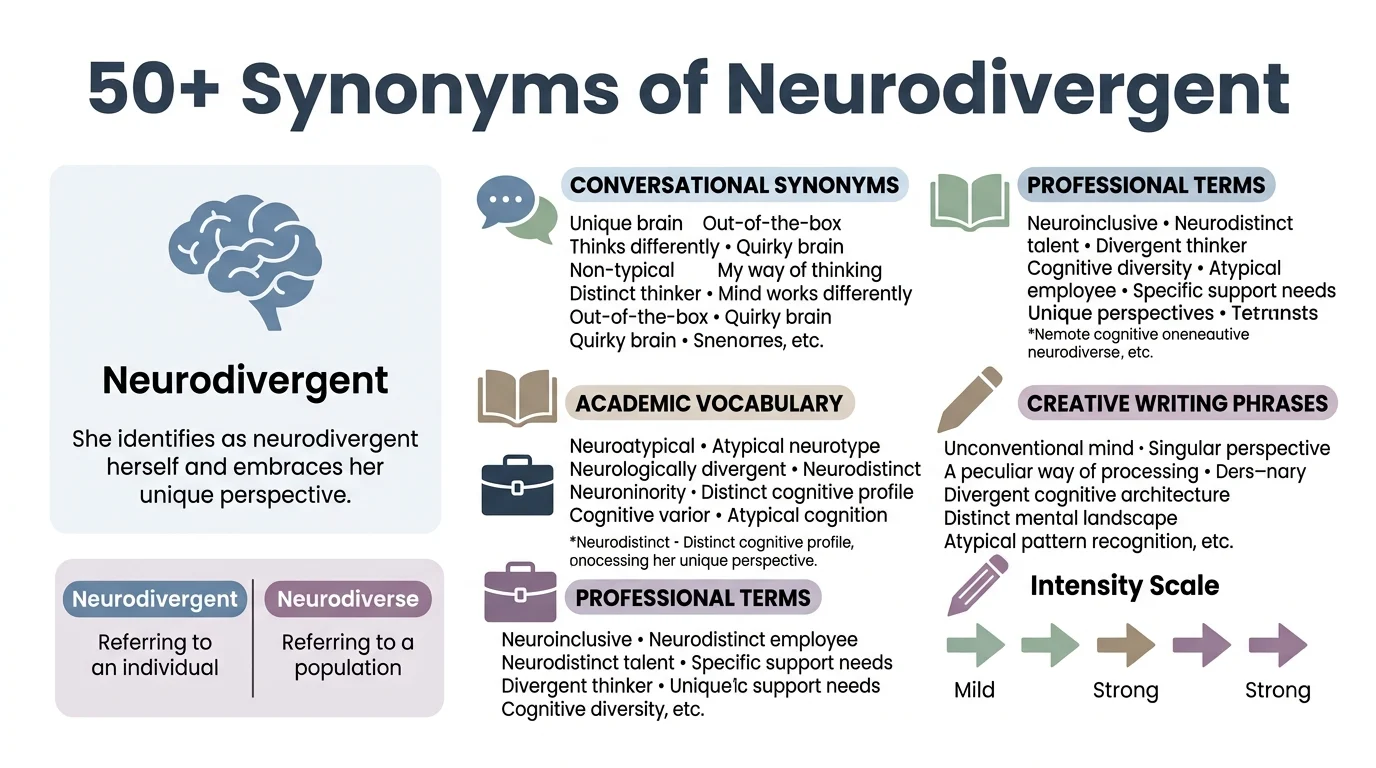
You are writing an important email and realize you have used the word “neurodivergent” three times in two paragraphs. It feels repetitive, but you are not sure which other words to use. This happens to writers, professionals, and students all the time. Finding the right synonyms of neurodivergent can make your writing clearer and more engaging. The word itself is valuable, but using it too often can make your message feel stale. Choosing the right alternative helps you communicate with precision while keeping your audience interested. This guide will help you understand the meaning of neurodivergent, explore its best synonyms, and learn exactly when to use each one.
What Are the Best Synonyms of “Neurodivergent”?
Neurodivergent describes people whose brains function differently from what society considers typical. This includes conditions like autism, ADHD, dyslexia, and other cognitive differences. Formal writing, choose neuroatypical or non-neurotypical. For casual conversation, use neurospicy or brain-different. Professional communication, neurologically diverse or neurovariant work well. For academic writing, neurodivergent individual or atypical neurological development are appropriate.
Meaning, Tone, and Context
Simple Definition
Neurodivergent is a nonmedical term that describes people whose brains develop or work differently for some reason. It means the person has different strengths and struggles compared to people whose brains develop or work more typically.
Part of Speech
- Adjective: Describing a person or their neurological characteristics
- Noun: Referring to a neurodivergent person
Overall Tone
Neutral to positive. The term was created as an affirming alternative to words like “disorder” or “abnormal”. It emphasizes that neurological differences are natural variations rather than defects.
Formality Level
Semi-formal to neutral. Neurodivergent is widely used in professional, academic, and everyday contexts. It is not overly technical but carries more weight than casual slang terms.
Common Uses
Native English speakers use neurodivergent when:
- Discussing workplace inclusion and accommodations
- Writing about education and learning support
- Describing personal identity in the neurodiversity movement
- Creating accessible policies and environments
- Talking about autism, ADHD, dyslexia, and related conditions
Word Forms
- Neurodivergence (noun): The state or condition of being neurodivergent
- Neurodivergent (adjective/noun): The primary form
- Neurotypical (opposite): Describes people whose brain function aligns with societal norms
When and How to Use “Neurodivergent”
Choose neurodivergent when you want to describe someone whose brain functions differently from what is considered typical, especially in contexts related to identity, inclusion, and neurodiversity. It is the preferred term in most professional and social settings today.
Real-Life Examples by Context
Professional
Our company has implemented new hiring practices to attract neurodivergent candidates and create a more inclusive workplace.
Academic
The study examined how neurodivergent students perform in traditional classroom environments compared to their neurotypical peers.
Workplace
We are training our managers to better support neurodivergent employees through flexible work arrangements.
Personal
My sister is neurodivergent, and she has taught me so much about seeing the world from a different perspective.
I wanted to reach out because our organization is launching a mentorship program specifically for neurodivergent professionals.
Resume
Developed accessible training materials that improved learning outcomes for neurodivergent team members by 40%.
Being neurodivergent is not a disadvantage. It is a different way of experiencing the world with its own unique strengths.
Best Synonyms of “Neurodivergent”
No synonym is identical in every situation. The best choice depends on your audience, purpose, and tone. Here are the top recommendations for specific contexts.
Professional Writing
Best synonym: Neuroatypical
This term carries a clinical yet respectful tone that works well in professional documents. It clearly communicates neurological difference without sounding informal.
Academic Writing
Best synonym: Neurologically diverse individual
This phrase is precise and aligns with the language used in research papers and scholarly articles about neurodiversity.
Business Communication
Best synonym: Neurovariant
This modern term is gaining acceptance in business settings. It sounds professional while acknowledging individual neurological differences.
Casual Conversation
Best synonym: Neurospicy
This playful slang term is used affectionately within the neurodivergent community. It is lighthearted and works well among friends.
Emotional Writing
Best synonym: Brain-different
This simple, direct phrase carries emotional weight and emphasizes the personal experience of being neurodivergent.
Creative Writing
Best synonym: Neurologically unique
This phrase adds a poetic quality while remaining accurate. It highlights the individuality of each neurodivergent person.
Resume Writing
Best synonym: Neurodivergent professional
Keeping the original term on a resume shows self-awareness and confidence. It signals that you understand your strengths and needs.
Workplace Communication
Best synonym: Non-neurotypical
This neutral term is useful in workplace policies and training materials. It clearly defines who is being discussed without value judgments.
Stronger Meaning
Best synonym: Neurominority
This term emphasizes that neurodivergent people represent a smaller portion of the population. It carries a stronger sociopolitical message.
Softer Meaning
Best synonym: Differently wired
This gentle, approachable phrase softens the concept of neurological difference. It is warm and accessible for general audiences.
When Not to Use “Neurodivergent”
Neurodivergent is not always the best choice. Understanding when to avoid it helps you communicate more effectively.
When It Sounds Too General
Neurodivergent is an umbrella term that covers many different conditions. If you need to be specific about a particular condition, use the precise term instead.
Less effective: Our program supports neurodivergent children.
Better: Our program supports children with autism and ADHD.
When It Sounds Too Formal
In casual conversations with friends, neurodivergent can feel overly clinical. Use more relaxed alternatives.
Less effective: I am neurodivergent, so I struggle with loud environments.
Better: My brain works a little differently, so loud places are tough for me.
When It Sounds Too Weak
Sometimes you need stronger language to advocate for rights or resources. Neurodivergent may not carry enough weight in these situations.
Less effective: Neurodivergent people deserve accommodations.
Better: Neurominorities deserve full access and accommodations.
When It Is Outdated in Certain Contexts
While neurodivergent is current and widely accepted, some older publications may still use outdated terms. Always prioritize the language preferred by the neurodivergent community itself.
Words Commonly Confused With “Neurodivergent”
Neurodivergent vs Neurodiverse
Difference: Neurodivergent describes an individual person. Neurodiverse describes a group that includes both neurodivergent and neurotypical people.
When to Use It: Use neurodivergent for individuals. Use neurodiverse for teams, workplaces, or populations.
Example (neurodivergent): My cousin is neurodivergent and has incredible attention to detail.
Example (neurodiverse): Our department is neurodiverse, with employees who think in many different ways.
Neurodivergent vs Neurotypical
Difference: Neurotypical is the direct opposite. It describes people whose brain function falls within what society considers typical.
When to Use It: Use neurotypical when you need to contrast with neurodivergent experiences.
Example (neurodivergent): Neurodivergent people often process sensory information differently.
Example (neurotypical): The training was designed for neurotypical learners, so it may not suit everyone.
Neurodivergent vs Atypical
Difference: Atypical simply means “not typical” and can apply to many things beyond neurology. Neurodivergent is specifically about brain function.
When to Use It: Use atypical when you want a broader, less specific term.
Example (neurodivergent): She is neurodivergent and thrives in structured environments.
Example (atypical): His approach to problem-solving is atypical but highly effective.
Neurodivergent vs Disabled
Difference: Not all neurodivergent people identify as disabled. Neurodivergent focuses on neurological difference, while disabled refers to functional limitations in society.
When to Use It: Use disabled only if the person identifies that way. Neurodivergent is generally preferred as a neutral or positive term.
Example (neurodivergent): Many neurodivergent people prefer identity-first language.
Example (disabled): The building was not accessible to disabled visitors.
Neurodivergent vs Neuroatypical
Difference: These terms are largely synonymous, but neuroatypical places more emphasis on deviating from a “typical” standard.
When to Use It: Use neuroatypical in clinical or formal writing where precision matters.
Example (neurodivergent): The conference welcomed neurodivergent attendees with quiet rooms.
Example (neuroatypical): The assessment identified neuroatypical cognitive patterns.
Best Synonyms of “Neurodivergent” by Context
| Context | Best Synonym | Why It Works | Example |
|---|---|---|---|
| Formal writing | Neuroatypical | Sounds clinical and precise | The neuroatypical population requires tailored support. |
| Academic writing | Neurologically diverse individual | Aligns with research terminology | Neurologically diverse individuals were included in the study. |
| Professional communication | Neurovariant | Modern and professional | Our neurovariant employees bring unique perspectives. |
| Business emails | Non-neurotypical | Neutral and clear | We are expanding benefits for non-neurotypical staff. |
| Resume writing | Neurodivergent professional | Shows confidence and self-awareness | Neurodivergent professional with 5+ years in project management. |
| Workplace communication | Neurominority | Emphasizes inclusion | We are committed to supporting neurominority employees. |
| Casual conversation | Neurospicy | Playful and community-driven | I am neurospicy, so I need my routine. |
| Everyday speaking | Brain-different | Simple and relatable | My brain-different kid thinks in ways that amaze me. |
| Creative writing | Neurologically unique | Adds artistic flair | Her neurologically unique mind saw patterns others missed. |
| Storytelling | Differently wired | Warm and accessible | He was differently wired, and that was his superpower. |
| Emotional writing | Neurodistinct | Emphasizes individuality | Being neurodistinct is part of who I am. |
| Strong emphasis | Neurominority | Carries sociopolitical weight | Neurominorities deserve equal representation. |
| Mild tone | Atypical | Gentle and broad | She has an atypical learning style. |
| Social media captions | Neurospicy | Engaging and relatable | Neurospicy and proud. 🌶️ |
How to Choose the Best Synonym of “Neurodivergent”
Choosing the right synonym comes down to four key factors.
1. Consider Your Audience
- Formal audience (executives, academics): Use neuroatypical or non-neurotypical
- General audience (blog readers, social media): Use neurodivergent or brain-different
- Community audience (neurodivergent groups): Use neurospicy or neurovariant
2. Consider Your Tone
- Neutral tone: Stick with neurodivergent
- Professional tone: Choose neuroatypical or neurovariant
- Playful tone: Use neurospicy
- Emotional tone: Try brain-different or differently wired
3. Consider Your Purpose
- Describing an individual: Neurodivergent, neuroatypical, or neurovariant
- Describing a group: Neurodiverse
- Advocating for rights: Neurominority
- Explaining a concept: Neurologically diverse
4. Consider Natural Sound
The best synonym is the one that sounds most natural in your sentence. Read your sentence aloud. If it feels forced, try a different option.
Real-Life Examples of “Neurodivergent”
School
The school created a sensory-friendly library for neurodivergent students who needed quiet spaces to study.
College
Neurodivergent college students often benefit from extended time on exams and access to note-taking software.
Workplace
Our team includes several neurodivergent members whose analytical thinking has improved our project outcomes.
Business
The company launched a neurodiversity hiring initiative to attract neurodivergent talent.
I am writing to request accommodations for our neurodivergent employees during the office renovation.
Resume
Stronger: Advocated for neurodivergent inclusion in company policies, resulting in a 25% increase in employee satisfaction.
Conversation
Original: My brother is neurodivergent.
Stronger: My brother is neurodivergent, which means he experiences the world in a completely different way than I do.
Storytelling
Original: The hero was neurodivergent.
Stronger: The hero’s neurodivergent mind, with its unusual patterns and connections, solved the mystery that baffled everyone else.
Blogging
Being neurodivergent is not about being broken. It is about being wired differently in a world built for one type of brain.
Social Media
Neurodivergent pride. Our brains are not less. They are just different. 🧠✨
18 Best Synonyms of “Neurodivergent”
| Synonym | Simple Meaning | Best Used For | Example Sentence |
|---|---|---|---|
| Neuroatypical | Having neurological differences from the typical | Formal and clinical writing | The neuroatypical participants showed unique problem-solving approaches. |
| Neurovariant | Having a different neurological configuration | Professional and modern contexts | As a neurovariant individual, she thrives in creative roles. |
| Non-neurotypical | Not fitting the typical neurological profile | Neutral, descriptive writing | Non-neurotypical employees may need different kinds of support. |
| Neurospicy | Playful slang for being neurodivergent | Casual conversation and social media | I am neurospicy, and I embrace my chaotic brain. |
| Brain-different | Having a brain that works differently | Personal and emotional writing | Being brain-different has shaped my entire life experience. |
| Neurologically diverse | Having a diverse neurological profile | Academic and research contexts | Neurologically diverse individuals were overrepresented in the sample. |
| Neurominority | Belonging to a minority neurological group | Advocacy and sociopolitical writing | Neurominorities deserve equal access to education. |
| Neurodistinct | Having a distinct neurological makeup | Creative and identity-focused writing | Her neurodistinct perspective added depth to the conversation. |
| Differently wired | Having a different brain wiring | Warm, accessible communication | My differently wired son sees beauty where others see chaos. |
| Atypical | Not typical or usual | General, less specific contexts | She has an atypical cognitive style that works well in research. |
| Neurodiverse (individual) | Having neurological diversity | When the group/individual distinction is less critical | He is neurodiverse and excels in pattern recognition. |
| Aneurotypical | Not neurotypical | Technical or clinical discussions | The aneurotypical subjects demonstrated varied responses. |
| Neurologically atypical | Having atypical neurology | Formal, precise descriptions | Neurologically atypical patients require personalized care plans. |
| Neurodifferent | Having a different neurology | Modern, inclusive language | Neurodifferent thinkers often challenge conventional wisdom. |
| Cognitively diverse | Having diverse cognitive patterns | Workplace and team contexts | Our cognitively diverse team solves problems from multiple angles. |
| Neurobiological variant | Having a variant neurological biology | Scientific and medical writing | The study examined neurobiological variants in the population. |
| Non-normative neurological | Not fitting neurological norms | Academic and theoretical discussions | Non-normative neurological development is more common than previously thought. |
| Neuroqueer | Intersection of neurodivergence and queer identity | Identity-specific contexts | She identifies as neuroqueer and advocates for both communities. |
Synonyms of “Neurodivergent” by Usage
Professional vs Personal Synonyms
Professional Synonyms (Workplace, Business, Formal Settings)
- Neuroatypical
- Neurovariant
- Non-neurotypical
- Neurologically diverse
- Neurodistinct
These words sound polished and appropriate for resumes, performance reviews, and client communication. They show that you understand professional terminology without being overly casual.
Personal Synonyms (Friends, Family, Everyday Conversations)
- Neurospicy
- Brain-different
- Differently wired
- Atypical
- Neurodifferent
These words feel warmer and more relatable. They work well when talking about your own experience or describing someone close to you.
Formal vs Conversational Synonyms
Formal Synonyms (Reports, Essays, Business Writing, Presentations)
- Neuroatypical
- Non-neurotypical
- Neurologically atypical
- Neurobiological variant
These choices belong in academic papers, corporate reports, and formal presentations. They communicate precision and professionalism.
Conversational Synonyms (Emails, Texting, Casual Talks)
- Neurospicy
- Brain-different
- Differently wired
- Neurodifferent
These options are relaxed and approachable. They are perfect for everyday communication where formality is not required.
Academic Synonyms
For research papers, essays, and academic discussions, choose precise vocabulary that sounds authoritative.
- Neurologically diverse individual: Precise and respectful
- Neuroatypical: Clinically accurate
- Non-neurotypical: Clear and neutral
- Neurobiological variant: Scientifically rigorous
These terms demonstrate scholarly understanding and maintain the objectivity expected in academic writing.
Professional and Business Synonyms
For resumes, interviews, meetings, and client communication, these synonyms make the strongest impression.
- Neurovariant: Modern and professional
- Neuroatypical: Clinical but respectful
- Non-neurotypical: Clear and neutral
- Neurominority: Emphasizes inclusion and representation
- Cognitively diverse: Team-focused and collaborative
Each of these fits professional settings because they sound informed, respectful, and current.
Creative and Literary Synonyms
For storytelling, fiction, poetry, and descriptive writing, these expressive alternatives add emotion and imagery.
- Differently wired: Warm and evocative
- Brain-different: Direct and honest
- Neurologically unique: Celebrates individuality
- Neurodistinct: Emphasizes uniqueness
- Neuroqueer: Specific and identity-affirming
These words help create vivid, emotional connections with readers.
Slang or Modern Synonyms
Neurospicy is the primary slang synonym for neurodivergent. It emerged in online communities as a playful, pride-filled way to describe having a neurodivergent brain.
Where it is acceptable:
- Social media
- Casual conversations with friends
- Neurodivergent community spaces
- Informal blog posts
Where it should be avoided:
- Professional emails
- Academic papers
- Formal presentations
- Job interviews
- Client communication
Strongest to Mildest Synonyms
| Intensity | Synonym | Emotional Weight |
|---|---|---|
| Mild | Atypical | Very low. Simply means “not typical.” |
| Mild | Non-neurotypical | Low. Neutral description. |
| Moderate | Neurodivergent | Moderate. The standard term. |
| Moderate | Neuroatypical | Moderate. Clinical but neutral. |
| Moderate | Neurovariant | Moderate. Modern and professional. |
| Strong | Neurominority | Strong. Emphasizes minority status. |
| Strong | Neurodistinct | Strong. Highlights uniqueness. |
| Very Strong | Neuroqueer | Very strong. Intersectional identity term. |
Emotional vs Neutral Synonyms
Emotional Synonyms
These words express stronger feelings and personal connection.
- Neurospicy: Playful, proud, community-driven
- Brain-different: Personal, honest, vulnerable
- Differently wired: Warm, accepting, gentle
- Neurodistinct: Celebratory, identity-focused
- Neuroqueer: Political, intersectional, affirming
Use these when you want to convey emotion, pride, or personal experience.
Neutral Synonyms
These words simply communicate information without adding emotion.
- Neuroatypical: Clinical, factual
- Non-neurotypical: Descriptive, objective
- Neurovariant: Modern, straightforward
- Atypical: Broad, general
- Neurologically diverse: Academic, precise
Use these when you need to communicate clearly without emotional coloring.
Antonyms of “Neurodivergent”
| Antonym | Meaning | Example Sentence |
|---|---|---|
| Neurotypical | Having typical neurological function | Neurotypical students may not understand the challenges their neurodivergent peers face. |
| Neurologically typical | Having typical neurology | The study compared neurologically typical and neurodivergent participants. |
| Normal | Conforming to a standard (use with caution) | The word “normal” is often avoided in favor of “neurotypical.” |
| Average | Falling within the average range | Average cognitive function does not account for neurodivergent strengths. |
| Non-neurodivergent | Not neurodivergent | Non-neurodivergent employees may not require the same accommodations. |
| Neuroconforming | Conforming to neurological norms | Neuroconforming individuals often assume everyone thinks like they do. |
| Predominant Neurotype | The most common neurological type | The Predominant Neurotype sets the standard for what is considered “typical.” |
| Standard | Meeting the standard | Standard teaching methods do not always work for every student. |
| Conventional | Following convention | Conventional thinking patterns are not the only valid way to process information. |
| Typical | Being typical | Typical brain development follows predictable patterns. |
| Neurologically standard | Fitting the neurological standard | Neurologically standard individuals may not recognize neurodivergent experiences. |
| Neuro-mainstream | Belonging to the mainstream neurology | Neuro-mainstream culture often excludes neurominorities. |
| Non-atypical | Not atypical | Non-atypical development is what most educational systems expect. |
| Neuro-ordinary | Having ordinary neurology | Neuro-ordinary people rarely think about how their brains work. |
| Neurologically normative | Fitting neurological norms | Neurologically normative standards disadvantage those who diverge from them. |
Comparison: “Neurodivergent” vs Similar Words
Neurodivergent vs Neurodiverse
Main Difference: Neurodivergent describes an individual. Neurodiverse describes a group or population.
Which Is Stronger? Neurodivergent is more specific and direct.
Which Is More Formal? Both are equally formal and widely accepted.
When to Use Each:
- Neurodivergent: When talking about one person
- Neurodiverse: When talking about a team, workplace, or population
Examples:
- Neurodivergent: My colleague is neurodivergent.
- Neurodiverse: Our company has a neurodiverse workforce.
Neurodivergent vs Neuroatypical
Main Difference: These terms are largely synonymous, but neuroatypical emphasizes deviation from a “typical” standard.
Which Is Stronger? Neuroatypical sounds slightly more clinical and precise.
Which Is More Formal? Neuroatypical is more formal and clinical.
When to Use Each:
- Neurodivergent: General use, preferred by the community
- Neuroatypical: Clinical, formal, or research contexts
Examples:
- Neurodivergent: The workshop was designed for neurodivergent participants.
- Neuroatypical: The assessment revealed neuroatypical cognitive patterns.
Neurodivergent vs Atypical
Main Difference: Atypical is broader and can describe anything not typical. Neurodivergent is specifically about neurology.
Which Is Stronger? Neurodivergent is more specific and meaningful.
Which Is More Formal? Atypical is formal but less precise.
When to Use Each:
- Neurodivergent: When discussing neurological differences specifically
- Atypical: When you need a general term for anything unusual
Examples:
- Neurodivergent: She is neurodivergent and needs quiet workspaces.
- Atypical: His atypical approach to marketing won the campaign award.
Neurodivergent vs Disabled
Main Difference: Not all neurodivergent people identify as disabled. Neurodivergent is about neurological difference; disabled is about functional limitations.
Which Is Stronger? Disabled carries more weight regarding access and rights.
Which Is More Formal? Both are formal and acceptable.
When to Use Each:
- Neurodivergent: When the person identifies this way
- Disabled: When discussing access, accommodations, or if the person identifies as disabled
Examples:
- Neurodivergent: Many neurodivergent people prefer identity-first language.
- Disabled: The building was inaccessible to disabled visitors.
Neurodivergent vs Neurotypical
Main Difference: Neurotypical is the direct opposite of neurodivergent.
Which Is Stronger? Neither is stronger; they are opposites.
Which Is More Formal? Both are equally formal.
When to Use Each:
- Neurodivergent: To describe someone with atypical neurology
- Neurotypical: To describe someone with typical neurology
Examples:
- Neurodivergent: Neurodivergent people often think outside the box.
- Neurotypical: Neurotypical people may not notice sensory overload in a room.
Neurodivergent vs Neurominority
Main Difference: Neurominority emphasizes that neurodivergent people are a minority group. Neurodivergent is a broader descriptive term.
Which Is Stronger? Neurominority is stronger and more political.
Which Is More Formal? Neurominority is formal and often used in advocacy.
When to Use Each:
- Neurodivergent: General description
- Neurominority: Advocacy, rights discussions, and sociopolitical contexts
Examples:
- Neurodivergent: She is neurodivergent and excels in analytical roles.
- Neurominority: Neurominorities deserve equal representation in government.
Common Phrases and Expressions with “Neurodivergent”
Neurodivergent community
Meaning: The collective group of neurodivergent individuals and their allies.
Example Sentence: The neurodivergent community has advocated for better workplace accommodations for years.
Neurodivergent-friendly
Meaning: Designed or adapted to be accessible and welcoming to neurodivergent people.
Example Sentence: The library created a neurodivergent-friendly space with dim lighting and quiet zones.
Neurodivergent-affirming
Meaning: Validating and supporting neurodivergent identities and experiences.
Example Sentence: We are committed to neurodivergent-affirming practices in our therapy sessions.
Neurodivergent identity
Meaning: The personal identification with being neurodivergent.
Example Sentence: Embracing her neurodivergent identity helped her understand her strengths and challenges.
Neurodivergent experience
Meaning: The lived experience of being neurodivergent.
Example Sentence: The podcast explores the neurodivergent experience through personal stories and expert interviews.
Neurodivergent-led
Meaning: Organized, created, or led by neurodivergent people.
Example Sentence: The neurodivergent-led organization focuses on peer support and advocacy.
Neurodivergent representation
Meaning: The inclusion and portrayal of neurodivergent people in media, politics, and society.
Example Sentence: Neurodivergent representation in film has improved significantly in recent years.
Common Mistakes to Avoid
1: Using “Neurodiverse” for an Individual
Incorrect: My sister is neurodiverse.
Better: My sister is neurodivergent.
Why: Neurodiverse describes a group, not an individual. A single person cannot be neurodiverse.
2: Using “Neurospicy” in Professional Writing
Incorrect: We are hiring neurospicy candidates for our engineering team.
Better: We are hiring neurodivergent candidates for our engineering team.
Why: Neurospicy is slang and inappropriate for professional contexts.
3: Confusing “Neurodivergent” with “Disabled”
Incorrect: All neurodivergent people are disabled.
Better: Some neurodivergent people identify as disabled, but not all do.
Why: Neurodivergence is about neurological difference, not necessarily disability. Many neurodivergent people do not consider themselves disabled.
4: Using Outdated or Offensive Terms
Incorrect: He suffers from neurodivergence.
Better: He is neurodivergent.
Why: The word “suffers” implies that being neurodivergent is inherently negative. The neurodivergent community prefers neutral or positive language.
5: Using “Neurodivergent” as a Diagnosis
Incorrect: The doctor diagnosed him as neurodivergent.
Better: The doctor diagnosed him with autism.
Why: Neurodivergent is not a medical diagnosis. It is a descriptive term. Always use specific diagnoses when discussing medical conditions.
6: Overusing “Neurodivergent” in Writing
Incorrect: Neurodivergent employees need neurodivergent-friendly policies. Neurodivergent leaders should guide neurodivergent initiatives.
Better: Neurodivergent employees need accessible policies. Leaders with lived experience should guide these initiatives.
Why: Repetition makes writing feel stale. Vary your vocabulary to keep readers engaged.
Frequently Asked Questions
1. What are the best synonyms of “neurodivergent”?
The best synonyms depend on context. Formal writing, use neuroatypical or non-neurotypical. For casual conversation, use neurospicy or brain-different. For professional settings, try neurovariant or neurologically diverse.
2. What are the best formal synonyms of “neurodivergent”?
The best formal synonyms are neuroatypical, non-neurotypical, neurologically atypical, and neurobiological variant. These terms sound professional and precise in academic, medical, and business contexts.
3. What are common informal synonyms of “neurodivergent”?
Common informal synonyms include neurospicy, brain-different, differently wired, and neurodifferent. These are used in casual conversation, social media, and community spaces.
4. What is another word for “neurodivergent” in professional writing?
In professional writing, use neurovariant, neuroatypical, or non-neurotypical. These terms maintain professionalism while accurately describing neurological differences.
5. What is the difference between “neurodivergent” and “neurodiverse”?
Neurodivergent describes an individual person. Neurodiverse describes a group that includes both neurodivergent and neurotypical people. No single person can be neurodiverse.
6. What is the opposite of “neurodivergent”?
The opposite of neurodivergent is neurotypical. Neurotypical describes people whose brain function falls within what society considers typical or standard.
Conclusion
Neurodivergent is a valuable term that describes people whose brains function differently from what society considers typical. It encompasses conditions like autism, ADHD, dyslexia, and many other cognitive differences. The best synonyms of neurodivergent depend entirely on your audience, purpose, and tone. Formal writing, choose neuroatypical or non-neurotypical. For casual conversations, neurospicy or brain-different work well. For professional settings, neurovariant or neurologically diverse communicate clearly and respectfully. No single synonym works perfectly in every situation. The key to strong writing is choosing the word that best matches your message and your reader. Always consider your audience and the emotional weight of each option. Remember, the goal is not just to avoid repetition but to communicate with precision and empathy. The neurodivergent community has worked hard to create language that respects identity and celebrates difference. Use these synonyms thoughtfully, and your writing will be clearer, more inclusive, and more engaging.