Have you ever found yourself writing an essay, a professional email, or a social media caption and realized you have used the word “justice” three times in two sentences? You are not alone. Many writers, students, and professionals struggle to find the right alternative for this powerful word.
Whether you are drafting a legal document, crafting a persuasive essay, or simply trying to express a sense of fairness in everyday conversation, knowing the right synonym can elevate your communication.
This guide will give you a complete toolbox of synonyms for justice to help you choose the perfect word for any situation.
What Does “Justice” Mean?
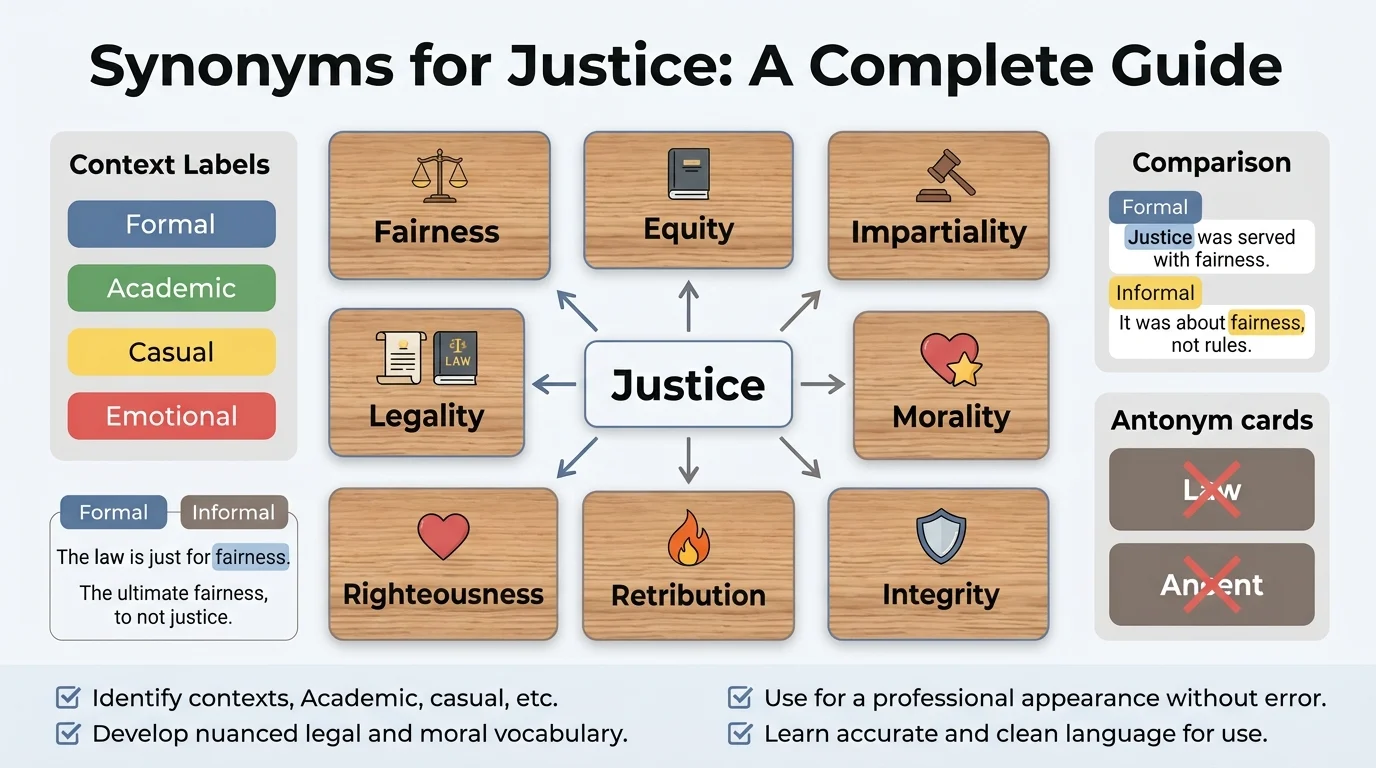
Justice means fairness, moral rightness, or the fair treatment of people according to the law. The best synonyms depend on your context. For formal writing, use “fairness” or “equity.” For emotional contexts, try “righteousness.” legal situations, “impartiality” works well. Academic writing often prefers “equity” or “legitimacy.”
Meaning, Tone and Context
Simple definition: Justice refers to the quality of being fair, reasonable, and morally right. It also means the legal system and the process of upholding laws.
Part of speech: Noun
Tone: Neutral to positive, depending on usage
Formality level: Formal to semi formal
Common use cases: Legal writing, academic essays, social justice discussions, professional communication, ethics debates, and everyday conversations about fairness
Important word forms:
- Adjective: just
- Adverb: justly
- Noun: justness
- Verb: justify (related but different meaning)
When and How to Use “Justice”
You should use “justice” when you want to emphasize moral rightness, legal fairness, or ethical treatment. It carries weight and seriousness, so avoid using it for trivial matters. Reserve this word for situations involving fairness, rights, legal matters, or moral principles.
Professional context:
The new policy ensures justice for all employees by creating equal opportunities for advancement.
Academic context:
The study examines how social justice can be achieved through educational reform and community engagement.
Personal context:
She felt a deep sense of justice when her complaint about workplace discrimination was finally addressed.
Emotional context:
The family sought justice for their loved one after the long and difficult trial concluded.
Creative writing context:
The hero’s quest was not for revenge but for justice, a pursuit that tested his very soul.
Social media context:
Standing up for justice means using your voice to speak for those who cannot speak for themselves.
Email context:
I believe we can find a solution that brings justice to all parties involved in this dispute.
Another Word for “Justice”
The best single replacement depends entirely on your context and what aspect of justice you want to emphasize.
Professional writing: fairness
Academic writing: equity
Casual conversation: fairness or rightness
Emotional writing: righteousness
Creative writing: retribution or vindication
Resume or workplace use: integrity or impartiality
Social media captions: equality or fairness
Stronger meaning: retribution or punishment
Softer meaning: fairness or decency
When Not to Use “Justice”
Avoid using “justice” when you are describing a simple preference, a minor disagreement, or a personal opinion that does not involve fairness or ethics. The word carries too much moral weight for everyday trivial situations.
Weak usage:
The cafeteria should serve pizza every Friday for justice.
Improved:
The cafeteria should serve pizza every Friday because it is the most popular choice among students.
Weak usage:
My team deserves justice because the referee made a bad call.
Improved:
My team deserves a fair review of the referee’s call because it might have been incorrect.
Words Commonly Confused With “Justice”
Justice vs. Fairness
Justice is a broader concept that includes legal and moral principles. Fairness is more about equality and impartiality in specific situations. Use “justice” for systemic issues and “fairness” for everyday decisions.
Justice vs. Equality
Equality means giving everyone the same resources or opportunities. means giving people what they need to reach a fair outcome, which may require different treatment for different people.
Justice vs. Mercy
involves giving people what they deserve according to rules or laws. Mercy involves showing compassion or forgiveness, often by reducing or waiving punishment.
Justice vs. Vengeance
Justice is impartial and aims for a fair outcome. Vengeance is personal and driven by a desire for revenge, often without regard for fairness.
Justice vs. Law
Law is the system of rules. Justice is the moral principle that those rules aim to uphold. Laws can sometimes be unjust.
Justice vs. Righteousness
Righteousness is a moral quality of being virtuous or morally correct. Justice is the application of that morality through fair treatment and legal processes.
Best Synonym by Context for “Justice”
| Context | Best Synonym | Why It Works | Example |
|---|---|---|---|
| Formal writing | Equity | Shows sophisticated understanding of fairness in systems | The organization is committed to equity in all its hiring practices. |
| Academic writing | Impartiality | Emphasizes objectivity and lack of bias | The study demands impartiality in evaluating all research subjects. |
| Professional business use | Fairness | Clear and accessible for workplace communication | We must ensure fairness in our performance review process. |
| Resume use | Integrity | Highlights personal ethical standards | Maintained integrity in all client dealings and legal matters. |
| Casual conversation | Fairness | Easy to understand and relatable | All we want is fairness in how the rules are applied. |
| Creative writing | Retribution | Adds dramatic weight and consequence | The story explores retribution and its cost to the human soul. |
| Emotional tone | Righteousness | Conveys moral passion and conviction | Her righteousness gave her the strength to speak truth to power. |
| Strong intensity | Vindication | Suggests proven correctness and triumph | The verdict was complete vindication after years of struggle. |
| Soft moderate tone | Decency | Gentle and approachable | Basic human decency should guide all our decisions. |
| Social media captions | Equality | Resonates with modern social movements | Fighting for equality means fighting for everyone’s rights. |
| US usage | Justice | Standard American English usage | The American justice system is based on constitutional principles. |
| UK usage | Justice | Similar to US usage | British justice emphasizes the rule of law and parliamentary sovereignty. |
Which Synonym Should You Choose?
Choosing the right synonym for justice depends on several factors. Consider your audience first. If you are writing for academics, “equity” or “impartiality” will sound professional. For general readers, “fairness” is more accessible.
Think about the emotional weight you want to carry. “Righteousness” and “retribution” carry strong emotions, while “fairness” and “decency” are more neutral. Consider the legal context. “Impartiality” and “legitimacy” work well for legal writing.
Examine your sentence structure. Some synonyms fit naturally in certain phrases. For example, “seek justice” can become “pursue fairness” or “demand equity.” Match the formality level to your situation. Formal writing needs formal synonyms. Casual conversation needs simpler words.
Real Life Examples of “Justice” in Sentences
School context:
The students organized a forum to discuss social justice issues affecting their community.
Workplace context:
The human resources department handled the complaint with justice and impartiality.
Writing context:
In her memoir, she explored themes of justice, identity, and belonging.
Conversation context:
Do you think the legal system can truly provide justice for all citizens?
Social media context:
True justice means building a world where everyone can thrive, not just survive.
Email context:
Our policy is designed to deliver justice by ensuring equal treatment for all candidates.
Storytelling context:
The old judge had spent his entire career pursuing justice, even when it was unpopular.
15 Synonyms for “Justice”
| Synonym | Simple Meaning | Best Used For | Example Sentence |
|---|---|---|---|
| Fairness | Impartial and just treatment | General use, everyday conversation | Fairness in grading should be the priority for every teacher. |
| Equity | Fairness that accounts for different needs | Academic and professional writing | The new funding model promotes equity across all school districts. |
| Impartiality | Lack of bias or favoritism | Legal and judicial contexts | The judge was known for her impartiality in difficult cases. |
| Righteousness | Moral rightness and virtue | Emotional and religious contexts | His righteousness gave him the courage to stand alone. |
| Retribution | Punishment for wrongdoing | Creative writing, strong emotional tone | The story ends with retribution for all the villains. |
| Vindication | Proof of being right or justified | Strong, conclusive contexts | The evidence provided complete vindication for the accused. |
| Legitimacy | Conformity to rules or principles | Political and institutional contexts | The election results have legitimacy because of the fair process. |
| Integrity | Honesty and moral principles | Professional and personal character | She handled every case with integrity and professionalism. |
| Decency | Basic moral goodness | Soft, humanistic contexts | We should treat all people with decency and respect. |
| Honesty | Truthfulness and fairness | Simple, clear communication | Honesty in business dealings builds lasting trust. |
| Objectivity | Judgment based on facts | Scientific and analytical writing | The research required complete objectivity from all observers. |
| Due process | Fair legal procedures | Legal and formal contexts | The accused was granted due process under the law. |
| Redress | Remedy or compensation for wrong | Formal, legal situations | The victim sought redress through the legal system. |
| Equality | Equal rights and opportunities | Social and political discourse | The movement fights for equality in education and employment. |
| Truth | Factual and moral correctness | Philosophical and ethical discussions | The search for truth often leads to questions of justice. |
Synonym Groups and Usage Differences
Professional vs. Personal Synonyms
Professional synonyms like “impartiality” and “equity” emphasize systems and procedures. Personal synonyms like “decency” and “fairness” focus on individual interactions and moral character. Choose professional synonyms for workplace policies and legal documents. Use personal synonyms for everyday conversations and personal values.
Formal vs. Conversational Synonyms
Formal synonyms include “legitimacy,” “redress,” and “due process.” These words belong in legal documents, academic papers, and official statements. Conversational synonyms include “fairness,” “honesty,” and “decency.” These words work well in casual writing, texts, and everyday speech.
Academic Synonyms
Academic writing values precision and objectivity. “Equity” shows understanding of systemic fairness. “Impartiality” demonstrates awareness of bias. “Legitimacy” suggests institutional validity. These words elevate essays, research papers, and scholarly articles.
Professional and Business Synonyms
Workplace communication benefits from “integrity,” “fairness,” and “objectivity.” These words build trust and demonstrate professionalism. Use them in performance reviews, policy documents, and leadership communication.
Creative or Literary Synonyms
Creative writers can choose “retribution,” “vindication,” or “righteousness” to add dramatic weight. These words carry emotional and narrative power. They work well in novels, poetry, and storytelling.
Slang or Modern Synonyms
Modern usage sometimes uses “fair shake,” “square deal,” or “just desserts.” These informal expressions are acceptable in casual conversation but too colloquial for professional writing. Use them sparingly and only in appropriate contexts.
Strongest vs. Weaker Synonyms
Mild: Decency, fairness, honesty
Moderate: Impartiality, objectivity, legitimacy
Strong: Retribution, vindication, righteousness
Strongest: Vengeance, retribution, punishment
Emotional vs. Neutral Synonyms
Emotional synonyms carry moral passion and intensity. “Righteousness,” “retribution,” and “vindication” evoke strong feelings. Neutral synonyms stay factual and objective. “Impartiality,” “objectivity,” and “legitimacy” avoid emotional weight. Choose based on your purpose.
Antonyms of “Justice”
| Antonym | Meaning | Example Sentence |
|---|---|---|
| Injustice | Lack of fairness or moral rightness | The injustice of the system became painfully clear. |
| Inequality | Unequal treatment or opportunities | Economic inequality undermines social stability. |
| Bias | Prejudice or unfair preference | Bias in hiring decisions creates an unfair workplace. |
| Prejudice | Unfair preconceived opinion | Prejudice prevents true justice from occurring. |
| Discrimination | Unfair treatment based on characteristics | Discrimination violates basic principles of justice. |
| Partiality | Favoritism or bias | The judge’s partiality compromised the trial. |
| Unfairness | Lack of fairness | The unfairness of the policy angered employees. |
| Inequity | Lack of fairness or justice | Systemic inequity affects marginalized communities. |
| Corruption | Dishonest or fraudulent conduct | Corruption undermines the justice system. |
| Oppression | Cruel or unjust treatment | The people rose against oppression. |
| Tyranny | Cruel and oppressive rule | Tyranny replaces justice with fear. |
| Imbalance | Lack of proportion or fairness | The power imbalance made justice impossible. |
| Unlawfulness | Violation of law | Unlawfulness destroys the foundation of justice. |
| Dishonesty | Lack of truthfulness | Dishonesty in court undermines justice. |
| Favoritism | Unfair preference for one person | Favoritism in promotions creates resentment. |
Comparison: Justice vs. Similar Words
Justice vs. Fairness
Main difference: Justice is a broader moral and legal concept. Fairness is more specific and focuses on equal treatment in particular situations.
Which is stronger: Justice is stronger because it encompasses legal, moral, and social dimensions.
Which is more formal: Justice is more formal and carries more weight.
Example with justice: The criminal justice system must protect the rights of all citizens.
Example with fairness: The teacher distributed the snacks with perfect fairness.
Justice vs. Equality
Main difference: Equality means giving everyone the same resources. Justice means giving people what they need for a fair outcome.
Which is stronger: Justice is stronger because it addresses systemic issues.
Which is more formal: Both are formal, but justice appears more in legal contexts.
Example with justice: Social justice requires addressing root causes of disadvantage.
Example with equality: All students should have equality of access to education.
Justice vs. Equity
Main difference: Equity focuses on proportionate fairness that considers individual circumstances. Justice is the broader principle that includes equity.
Which is stronger: Justice is broader and more encompassing.
Which is more formal: Both are formal, but equity is more common in academic writing.
Example with justice: We must pursue justice for all members of society.
Example with equity: The program provides equity in funding based on student needs.
Justice vs. Righteousness
Main difference: Righteousness is a personal moral quality. Justice is the application of moral principles through systems and laws.
Which is stronger: Righteousness carries more emotional intensity.
Which is more formal: Justice is more formal and institutional.
Example with justice: The legal system strives for justice in all cases.
Example with righteousness: Her righteousness motivated her to fight for change.
Justice vs. Vengeance
Main difference: Justice is impartial and seeks fair outcomes. Vengeance is personal and driven by a desire for revenge.
Which is stronger: Vengeance is more emotionally powerful and dangerous.
Which is more formal: Justice is formal and legal. Vengeance is informal and emotional.
Example with justice: The court delivered justice through a fair trial.
Example with vengeance: He sought vengeance for the wrong done to his family.
Justice vs. Impartiality
Main difference: Impartiality is the absence of bias. Justice is the broader system of fair treatment.
Which is stronger: Justice is broader and more comprehensive.
Which is more formal: Impartiality is very formal and specific to judicial contexts.
Example with justice: The organization is dedicated to justice and human rights.
Example with impartiality: The mediator maintained strict impartiality throughout the process.
Common Phrases and Expressions with “Justice”
1. Justice served
Meaning: The fair and correct outcome occurred.
Example sentence: After years of legal battles, justice was finally served.
2. Social justice
Meaning: Fair treatment and rights for all people in society.
Example sentence: The organization advocates for social justice through community education.
3. Justice system
Meaning: The legal institutions and processes that administer justice.
Example sentence: The justice system must evolve to meet modern challenges.
4. Justice delayed is justice denied
Meaning: Delays in legal processes prevent true justice.
Example sentence: The court expedited the case because justice delayed is justice denied.
5. Do justice to
Meaning: Represent or treat something fairly and accurately.
Example sentence: The review does justice to the author’s complex ideas.
6. Criminal justice
Meaning: The system of law enforcement and legal punishment.
Example sentence: Criminal justice reform is a pressing national issue.
7. Just desserts
Meaning: What someone deserves, especially punishment.
Example sentence: The villain finally received his just desserts.
8. Act of justice
Meaning: An action that promotes fairness or corrects a wrong.
Example sentence: The scholarship was an act of justice for underserved students.
Common Mistakes to Avoid
Mistake 1: Using justice when fairness would be more precise
Wrong: The teacher’s decision about the seating chart was a matter of justice.
Right: The teacher’s decision about the seating chart was a matter of fairness.
Mistake 2: Confusing justice with vengeance
Wrong: I will have justice for what they did to me.
Right: I will seek fair legal recourse for what they did to me.
Mistake 3: Using casual synonyms in formal writing
Wrong: The court ensured everyone got a fair shake.
Right: The court ensured due process for all parties.
Mistake 4: Using overly dramatic synonyms for simple situations
Wrong: His choice of pizza toppings was a matter of righteousness.
Right: His choice of pizza toppings was a matter of personal preference.
Mistake 5: Repeating justice too often in a paragraph
Wrong: Justice is important. The justice system should provide justice for everyone.
Right: Justice is important. The legal system should provide fairness for everyone.
Mistake 6: Choosing a synonym with the wrong emotional tone
Wrong: The peaceful protest was an act of retribution.
Right: The peaceful protest was an act of seeking justice.
Mistake 7: Using slang in academic or professional writing
Wrong: The policy provides a square deal for all employees.
Right: The policy provides equitable treatment for all employees.
FAQs
What is the best synonym for justice?
The best synonym depends on context. “Fairness” works for general use. “Equity” suits academic writing. “Impartiality” fits legal contexts. Choose based on your situation.
What is a formal synonym for justice?
“Impartiality,” “equity,” and “legitimacy” are formal synonyms. They appear in legal documents, academic papers, and professional communication.
What is an informal synonym for justice?
Fairness” is the most common informal synonym. “Just desserts” and “fair shake” are colloquial expressions used in casual conversation.
What is another word for justice in professional writing?
“Integrity,” “fairness,” and “objectivity” work well in professional writing. Use “equity” for formal policy documents.
What is the difference between justice and fairness?
Justice is broader and includes legal and moral principles. Fairness is more specific and focuses on equal treatment in particular situations.
What is the opposite of justice?
“Injustice,” “inequality,” and “bias” are opposites of justice. “Unfairness” and “discrimination” also convey the opposite meaning.
Conclusion
Justice is a powerful word that carries moral, legal, and emotional weight. Understanding its synonyms helps you communicate with precision and impact. “Fairness” and “equity” work in most formal contexts. “Righteousness” adds emotional depth. “Impartiality” suits legal writing. The key is matching your word choice to your audience, purpose, and context. Practice using different synonyms in your writing and speaking. Pay attention to how tone and formality shift with each choice. Keep a list of synonyms handy for when you need variety. Your vocabulary will grow stronger with each intentional word choice. For accurate definitions and usage, verify word meanings using trusted dictionaries such as Cambridge, Oxford, Merriam Webster, Collins, or Britannica before publishing your work.