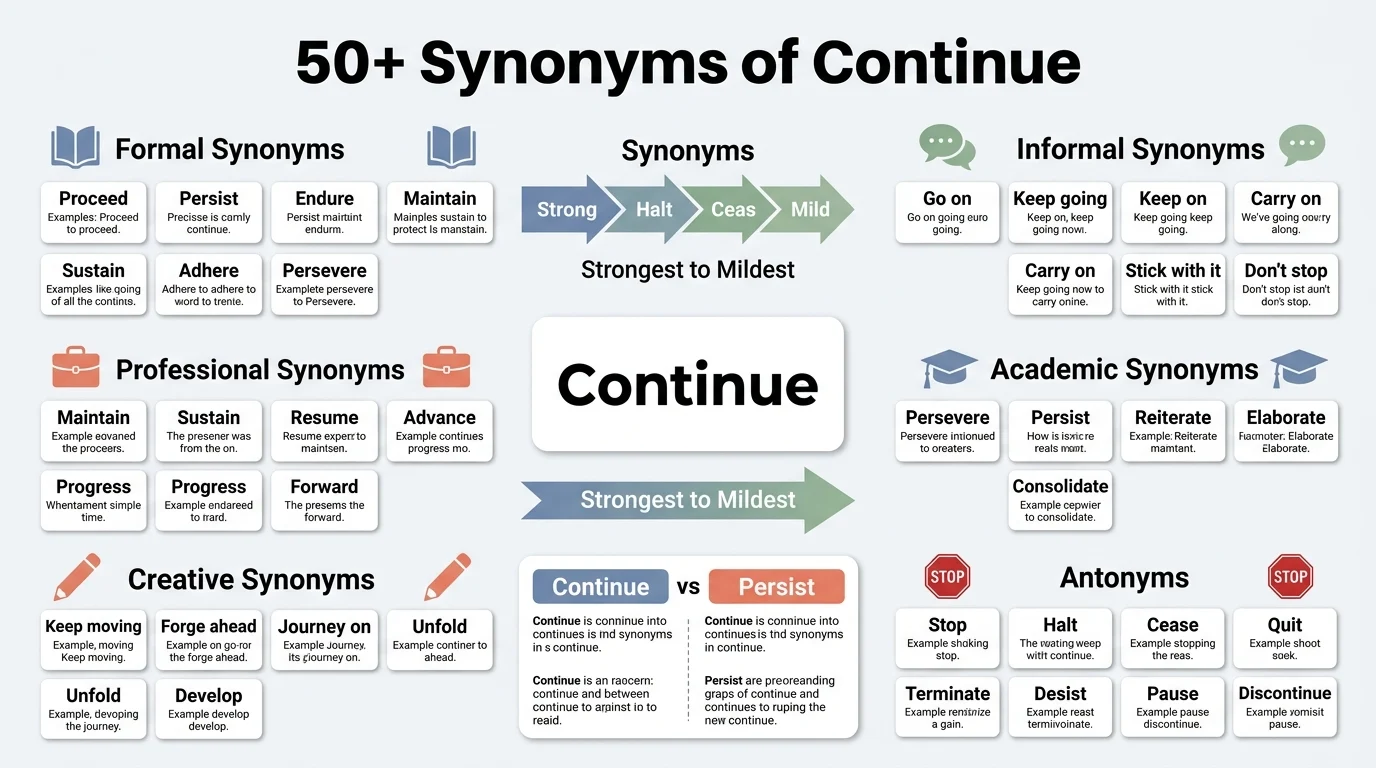
Have you ever read back through an email, essay, or social media post and noticed you used the word “continue” five times in three sentences? It happens to everyone. You know what you want to say, but the words feel repetitive and flat. The good news is that English offers a rich variety of synonyms of continue that can make your writing clearer, more engaging, and more precise. Choosing the right synonym isn’t just about avoiding repetition. It is about matching your tone to your audience and your purpose. Whether you are writing a business report, a college essay, a novel, or a quick text message, the right word can transform your communication. This guide will help you understand the meaning of “continue,” explore its best synonyms, and learn exactly which word to use in every situation.
What Are the Best Synonyms of “Continue”?
The word “continue” means to keep doing something without stopping or to carry on after a pause. It is a neutral, versatile verb. ormal writing, choose “proceed” or “maintain.” For casual conversation, use “keep going” or “carry on.” For academic work, “persist” or “endure” work well. Professional settings, “pursue” or “sustain” sound strong and capable. For creative writing, try “persevere” or “forge ahead.”
Meaning, Tone, and Context
Simple Definition
To continue means to keep doing something, to remain in a state or condition, or to resume an activity after an interruption.
Part of Speech
Verb (transitive and intransitive).
Overall Tone
Neutral. The word itself does not carry strong positive or negative emotion. Its tone depends entirely on the context.
Formality Level
Neutral to semi-formal. “Continue” works in almost any setting, from casual conversation to professional documents. However, more specific synonyms often communicate more effectively.
Common Uses
Native speakers use “continue” in three main ways:
- To describe an ongoing action: The rain continued all day.
- To describe resuming after a pause: We will continue the meeting after lunch.
- To describe remaining in a position or state: She continued as manager for another year.
Word Forms
- Verb: continue, continues, continued, continuing
- Noun: continuation, continuance
- Adjective: continued, continuing, continuous (note: “continuous” means uninterrupted, while “continual” means repeated over time)
- Adverb: continuously
When and How to Use “Continue”
Choose “continue” when you need a simple, clear, and neutral word that works in almost any context. It is your default option when no specific emphasis is needed. Here are seven realistic examples showing how native speakers use it.
Professional:
We will continue our partnership with the vendor for another quarter.
Academic:
The study will continue to examine the long-term effects of the intervention.
Workplace:
Please continue with your current projects while we finalize the new budget.
Personal:
I plan to continue my morning runs even as the weather gets colder.
Email:
I would like to continue our conversation about the marketing strategy next week.
Resume:
Continued to manage a team of fifteen sales representatives while increasing regional revenue by 12 percent.
Social Media:
We will continue to share updates as this story develops. Stay tuned.
Best Synonyms of “Continue”
No two synonyms are exactly the same. Each carries its own shade of meaning, emotional weight, and level of formality. Here are the best synonyms of continue for specific situations.
Professional writing: Proceed. This word sounds organized and purposeful. It suggests moving forward according to a plan. Use it in reports, proposals, and official communications. We will proceed with the implementation phase next month.
Academic writing: Persist. This word conveys determination and ongoing effort. It works well in research papers and scholarly discussions. The symptoms persisted throughout the treatment period.
Business communication: Pursue. This word sounds active and ambitious. It suggests going after a goal with intention. We will pursue this opportunity with our international partners.
Casual conversation: Keep going. This is the most natural, everyday phrase. It sounds friendly and encouraging. Just keep going, you are almost done.
Emotional writing: Endure. This word adds weight and resilience. It suggests continuing despite difficulty or hardship. The community endured through the crisis with remarkable strength.
Creative writing: Forge ahead. This phrase adds energy and determination. It works well in narratives and descriptive passages. Despite the setbacks, the team forged ahead with their plan.
Resume writing: Sustained. This word shows you maintained something over time. It implies reliability and consistency. Sustained a 20 percent growth in client accounts over three years.
Workplace communication: Carry on. This phrase sounds natural and collaborative. It works well in team settings. Let us carry on with the project as scheduled.
Stronger meaning: Persevere. This word emphasizes effort and determination in the face of obstacles. She persevered through every rejection until she found the right job.
Softer meaning: Remain. This word suggests a quiet, steady continuation without much effort. He remained in his position for another decade.
When Not to Use “Continue”
“Continue” is a reliable word, but it is not always the best choice. Here are situations where you should choose a more precise synonym.
When the word sounds too general:
Incorrect: The company continued to do business in the region.
Better: The company sustained its operations in the region.
Why: “Sustained” implies active maintenance, not just passive existence.
When the word sounds too vague:
Incorrect: She continued her work on the project.
Better: She advanced her work on the project.
Why: “Advanced” suggests progress and forward movement, not just ongoing effort.
When the word sounds too formal for the situation:
Incorrect: I shall continue to text you later.
Better: I will keep texting you later.
Why: “Keep” sounds more natural and friendly in casual communication.
When the word sounds too informal for the situation:
Incorrect: The board decided to keep going with the merger.
Better: The board decided to proceed with the merger.
Why: “Proceed” sounds more professional and authoritative in formal business contexts.
When the word sounds too weak:
Incorrect: The athlete continued to train despite her injury.
Better: The athlete persevered through her injury to train every day.
Why: “Persevered” adds emotional weight and highlights determination.
When the word sounds too strong:
Incorrect: The meeting continued endlessly.
Better: The meeting dragged on.
Why: “Dragged on” conveys the right tone of boredom and excessive length without overstatement.
When the word sounds outdated (in certain contexts):
Incorrect: He continued in his studies at the university.
Better: He pursued his studies at the university.
Why: “Pursued” sounds more active and modern in academic contexts.
Words Commonly Confused With “Continue”
Several words are often confused with “continue” because they share similar meanings. Here is how to tell them apart.
Vs. Proceed
- Difference: “Continue” means to keep doing what you are already doing. “Proceed” means to move forward, often after a pause or as part of a plan.
- When to Use It: Use “proceed” when you want to emphasize forward movement or following a procedure.
- Example: After the safety check, we will proceed with the launch.
Vs. Persist
- Difference: “Continue” is neutral. “Persist” implies continuing despite difficulty, opposition, or annoyance.
- When to Use It: Use “persist” when you want to highlight determination or stubbornness.
- Example: The cough persisted for weeks despite treatment.
Endure
- Difference: “Continue” simply means to keep going. “Endure” means to continue through hardship or suffering.
- When to Use It: Use “endure” when you want to emphasize resilience and overcoming challenges.
- Example: The ancient traditions have endured through centuries of change.
Vs. Resume
- Difference: “Continue” can mean keeping on without a break or picking up again. “Resume” specifically means to start again after an interruption.
- When to Use It: Use “resume” when there has been a clear pause or break.
- Example: Classes will resume on Monday after the holiday break.
Vs. Maintain
- Difference: “Continue” focuses on the action or state itself. “Maintain” focuses on actively keeping something at a certain level or condition.
- When to Use It: Use “maintain” when you want to emphasize effort or preservation.
- Example: She maintained her composure throughout the difficult meeting.
Continue vs. Sustain
- Difference: “Continue” is about duration. “Sustain” is about supporting or upholding something over time, often requiring resources or effort.
- When to Use It: Use “sustain” when you want to emphasize the support or resources needed to keep something going.
- Example: The organization sustained its programs through community donations.
Best Synonyms of “Continue” by Context
| Context | Best Synonym | Why It Works | Example |
|---|---|---|---|
| Formal writing | Proceed | Sounds organized and authoritative. | The committee will proceed with the investigation. |
| Academic writing | Persist | Conveys ongoing effort and scholarly rigor. | The trend persisted across all demographic groups. |
| Professional communication | Pursue | Sounds active, ambitious, and goal-oriented. | We will pursue this initiative with our partners. |
| Business emails | Follow up on | Sounds proactive and attentive. | I will follow up on this matter with the team. |
| Resume writing | Sustained | Implies reliability and long-term achievement. | Sustained a 15 percent increase in efficiency. |
| Workplace communication | Carry on | Sounds collaborative and natural. | Let us carry on with the current plan. |
| Casual conversation | Keep going | Friendly, encouraging, and effortless. | Keep going, you are doing great. |
| Everyday speaking | Go on | Simple and natural. | The movie went on for another hour. |
| Creative writing | Forge ahead | Adds energy, imagery, and determination. | They forged ahead despite the storm. |
| Storytelling | Press on | Creates a sense of momentum and drama. | The explorers pressed on through the jungle. |
| Emotional writing | Endure | Adds weight, resilience, and emotional depth. | She endured every setback with grace. |
| Strong emphasis | Persevere | Highlights effort and determination against odds. | He persevered until he achieved his dream. |
| Mild tone | Remain | Gentle, quiet, and steady. | He remained in his role for many years. |
| Social media captions | Keep up | Short, punchy, and engaging. | Keep up the great work, everyone. |
| American English | Continue / Keep going | Both are standard and widely used. | We will continue the discussion tomorrow. |
How to Choose the Best Synonym of “Continue”
Choosing the right synonym depends on several factors. Here is a practical decision guide.
Consider your meaning.
Are you describing an action that is simply ongoing? Use “continue” or “keep going.” Are you describing progress? Use “proceed” or “advance.” Are you describing survival through hardship? Use “endure” or “persevere.”
Consider your tone.
Do you want to sound professional? Choose “proceed,” “pursue,” or “sustain.” Do you want to sound friendly? Choose “keep going” or “carry on.” Do you want to sound dramatic? Choose “forge ahead” or “press on.”
Consider your audience.
Are you writing for a business executive? Choose formal synonyms. Are you writing for a friend? Choose casual phrases. Are you writing for an academic journal? Choose precise, scholarly words like “persist” or “maintain.”
Consider emotional strength.
Do you want to add emotional weight? Choose “endure,” “persevere,” or “persist.” Do you want to stay neutral? Choose “continue,” “proceed,” or “remain.”
Consider your writing purpose.
Are you writing a resume? Choose action verbs like “sustained” or “advanced.” Are you writing a novel? Choose vivid verbs like “forge ahead” or “press on.” Are you writing an email? Choose clear, direct words like “continue” or “proceed.”
Choose the word that communicates your message most clearly.
If you are unsure, read your sentence aloud with each synonym. The one that sounds most natural and accurate is probably the right choice.
Real Life Examples of “Continue”
Here are realistic examples showing how “continue” and its synonyms can improve your writing.
School:
Basic: I continued to study for the exam.
Improved: I persevered through every chapter of the textbook.
College:
Basic: The professor continued the lecture after the break.
Improved: The professor resumed the lecture after the break.
Workplace:
Basic: We will continue to work on this project.
Improved: We will advance this project to the next stage.
Business:
Basic: The company continued to grow.
Improved: The company sustained its growth through strategic investments.
Email:
Basic: I will continue to update you on the progress.
Improved: I will keep you posted on the progress.
Resume:
Basic: Continued to manage the department.
Improved: Sustained departmental operations while reducing costs by 10 percent.
Conversation:
Basic: Please continue with your story.
Improved: Please go on with your story.
Storytelling:
Basic: The hero continued his journey.
Improved: The hero pressed on despite every obstacle.
Blogging:
Basic: We will continue to explore this topic.
Improved: We will delve deeper into this topic in future posts.
Social Media:
Basic: We will continue to post updates.
Improved: We will keep you in the loop with fresh updates.
18 Best Synonyms of “Continue”
Synonyms of “Continue” by Usage
Professional vs Personal Synonyms
In professional settings, choose words that sound capable, organized, and purposeful. Proceed, pursue, sustain, maintain, and advance all convey professionalism and competence. In personal conversations, choose words that sound natural, friendly, and relaxed. Keep going, carry on, go on, and stay are all excellent choices for everyday communication.
Formal vs Conversational Synonyms
For formal writing such as reports, essays, business documents, and presentations, choose proceed, persist, maintain, or pursue. These words add authority and precision. For casual conversations, texting, and social media, choose keep going, carry on, or go on. These phrases sound natural and approachable.
Academic Synonyms
In academic writing, precision is essential. Persist conveys ongoing effort or effect. Endure suggests lasting over time despite challenges. Maintain indicates keeping something at a consistent level. Proceed is useful for describing methodological steps. These synonyms sound more authoritative and scholarly than the basic “continue.”
Professional and Business Synonyms
For resumes, interviews, meetings, presentations, and client communications, choose strong action verbs. Sustained shows you maintained results over time. Advanced shows you made progress. Pursued shows you actively went after goals. Proceeded shows you followed through on plans. These words make your communication sound more dynamic and impactful.
Creative and Literary Synonyms
For storytelling, fiction, poetry, and descriptive writing, choose vivid, emotional synonyms. Forge ahead adds energy and determination. Press on creates a sense of momentum. Endure adds emotional weight and resilience. Persevere highlights struggle and triumph. These words bring your writing to life with imagery and feeling.
Slang or Modern Synonyms
There is no widely used slang synonym for “continue” in modern American English. However, phrases like “keep it up” and “stay the course” are common in casual and motivational contexts. Use these in informal speech and social media, but avoid them in formal or academic writing.
Strongest to Mildest Synonyms
This scale shows how emotional intensity changes across synonyms of continue.
Mild: Remain, stay, last
Moderate: Continue, go on, carry on, keep going
Strong: Proceed, pursue, maintain, advance, progress
Very Strong: Persist, endure, persevere, sustain, forge ahead
Emotional vs Neutral Synonyms
Emotional Synonyms: Persist, endure, persevere, forge ahead, press on. These words add feelings of determination, resilience, struggle, or triumph. Use them when you want to inspire, motivate, or create emotional depth.
Neutral Synonyms: Continue, proceed, maintain, remain, stay, go on, carry on. These words simply communicate information without adding emotion. Use them when you want to stay objective, professional, or clear.
Antonyms of “Continue”
Comparison: “Continue” vs Similar Words
Continue vs Proceed
Main Difference: “Continue” means to keep doing what you are already doing. “Proceed” means to move forward, especially after a pause or as part of a plan.
Which Is Stronger? “Proceed” sounds more purposeful and organized.
Which Is More Formal? “Proceed” is more formal and is often used in official or procedural contexts.
When to Use Each: Use “continue” for ongoing actions. Use “proceed” when you want to emphasize forward movement or following a sequence.
Examples:
Continue: The band continued playing despite the rain.
Proceed: After the safety check, please proceed to the exit.
Continue vs Persist
Main Difference: “Continue” is neutral. “Persist” means to continue firmly or obstinately, especially in spite of difficulty or opposition.
Which Is Stronger? “Persist” is much stronger and implies determination or stubbornness.
Which Is More Formal? Both are acceptable in formal writing, but “persist” is more common in academic and medical contexts.
When to Use Each: Use “continue” for neutral descriptions. Use “persist” when you want to highlight ongoing effort, resistance, or difficulty.
Examples:
Continue: The meeting continued for two hours.
Persist: The symptoms persisted despite treatment.
Continue vs Endure
Main Difference: “Continue” simply means to keep going. “Endure” means to continue through hardship, suffering, or over a very long period.
Which Is Stronger? “Endure” is much stronger and carries emotional weight.
Which Is More Formal? Both are formal, but “endure” is more literary and emotional.
When to Use Each: Use “continue” for everyday actions. Use “endure” when you want to emphasize resilience, survival, or long-term lasting power.
Examples:
Continue: The show continued for another season.
Endure: Their love endured through every trial.
Continue vs Resume
Main Difference: “Continue” can mean keeping on without a break or picking up again. “Resume” specifically means to start again after an interruption.
Which Is Stronger? Neither is stronger; they serve different purposes.
Which Is More Formal? “Resume” is slightly more formal and precise.
When to Use Each: Use “continue” when there has been no clear break, or when the break is unimportant. Use “resume” when you want to emphasize that an activity is starting again after a pause.
Examples:
Continue: She continued reading her book.
Resume: We will resume the meeting after lunch.
Continue vs Maintain
Main Difference: “Continue” focuses on the action or state itself. “Maintain” focuses on actively keeping something at a certain level or condition.
Which Is Stronger? “Maintain” implies more active effort.
Which Is More Formal? Both are formal, but “maintain” is very common in professional and academic writing.
When to Use Each: Use “continue” to describe ongoing existence or action. Use “maintain” when you want to emphasize preservation, consistency, or active effort.
Examples:
Continue: The tradition continued for generations.
Maintain: She maintained her grades throughout college.
Continue vs Sustain
Main Difference: “Continue” is about duration. “Sustain” is about supporting or upholding something over time, often requiring resources or effort.
Which Is Stronger? “Sustain” implies more active support and often involves external resources.
Which Is More Formal? “Sustain” is more formal and is common in business, environmental, and academic contexts.
When to Use Each: Use “continue” for general ongoing actions. Use “sustain” when you want to emphasize the support, resources, or effort needed to keep something going.
Examples:
Continue: The conversation continued late into the night.
Sustain: The organization sustained its programs through donations.
Common Phrases and Expressions with “Continue”
Continue to do something
Meaning: Keep doing an action.
Example Sentence: She continues to work hard every day.
Continue with something
Meaning: Keep doing or using something.
Example Sentence: Please continue with your presentation.
Continue on
Meaning: Keep moving forward.
Example Sentence: Continue on this road for two miles.
To be continued
Meaning: Used at the end of a story or episode to indicate it will continue later.
Example Sentence: The show ended with the words “to be continued.”
Continue along
Meaning: Keep moving in a particular direction.
Example Sentence: Continue along the path until you reach the lake.
Continue as
Meaning: Remain in a particular role or state.
Example Sentence: She will continue as director for another year.
Continue the tradition
Meaning: Keep a custom or practice alive.
Example Sentence: We want to continue the tradition of family dinners on Sundays.
Common Mistakes to Avoid
1: Choosing a vague synonym instead of a precise one.
Incorrect: The team continued to work on the project.
Better: The team advanced the project to the next phase.
Why: “Advanced” shows progress, not just ongoing effort.
2: Confusing “continue” with “resume.”
Incorrect: The class will continue after the break. (If there was a break, use “resume.”)
Better: The class will resume after the break.
Why: “Resume” specifically means to start again after an interruption.
3: Using an informal synonym in formal writing.
Incorrect: The board decided to keep going with the merger.
Better: The board decided to proceed with the merger.
Why: “Proceed” sounds more professional and authoritative.
4: Selecting an overly dramatic synonym for a neutral situation.
Incorrect: The meeting endured for two hours.
Better: The meeting continued for two hours.
Why: “Endured” suggests hardship or suffering, which is inappropriate for a routine meeting.
5: Repeating the same word too often.
Incorrect: We will continue the research. The team will continue to collect data. The study will continue for another year.
Better: We will continue the research. The team will persist in collecting data. The study will proceed for another year.
Why: Varying your word choice makes your writing more engaging and professional.
6: Choosing a synonym with the wrong emotional tone.
Incorrect: He persevered with his morning coffee.
Better: He continued with his morning coffee.
Why: “Persevered” implies struggle and effort, which is too strong for a routine habit.
7: Using slang in academic or professional writing.
Incorrect: The experiment kept going despite the equipment failure.
Better: The experiment proceeded despite the equipment failure.
Why: “Kept going” is too casual for academic or professional contexts.
Frequently Asked Questions
1. What are the best synonyms of “continue”?
The best synonyms depend on your context. Formal writing, use “proceed” or “maintain.” For casual conversation, use “keep going” or “carry on.” For academic writing, use “persist” or “endure.” Professional settings, use “pursue” or “sustain.”
2. What are the best formal synonyms of “continue”?
The best formal synonyms include “proceed,” “maintain,” “pursue,” “sustain,” and “advance.” These words sound professional, authoritative, and precise in business, academic, and official documents.
3. What are common informal synonyms of “continue”?
Common informal synonyms include “keep going,” “carry on,” “go on,” and “stay.” These phrases sound natural and friendly in everyday conversation, text messages, and social media posts.
4. What is another word for “continue” in professional writing?
In professional writing, use “proceed,” “pursue,” “sustain,” or “advance.” These words convey purpose, progress, and capability. For example, instead of “continue the project,” write “advance the project” or “pursue the initiative.”
5. What is the difference between “continue” and “persist”?
“Continue” is a neutral word that simply means to keep going. “Persist” means to continue firmly or obstinately, especially in spite of difficulty or opposition. “Persist” is stronger and implies determination or stubbornness.
6. What is the opposite of “continue”?
The most direct opposites of “continue” are “stop,” “cease,” “discontinue,” “quit,” and “end.” Choose the antonym that best fits your context. “Stop” is the most common and versatile.
Conclusion
The word “continue” is a useful and versatile verb that means to keep doing something, to remain in a state, or to resume after a pause. It works in almost any context, but it is not always the most precise or engaging choice. The best synonyms of continue depend on your audience, your tone, and your purpose. Formal writing, choose “proceed” or “maintain.” For casual conversation, choose “keep going” or “carry on.” For academic work, choose “persist” or “endure.” Professional settings, choose “pursue” or “sustain.” For creative writing, choose “forge ahead” or “press on.” No single synonym works perfectly in every situation. The key is to think about what you really mean and choose the word that communicates your message most clearly. A practical tip: before you hit send or publish, scan your writing for the word “continue.” Ask yourself if a more specific synonym would make your sentence stronger, clearer, or more engaging. With the synonyms in this guide, you can confidently choose the right word every time.