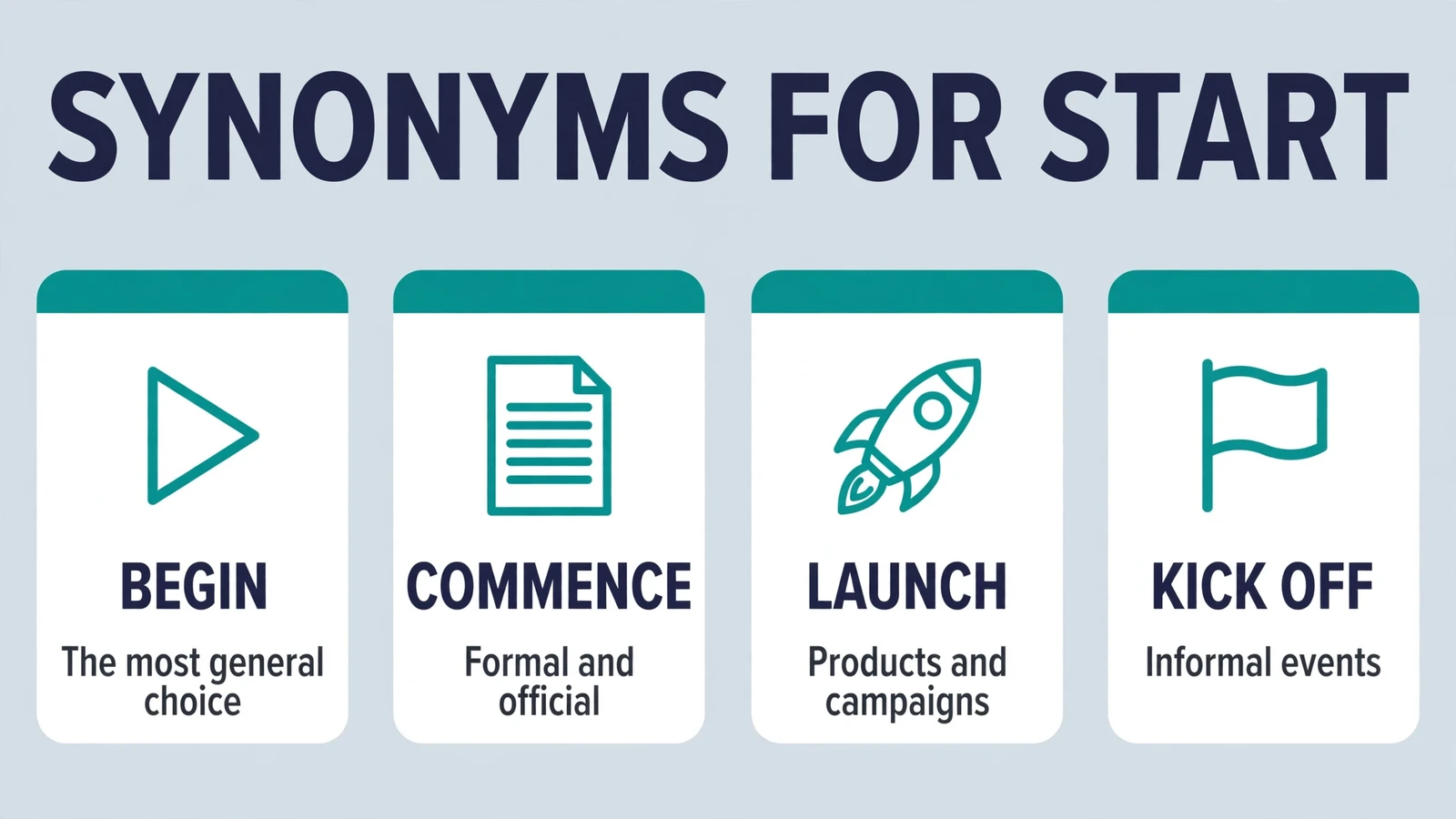
Few verbs work as hard as start. You start a car, start a job, start an argument and start a company. Each job wants a slightly different replacement. The closest synonyms for start are begin, commence, launch, kick off, set up, initiate and open. The right pick, though, depends on what is beginning and how formal you want to sound.
This guide sorts more than 60 synonyms and useful phrases by sense, so you can grab the word that fits. You will find everyday options and formal upgrades for essays. You will also find business words for founders, plus the separate sense where start means a sudden jump of surprise.
What Does Start Mean?
At its heart, start means to take the first step in something. Merriam-Webster’s thesaurus gives its closest synonyms one shared idea: “to take the first step in a course, process, or operation.” That is why begin, commence and initiate all cluster around it.
The same source points out a useful pairing. Start is the natural opposite of stop, just as begin is the natural opposite of end. That small difference quietly shapes the choices in the rest of this guide.
The verb senses
As a verb, start covers several jobs. First, it means to begin doing something, as in “she started her homework.” Second, it means to begin to happen, as in “the meeting starts at nine.” Third, it can mean to cause something to happen, as in “he started a rumour.” Fourth, it works for machines and for founding organisations, and those senses get their own sections below.
The noun senses
As a noun, a start is the beginning of something: the start of the race, the start of the book. However, the same word also names a sudden movement of surprise, as in “she gave a start.” That jump sense is a different meaning entirely, so this guide keeps it in its own clearly marked section.
How start behaves in sentences
Start is flexible about what follows it. You can start to do something or start doing it, and both patterns are normal English. You can also start with something, meaning it is your first item: “Let’s start with the soup.” And you can start from a place or a level: “Prices start from twenty dollars.”
Notice how often start pairs with a direction. People start over, start again and start afresh when a first attempt fails. Each phrase keeps the same core idea: a first step, taken now.
Quick Reference: The Most Useful Synonyms for Start
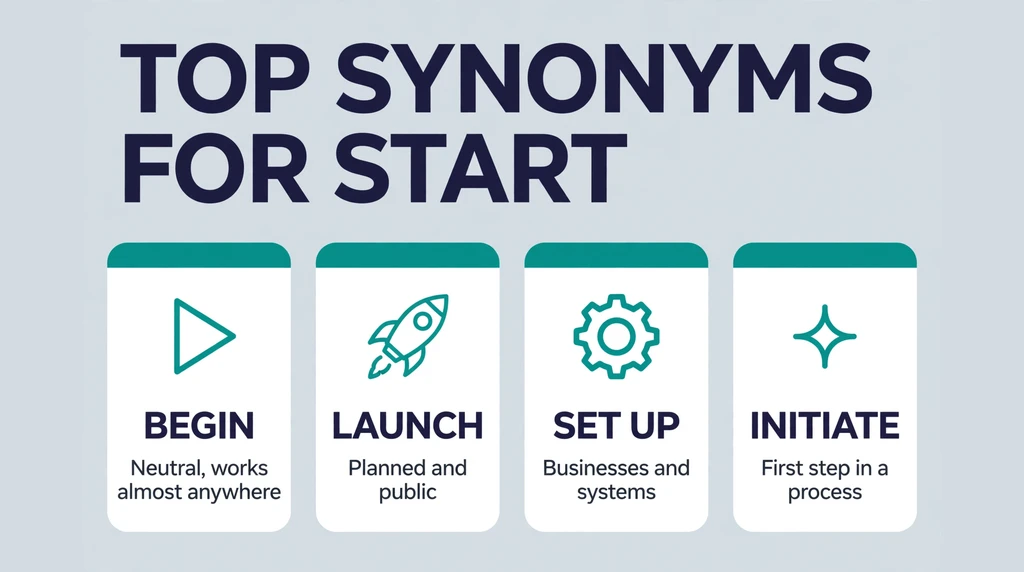
The table below gathers the words readers reach for most often. Each row gives a one-line meaning and a note on tone or best use, so you can scan first and read in depth later.
| Word | Meaning in one line | Best for / tone |
|---|---|---|
| begin | to take the first step in something | neutral, the most general choice |
| commence | to begin, in formal language | formal, ceremonies and official writing |
| launch | to start something with planning and publicity | business, products, campaigns |
| kick off | to start an event or activity | informal, sport and meetings |
| set up | to create or arrange something new | business, systems, everyday organising |
| initiate | to take the first step in a process | formal, processes and talks |
| open | to begin a meeting, show or account | neutral, formal events |
| embark on | to begin a long or important undertaking | slightly formal, journeys and projects |
| set about | to begin a task in an organised way | neutral, practical tasks |
| get going | to begin moving or working | informal, spoken English |
| get the ball rolling | to make a start so others can follow | informal, group work |
| arise | to begin to exist, for problems or situations | formal, written English |
| originate | to begin in a place or idea | neutral, origins and history |
| break out | to begin suddenly, for bad events | news style, wars, fires, disease |
| trigger | to cause something to start | neutral, often negative results |
| set in motion | to cause a process to begin | formal, processes and plans |
| start up | to begin running, for engines and firms | neutral, machines and business |
| fire up | to start an engine or device | informal, machines |
| activate | to make a system or device begin working | technical, systems and alarms |
| found | to create an organisation from nothing | formal, companies and charities |
| establish | to create something meant to last | formal, institutions |
| institute | to introduce a system or rule officially | formal, policy and law |
| inaugurate | to begin something significant with ceremony | formal, eras and buildings |
| usher in | to mark the beginning of a period | formal, written English |
| outset | the very beginning of something | noun, neutral to formal |
| inception | the beginning of an organisation or plan | noun, formal |
| commencement | the beginning, in official language | noun, formal |
| genesis | the origin or beginning of something | noun, formal |
| dawn | the beginning of a period, in poetic use | noun, literary |
After this quick scan, the sections below explain the groups in detail, with examples that show how each word behaves in a real sentence.
Synonyms for Start When You Begin an Activity
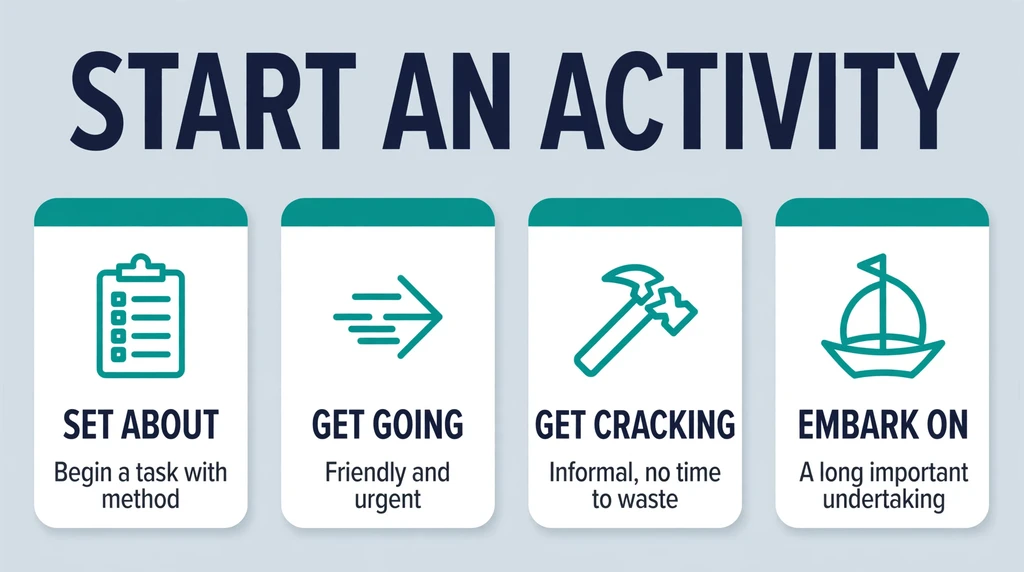
This is the sense most people mean. Somebody begins doing something: working, cooking, reading, training. The words below all fit, yet each one shades the moment differently.
The everyday core
Begin is the safe default, and dictionaries treat it as the most general of the group. It suits almost any activity: “We began the lesson with a quiz.” Open works when an event begins with a first item or speaker: “She opened the meeting with the budget figures.” Meanwhile, set about adds a sense of method, so it fits tasks you tackle step by step: “He set about cleaning the garage.”
Phrases that sound natural in speech
Several set phrases beat a single verb in conversation. Get going and get started sound friendly and urgent: “Let’s get going before the traffic builds.” Get the ball rolling means you make the first move so a group can follow: “I’ll get the ball rolling with the first question.” Similarly, get cracking is brisk and informal: “No time to chat, I need to get cracking on this report.”
When the task feels big
For a long or serious undertaking, embark on carries weight: “They embarked on a three-year renovation.” Take the first step highlights courage or hesitation, while take the plunge suggests you finally commit after holding back: “After months of planning, she took the plunge and opened her bakery.” Because these phrases imply effort, they suit journeys, careers and major projects better than tiny daily tasks.
One more everyday pattern deserves a place here. To make a start means you begin at least part of a job: “We made a start on the garden before lunch.” It is honest and modest, so speakers use it when the whole task still lies ahead. Similarly, work that has properly begun is under way, a phrase that bridges this group and the next one.
Synonyms for Start When Something Begins to Happen
Sometimes nobody starts anything. Instead, an event, feeling or problem simply begins. This group covers that in-between ground, and the register shifts matter more here.
Neutral and written choices
Begin and commence both work, with commence clearly formal: “The ceremony commenced at noon.” Arise is formal too, and it belongs mainly to problems, questions and situations: “Difficulties arose during the talks.” Originate points back to a source: “The custom originated in coastal villages.” In addition, appear and come into being describe something new coming into existence: “A crack appeared in the wall.”
Seasons, effects and sudden events
Arrive fits seasons and long-awaited moments: “Winter arrived early this year.” When a medicine, rule or feeling begins to work, kick in is the natural phrase: “The painkillers kicked in after twenty minutes.” Processes and meetings get under way once they are moving: “The investigation got under way on Monday.”
By contrast, break out is reserved for sudden, unpleasant events: “Fighting broke out near the border.” Journalists use it for wars, fires, epidemics and arguments, never for pleasant news. Finally, come along describes something appearing and changing the picture: “Then a better offer came along.”
Events with a programme also open: “The festival opens with a parade.” And when something exists for the very first time, English reaches for a grander phrase. Collins lists first see the light of day for this moment: “The design first saw the light of day in a small workshop.” It is vivid, so save it for ideas, inventions and works of art.
Timetables and announcements lean on this group heavily. Trains, terms and seasons all begin, commence or open, depending on the voice of the announcer. A university will say the term commences, a railway poster says services begin, and a theatre says the show opens on Friday. None of these is wrong; each simply wears a different uniform.
Weather reports do the same quiet work. Rain begins, frost arrives, and storms break out, three beginnings with three different tempers. Reading the group this way, as weather rather than grammar, often makes the right choice obvious.
Synonyms for Start When You Set Something in Motion
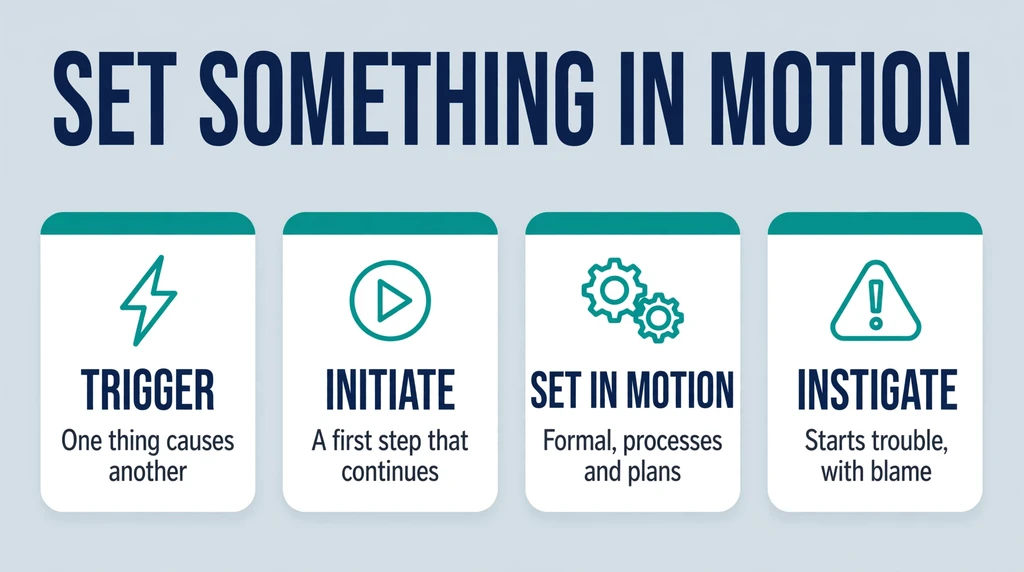
In this sense, a person or event causes something else to begin. A single remark can start a trend, a panic or a whole investigation, so the verbs here often carry results with them.
Neutral causers
Set in motion is the clearest formal option: “Her speech set in motion a wave of reforms.” Initiate implies the first step of a process that will continue, which is why officials initiate talks, inquiries and procedures. Launch also belongs here when there is planning behind the move: “The charity launched an appeal for funds.”
Words with a spark or a shadow
Trigger means one thing directly causes another to begin, and the result is usually unwelcome: “The announcement triggered a sell-off in the shares.” Instigate is stronger and blames someone for trouble: “A small group instigated the protest.” Kick off stays light and informal for events: “A drum performance kicked off the festival.”
For group efforts, get something off the ground means you succeed in starting a project that needs effort: “It took a year to get the scheme off the ground.” Likewise, get the ball rolling works when your first action lets everyone else join in.
Notice the pattern across this group. The lighter verbs, kick off and launch, usually start things the speaker welcomes. The heavier ones, trigger and instigate, usually start things nobody wanted. Choosing between them is therefore not just about grammar. It also tells the reader how you judge the result.
Synonyms for Start for Machines and Engines
Machines have their own small vocabulary, and begin never appears in it. Nobody begins a car. Instead, engines and devices start, and the synonyms below are the ones drivers and technicians actually use.
Start up is the standard phrasal verb: “The generator started up with a cough.” Turn on and switch on fit anything with a switch, from laptops to lamps. For engines with character, fire up is the informal favourite: “He fired up the old tractor.”
Meanwhile, activate is the technical choice for systems, alarms and features: “The sensor activates the lights at dusk.” Get going appears in speech about stubborn engines: “I finally got the van going.” In short, if it has a key, a button or a battery, choose from this group and leave begin out of the garage.
Writers sometimes borrow this group for people, too. A coach fires up a team, and a speech can fire up a crowd. The metaphor works because the machine sense is so concrete: one push, and the whole system wakes.
Homes run on this vocabulary all day. We switch on the heating, turn on the tap and fire up the oven without thinking about it. Software has joined the same family: a laptop starts up, a programme opens, and an update activates at midnight. The verbs feel invisible precisely because they are exactly right.
Synonyms for Start for Businesses and Organizations
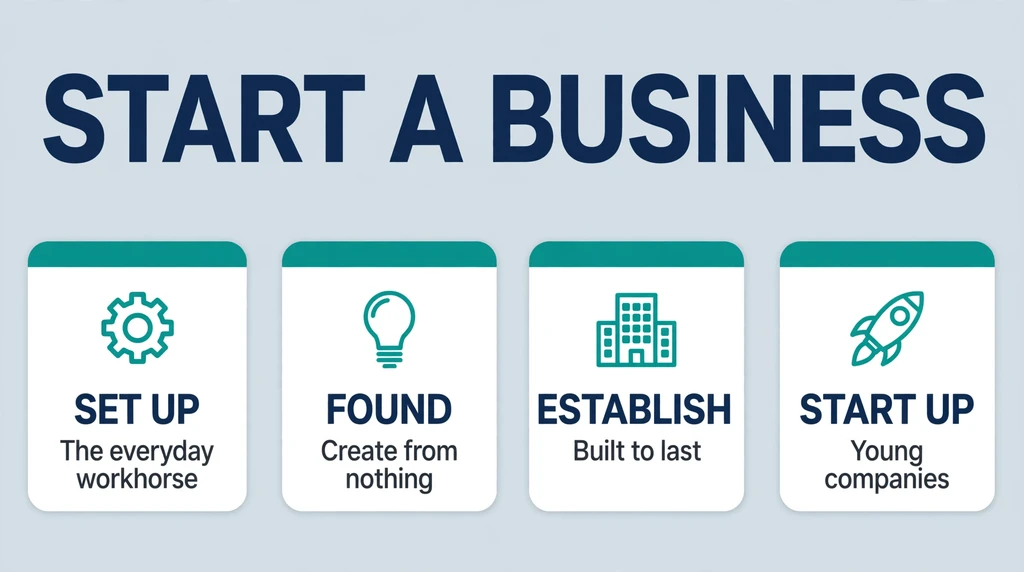
Founders start things that are meant to last, and English gives them a richer set of verbs than everyday speech. The choice signals how permanent, public or official the new venture is.
The everyday business verbs
Set up is the workhorse: “They set up a small design studio in Leeds.” It covers companies, accounts, systems and committees. Start up works both as a verb and inside the noun startup: “She started up a catering business from her kitchen.” Someone who works alone may set up shop, a cosy phrase for opening a small practice or store.
Verbs that imply permanence
Found is the classic verb for creating an organisation from nothing: “The school was founded in 1902.” Establish sounds slightly more official and stresses that the thing is built to endure: “The bank established a branch in the capital.” Create is broader and plainer, while lay the foundations for describes the early work that makes later growth possible.
Launches, systems and firsts
Launch adds planning and publicity: a company launches a product, a service or an appeal. Introduce and institute fit systems and rules rather than companies: “The government instituted a new inspection regime.” Pioneer honours the first mover: “She pioneered a recycling scheme for the whole district.” Finally, inaugurate belongs to formal openings and first uses, a word the next section explores further.
A practical tip closes this group. Investors and journalists describe very young companies with start up as a verb and startup as a noun. Charities and schools, though, usually prefer founded or established in their own histories. Matching the verb to the institution keeps a company history sounding natural rather than inflated.
Formal and Informal Synonyms for Start
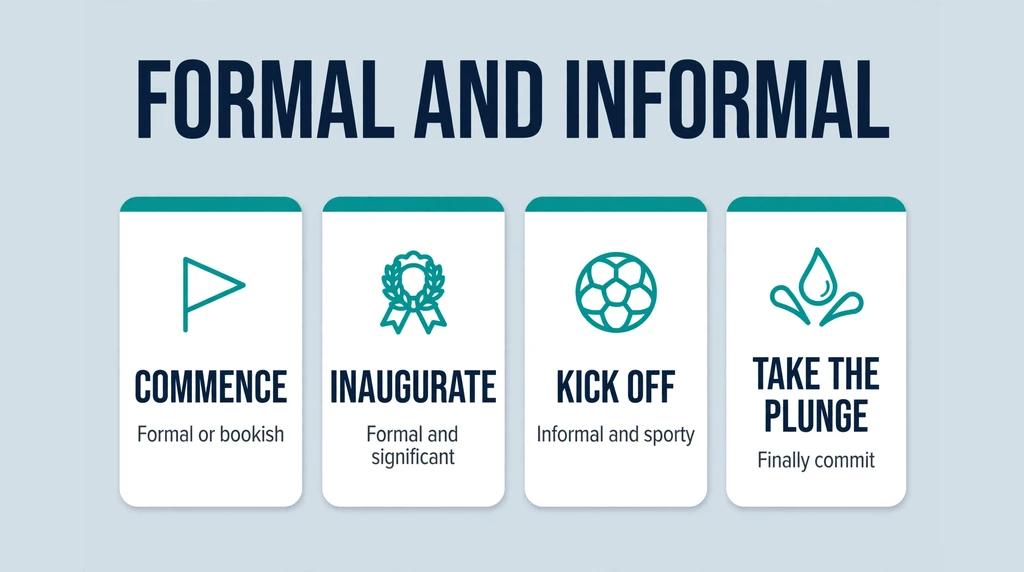
Register is where synonyms for start really separate. A word that shines in a ceremony can sound stiff in a text message, and the reverse is also true.
Formal choices for essays and official writing
Commence is the headline formal word. Dictionaries note it can sound more formal or bookish than begin or start, so save it for ceremonies, legal writing and exams. Inaugurate suggests a beginning with formality or significance: “The discovery inaugurated a new era in medicine.” Initiate and institute suit official processes, while usher in marks the start of a period in polished writing: “The treaty ushered in two decades of peace.” Enter upon survives in older formal texts and now sounds old fashioned.
Informal choices for speech and stories
At the other end, kick off starts events with energy: “Let’s kick off with introductions.” Get cracking, get going and get the ball rolling all hurry people along in a friendly way. Take the plunge adds drama to a decision, and fire up does the same for engines. Because these phrases carry personality, they suit dialogue, blogs and friendly emails far better than reports.
The neutral middle ground
Between the two poles sit begin, open, launch, set up and set in motion. These words rarely raise eyebrows anywhere. When you cannot judge the audience, the middle ground is the safest place to stand.
A Different Meaning: Start as a Sudden Movement
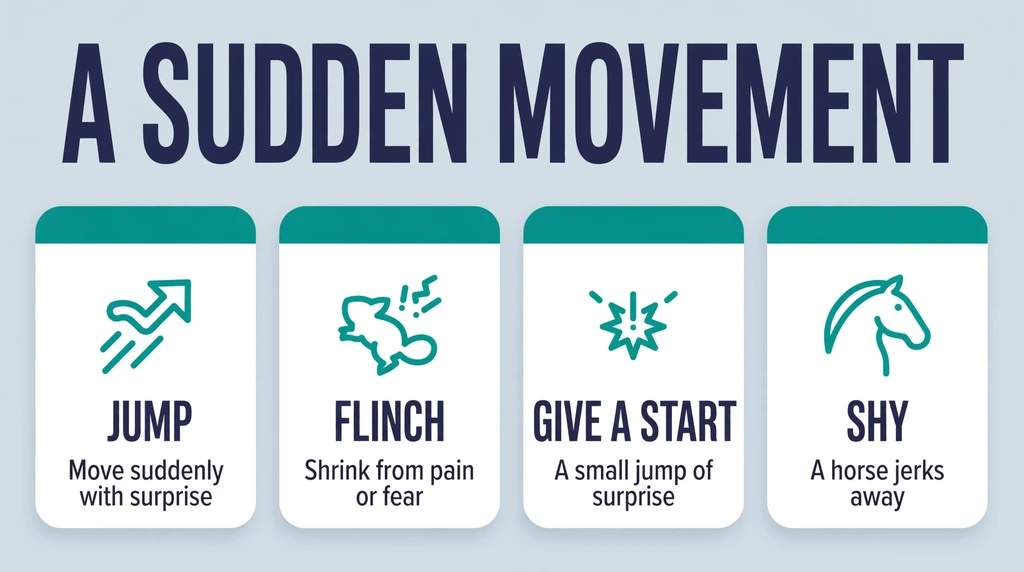
Now for the sense that catches learners out. Start can also mean to move suddenly because of surprise or fright. The body reacts before the mind does, and this start has nothing to do with beginnings.
As a verb, the synonyms are jump, flinch, twitch and shy. “She started at the sudden bang” means she jumped, not that she began anything. A horse that shies jerks away from something frightening, and a flinch is the small shrinking movement you make at pain or a near miss. A twitch is smaller still, often just one muscle.
As a noun, the same idea appears in the phrase give a start: “He gave a start when the door slammed.” Collins lists jump, jerk, twitch and spasm for this noun, moving from a small jolt to a strong muscular reaction. Writers use this sense to show fear without naming it, which makes it a favourite in stories.
One caution: because this meaning lives in set patterns like “start at” and “give a start,” you cannot swap in begin. “She began at the noise” is simply wrong.
There is also a causative use. You can start an animal, meaning you startle it into movement. Cambridge illustrates it with a hunting scene: “The gunshot started the ducks.” In older and more literary writing, a person may start from a chair or a seat, leaping up suddenly. Modern readers still meet this in classic novels, so recognising it saves confusion when a character “starts” mid-page for no obvious reason.
Start as a Noun: Words for the Beginning
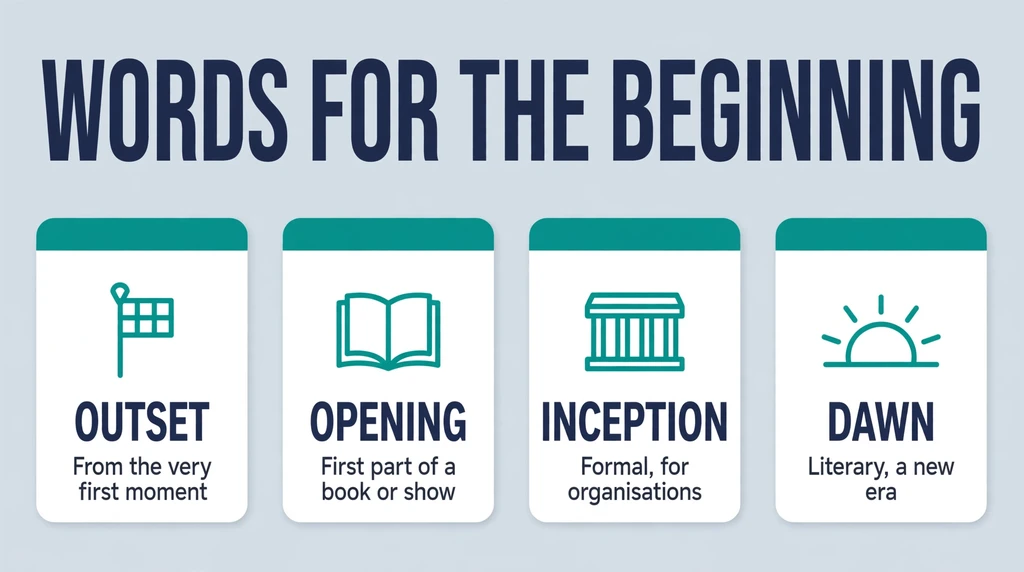
When start is a noun, it names the point where something begins. Several nouns compete for this job, and they divide neatly by tone and by what is beginning.
Beginning is the all-purpose word: the beginning of the film, the beginning of the week. Outset almost always appears in the phrase “from the outset” or “at the outset,” and it stresses the very first moment: “The plan was clear from the outset.” Opening fits books, films, ceremonies and speeches, the first part you actually experience.
Formal documents prefer commencement and inception: “Since its inception, the charity has raised a million pounds.” For ideas, eras and movements, writers reach for birth, genesis and dawn. Birth is warm and concrete, genesis is formal, and dawn is literary: “the dawn of the railway age.” If you want more options in this fresh-beginnings family, browse these synonyms for new as well.
Two smaller items complete the set. Kickoff is the informal noun for when an event or match begins, borrowed from sport. Onset names the beginning of something unwelcome, usually illness, winter or problems: “the onset of fever.” Finally, Collins also lists head start among the noun relatives, where start means an early advantage rather than a beginning; it is a useful phrase to recognise, even though it plays by different rules.
Fixed phrases with start as a noun
Some noun phrases deserve a moment of their own. From the start means from the very beginning, and it often carries a hint of warning: “The plan was flawed from the start.” A fresh start is a new beginning after failure, and to make a start is to begin at least the first part of a job.
Sport gives us the flying start, a beginning so strong it feels like an advantage. Together, these phrases show why the noun start survives even where beginning sounds grander: it is short, plain and hard to misunderstand.
Synonyms for Start in Writing: Essays, Stories and Speeches
Writers repeat start more than any other group of readers, so this section gathers the advice by task. The same synonym rarely serves an examiner, a novelist and a manager equally well.
In essays and exams
Examiners reward control, not decoration. Commence can open one formal sentence, but a page of it sounds strained. Safer upgrades are begin, initiate for processes and establish when you introduce a system or idea. At the end of an argument, in conclusion takes over the job, because finally belongs to sequence rather than starting.
Transitions matter as well. A phrase like “to begin with” works once, early, and then should retire. After that, let the argument itself move, and save strong starters for genuinely new points.
In stories and dialogue
Fiction lives on movement. Characters get going, chase clues through the night and give a start when frightened. An era can dawn, a rumour can break out like a fire, and a quiet scene can kick off a chapter with energy. Choosing by sense keeps the prose varied without sounding forced.
Dialogue, meanwhile, prefers the informal set. Real people say “let’s get cracking” and “who wants to kick off?” They rarely say “let us commence,” unless the joke is deliberate.
In speeches and presentations
Speakers open with a welcome, lay out their plan and usher in new phases with confidence. A launch word helps when the moment is public: “Today we launch a programme that…” Used once, at the top, such verbs give a talk its sense of occasion.
How to Choose the Right Synonym for Start
Choosing well comes down to three questions. What is beginning: an activity, an event, a machine or an organisation? Who will read it? And do you want the moment to feel neutral, formal or lively? The comparisons below answer the questions writers ask most.
Start vs begin
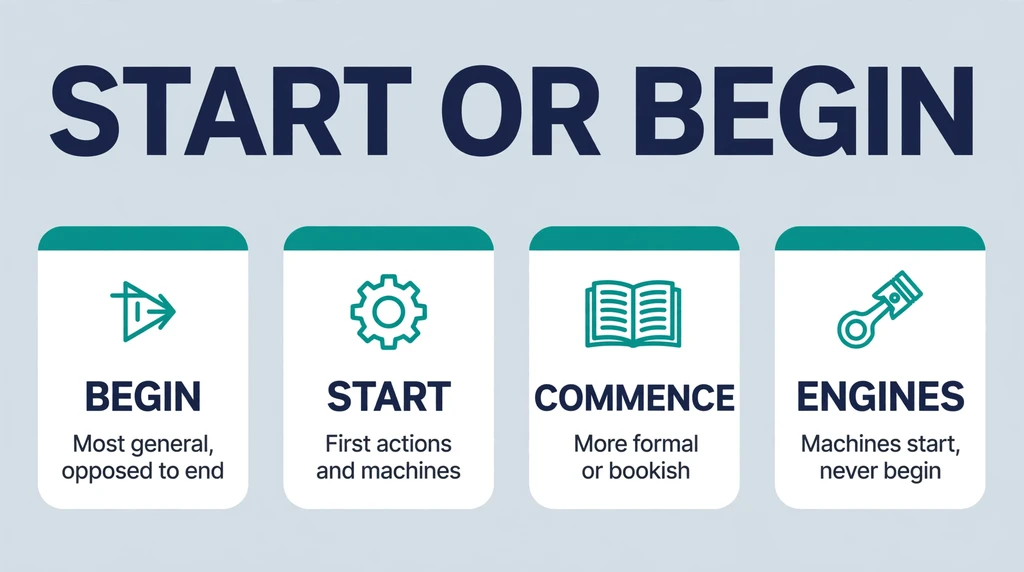
Merriam-Webster’s thesaurus puts it plainly: “Begin, start, and commence are often interchangeable, with begin, opposed to end, being the most general.” In practice, begin is the calm default for activities and events: “The course begins in September.”
Start, the same source notes, is “opposed to stop” and “applies especially to first actions, steps, or stages.” That is why start feels physical and immediate. We say “start the car,” “start walking,” and “start for home,” where begin would sound odd or wrong. Machines settle the argument completely: engines start, they never begin.
Commence, meanwhile, “can be more formal or bookish than begin or start.” Choose it for ceremonies and official prose, and avoid it in friendly writing. If you want the fuller picture, our guide to synonyms for begin compares the whole family in depth.
Kick off vs launch vs open
All three start events, but the flavour differs. Kick off is informal and sporty, ideal for workshops and festivals. Launch implies preparation and an audience, so it suits products and campaigns. Open is the measured choice for meetings, exhibitions and ceremonies, where the first item matters: “The mayor opened the exhibition.”
A quick checklist before you choose
Run through three checks. First, name the thing that begins: an action, an event, a machine or an organisation. Second, set the tone: plain, formal or lively. Third, check the result: does your word praise the beginning, blame it, or stay neutral?
If two words still tie, read the sentence aloud. The one that sounds like something a person would say is usually the winner. Tools and tables help, but the ear settles most ties in this family.
Paired examples
- Weak: “The meeting started, and then the problems started.” Stronger: “The meeting began, and then the problems arose.”
- Weak: “She started a charity and started a fundraiser.” Stronger: “She founded a charity and launched a fundraiser.”
- Weak: “He commenced eating his sandwich.” Stronger: “He started eating his sandwich,” because commence is far too grand for lunch.
- Weak: “The rain started, and the match started late.” Stronger: “The rain began, and the match kicked off late,” because each event now has its own verb.
- Weak: “They started the engine and started the journey.” Stronger: “They fired up the engine and began the journey,” because machines and journeys take different partners.
Antonyms for Start
Every beginning implies an ending, and the opposites of start split by sense just as the synonyms do. For activities, the core antonyms are stop, end, finish, conclude, cease and quit. Give up and abandon add the sense of leaving something unfinished, while wind up and the informal call it a day describe wrapping work up.
Businesses meet the opposite close down, and machines meet turn off and switch off. Formal writing may use desist, meaning to stop an action, usually on instruction. For nouns, the opposites are end, finish, conclusion, finale, termination and cessation.
One warning: delay and put off are not true opposites of start. They move a beginning later rather than cancelling it, so grammars treat them separately. Our companion list of synonyms for end covers the finishing family in full.
Common Mistakes: Words That Are Not True Synonyms for Start
A few familiar words look like synonyms for start but behave differently. Knowing them protects your writing from quiet errors.
Proceed means to go ahead or continue, not to begin. A trial that proceeds is already running, so “we proceeded the meeting” is wrong twice over. Continue and resume also fail the test, because both need something that exists already.
Startle tricks many learners. When a noise startles you, the noise does the work and you give a start. Startle is not something you do on purpose, and it belongs to the sudden-movement sense, not to beginnings. Similarly, found is the past of find, yet as a founding verb it means create, so “they founded a bakery” is correct and has nothing to do with finding one.
Register mistakes matter too. Commence before an everyday object sounds pompous: nobody commences a sandwich. At the other extreme, kick off in a legal notice looks careless. Finally, break out only starts bad things; a party does not break out, but an argument at one might.
One last trap involves the verb pattern. Start takes an object or an activity, but it does not take a person as its direct object in the beginning sense. You start a race; you do not “start the runners” unless you mean you startled them or set them moving. That small difference changes the whole sentence.
Frequently Asked Questions
What is the best synonym for start?
Begin is the best all-purpose synonym, because dictionaries describe it as the most general of the group. For formal writing choose commence or initiate, for events try launch or kick off, and for businesses set up, found and establish are the strongest options. If you only remember one rule, remember this: activities take begin, machines take start, and ceremonies take commence.
What is a formal word for start?
Commence is the classic formal verb, and inaugurate, initiate and institute are also formal. For nouns, commencement and inception are the formal pair. These words suit ceremonies, official documents and academic essays.
Is start or begin more formal?
Begin is slightly more formal and more general than start. Start feels more physical and immediate, which is why it wins for machines, journeys and first steps. Commence is more formal than both and can sound bookish in everyday writing.
Can I use begin for a car or a machine?
No. Engines and machines start; they do not begin. Use start, start up, fire up for engines in informal speech, or turn on and switch on for devices with a switch. Activate is the technical choice for systems.
What is another word for start a business?
Set up is the everyday choice, as in “set up a company.” Found and establish sound more formal and lasting, launch fits a public opening, and start up gives you the noun startup for a young company.
Does start also mean jump?
Yes. Start can mean to move suddenly from surprise or fright: “She started at the noise.” As a noun, “he gave a start” means he gave a small jump. This is a separate meaning from beginning, with synonyms like jump, flinch and jerk.
What is the opposite of start?
The main opposites are stop, end and finish. Conclude and cease are formal, close down is for businesses, and turn off is for machines. For the noun, the opposite is the end, the finish or, formally, the termination.
How many synonyms for start are there?
Dictionaries list hundreds of related words, but most are loose cousins. This guide lists more than 60 synonyms and set phrases that genuinely replace start in a sentence, grouped by sense so each one is safe to use.
Final Thoughts
Start is a small word with a large family. Begin covers most ground, commence adds ceremony, and launch, kick off and set up each bring their own setting with them. Once you match the word to what is beginning, your sentences stop repeating themselves and start sounding chosen.
For the full dictionary treatment, including every sense and related word, the Merriam-Webster Thesaurus entry for start is the natural next stop. Keep this page nearby the next time a first sentence, a business plan or an essay needs a stronger opening word.
Beginnings set the tone for everything that follows them. Choose the word that matches the moment, and the rest of the sentence usually falls into place behind it.