Have you ever been writing an email and realized you have typed the word “scared” three times in two sentences? It happens to everyone. You are describing a tense situation, a spooky movie, or a nervous moment before a big presentation. The word “scared” is useful, but it can also feel repetitive and flat. It does not always capture the exact shade of fear you want to express.
This guide will change that. We will explore a wide range of synonyms that will elevate your vocabulary. You will learn the subtle differences between common alternatives. We will show you the perfect word for every situation, from a formal report to a casual text message. By the end of this article, you will never have to overuse the word “scared” again.
What Does “Scared” Mean?
Scared” means feeling fear or anxiety. It is a general term for being frightened or worried. The best synonym for scared depends on your context. For formal writing, use “apprehensive.”casual conversation, use “spooked” or “freaked out.” For a stronger emotion, choose “terrified,” and for a mild feeling, use “uneasy.”
Meaning, Tone and Context
- Simple definition: “Scared” describes a feeling of fear or alarm. It is the emotional response to a perceived threat or danger.
- Part of speech: It is primarily an adjective. It is the past participle of the verb “to scare.”
- Positive, negative, or neutral tone: The tone is undeniably negative. It describes an unpleasant emotional state.
- Formality level: “Scared” is neutral and informal. It works well in everyday conversation and personal writing. However, in academic or professional contexts, more precise alternatives are often better.
- Common use cases: You will use “scared” to talk about horror movies, unexpected noises, stressful exams, and difficult conversations. It describes both temporary fright and longer-lasting anxiety.
- Important word forms: The noun form is “fear.” The verb is “to scare.” Other related adjectives include “scary” (causing fear) and “scareder” and “scaredest” (comparative and superlative forms, though less common).
When and How to Use “Scared”
Use “scared” when you want a straightforward, common word for fear. It is appropriate for most everyday situations. works well when the cause of the fear is clear and immediate. It is a safe choice for personal stories, social media captions, and casual emails. Avoid it in formal reports, academic essays, or professional presentations where a more nuanced term would be more impressive. The following examples show how to use “scared” in different situations.
1. Professional
I was scared to share my idea with the team, but the feedback was actually very helpful.
2. Personal
He is scared of spiders and will leave the room if he sees one.
3. Academic
Students often feel scared before a major exam like the SATs.
4. Emotional
My heart was pounding, and I felt genuinely scared for my safety.
5. Creative
The character was scared of the unknown, afraid of what lurked in the shadows.
6. Social Media
That movie had me so scared I couldn’t sleep last night.
7. Casual Conversation
I was scared to ask my boss for a day off, but she said yes.
8. Email
I am a little scared about the upcoming project deadlines.
Another Word for “Scared”
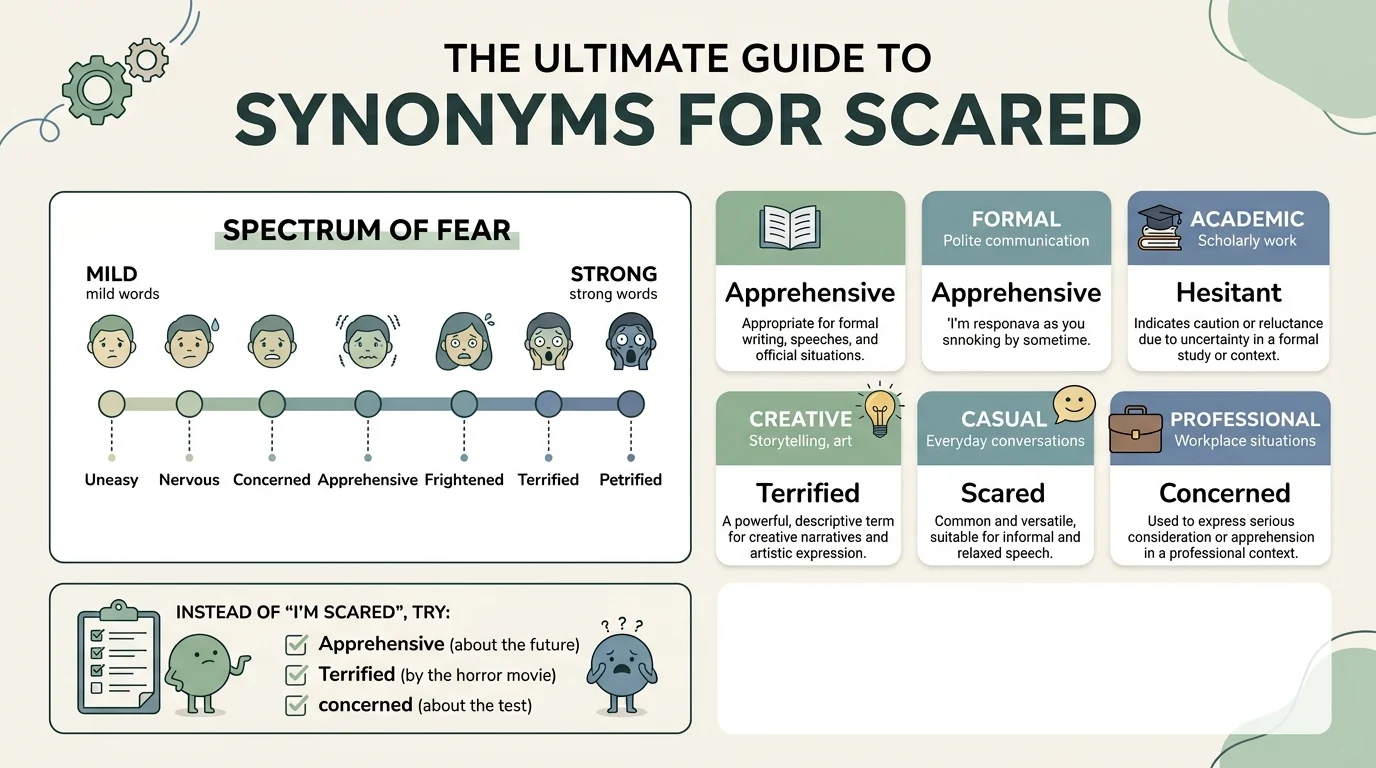
The best single replacement for “scared” depends entirely on the context. For professional writing, choose “apprehensive.” It shows a nervousness about the future without sounding panicked. In academic writing, “fearful” is a solid, neutral choice. For a casual conversation, “spooked” is vivid and fun. For emotional writing, “terrified” conveys a much stronger fear. In a resume or workplace context, you might want to avoid the word altogether. Instead of saying you are scared of failure, you could say you are “cautious” or “thorough.” For social media captions, “freaked out” is relatable, while “petrified” works for stronger meaning. Uneasy” is a perfect choice for a softer meaning.
When Not to Use “Scared”
Sometimes “scared” sounds too vague or too casual. For example, if you are writing a report about a cybersecurity threat, saying you are “scared” of a data breach is unprofessional. It weakens your credibility. Instead, say you are “concerned” or “wary.”
Another example: if you are writing a story and want to describe a character’s intense fear, “scared” is simply too weak. It fails to convey the depth of the character’s emotion. Replacing it with “terrified” or “horrified” creates a much more powerful image for the reader.
Words Commonly Confused With “Scared”
Scared vs. Afraid
Afraid” is a more formal synonym. They are often interchangeable. “Afraid” often implies a fear that is more constant or a general feeling. For example, “I am afraid of heights.” “Scared” is often used for a sudden, short-lived fright.
Scared vs. Frightened
“Frightened” is closer to “scared” but can be slightly more formal. “Frightened” often describes a reaction to an immediate, external threat. “Scared” is a bit more general. For example, “The loud noise frightened the baby.”
Scared vs. Terrified
“Terrified” is much stronger than “scared.” It means to be extremely scared. If you are “terrified,” you are in a state of intense fear. Use “terrified” when you want to emphasize the severity of the fear. “Scared” is a milder emotion.
Scared vs. Anxious
“Anxious” is different from “scared.” “Scared” is a reaction to an immediate threat. “Anxious” is a feeling of worry, nervousness, or unease about something with an uncertain outcome. It is more about the future. For example, “I am anxious about my job interview” is different from “I am scared of the dark.”
Scared vs. Spooked
Spooked” is an informal synonym for scared. It often implies being startled or frightened by something sudden or unexpected. For example, “The horse was spooked by a car backfiring.” It has a more playful or casual tone.
Scared vs. Horrified
Horrified” is a very strong synonym. It means to be filled with intense fear, shock, or disgust. You might be “horrified” by a gruesome scene in a movie. “Scared” is a more general and less intense feeling.
Best Synonym by Context for “Scared”
| Context | Best Synonym | Why It Works | Example |
|---|---|---|---|
| Formal Writing | Apprehensive | It sounds professional and specific to future events. | We are apprehensive about the potential market downturn. |
| Academic Writing | Fearful | It is a standard, neutral term suitable for analysis. | The participants reported feeling fearful before the test. |
| Professional Use | Concerned | It shows worry in a measured and appropriate way. | We are concerned about the project’s tight timeline. |
| Resume | Cautious | It frames being careful as a positive, proactive trait. | I am cautious when managing sensitive client data. |
| Casual Conversation | Spooked | It is fun, vivid, and perfect for everyday stories. | The strange noise in the house really spooked me. |
| Creative Writing | Petrified | It is descriptive and creates a strong image of fear. | He stood petrified, unable to move a single muscle. |
| Emotional Tone | Terrified | It conveys a high level of intense, personal fear. | I was terrified when I got lost in the city. |
| Soft or Moderate Tone | Uneasy | It is a gentle word for mild discomfort or worry. | I feel uneasy about walking home alone at night. |
| Social Media Captions | Freaked Out | It is a common and relatable modern expression. | My dog is freaked out by the vacuum cleaner. |
| Strong Intensity | Horrified | It implies shock and disgust, a very powerful feeling. | She was horrified by the news report. |
Which Synonym Should You Choose?
Choosing the right word is like picking the right tool for a job. First, consider your meaning. Are you describing a sudden fright or a long-lasting worry? Second, think about your formality. Are you writing a text to a friend or a report to your boss? Third, consider the emotional intensity you want to convey. Is it a mild feeling or a powerful terror? Finally, think about the professional value of your word choice. Using a precise word shows that you are a careful and skilled communicator. Your sentence’s context is the key to unlocking the perfect vocabulary choice.
Real Life Examples of “Scared” in Sentences
Let’s look at how “scared” and its appear in everyday situations. In a school setting, a student might say, “I felt apprehensive about my history presentation.” This is more precise than just saying they were scared. In the workplace, a professional could write in an email, “I am concerned about the client’s reaction to this proposal.” Here, “concerned” sounds much more professional than “scared.”
In a creative story, you might write, “She was petrified by the ghostly figure in the mirror.” This creates a much more vivid image. In a casual text to a friend, you could say, “I’m totally freaked out by this storm.” On a resume, you might include a bullet point like, “I am cautious about accuracy when managing financial data.” This frames a careful approach as a strength. For an emotional email, one might write, “I felt terrified when I heard the news.” For storytelling, using “horrified” can make the scene more powerful.
25 Synonyms
| Synonym | Simple Meaning | Best Used For | Example Sentence |
|---|---|---|---|
| Afraid | Feeling fear or anxiety. | A general, slightly more formal alternative. | She is afraid of the dark. |
| Alarmed | Suddenly frightened or worried by a threat. | Sudden realizations or warnings. | I was alarmed by the sound of the fire alarm. |
| Anxious | Worried and nervous about the future. | Ongoing worry or stress. | He felt anxious before the big job interview. |
| Apprehensive | Fearful about something that might happen. | Formal writing and professional contexts. | We are apprehensive about the test results. |
| Concerned | Worried or troubled about a particular issue. | Professional and measured worry. | I am concerned about his health. |
| Fearful | Feeling or showing fear or anxiety. | A strong, direct, and neutral adjective. | The fearful child clung to his mother. |
| Frightened | Scared or afraid. | Standard synonym for being scared. | The frightened bird flew away. |
| Horrified | Filled with intense fear, shock, or disgust. | Very strong fear involving shock or disgust. | They were horrified by the accident. |
| Nervous | Easily agitated or alarmed; anxious. | Mild worry, often about a performance. | I’m feeling nervous about my speech. |
| Panicked | Struck with sudden, uncontrolled fear. | Sudden and overwhelming fear. | People panicked when the fire started. |
| Petrified | So scared that you cannot move. | Creative writing, extreme fear. | She stood petrified, unable to speak. |
| Spooked | Suddenly scared or startled. | Casual, informal conversations. | The dog got spooked by a loud bang. |
| Startled | Feeling a sudden shock or surprise. | A brief, mild moment of surprise. | I was startled by the doorbell. |
| Terrified | Extremely frightened. | Very strong, intense fear. | I am terrified of deep water. |
Synonym Groups and Usage Differences
Professional vs. Personal Synonyms
In a professional context, you want to sound composed and in control. Use “concerned” or “apprehensive.” These words show you are aware of a risk without appearing emotionally unstable. For personal writing, you can be more direct and emotional. Words like “terrified” or “spooked” are perfectly acceptable. They allow you to be more vulnerable and expressive.
Formal vs. Conversational Synonyms
For formal writing, like academic essays, official reports, or professional emails, stick to precise words. “Fearful,” “apprehensive,” and “concerned” are strong choices. They demonstrate a sophisticated vocabulary. In conversational settings, informal synonyms are better. “Spooked,” “freaked out,” and “rattled” are great for texts, social media, and talking to friends. They are more relatable and natural in casual speech.
Academic Synonyms
For essays and research, precision is paramount. Words like “fearful” are clear and direct. “Apprehensive” is excellent for discussing anxiety about future events. “Wary” can be used for being cautious of a potential danger. These words show you have a command of the language and can express nuanced ideas. They avoid the vagueness of “scared” in an academic setting.
Professional and Business Synonyms
In the workplace, you need to communicate risk and worry without sounding panicked. “Concerned” is a standard and effective choice for voicing a problem. “Cautious” is excellent for describing a careful approach to a task. “Apprehensive” can be used to describe a team’s feelings about a new policy. These words convey awareness and a professional demeanor.
Creative or Literary Synonyms
Writers choose synonyms to paint a picture. “Petrified” is a fantastic word to show a character frozen in fear. “Horrified” is perfect for a character reacting to something shocking and grotesque. “Alarmed” is great for a sudden, sharp feeling of danger. “Daunted” is useful for showing a character’s fear of a great challenge. These words add depth and imagery to your storytelling.
Slang or Modern Synonyms
In modern language, we use many casual expressions for being scared. “Freaked out” is a common and very relatable phrase. Spooked” is a fun, informal synonym. “Jittery” describes a nervous, energy-filled fear. These are acceptable in text messages, social media captions, and casual conversation. However, they are too informal for professional or academic writing.
Strongest vs. Weaker Synonyms
Imagine a spectrum of fear. On the mild end, you have words like “uneasy,” “nervous,” and “concerned.” These describe a low level of worry. As the intensity builds, you have “frightened” and “scared.” These are general, moderate fear. At the strongest end, you have “terrified,” “petrified,” and “horrified.” These words describe an intense, overwhelming fear. Choose your word based on the level of fear you want to express.
Emotional vs. Neutral Synonyms
Some synonyms are purely descriptive. “Apprehensive” and “fearful” are relatively neutral. They describe a state of fear without adding a lot of emotional color. Other synonyms are highly emotional. “Terrified” and “horrified” are charged words. They convey a strong emotional reaction. “Panicked” also carries a strong emotional weight. Choose an emotional synonym to make your writing more powerful and engaging. Choose a neutral synonym for objective descriptions.
Antonyms of “Scared”
| Antonym | Meaning | Example Sentence |
|---|---|---|
| Brave | Ready to face danger without fear. | The brave firefighter rushed into the burning building. |
| Calm | Not showing or feeling nervousness or anger. | She remained calm during the emergency. |
| Confident | Feeling sure of your abilities or prospects. | He felt confident about his job interview. |
| Courageous | Not deterred by danger or pain. | The courageous soldier was awarded a medal. |
| Fearless | Lacking fear; brave. | She was fearless in her pursuit of justice. |
| Unafraid | Feeling no fear. | He is unafraid of taking risks. |
| Bold | Showing a willingness to take risks. | Her bold idea impressed the entire board. |
| Dauntless | Unable to be intimidated or discouraged. | His dauntless spirit inspired his team. |
| Intrepid | Fearless; adventurous. | The intrepid explorer journeyed to the Arctic. |
| Valiant | Possessing or showing great bravery. | The valiant knight saved the kingdom. |
| Composed | Having one’s feelings under control. | She remained composed under pressure. |
| Relaxed | Free from tension and anxiety. | He felt relaxed in the comfortable chair. |
| Secure | Confident and free from worry. | She feels secure in her new job. |
| Plucky | Having or showing determined courage. | The plucky little dog barked at the big dog. |
| Audacious | Showing a willingness to take bold risks. | The audacious plan was a huge success. |
Comparison: Scared vs. Similar Words
Scared vs. Afraid
The main difference is subtle but important. “Afraid” can be used for a long-term, general feeling of fear. For example, “I am afraid of failure.” “Scared” is often used for a specific, immediate incident. For example, “I was scared by the thunder.” Both are common, but “afraid” is slightly more formal.
Scared vs. Frightened
“Frightened” often implies a reaction to an external stimulus. It suggests being startled or alarmed by something specific. “Scared” is a more general term. The difference is small, but “frightened” is a bit stronger and more immediate. “Frightened” is also considered slightly more formal.
Scared vs. Terrified
The difference is one of degree. “Terrified” is much stronger than “scared.” If you are “terrified,” your fear is intense and overwhelming. “Scared” can describe a mild worry or a moderate fright. For example, you might be scared to give a speech, but terrified of a bear attack. “Terrified” is also more emotionally charged.
Scared vs. Anxious
This is an important distinction. “Scared” is a response to a clear and present danger. “Anxious” is a feeling of worry about the future. “Scared” is about the “now.” “Anxious” is about the “what if.” For example, you are scared of a bee flying near you. You are anxious about your upcoming exam. They are different emotional states.
Scared vs. Spooked
“Spooked” is an informal, often playful word. It implies being suddenly startled by something unexpected. A “spooked” horse is one that has been frightened by a sudden noise. “Scared” is the general, more formal term. “Spooked” is best for casual storytelling or describing a lighthearted fright.
Scared vs. Horrified
“Horrified” is a very intense emotion. It combines fear with shock and often disgust. You might be “scared” by a creaking sound. You would be “horrified” by a gruesome scene in a movie. “Horrified” is also a more formal and dramatic word than “scared.”
Common Phrases and Expressions with “Scared”
1. Scared Stiff
Meaning: To be so frightened that you cannot move.
Example sentence: The loud crash in the middle of the night scared me stiff.
2. Scared to Death
Meaning: To be extremely frightened.
Example sentence: I was scared to death when I heard the fire alarm.
3. Scared of One’s Own Shadow
Meaning: To be very easily frightened; extremely timid.
Example sentence: He is so nervous lately that he is scared of his own shadow.
4. Running Scared
Meaning: To be in a state of fear or panic about a situation or competition.
Example sentence: The politician is running scared after the scandal broke.
5. Scaredy Cat
Meaning: A childish term for a person who is easily frightened.
Example sentence: Don’t be such a scaredy cat; it is only a children’s movie.
6. More Scared Than Hurt
Meaning: To be more frightened than physically injured.
Example sentence: After the small car accident, he was more scared than hurt.
Common Mistakes to Avoid
- Using “scared” when a more precise synonym is better. Your writing will become more vivid and interesting if you choose a word like “apprehensive” or “terrified.”
- Confusing “scared” with “anxious.” Remember, “scared” is a reaction to a present threat, while “anxious” is a worry about the future.
- Using casual synonyms in formal writing. Words like “spooked” or “freaked out” have no place in a professional report or academic essay.
- Using overly dramatic synonyms for a simple situation. Saying you are “terrified” when you are merely “nervous” about a meeting is exaggerating and can make you sound less credible.
- Repeating the same word too often. The entire purpose of learning synonyms is to avoid redundancy and add variety to your language.
- Choosing a synonym with the wrong emotional tone. Be careful not to overstate the intensity of your fear.
- Using slang in academic or professional writing. Never use words like “spooked” or “jittery” in a formal context.
FAQs
What is the best synonym for scared?
The best synonym depends on the context. “Terrified” is best for extreme fear. “Apprehensive” is ideal for formal situations. “Spooked” is great for casual conversation.
What is a formal synonym for scared?
Formal synonyms include “apprehensive,” “fearful,” and “concerned.” These are excellent choices for professional and academic writing.
What is an informal synonym for scared?
Informal synonyms include “spooked,” “freaked out,” and “rattled.” These are perfect for texting with friends or writing social media captions.
What is another word for scared in professional writing?
In professional writing, use “concerned” or “apprehensive.” These words convey worry without sounding panicked.
What is the difference between scared and terrified?
“Terrified” is a much stronger word. It means to be extremely scared. “Scared” is a milder, more general word for fear.
What is the opposite of scared?
The opposite of scared is “brave” or “fearless.” These words describe a lack of fear.
Conclusion
In short, “scared” is a perfectly good word, but it is often not the best word. English is rich with vocabulary that allows you to express the exact flavor and intensity of fear. Your choice of a synonym can change the tone of your sentence, making it more professional, emotional, or dramatic. The best vocabulary tip is to be intentional with your word choice. Always consider your audience, your context, and the precise feeling you want to convey. By using this guide, you will never be at a loss for words again.