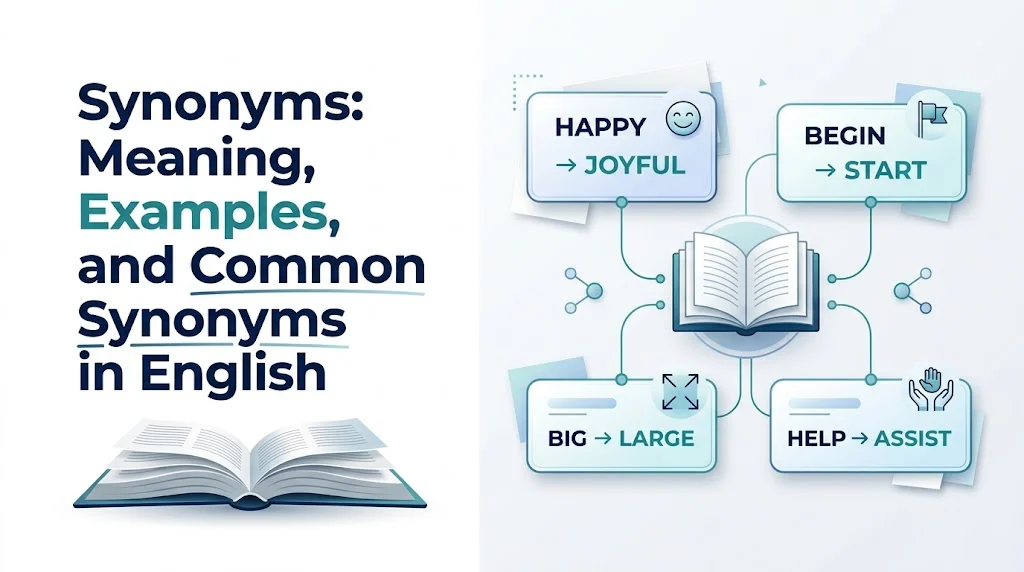
Synonyms are words that have the same or similar meanings. They help you express ideas clearly, avoid repeating the same words, and make your writing more interesting. For example, happy and joyful describe similar feelings, while begin and start often express the same action.
However, synonyms aren’t always interchangeable. Words can differ in tone, intensity, formality, and meaning depending on the sentence. Choosing the right alternative requires more than finding a word with a similar definition.
This guide explains the meaning of synonyms, provides a useful list of common English synonyms, and shows how to use them in everyday conversation, academic writing, and professional communication. You’ll also learn how synonyms differ from antonyms and related words, how to find suitable alternatives, and how to choose words that fit your message.
What Are Synonyms?
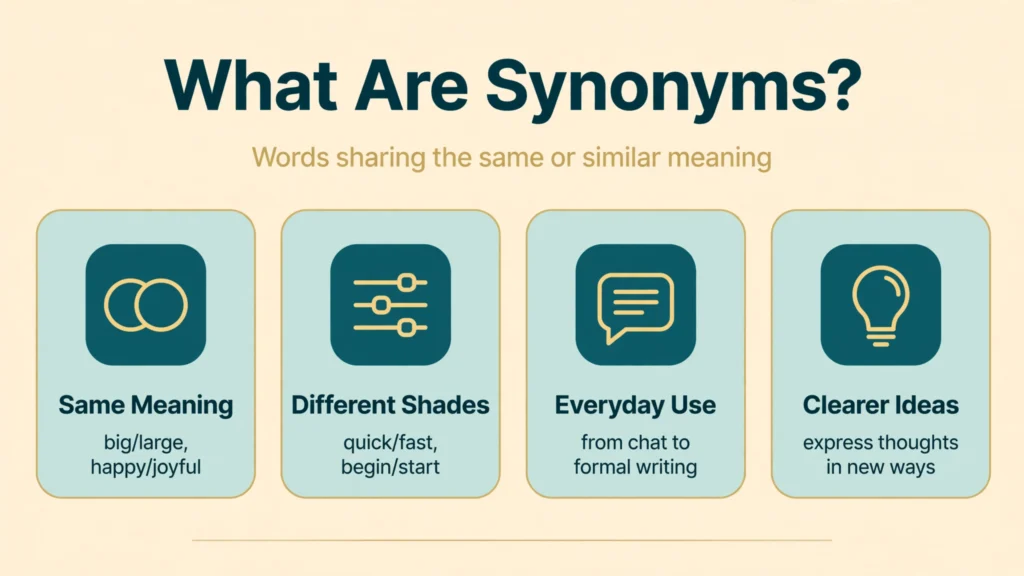
Synonyms are words or expressions that share the same or a closely related meaning. Writers, students, teachers, and English learners use them to communicate ideas in different ways.
For example, big and large have similar meanings. You can describe a big house as a large house without changing the main idea. Likewise, quick and fast can describe something that happens or moves at a high speed.
Synonyms appear throughout the English language. Some are common in everyday conversation, while others suit formal reports, academic papers, or creative writing.
Consider these examples:
- Happy: Joyful, cheerful, pleased, delighted
- Important: Significant, essential, crucial, valuable
- Help: Assist, support, aid
- Beautiful: Attractive, lovely, gorgeous, stunning
- Begin: Start, commence, initiate
Each group contains words with related meanings. However, the best replacement depends on what you want to say and how you want your reader to understand it.
For example, essential usually communicates a stronger need than important. Similarly, delighted often expresses greater happiness than pleased.
The main principle is simple: synonyms give you more ways to express an idea, but context determines which word works best.
Synonym Definition and Meaning
The word synonym refers to a word or expression that has the same or a similar meaning as another word or expression.
The plural form is synonyms. Use synonym when discussing one word relationship and synonyms when referring to multiple alternatives.
Here are some examples:
- Small is a synonym of little in many situations.
- Purchase is a more formal synonym for buy.
- Assist can serve as a synonym for help.
- Difficult and hard are synonyms in many contexts.
- Finish and complete often express the same action.
Synonyms belong to the field of language study concerned with word meanings and relationships. This area is known as lexical semantics.
Understanding these relationships helps you recognize that words can share a general meaning without expressing precisely the same idea.
For instance, slim, thin, and skinny all describe a small body size. Yet they can create different impressions. Slim often sounds positive, thin is usually more neutral, and skinny can sound critical depending on the situation.
That difference matters when you write a description, give feedback, or choose words for a sensitive conversation.
What Are Synonyms in English?
English synonyms allow you to express similar ideas through different vocabulary choices. You can find them among nouns, verbs, adjectives, adverbs, and complete expressions.
For example, the verb explain has several alternatives:
- Clarify
- Describe
- Illustrate
- Interpret
- Elucidate
These words overlap in meaning, but their uses differ. You clarify something confusing, describe its features, illustrate an idea with examples, or interpret what something means.
The adjective important also has several alternatives. You might use significant to describe a meaningful change, essential for something necessary, or crucial for something that strongly affects an outcome.
Synonyms therefore do more than expand your vocabulary. They help you select words that express specific ideas with greater accuracy.
Are Synonyms Exactly the Same in Meaning?
Some synonyms come very close to sharing the same meaning. Others overlap only in certain situations.
Linguists often distinguish between near-synonyms and words that can function as equivalent expressions in a specific context. Complete synonymy across every situation is uncommon because words carry different associations and usage patterns.
Consider begin and start:
- We will begin the meeting at nine.
- We will start the meeting at nine.
Both sentences communicate essentially the same information.
Now compare inexpensive and cheap:
- This jacket is inexpensive.
- This jacket is cheap.
The first sentence generally emphasizes a low price without necessarily criticizing quality. The second can describe low cost but may also suggest poor quality.
The dictionary meaning isn’t the only thing that matters. Tone, context, and common usage can change how a word sounds to the reader.
Common Synonyms in English With Meanings
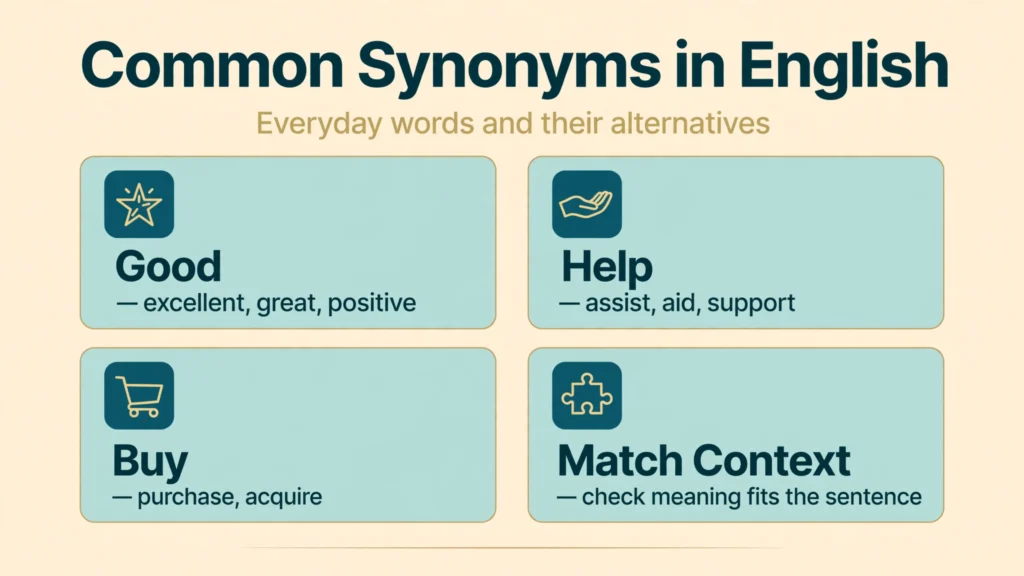
A practical synonyms list makes it easier to find suitable alternatives without searching through unrelated definitions. The following tables cover common adjectives, verbs, nouns, and expressions.
Use these lists as a starting point. Before replacing a word, check that the alternative matches your intended meaning and fits the sentence naturally.
Common Synonyms for Adjectives
Adjectives describe people, places, objects, feelings, and conditions. The right adjective can make a sentence more specific and expressive.
| Word | Common Synonyms | Meaning or Usage Note |
|---|---|---|
| Good | Excellent, great, positive, beneficial | Beneficial emphasizes a helpful effect. |
| Bad | Poor, harmful, unfavorable, unpleasant | Harmful indicates damage or injury. |
| Happy | Joyful, cheerful, pleased, delighted | Delighted often conveys stronger happiness. |
| Sad | Unhappy, sorrowful, gloomy, disappointed | Disappointed suggests an unmet expectation. |
| Important | Significant, essential, crucial, major | Essential means necessary. |
| Big | Large, huge, enormous, substantial | Substantial can describe size or amount. |
| Small | Little, tiny, compact, minor | Minor refers to limited importance or degree. |
| Beautiful | Lovely, attractive, gorgeous, stunning | Attractive can describe appearance more broadly. |
| Fast | Quick, rapid, speedy, swift | Rapid often describes change or movement. |
| Smart | Intelligent, clever, bright, sharp | Intelligent often emphasizes mental ability. |
| Easy | Simple, straightforward, effortless, uncomplicated | Effortless suggests little apparent effort. |
| Difficult | Hard, challenging, demanding, complicated | Demanding emphasizes the effort required. |
| Strong | Powerful, sturdy, robust, forceful | Sturdy often describes physical construction. |
| Weak | Feeble, fragile, frail, ineffective | Ineffective means unable to produce the desired result. |
| Quiet | Silent, peaceful, hushed, subdued | Peaceful emphasizes calmness. |
| Angry | Annoyed, irritated, furious, enraged | Furious and enraged indicate greater intensity. |
| Honest | Truthful, sincere, candid, straightforward | Candid suggests openness and directness. |
| Interesting | Engaging, fascinating, compelling, intriguing | Fascinating suggests strong interest. |
| Clear | Understandable, obvious, evident, transparent | Transparent can mean easy to understand or see through. |
| Useful | Helpful, practical, valuable, beneficial | Practical emphasizes usefulness in real situations. |
These synonyms aren’t identical in every setting. For example, large and enormous both describe size, but enormous emphasizes an especially great size.
Similarly, good, beneficial, and positive overlap without always working as direct replacements. A good performance might be positive, but a beneficial treatment describes something that produces a helpful effect.
A useful rule: Choose the word that describes the exact quality you want to communicate, not simply the one that appears first in a synonym list.
Common Synonyms for Verbs
Verbs describe actions, events, processes, and states. Replacing an overused verb can improve clarity, but the alternative should preserve the original action.
| Word | Common Synonyms | Example or Usage Note |
|---|---|---|
| Help | Assist, support, aid | Assist often sounds more formal. |
| Show | Display, demonstrate, reveal | Demonstrate often means explaining through proof or examples. |
| Make | Create, produce, build | Build commonly refers to constructing or developing. |
| Start | Begin, launch, initiate | Launch often suits projects or products. |
| End | Finish, conclude, complete | Conclude can sound formal. |
| Say | State, mention, remark | State often introduces a definite point. |
| Get | Receive, obtain, acquire | Acquire often suggests gaining something over time. |
| Improve | Enhance, strengthen, refine | Refine means improving through careful changes. |
| Choose | Select, pick, decide | Select often sounds more formal than pick. |
| Explain | Clarify, describe, interpret | Clarify focuses on making something easier to understand. |
| Think | Consider, reflect, contemplate | Contemplate suggests deeper thought. |
| Show up | Arrive, appear, attend | Attend usually refers to being present at an event. |
| Change | Alter, modify, adjust | Adjust often suggests a limited change. |
| Keep | Retain, preserve, maintain | Preserve suggests protecting something from harm or loss. |
| Need | Require, depend on, call for | Require often suits formal instructions. |
Notice how the intended action affects the best replacement.
For example, make a plan can become create a plan. However, make a mistake doesn’t usually become create a mistake in natural English.
Likewise, get a package can mean receive a package. Yet get ready means prepare, not receive ready-made instructions.
This is why a strong synonyms resource should include usage information rather than presenting every alternative as interchangeable.
Common Synonyms for Nouns
Nouns name people, places, objects, ideas, events, and conditions. Choosing a precise noun can help readers understand your point without lengthy explanations.
| Word | Common Synonyms | Meaning or Usage Note |
|---|---|---|
| Idea | Thought, concept, notion | Concept often refers to an organized or abstract idea. |
| Problem | Issue, difficulty, challenge | Challenge can present an obstacle constructively. |
| Goal | Aim, objective, target | Objective often suits formal planning. |
| Change | Shift, adjustment, modification | Modification suggests an alteration to something existing. |
| Result | Outcome, effect, consequence | Consequence often emphasizes what follows an action. |
| Benefit | Advantage, gain, value | Advantage suggests a favorable position. |
| Choice | Option, selection, alternative | Option refers to one available possibility. |
| Method | Approach, technique, procedure | Procedure often describes an established sequence of steps. |
| Job | Position, role, occupation | Occupation can describe a person’s type of work. |
| Opportunity | Chance, opening, possibility | Opening can refer to a favorable available position. |
| Answer | Response, reply, solution | Solution specifically resolves a problem. |
| Reason | Cause, explanation, motive | Motive often relates to the reason behind someone’s actions. |
| Story | Tale, account, narrative | Account often describes a report of events. |
| Mistake | Error, oversight, blunder | Blunder suggests a serious or careless mistake. |
| Plan | Strategy, proposal, scheme | Strategy often refers to a broader approach. |
The context determines whether two nouns can replace one another.
For instance, an answer responds to a question, while a solution resolves a problem. These meanings sometimes overlap, but they aren’t always equivalent.
A strategy can include several plans or actions. A proposal presents an idea for consideration, while a scheme may sound negative in some contexts.
Use these distinctions to choose nouns that explain your meaning accurately.
Common Synonyms for Everyday Expressions
Synonyms don’t have to be single words. Phrases can express similar meanings and offer useful alternatives for conversation and writing.
| Original Expression | Alternative Expressions | Usage Note |
|---|---|---|
| A lot of | Many, much, numerous, plenty of | Many usually modifies countable nouns; much often modifies uncountable nouns. |
| Because of | Due to, owing to, as a result of | Choose the expression that fits your sentence structure. |
| In order to | To, so as to | To is usually simpler and more natural. |
| For example | For instance, such as | Such as commonly introduces examples within a sentence. |
| Find out | Discover, learn, determine | Determine can suggest a deliberate investigation. |
| Look for | Search for, seek | Seek often sounds more formal. |
| Put off | Postpone, delay | Both can refer to moving something to a later time. |
| Come up with | Develop, devise, think of | Devise suggests creating a deliberate plan or solution. |
| In the end | Ultimately, finally, eventually | These alternatives can differ in timing and emphasis. |
| Right away | Immediately, promptly, at once | Promptly can sound more formal. |
| On the other hand | However, by contrast, conversely | Each expression establishes a different kind of contrast. |
| Take care of | Handle, manage, look after | The best alternative depends on whether the context involves a task or person. |
Phrase alternatives require special attention because they may change grammar.
For example:
- Original: She went to the library in order to study.
- Alternative: She went to the library to study.
The second version is shorter and retains the original meaning.
However, replacing because of with because requires a grammatical adjustment:
- Original: The match was canceled because of the rain.
- Alternative: The match was canceled because it rained.
Both sentences communicate a similar cause, but their structures differ.
Synonym Examples in Sentences
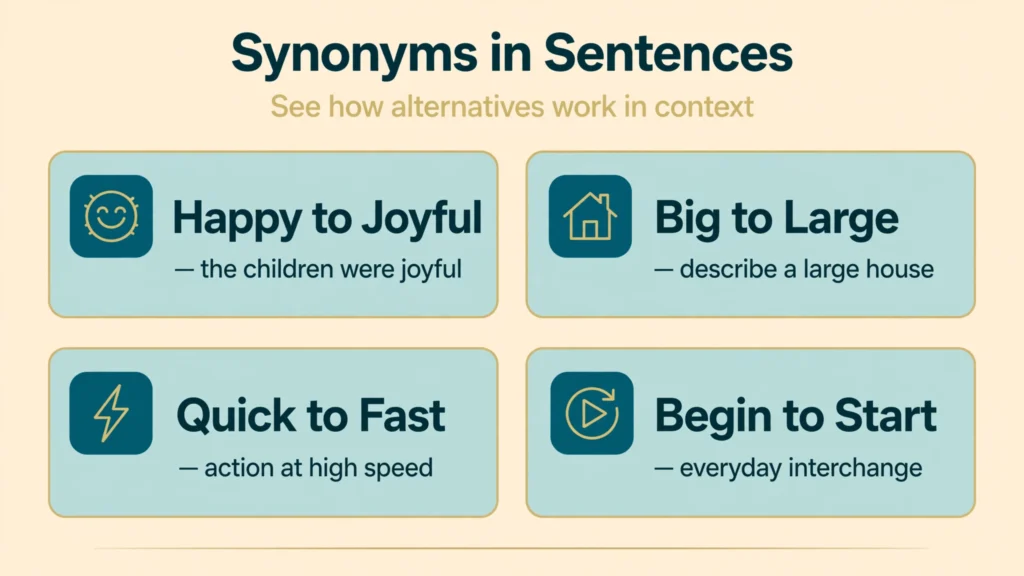
A synonym makes more sense when you see it in a complete sentence. Isolated word pairs show a relationship, while sentences demonstrate how the words function in real communication.
The examples below cover everyday usage and show how alternative words can preserve, sharpen, or slightly change meaning.
Examples of Synonyms in Simple Sentences
Happy and joyful
- Original: The children were happy about the school trip.
- Alternative: The children were joyful about the school trip.
Both sentences express happiness. Joyful sounds slightly more expressive and may emphasize the feeling.
Quick and rapid
- Original: The company made a quick decision.
- Alternative: The company made a rapid decision.
The first sentence sounds natural in everyday English. Rapid decision is possible, but quick decision is generally the more familiar expression.
Help and assist
- Original: The teacher helped the student with the assignment.
- Alternative: The teacher assisted the student with the assignment.
Both sentences describe support. Assisted gives the alternative a somewhat more formal tone.
Begin and start
- Original: The workshop will begin at ten.
- Alternative: The workshop will start at ten.
The meaning remains essentially the same. Both versions sound natural.
Important and crucial
- Original: Communication is important for teamwork.
- Alternative: Communication is crucial for teamwork.
The second sentence emphasizes the importance more strongly. Use crucial when the idea is especially necessary for success.
Explain and clarify
- Original: The manager explained the new policy.
- Alternative: The manager clarified the new policy.
These sentences overlap in meaning. However, clarified suggests that the manager made the policy easier to understand.
Improve and enhance
- Original: The new design improved the website.
- Alternative: The new design enhanced the website.
Both sentences suggest a positive change. Enhanced can place greater emphasis on making something better or more effective.
How a Synonym Changes Meaning or Tone
Some alternatives express the same general idea but create different impressions. Understanding those differences is essential when you write about people, describe situations, or give feedback.
| Word Pair | Main Difference | Example |
|---|---|---|
| Angry / furious | Furious expresses greater intensity. | She was angry about the delay. / She was furious about the delay. |
| Thin / slim | Slim often sounds more positive. | The model looked slim in the photograph. |
| Curious / nosy | Nosy can imply unwanted interest. | He was curious about the project. / He was nosy about their private lives. |
| Cheap / inexpensive | Cheap can suggest poor quality; inexpensive is more neutral. | We found an inexpensive hotel. |
| Confident / arrogant | Arrogant suggests excessive self-importance. | She was confident during the interview. |
| Old / elderly | Elderly specifically refers to people of advanced age and can carry social sensitivities. | An elderly man crossed the street. |
| Firm / stubborn | Stubborn often suggests unreasonable resistance. | She remained firm about her decision. |
| Brave / reckless | Reckless implies a willingness to take unreasonable risks. | The rescue team made a brave effort. |
Imagine writing a performance review for an employee. Describing the person as confident suggests self-assurance. Calling the same person arrogant criticizes their attitude.
The two adjectives may refer to related behavior, but they communicate different judgments.
Good synonym choices preserve the intended meaning and the emotional tone of your message.
Synonyms for Different Parts of Speech
A word’s grammatical role matters just as much as its meaning. An alternative should fit the sentence in the same way as the original word or require a suitable change to the sentence.
Compare these examples:
- Adjective: The instructions are clear.
- Adjective: The instructions are understandable.
Both describe the instructions.
Now consider:
- Verb: She decided to leave.
- Verb: She chose to leave.
The verbs work in similar ways.
However, a change in grammatical form may require rewriting:
- Original: The team made an improvement.
- Alternative: The team improved.
Both communicate progress, but improvement is a noun and improved is a verb.
The second version changes the sentence structure. This is perfectly acceptable as long as the revised sentence preserves the intended message.
When checking a synonym, ask whether it fits the sentence’s grammatical role and common usage patterns.
Types of Synonyms
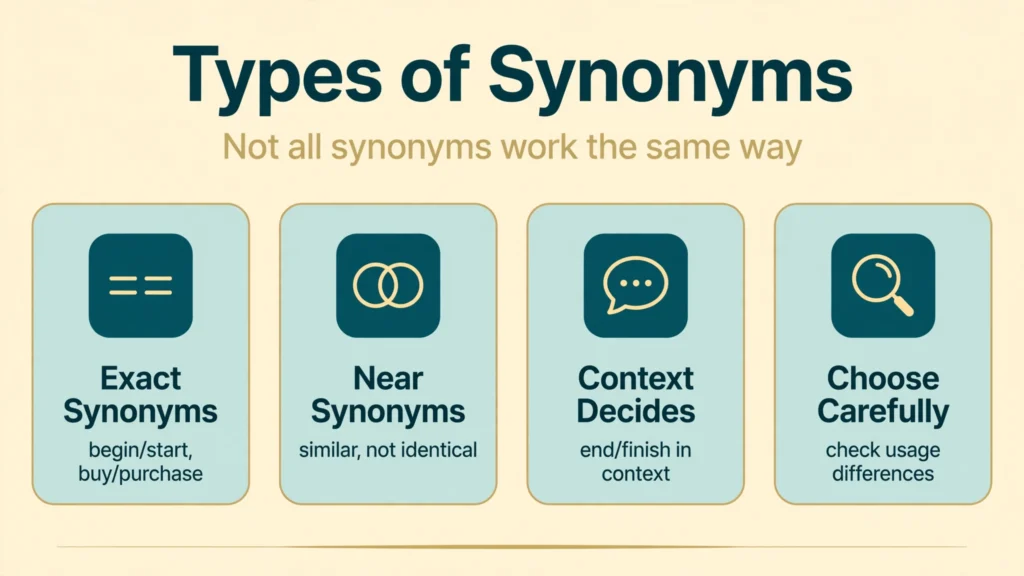
Understanding the types of synonyms helps explain why some words can replace one another easily while others require more care.
Exact Synonyms
Exact synonyms are words that share the same meaning in a particular context. In some situations, one word can replace another without changing the essential message.
For example:
- Begin and start in many everyday sentences.
- Purchase and buy when referring to acquiring something in exchange for money.
- End and finish when describing the completion of an activity.
These pairs overlap strongly, but their uses still differ in certain expressions.
People usually say start a car, not begin a car. Likewise, buy a house is a familiar expression, while purchase a house sounds more formal.
This illustrates an important point: even words with very similar meanings may follow different usage conventions.
Rather than assuming two words are exact synonyms everywhere, consider whether they work in the particular sentence you are writing.
Near-Synonyms
Near-synonyms share a broad meaning but differ in intensity, implication, or typical use.
Consider these words:
- Annoyed: Slightly upset or irritated.
- Angry: Feeling strong displeasure.
- Furious: Extremely angry.
All three describe related emotional states. However, they communicate different levels of intensity.
Another example involves look, stare, and glance.
- To look means to direct your eyes toward something.
- To stare means to look for a relatively long time, often steadily.
- To glance means to look quickly.
Replacing these verbs without considering their differences can change the picture a sentence creates.
Near-synonyms are particularly valuable when writing descriptive passages. They let you communicate specific details instead of relying on a broad, general word.
Contextual Synonyms
Contextual synonyms are words that function as alternatives in a particular sentence, even though their meanings differ elsewhere.
For example, bright and intelligent can overlap when describing someone’s mental ability.
- She is a bright student.
- She is an intelligent student.
Both sentences describe a capable learner.
However, bright can also describe light or color. You wouldn’t normally replace bright sunlight with intelligent sunlight.
Likewise, light can refer to illumination, low weight, or a pale color. A possible synonym depends on which meaning the sentence expresses.
For example:
- Light bag → Lightweight bag
- Light room → Bright room
- Light meal → Small meal
These alternatives work because they match the intended meaning of light in each sentence.
Context determines the relationship between words. A synonym for one meaning may be unsuitable for another.
Formal and Informal Synonyms
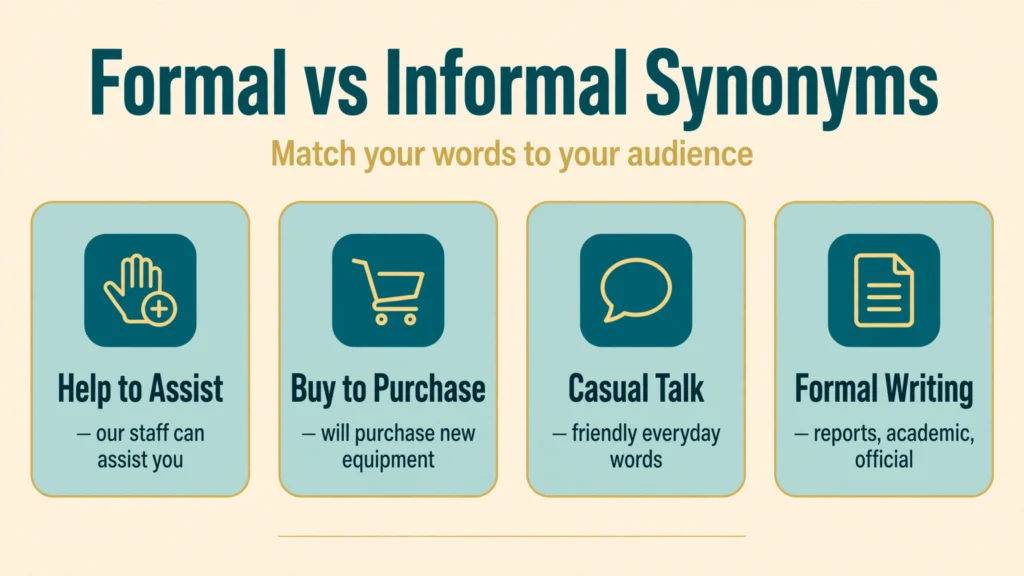
Word choice also communicates the level of formality. Some synonyms sound natural in friendly conversation, while others fit professional reports, academic writing, or official documents.
Neither style is automatically better. The best choice depends on your audience and purpose.
Formal Synonyms for Academic and Professional Writing
Formal alternatives can make your writing suitable for reports, presentations, business correspondence, and academic assignments.
| Everyday Word | More Formal Alternative | Example |
|---|---|---|
| Help | Assist | Our staff can assist you. |
| Buy | Purchase | The department will purchase new equipment. |
| Ask | Inquire | Please inquire about availability. |
| Start | Commence | The session will commence shortly. |
| Show | Demonstrate | The results demonstrate a clear pattern. |
| Need | Require | Applicants require valid identification. |
| Use | Utilize | The team will use the available data. |
| Tell | Inform | Please inform the supervisor. |
| Get | Obtain | Researchers obtained the necessary information. |
| End | Conclude | The report concludes with several recommendations. |
A formal synonym should improve precision or suit the setting. It shouldn’t make a sentence unnecessarily difficult to read.
For example, use is usually clearer than utilize. Both words can be correct, but the longer option doesn’t automatically strengthen your writing.
Compare these sentences:
- Simple: We used the available data to improve the plan.
- Formal: We used the available data to refine the plan.
The second version changes a word because refine more precisely describes making careful improvements.
That is a useful substitution. Replacing every simple verb with a longer alternative would not be.
Informal Synonyms for Everyday Conversation
Informal words make conversation feel natural and relaxed. They often appear in text messages, friendly emails, social media posts, and casual discussions.
| Neutral Word | Informal Alternative | Example |
|---|---|---|
| Friend | Buddy, pal | My buddy is coming over. |
| Child | Kid | The kid is playing outside. |
| Leave | Head out | We should head out soon. |
| Find out | Figure out | I’ll figure out what happened. |
| Tired | Worn out, beat | I’m worn out after work. |
| Enjoy | Have fun with | I had fun with the new game. |
| Understand | Get | I get what you’re saying. |
| Talk | Chat | We chatted for an hour. |
| Excellent | Awesome | That was an awesome performance. |
| Difficult | Tough | The exam was tough. |
Some expressions have regional or social associations. For instance, beat can mean very tired in casual American English, but its meaning changes in other contexts.
Informal alternatives also vary in how suitable they are for a particular audience. Kid is common in casual settings, while child may suit formal descriptions better.
Choosing Synonyms for Academic, Business, and Casual Writing
Consider the idea that a company needs to improve its customer service.
- In casual conversation, you might say:
The company needs to do a better job helping customers.
- In a business report, you might write:
The company needs to improve customer support.
- In a formal analysis, you could say:
The company should enhance its customer service processes.
Each sentence expresses a related idea, but the language and level of detail differ.
Use these guidelines when selecting synonyms:
- Academic writing: Prefer precise terms and clearly defined concepts.
- Business communication: Use professional language that communicates actions and outcomes directly.
- Casual conversation: Choose familiar words that sound natural.
- Creative writing: Select words that establish character, mood, imagery, and voice.
The objective isn’t to make every sentence sound formal. It’s to make the language appropriate for the situation.
Synonyms vs. Antonyms and Related Words
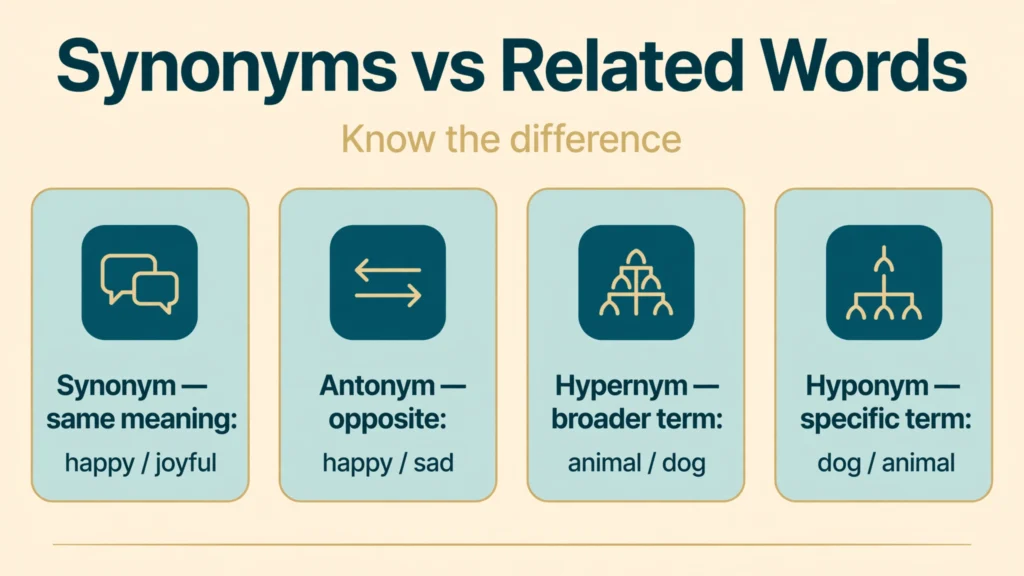
Several linguistic concepts describe relationships between words. Understanding the differences helps you identify true synonyms instead of choosing words that merely belong to the same topic.
| Term | Definition | Example |
|---|---|---|
| Synonym | A word with the same or a similar meaning | Happy / joyful |
| Antonym | A word with an opposite meaning | Happy / sad |
| Related word | A word connected through subject, association, or use | Doctor / hospital |
| Hypernym | A broader category term | Animal / dog |
| Hyponym | A more specific term within a broader category | Dog / animal |
| Homonym | A word sharing its form with another word that has a different meaning | Bat, meaning an animal or sports equipment |
What Is the Difference Between Synonyms and Antonyms?
Synonyms have similar meanings, while antonyms express opposite meanings.
Examples of synonyms:
- Hot / warm, in suitable contexts
- Quick / fast
- Begin / start
- Intelligent / smart
Examples of antonyms:
- Hot / cold
- Quick / slow
- Begin / end
- Intelligent / unintelligent
Antonyms aren’t necessarily exact opposites across every situation. For instance, unintelligent and smart contrast directly, but unintelligent may sound more critical than simply saying someone is not particularly clever.
Use synonyms when you want to express a similar idea. Use antonyms when you want to introduce contrast or communicate an opposite meaning.
What Are Related Words?
Related words share a connection but don’t necessarily have the same meaning.
Consider doctor, patient, medicine, and hospital. They all belong to the medical field, but each word refers to something different.
Replacing doctor with medicine would change the meaning of a sentence. A doctor is a person, while medicine can refer to a substance used for treatment or the broader practice of medical care.
This distinction matters when searching for alternatives. A dictionary or thesaurus may present associated words alongside synonyms, but related terms shouldn’t automatically be treated as interchangeable.
What Are Hypernyms and Hyponyms?
A hypernym represents a broader category, while a hyponym refers to a more specific member of that category.
For example, animal is a hypernym of dog. The word dog is a hyponym of animal.
Other examples include:
- Fruit → Apple
- Vehicle → Bicycle
- Flower → Rose
- Furniture → Chair
These words have a category relationship rather than a synonym relationship.
A rose is a type of flower, but rose and flower aren’t synonyms. The broader term includes more items than the specific term.
This relationship is useful for vocabulary development and classification. However, when you need a true synonym, focus on words that preserve the intended meaning.
How to Choose the Right Synonym
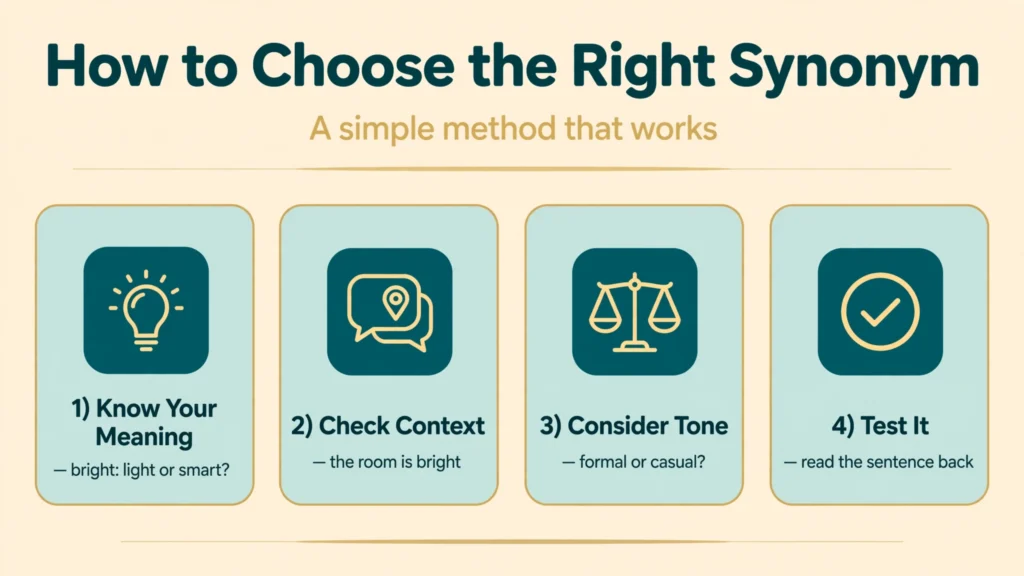
Finding a list of alternatives is only the first step. You also need to identify the word that communicates your intended message clearly and naturally.
The following method works for essays, emails, reports, stories, and everyday writing.
Identify the Meaning You Want to Express
Start by determining exactly what the original word means in your sentence.
Many English words have several meanings. A synonym that works for one meaning may fail for another.
For example, bright can describe light, color, intelligence, or a promising future.
Consider these sentences:
- The room is bright.
- She is a bright student.
- He has a bright future.
The suitable alternatives differ:
- Bright room → Well-lit room
- Bright student → Intelligent student
- Bright future → Promising future
Although well-lit, intelligent, and promising can replace bright in these examples, they aren’t general synonyms for every use of the word.
First identify the intended sense. Then look for alternatives that express that same idea.
Check the Context and Sentence Structure
A synonym should fit the surrounding words and sentence structure.
For example, strong and powerful overlap in meaning. However, their natural combinations vary.
People commonly say:
- Strong coffee
- Powerful engine
- Strong argument
- Powerful speech
You can sometimes switch these adjectives, but the original combinations often sound more natural.
English speakers develop these patterns through repeated use. Linguists call many of these recurring word combinations collocations.
A word may have a similar dictionary meaning but sound awkward when paired with a particular noun or verb.
Read the complete sentence before choosing a replacement. If the alternative disrupts the sentence’s natural flow, look for another option.
Match the Tone and Level of Formality
Think about how the replacement will sound to your audience.
For example:
- Ask → Inquire
- Buy → Purchase
- Start → Commence
- Help → Assist
The alternatives on the right may sound more formal. That doesn’t make them better in every sentence.
Compare these examples:
- Natural: Can you help me with this?
- Formal: Could you assist me with this matter?
Both versions are appropriate in different settings.
Now consider a sentence from a children’s story. Replacing every simple word with a formal alternative could make the passage sound unnatural for its audience.
Choose synonyms that match the tone you want to create. Don’t use difficult words simply because they appear more sophisticated.
Compare Definitions and Example Sentences
When you’re unsure whether two words are interchangeable, compare their definitions and examples.
Look for these details:
- Meaning: Does the alternative express the intended idea?
- Intensity: Is it stronger or weaker than the original?
- Tone: Does it sound positive, negative, neutral, formal, or informal?
- Grammar: Does it function correctly in the sentence?
- Usage: Do people commonly use it in that context?
For example, consider problem, challenge, and obstacle.
A problem is something that needs attention or a solution. A challenge is a difficult task or situation that requires effort. An obstacle is something that stands in the way of progress.
These nouns sometimes overlap, but they emphasize different aspects of a situation.
If you’re describing a technical fault, problem may be the clearest choice. If you’re discussing a demanding professional goal, challenge may fit better.
Test the Replacement in the Original Sentence
Before finalizing your choice, replace the original word and reread the sentence.
Suppose your original sentence says:
The new software helped the team finish the project.
You might consider assisted, supported, or enabled as alternatives.
- The new software assisted the team in finishing the project.
- The new software supported the team throughout the project.
- The new software enabled the team to finish the project.
Each sentence makes a slightly different claim. Assisted emphasizes help, supported emphasizes ongoing backing, and enabled suggests that the software made the result possible.
The best option depends on what actually happened.
Never sacrifice factual accuracy for vocabulary variety. The replacement should preserve the original claim unless you intentionally want to change its meaning.
How to Find Synonyms for a Word
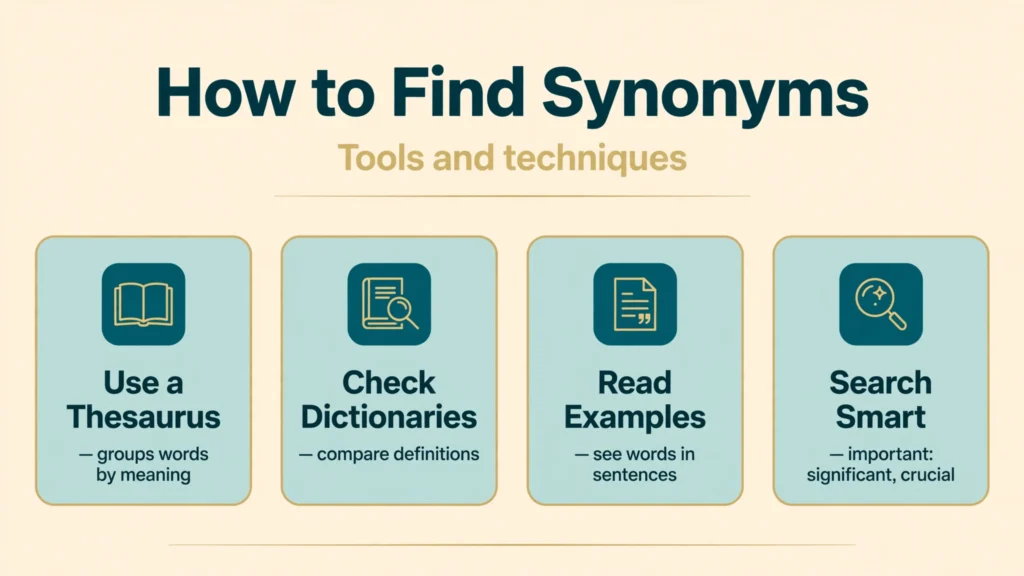
You can find synonyms by consulting a thesaurus, checking dictionary definitions, comparing example sentences, or searching for alternatives that fit a particular context.
A good search process is more useful than collecting the largest possible list.
Use an Online Synonym Dictionary or Thesaurus
A thesaurus is a reference tool that groups words by meaning and relationship. It helps you discover alternative expressions when you know what you want to communicate but need a different word.
For example, searching for important may produce alternatives such as:
- Significant
- Essential
- Crucial
- Major
- Meaningful
- Valuable
These results provide useful starting points. However, they don’t all express the same shade of meaning.
Essential emphasizes necessity, significant suggests importance or meaningful impact, and valuable emphasizes worth or usefulness.
A dictionary serves a different but complementary purpose. It helps you check a word’s definition, grammatical category, usage labels, and sometimes example sentences.
The most reliable approach is to use a thesaurus to discover alternatives and a dictionary to verify them.
Search for Synonyms by Meaning and Context
Searching for an isolated word may produce alternatives that don’t suit your intended meaning.
Instead, identify the sense you need.
For example, searching for light could produce words connected with illumination, color, weight, or food.
More specific searches may help:
- Synonyms for light meaning not heavy
- Synonyms for light meaning bright
- Synonyms for light meaning a small meal
- Synonyms for light meaning pale in color
The added context narrows the results and helps you find more relevant choices.
You can also search for alternatives within a sentence. If you’re revising a business report, a synonym that fits professional writing may be more useful than a slang expression.
The key is to search for the meaning you need rather than accepting every suggested alternative.
Use a Synonym Finder Without Losing Accuracy
Synonym finders can save time, especially when you’re editing a long article or trying to reduce repeated words.
However, automated suggestions can’t always determine your intended tone or the precise meaning of a sentence.
Use a simple process:
- Enter the original word.
- Review the suggested alternatives.
- Identify the alternatives that match your intended meaning.
- Check the definition of an unfamiliar word.
- Test the replacement in the original sentence.
- Keep the change only if it improves clarity, precision, or flow.
For example, a tool might suggest commence as an alternative to start. That choice works well for a formal ceremony, but it may sound stiff in a casual message.
A synonym finder expands your options. Your understanding of the context determines which option belongs in the final sentence.
Benefits of Using Synonyms in Writing and Communication
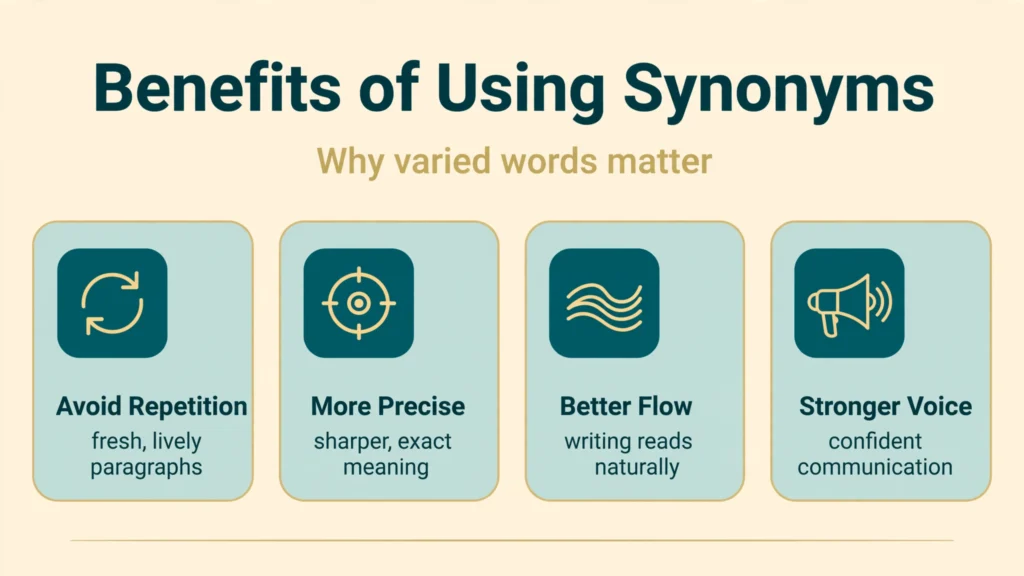
Synonyms are useful because they give you more control over language. When you understand how alternatives differ, you can communicate the same general idea with greater variety and precision.
Avoid Repeating the Same Words
Repeated words can make a paragraph feel dull or difficult to read. Synonyms offer ways to vary the wording when the alternatives preserve the original meaning.
Consider this example:
The project was difficult. The difficult project took several months. The difficult work required a difficult decision.
The repetition makes the paragraph sound awkward.
A revised version might read:
The project was challenging and took several months. The demanding work eventually required a tough decision.
The second version uses related words to create variety.
However, repetition isn’t always a problem. Repeating a key term can improve clarity when a topic requires precise language.
For example, a technical guide may need to use the same term consistently to avoid confusing readers. Synonyms should improve the text, not create unnecessary variation.
Improve Clarity and Precision
General words can communicate basic ideas, but specific alternatives may explain them more clearly.
Consider the sentence:
The situation changed.
The sentence tells us that something happened, but it doesn’t explain the change.
Depending on the facts, you might write:
- The situation improved.
- The situation deteriorated.
- The situation shifted.
- The situation stabilized.
These alternatives express different outcomes.
Using a precise synonym helps readers understand the nature of the change. It also reduces the need for extra explanations.
Nevertheless, precision requires accuracy. If the situation didn’t necessarily improve, replacing changed with improved would introduce a misleading claim.
Choose the more specific word only when the evidence supports it.
Expand English Vocabulary
Learning synonyms gives you a deeper understanding of English vocabulary. It helps you recognize shades of meaning and understand how different words function.
For example, studying look, glance, stare, gaze, and glimpse teaches you more than five alternative words.
It also reveals differences in the type, duration, or nature of looking.
- Look: Direct your eyes toward something.
- Glance: Look quickly.
- Stare: Look steadily for a period.
- Gaze: Look steadily, often with interest or admiration.
- Glimpse: See something briefly or partially.
These distinctions can help you understand books, write descriptions, and communicate ideas more accurately.
A practical way to learn synonyms is to study them in groups. Compare their definitions, write example sentences, and note which situations suit each word.
Adapt Language to Different Audiences
The same message can require different wording depending on who will read it.
A casual conversation with a friend doesn’t need the same language as a formal business report. An educational article may require direct, accessible wording, while a technical report may need precise terminology.
For example:
- Casual: We need to fix the problem.
- Professional: We need to resolve the issue.
- Technical: We need to correct the identified fault.
Each sentence describes addressing something that isn’t working as intended. Yet the vocabulary reflects a different context.
Synonyms help you adjust your communication without losing the essential message.
This skill is especially valuable in professional writing, where word choice affects clarity, tone, and credibility.
Common Mistakes When Using Synonyms
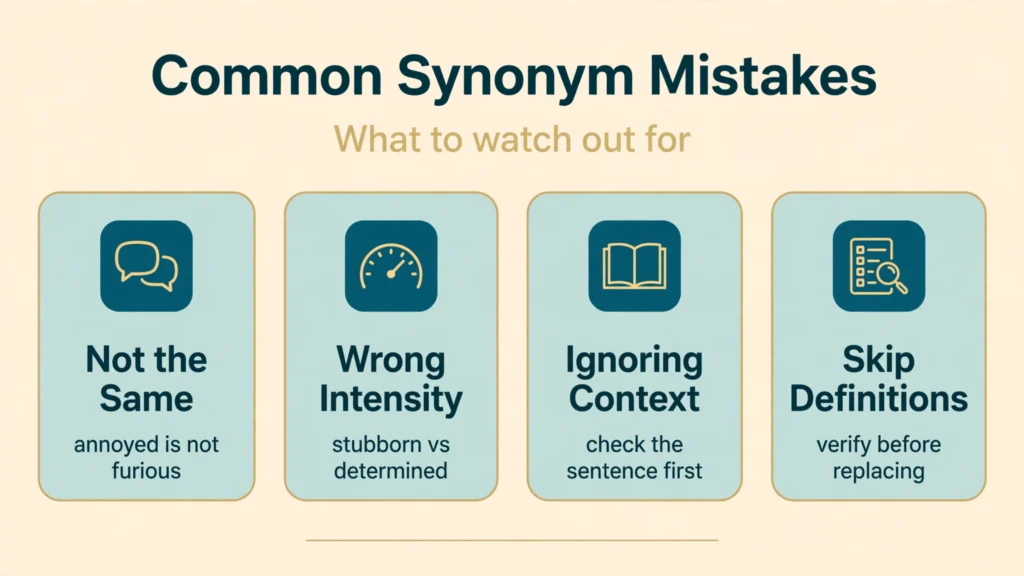
Choosing alternatives carelessly can introduce confusion, awkward phrasing, or unintended meanings. Watch for these common mistakes when editing your work.
Assuming All Synonyms Are Interchangeable
This is one of the most common errors.
Words such as angry, furious, annoyed, and irritated describe related feelings. However, they differ in intensity and usage.
Replacing annoyed with furious can exaggerate someone’s emotional response. Similarly, describing a person as stubborn instead of determined may change a positive description into a negative one.
What to do: Compare definitions and check the emotional or practical meaning of the alternative before using it.
Ignoring Grammar and Word Combinations
A synonym may have the right general meaning but fail to fit the sentence grammatically.
For example:
- Natural: She made a decision.
- Natural: She decided.
These sentences express a similar idea using a noun and a verb. You can’t simply replace decision with decided without adjusting the structure.
Collocations matter, too. English speakers generally say strong coffee rather than powerful coffee. Although both adjectives can describe strength in other contexts, the first combination is more natural.
What to do: Check the whole sentence, not just the word you want to replace.
Choosing Complicated Words Unnecessarily
Longer or less familiar words don’t automatically improve your writing.
Compare these sentences:
- Simple: We used the information.
- Wordier: We utilized the information.
Both can be correct, but used is usually clearer and more direct.
Similarly, help often communicates the same practical idea as facilitate without adding complexity.
Use a more formal synonym when it improves precision or fits the audience. Otherwise, choose the simpler option.
Good writing makes ideas easy to understand. It doesn’t force readers to work through unnecessary vocabulary.
Replacing Words Without Checking Context
A synonym that works in one situation may not work in another.
For example, bright can mean well-lit, vivid, intelligent, or promising.
Replacing it with intelligent works when describing a capable student. It fails when describing a room full of sunlight.
The same problem occurs with words such as sharp, light, fine, and fair. Their meanings vary according to context.
What to do: Identify the intended sense first. Then choose an alternative that matches that meaning.
Using Synonyms Just to Avoid Repetition
Variety is useful, but excessive variation can confuse readers.
Imagine an article that uses client, customer, buyer, consumer, and purchaser interchangeably. These terms overlap, but they can refer to different relationships and activities.
A client often receives professional services, while a customer buys goods or services. A buyer specifically emphasizes purchasing, and consumer often describes someone who uses goods or services.
Changing the term in every sentence may make a consistent subject appear to change.
Keep important terminology consistent when distinctions matter. Use alternatives when they improve readability without weakening precision.
Frequently Asked Questions
What Is a Synonym?
A synonym is a word or expression with the same or a similar meaning as another word or expression. For example, begin and start are synonyms in many contexts.
What Is the Difference Between a Synonym and Synonyms?
Synonym is the singular form, referring to one word relationship. Synonyms is the plural form, referring to multiple words or expressions with similar meanings.
What Are Five Examples of Synonyms?
Five common examples are happy and joyful, big and large, quick and fast, begin and start, and help and assist. Their interchangeability depends on context.
Are Synonyms and Similar Words the Same Thing?
Not always. Synonyms share the same or a similar meaning, while similar words may be connected by topic, association, or some other relationship.
How Can I Find Synonyms for Any Word?
Use a thesaurus to discover alternatives, then check their definitions and example sentences. Choose a replacement that matches your intended meaning and fits the context.
What Is the Difference Between Synonyms and Antonyms?
Synonyms have the same or similar meanings, while antonyms express opposite meanings. For example, happy and joyful are synonyms, whereas happy and sad are antonyms.
Can Two Synonyms Be Used Interchangeably in Every Sentence?
No. Synonyms can differ in meaning, intensity, formality, grammar, and common usage. Always check the context before replacing one word with another.
Why Are Synonyms Important in Writing?
Synonyms help writers reduce unnecessary repetition, express ideas more precisely, adjust tone, and develop vocabulary. The best results come from choosing alternatives that preserve the intended meaning.
What Is the Difference Between a Thesaurus and a Dictionary?
A thesaurus helps you find synonyms and related words. A dictionary focuses on definitions and may also provide pronunciation, grammatical information, usage labels, and examples.
What Are Near-Synonyms?
Near-synonyms are words with closely related meanings that aren’t identical in every situation. For example, annoyed, angry, and furious describe related emotions but differ in intensity.
Final Thoughts on Synonyms
Synonyms give you more ways to communicate ideas clearly and naturally. They help you discover alternative words, expand your English vocabulary, and adjust your writing to different audiences.
A useful synonyms list is only the starting point. The real skill lies in understanding how words differ and recognizing which alternative fits a particular sentence.
When choosing synonyms, consider meaning, context, tone, grammar, and common usage. Compare definitions when necessary and test each replacement before using it.
Remember one simple rule: the best synonym isn’t necessarily the most impressive word. It’s the word that communicates your intended meaning most accurately.