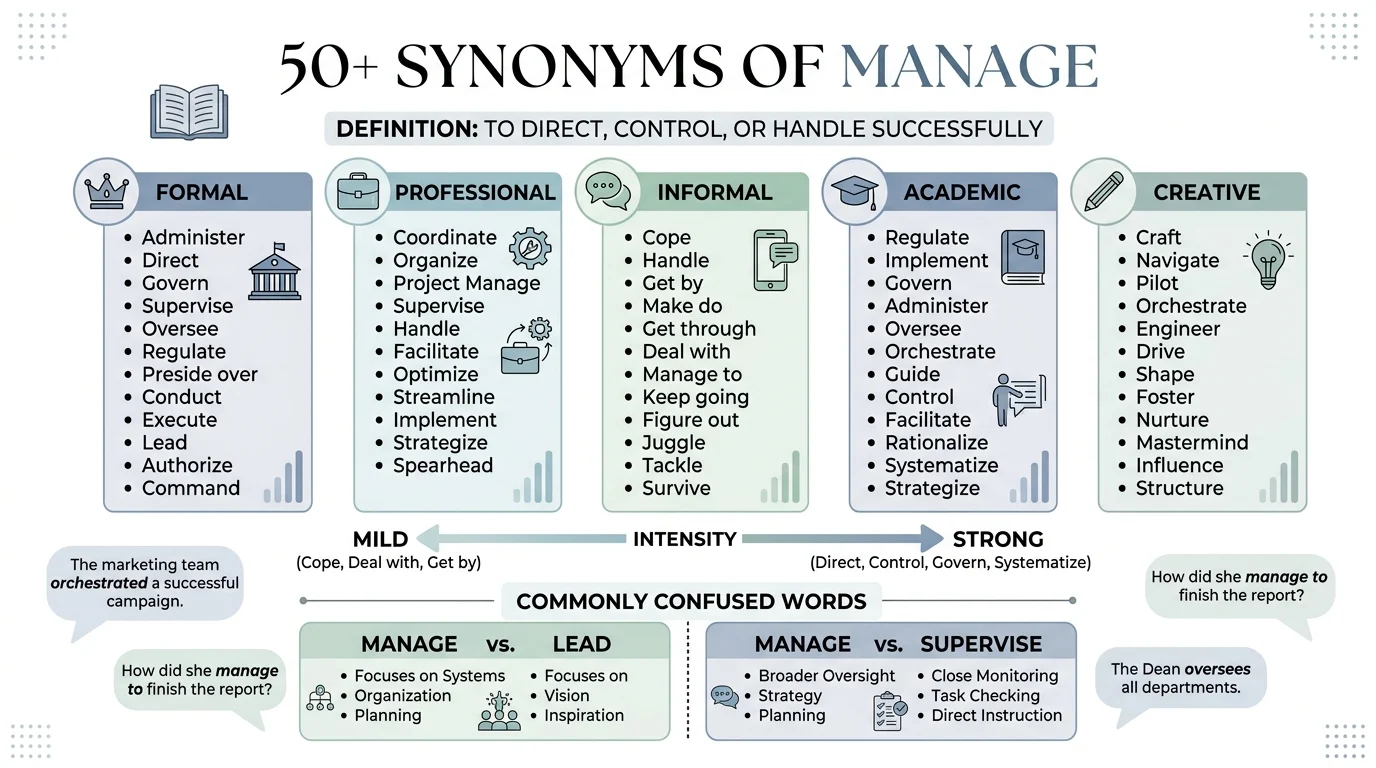
Have you ever re-read an email, essay, or social media caption and realized you used the word “manage” three times in two sentences? It happens to everyone. You are writing about handling a project, overseeing a team, or controlling a budget, and the same word keeps appearing. This repetition makes your writing feel flat and uninspired.
Finding the right synonyms of manage can transform your communication. The right word adds precision, adjusts your tone, and makes your message more compelling. Whether you are writing a resume, an academic paper, or a casual text, choosing the best synonym helps you say exactly what you mean.
Quick Answer: What Are the Best Synonyms of “Manage”?
To manage means to handle, control, or direct something with skill. The best synonym depends on your context.Professional writing, use “administer” or “oversee.” Casual conversation, use “handle” or “run.” For academic work, use “supervise” or “coordinate.” For emotional situations, use “navigate” or “steer.” Choose based on your audience and purpose.
Meaning, Tone, and Context
Simple Definition
To manage means to be in charge of something, to handle it skillfully, or to succeed in doing something despite difficulties. The word covers a wide range of activities, from running a business to controlling your time.
Part of Speech
Manage is primarily a verb. Its related forms include manager (noun), management (noun), and manageable (adjective).
Overall Tone
Manage is neutral. It does not carry a strong positive or negative emotional charge. This neutrality makes it useful in many situations, but it also means the word can feel bland or generic when you need more impact.
Formality Level
Manage is semi-formal. You can use it in professional emails, workplace conversations, and everyday speech. However, in very formal writing like academic papers or legal documents, more precise synonyms often work better.
Common Uses
Native English speakers use manage in three main ways:
- To control or direct: managing a team, a project, or a business
- To handle skillfully: managing time, money, or resources
- To cope or succeed: managing to finish a task or get by with limited resources
Word Forms
- Noun: management, manager
- Verb: manage, manages, managed, managing
- Adjective: manageable, managerial
- Adverb: manageably
When and How to Use “Manage”
Choose “manage” when you need a general, neutral word that works across many contexts. It is safe, clear, and widely understood. However, for more specific situations, a synonym often communicates more effectively.
Here are seven realistic examples showing how to use “manage” in different contexts.
Professional
She manages a team of twelve software engineers at the Chicago office.
Academic
The study examined how teachers manage disruptive behavior in middle school classrooms.
Workplace
Our department needs to manage the budget more carefully this quarter.
Personal
I am learning to manage my stress through daily meditation and exercise.
Can you manage the client presentation while I handle the contract negotiations?
Resume
Managed a $500,000 annual budget and reduced operating costs by 12 percent.
Trying to manage work, family, and fitness all in one day is a challenge.
Best Synonyms of “Manage”
No synonym is identical in every situation. The best choice depends on your audience, tone, and purpose. Here are the top recommendations for specific contexts.
Professional writing: Use administer. It sounds authoritative and suggests formal oversight of systems, policies, or organizations.
Academic writing: Use supervise. It implies careful oversight and guidance, which fits research and educational settings.
Business communication: Use direct. It conveys leadership and clear decision-making authority.
Casual conversation: Use handle. It is natural, approachable, and widely used in everyday speech.
Emotional writing: Use navigate. It suggests moving through challenges with care and awareness.
Creative writing: Use steer or pilot. These words add imagery and suggest active guidance.
Resume writing: Use oversee. It highlights leadership and responsibility without sounding arrogant.
Workplace communication: Use coordinate. It emphasizes organization and teamwork.
Stronger meaning: Use command. It suggests authority and control.
Softer meaning: Use conduct. It implies carrying out activities with professionalism and care.
When Not to Use “Manage”
Knowing when to avoid “manage” is just as important as knowing when to use it.
When the word sounds too general
Using “manage” for every situation makes your writing vague. If you are describing specific actions, choose a more precise word.
Vague: I managed the event.
Better: I coordinated the event logistics and supervised the volunteer staff.
When the word sounds too vague on a resume
Employers want to see concrete achievements, not generic responsibilities.
Vague: Managed social media accounts.
Better: Oversaw social media strategy and grew followers by 40 percent in six months.
When the word feels too informal for academic writing
In research papers, “manage” can seem casual. Use more formal alternatives.
Informal: The experiment managed the variables effectively.
Better: The experiment controlled the variables effectively.
When the word is too weak for leadership roles
If you are describing executive-level responsibility, “manage” may understate your authority.
Weak: Managed the regional sales team.
Better: Directed the regional sales team and drove a 25 percent revenue increase.
When the word sounds too strong for collaborative situations
In team settings, “manage” can imply top-down control. Choose a more collaborative word.
Too strong: I managed the project team.
Better: I coordinated with the project team to meet our deadlines.
Words Commonly Confused With “Manage”
Several words overlap with “manage” but have distinct meanings. Understanding these differences helps you choose the right word.
Vs Administer
- Difference: Manage implies hands-on handling and day-to-day control. Administer suggests formal implementation of policies, rules, or systems.
- When to use manage: When you are directly handling operations. Example: She manages the store’s daily operations.
- When to use administer: When you are carrying out established procedures. Example: He administers the employee benefits program.
Direct
- Difference: Direct implies giving guidance and instructions to achieve smooth operation. Manage suggests broader handling and maneuvering toward a result.
- When to use manage: When you are overseeing all aspects. Example: He manages the entire production process.
- When to use direct: When you are providing clear guidance. Example: She directs the actors during rehearsals.
Vs Supervise
- Difference: Supervise focuses on watching over and guiding people or activities. Manage covers a wider range of responsibilities including planning, budgeting, and strategy.
- When to use manage: When you have overall responsibility. Example: She manages the marketing department.
- When to use supervise: When your main role is oversight. Example: He supervises the evening shift workers.
Manage vs Control
- Difference: Control implies regulation, restraint, or keeping within bounds. Manage suggests skillful handling toward a desired outcome.
- When to use manage: When you are guiding a process. Example: She manages the project timeline carefully.
- When to use control: When you are regulating or restraining. Example: He controls his spending habits.
Vs Handle
- Difference: Handle often refers to dealing with specific tasks, problems, or situations. Manage implies broader, ongoing responsibility.
- When to use manage: When you have ongoing responsibility. Example: She manages the company’s finances.
- When to use handle: When you are dealing with a specific issue. Example: He handled the customer complaint professionally.
Manage vs Run
- Difference: Run suggests operating something day-to-day, often a business or organization. Manage can be more strategic and broader in scope.
- When to use manage: When you oversee all aspects including strategy. Example: She manages the nonprofit organization.
- When to use run: When you operate daily activities. Example: He runs the family bakery.
Best Synonyms of “Manage” by Context
| Context | Best Synonym | Why It Works | Example |
|---|---|---|---|
| Formal writing | Administer | Sounds authoritative and precise | The committee will administer the new policies. |
| Academic writing | Supervise | Implies careful oversight and guidance | The professor supervised the graduate research projects. |
| Professional communication | Direct | Conveys clear leadership authority | She directs the company’s strategic initiatives. |
| Business emails | Coordinate | Emphasizes organization and teamwork | Please coordinate the meeting logistics with the client. |
| Resume writing | Oversee | Highlights responsibility without arrogance | Oversaw a team of twenty sales representatives. |
| Workplace communication | Conduct | Suggests professional execution of duties | He conducted the performance reviews last week. |
| Casual conversation | Handle | Natural and approachable | I can handle the dinner arrangements. |
| Everyday speaking | Run | Simple and widely understood | Who runs this place anyway? |
| Creative writing | Steer | Adds imagery and direction | She steered the conversation toward a productive topic. |
| Storytelling | Pilot | Suggests active guidance through challenges | He piloted the project through multiple obstacles. |
| Emotional writing | Navigate | Implies moving through difficulties with care | They navigated the difficult transition together. |
| Strong emphasis | Command | Suggests authority and control | He commands respect from everyone on the team. |
| Mild tone | Conduct | Professional and measured | She conducted the meeting with grace. |
| Social media captions | Juggle | Relatable and conversational | Juggling work, family, and fitness is my daily reality. |
How to Choose the Best Synonym of “Manage”
Choosing the right synonym requires considering several factors.
Consider your meaning: Are you overseeing people, handling a task, or coping with a challenge? Each situation calls for a different word. People, use “supervise” or “direct.” For tasks, use “handle” or “coordinate.” For challenges, use “cope” or “navigate.”
Consider your tone: Formal writing demands precise, authoritative words like “administer” or “direct.” Casual conversation welcomes approachable words like “handle” or “run.”
Consider your audience: A resume reader wants to see “oversee” or “coordinate.” A friend wants to hear “handle” or “juggle.” An academic reader expects “supervise” or “conduct.”
Consider emotional strength: Words like “command” and “control” feel strong and authoritative. Words like “conduct” and “coordinate” feel measured and collaborative. Choose the intensity that matches your message.
Consider naturalness: The best synonym sounds natural in your sentence. Read your sentence aloud. If it feels forced or awkward, try a different word.
Real Life Examples of “Manage”
Here are realistic examples showing how to replace “manage” with stronger synonyms in different situations.
School
The student council president managed the homecoming dance planning.
Improved: The student council president coordinated the homecoming dance planning.
College
She managed her time effectively during finals week.
Improved: She balanced her time effectively during finals week.
Workplace
He manages the customer service department.
Improved: He oversees the customer service department.
Business
The CEO manages the company’s expansion strategy.
Improved: The CEO directs the company’s expansion strategy.
I will manage the project updates.
Improved: I will handle the project updates.
Resume
Managed a team of fifteen employees.
Improved: Supervised a team of fifteen employees.
Conversation
How do you manage everything on your plate?
Improved: How do you juggle everything on your plate?
Storytelling
She managed the chaotic situation with calm.
Improved: She navigated the chaotic situation with calm.
Blogging
Here is how to manage your finances better.
Improved: Here is how to handle your finances better.
Managing adulthood is harder than it looks.
Improved: Navigating adulthood is harder than it looks.
18 Best Synonyms of “Manage”
| Synonym | Simple Meaning | Best Used For | Example Sentence |
|---|---|---|---|
| Administer | To implement and oversee formally | Formal reports, policy implementation | The board will administer the new compliance procedures. |
| Oversee | To watch over and guide | Leadership roles, supervision | She oversees the quality control department. |
| Supervise | To direct and watch over activities | Academic, workplace oversight | He supervises the laboratory assistants. |
| Direct | To guide with clear authority | Business leadership, strategy | She directs the company’s marketing efforts. |
| Coordinate | To organize different elements | Teamwork, project management | He coordinated the event logistics perfectly. |
| Handle | To deal with effectively | Everyday tasks, problem-solving | She handled the customer complaint professionally. |
| Run | To operate day-to-day | Business operations, organizations | He runs a successful consulting firm. |
| Conduct | To carry out professionally | Meetings, experiments, business | She conducted the training session for new hires. |
| Govern | To exercise authority over | Large organizations, policy | The committee governs the university’s academic standards. |
| Command | To have authority and control | Military, strong leadership | He commands the entire Eastern division. |
| Steer | To guide in a direction | Creative writing, direction | She steered the project toward completion. |
| Navigate | To move through challenges | Emotional situations, difficult times | They navigated the economic downturn successfully. |
| Pilot | To guide through a process | Creative writing, project leadership | He piloted the initiative through regulatory hurdles. |
| Regulate | To control according to rules | Systems, processes, behavior | The agency regulates the financial industry. |
| Control | To exercise restraint or direction | Emotions, systems, resources | She controls the department’s spending. |
| Organize | To arrange systematically | Events, information, tasks | He organized the annual conference schedule. |
| Orchestrate | To arrange and coordinate skillfully | Creative, complex projects | She orchestrated a successful product launch. |
| Juggle | To handle multiple things at once | Casual, everyday situations | He juggles work, school, and family commitments. |
Synonyms of “Manage” by Usage
Professional vs Personal Synonyms
In professional settings, choose words that convey competence and authority. Oversee, direct, and administer sound impressive on resumes and in meetings. In personal conversations, choose approachable words like handle, run, or juggle. These words feel natural and relatable.
Formal vs Conversational Synonyms
Formal writing such as reports, essays, and business presentations benefits from words like administer, supervise, and conduct. These words sound authoritative and precise. Casual conversations, texting, and social media posts welcome words like handle, run, and juggle. These words are simple and widely understood.
Academic Synonyms
In research, essays, and academic discussions, choose words that sound precise and authoritative. Supervise implies careful guidance of research activities. Conduct suggests carrying out experiments or studies professionally. Administer works well for implementing research protocols. These words add credibility to academic writing.
Professional and Business Synonyms
Resumes, interviews, meetings, and client communication demand strong, confident language. Oversee highlights leadership without arrogance. Direct conveys clear authority. Coordinate emphasizes organizational skills. Administer suggests formal responsibility. These words make you sound capable and professional.
Creative and Literary Synonyms
Storytelling, fiction, and descriptive writing benefit from expressive alternatives. Steer adds imagery of guidance. Navigate suggests moving through challenges. Pilot implies skilled direction. Orchestrate suggests arranging elements skillfully. These words add emotion and visual appeal to your writing.
Slang or Modern Synonyms
While “manage” does not have widely recognized slang equivalents, juggle has become popular in casual conversation to describe handling multiple responsibilities. It is acceptable in social media, texting, and everyday speech. Avoid using it in formal or professional writing.
Strongest to Mildest Synonyms
Mild: handle, run, coordinate
Moderate: oversee, supervise, conduct
Strong: direct, administer, govern
Very Strong: command, control
The emotional intensity increases as you move from mild to very strong. Choose the level that matches your message and audience.
Emotional vs Neutral Synonyms
Emotional Synonyms: Navigate, steer, and orchestrate carry emotional weight. They suggest care, intention, and skill in challenging situations. Use these when you want to convey effort, resilience, or artistry.
Neutral Synonyms: Administer, supervise, and coordinate simply communicate information without adding emotion. Use these when you need to be factual, objective, or professional.
Antonyms of “Manage”
| Antonym | Meaning | Example Sentence |
|---|---|---|
| Fail | To not succeed | He failed to complete the project on time. |
| Mismanage | To handle poorly | She mismanaged the department’s budget. |
| Neglect | To fail to care for | He neglected his responsibilities at work. |
| Mishandle | To deal with incompetently | They mishandled the customer complaint. |
| Bungle | To carry out clumsily | She bungled the presentation. |
| Botch | To perform badly | He botched the repair job. |
| Abandon | To give up completely | They abandoned the project midway. |
| Surrender | To give up control | She surrendered her leadership role. |
| Ignore | To pay no attention to | He ignored the warning signs. |
| Overlook | To fail to notice | She overlooked the important detail. |
| Forsake | To abandon | He forsook his duties. |
| Abdicate | To renounce authority | The CEO abdicated his decision-making power. |
| Flounder | To struggle without progress | The team floundered without clear direction. |
| Blunder | To make a serious mistake | She blundered through the negotiation. |
| Derelict | To be neglectful of duty | He was derelict in his managerial responsibilities. |
Comparison: “Manage” vs Similar Words
Manage vs Administer
Main Difference: Manage implies hands-on handling and day-to-day control. Administer suggests formal implementation of policies and systems.
Which Is Stronger?: Administer feels more formal and authoritative in institutional contexts.
Which Is More Formal?: Administer is more formal.
When to Use Each: Use manage for daily operations. Use administer for formal policy implementation.
Examples:
- Manage: She manages the store’s daily operations.
- Administer: He administers the employee benefits program.
Manage vs Direct
Main Difference: Direct implies giving guidance and instructions. Manage suggests broader handling and maneuvering.
Which Is Stronger?: Direct often feels more authoritative because it implies clear leadership.
Which Is More Formal?: Direct is slightly more formal than manage.
When to Use Each: Use manage for overall responsibility. Use direct when you are providing specific guidance.
Examples:
- Manage: She manages the entire production department.
- Direct: He directs the actors during rehearsals.
Manage vs Supervise
Main Difference: Supervise focuses on watching over and guiding. Manage covers wider responsibilities like planning and budgeting.
Which Is Stronger?: Supervise implies direct oversight. Manage implies broader authority.
Which Is More Formal?: Supervise is commonly used in academic and professional contexts.
When to Use Each: Use manage for overall responsibility. Use supervise when your main role is oversight.
Examples:
- Manage: She manages the marketing department.
- Supervise: He supervises the evening shift workers.
Manage vs Control
Main Difference: Control implies regulation or restraint. Manage suggests skillful handling.
Which Is Stronger?: Control feels stronger and more forceful.
Which Is More Formal?: Both are used in formal and informal contexts.
When to Use Each: Use manage for guiding a process. Use control for regulating or restraining.
Examples:
- Manage: She manages the project timeline.
- Control: He controls his spending habits.
Manage vs Handle
Main Difference: Handle often refers to specific tasks or problems. Manage implies broader, ongoing responsibility.
Which Is Stronger?: Manage implies greater scope and authority.
Which Is More Formal?: Manage is more formal. Handle is more casual.
When to Use Each: Use manage for ongoing responsibility. Use handle for specific issues.
Examples:
- Manage: She manages the company’s finances.
- Handle: He handled the customer complaint.
Manage vs Run
Main Difference: Run suggests operating something day-to-day. Manage can be more strategic.
Which Is Stronger?: Manage often implies broader strategic responsibility.
Which Is More Formal?: Manage is more formal. Run is more casual.
When to Use Each: Use manage for strategic oversight. Use run for daily operations.
Examples:
- Manage: She manages the nonprofit organization.
- Run: He runs the family bakery.
Common Phrases and Expressions with “Manage”
Manage to
- Meaning: To succeed in doing something despite difficulty.
- Example: She managed to finish the report before the deadline.
Manage without
- Meaning: To cope or function in the absence of something.
- Example: I don’t know how we managed without internet for a week.
Expectations
- Meaning: To control what people expect from a situation.
- Example: The manager carefully managed expectations about the project timeline.
A budget
- Meaning: To control and allocate financial resources.
- Example: She managed the department’s budget efficiently.
Manage stress
Manage time
A team
- Meaning: To lead and coordinate a group of people.
- Example: He managed a team of fifteen software developers.
Common Mistakes to Avoid
1: Choosing a vague synonym
Using a vague synonym weakens your message.
Incorrect: I managed the project successfully.
Better: I coordinated the project and delivered it ahead of schedule.
Why: The improved version specifies what you actually did.
2: Confusing “manage” with “control”
These words are not interchangeable in every situation.
Incorrect: She controlled the meeting professionally.
Better: She conducted the meeting professionally.
Why: “Conducted” suggests facilitation. “Controlled” sounds overly forceful.
3: Using informal synonyms in formal writing
Casual words can undermine your credibility.
Incorrect: The experiment handled the variables effectively.
Better: The experiment controlled the variables effectively.
Why: “Controlled” sounds more precise and academic.
4: Selecting an overly dramatic synonym
Strong words can sound exaggerated in everyday contexts.
Incorrect: I commanded the dinner preparations.
Better: I handled the dinner preparations.
Why: “Commanded” sounds excessive for a casual task.
5: Repeating the same word too often
Repetition makes writing dull.
Incorrect: She manages the team. She manages the budget. She manages the schedule.
Better: She leads the team. She oversees the budget. She coordinates the schedule.
Why: Variety keeps writing engaging and precise.
6: Using a synonym with the wrong emotional tone
Choose words that match the emotional context.
Incorrect: He navigated the weekly staff meeting.
Better: He conducted the weekly staff meeting.
Why: “Navigated” suggests difficulty. “Conducted” is neutral and professional.
7: Using slang in professional writing
Avoid casual language in formal contexts.
Incorrect: She juggles the company’s finances.
Better: She manages the company’s finances.
Why: “Juggles” sounds casual. “Manages” sounds professional.
Frequently Asked Questions
1. What are the best synonyms of “manage”?
The best synonyms depend on your context. Professional writing, use “administer” or “oversee.” For casual conversation, use “handle” or “run.” For academic work, use “supervise” or “conduct.”
2. What are the best formal synonyms of “manage”?
The best formal synonyms include “administer,” “direct,” “supervise,” and “conduct.” These words sound authoritative and precise, making them suitable for reports, academic papers, and business communication.
3. What are common informal synonyms of “manage”?
Common informal synonyms include “handle,” “run,” and “juggle.” These words are natural and approachable, perfect for everyday conversations, texting, and social media posts.
4. What is another word for “manage” in professional writing?
In professional writing, use “oversee,” “direct,” or “administer.” These words convey leadership and responsibility. For example, “oversaw a team of twenty employees” sounds stronger than “managed a team.”
5. What is the difference between “manage” and “supervise”?
Manage implies broader responsibility including planning, budgeting, and strategy. Supervise focuses specifically on watching over and guiding people or activities. Use “manage” for overall authority and “supervise” for direct oversight.
6. What is the opposite of “manage”?
The main opposites of “manage” include “fail,” “mismanage,” “neglect,” and “mishandle.” These words describe situations where someone does not successfully handle, control, or direct something.
Conclusion
The word “manage” is useful and versatile, but it is not always the best choice. Understanding its meaning and knowing when to choose a synonym improves your writing significantly. The best synonym depends on your audience, tone, and purpose. Professional settings, choose “administer” or “oversee.” For casual conversations, choose “handle” or “run.” For academic writing, choose “supervise” or “conduct.” No synonym works perfectly in every situation, so always consider your context. The next time you write an email, essay, or social media post, pause before using “manage.” Ask yourself if a more precise word would communicate your message more clearly. This small habit will make your writing stronger and more engaging.