Have you ever found yourself writing an email, an essay, or a social media caption and realized you have used the word “despite” three times in two paragraphs? You know the meaning is right, but the repetition makes your writing feel stale and uninspired. Whether you are drafting a cover letter, composing a blog post, or working on a school assignment, leaning too heavily on one word weakens your message.
That is exactly why you need a strong command of the synonyms of despite. Choosing the right alternative does more than just eliminate repetition. It sharpens your tone, clarifies your meaning, and makes your communication more professional and engaging. The word “despite” itself is a useful preposition that shows contrast, but overusing it can make your writing feel mechanical. This guide will help you understand what “despite” really means, explore the best synonyms for every context, and teach you how to choose the perfect word every time.
What Are the Best Synonyms of “Despite”?
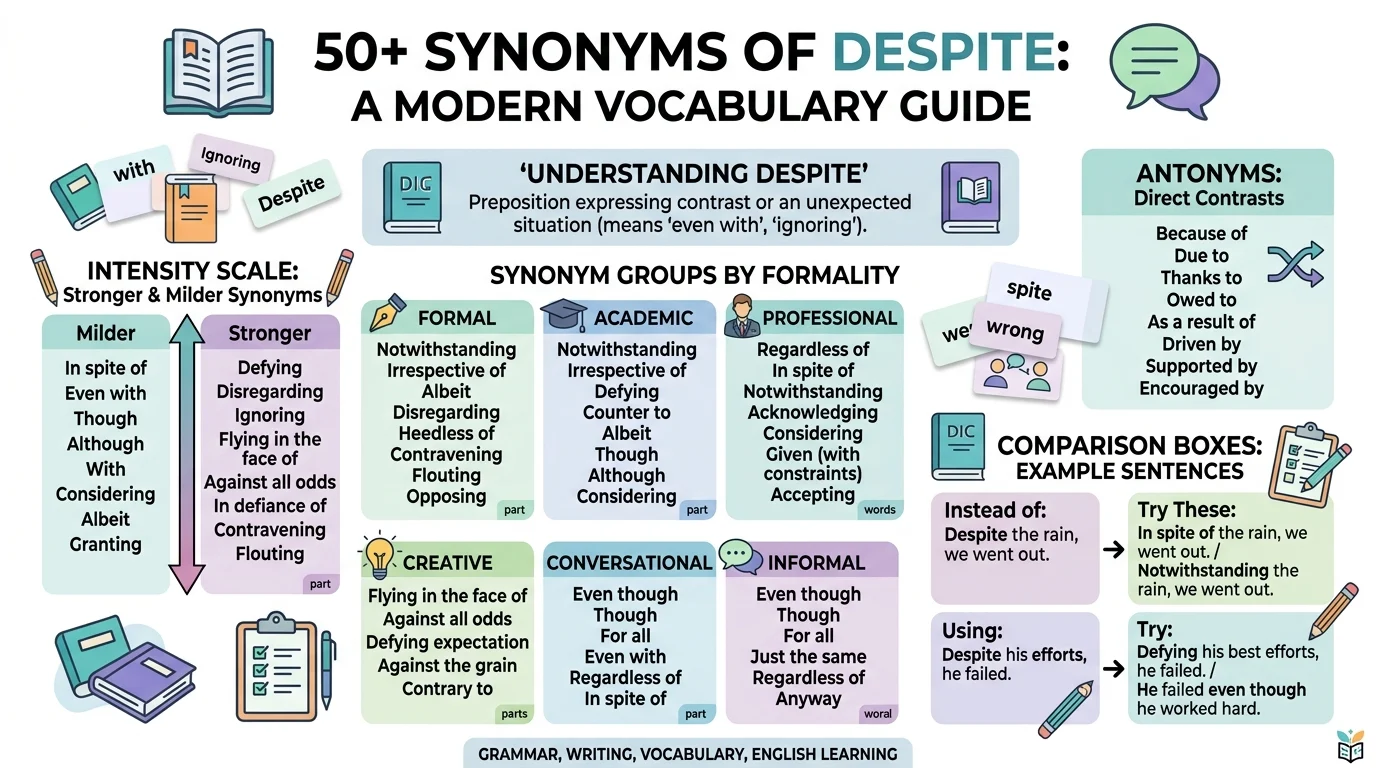
“Despite” means without being influenced or prevented by something. It expresses contrast between two ideas. The best synonyms include “in spite of” for everyday use, “notwithstanding” for formal writing, “regardless of” for professional contexts, and “even though” when you need a conjunction. Choose based on your audience and purpose.
Meaning, Tone, and Context
Simple Definition
“Despite” is a preposition that means without being affected or prevented by something. It shows that one fact does not stop another fact from being true.
Part of Speech
Preposition
Overall Tone
Neutral. The word itself does not carry strong positive or negative emotional weight. It simply presents a factual contrast.
Formality Level
Semi-formal to formal. “Despite” is appropriate in most professional and academic settings. It is slightly more formal than its closest equivalent, “in spite of.”
Common Uses
Native English speakers use “despite” frequently in both writing and speech. You will encounter it in news articles, academic papers, business reports, professional emails, and everyday conversation. It appears when someone wants to highlight that an outcome occurred even though an obstacle or opposing factor existed.
Word Forms
- Preposition: despite (primary form)
- Noun: despite (archaic, meaning contempt or malice; rarely used in modern English)
When and How to Use “Despite”
Use “despite” when you want to show that something happened or is true even though another factor might have prevented it. The structure is simple: “despite” + noun, pronoun, or gerund (the -ing form of a verb). You cannot follow “despite” with a full clause that has a subject and a conjugated verb. For that, you need a conjunction like “although” or “even though.”
Here are seven realistic examples showing “despite” in different contexts.
Professional:
Despite the tight deadline, the team delivered the project on time.
Academic:
Despite conflicting evidence, the researcher maintained her original hypothesis.
Workplace:
Despite several rounds of feedback, the proposal still contained major errors.
Personal:
Despite his busy schedule, he always finds time for his family.
Email:
Despite our best efforts, we were unable to resolve the issue before the weekend.
Resume:
Despite having no formal management training, I successfully led a team of twelve.
Social Media:
Despite the gloomy forecast, we had an amazing day at the beach.
Best Synonyms of “Despite”
No synonym is identical to “despite” in every situation. Each alternative carries its own tone, formality level, and grammatical behavior. Here are the best recommendations for specific contexts.
Professional writing: “Notwithstanding” works well in legal documents, contracts, and formal reports. It sounds authoritative and precise.
Academic writing: “In spite of” is widely accepted in academic papers and essays. It is interchangeable with “despite” but feels slightly more deliberate.
Business communication: “Regardless of” emphasizes that something applies without exception, making it ideal for policies and instructions.
Casual conversation: “Even with” sounds natural in everyday speech and informal writing.
Emotional writing: “In defiance of” adds a sense of rebellion or determination against opposition.
Creative writing: “In the face of” creates vivid imagery and suggests active resistance.
Resume writing: “Notwithstanding” or “regardless of” demonstrate strong vocabulary skills and professional polish.
Workplace communication: “In spite of” is clear and widely understood by all colleagues.
Stronger meaning: “In defiance of” or “in the teeth of” convey active opposition.
Softer meaning: “Even with” or “for all” sound milder and less confrontational.
When Not to Use “Despite”
There are situations where “despite” is not the best choice. Knowing when to avoid it will make your writing stronger.
When the word sounds too vague: “Despite” can feel weak if you do not specify what obstacle or opposing factor you mean.
- Less effective: Despite issues, we finished.
- Better: Despite significant budget cuts, we finished the project on time.
When you need a conjunction: “Despite” is a preposition, not a conjunction. If you need to introduce a full clause with a subject and verb, use “although” or “even though.”
When the word sounds too formal: In casual conversations or text messages, “despite” can feel stiff.
- Too formal: Despite the rain, I am coming.
- More natural: Even with the rain, I am coming.
When you mean “because of”: “Despite” shows contrast, not cause. Do not use it when you mean something happened as a result of something else.
- Incorrect: Despite the heavy rain, the plants grew well. (If the rain helped them grow, this is wrong.)
- Correct: Because of the heavy rain, the plants grew well.
When you need to express a general condition: Use “regardless of” when you mean something applies to everyone or everything without exception.
- Less precise: Despite their ability, everyone can apply.
- Better: Regardless of their ability, everyone can apply.
Words Commonly Confused With “Despite”
Despite vs In Spite Of
Difference: They mean exactly the same thing. The only difference is that “in spite of” has three words and includes the word “of.” “Despite” has one word and never takes “of.”
When to Use It: Use either one. “Despite” is slightly more concise and often preferred in formal writing.
Example: Despite the rain, we went out. / In spite of the rain, we went out.
Despite vs Although
Difference: “Despite” is a preposition and must be followed by a noun or gerund. “Although” is a conjunction and must be followed by a full clause with a subject and verb.
When to Use It: Use “despite” before nouns and -ing forms. Use “although” before clauses.
Example: Despite being tired, she worked late. / Although she was tired, she worked late.
Despite vs Regardless Of
Difference: “Despite” shows that something happened even though an obstacle existed. “Regardless of” emphasizes that something applies without being affected by any circumstances.
When to Use It: Use “regardless of” for general rules or conditions that apply to everyone.
Example: Despite his injury, he played well. / Regardless of age, everyone is welcome.
Despite vs Notwithstanding
Difference: “Notwithstanding” is more formal and often appears in legal or official documents. It can be placed before or after the noun it modifies.
When to Use It: Use “notwithstanding” in very formal writing, contracts, or academic papers.
Example: Notwithstanding the evidence, the jury acquitted him. / The evidence notwithstanding, the jury acquitted him.
Despite vs Even Though
Difference: “Even though” is a conjunction that introduces a full clause. “Despite” is a preposition that introduces a noun phrase.
When to Use It: Use “even though” when you need a clause with a subject and verb.
Example: Even though it was raining, we went out. / Despite the rain, we went out.
Best Synonyms of “Despite” by Context
| Context | Best Synonym | Why It Works | Example |
|---|---|---|---|
| Formal writing | Notwithstanding | Sounds authoritative and precise | Notwithstanding the opposition, the policy was approved. |
| Academic writing | In spite of | Widely accepted and slightly more deliberate | In spite of the limitations, the study yielded valuable insights. |
| Professional communication | Regardless of | Emphasizes universal application | Regardless of the outcome, we will proceed. |
| Business emails | In spite of | Clear and professional without sounding stiff | In spite of the delays, we remain on track. |
| Resume writing | Notwithstanding | Demonstrates strong vocabulary | Notwithstanding my lack of direct experience, I have relevant skills. |
| Workplace communication | In spite of | Universally understood and appropriate | In spite of the challenges, the team pulled through. |
| Casual conversation | Even with | Sounds natural and conversational | Even with the traffic, we made it on time. |
| Everyday speaking | Even with | Informal and relaxed | Even with all that noise, I slept well. |
| Creative writing | In the face of | Creates vivid imagery | In the face of overwhelming odds, they persevered. |
| Storytelling | In defiance of | Adds drama and rebellion | In defiance of the king’s orders, she spoke out. |
| Emotional writing | In defiance of | Conveys strong determination | In defiance of her fears, she stepped forward. |
| Strong emphasis | In defiance of / In the teeth of | Conveys active opposition | In the teeth of the storm, the ship sailed on. |
| Mild tone | Even with | Soft and unobtrusive | Even with the distractions, I finished my work. |
| Social media captions | Even with | Casual and relatable | Even with the bad hair day, I felt great. |
| American English | In spite of | Commonly used and understood | In spite of the heat, we had a wonderful time. |
How to Choose the Best Synonym of “Despite”
Choosing the right synonym depends on several factors. Here is a practical decision guide.
Consider your audience. Are you writing for a professor, a boss, a friend, or the general public? Formal audiences appreciate “notwithstanding” and “in spite of.” Casual audiences respond better to “even with” and “regardless of.”
Consider your tone. Do you want to sound authoritative, neutral, emotional, or conversational? “Notwithstanding” sounds formal and legalistic. “In defiance of” sounds dramatic and emotional. “Even with” sounds relaxed and friendly.
Consider your purpose. Are you stating a fact, making a rule, or telling a story? “Regardless of” works well for rules and policies. “In the face of” works beautifully for narratives. “In spite of” works for almost everything.
Consider the emotional strength. Do you want to emphasize active resistance or simply note an exception? “In defiance of” is strong. “Notwithstanding” is neutral. “Even with” is mild.
Consider the grammar. Remember that “despite” and its prepositional synonyms must be followed by a noun or gerund. If you need a clause, choose “although” or “even though.”
The best synonym is the one that communicates your intended message most clearly to your specific reader.
Real Life Examples of “Despite”
Here are realistic examples showing how “despite” and its synonyms can improve your writing across different situations.
School: Despite the late start, I finished the exam with time to spare. / In spite of the late start, I finished the exam with time to spare.
College: Despite the heavy course load, she maintained a 4.0 GPA. / Notwithstanding the heavy course load, she maintained a 4.0 GPA.
Workplace: Despite the equipment failure, we met our production targets. / In spite of the equipment failure, we met our production targets.
Business: Despite the economic downturn, our company posted record profits. / Regardless of the economic downturn, our company posted record profits.
Email: Despite my repeated requests, I have not received a response. / In spite of my repeated requests, I have not received a response.
Resume: Despite having only two years of experience, I have managed multimillion-dollar budgets. / Notwithstanding my limited experience, I have managed multimillion-dollar budgets.
Conversation: Despite all that noise, I still got some sleep. / Even with all that noise, I still got some sleep.
Storytelling: Despite the danger, the young knight charged forward. / In the face of danger, the young knight charged forward.
Blogging: Despite the negative reviews, I actually enjoyed the movie. / In spite of the negative reviews, I actually enjoyed the movie.
Social Media: Despite the chaos, we made it work. / Even with the chaos, we made it work.
18 Best Synonyms of “Despite”
| Synonym | Simple Meaning | Best Used For | Example Sentence |
|---|---|---|---|
| In spite of | Same as despite, with “of” | Everyday writing and speech | In spite of the heat, we went for a walk. |
| Notwithstanding | Despite; in spite of | Formal and legal documents | Notwithstanding the objections, the plan moved forward. |
| Regardless of | Without being affected by | Rules, policies, and general conditions | Regardless of the outcome, we will continue. |
| Even with | Despite having or experiencing | Casual conversation and informal writing | Even with the traffic, we arrived early. |
| In the face of | When confronted with | Creative and emotional writing | In the face of adversity, she remained hopeful. |
| In defiance of | Acting against opposition | Dramatic and rebellious contexts | In defiance of the rules, he spoke his mind. |
| In the teeth of | Against strong opposition | Strong, vivid descriptions | In the teeth of the storm, they pressed on. |
| Undeterred by | Not discouraged or stopped by | Describing persistence | Undeterred by the setback, she tried again. |
| Irrespective of | Without considering | Formal and professional contexts | Irrespective of the costs, we must proceed. |
| Even though | Although (conjunction) | When you need a full clause | Even though it was cold, we went swimming. |
| Although | Though; in spite of the fact that | Introducing contrasting clauses | Although he was tired, he finished the race. |
| Though | Although (more informal) | Casual speech and writing | Though it was late, they kept talking. |
| For all | Despite; in spite of | Idiomatic expressions | For all his wealth, he was not happy. |
| In contempt of | Showing disregard for | Formal and legal contexts | In contempt of the court order, he refused to comply. |
| Against | In opposition to | Simple, direct statements | Against all advice, she made her own choice. |
| In opposition to | Against; in contrast with | Formal and political contexts | In opposition to the plan, they submitted a counterproposal. |
| In the face of | When confronted with | Descriptive and narrative writing | In the face of criticism, he stood his ground. |
| In spite of everything | Despite all obstacles | Emphasizing perseverance | In spite of everything, they succeeded. |
Synonyms of “Despite” by Usage
Professional vs Personal Synonyms
In workplaces, choose synonyms that sound competent without being pretentious. “In spite of,” “regardless of,” and “notwithstanding” all work well in professional settings. For personal conversations, “even with” and “though” sound more natural and less stiff.
Formal vs Conversational Synonyms
Formal synonyms suitable for reports, essays, and business writing:
- Notwithstanding
- Regardless of
- Irrespective of
- In spite of
Conversational synonyms for texting and casual talk:
- Even with
- Though
- Even though
- For all
Academic Synonyms
For research papers and academic essays, choose precise vocabulary that sounds authoritative.
- Notwithstanding: Adds formality and weight to academic arguments.
- In spite of: Widely accepted and appropriately formal.
- Irrespective of: Useful when discussing variables or conditions.
- Regardless of: Clear and direct for academic writing.
Professional and Business Synonyms
For resumes, interviews, meetings, and client communication, these synonyms make the strongest impression.
- Notwithstanding: Demonstrates advanced vocabulary in cover letters and executive summaries.
- Regardless of: Shows clarity and decisiveness in business decisions.
- In spite of: Professional without sounding overly formal.
Creative and Literary Synonyms
For storytelling, fiction, and descriptive writing, these alternatives add emotion and imagery.
- In the face of: Creates vivid scenes of challenge and perseverance.
- In defiance of: Adds drama and rebellion to character actions.
- In the teeth of: Suggests intense opposition and struggle.
- Undeterred by: Shows resilience and determination.
Slang or Modern Synonyms
“Despite” does not have widely used slang equivalents. However, phrases like “even with” and “for all” sound more casual and conversational in modern English. Avoid using slang substitutes in formal writing.
Strongest to Mildest Synonyms
Mild:
- Even with
- For all
Moderate:
- In spite of
- Regardless of
- Even though
Strong:
- Notwithstanding
- In the face of
Very Strong:
- In defiance of
- In the teeth of
- Undeterred by
Emotional vs Neutral Synonyms
Emotional Synonyms (express stronger feelings):
- In defiance of (rebellion, determination)
- In the teeth of (struggle, intensity)
- In the face of (courage, endurance)
- Undeterred by (resilience, perseverance)
Neutral Synonyms (simply communicate information):
- In spite of (straightforward contrast)
- Notwithstanding (formal contrast)
- Regardless of (universal application)
- Irrespective of (formal universality)
Antonyms of “Despite”
| Antonym | Meaning | Example Sentence |
|---|---|---|
| Because of | As a result of | Because of the rain, the game was cancelled. |
| Due to | Caused by | Due to the delays, we missed the deadline. |
| Thanks to | Because of (positive) | Thanks to her help, we finished on time. |
| Owing to | Because of | Owing to the storm, the flight was delayed. |
| As a result of | Because of | As a result of the new policy, productivity increased. |
| On account of | Because of | On account of the weather, the event was moved indoors. |
| Through | By means of; because of | Through hard work, he achieved his goals. |
| By reason of | Because of (formal) | By reason of his age, he was exempt from service. |
| In consequence of | As a result of | In consequence of the error, the project was restarted. |
| In view of | Considering; because of | In view of the circumstances, we postponed the meeting. |
| Considering | Taking into account | Considering the cost, we decided to wait. |
| Given | Considering | Given the circumstances, she did remarkably well. |
| With | Having or possessing | With her experience, she was the perfect candidate. |
| In light of | Because of; considering | In light of the new evidence, the case was reopened. |
| On the grounds of | Because of | On the grounds of safety, the building was evacuated. |
Comparison: “Despite” vs Similar Words
Despite vs In Spite Of
Main Difference: They mean exactly the same thing. “Despite” is one word. “In spite of” is three words and includes “of.” Never say “despite of.”
Which Is Stronger? Neither. They have identical meaning and strength.
Which Is More Formal? “Despite” is slightly more formal and concise.
When to Use Each: Use “despite” in formal writing for a polished look. Use “in spite of” in everyday writing and speech. Both are interchangeable.
Examples:
- Despite: Despite the obstacles, we succeeded.
- In spite of: In spite of the obstacles, we succeeded.
Despite vs Although
Main Difference: “Despite” is a preposition followed by a noun or gerund. “Although” is a conjunction followed by a full clause.
Which Is Stronger? “Although” often introduces a stronger contrast because it connects two complete ideas.
Which Is More Formal? Both are neutral, but “although” is slightly more formal than “though.”
When to Use Each: Use “despite” before nouns and -ing forms. Use “although” before clauses with subjects and verbs.
Examples:
- Despite: Despite the rain, we went out. / Despite raining, we went out.
- Although: Although it was raining, we went out.
Despite vs Regardless Of
Main Difference: “Despite” shows that an outcome occurred even though an obstacle existed. “Regardless of” shows that something applies without being affected by any circumstance.
Which Is Stronger? “Regardless of” is stronger in emphasizing that nothing changes the outcome.
Which Is More Formal? Both are acceptable in formal writing.
When to Use Each: Use “despite” for specific obstacles. Use “regardless of” for general rules or conditions.
Examples:
- Despite: Despite his injury, he played.
- Regardless of: Regardless of the weather, the show will go on.
Despite vs Notwithstanding
Main Difference: “Notwithstanding” is more formal and can be placed before or after the noun it modifies. “Despite” always comes before.
Which Is Stronger? “Notwithstanding” sounds stronger and more authoritative.
Which Is More Formal? “Notwithstanding” is much more formal and often appears in legal documents.
When to Use Each: Use “notwithstanding” in very formal writing. Use “despite” in most other contexts.
Examples:
- Despite: Despite the evidence, he was acquitted.
- Notwithstanding: Notwithstanding the evidence, he was acquitted. / The evidence notwithstanding, he was acquitted.
Despite vs Even Though
Main Difference: “Even though” is a conjunction that introduces a full clause. “Despite” is a preposition that introduces a noun phrase.
Which Is Stronger? “Even though” is slightly stronger and more emphatic than “although.”
Which Is More Formal? “Despite” is more formal. “Even though” is neutral.
When to Use Each: Use “even though” for clauses. Use “despite” for noun phrases.
Examples:
- Despite: Despite the cold, we went swimming.
- Even though: Even though it was cold, we went swimming.
Despite vs In Defiance Of
Main Difference: “In defiance of” suggests active rebellion or intentional opposition. “Despite” is neutral.
Which Is Stronger? “In defiance of” is much stronger and more dramatic.
Which Is More Formal? Both can be formal, but “in defiance of” appears more in literature and legal contexts.
When to Use Each: Use “despite” for neutral contrast. Use “in defiance of” when someone deliberately acts against rules or authority.
Examples:
- Despite: Despite the rules, she wore casual clothes.
- In defiance of: In defiance of the dress code, she wore jeans.
Common Phrases and Expressions with “Despite”
Despite the fact that
Meaning: Although; even though. Used to introduce a clause.
Example Sentence: Despite the fact that she was exhausted, she finished the marathon.
Despite everything
Meaning: In spite of all difficulties or obstacles.
Example Sentence: Despite everything, they remained optimistic.
Despite all odds
Meaning: Even though success seemed very unlikely.
Example Sentence: Despite all odds, the small team won the championship.
Despite yourself
Meaning: Even though you did not intend to or want to.
Example Sentence: He laughed despite himself.
Despite his/her/their efforts
Meaning: Even though someone tried hard.
Example Sentence: Despite his best efforts, he could not fix the problem.
Despite the weather
Meaning: Regardless of the weather conditions.
Example Sentence: Despite the weather, the festival was a huge success.
Common Mistakes to Avoid
1: Using “despite of”
This is the most common error. “Despite” never takes “of.” Only “in spite of” uses “of.”
- Incorrect: Despite of the rain, we went out.
- Correct: Despite the rain, we went out.
2: Using “despite” with a full clause
“Despite” is a preposition and must be followed by a noun or gerund, not a clause with a subject and verb.
- Incorrect: Despite he was tired, he kept working.
- Correct: Despite being tired, he kept working. / Although he was tired, he kept working.
3: Using “despite” when you mean “because of”
“Despite” shows contrast, not cause.
- Incorrect: Despite the rain, the plants grew well. (If the rain helped them grow.)
- Correct: Because of the rain, the plants grew well.
4: Using “despite” for general conditions
Use “regardless of” when something applies without exception.
- Less precise: Despite their ability, everyone can apply.
- Better: Regardless of their ability, everyone can apply.
5: Overusing “despite” in a single paragraph
Repetition makes writing dull. Vary your word choice.
- Weak: Despite the rain, we went out. Despite the cold, we had fun. Despite the wind, we stayed.
- Stronger: Despite the rain, we went out. In spite of the cold, we had fun. Even with the wind, we stayed.
6: Confusing “despite” with “although” in grammar
Remember the structure: “despite” + noun/gerund; “although” + clause.
- Incorrect: Despite it was late, we continued.
- Correct: Although it was late, we continued.
7: Using “despite” in overly casual contexts
In text messages or very casual speech, “despite” can sound stiff.
- Too formal: Despite the traffic, I will be there.
- More natural: Even with the traffic, I will be there.
Frequently Asked Questions
1. What are the best synonyms of “despite”?
The best synonyms depend on your context. For formal writing, use “notwithstanding.” For everyday use, use “in spite of.” For casual conversation, use “even with.” For clauses, use “although” or “even though.”
2. What are the best formal synonyms of “despite”?
The best formal synonyms include “notwithstanding,” “irrespective of,” and “regardless of.” “Notwithstanding” is especially common in legal and official documents.
3. What are common informal synonyms of “despite”?
Common informal synonyms include “even with,” “though,” and “for all.” These sound natural in casual conversation and informal writing.
4. What is another word for “despite” in professional writing?
In professional writing, “notwithstanding,” “regardless of,” and “in spite of” are excellent alternatives. “Notwithstanding” conveys authority and precision.
5. What is the difference between “despite” and “although”?
“Despite” is a preposition followed by a noun or gerund. “Although” is a conjunction followed by a full clause with a subject and verb. They mean the same thing but follow different grammar rules.
6. What is the opposite of “despite”?
The opposites of “despite” are words that express causation rather than contrast. These include “because of,” “due to,” “thanks to,” and “owing to.”
Conclusion
“Despite” is a valuable word that helps you express contrast and show that one fact does not prevent another. It is neutral, semi-formal, and appropriate in most contexts. But no single word fits every situation. The best synonyms of despite include “in spite of” for everyday use, “notwithstanding” for formal writing, “regardless of” for professional contexts, “even with” for casual conversation, and “in defiance of” for emotional or dramatic expression. Each synonym carries its own tone, formality, and emotional weight. The key to strong writing is choosing the word that matches your audience, purpose, and desired impact. The next time you reach for “despite,” pause and ask yourself whether one of its alternatives might serve you better.