Have you ever caught yourself using the word “similar” over and over in an essay, email, or presentation? You are not alone. Many writers, students, and professionals fall into the habit of repeating this versatile word without realizing how many better alternatives exist.
The English language offers dozens of precise ways to express likeness, resemblance, and comparison. Knowing when to choose “alike” over “akin” or “comparable” over “analogous” can elevate your writing from average to exceptional. This guide will help you master the synonyms for similar and choose the perfect word for every situation.
What Does “Similar” Mean?
Similar” means having qualities in common without being identical. The best synonyms depend on your context. For formal writing, try “comparable” or “analogous.” For casual conversation, use “alike” or “like.” In academic work, choose “corresponding” or “parallel.” For emotional writing, “resembling” or “mirroring” works well. Creative contexts often benefit from “akin” or “kindred.”
Meaning, Tone and Context
Simple Definition
Similar describes two or more things that share characteristics, features, or qualities while remaining distinct from each other. The word indicates resemblance without implying exact duplication.
Part of Speech
Similar is an adjective. It modifies nouns to show comparison between people, objects, ideas, or situations.
Tone
The tone of “similar” is neutral and objective. It does not carry strong emotional weight, which makes it useful in both professional and personal contexts.
Formality Level
“Similar” sits comfortably in the middle of the formality scale. It works in casual conversation, business emails, academic papers, and creative writing without sounding out of place.
Common Use Cases
You will use “similar” when comparing products, describing shared traits between people, explaining related concepts, or noting comparable situations. It appears frequently in everyday speech, workplace communication, and academic writing.
Word Forms
The noun form is “similarity.” The adverb form is “similarly.” The opposite is “different” or “dissimilar.”
When and How to Use “Similar”
Use “similar” when you want to point out shared qualities between two or more things without claiming they are exactly the same. The word works best when the resemblance is clear but not absolute.
Here are realistic examples with different contexts:
Professional Context
The two marketing strategies produced similar results despite using different approaches.
Personal Context
My brother and I have similar taste in music, which makes road trips enjoyable.
Academic Context
Researchers found similar patterns in both studies, confirming their initial hypothesis.
Emotional Context
Her experience felt similar to what I went through last year.
Creative Context
The two poems used similar imagery to explore themes of loss and renewal.
Social Media Context
Has anyone else noticed how similar these two fashion trends look this season?
Resume Context
Implemented similar cost saving measures in three departments across the company.
Another Word for “Similar”
The best replacement for “similar” depends entirely on your context, tone, and audience. Here are the most effective alternatives for specific situations.
Professional Writing
Use “comparable” for business contexts. It sounds more analytical and precise than “similar.”
Academic Writing
Choose “analogous” for research papers. It suggests a deeper, more structural relationship between concepts.
Casual Conversation
Go with “alike” for everyday speech. It feels natural and effortless in dialogue.
Emotional Writing
Select “resembling” when describing heartfelt comparisons. It adds a gentle, reflective quality.
Creative Writing
Use “akin” to add literary flair. It works beautifully in descriptive passages and character reflections.
Resume Writing
Apply “parallel” to describe your experience in relation to job requirements. It shows clear relevance.
Social Media Captions
Try “twin” or “matching” for playful comparisons in posts and stories.
Stronger Meaning
Use “identical” or “indistinguishable” when the resemblance is extremely close.
Softer Meaning
Use “similarish” or “sort of like” only in extremely casual, informal situations.
When Not to Use “Similar”
Avoid “similar” when you need to emphasize exactness. If two things are truly identical, use “identical” or “exact” instead.
Do not use “similar” in legal or technical writing where precision matters. Words like “equivalent” or “corresponding” are better.
Avoid overusing “similar” in creative writing. Repetition weakens your descriptive power and makes your prose feel lazy.
Sometimes “similar” sounds too vague. Compare these sentences:
Weak: The two plans were similar.
Better: The two plans had comparable budgets and timelines.
Weak: Her voice sounded similar to her mother’s.
Better: Her voice echoed her mother’s tone and rhythm.
Words Commonly Confused With “Similar”
Several words share territory with “similar” but have distinct meanings. Understanding these differences will improve your word choice significantly.
Similar vs. Alike
“Alike” emphasizes shared appearance or character. “Similar” suggests shared qualities. “Alike” often describes people or living things. “Similar” works better for abstract concepts.
Similar vs. Comparable
“Comparable” implies that two things can be measured against each other. “Similar” simply notes shared traits without suggesting measurement. Use “comparable” for analytical writing.
Similar vs. Analogous
“Analogous” suggests a functional or structural relationship. It works best in academic and scientific contexts. “Similar” is more general and everyday.
Similar vs. Identical
“Identical” means exactly the same in every detail. “Similar” allows for differences. Never use “identical” when you mean “similar.”
Similar vs. Corresponding
“Corresponding” suggests a matching relationship, often in sequence or position. “Similar” is broader and less structured.
Similar vs. Equivalent
“Equivalent” means equal in value, function, or meaning. “Similar” only indicates resemblance. Use “equivalent” for mathematical or logical comparisons.
Best Synonym by Context for “Similar”
| Context | Best Synonym | Why It Works | Example |
|---|---|---|---|
| Formal Writing | Comparable | Sounds professional and analytical | The two economic models are comparable in their predictive power. |
| Academic Writing | Analogous | Indicates structural or functional relationships | The cell structure is analogous to a highly organized factory. |
| Professional Business | Corresponding | Suggests matching elements in different systems | The sales figures show corresponding growth in both regions. |
| Resume | Parallel | Highlights relevant matching experience | Managed parallel initiatives across multiple departments. |
| Casual Conversation | Alike | Feels natural and effortless in speech | Our tastes in movies are completely alike. |
| Creative Writing | Akin | Adds literary depth and elegance | Her writing style is akin to poetry in its rhythm. |
| Emotional Tone | Resembling | Creates a gentle, reflective quality | His face was resembling his grandfather’s more each day. |
| Strong Intensity | Indistinguishable | Emphasizes extreme closeness | The counterfeit documents were indistinguishable from the originals. |
| Soft Moderate Tone | Similarish | Very informal, for casual use only | The colors are similarish but not quite matching. |
| Social Media Captions | Matching | Works for visual comparisons | Matching vibes with my favorite coffee shop. |
| US Usage | Like | Common and understood everywhere | The new model looks like the previous version. |
| UK Usage | Similar | Used identically in both regions | No significant difference between US and UK usage. |
Which Synonym Should You Choose?
Choosing the right synonym for “similar” requires considering four key factors: meaning precision, formality level, emotional intensity, and sentence context.
Start by asking yourself what kind of resemblance you want to describe. Are the things nearly identical, or do they share only a few traits? This will help you pick between strong words like “indistinguishable” and softer ones like “akin.”
Next, consider your audience and setting. Academic papers demand precise words like “analogous” or “corresponding.” Business emails benefit from “comparable” or “parallel.” Text messages and casual conversations welcome simpler words like “alike” or “like.”
Think about the emotional weight you want to carry. Do you need a neutral comparison or one that feels warm and personal? “Resembling” and “echoing” add emotion. “Comparable” and “equivalent” stay strictly factual.
Finally, read your sentence aloud. Does the synonym fit naturally, or does it feel forced? The best word choice flows easily and enhances your meaning without drawing attention to itself.
Real Life Examples of “Similar” in Sentences
School Context
The two historical events followed surprisingly similar patterns of social change and political response.
Workplace Context
Our team discovered similar inefficiencies in the production process and implemented corrective measures.
Writing Context
The author used similar rhetorical devices throughout the novel to reinforce her central themes.
Conversation Context
Our parenting styles are fairly similar, which makes co-parenting much easier.
Social Media Context
Can we talk about how similar these two celebrity outfits look on the red carpet tonight?
Resume Context
Achieved similar performance improvements in three consecutive quarters through strategic planning.
Email Context
We encountered similar challenges at our previous company and developed effective solutions.
Storytelling Context
The old house on the hill had a similar eerie quality to the one from my childhood nightmares.
25 Synonyms for “Similar”
| Synonym | Simple Meaning | Best Used For | Example Sentence |
|---|---|---|---|
| Alike | Sharing common qualities | Casual speech and informal writing | The two sisters look incredibly alike. |
| Comparable | Able to be measured against each other | Business, analysis, professional writing | The products are comparable in quality and price. |
| Analogous | Similar in function or structure | Academic, scientific, technical writing | The brain’s neural networks are analogous to computer systems. |
| Corresponding | Matching in position or relationship | Formal writing, organizational contexts | Each region has a corresponding representative in the council. |
| Parallel | Following a similar course or pattern | Professional writing, comparisons of processes | The two companies followed parallel growth trajectories. |
| Akin | Related by shared qualities | Creative, literary, descriptive writing | The two philosophies are closely akin in their core beliefs. |
| Resembling | Having a similar appearance or quality | Emotional, descriptive, personal writing | Her painting style is strongly resembling that of Monet. |
| Like | Having shared characteristics | Everyday conversation, casual writing | Their approach was like ours in many ways. |
| Indistinguishable | Impossible to tell apart | Strong comparisons, extreme similarity | The twins are nearly indistinguishable in appearance. |
| Matching | Having identical or corresponding features | Visual comparisons, product descriptions | They wore matching outfits to the event. |
| Equivalent | Equal in value or meaning | Mathematical, logical, formal contexts | The two terms are equivalent in this equation. |
| Homogeneous | Made up of similar elements | Scientific, technical, formal writing | The sample consisted of homogeneous particles. |
| Uniform | Consistent or identical throughout | Formal writing, descriptions of groups | The staff wore uniform attire for the presentation. |
| Congruent | Agreeing or corresponding | Mathematical, formal, precise writing | Their views were congruent on most major issues. |
| Consonant | Consistent or in agreement | Formal writing, academic papers | The findings were consonant with previous research. |
| Coincident | Occurring at the same time or place | Formal, precise writing | The two events were coincident in both time and location. |
| Coextensive | Extending over the same area or time | Technical, formal writing | The two jurisdictions are coextensive in territory. |
| Cognate | Related by origin or derivation | Linguistic, academic, specialized writing | The words are cognate in both English and French. |
| Commensurate | Corresponding in size or degree | Formal, professional writing | The salary is commensurate with experience and qualifications. |
| Proportionate | Corresponding in size or amount | Formal, technical writing | The punishment should be proportionate to the crime. |
| Twin | Matching or paired | Creative, descriptive, informal writing | The twin towers stood as architectural mirrors. |
| Mirroring | Reflecting or copying | Descriptive, creative writing | Her gestures were mirroring his across the table. |
| Echoing | Repetition of a quality or style | Creative, literary, descriptive writing | The design was echoing elements of Gothic architecture. |
| Replicating | Reproducing or copying | Scientific, technical, precise writing | The experiment was replicating previous findings. |
| Duplicating | Making an exact copy | Technical, precise, literal contexts | The software was duplicating the original functionality. |
Synonym Groups and Usage Differences
Professional vs. Personal Synonyms
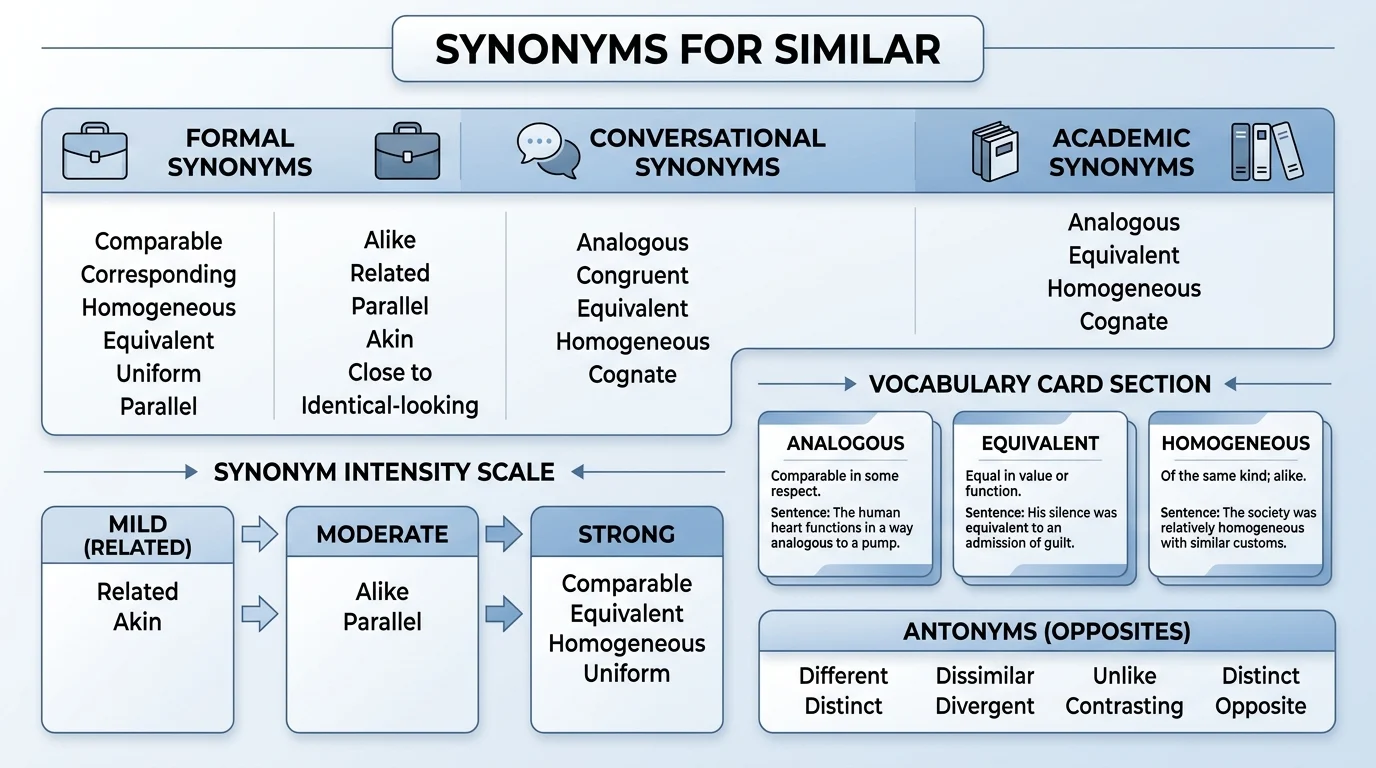
Professional contexts call for words that sound objective and measured. “Comparable,” “parallel,” and “corresponding” project competence and analytical thinking. Personal situations allow warmer words like “alike,” “resembling,” and “akin” that feel more human and relatable.
Formal vs. Conversational Synonyms
Formal writing demands precise vocabulary. Use “analogous,” “congruent,” or “commensurate” for reports, essays, and speeches. Conversational settings welcome simpler choices like “like,” “alike,” and “similarish” for texts and casual emails.
Academic Synonyms
Academic writing requires exact, neutral language that avoids emotional coloring. “Analogous,” “corresponding,” and “homogeneous” work well for research papers. “Consonant” and “coextensive” appear in more specialized academic fields.
Professional and Business Synonyms
Business communication benefits from action oriented words that suggest measurable relationships. “Comparable” helps in market analysis. “Parallel” describes project management. “Commensurate” appears in compensation discussions and performance evaluations.
Creative or Literary Synonyms
Writers need words that paint pictures and evoke feelings. “Akin” adds elegance. “Mirroring” and “echoing” create visual and auditory imagery. “Kindred” suggests deeper, soulful connections between characters or ideas.
Slang or Modern Synonyms
In casual speech, “similarish” and “like” serve as easy stand ins. These are acceptable in text messages and social media posts but should never appear in professional or academic writing. Always match your word choice to your audience’s expectations.
Strongest vs. Weaker Synonyms
Intensity scale from mild to strongest:
Mild: like, alike, similarish
Moderate: comparable, resembling, akin
Strong: parallel, corresponding, analogous
Very Strong: indistinguishable, identical, exact
Extreme: congruent, commensurate, uniform
Emotional vs. Neutral Synonyms
Neutral words stay factual and objective. “Comparable,” “equivalent,” and “corresponding” carry no emotional weight.
Emotionally charged words add feeling and perspective. “Resembling” suggests fond observation. “Mirroring” implies connection and understanding. “Echoing” brings a sense of history or repetition.
Antonyms of “Similar”
| Antonym | Meaning | Example Sentence |
|---|---|---|
| Different | Not alike in any way | Their approaches to solving the problem were completely different. |
| Dissimilar | Lacking common qualities | The two paintings are dissimilar in style and technique. |
| Opposite | Completely different or contrary | His opinion was opposite to everything she believed. |
| Distinct | Clearly separate and different | Each culture has distinct traditions and customs. |
| Contrary | Completely opposed in nature | The evidence pointed to contrary conclusions. |
| Divergent | Moving apart or differing | Their career paths became increasingly divergent over time. |
| Discordant | Lacking harmony or agreement | The committee held discordant views on the proposal. |
| Incompatible | Unable to exist together | Their working styles were incompatible from the start. |
| Unequal | Not equal in quality or value | The treatment of the two groups was noticeably unequal. |
| Unlike | Having no shared features | The two sisters are unlike in every possible way. |
| Unrelated | Having no connection | Their concerns were unrelated to the main issue. |
| Conflicting | Contradictory or opposed | The witness statements presented conflicting accounts. |
| Disparate | Essentially different in kind | The two datasets were too disparate to compare. |
| Heterogeneous | Composed of unlike elements | The population was highly heterogeneous in its demographics. |
| Mismatched | Not corresponding or well suited | They wore mismatched socks to the formal event. |
Comparison: Similar vs. Similar Words
Similar vs. Alike
Main difference: “Alike” focuses on visible or obvious shared traits. “Similar” works for abstract or less obvious connections.
Which is stronger: Neither is consistently stronger, but “alike” feels more immediate and visual.
Which is more formal: “Similar” is slightly more formal than “alike.”
Example with “alike”: The new neighbors are very much alike in their interests and hobbies.
Example with “similar”: The two research projects had similar methodologies but different outcomes.
Similar vs. Comparable
Main difference: “Comparable” implies that measurement or evaluation is possible. “Similar” only suggests shared qualities.
Which is stronger: “Comparable” is stronger because it invites direct evaluation.
Which is more formal: “Comparable” is more formal and analytical.
Example with “comparable”: The two software packages are comparable in performance and cost.
Example with “similar”: Both packages have similar user interfaces.
Similar vs. Analogous
Main difference: “Analogous” suggests a structural or functional relationship. “Similar” is broader and less specific.
Which is stronger: “Analogous” is stronger and more precise.
Which is more formal: “Analogous” is significantly more formal.
Example with “analogous”: The human eye is analogous to a camera in its basic function.
Example with “similar”: The color of her eyes is similar to her mother’s.
Similar vs. Identical
Main difference: “Identical” means exactly the same in all respects. “Similar” allows for differences.
Which is stronger: “Identical” is the strongest possible comparison.
Which is more formal: Both are formal, but “identical” carries more weight.
Example with “identical”: The DNA samples from the crime scene were identical to the suspect’s.
Example with “similar”: The fingerprints showed similar patterns but were not matching.
Similar vs. Corresponding
Main difference: “Corresponding” suggests a matching relationship in sequence or position. “Similar” is more general.
Which is stronger: “Corresponding” is more specific and often stronger in structured contexts.
Which is more formal: “Corresponding” is more formal.
Example with “corresponding”: Each department has a corresponding budget allocation.
Example with “similar”: Department budgets follow similar patterns across the organization.
Similar vs. Equivalent
Main difference: “Equivalent” means equal in value, function, or meaning. “Similar” only indicates resemblance.
Which is stronger: “Equivalent” is definitively stronger and more precise.
Which is more formal: “Equivalent” is more formal and technical.
Example with “equivalent”: The British pound is roughly equivalent to the US dollar in purchasing power.
Example with “similar”: The two currencies have similar exchange rates this quarter.
Common Phrases and Expressions with “Similar”
1. Similar to
Meaning: Used to compare two things and show they share qualities.
Example sentence: Her approach to teaching is similar to her mentor’s methodology.
2. Similar in nature
Meaning: Having the same basic characteristics or type.
Example sentence: The two complaints were similar in nature, both citing customer service issues.
3. Strikingly similar
Meaning: So alike that it is surprising or notable.
Example sentence: The two paintings were strikingly similar, raising questions about possible copying.
4. Broadly similar
Meaning: Sharing general characteristics but with some differences.
Example sentence: The company’s financial results were broadly similar to industry projections.
5. Roughly similar
Meaning: Approximately alike with some variation.
Example sentence: Both candidates had roughly similar qualifications and experience levels.
6. Essentially similar
Meaning: Sharing the most important features.
Example sentence: The two theories are essentially similar in their core assumptions.
7. Similar to that of
Meaning: A formal comparative structure for analytical writing.
Example sentence: The performance of the new model was similar to that of its predecessor.
Common Mistakes to Avoid
1. Using “Similar” When You Mean “Identical”
Do not use “similar” for things that are exactly the same. This mistake weakens your writing and shows carelessness. If there is no difference, say “identical.”
2. Confusing “Comparable” With “Similar”
Remember that “comparable” implies measurement and evaluation. Only use it when you can actually compare the two things on some metric.
3. Using Casual Synonyms in Formal Writing
Words like “similarish” and “like” have no place in academic papers or business reports. Always choose vocabulary that matches the formality of your context.
4. Overusing “Akin” and “Analogous”
These words lose their impact through repetition. Use them sparingly for maximum effect. “Similar” is often the better, simpler choice.
5. Choosing the Wrong Emotional Tone
“Matching” sounds playful and visual. “Resembling” feels gentle and reflective. Choose the synonym that fits the emotional atmosphere of your writing.
6. Using “Parallel” in Non-Structured Contexts
“Parallel” suggests a specific kind of relationship where two things follow similar paths. Do not use it for simple, static comparisons.
7. Repeating the Same Synonym
Variety is the key to good writing. Rotate through different synonyms to keep your prose fresh and engaging.
FAQs
What is the best synonym for similar?
The best synonym depends on your context. Use “comparable” for professional writing, “alike” for conversation, and “analogous” for academic work. Always match the word to your audience and purpose.
What is a formal synonym for similar?
“Comparable,” “analogous,” and “corresponding” are excellent formal alternatives. These words appear frequently in academic papers, business reports, and professional presentations.
What is an informal synonym for similar?
“Alike,” “like,” and “similarish” work well in casual speech and informal writing. Use these in texts, emails to friends, and social media posts only.
What is another word for similar in professional writing?
“Parallel,” “comparable,” and “corresponding” are strong choices for business contexts. They suggest measurable relationships and structured comparisons.
What is the difference between similar and analogous?
“Similar” is a general term for shared qualities. “Analogous” specifically describes functional or structural relationships. Use “analogous” when explaining how two things work in similar ways.
What is the opposite of similar?
The main antonyms are “different,” “dissimilar,” and “opposite.” “Distinct” and “divergent” also work, depending on whether you want to emphasize separation or difference in direction.
Conclusion
“Similar” is a foundational word in the English language, but it should not be your only tool for describing resemblance. The best writers know that synonyms for similar offer precision, variety, and emotional depth that a single word cannot provide.
Remember to match your word choice to your context. Use “comparable” for business, “analogous” for academic writing, and “alike” for casual conversation. Pay attention to formality levels and emotional tones. A well chosen synonym can make your writing more engaging and memorable.
The next time you reach for “similar,” pause and consider your options. With over 50 alternatives at your disposal, you can express yourself with greater clarity and style. Expand your vocabulary, and your readers will thank you for it.