Have you ever found yourself writing an email, essay, or social media caption and realizing you have used the word “problem” five times in two paragraphs? You are not alone. Most English learners and even native speakers fall into this repetitive habit.
The word “problem” is useful, but it can make your writing sound dull and uninspired. Professional writers, students, and job seekers all need a richer vocabulary to communicate with clarity and impact. Using varied synonyms shows your command of the language and keeps your audience engaged.
This guide will help you master the art of choosing the perfect alternative for “problem” in any situation. You will learn the subtle differences between similar words, discover when to use formal versus casual terms, and avoid common mistakes that weaken your writing.
What Does “Problem” Mean?
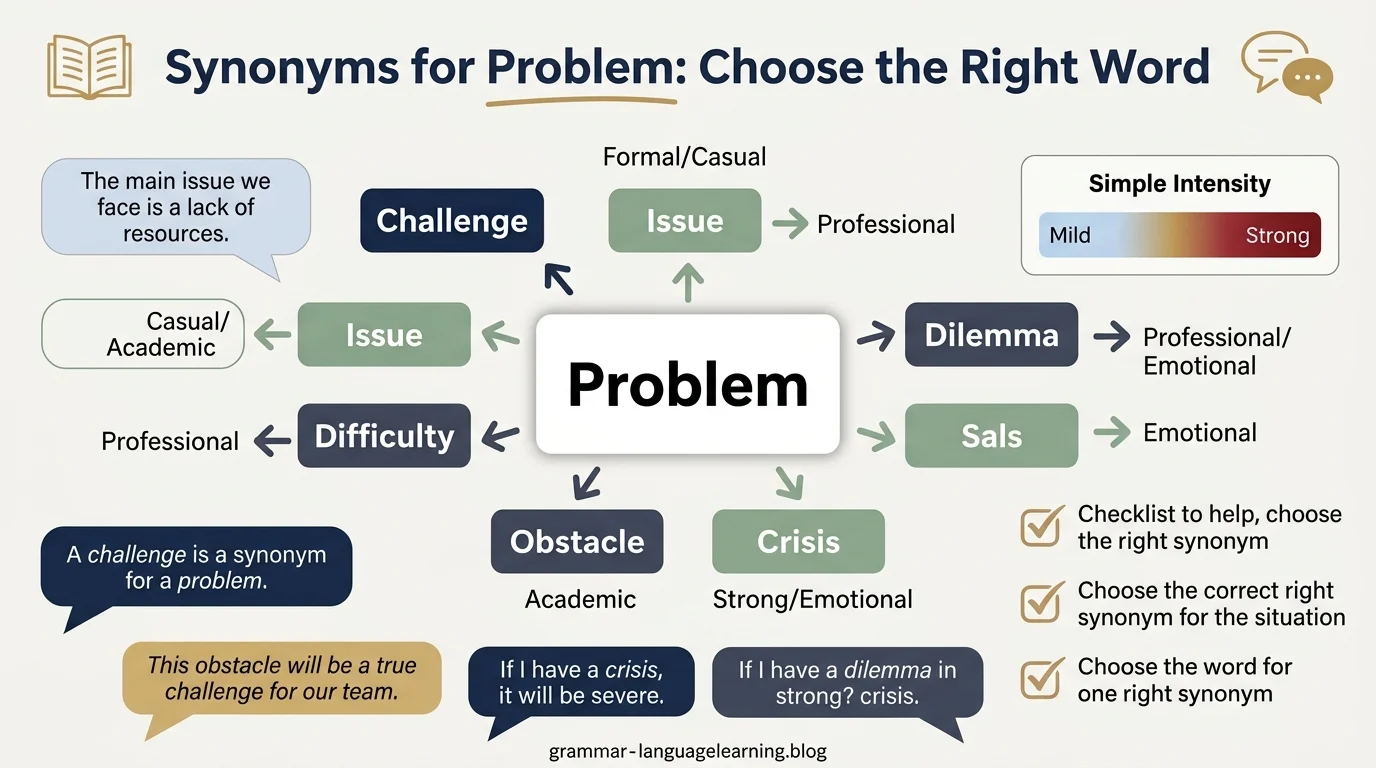
A problem is a situation, question, or matter that causes difficulty, uncertainty, or distress. The best synonym depends entirely on your context. For formal writing, choose “challenge” or “obstacle.” casual conversation, use “issue” or “glitch.” For academic work, select “difficulty” or “complexity.” Professional settings call for “concern” or “matter.”
Meaning, Tone and Context
Simple Definition
A problem is any situation that requires a solution, causes trouble, or presents a difficulty that must be overcome. It can be practical, emotional, technical, or abstract.
Part of Speech
Problem functions primarily as a noun. It can also appear as an adjective in compound forms like “problem child” or “problem area.”
Tone
The word “problem” has a neutral to slightly negative tone. It acknowledges difficulty without assigning blame or emotional weight.
Formality Level
“Problem” works across all formality levels. It is appropriate in casual conversation, professional emails, academic essays, and formal reports.
Common Use Cases
You will encounter “problem” in everyday situations, workplace discussions, academic assignments, customer service interactions, and personal relationships.
Important Word Forms
- Noun: problem
- Adjective: problematic
- Verb: to problem solve
- Related: problem solver, problem solving
When and How to Use “Problem”
The word “problem” works best when you need to identify a difficulty clearly and directly. It signals that something requires attention without being overly dramatic or technical.
Professional Context
“Our team has identified a problem with the supply chain delivery schedule.”
Personal Context
“I have a problem with my phone battery draining too quickly.”
Academic Context
“The researchers addressed the problem of data collection in remote areas.”
Emotional Context
“She struggled with the emotional problem of letting go of past grievances.”
Creative Context
“The protagonist faced a moral problem that tested his values.”
Social Media Context
“First world problems: my coffee was too hot this morning.”
Email Context
“I am writing to discuss a problem that has arisen with our project timeline.”
Casual Conversation
“Can you help me with this math problem I am stuck on?”
Another Word for “Problem”
The best single replacement depends on your specific context and intended tone. Here are the top choices for different situations.
Professional Writing
Choose “challenge” when you want to present a difficulty as an opportunity for growth. Use “concern” for sensitive issues that require careful handling.
Academic Writing
Select “difficulty” or “complexity” to describe theoretical or research related problems. These words sound precise and analytical.
Casual Conversation
Use “issue” for everyday matters. It is informal without being too casual. “Hiccup” works well for minor temporary setbacks.
Emotional Writing
Choose “struggle” to convey personal hardship. “Trouble” works for situations that cause worry or distress.
Creative Writing
Select “dilemma” for moral or ethical conflicts. “Predicament” adds a sense of urgency or helplessness.
Resume or Workplace Use
Use “challenge” to frame difficulties positively. Employers appreciate candidates who see obstacles as opportunities.
Social Media Captions
“Struggle” and “issue” feel authentic and relatable. “Glitch” works for tech or minor annoyances.
Stronger Meaning
Choose “crisis” for urgent, serious situations. “Catastrophe” suggests severe consequences.
Softer Meaning
Select “concern” for minor issues that need attention. “Matter” is neutral and non alarming.
When Not to Use “Problem”
The word “problem” sounds too vague when a more specific term would communicate more clearly. It can also feel too negative in situations where a neutral or positive framing is more appropriate.
Vague Usage
Weak: “We have a problem with the new system.”
Stronger: “We have encountered a compatibility issue with the new system.”
Too Casual for Formal Writing
Weak: “The study identified a problem with the methodology.”
Better: “The study identified a methodological limitation.”
Too Negative in Professional Settings
Weak: “There is a problem with your performance.”
Better: “There is room for improvement in your performance.”
Too General for Technical Situations
Weak: “The software has a problem.”
Better: “The software contains a bug in the authentication module.”
Too Emotional for Factual Reporting
Weak: “The problem devastated the community.”
Better: “The crisis significantly impacted the community.”
Words Commonly Confused With “Problem”
Problem vs. Issue
“Problem” suggests a difficulty that requires a solution. “Issue” is broader and can refer to any topic or concern.
Example with problem: “The car has a mechanical problem.”
Example with issue: “We need to discuss the budget issue.”
Problem vs. Challenge
“Problem” has a negative connotation. “Challenge” frames the situation as an opportunity for growth.
Example with problem: “Lack of funding is a problem.”
Example with challenge: “Lack of funding is a challenge we can overcome.”
Problem vs. Dilemma
“Problem” can be solved with the right approach. “Dilemma” involves a difficult choice between two undesirable options.
Example with problem: “We have a problem with our internet connection.”
Example with dilemma: “She faced a dilemma between career and family.”
Problem vs. Obstacle
“Problem” is a general difficulty. “Obstacle” specifically refers to something that blocks progress.
Example with problem: “Time management is a problem.”
Example with obstacle: “Lack of experience is an obstacle to getting hired.”
Problem vs. Predicament
“Problem” is neutral and solvable. “Predicament” implies a difficult, often embarrassing situation with limited options.
Example with problem: “The project has a budget problem.”
Example with predicament: “He found himself in a predicament after missing the last train.”
Problem vs. Crisis
“Problem” can be minor or major. “Crisis” always indicates an urgent, dangerous, or critical situation.
Example with problem: “We have a scheduling problem.”
Example with crisis: “The company faced a financial crisis.”
Problem vs. Trouble
“Problem” is neutral and factual. “Trouble” suggests personal difficulty, distress, or conflict.
Example with problem: “We identified a problem in the system.”
Example with trouble: “She is having trouble with her new boss.”
Best Synonym by Context for “Problem”
| Context | Best Synonym | Why It Works | Example |
|---|---|---|---|
| Formal Writing | Difficulty | Sounds precise and objective | “The study addresses the difficulty of measuring abstract concepts.” |
| Academic Writing | Complexity | Suggests depth and intellectual challenge | “The complexity of the data required advanced analysis.” |
| Professional or Business Use | Challenge | Frames issues positively as opportunities | “We view this market shift as a challenge to innovate.” |
| Resume | Challenge | Shows problem solving ability | “Successfully overcame a major supply chain challenge.” |
| Casual Conversation | Issue | Natural and widely understood | “The issue with the printer is frustrating.” |
| Creative Writing | Predicament | Adds narrative tension and urgency | “The hero found himself in a desperate predicament.” |
| Emotional Tone | Struggle | Conveys personal hardship authentically | “Her struggle with anxiety was deeply personal.” |
| Strong Intensity | Crisis | Communicates urgency and seriousness | “The housing crisis demands immediate action.” |
| Soft or Moderate Tone | Concern | Non alarming and professional | “We have a concern about the project timeline.” |
| Social Media Captions | Struggle | Relatable and authentic | “The struggle to wake up early is real.” |
| US or UK Usage | Challenge | Works equally well in both dialects | “We accept this challenge with confidence.” |
Which Synonym Should You Choose?
Follow this decision guide to select the perfect synonym for your situation.
Consider Your Audience
Use formal synonyms like “difficulty” or “complexity” for academic readers. Choose “issue” or “concern” for general audiences. Select “challenge” or “opportunity” for professional settings where a positive tone matters.
Evaluate the Emotional Intensity
For mild problems, use “concern” or “matter.” For moderate difficulties, choose “issue” or “challenge.” serious situations, select “crisis,” “emergency,” or “catastrophe.”
Assess the Formality Level
Formal contexts call for “difficulty,” “complication,” or “obstacle.” Semiformal situations work well with “challenge” or “concern.” Casual settings welcome “issue,” “glitch,” or “hiccup.”
Think About Your Goal
If you want to sound proactive and capable, use “challenge.” you need to sound analytical and precise, choose “complexity.” If you want to soften bad news, select “concern” or “matter.”
Consider Your Sentence Structure
Short, direct sentences work well with “problem” or “issue.” Longer, more descriptive sentences benefit from words like “predicament” or “difficulty” that add nuance.
Real Life Examples of “Problem” in Sentences
School Context
“The geometry problem took the entire class period to solve. The teacher broke it down into smaller steps for better understanding.”
Workplace Context
“Our team identified a scheduling conflict that created a problem for the upcoming product launch. We adjusted the timeline accordingly.”
Writing Context
“The writer struggled with the problem of maintaining consistent character voices throughout the novel. Each character required a unique speech pattern.”
Conversation Context
“We had a problem with the restaurant reservation, so we found another place to eat. Everything worked out in the end.”
Social Media Context
“Adulting problem: I bought groceries and forgot to bring them inside. Now they are warm.”
Resume Context
“Developed creative solutions to complex production problems, resulting in a fifteen percent efficiency increase.”
Email Context
“I hope this email finds you well. I am writing about a problem with the invoice that was sent last week.”
Storytelling Context
“The expedition encountered a problem when their navigation equipment failed in the middle of the desert. They had to rely on the stars for guidance.”
25 Synonyms for “Problem”
| Synonym | Simple Meaning | Best Used For | Example Sentence |
|---|---|---|---|
| Challenge | An obstacle that tests abilities | Professional and motivational contexts | “We face a significant challenge in reducing our carbon footprint.” |
| Issue | A matter of concern or discussion | General use across all contexts | “The committee discussed the issue of funding allocations.” |
| Difficulty | A state of being hard to accomplish | Academic and formal writing | “The difficulty of the exam surprised many students.” |
| Obstacle | Something that blocks progress | Goal oriented and professional contexts | “Lack of funding remains the primary obstacle to expansion.” |
| Complication | An unexpected element that makes things harder | Medical, technical, and narrative contexts | “A complication arose during the surgical procedure.” |
| Dilemma | A difficult choice between options | Ethical, moral, and decision making contexts | “She faced the dilemma of choosing between two job offers.” |
| Predicament | A difficult or embarrassing situation | Narrative and casual conversation | “He found himself in a predicament after losing his wallet.” |
| Crisis | A time of intense difficulty or danger | Serious situations requiring immediate action | “The country faced an economic crisis after the crash.” |
| Emergency | An unexpected situation requiring urgent action | Urgent, safety related contexts | “Call an ambulance in case of a medical emergency.” |
| Hurdle | An obstacle that must be overcome | Goal oriented and sports metaphors | “The team cleared every hurdle on the way to success.” |
| Setback | A temporary reversal or delay | Professional and personal development | “The project experienced a setback due to weather conditions.” |
| Snag | A minor unexpected problem | Casual conversation and informal writing | “We hit a snag with the software installation.” |
| Glitch | A temporary malfunction or error | Technical and casual contexts | “The system had a glitch that caused data loss.” |
| Hiccup | A minor and temporary problem | Casual and humorous contexts | “We had a small hiccup in the production schedule.” |
| Quandary | A state of uncertainty over choices | Formal and intellectual contexts | “The philosopher’s quandary puzzled the students.” |
| Plight | A dangerous or difficult situation | Emotional and literary contexts | “The refugees’ plight moved the entire community.” |
| Struggle | A determined effort against difficulty | Personal and emotional contexts | “Her struggle with addiction inspired others.” |
| Trouble | Difficulty or distress | Personal and casual contexts | “The company is in financial trouble.” |
| Concern | A matter of worry or interest | Professional and polite contexts | “Our main concern is customer satisfaction.” |
| Matter | A subject or situation requiring attention | Formal and neutral contexts | “We need to address this matter immediately.” |
| Obstruction | Something that blocks or hinders | Legal, technical, and formal contexts | “The obstruction in the pipeline caused a delay.” |
| Impediment | A hindrance or obstruction | Formal and legal contexts | “His lack of experience was an impediment to promotion.” |
| Hindrance | Something that causes delay or difficulty | General and formal contexts | “The traffic was a hindrance to our arrival time.” |
| Adversity | Difficulties or misfortune | Inspirational and narrative contexts | “She overcame great adversity to achieve success.” |
| Drawback | A disadvantage or negative aspect | Analytical and comparative contexts | “The main drawback of the plan is its cost.” |
Synonym Groups and Usage Differences
Professional vs. Personal Synonyms
Professional contexts require words that maintain a neutral or positive tone. Choose “challenge,” “concern,” or “opportunity” to avoid sounding negative. Personal contexts allow for more emotional words like “struggle” or “trouble” that express genuine difficulty.
Formal vs. Conversational Synonyms
Formal writing favors “difficulty,” “complexity,” “obstacle,” and “impediment.” These words appear in academic papers, legal documents, and official reports. Conversational settings welcome “issue,” “snag,” “glitch,” and “hiccup.” These words feel natural in everyday speech and casual writing.
Academic Synonyms
Academic writers should use “difficulty,” “complexity,” “complication,” and “limitation.” These words sound precise and analytical. They suggest intellectual rigor without emotional bias. Professors and researchers prefer these terms in scholarly publications.
Professional and Business Synonyms
Business communication benefits from “challenge,” “concern,” “matter,” and “opportunity.” These words frame problems constructively. They maintain professionalism while acknowledging difficulties. Use them in emails, presentations, and client communications.
Creative or Literary Synonyms
Creative writers can draw from “predicament,” “dilemma,” “plight,” and “quandary.” These words add narrative depth and emotional resonance. They create vivid imagery and tension in storytelling. Poets and novelists use these terms to enrich their prose.
Strongest vs. Weaker Synonyms
Mildest words include “issue,” “matter,” and “concern.” These words minimize the severity of the situation. Moderate words include “problem,” “difficulty,” and “obstacle.” Strongest words include “crisis,” “emergency,” “catastrophe,” and “adversity.” These words signal urgent or serious situations.
Emotional vs. Neutral Synonyms
Neutral synonyms include “issue,” “matter,” “difficulty,” and “complexity.” These words describe problems factually without emotional coloring. Emotional synonyms include “struggle,” “plight,” “trouble,” and “adversity.” These words convey personal hardship and evoke empathy.
Antonyms of “Problem”
| Antonym | Meaning | Example Sentence |
|---|---|---|
| Solution | The answer to a problem | “We found a simple solution to the scheduling conflict.” |
| Advantage | A beneficial factor | “Her experience was an advantage in the hiring process.” |
| Benefit | A positive outcome or gain | “The new policy offers significant benefits to employees.” |
| Opportunity | A favorable situation | “The economic downturn created new opportunities for startups.” |
| Asset | A valuable resource | “His language skills were an asset to the team.” |
| Resolution | The act of solving a problem | “The resolution of the dispute took several weeks.” |
| Improvement | A positive change | “The new system represents a clear improvement.” |
| Success | The achievement of a goal | “Their success came from careful planning.” |
| Aid | Help or assistance | “The government provided aid to affected regions.” |
| Assistance | Support or help | “We offered assistance to the struggling department.” |
| Boon | A useful benefit | “The tax break was a boon for small businesses.” |
| Relief | Alleviation of difficulty | “The new medication offered relief from symptoms.” |
| Ease | Freedom from difficulty | “The new software brings ease to the workflow.” |
| Breakthrough | A sudden advance or discovery | “The breakthrough changed how we treat the disease.” |
| Remedy | A cure or solution | “The remedy for the issue was surprisingly simple.” |
Comparison: Problem vs. Similar Words
Problem vs. Challenge
The main difference is tone. “Problem” focuses on difficulty and obstruction. “Challenge” emphasizes opportunity and growth.
Which one is stronger: “Challenge” is psychologically stronger because it frames difficulty positively.
Which one is more formal: Both are acceptable in formal contexts, but “challenge” sounds more optimistic.
Example with problem: “The financial problem delayed the project.”
Example with challenge: “The financial challenge motivated us to innovate.”
Problem vs. Issue
“Problem” suggests a situation that requires a solution. “Issue” is broader and can refer to any topic of discussion or concern.
Which one is stronger: “Problem” indicates a more urgent need for resolution.
Which one is more formal: “Issue” is slightly more formal in professional writing.
Example with problem: “We have a problem with the printer.”
Example with issue: “We need to discuss the issue of overtime pay.”
Problem vs. Dilemma
A “problem” has a potential solution. A “dilemma” involves a difficult choice between equally undesirable options.
Which one is stronger: “Dilemma” carries more emotional weight and complexity.
Which one is more formal: Both are formal, but “dilemma” appears more in philosophical or ethical discussions.
Example with problem: “The math problem was difficult but solvable.”
Example with dilemma: “The moral dilemma kept him awake at night.”
Problem vs. Crisis
A “problem” can be resolved over time. A “crisis” demands immediate action and signals serious danger.
Which one is stronger: “Crisis” is significantly stronger and more urgent.
Which one is more formal: “Crisis” is used in formal and emergency contexts.
Example with problem: “The budget problem requires careful planning.”
Example with crisis: “The budget crisis forced immediate layoffs.”
Problem vs. Predicament
A “problem” is a difficulty. A “predicament” implies a difficult situation with limited options, often involving embarrassment.
Which one is stronger: “Predicament” suggests more urgency and personal distress.
Which one is more formal: “Predicament” is more literary and less formal in business writing.
Example with problem: “We solved the scheduling problem.”
Example with predicament: “His predicament left him with no good options.”
Problem vs. Obstacle
A “problem” is a general difficulty. An “obstacle” specifically blocks progress toward a goal.
Which one is stronger: “Obstacle” emphasizes the blocking aspect more intensely.
Which one is more formal: Both are appropriate in formal contexts.
Example with problem: “Time management is a common problem.”
Example with obstacle: “Lack of funding remains an obstacle to growth.”
Common Phrases and Expressions with “Problem”
1. No problem
Meaning: An expression used to acknowledge thanks or to indicate that something is not difficult.
Example sentence: “Thank you for your help.” “No problem, I was happy to assist.”
2. Problem solver
Meaning: A person who finds solutions to difficulties.
Example sentence: “She is an excellent problem solver who thinks creatively under pressure.”
3. Problem child
Meaning: A child who is difficult to manage or who causes constant trouble.
Example sentence: “The new software update has become the problem child of our IT department.”
4. The problem with
Meaning: A phrase used to introduce a criticism or difficulty.
Example sentence: “The problem with this approach is that it overlooks the human factor.”
5. That’s your problem
Meaning: A dismissive phrase indicating that someone else must handle their own difficulty.
Example sentence: “If you forgot your keys, that’s your problem, not mine.”
6. Problem area
Meaning: A specific section or aspect that causes difficulty.
Example sentence: “We identified grammar as a problem area for most students.”
7. Problem solving skills
Meaning: The ability to find solutions to difficulties.
Example sentence: “Employers value candidates with strong problem solving skills.”
8. A problem shared is a problem halved
Meaning: Discussing a problem with someone makes it easier to handle.
Example sentence: “She called her friend because a problem shared is a problem halved.”
Common Mistakes to Avoid
1. Using “problem” when a more precise synonym is better
Weak: “We have a problem with customer satisfaction.”
Stronger: “We have a concern regarding customer satisfaction trends.”
2. Confusing “problem” with “issue” in formal writing
“Issue” often works better in professional reports because it sounds less negative. Use “problem” only when you specifically need to highlight a difficulty.
3. Using a casual synonym in formal writing
Avoid “glitch,” “hiccup,” or “snag” in academic papers or official documents. These words sound informal and unprofessional.
4. Using an overly dramatic synonym for a simple situation
Don’t describe a minor inconvenience as a “crisis” or “catastrophe.” Save strong words for truly serious situations.
5. Repeating the same word too often
Vary your vocabulary throughout your writing. Use “issue,” “challenge,” “concern,” and “difficulty” to maintain reader interest.
6. Choosing a synonym with the wrong emotional tone
“Struggle” and “plight” carry emotional weight. Use them only when you intend to evoke empathy or describe personal hardship.
7. Using slang in academic or professional writing
Avoid words like “mess,” “jam,” or “pickle” in formal contexts. These terms belong in casual conversation.
FAQs
1. What is the best synonym for problem?
The best synonym depends on your context. For professional writing, use “challenge.” casual conversation, use “issue.” For academic work, use “difficulty.”
2. What is a formal synonym for problem?
“Difficulty,” “complexity,” “obstacle,” and “impediment” are formal synonyms appropriate for academic and professional writing.
3. What is an informal synonym for problem?
“Glitch,” “snag,” “hiccup,” and “issue” work well in casual conversation and informal writing.
4. What is another word for problem in professional writing?
“Challenge,” “concern,” and “matter” are excellent choices for professional business communication.
5. What is the difference between problem and issue?
A problem requires a solution. An issue is a broader term that can refer to any topic of discussion, concern, or difficulty.
6. What is the opposite of problem?
“Solution,” “opportunity,” “advantage,” and “benefit” are common antonyms of problem.
Conclusion
The word “problem” serves as a useful foundation, but your vocabulary should not stop there. Mastering synonyms for problem allows you to communicate with precision, emotional intelligence, and professional polish. The right word can transform a negative statement into a constructive challenge, a vague complaint into a specific observation, or a casual remark into a powerful narrative.
Remember to consider your audience, the formality of your situation, and the emotional weight you want to convey. A thoughtful word choice shows respect for your readers and demonstrates your command of the English language. Start replacing generic “problems” with more specific alternatives. Your writing will become clearer, more engaging, and more persuasive.