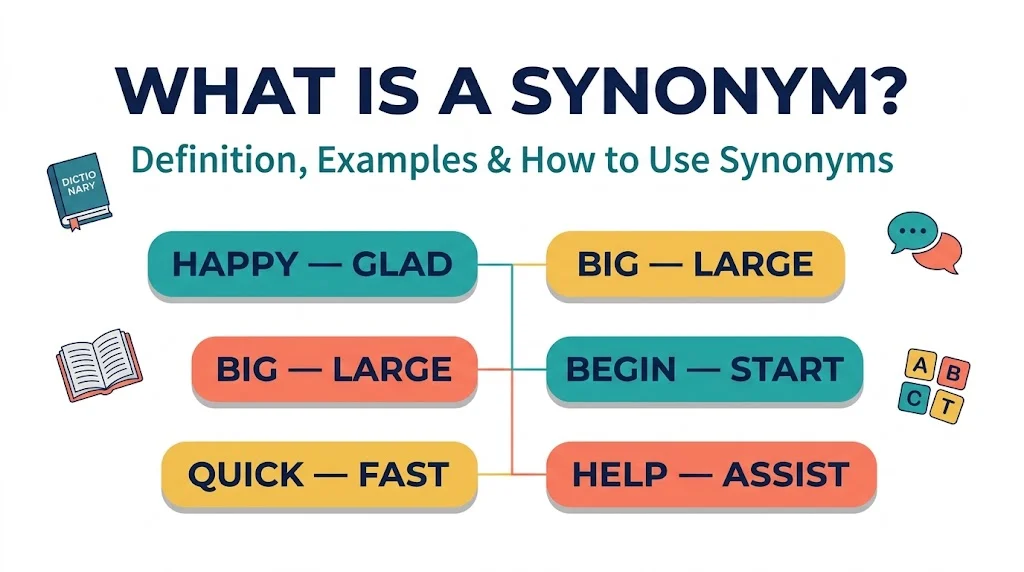
Have you ever wanted to describe something as beautiful without using the same word repeatedly? Perhaps you wanted to replace big with large or start with begin. These simple word choices introduce an important part of the English language: synonyms.
A synonym is a word or expression that has the same or nearly the same meaning as another word or expression in a particular context. For example, happy and joyful share a similar meaning, while begin and start can often be used interchangeably.
Synonyms help you express ideas clearly, choose the right tone, expand your vocabulary, and make your writing more engaging. However, words with similar meanings don’t always work in exactly the same situations. The context, grammatical structure, and intended message all influence which synonym fits best.
In this guide, you’ll learn what a synonym means, explore common examples, understand the different types of synonyms, and discover how to use them correctly in everyday conversations, academic assignments, and professional writing.
What Is a Synonym?
A synonym is a word that shares the same or a similar meaning with another word. The relationship between words that have similar meanings is called synonymy.
For example, small and little often describe something of limited size. Likewise, quick and fast can describe something that moves or happens at a high speed.
Synonyms give you different ways to communicate the same basic idea. Instead of relying on one word in every situation, you can choose an alternative that suits your sentence.
Consider these examples:
- The child was happy.
- The child was cheerful.
- The child was joyful.
Each sentence describes a positive emotional state. However, happy, cheerful, and joyful carry slightly different shades of meaning. A cheerful person often appears upbeat, while a joyful person may experience or express intense happiness.
This distinction shows why understanding synonyms involves more than memorizing pairs of words.
Synonym Definition in English
The definition of a synonym is straightforward: a word or expression that means the same as or nearly the same as another word or expression in a particular context.
The word synonym is a noun. Its plural form is synonyms.
Here are a few examples:
| Word | Synonym | Shared meaning |
|---|---|---|
| Happy | Glad | Feeling pleasure or satisfaction |
| Begin | Start | To commence an action |
| Large | Big | Having considerable size |
| Difficult | Hard | Not easy to accomplish |
| Assist | Help | To provide support |
| Purchase | Buy | To obtain something in exchange for money |
| Silent | Quiet | Making little or no sound, depending on context |
These pairs demonstrate how different words can communicate closely related ideas.
A synonym doesn’t have to share the same spelling, pronunciation, or history as another word. What matters is the similarity in meaning and whether the words can serve a similar purpose in context.
What Does Synonym Mean in Simple Words?
In simple English, a synonym is a word that means the same thing or almost the same thing as another word.
For example:
- Big means nearly the same as large.
- Happy means nearly the same as glad.
- Fast means nearly the same as quick.
- Smart can mean nearly the same as intelligent.
- End can mean nearly the same as finish.
Imagine that you have a box of colored pencils. You might describe a particular pencil as red, bright red, or scarlet. These expressions are related, although they don’t necessarily describe the exact same shade.
Synonyms work in a similar way. They let you express related meanings with different words, but the alternatives may have slightly different levels of intensity or emotional associations.
Remember: Synonyms have similar meanings, but they aren’t always interchangeable in every sentence.
What Are Some Examples of Synonyms?
Examples make the meaning of a synonym easier to understand. English contains thousands of words with similar meanings, ranging from everyday vocabulary to formal and technical expressions.
The following tables group common synonym examples by their usual grammatical roles. Some alternatives fit particular contexts better than others.
Common Synonyms for Everyday Words
These examples are useful for English learners, students, and anyone who wants to improve everyday vocabulary.
| Word | Common synonyms | Example sentence |
|---|---|---|
| Happy | Glad, joyful | She felt happy about the news. |
| Sad | Unhappy, sorrowful | He felt sad after the farewell. |
| Big | Large, sizable | They bought a big house. |
| Small | Little, tiny | A small bird landed nearby. |
| Fast | Quick, rapid | We took a fast train. |
| Slow | Unhurried, gradual | The process was slow. |
| Easy | Simple, straightforward | The instructions were easy to follow. |
| Difficult | Hard, challenging | The final question was difficult. |
| Beautiful | Lovely, attractive | The garden looks beautiful. |
| Angry | Mad, furious | She was angry about the delay. |
| Quiet | Silent, peaceful | The library was quiet. |
| Brave | Courageous, bold | The brave firefighter entered the building. |
| Smart | Clever, intelligent | He is a smart student. |
| Friendly | Warm, welcoming | Our neighbors are friendly. |
| Important | Significant, crucial | This is an important decision. |
Although each row provides alternatives, the words don’t always express precisely the same idea. For example, furious usually communicates stronger anger than angry. Similarly, tiny suggests a smaller size than the more general word small.
Synonyms for Verbs
Verbs describe actions, states, and events. Choosing a suitable verb can make your writing more precise and help readers understand what happened.
| Verb | Synonyms | Example |
|---|---|---|
| Begin | Start, commence | The meeting will begin at noon. |
| End | Finish, conclude | We need to end the discussion. |
| Help | Assist, aid | Please help your classmates. |
| Show | Display, demonstrate | The chart shows the results. |
| Choose | Select, pick | Choose your preferred option. |
| Speak | Talk, converse | They speak every evening. |
| Buy | Purchase, acquire | She plans to buy a laptop. |
| Explain | Clarify, describe | Can you explain the rule? |
| Build | Construct, assemble | Workers will build a bridge. |
| Improve | Enhance, develop | Practice can improve your skills. |
| Look | Glance, gaze | She looked at the painting. |
| Answer | Reply, respond | Please answer the question. |
Notice that some verbs describe more specific actions than others. Glance means to look briefly, while gaze generally suggests looking steadily or for an extended period. Replacing look with either verb changes the detail conveyed by the sentence.
Synonyms for Adjectives
Adjectives describe nouns and pronouns. Synonyms for adjectives can help you communicate qualities, emotions, appearance, and degrees of intensity.
| Adjective | Synonyms | Example |
|---|---|---|
| Important | Significant, essential | This is an important task. |
| Difficult | Challenging, demanding | The assignment was difficult. |
| Beautiful | Lovely, gorgeous | She wore a beautiful dress. |
| Intelligent | Smart, clever | The intelligent student solved it. |
| Kind | Caring, considerate | He gave us a kind response. |
| Honest | Truthful, sincere | She gave an honest answer. |
| Calm | Peaceful, composed | He remained calm under pressure. |
| Strong | Powerful, sturdy | The team showed strong determination. |
| Funny | Humorous, amusing | That was a funny story. |
| Tired | Exhausted, weary | I felt tired after the journey. |
These alternatives differ in intensity and context. Exhausted, for instance, describes a more extreme degree of tiredness than the general adjective tired.
Synonyms for Nouns
Nouns name people, places, objects, concepts, and events. Their synonyms help you describe familiar ideas in different ways.
| Noun | Synonyms | Example |
|---|---|---|
| Job | Occupation, position | She found a new job. |
| Idea | Thought, concept | He shared an interesting idea. |
| Gift | Present | I bought her a gift. |
| Error | Mistake | The report contains an error. |
| Goal | Aim, objective | Our goal is to improve sales. |
| Story | Tale, narrative | The children enjoyed the story. |
| Answer | Response, reply | His answer surprised everyone. |
| Problem | Issue, difficulty | We need to solve this problem. |
| Method | Approach, technique | This method saves time. |
| Chance | Opportunity, possibility | Everyone deserves a chance. |
Some noun pairs are especially close in meaning. Gift and present are often interchangeable when referring to something given to another person. However, opportunity usually emphasizes a favorable situation, while chance can describe either an opportunity or the possibility of something happening.
What Are the Different Types of Synonyms?
Not all synonyms have the same relationship. Linguists and language educators distinguish between words that are interchangeable in particular contexts and words that merely share some aspects of meaning.
Understanding these differences helps you select words more accurately.
Absolute Synonyms
Absolute synonyms are words that share the same meaning and can be used interchangeably across the relevant contexts, without a meaningful difference in usage.
For example, two specialized terms might refer to the same concept in a particular technical setting. However, even terms that seem identical may develop different associations or usage restrictions.
Truly absolute synonyms are uncommon in natural language because words often differ in tone, frequency, grammatical behavior, or the situations in which people use them.
Consider begin and start. Both can describe the opening of an event or action:
- The class will begin at nine.
- The class will start at nine.
The sentences communicate essentially the same information. Nevertheless, the two verbs don’t work identically in every expression. People commonly say start a car, while begin a car doesn’t normally express the same meaning.
This is why many familiar synonym pairs are better described as near synonyms rather than absolute synonyms.
Near Synonyms
Near synonyms share an important part of their meaning but differ in one or more ways. These differences may involve intensity, emotional tone, formality, or context.
Examples include:
- Angry, annoyed, furious: These words describe negative emotional states but differ in intensity.
- Large, huge, enormous: Each refers to considerable size, but huge and enormous often communicate a greater degree.
- Smart, clever, intelligent: These words overlap but may emphasize different kinds of mental ability.
- Difficult, challenging, demanding: These words describe tasks that require effort, although demanding often emphasizes the amount of effort required.
- Thin, slim, skinny: These words describe body size or shape, but their connotations differ.
Consider the sentence, “The exam was challenging.”
Replacing challenging with impossible would substantially change its meaning. A challenging exam requires effort, while an impossible exam cannot reasonably be completed under the stated conditions.
Near synonyms help you express subtle distinctions. They don’t simply offer different spellings for an identical idea.
Contextual Synonyms
Contextual synonyms are words that have similar meanings in a particular situation or sentence, even though they aren’t interchangeable in every setting.
For example:
- “She is a bright student.”
- “She is an intelligent student.”
In these sentences, bright and intelligent both describe someone’s ability to understand and learn.
However, bright also describes light, color, and visual appearance. You can say “a bright room” but cannot normally replace bright with intelligent in that sentence.
Context determines which meaning applies.
Another example involves cold and chilly. Both can describe low temperatures, but chilly often suggests a mildly uncomfortable cold rather than the full range of meanings associated with cold.
Contextual synonyms matter because the same word can participate in different meaning relationships depending on how someone uses it.
Formal and Informal Synonyms
Words can share similar meanings while belonging to different levels of formality.
For example:
| Informal or everyday word | More formal alternative | Example |
|---|---|---|
| Ask | Inquire | She asked about the schedule. |
| Buy | Purchase | We bought new equipment. |
| Help | Assist | The staff helped the visitors. |
| Get | Obtain | He got permission to leave. |
| Tell | Inform | Please tell the manager. |
| Start | Commence | The ceremony started at noon. |
Formal alternatives can suit academic papers, reports, business communication, and official documents. Everyday words often work better in casual conversations and accessible online writing.
However, formality doesn’t automatically make a word more effective. Purchase isn’t inherently better than buy. The best choice depends on the audience, purpose, and tone.
How Do Synonyms Work in a Sentence?
Synonyms work by allowing different words to communicate similar meanings within a particular grammatical and semantic context.
A replacement may preserve a sentence’s central idea, but it can also change its emotional tone, level of detail, or naturalness.
Consider these examples:
- Original: “The house is large.”
- Alternative: “The house is big.”
Both sentences describe a house with considerable size. The main message remains the same.
Now consider:
- Original: “The child was angry.”
- Alternative: “The child was furious.”
Both sentences describe anger, but furious suggests a more intense emotion. The alternative changes the strength of the description.
How to Identify Synonyms in a Sentence
To identify synonyms, focus on what the words mean in context rather than relying only on their dictionary definitions.
Follow these steps:
- Read the complete sentence. Understand the situation before interpreting an individual word.
- Identify the intended meaning. Determine what the word describes, expresses, or communicates.
- Look for a word with a similar meaning. Consider the sentence’s subject, action, and tone.
- Replace the original word mentally. Check whether the new sentence preserves the essential message.
- Review the grammar and naturalness. Confirm that the alternative fits the surrounding words.
For example, consider this sentence:
“The teacher asked the students to explain their answers.”
Possible alternatives include describe, clarify, and elaborate on. However, each option carries a slightly different meaning.
“Clarify their answers” suggests making the answers easier to understand. “Elaborate on their answers” suggests adding more detail. The best replacement depends on what the teacher expects.
How to Use a Synonym Without Changing the Intended Meaning
Replacing a word is easy. Choosing a replacement that preserves the message requires more care.
Imagine that a writer describes a meal as “delicious.” A thesaurus might suggest tasty, flavorful, appetizing, and excellent.
These alternatives overlap, but they emphasize different qualities. Flavorful focuses on taste, while appetizing often describes something that looks or smells appealing before someone eats it.
Here is another example:
- Original: “The instructions were simple.”
- Alternative: “The instructions were clear.”
These sentences may describe the same instructions, but the meanings differ slightly. Simple suggests a lack of complexity, while clear suggests that the information is easy to understand.
A useful synonym preserves the important meaning without introducing an unintended change.
Examples of Synonyms Used Correctly in Sentences
| Original sentence | Revised sentence | Why it works |
|---|---|---|
| Let’s begin the meeting. | Let’s start the meeting. | Both verbs refer to the beginning of an event. |
| She is a smart student. | She is an intelligent student. | Both adjectives describe intellectual ability. |
| The road is very wide. | The road is very broad. | Both adjectives describe substantial width. |
| He assisted his colleague. | He helped his colleague. | Both verbs describe providing support. |
| We completed the assignment. | We finished the assignment. | Both verbs describe bringing the task to completion. |
These substitutions preserve the main message while changing the wording.
Why Some Synonyms Don’t Work in Every Sentence
English contains common word combinations called collocations. These are combinations that speakers naturally use together because of established language conventions.
For example, people commonly say:
- Strong coffee
- Heavy rain
- Make a decision
- Take a break
- Fast food
A word with a similar dictionary meaning might not fit the same expression naturally. Powerful coffee is understandable, but strong coffee is the usual phrase when describing concentrated or intense coffee.
Similarly, people generally say make a mistake rather than do a mistake.
Synonyms must fit these established patterns. A word may have the right general meaning and still sound unnatural in a particular sentence.
What Is the Difference Between Synonyms and Antonyms?
Synonyms and antonyms describe different relationships between words.
Synonyms have the same or similar meanings, while antonyms have opposite meanings.
For example, happy and joyful are synonyms. By contrast, happy and sad are commonly treated as antonyms.
Understanding this distinction makes it easier to build vocabulary, interpret sentences, and answer language exercises.
Synonyms vs. Antonyms: Examples
| Word | Synonym | Antonym |
|---|---|---|
| Happy | Glad | Sad |
| Hot | Warm | Cold |
| Easy | Simple | Difficult |
| Early | Premature | Late |
| Brave | Courageous | Cowardly |
| Generous | Giving | Selfish |
| Accept | Approve, agree to take | Reject |
| Expand | Enlarge | Contract |
| Increase | Grow, rise | Decrease |
| Quiet | Silent | Noisy |
The alternatives in the synonym column express similar meanings, while the antonyms express opposing ideas in the relevant sense.
Keep in mind that synonyms and antonyms can be context-dependent. For example, light can refer to brightness or low weight. The most suitable synonym or antonym changes with the intended meaning.
Can a Word Have Several Synonyms and Antonyms?
Yes. A single word can have multiple synonyms and antonyms because its meaning may vary across situations.
Consider light:
- When describing weight, a synonym might be lightweight, while an antonym is heavy.
- When describing illumination, synonyms might include brightness in an appropriate grammatical context, while an opposite might be darkness.
- When describing color, pale may be a suitable alternative in certain sentences.
The important point is to identify the correct sense of a word before selecting its synonyms or antonyms.
How Are Synonyms Different From Other Related Words?
Synonyms are only one type of relationship between words. English also contains homonyms, homophones, homographs, and related expressions that share particular features without having the same meaning.
Understanding these terms helps prevent common vocabulary mistakes.
Synonyms vs. Homonyms
Homonyms are words that share the same form but have different meanings. Depending on the linguistic framework, this may involve the same spelling, pronunciation, or both.
For example, bat can refer to a flying mammal or a piece of equipment used in sports.
The two meanings belong to the same written form, but neither meaning is a synonym of the other.
Compare:
- Synonyms: large and big
- Homonym example: bat, meaning an animal or sports equipment
The first pair shares a similar meaning. The second example illustrates how one word form can represent different concepts.
Synonyms vs. Homophones
Homophones are words that sound alike but have different meanings. They may have different spellings.
Examples include:
- Pair and pear
- Right and write
- Sea and see
- Flour and flower
Homophones are identified by their pronunciation, not by whether they share a meaning.
For example, right can refer to correctness or a direction, while write refers to producing written words. Their pronunciation is the same in standard English, but their meanings differ.
Synonyms vs. Homographs
Homographs are words that share the same spelling but have different meanings. Their pronunciations may be the same or different.
For example:
- Lead: To guide or direct someone.
- Lead: A metallic chemical element, pronounced differently from the verb in standard English.
Another example is bow, which can refer to a ribbon tied into loops or the action of bending at the waist. Depending on the intended meaning, its pronunciation can differ.
Homographs demonstrate why spelling alone isn’t enough to establish a synonym relationship.
Synonyms vs. Related Words
Related words belong to the same topic or concept, but they don’t necessarily share the same meaning.
Consider the words doctor, hospital, and medicine. All three relate to health care, yet each refers to something different.
- A doctor is a medical professional.
- A hospital is a health care facility.
- Medicine can refer to substances used to treat illnesses or to the field of medical practice.
These words are semantically related, but they aren’t synonyms.
The distinction matters when writing, searching for words, or studying vocabulary. A synonym must share a relevant meaning, not merely appear in the same subject area.
Synonyms vs. Paraphrases
A synonym is usually a word or expression that shares a meaning with another word or expression. A paraphrase restates a larger expression using different wording.
For example:
- Original: “The task was difficult.”
- Synonym substitution: “The task was challenging.”
- Paraphrase: “Completing the task required considerable effort.”
The synonym substitution replaces one adjective. The paraphrase expresses the central idea in a different sentence structure.
Both methods can help writers communicate ideas more effectively, but they operate at different levels of language.
Why Are Synonyms Important?
Synonyms play an important role in communication because they give you more ways to express ideas, describe experiences, and explain complex information.
Their value extends beyond avoiding repetition. Well-chosen synonyms can improve precision, clarify meaning, and help you adapt your language to different audiences.
Synonyms Improve Writing
Repeated words can make a paragraph feel mechanical, especially when the writer uses the same adjective or verb several times.
Consider this example:
“The film was interesting. It had interesting characters and an interesting ending.”
The repetition makes the description less engaging.
A revised version could read:
“The film was engaging. Its characters felt believable, and the ending was thought-provoking.”
The revised paragraph uses more precise language instead of replacing interesting with random alternatives. Believable describes the characters, while thought-provoking describes the effect of the ending.
This is an important lesson: effective synonym use isn’t about changing every repeated word. It’s about finding the word that best expresses each idea.
Synonyms Help Expand Vocabulary
Learning synonyms introduces you to related words and the distinctions between them.
For example, learning the word walk can lead you to stroll, wander, march, and stride.
Each verb describes a way of moving on foot:
- Stroll: Walk in a relaxed way, often for pleasure.
- Wander: Move around without a clear destination or fixed direction.
- March: Walk with regular, deliberate steps.
- Stride: Walk with long, confident steps.
These alternatives help you describe actions more precisely.
Instead of memorizing a list without context, learn a synonym alongside its definition, grammatical behavior, and example sentence. This approach makes it easier to remember the word and use it correctly.
Synonyms Support Reading Comprehension
Writers don’t always use the same vocabulary that readers already know. A sentence may contain an unfamiliar word whose meaning becomes clearer when you recognize a familiar synonym or related expression.
For example, if you understand assist, you can often recognize a similar meaning in the word help. That connection can make unfamiliar passages easier to follow.
Synonym knowledge also supports paraphrasing. When you encounter the same idea expressed in different words, you can recognize the shared meaning more easily.
However, context remains important. A familiar word may have a less common meaning in a particular sentence.
Synonyms Make Communication More Precise
Different synonyms can communicate different degrees of intensity, emotion, and formality.
Compare these words:
- Interested: Showing curiosity or attention.
- Fascinated: Extremely interested.
- Curious: Wanting to know or learn something.
- Intrigued: Interested because something is unusual, mysterious, or compelling.
Choosing the right word helps readers understand not only what you mean but also how strongly you feel about it.
In professional writing, precise word choice can distinguish between a possibility, a recommendation, and a requirement. In storytelling, it can communicate mood and character. In everyday conversation, it helps you explain experiences with greater accuracy.
How to Choose the Right Synonym
Finding a synonym is only the first step. Selecting an appropriate replacement requires you to consider meaning, context, tone, grammar, and the expectations of your audience.
A thesaurus might offer ten alternatives, but only a few may work well in your sentence.
Consider the Meaning and Context
Start by identifying the exact meaning you want to communicate.
For example, run can describe moving quickly on foot, operating a business, managing a project, or functioning as a machine.
Possible replacements depend on the context:
- Run quickly: Sprint
- Run a company: Manage
- Run a project: Coordinate
- A machine runs: Operates
You wouldn’t normally replace run a company with sprint a company. The correct synonym depends on the meaning of the original word.
Before choosing an alternative, ask yourself: What does this word mean in this particular sentence?
Check Tone and Connotation
Connotation refers to the feelings, associations, or impressions a word may suggest beyond its basic meaning.
Consider slim, thin, and skinny. All three can describe a small body size, but they don’t necessarily communicate the same attitude.
- Slim often has a positive association.
- Thin is generally more neutral, depending on context.
- Skinny can sound informal or critical.
Choosing one of these words can change how a reader perceives the description.
The same principle applies to words such as confident, arrogant, and self-assured. They relate to a person’s belief in their own abilities, but their emotional associations differ.
A suitable synonym should match the tone you want to create.
Match the Formality of Your Writing
Different audiences and situations call for different language choices.
Compare these examples:
- Informal: “We need to get more information.”
- Formal: “We need to obtain more information.”
- Informal: “Please ask the manager.”
- Formal: “Please inquire with the relevant office.”
The second examples may suit certain professional contexts, although the most natural wording depends on the sentence and regional usage. In many situations, simpler language communicates more clearly.
Don’t choose a complicated word merely because it sounds sophisticated. Use the alternative that fits your reader, purpose, and tone.
Check Grammar and Collocations
A synonym should fit the grammatical structure of the original sentence.
For example:
- “She made a decision.”
- “She reached a decision.”
Both expressions are natural, but made and reached follow different common word combinations.
Similarly, look at, listen to, and depend on use specific prepositions. A replacement verb may require a different grammatical pattern.
When replacing a word, check these details:
- Does the alternative have the correct part of speech?
- Does it require a different preposition?
- Does it change the tense or sentence structure?
- Does the new expression sound natural to fluent English speakers?
These checks help you avoid technically understandable but awkward sentences.
Verify the Synonym With a Dictionary or Thesaurus
A dictionary explains what a word means and often provides examples of how people use it. A thesaurus suggests synonyms and other related words.
Use both resources thoughtfully.
If you want a synonym for bright, first determine whether you’re describing strong light, a vivid color, an intelligent person, or an optimistic future.
Then compare the suggested alternatives within the intended meaning.
For example:
- Bright light → Brilliant light, in a suitable context.
- Bright student → Intelligent student.
- Bright color → Vivid color.
- Bright future → Promising future.
These expressions share aspects of meaning with bright, but they aren’t interchangeable with one another.
Where Can You Find Synonyms?
You don’t need to memorize every synonym in English. Reference tools can help you discover alternatives, understand their differences, and use them more accurately.
Dictionaries
A dictionary provides word definitions, grammatical information, pronunciations, and example sentences. Some dictionaries also include synonym suggestions and usage notes.
Use a dictionary when you need to confirm whether an alternative has the intended meaning.
For example, if you’re unsure whether concerned can replace worried, comparing their definitions and examples can help you understand their overlap and differences.
Thesauruses
A thesaurus organizes synonyms and related words around a main entry. It can help you explore vocabulary, avoid repetitive wording, and discover more precise expressions.
However, a thesaurus usually presents alternatives rather than fully explaining every contextual distinction.
Don’t automatically select the first word in a synonym list. Review its definition, consider how people use it, and test it in your sentence.
Online Synonym Finders
Online synonym finders can provide quick suggestions when you’re writing an assignment, report, article, or personal message.
For better results, search using the meaning you need rather than choosing an alternative based only on the original word.
A practical process looks like this:
- Search for the word.
- Identify the intended meaning.
- Review the suggested synonyms.
- Compare their definitions and example sentences.
- Select the alternative that fits your sentence.
- Read the revised sentence to make sure it sounds natural.
Reference tools can speed up the process, but your understanding of the sentence should guide the final choice.
Synonym Practice: Test Your Understanding
Practice helps you recognize synonyms and understand how context affects their use. Try these exercises before checking the answers.
Match Each Word With Its Synonym
Match the words in Column A with the closest alternatives in Column B.
| Column A | Column B |
|---|---|
| Happy | Assist |
| Begin | Glad |
| Large | Start |
| Help | Big |
| Difficult | Challenging |
| Purchase | Buy |
| Clever | Intelligent |
| Finish | Complete |
Challenge: Write one sentence using each pair. This exercise will help you remember both the words and how they function in context.
Choose the Best Synonym for the Sentence
Select the alternative that best preserves the meaning of each sentence.
Question: The instructions were easy to understand.
A. Complicated
B. Clear
C. Confusing
D. Uncertain
Question: The team will begin the project tomorrow.
A. Start
B. Cancel
C. Delay
D. Finish
Question: She felt furious about the unfair decision.
A. Calm
B. Pleased
C. Extremely angry
D. Nervous
Question: The scientist explained the results.
A. Clarified
B. Hid
C. Ignored
D. Questioned
Question: The company wants to improve its service.
A. Damage
B. Enhance
C. Reduce
D. Abandon
Find a Suitable Synonym in Each Sentence
Read each sentence and suggest an alternative for the bolded word. More than one answer may be correct.
- The beautiful garden attracted many visitors.
- The student gave a correct answer.
- We need to finish the report today.
- The instructions were difficult to follow.
- She offered to help her neighbor.
- The room was quiet during the examination.
Answer Key
Matching exercise
- Happy — Glad
- Begin — Start
- Large — Big
- Help — Assist
- Difficult — Challenging
- Purchase — Buy
- Clever — Intelligent
- Finish — Complete
Multiple-choice exercise
- Easy to understand — B. Clear
- Begin the project — A. Start
- Furious — C. Extremely angry
- Explained the results — A. Clarified
- Improve its service — B. Enhance
Sentence exercise: Possible answers
- Beautiful — Lovely
- Correct — Accurate
- Finish — Complete
- Difficult — Challenging
- Help — Assist
- Quiet — Silent
These suggestions fit the intended meanings, but other answers may also work. The best option depends on how the word functions in the complete sentence.
Frequently Asked Questions
What Is a Synonym in English?
A synonym is a word or expression that has the same or a similar meaning as another word or expression. For example, happy and glad are synonyms because both describe a positive emotional state. Synonyms help people express similar ideas using different words.
What Is a Simple Synonym Definition for Kids?
A synonym is a word that means the same thing or almost the same thing as another word.
For example, big and large have similar meanings. Likewise, small and little are synonyms in many sentences. Learning synonyms helps children build vocabulary and find different ways to describe people, places, things, and experiences.
Can Two Words Have Exactly the Same Meaning?
Yes, two words can share the same meaning in a particular context. However, absolute synonyms that remain interchangeable in every situation are uncommon.
Even when two words seem identical, they may differ in formality, emotional associations, pronunciation, or grammatical usage. For example, begin and start often mean the same thing, but they don’t fit every expression equally well.
Are Synonyms and Similar Words the Same?
Not necessarily. Synonyms share the same or nearly the same meaning in a particular context. Similar words may share only one feature or belong to the same general subject.
For example, large and big are synonyms in many contexts. By contrast, doctor and hospital are related because both concern health care, but they have different meanings.
How Many Synonyms Can a Word Have?
There is no fixed number of synonyms that applies to every word. Some words have only a few common alternatives, while others have many possible synonyms across different meanings and contexts.
For example, happy can be replaced by glad, cheerful, joyful, or pleased in suitable sentences. However, each alternative carries a slightly different meaning or emotional tone.
The number of useful synonyms depends on the word’s meaning, grammatical role, and context.
What Is the Difference Between a Synonym and an Antonym?
A synonym is a word with the same or a similar meaning as another word. An antonym is a word with an opposite meaning.
For example, quick and fast are synonyms, while quick and slow are commonly treated as antonyms.
Synonyms help you express similar ideas in different ways. Antonyms help you communicate contrasts and opposites.
How Do You Find a Synonym for a Word?
Start by identifying the meaning of the word in your sentence. Then consult a dictionary or thesaurus, compare the suggested alternatives, and check whether the replacement fits the context.
For example, if bright describes an intelligent student, clever or intelligent may work. If bright describes a room, well-lit may be more appropriate.
Always review the complete sentence after making the substitution.
Can a Word Have Different Synonyms in Different Contexts?
Yes. A word with multiple meanings can have different synonyms for each meaning.
For example, run can describe physical movement, managing a business, or operating a machine.
- Run quickly — Sprint
- Run a business — Manage
- The machine runs — Operates
These alternatives work because they match specific meanings of run. A synonym that fits one use may not fit another.
Do Synonyms Always Have the Same Part of Speech?
In ordinary word-level synonym pairs, the words generally share the same part of speech. For example, happy and joyful are adjectives, while help and assist are verbs in their common uses.
However, related expressions can sometimes convey similar meanings using different grammatical structures. For example, decide and make a decision express closely related ideas, even though one is a verb and the other is a verb phrase containing a noun.
When replacing a word directly, make sure the alternative fits the sentence’s grammar.
Why Are Synonyms Useful in Writing?
Synonyms help writers reduce unnecessary repetition, express subtle differences, and match their language to the audience.
For example, a writer might use said, whispered, replied, or announced instead of repeating said in every sentence. These verbs communicate different ways of speaking, so they can make a passage more descriptive.
The best synonym adds accuracy or clarity. Replacing a word merely to make the vocabulary appear more complicated can weaken the writing instead.
Conclusion: Understand Synonyms and Choose Your Words Carefully
A synonym is a word or expression with the same or nearly the same meaning as another word or expression in a particular context. Examples such as happy–glad, begin–start, and large–big show how synonyms allow you to express similar ideas in different ways.
However, similar meanings don’t always make words interchangeable. Context, tone, connotation, grammar, and common word combinations all influence which alternative works best.
To use synonyms effectively, identify the meaning you want to communicate, explore suitable alternatives, and test your choice in the complete sentence. With regular practice, you’ll build a stronger vocabulary, write more clearly, and express your ideas with greater precision.
The key takeaway: Choose a synonym because it communicates your meaning accurately, not simply because it gives you a different word to use.