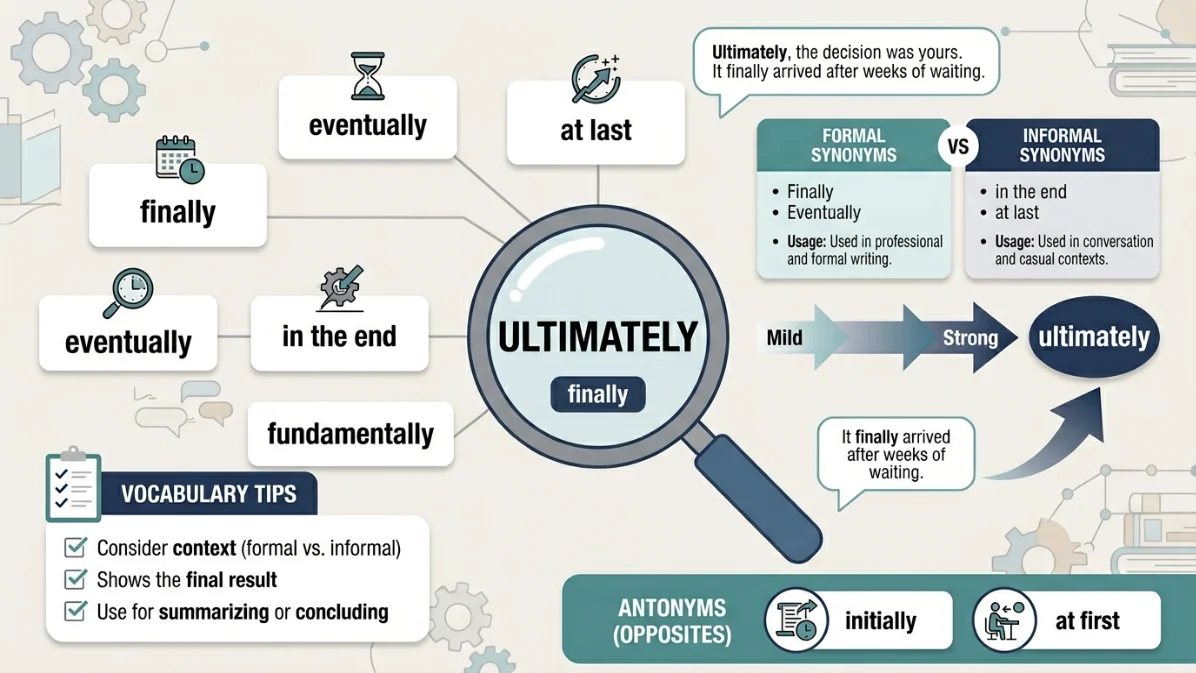
Have you ever read back your own writing and realized you used the word “ultimately” in nearly every paragraph? You are not alone. This useful word often becomes a crutch for writers who want to signal a final point or a conclusion.
Repeating it too often makes your writing feel repetitive and less engaging. Whether you are writing an email, a college essay, a professional report, or a social media caption, varying your word choice can transform your communication. A more precise synonym can also sharpen your meaning and make your message clearer.
This guide will show you the best ways to express the idea of “ultimately” in almost any situation.
What Does Ultimately Mean?
Ultimately is an adverb that means finally, in the end, or after everything else has been considered. The best synonyms depend on your context. Use “eventually” for time, “finally” for sequence, “fundamentally” for core meaning, “in the end” for casual writing, and “at last” for emotional relief. For professional writing, consider “in conclusion” or “finally.”
Meaning, Tone and Context
Simple definition: Ultimately means at the end of a process, period of time, or sequence of events. It can also refer to the most basic or fundamental level of something.
Part of speech: Adverb
Tone: Neutral, but can lean slightly formal depending on usage.
Formality level: Formal to semi formal. It works well in academic, professional, and serious writing.
Common use cases:
- Drawing a conclusion
- Indicating a final result after a long process
- Highlighting the most important or basic point
- Showing the end of a sequence
Important word forms:
- Ultimately (adverb)
- Ultimate (adjective)
- Ultimacy (noun, rare)
When and How to Use “Ultimately”
Use “ultimately” when you want to emphasize the final result after a series of events. It also works when you want to stress the most essential aspect of something. The word signals that you have considered many factors and have reached a final point.
Professional example:
The team considered several vendors, but they ultimately chose the one with the best customer support.
Personal example:
We debated where to eat for an hour and ultimately ordered pizza.
Academic example:
Ultimately, the study reveals that early education has a profound impact on lifelong learning.
Emotional example:
After years of struggle, she ultimately found peace in her new home.
Creative example:
The hero faced many obstacles, but ultimately, his courage prevailed.
Social media caption example:
We took the scenic route and ultimately ended up at the most beautiful sunset spot.
Email example:
I have reviewed your proposal, and I ultimately agree with your recommended approach.
Resume example:
I ultimately increased sales by 40 percent through targeted marketing strategies.
Another Word for “Ultimately”
Selecting the perfect replacement depends heavily on your audience and purpose. Consider these targeted suggestions.
For professional writing: Use “finally” or “in conclusion” for meetings and summaries. These words sound decisive and clear in business settings.
For academic writing: Choose “fundamentally” or “essentially” to emphasize core findings. These words add intellectual weight to research papers.
For casual conversation: Say “in the end” or “at the end of the day.” These phrases feel natural and conversational.
For emotional writing: Use “at last” or “after everything” to convey relief or strong feeling.
For creative writing: Pick “eventually” for storytelling and “in the final analysis” for dramatic effect.
For resume or workplace use: Use “finally” or “as a result” to show successful outcomes.
For social media captions: Choose “eventually” or “in the end” for a friendly, relatable tone.
For stronger meaning: Use “decisively” to show an action with strong finality.
For softer meaning: Use “in general” or “broadly” to reduce emphasis.
When Not to Use “Ultimately”
Do not use “ultimately” when you mean something more specific. The word becomes vague when a precise term would work better. For example, do not say “ultimately” if you mean “quickly” or “suddenly.
Vague example:
Ultimately, I finished the project.
Improved:
I finished the project on time.
Vague example:
Ultimately, she walked through the door.
Improved:
She finally walked through the door.
Vague example:
Ultimately, the problem was solved.
Improved:
The problem was solved efficiently.
Vague example:
Ultimately, he made a mistake.
Improved:
He made a costly mistake.
Words Commonly Confused With “Ultimately”
Ultimately vs. Eventually
Main difference: Ultimately focuses on the final outcome or core point. Eventually focuses on time and delay.
Which one is stronger: Ultimately is stronger for conclusions. Eventually is stronger for timing.
Example for ultimately:
Ultimately, your happiness matters most.
Example for eventually:
You will eventually finish the book.
Ultimately vs. Finally
Main difference: Finally is more direct and concrete. Ultimately has a broader, more abstract sense of finality.
Which one is stronger: Finally feels more decisive. Ultimately feels more reflective.
Example for ultimately:
Ultimately, the decision was based on cost.
Example for finally:
Finally, we reached the summit.
Ultimately vs. Fundamentally
Main difference: Ultimately indicates a final point. Fundamentally indicates a basic or essential truth.
Which one is stronger: Fundamentally is stronger for core principles. Ultimately is stronger for final results.
Example for ultimately:
Ultimately, we chose the safer option.
Example for fundamentally:
This approach is fundamentally different.
Ultimately vs. Essentially
Main difference: Essentially means the core or most important part. Ultimately means the final result after everything.
Which one is more formal: Essentially is slightly more formal. Ultimately is more commonly used in general writing.
Example for ultimately:
Ultimately, the project failed.
Example for essentially:
The project essentially failed due to poor planning.
Ultimately vs. In Conclusion
Main difference: In conclusion is used specifically to end a piece of writing or speech. Ultimately can be used more broadly.
Which one is more formal: In conclusion is more formal and structured. Ultimately is more flexible.
Example for ultimately:
Ultimately, we decided to stay home.
Example for in conclusion:
In conclusion, this research shows significant results.
Best Synonym by Context for “Ultimately”
| Context | Best Synonym | Why It Works | Example |
|---|---|---|---|
| Formal writing | In conclusion | Signals a clear, structured ending | In conclusion, these findings support our hypothesis. |
| Academic writing | Fundamentally | Emphasizes core principles and essential truths | Fundamentally, this theory reshapes our understanding. |
| Professional business | Finally | Provides a direct, decisive ending | Finally, we approved the budget for next quarter. |
| Resume | As a result | Shows cause and effect clearly | As a result, I was promoted to senior manager. |
| Casual conversation | In the end | Sounds natural and conversational | In the end, we decided to skip the movie. |
| Creative writing | Eventually | Adds a sense of time and patience | Eventually, the dragon fell asleep. |
| Emotional tone | At last | Conveys relief or satisfaction | At last, she found her true calling. |
| Strong intensity | Decisively | Shows strong, final action | The CEO decisively ended the negotiations. |
| Soft moderate tone | Broadly | Reduces intensity and keeps it general | Broadly, this policy benefits everyone. |
| Social media captions | Eventually | Relatable and easy to read | Eventually, we made it to the concert. |
| US usage | Ultimately | Standard and widely accepted | Ultimately, we chose the blue paint. |
| UK usage | In the final analysis | Preferred in British academic writing | In the final analysis, the data supports this view. |
Which Synonym Should You Choose?
The best synonym depends on the specific situation and what you want to emphasize.
First, consider your formality level. For formal documents, choose “in conclusion” or “fundamentally.” For casual writing, choose “in the end” or “eventually.”
Second, decide if you are emphasizing time or outcome. If time matters, use “eventually” or “finally.” If the outcome matters, use “ultimately” or “in the end.”
Third, think about emotional intensity. For a softer tone, choose “broadly” or “in general.” For stronger emphasis, choose “decisively” or “at last.”
Fourth, match the synonym to your sentence structure. Some words fit better at the beginning of a sentence, while others fit better at the end.
Finally, trust your ear. Read the sentence aloud with each synonym and choose the one that sounds most natural.
Real Life Examples of “Ultimately” in Sentences
School example:
The students studied for weeks and ultimately passed their final exams.
Workplace example:
After months of collaboration, the team ultimately delivered the project ahead of schedule.
Writing example:
The author ultimately reveals the killer in the final chapter.
Conversation example:
We talked about it for hours, but ultimately, we agreed to disagree.
Social media example:
We got lost twice, but ultimately, the road trip was unforgettable.
Resume example:
I ultimately managed a team of 15 people and increased productivity by 20 percent.
Email example:
Thank you for your patience. We ultimately resolved the technical issue.
Storytelling example:
The old man faced many hardships, but ultimately, he lived a happy life.
15 Synonyms for “Ultimately”
| Synonym | Simple Meaning | Best Used For | Example Sentence |
|---|---|---|---|
| Finally | After a long time or at the end | Formal and casual writing | Finally, the jury reached a verdict. |
| Eventually | At some point in the future | Showing time and patience | You will eventually understand the lesson. |
| In the end | After everything is considered | Casual and conversational | In the end, love conquered all. |
| In conclusion | To summarize or finish | Formal speeches and essays | In conclusion, these results are significant. |
| Fundamentally | In a basic or essential way | Academic and intellectual writing | This law is fundamentally flawed. |
| Essentially | In the most important way | Professional and clear explanations | The plan is essentially the same as before. |
| Decisively | In a firm and final way | Strong business decisions | The manager decisively ended the debate. |
| At last | After a long wait | Emotional and personal stories | At last, she graduated from college. |
| As a result | Because of something | Showing cause and effect | As a result, sales increased dramatically. |
| In the final analysis | After careful thought | Formal and analytical writing | In the final analysis, the evidence is clear. |
| After all | Despite everything | Casual and reflective statements | After all, he was only trying to help. |
| All things considered | Thinking about everything | Balanced and fair writing | All things considered, it was a good year. |
| At the end of the day | When everything is done | Conversational and modern phrases | At the end of the day, family matters most. |
| To sum up | To give a brief summary | Quick summaries and presentations | To sum up, we need more funding. |
| With that said | Introducing a final point | Transitional and thoughtful writing | With that said, we should move forward. |
Synonym Groups and Usage Differences
Professional vs. Personal Synonyms
Professional synonyms like “finally” and “as a result” keep your writing clear and objective. Personal synonyms like “in the end” and “after all” add a human touch to casual conversations and personal stories.
Professional example:
Finally, we submitted the quarterly report.
Personal example:
In the end, we just wanted to relax.
Formal vs. Conversational Synonyms
Formal synonyms belong in academic papers, business reports, and official speeches. These include “in conclusion,” “in the final analysis,” and “fundamentally.” Conversational synonyms work best in texts, emails, and casual writing. These include “at the end of the day,” “after all,” and “in the end.”
Formal example:
In conclusion, this study confirms the hypothesis.
Conversational example:
At the end of the day, we all just want to be happy.
Academic Synonyms
Academic writing demands precision. Use “fundamentally” to highlight core concepts. Use “essentially” to simplify complex ideas. Use “in the final analysis” to show deep reflection. These words signal intellectual rigor.
Academic example:
Fundamentally, this theory challenges traditional assumptions.
Professional and Business Synonyms
In emails, reviews, resumes, and presentations, clarity matters most. Use “finally” to end a list. Use “as a result” to show outcomes. Use “decisively” to demonstrate strong action. These words project confidence and competence.
Professional example:
We decisively addressed all client concerns.
Creative or Literary Synonyms
Creative writing benefits from vivid language. Use “at last” for dramatic relief. Use “eventually” to build suspense. Use “in the end” for moral conclusions. These words add texture to stories.
Creative example:
The hero fought bravely, and at last, the kingdom was saved.
Slang or Modern Synonyms
Modern and casual phrases like “at the end of the day” appear in everyday conversation and social media. They are acceptable in informal writing but avoid them in academic or professional contexts.
Modern example:
At the end of the day, it is what it is.
Strongest vs. Weaker Synonyms
Mild intensity: broadly, in general, all things considered.
Moderate intensity: ultimately, finally, in the end.
Strong intensity: decisively, fundamentally, at last.
Emotional vs. Neutral Synonyms
Emotional synonyms add feeling. “At last” expresses relief. “After all” expresses gentle resignation. Neutral synonyms stay factual. “Finally” and “as a result” are straightforward and objective.
Emotional example:
At last, we found each other.
Neutral example:
Finally, we completed the assignment.
Antonyms of “Ultimately”
| Antonym | Meaning | Example Sentence |
|---|---|---|
| Initially | At the beginning | Initially, we planned to go to the park. |
| First | Before anything else | First, we need to gather supplies. |
| At first | In the beginning | At first, she was nervous about the speech. |
| In the beginning | Early in a process | In the beginning, everything seemed simple. |
| Early on | At an early stage | Early on, we realized the project was too big. |
| Primarily | Mainly or mostly | Primarily, we focus on customer satisfaction. |
| Mostly | For the most part | Mostly, people agreed with the decision. |
| Largely | To a great extent | Largely, the event was a success. |
| Partially | Not completely | Partially, we agree with your assessment. |
| Temporarily | For a limited time | Temporarily, we closed the office. |
| Provisionally | For now, but not final | Provisionally, we approved the budget. |
| Conditionally | Depending on conditions | Conditionally, we accepted the offer. |
| Tentatively | Without final commitment | Tentatively, we scheduled the meeting. |
| Superficially | On the surface only | Superficially, the problem seems easy. |
| Externally | From the outside | Externally, the building looks old. |
Comparison: Ultimately vs. Similar Words
Ultimately vs. Finally
Main difference: Ultimately suggests a broad conclusion after considering many factors. Finally suggests the last event in a sequence.
Which one is stronger: Ultimately is stronger for abstract conclusions. Finally is stronger for concrete events.
Example for ultimately:
Ultimately, your health is your greatest wealth.
Example for finally:
Finally, I finished my homework.
Ultimately vs. Eventually
Main difference: Ultimately emphasizes the final result. Eventually emphasizes the passage of time.
Which one is more formal: Ultimately is more formal. Eventually is more neutral.
Example for ultimately:
Ultimately, the company chose a new direction.
Example for eventually:
Eventually, the company will need to change direction.
Ultimately vs. Essentially
Main difference: Ultimately points to the final outcome. Essentially points to the core nature of something.
Which one is stronger: Essentially is stronger for defining something. Ultimately is stronger for concluding something.
Example for ultimately:
Ultimately, we all want the same thing.
Example for essentially:
This policy is essentially a tax increase.
Ultimately vs. Fundamentally
Main difference: Ultimately indicates a final point in time or reasoning. Fundamentally indicates a deep, unchanging truth.
Which one is more academic: Fundamentally is more academic. Ultimately is more general.
Example for ultimately:
Ultimately, the experiment failed.
Example for fundamentally:
The experiment was fundamentally flawed.
Ultimately vs. As a Result
Main difference: Ultimately can mean “in the end” or “fundamentally.” As a result always means “because of something.”
Which one is more causal: As a result is more causal and direct.
Example for ultimately:
Ultimately, we decided to move.
Example for as a result:
As a result of the storm, we decided to move.
Ultimately vs. In Conclusion
Main difference: In conclusion is a signal that a speech or piece of writing is ending. Ultimately is more flexible.
Which one is more formal: In conclusion is more formal and structured.
Example for ultimately:
Ultimately, the choice is yours.
Example for in conclusion:
In conclusion, I thank you for your time.
Common Phrases and Expressions with “Ultimately”
1. Ultimately responsible
Meaning: Having the final responsibility for something.
Example sentence:
The manager is ultimately responsible for the team’s performance.
2. Ultimately decided
Meaning: Made a final decision after a process.
Example sentence:
They ultimately decided to cancel the event.
3. Ultimately led to
Meaning: Caused a final result.
Example sentence:
Poor planning ultimately led to the project’s failure.
4. Ultimately depends on
Meaning: Depends finally on a specific factor.
Example sentence:
The outcome ultimately depends on your effort.
5. Ultimately up to you
Meaning: The final decision is yours.
Example sentence:
The choice is ultimately up to you.
6. Ultimately proved
Meaning: Was finally shown to be true.
Example sentence:
His theory was ultimately proved correct.
7. Ultimately successful
Meaning: Finally achieved success.
Example sentence:
The mission was ultimately successful.
8. Ultimately worth it
Meaning: Worth the effort in the end.
Example sentence:
The long journey was ultimately worth it.
Common Mistakes to Avoid
1. Overusing Ultimately
Repeating “ultimately” too often makes your writing dull. Use synonyms to keep your writing fresh and engaging.
Bad example:
Ultimately, we decided to go. Ultimately, it was a good choice. Ultimately, we had fun.
Good example:
Finally, we decided to go. In the end, it was a good choice. We had fun.
2. Using Ultimately When You Mean Quickly
Ultimately is about finality, not speed. Do not use it when a time adverb like “quickly” or “soon” is better.
Bad example:
He ultimately ran to the store.
Good example:
He quickly ran to the store.
3. Using Ultimately When You Mean Basically
Ultimately focuses on final results. Basically focuses on simplicity. Choose carefully.
Bad example:
Ultimately, you just need to press the button.
Good example:
Basically, you just need to press the button.
4. Using a Casual Synonym in Formal Writing
Avoid phrases like “at the end of the day” in academic papers or business reports. They sound too informal.
Bad example:
At the end of the day, this research is important.
Good example:
Ultimately, this research is important.
5. Using an Overly Dramatic Synonym for Simple Situations
Do not use “at last” for everyday events. Save it for moments of real significance.
Bad example:
At last, I finished my coffee.
Good example:
Finally, I finished my coffee.
6. Choosing the Wrong Emotional Tone
Match your word to the feeling of your sentence. Do not use a neutral word for an emotional moment.
Bad example:
Ultimately, she received the award she dreamed of.
Good example:
At last, she received the award she dreamed of.
7. Using Slang in Academic or Professional Writing
Avoid slang phrases like “at the end of the day” in formal contexts.
Bad example:
At the end of the day, the data supports our claim.
Good example:
In conclusion, the data supports our claim.
FAQs
What is the best synonym for ultimately?
The best synonym depends on your context. For formal writing, use “in conclusion” or “fundamentally.” For casual writing, use “in the end” or “eventually.”
What is a formal synonym for ultimately?
Formal synonyms include “in conclusion,” “in the final analysis,” and “fundamentally.” These words work well in academic and professional settings.
What is an informal synonym for ultimately?
Informal synonyms include “in the end,” “at the end of the day,” and “after all.” These phrases are common in conversation and casual writing.
What is another word for ultimately in professional writing?
In professional writing, use “finally,” “as a result,” or “decisively.” These words sound clear and confident in business contexts.
What is the difference between ultimately and eventually?
Ultimately focuses on the final outcome or core conclusion. Eventually focuses on time and something happening after a delay.
What is the opposite of ultimately?
The opposite of ultimately is “initially” or “at first.” These words refer to the beginning of a process, not the end.
Conclusion
Ultimately is a versatile and useful word, but it should not dominate your writing. Understanding its meaning, tone, and context helps you choose the best synonym for every situation. Remember to consider formality, emotional intensity, and the specific message you want to convey.
The best vocabulary tip is to read your sentences aloud and trust your ear. If a word feels repetitive or awkward, try a synonym from this guide. Small changes in word choice can make your writing clearer, more engaging, and more professional.
Keep this guide handy the next time you write an email, essay, or social media post. With practice, you will naturally choose the perfect word every time.