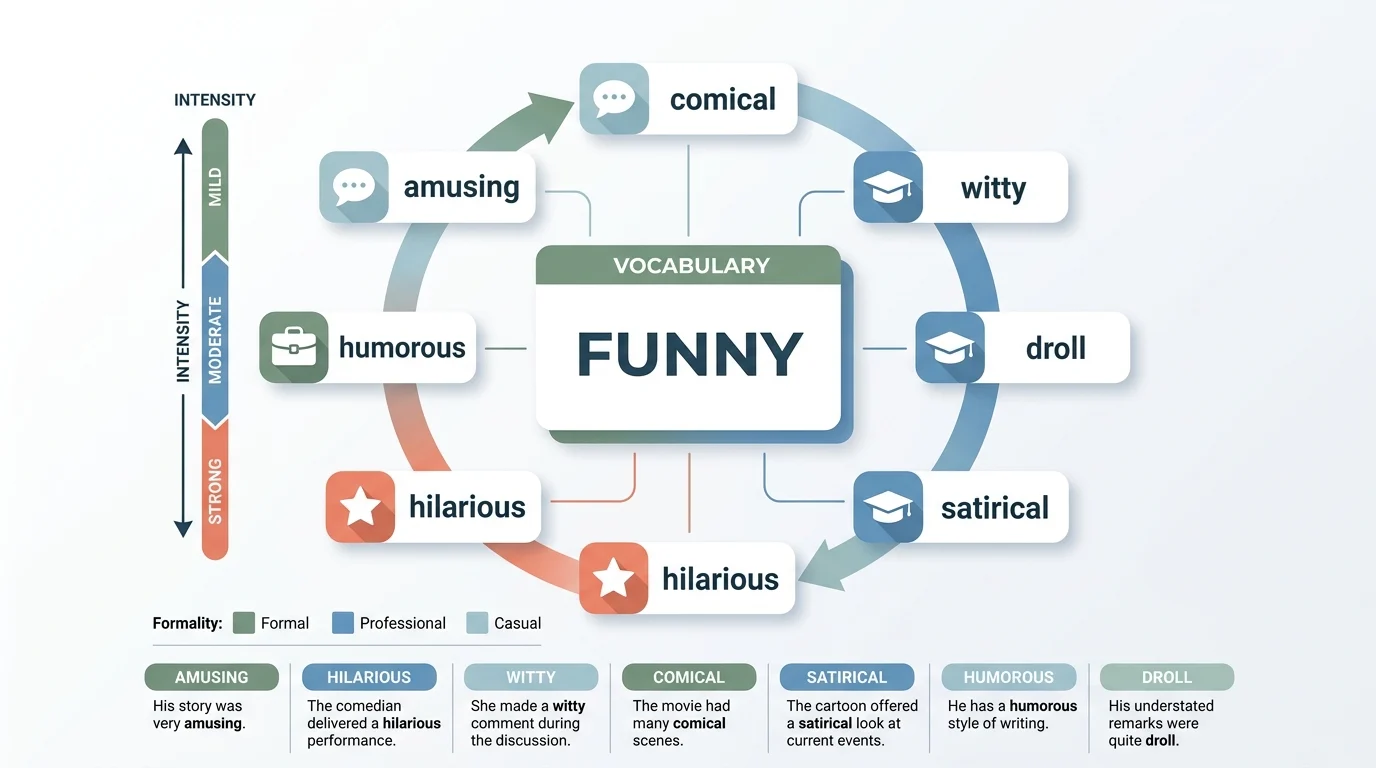
Do you keep using the word “funny” over and over again in your writing? You are not alone. Many writers, students, and professionals struggle to find fresh alternatives for this common word. Whether you are writing a social media caption, an email to a colleague, or a creative story, the word “funny” can start to feel repetitive and vague.
The good news is that English offers a rich variety of words to describe humor in all its forms. This guide will help you choose the perfect synonym for any situation.
What Does “Funny” Mean?
Funny means something that causes amusement or laughter. The best synonyms for funny depend on your context. For professional writing, use humorous or amusing.casual conversation, try hilarious or comical. For creative writing, consider whimsical or droll. Academic writing calls for witty or satirical. Emotional contexts work well with lighthearted or playful.
Meaning, Tone and Context
Simple definition
Funny describes anything that makes you smile, laugh, or feel amused. It can refer to jokes, situations, people, or even facial expressions.
Part of speech
Funny is primarily an adjective.
Tone
Funny is neutral to positive in tone. It becomes negative only when used to mean strange or odd.
Formality level
Funny is informal to neutral. It works in most everyday situations but may be too casual for academic papers or formal business reports.
Common use cases
You will hear funny used in conversations, social media posts, emails, and informal writing. It describes jokes, stories, movies, comedians, and everyday moments.
Important word forms
Funny is the adjective. The adverb form is funnily. The noun form is funniness. The comparative form is funnier. The superlative form is funniest.
When and How to Use “Funny”
Use funny when you want to describe something that causes laughter or amusement in a general way. It is your default word for humor. However, relying on it too often can weaken your writing. The word works well when you do not need to specify the type or intensity of humor.
Professional context
The team presentation included a funny story about the company’s early days.
Personal context
My grandmother tells the funniest stories about her childhood.
Academic context
The author used funny observations to critique social norms in the novel.
Emotional context
Her funny comments lifted everyone’s spirits during a difficult meeting.
Creative context
The playwright wrote a funny scene that had the audience roaring with laughter.
Social media context
This video is too funny not to share with all of you.
Casual context
That movie was so funny that I watched it twice.
Email context
I wanted to share a funny moment from our team offsite last week.
Another Word for “Funny”
The best single replacement for funny depends entirely on your situation. Here are the top alternatives for different contexts.
Professional writing
Use amusing. It sounds more polished than funny and maintains a professional tone while still conveying humor.
Academic writing
Use humorous. This word is precise and widely accepted in scholarly writing about comedy and literature.
Casual conversation
Use hilarious for strong laughter or comical for a lighter, sillier feeling.
Emotional writing
Use lighthearted when you want to convey warmth and gentle humor.
Creative writing
Use whimsical for playful, imaginative humor or droll for dry, clever wit.
Resume or workplace use
Use witty to describe your communication style or engaging to describe presentations.
Social media captions
Use hilarious for maximum reaction or entertaining for a broader appeal.
Stronger meaning
Use or side splitting for extreme laughter.
Softer meaning
Use playful or cheerful for mild, gentle humor.
When Not to Use “Funny”
Funny sounds too vague when you want to describe the specific type of humor you encountered. It also appears weak when you want to emphasize the intensity of laughter.
When funny is too vague
Instead of saying “The movie was funny,” try “The movie was clever” or “The movie was satirical.”
When funny is too casual
Avoid funny in formal business reports. Use humorous or entertaining instead.
When funny is too weak
Do not say “The comedian was funny” if the audience could not stop laughing. Use hilarious.
When funny means strange
Be careful because funny also means odd or unusual. If you mean strange, use that word instead.
When you need a precise description
Replace funny with witty, comical, amusing, or droll to give your reader a clearer picture.
Before and after example
Before: Her speech was funny.
After: Her speech was witty and engaging.
The second sentence gives the reader a more specific impression.
Words Commonly Confused With “Funny”
Funny vs. Humorous
Humorous is more formal. Use humorous in professional or academic writing. Use funny in casual conversation.
Funny vs. Hilarious
Hilarious is much stronger. Use hilarious when something makes you laugh uncontrollably. Use funny for milder amusement.
Funny vs. Comical
Comical suggests silliness or absurdity. Use comical when something is amusing because it seems ridiculous. Use funny for a broader range of humor.
Funny vs. Amusing
Amusing is gentler and more polite. Use amusing in professional settings. Use funny for everyday conversation.
Funny vs. Witty
Witty describes clever, intelligent humor. Use witty for quick jokes and sharp observations. Use funny for any type of humor.
Funny vs. Droll
Droll describes dry, understated, and often ironic humor. Use droll when the humor is subtle and sophisticated. Use funny for more obvious jokes.
Best Synonym by Context for “Funny”
| Context | Best Synonym | Why It Works | Example |
|---|---|---|---|
| Formal writing | Humorous | It maintains a professional, polished tone | The speaker delivered a humorous yet informative address |
| Academic writing | Satirical | It describes humor with intellectual purpose | The novel offers satirical commentary on modern life |
| Business communication | Amusing | It sounds professional without being too casual | Her amusing anecdote helped break the ice |
| Resume writing | Engaging | It describes your communication style positively | Used engaging storytelling in client presentations |
| Casual conversation | Hilarious | It conveys strong amusement in everyday speech | That story was absolutely hilarious |
| Creative writing | Whimsical | It adds imaginative and playful qualities | The whimsical tale charmed readers of all ages |
| Emotional writing | Lighthearted | It conveys gentle warmth and positivity | Her lighthearted attitude lifted the mood |
| Soft tone | Playful | It suggests gentle, harmless amusement | His playful jokes made everyone smile |
| Social media captions | Entertaining | It attracts attention and encourages engagement | This entertaining video will make your day |
| US usage | Comical | It is commonly used and understood across America | The comical scene had the whole theater laughing |
Which Synonym Should You Choose?
Choosing the right synonym for funny starts with understanding your audience. Think about who will read or hear your words. A professional audience expects more formal language. Friends and family appreciate casual expressions.
Consider the intensity of the humor. Did you chuckle quietly or laugh until you cried? Mild situations call for amusing or playful. Strong situations need hilarious.
Think about the type of humor you are describing. Clever wordplay deserves witty. Silly situations fit comical. Gentle humor works with lighthearted. Dry humor calls for droll.
Match your word to your purpose. Are you writing a serious essay? Use satirical. Are you posting on Instagram? Use entertaining or hilarious. Are you writing a work email? Use amusing or humorous.
Real Life Examples of “Funny” in Sentences
School context
The teacher used humorous examples to explain complex grammar rules.
Workplace context
His amusing story about the broken printer made the team meeting more enjoyable.
Academic writing
The researcher presented a satirical analysis of consumer behavior in the digital age.
Casual conversation
My brother told a hilarious joke at dinner that made everyone choke on their food.
Social media context
This entertaining video of a dog learning to skateboard is going viral.
Email context
I wanted to share a lighthearted moment from our project planning session.
Storytelling context
The whimsical character brought unexpected joy to every scene in the novel.
Resume context
Used engaging communication to present quarterly results to senior leadership.
Professional presentation
The keynote speaker delivered a witty opening that captivated the audience.
Creative description
Her droll observations about office life earned her a loyal following online.
25 Synonyms for “Funny”
| Synonym | Simple Meaning | Best Used For | Example Sentence |
|---|---|---|---|
| Humorous | Causing amusement in a thoughtful way | Professional writing, essays | His humorous speech kept the audience engaged throughout |
| Hilarious | Extremely funny, causing great laughter | Casual conversation, social media | The comedian’s routine was absolutely hilarious |
| Amusing | Pleasantly entertaining or enjoyable | Polite conversation, emails | Her amusing story brightened my afternoon |
| Comical | Funny in a silly or absurd way | Casual writing, storytelling | The comical misunderstanding led to an unexpected friendship |
| Witty | Showing clever humor and quick thinking | Intellectual writing, compliments | Her witty remark made everyone pause and think |
| Droll | Dry, understated, and ironic humor | Literary writing, sophisticated contexts | His droll commentary kept the dinner party entertained |
| Satirical | Using humor to criticize or expose | Academic writing, opinion pieces | The satirical article exposed political hypocrisy |
| Playful | Light and fun, not serious | Family contexts, gentle humor | The playful banter between siblings was heartwarming |
| Lighthearted | Cheerful and carefree | Emotional writing, positive messages | Her lighthearted approach eased everyone’s anxiety |
| Entertaining | Providing enjoyment or amusement | Social media, general use | The entertaining performance received a standing ovation |
| Whimsical | Playfully imaginative and unusual | Creative writing, children’s stories | The whimsical tale transported readers to a magical world |
| Jocular | Fond of joking, playful in a friendly way | Professional but relaxed settings | His jocular personality made him popular with colleagues |
| Waggish | Mischievously humorous or playful | Literary writing, character descriptions | The waggish professor kept his students on their toes |
| Facetious | Treating serious issues with deliberately inappropriate humor | Cautious contexts, irony | His facetious comment was not appreciated during the serious meeting |
| Comedic | Relating to comedy or professional humor | Entertainment writing, reviews | The comedic timing of the actors was flawless |
| Campy | Deliberately exaggerated and theatrical | Creative writing, pop culture | The campy horror film became a cult classic |
| Zany | Unconventionally funny | Creative writing, informal use | The zany characters made the show unforgettable |
| Quirky | Unusual in an interesting or amusing way | Personal descriptions, blogs | Her quirky sense of humor set her apart from others |
| Ridiculous | Deserving to be laughed at, absurd | Critical writing, social commentary | The ridiculous plot twist ruined the otherwise good movie |
| Absurd | Wildly unreasonable and funny | Creative writing, humor writing | The absurd situation had everyone questioning reality |
| Side splitting | Extremely funny, causing intense laughter | Informal, strong emphasis | The side splitting comedy had me in tears |
| Farcical | Ridiculously absurd, like a farce | Literary writing, reviews | The farcical elements of the play delighted the audience |
| Jolly | Cheerful and good humored | Traditional or nostalgic contexts | His jolly laugh was contagious |
| Piquant | Pleasantly stimulating or sharp | Sophisticated writing, culinary humor | Her piquant observations added spice to the conversation |
| Delightful | Highly pleasing and entertaining | Positive descriptions, reviews | The delightful comedy was a perfect escape from stress |
Synonym Groups and Usage Differences
Professional vs. Personal Synonyms
Professional settings require words like humorous, amusing, witty, and engaging. These words sound polished and appropriate for workplace communication. Personal contexts allow for playful, hilarious, and comical. These words feel natural with friends and family.
Formal vs. Conversational Synonyms
Formal writing accepts humorous, satirical, and witty. Use these words in reports, essays, and speeches. Conversational contexts welcome hilarious, comical, and zany. Use these in texts, casual emails, and everyday speech.
Academic Synonyms
Academic writing values precision. Use satirical when analyzing humor in literature. Choose ironic for discussing contradictions. Select witty for describing clever language use. These words show intellectual engagement with your subject.
Professional and Business Synonyms
Business communication needs professionalism. Use amusing in internal emails. Select engaging for presentations. Choose witty for networking situations. Avoid hilarious and comical in formal business documents.
Creative or Literary Synonyms
Creative writing thrives on vivid language. Use whimsical for magical, playful humor. Choose droll for dry, sophisticated wit. Select waggish for mischievous characters. These words add depth and imagery to your descriptions.
Slang or Modern Synonyms
Slang words for funny change quickly. Currently, popular options include hilarious, epic, and iconic. Use these on social media and with younger audiences. Avoid slang in professional or academic writing.
Strongest vs. Weaker Synonyms
Mildest
Amusing, pleasant, charming
Moderate
Funny, comical, entertaining
Strong
Hilarious, side splitting,
Intense
Riotous, gut busting, knee slapping
Emotional vs. Neutral Synonyms
Emotional synonyms
Lighthearted adds warmth and comfort.
Playful adds joy and fun.
Whimsical adds wonder and imagination.
Neutral synonyms
Humorous stays factual and professional.
Amusing remains polite but unemotional.
Comical describes without emotional weight.
Antonyms of “Funny”
| Antonym | Meaning | Example Sentence |
|---|---|---|
| Serious | Not funny, grave | The meeting had a serious tone throughout |
| Solemn | Deeply serious and dignified | The solemn ceremony moved everyone to silence |
| Grave | Extremely serious, worrying | His grave expression told us something was wrong |
| Somber | Dark and serious | The somber mood affected the entire room |
| Dull | Lacking interest or excitement | The dull presentation put everyone to sleep |
| Boring | Not interesting or amusing | The boring lecture seemed to last forever |
| Tragic | Causing sadness or suffering | The tragic ending left the audience in tears |
| Unfunny | Not amusing at all | His unfunny jokes made the situation awkward |
| Dry | Not interesting, lacking humor | The dry textbook failed to engage students |
| Dreary | Depressingly dull | The dreary weather matched his mood |
| Humorless | Lacking any sense of humor | His humorless response killed the conversation |
| Monotonous | Boring due to lack of variety | The monotonous speech droned on for hours |
| Tedious | Too long and boring | The tedious task made everyone groan |
| Lifeless | Lacking energy or interest | Her lifeless performance disappointed the critics |
| Melancholy | Deeply sad and thoughtful | The melancholy tone suited the sad story |
Comparison: Funny vs. Similar Words
Funny vs. Humorous
Main difference
Funny is casual and broad. Humorous is formal and intentional.
Which one is stronger
Funny can be stronger in casual contexts.
Which one is more formal
Humorous is significantly more formal.
Example for funny
The funny video made me smile.
Example for humorous
The humorous essay explored the absurdities of modern life.
Funny vs. Hilarious
Main difference
Funny describes mild to moderate amusement. Hilarious describes extreme laughter.
Which one is stronger
Hilarious is much stronger.
Which one is more formal
Funny is slightly more formal than hilarious.
Example for funny
The joke was somewhat funny.
Example for hilarious
The comedy show was absolutely hilarious.
Funny vs. Amusing
Main difference
Funny can cause laughter. Amusing causes mild pleasure.
Which one is stronger
Funny is generally stronger.
Which one is more formal
Amusing is more formal and polite.
Example for funny
The story was funny enough to share.
Example for amusing
The amusing anecdote brightened the conversation.
Funny vs. Witty
Main difference
Funny describes any humor. Witty describes clever, intelligent humor.
Which one is stronger
Witty implies higher quality humor.
Which one is more formal
Witty is more formal and admired.
Example for funny
His funny comments made everyone laugh.
Example for witty
Her witty reply impressed the entire panel.
Funny vs. Comical
Main difference
Funny is general. Comical suggests silliness or absurdity.
Which one is stronger
Comical often describes more visible humor.
Which one is more formal
Comical is slightly more formal.
Example for funny
The situation was rather funny.
Example for comical
The comical scene had the audience in stitches.
Funny vs. Droll
Main difference
Funny is straightforward. Droll is dry, understated, and ironic.
Which one is stronger
Funny can be stronger or weaker. Droll is subtle.
Which one is more formal
Droll is more sophisticated and literary.
Example for funny
He told a funny story about his cat.
Example for droll
His droll observations about modern art amused the gallery crowd.
Common Phrases and Expressions with “Funny”
1. Funny bone
Meaning
A sense of humor or the part of the body that feels a tingling sensation when hit.
Example sentence
The comedy special really tickled my funny bone.
2. Funny business
Meaning
Suspicious or dishonest behavior.
Example sentence
I suspect there is some funny business happening with the accounts.
3. Funny feeling
Meaning
A strange or uneasy intuition.
Example sentence
I have a funny feeling that something good is about to happen.
4. Funny money
Meaning
Counterfeit currency or illegally obtained money.
Example sentence
The authorities seized a large amount of funny money in the raid.
5. Funny turn
Meaning
A sudden strange feeling or slight illness.
Example sentence
She had a funny turn and needed to sit down.
6. Funny as a crutch
Meaning
Not funny at all, the opposite of amusing.
Example sentence
His attempt at humor was as funny as a crutch.
7. Funny ha ha or funny strange
Meaning
Used to clarify whether something is amusing or odd.
Example sentence
Did you mean funny ha ha or funny strange?
8. The funny thing is
Meaning
Used to introduce an amusing or surprising fact.
Example sentence
The funny thing is that he had no idea we were planning a party.
Common Mistakes to Avoid
Using funny when a more precise synonym is better
Saying “the speech was funny” is vague. Instead, say “the speech was witty” or “the speech was engaging.” This gives your reader a clearer impression.
Confusing funny with a related word
Remember that funny also means strange. If you mean something is unusual, say strange or odd. This prevents confusion.
Using a casual synonym in formal writing
Avoid hilarious and comical in academic papers. Use humorous or satirical instead. Your writing will sound more professional.
Using an overly dramatic synonym for a simple situation
Do not say “the mildly amusing anecdote” This sounds exaggerated and insincere. Match the intensity to the situation.
Repeating the same word too often
Vary your vocabulary. Use amusing, entertaining, and witty in the same piece. This keeps your writing fresh and interesting.
Choosing a synonym with the wrong emotional tone
Do not use satirical for a lighthearted joke. The tone will feel off. Match the emotional weight to your content.
Using slang in academic or professional writing
Avoid terms like epic or iconic in formal contexts. Stick with humorous, amusing, or witty. Your credibility will remain intact.
Forgetting that some synonyms sound old fashioned
Words like jolly and whimsical can feel dated. Use them only when the context supports a traditional or literary tone.
Overusing synonyms for the sake of variety
Sometimes funny is the best word. Do not force an awkward synonym into your writing. Natural language always wins.
Using synonyms without understanding their connotations
Study each synonym before using it. Some words carry cultural or historical baggage. Choose words that align with your intended meaning.
FAQs
What is the best synonym for funny?
The best synonym depends on your context. Use humorous for formal writing, hilarious for strong laughter, and amusing for polite conversation.
What is a formal synonym for funny?
Humorous is the most formal synonym for funny. It appears frequently in academic, professional, and literary contexts.
What is an informal synonym for funny?
Hilarious and comical are popular informal synonyms. They work well in casual conversation and social media posts.
What is another word for funny in professional writing?
Use amusing or engaging in professional writing. These words sound polished and appropriate for workplace communication.
What is the difference between funny and humorous?
Funny is casual and general. Humorous is formal and implies intentional wit. Use funny in conversation and humorous in writing.
What is the opposite of funny?
Serious is the most common opposite of funny. Other antonyms include solemn, grave, boring, and dull.
Conclusion
Funny remains one of the most useful words in English, but it should never be your only option. The right synonym transforms your writing from adequate to exceptional. Choose amusing for polite company. Select hilarious for genuine laughter. Pick witty for clever observations. Remember that context, audience, and intensity guide your choice. The next time you reach for the word funny, pause and consider your options. Your readers will appreciate the variety and precision. Keep this guide handy and watch your vocabulary grow.