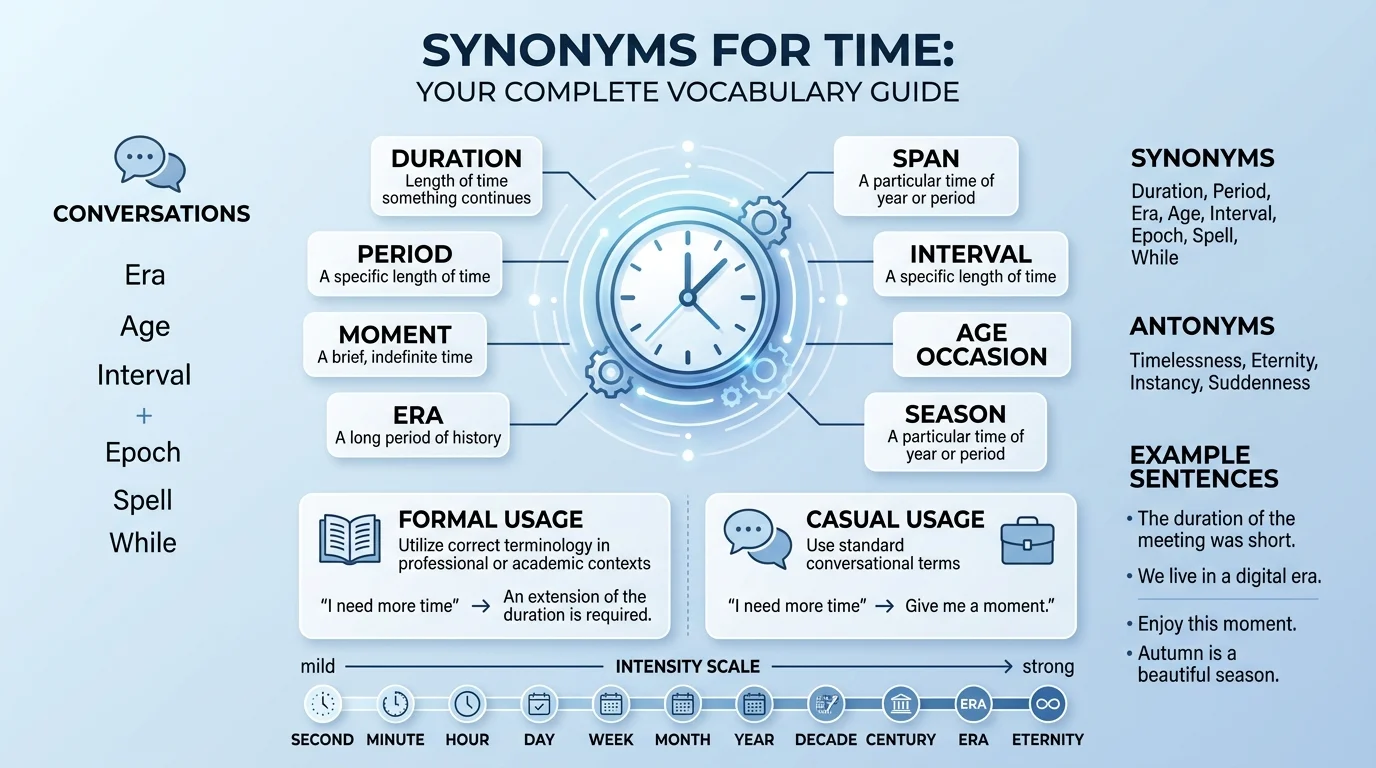
Do you keep using the word “time” over and over in your emails, essays, or everyday conversations?
You are not alone.
Many writers and speakers struggle to find fresh ways to express this essential concept.
Whether you are crafting a professional report, writing a creative story, or simply trying to sound more articulate, having a rich vocabulary for time related words makes a significant difference.
This guide will help you master synonyms for time and choose the perfect word for every situation.
What Does “Time” Mean?
Time refers to the ongoing sequence of existence and events from past through present to the future. The best synonyms for time depend on context. Use “duration” for formal writing, “period” for academic work, “moment” for casual conversation, and “era” for creative expression. Each synonym carries a unique tone and meaning.
Meaning, Tone and Context
Simple Definition
Time is the measurable period during which actions, events, or conditions exist or continue.
Part of Speech
Time functions primarily as a noun. It can also appear as a verb meaning to schedule or measure.
Tone
Time is neutral in tone. Its synonyms range from neutral to positive or negative depending on the word choice.
Formality Level
The word “time” is neutral and works in all contexts. Some synonyms are more formal, while others are more casual.
Common Use Cases
People use time to discuss schedules, historical periods, specific moments, durations, and opportunities.
Important Word Forms
Related forms include timely (adjective), timeless (adjective), and temporal (adjective). The verb form is “to time.”
When and How to Use “Time”
You should use “time” when you need a simple, clear, and universally understood word.
Here are examples showing time in different contexts.
Professional Context
The project manager allocated enough time for each phase of development.
Personal Context
I need to find time to visit my family this weekend.
Academic Context
The study measured the time required for students to complete each task.
Emotional Context
She cherished the time she spent with her grandmother.
Creative Context
Time moved like a slow river through the sleepy town.
Social Media Context
The time has come for positive change in our community.
Email Context
Please let me know a convenient time for our meeting next week.
Resume Context
Consistently delivered projects on time and within budget.
Another Word for “Time”
The best single replacement for time depends entirely on your context and intended meaning.
Professional Writing
Duration works best for workplace communication about project lengths and meeting schedules.
Academic Writing
Period provides the precision needed for research papers and scholarly articles.
Casual Conversation
Moment offers a natural, everyday feel for friendly discussions.
Emotional Writing
Season adds a poetic touch when describing personal growth or life changes.
Creative Writing
Epoch brings dramatic weight to storytelling and descriptive passages.
Resume or Workplace Use
Schedule or timeline demonstrates organization and professional awareness.
Social Media Captions
Hour or minute keeps captions short and relatable.
Stronger Meaning
Eternity or age suggests a very long period of time.
Softer Meaning
Instant or second implies a brief moment.
When Not to Use “Time”
Avoid using “time” when the word sounds too vague or general for your meaning.
Consider this example.
Vague sentence
The time we spent together was good.
More precise
Our afternoon together was delightful.
The vague sentence leaves the reader wondering which time and what kind of experience.
Another vague example
I need time for this project.
More precise
I need two weeks to complete this project.
Specific time words create clearer communication and stronger writing.
Words Commonly Confused With “Time”
Several words relate to time but have distinct meanings. Understanding these differences helps you choose correctly.
Time vs. Timing
Time refers to duration or a specific moment. Timing refers to the selection of the best moment for action.
Time vs. Tense
Time relates to chronology. Tense relates to grammatical verb forms that indicate time.
Time vs. Age
Time measures general duration. Age measures how old someone or something is.
Time vs. Era
Time is a general term. Era refers to a long and distinctive historical period.
Time vs. Season
Time is neutral. Season often implies a period characterized by particular events or qualities.
Time vs. Opportunity
Time simply marks duration. Opportunity implies a favorable moment for action.
Best Synonym by Context for “Time”
| Context | Best Synonym | Why It Works | Example |
|---|---|---|---|
| Formal Writing | Duration | Sounds precise and professional | The duration of the experiment lasted six months. |
| Academic Writing | Period | Provides scholarly precision | The study covered a period of five years. |
| Professional Business | Timeline | Emphasizes structure and planning | We need a clear timeline for product delivery. |
| Resume Writing | Tenure | Shows experience and commitment | Five years of tenure in project management. |
| Casual Conversation | Moment | Feels natural and approachable | Give me a moment to think about it. |
| Creative Writing | Era | Adds depth and imagination | The era of discovery changed everything. |
| Emotional Tone | Season | Carries warmth and reflection | This is the season of new beginnings. |
| Strong Intensity | Eternity | Suggests endlessness and power | It felt like an eternity waiting for news. |
| Soft Moderate Tone | Minute | Keeps things light and brief | I will be there in a minute. |
| Social Media Captions | Hour | Simple and relatable for posts | Best hour of my day, right here. |
Which Synonym Should You Choose?
Choosing the right synonym for time requires attention to several factors.
Start with your audience. Are you writing for colleagues, professors, friends, or the general public?
Next, consider your purpose. Are you describing duration, scheduling, history, or a specific moment?
Think about emotional intensity. Do you need a neutral word or something with feeling?
Consider sentence flow. Does the synonym match your paragraph rhythm and overall tone?
Finally, test your choice. Read the sentence aloud with the synonym to ensure it sounds natural.
Real Life Examples of “Time” in Sentences
These examples show how time and its synonyms appear in everyday situations.
School Example
The teacher explained that time management helps students succeed academically.
Workplace Example
Our team revised the project timeline to accommodate the new requirements.
Writing Example
Every writer must consider time as a key element in narrative structure.
Conversation Example
We have time to grab coffee before the movie starts.
Social Media Example
Time flies when you are living your best life.
Resume Example
Managed multiple deadlines with excellent time organization skills.
Email Example
I appreciate your time and consideration of my proposal.
Storytelling Example
In that moment, time seemed to stand perfectly still.
Using a stronger synonym
The contract specified a duration of twelve months for the service agreement.
Using a formal synonym
The historical period witnessed significant technological advancement.
25 Synonyms for “Time”
| Synonym | Simple Meaning | Best Used For | Example Sentence |
|---|---|---|---|
| Duration | Length of time something continues | Formal writing and reports | The duration of the training program is six weeks. |
| Period | Specific portion of time | Academic and historical contexts | The Victorian period produced remarkable literature. |
| Era | Long distinctive historical phase | Creative and historical writing | The digital era transformed how we communicate. |
| Age | Long period with particular features | Academic and literary contexts | We live in the age of information. |
| Epoch | Significant time in history | Formal historical writing | The Renaissance epoch changed European culture. |
| Interval | Gap between events | Scheduling and planning | We scheduled an interval between meetings. |
| Span | Full extent of time | Describing coverage or range | The manager’s span of control covers three departments. |
| Phase | Stage in a process | Project management and development | The testing phase requires additional resources. |
| Season | Period with particular qualities | Emotional and reflective writing | This is the season of personal growth. |
| Moment | Very brief time | Casual conversation and storytelling | Wait a moment while I check the schedule. |
| Instant | Extremely short moment | Emphasizing quickness | The solution appeared in an instant. |
| Second | Brief period | Casual and everyday use | Give me one second to respond. |
| Minute | Short time | Relaxed conversation | I will join you in a minute. |
| Hour | Specific measurement | Scheduling and daily life | The meeting starts in one hour. |
| Day | Full rotation period | General planning and conversation | We need a day to prepare the presentation. |
| Week | Seven day period | Professional and personal planning | The project will finish in a week. |
| Month | Monthly calendar period | Business and academic contexts | We review performance every month. |
| Year | Full calendar cycle | Annual planning and reflection | This year brought significant progress. |
| Decade | Ten year period | Historical and social commentary | The decade saw remarkable technological change. |
| Century | One hundred years | Long term historical analysis | The twentieth century witnessed two world wars. |
| Millennium | One thousand years | Epic historical perspective | The new millennium began with global celebration. |
| Timetable | Schedule of events | Professional planning | The timetable outlines all training sessions. |
| Schedule | Planned timing | Workplace organization | We followed the schedule precisely. |
| Chronology | Order of events | Historical and academic writing | The chronology clarifies the sequence of discoveries. |
| Eternity | Infinite time | Emotional and philosophical writing | The love between them felt like eternity. |
Synonym Groups and Usage Differences
Professional vs. Personal Synonyms
Professional contexts demand precise time words that show organization and clarity.
Use schedule, timetable, timeline, or duration in workplace settings.
Personal contexts allow softer synonyms like moment, season, or hour.
These personal synonyms create warmth and connection in casual conversation.
Formal vs. Conversational Synonyms
Formal writing benefits from words like duration, epoch, span, and chronology.
These words appear in reports, academic papers, and professional speeches.
Conversational settings welcome shorter synonyms like moment, second, or minute.
These casual options keep conversations flowing naturally.
Academic Synonyms
Academic writing requires precise words that demonstrate scholarly understanding.
Period, era, age, and phase work well in research and essays.
These synonyms show careful thinking about historical and scientific time concepts.
Professional and Business Synonyms
Workplace communication thrives on clear time related vocabulary.
Timeline, schedule, deadline, and timetable provide structure to business discussions.
These words help teams coordinate and meet organizational goals.
Creative or Literary Synonyms
Creative writing flourishes with vivid time words that paint pictures.
Epoch, season, millennium, and eternity add depth and imagination to stories.
These synonyms help writers create atmosphere and emotional resonance.
Strongest vs. Weaker Synonyms
Time synonyms vary in intensity from brief to infinite.
The mildest synonyms include moment, second, and minute.
The strongest synonyms include eternity, age, and millennium.
Choose intensity based on your intended emotional impact.
Emotional vs. Neutral Synonyms
Neutral time words simply mark duration or sequence.
Duration, period, and interval stay factual and objective.
Emotional synonyms like season, eternity, and moment carry feeling and personal significance.
Antonyms of “Time”
| Antonym | Meaning | Example Sentence |
|---|---|---|
| Eternity | Endless time without beginning or end | Eternity stands in contrast to our limited time on Earth. |
| Timelessness | Quality of being unaffected by time | The artwork achieves a sense of timelessness. |
| Infinity | Unlimited extent of time or space | Infinity makes our brief time seem precious. |
| Agelessness | Never appearing old or affected by time | Her agelessness seems to defy time itself. |
| Perpetuity | State of lasting forever | The contract remains in perpetuity. |
| Unending | Having no end | The journey felt unending to the travelers. |
| Endless | Without limits | The endless time stretched before them. |
| Permanent | Lasting indefinitely | Permanent installation requires time and planning. |
| Everlasting | Continuing forever | The everlasting love lasted through time. |
| Continuous | Uninterrupted sequence | Continuous progress requires time and effort. |
| Constant | Unchanging over time | The constant rhythm marked time passing. |
| Unceasing | Never stopping | The unceasing motion continued through time. |
| Interminable | Seemingly endless time | The interminable meeting exhausted everyone. |
| Uninterrupted | Without breaks in time | They enjoyed uninterrupted time together. |
| Boundless | Having no limits in time | Boundless time allowed for complete exploration. |
Comparison: Time vs. Similar Words
Time vs. Duration
The main difference is specificity. Time is general. Duration is the measurable length of time.
Duration sounds more precise and professional.
Time example
Time passes quickly when you enjoy yourself.
Duration example
The duration of the movie is exactly two hours.
Time vs. Period
Time is broader. Period refers to a specific portion of time.
Period is more formal and academic.
Time example
We need more time to complete the research.
Period example
The study examined a period of five years.
Time vs. Era
Time is neutral. Era implies a significant historical or cultural phase.
Era carries more dramatic weight.
Time example
We live in interesting time for technology.
Era example
The era of industrialization changed society permanently.
Time vs. Moment
Time can mean a long or short period. Moment always means a brief time.
Moment feels more personal and emotional.
Time example
I have no time for unimportant matters.
Moment example
This moment will stay with me forever.
Time vs. Age
Time measures general duration. Age measures how long someone or something has existed.
Age often relates to people or historical periods.
Time example
We measured the time required for completion.
Age example
The age of the building is over one hundred years.
Time vs. Season
Time is neutral. Season implies a period with particular qualities or events.
Season carries emotional meaning.
Time example
The time has come for change.
Season example
This is the season of gratitude and reflection.
Common Phrases and Expressions with “Time”
1. Time flies
Meaning: Time passes quickly
Example sentence: Time flies when you are working on something you love.
2. Time is money
Meaning: Time is valuable and should not be wasted
Example sentence: In business, time is money, so we avoid unnecessary meetings.
3. Killing time
Meaning: Doing something to pass time while waiting
Example sentence: We browsed the bookstore while killing time before our reservation.
4. In the nick of time
Meaning: Just before it is too late
Example sentence: We arrived in the nick of time for the departure.
5. Time and tide wait for no one
Meaning: Time keeps moving regardless of what people do
Example sentence: We need to act now because time and tide wait for no one.
6. The time of your life
Meaning: An extremely enjoyable experience
Example sentence: She had the time of her life during summer vacation.
7. Time after time
Meaning: Repeatedly, many times
Example sentence: Time after time, we see the importance of preparation.
8. Waste of time
Meaning: Something not worth the time spent
Example sentence: Arguing about minor details is a waste of time.
Common Mistakes to Avoid
1. Using “time” when a more precise synonym works better
Instead of saying “the time of the event,” say “the timing of the event.”
Precision improves clarity and professionalism.
2. Confusing “time” with “tense”
Time relates to chronology. Tense relates to grammar.
Do not use grammatical terms to describe chronological concepts.
3. Using casual synonyms in formal writing
Avoid “minute” or “second” in academic papers.
Choose “duration” or “period” for scholarly contexts.
4. Using overly dramatic synonyms for simple situations
Do not say “eternity” when “moment” is accurate.
Match intensity to your subject matter.
5. Repeating the same time word too often
Vary your time vocabulary to keep writing fresh.
Use duration, span, and period instead of time repeated five times.
6. Choosing a synonym with the wrong emotional tone
Avoid negative time words when you want positive meaning.
Use “season” instead of “phase” for personal growth.
7. Using slang or overly casual terms in professional writing
Avoid “tick” or “sec” in workplace communication.
Stick to standard professional time vocabulary.
FAQs
What is the best synonym for time?
The best synonym depends on your context. Duration works for formal writing, moment for casual conversation, and era for creative expression.
What is a formal synonym for time?
Duration, period, and chronology are formal synonyms for time suitable for academic and professional writing.
What is an informal synonym for time?
Moment, minute, and second are informal synonyms for time used in everyday conversation.
What is another word for time in professional writing?
Timeline, schedule, and duration are excellent professional synonyms for time in workplace contexts.
What is the difference between time and timing?
Time refers to duration or a specific moment. Timing refers to the selection of the best moment for action.
What is the opposite of time?
Eternity, timelessness, and infinity are common antonyms of time, suggesting endless duration.
Conclusion
Time is one of the most essential words in the English language. Its synonyms provide rich opportunities for precise, vivid, and effective communication. Remember to match your time vocabulary to your context, audience, and purpose. Choose duration for formal reports, moment for casual talks, and era for creative storytelling. Practice using these alternatives and your writing will grow stronger and more engaging.
The key to vocabulary improvement is consistent application. Start by replacing time with one new synonym each day and notice how your communication becomes more nuanced and professional.