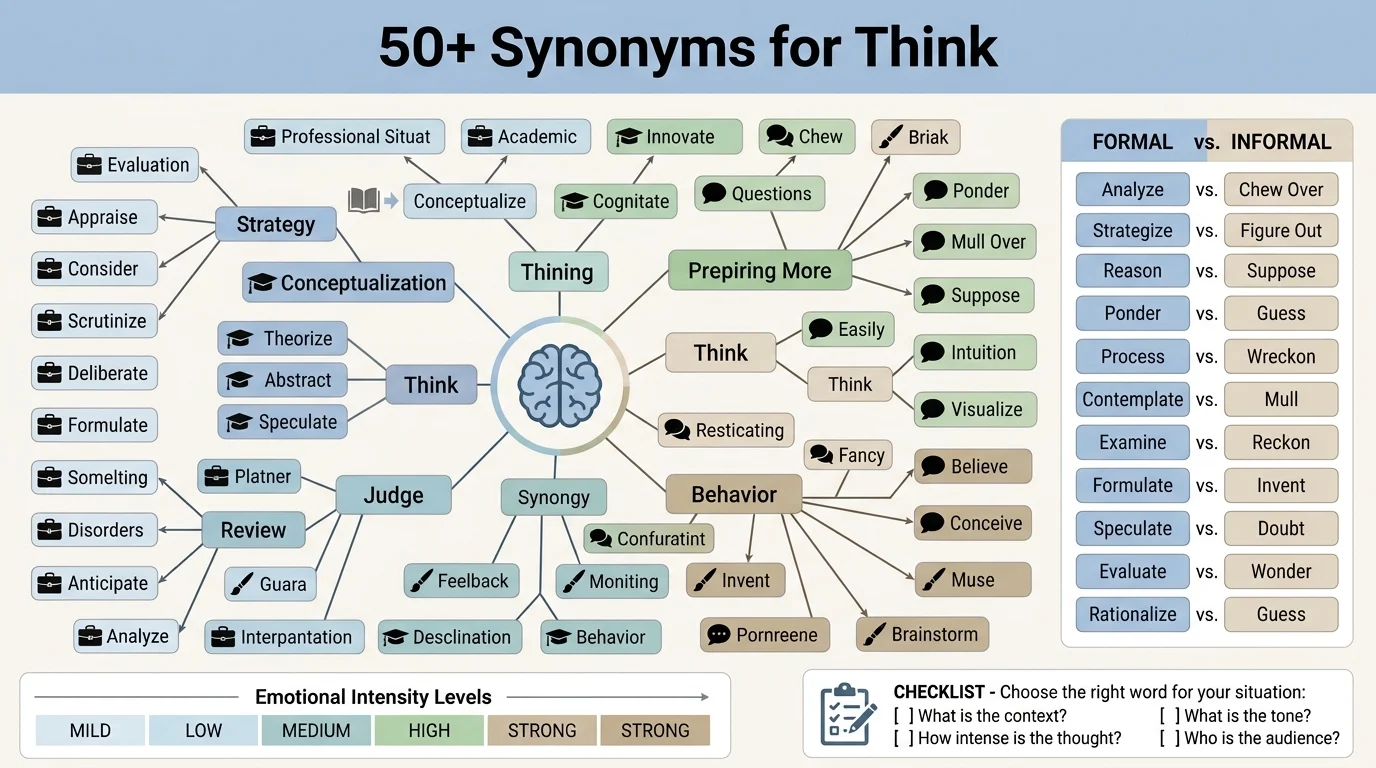
Do you catch yourself using the word “think” over and over in your emails, essays, or conversations? You are not alone. Many writers, students, and professionals rely on this single word far too often. The result can feel repetitive and dull.
Imagine you are writing a cover letter and every sentence starts with “I think.” Your reader might question your confidence. Now picture using precise alternatives like “believe,” “assume,” or “consider.” Your message becomes stronger and more persuasive.
This guide will help you replace “think” with the perfect synonym for any situation. You will learn the exact meaning, tone, and context for dozens of alternatives. By the end, your vocabulary will feel richer and more professional.
What Does “Think” Mean?
To think means to use your mind to form ideas, opinions, or judgments about something. The best synonyms depend on your situation. Use “believe” for personal opinions, “consider” for careful evaluation, “assume” for educated guesses, “reflect” for deep thought, “conclude” for final decisions, and “imagine” for creative thinking.
Meaning, Tone and Context
The word “think” serves as one of the most common verbs in English. It describes the mental process of processing information, forming ideas, or reaching conclusions. Understanding its nuances helps you choose better alternatives.
- Simple definition: To have an opinion, idea, or belief about something.
- Part of speech: Verb (irregular: think, thought, thought).
- Tone: Neutral. It does not carry strong emotional weight on its own.
- Formality level: Neutral and highly versatile. Works in any context.
- Common use cases: Expressing opinions, analyzing information, making decisions, imagining possibilities, remembering past events.
- Word forms: Think (verb), thought (noun/past tense), thinking (noun/gerund), thoughtful (adjective), thoughtless (adjective).
When and How to Use “Think”
Think works well when you need a general, neutral word for mental activity. It fits almost any situation. However, its simplicity can sometimes make your writing feel vague or unsophisticated.
Reserve “think” for everyday conversations and casual writing. In professional or academic contexts, consider using more precise alternatives that better capture your exact meaning.
Here are examples showing how “think” works in different contexts:
Professional context: I think we should extend the project deadline by one week.
Personal context: I think my sister would love this gift.
Academic context: The researcher thinks the results support the initial hypothesis.
Emotional context: Sometimes I think about how fast my children are growing up.
Creative context: The artist thinks in images rather than words.
Social media caption: I think this is my new favorite coffee shop.
Email context: I think Thursday works best for our meeting.
Casual conversation: What do you think about the new restaurant downtown?
Another Word for “Think”
The best single replacement for “think” depends entirely on your situation. You would not use the same word in a business proposal and a creative poem.
Here are direct suggestions for different contexts:
Professional writing: Consider or believe. These sound confident and polished.
Academic writing: Analyze or hypothesize. These show intellectual rigor.
Casual conversation: Figure or guess. These feel natural and friendly.
Emotional writing: Reflect or ponder. These add depth and feeling.
Creative writing: Imagine or envision. These spark visual imagery.
Resume or workplace: Evaluate or conclude. These demonstrate decision making skills.
Social media captions: Feel or guess. These sound authentic and relatable.
Stronger meaning: Assert or declare. These express firm certainty.
Softer meaning: Suppose or suspect. These show polite uncertainty.
When Not to Use “Think”
Avoid “think” when your writing needs precision or authority. This word sounds vague in formal reports, academic papers, and persuasive arguments. It can also weaken your credibility in professional settings.
Using “think” repeatedly in creative writing makes your prose feel flat. It lacks the descriptive power of words like “ponder” or “contemplate.” In speeches, relying on “think” reduces your perceived confidence.
Consider this weak sentence: “I think we should change our strategy.”
Now compare it with this stronger version: “I recommend we change our strategy.” The second sentence sounds more authoritative and decisive.
Another example: “I think the experiment failed because of contamination.”
Better alternative: “The experiment likely failed because of contamination.” This removes unnecessary self reference and sounds more objective.
Words Commonly Confused With “Think”
Several words relate to “think” but carry distinct meanings. Using them incorrectly can confuse your readers or change your message entirely.
Think vs. Believe
Think expresses a general mental process. Believe expresses acceptance of something as true. You might think about a problem but believe in a particular solution. Use “think” for mental activity and “believe” for convictions.
Think vs. Consider
Consider implies careful, deliberate evaluation. Think is more general and casual. You consider all options before making a decision. You think about what to eat for lunch. Consider suggests more thorough mental effort.
Think vs. Assume
Assume means taking something for granted without proof. Think does not carry this implication. You think the store opens at nine. You assume it opens at nine based on past experience. Assume suggests a guess, while think can include knowledge.
Think vs. Suppose
Suppose suggests a tentative guess or hypothesis. Think can be more definitive. You suppose the answer is correct. You think the answer is correct. Suppose feels less certain and more speculative.
Think vs. Reflect
Reflect means thinking deeply or meditatively about something. Think is more general. You reflect on your life choices. You think about what to have for dinner. Reflect implies more serious, sustained thought.
Think vs. Imagine
Imagine involves forming mental images or creative ideas. Think can be factual. You imagine winning the lottery. You think about your grocery list. Imagine is creative while think covers all mental activity.
Best Synonym by Context for “Think”
| Context | Best Synonym | Why It Works | Example |
|---|---|---|---|
| Formal writing | Posit | Sounds scholarly and precise | The professor posits that economic growth follows innovation cycles. |
| Academic writing | Hypothesize | Shows scientific reasoning | Researchers hypothesize that sleep affects memory consolidation. |
| Professional business | Evaluate | Demonstrates analytical thinking | The team will evaluate the proposal before making a recommendation. |
| Resume usage | Analyze | Shows critical thinking skills | Analyzed market data to identify growth opportunities. |
| Casual conversation | Reckon | Feels natural and friendly | I reckon we should leave before traffic gets heavy. |
| Creative writing | Envision | Adds visual imagery | She could envision a world where kindness ruled. |
| Emotional tone | Ponder | Adds depth and reflection | He pondered the meaning of his grandmother’s words. |
| Strong intensity | Contend | Expresses firm conviction | I contend that our approach is the most effective. |
| Soft moderate tone | Suspect | Expresses gentle uncertainty | I suspect you might enjoy this book. |
| Social media captions | Figure | Sounds authentic and relatable | Just figuring out life one day at a time. |
Which Synonym Should You Choose?
Your choice depends on four key factors. First, consider your meaning. Are you expressing a belief, making a guess, or analyzing information? Second, think about formality. Business reports demand precise words like “evaluate.” Casual conversations welcome words like “figure.”
Third, evaluate emotional intensity. Do you need a neutral word or one that conveys deep feeling? Fourth, consider your audience. Academic readers expect sophisticated vocabulary. Social media followers prefer conversational language.
For professional writing, choose words that demonstrate confidence and precision. creative writing, select words that paint vivid mental pictures. For everyday conversation, pick words that sound natural and unforced.
Remember that context changes everything. The same word can sound perfect in one sentence and awkward in another. Always test your chosen synonym by reading it aloud in the full sentence.
Real Life Examples of “Think” in Sentences
School context: The student thought carefully before answering the exam question. She analyzed each option thoroughly.
Workplace context: Our manager considers every proposal with great attention. She evaluates the pros and cons before deciding.
Writing context: The novelist reflected on her characters’ motivations before writing the next chapter. She pondered their deepest desires.
Conversation context: What do you suppose happened to our old high school friends? I reckon they are all doing well.
Social media context: Just sitting here contemplating life choices. Maybe I should stop overthinking everything.
Email context: I believe Friday works best for the presentation. Please let me know if you have any concerns.
Storytelling context: The detective hypothesized about the criminal’s next move. He considered every possible scenario.
Decision making: After examining all the evidence, I conclude that we need a new approach. Our current method is not working effectively.
25 Synonyms for “Think”
| Synonym | Simple Meaning | Best Used For | Example Sentence |
|---|---|---|---|
| Believe | Accept something as true | Personal opinions and convictions | I believe everyone deserves a second chance. |
| Consider | Think about carefully | Decision making and evaluation | Please consider all options before you decide. |
| Reflect | Think deeply and seriously | Emotional or philosophical thought | She reflected on her childhood memories. |
| Ponder | Think about slowly and carefully | Contemplative situations | He pondered the question for several minutes. |
| Contemplate | Think about something deeply | Serious consideration | The artist contemplated the meaning of life. |
| Deliberate | Think about carefully before deciding | Formal decision making | The jury will deliberate the verdict. |
| Evaluate | Assess or judge carefully | Professional and academic analysis | We need to evaluate the data thoroughly. |
| Analyze | Examine in detail | Research and problem solving | The scientist analyzed the experimental results. |
| Reason | Think logically | Problem solving and arguments | She reasoned that the plan would succeed. |
| Suppose | Assume something is true | Guesses and tentative ideas | I suppose we could try a different approach. |
| Assume | Take for granted without proof | Working theories and expectations | Let us assume the project will finish on time. |
| Guess | Estimate without sufficient information | Casual predictions | Can you guess what happens next? |
| Reckon | Think or suppose informally | Casual conversation | I reckon we will arrive by noon. |
| Figure | Think or suppose informally | Everyday American English | I figure it will cost about fifty dollars. |
| Imagine | Form a mental picture | Creative and hypothetical thinking | Imagine a world without pollution. |
| Envision | Picture something in the future | Planning and dreaming | She envisions a successful career. |
| Conclude | Reach a decision after thinking | Final judgments and decisions | We concluded the meeting was productive. |
| Determine | Decide or find out definitively | Fact finding and decisions | The team determined the cause of the problem. |
| Deduce | Reach a conclusion by reasoning | Logical thinking and investigations | He deduced the answer from the clues. |
| Infer | Conclude from evidence | Reading comprehension and analysis | I inferred her meaning from her tone. |
| Meditate | Think deeply in a focused way | Mindfulness and spiritual practice | She meditated on the nature of happiness. |
| Muse | Think about something thoughtfully | Literary and creative contexts | The poet mused about love and loss. |
| Speculate | Form a theory without firm evidence | Discussions and debates | The experts speculate about future trends. |
| Hypothesize | Suggest an explanation for testing | Scientific and academic writing | The researcher hypothesized a new theory. |
| Recognize | Identify or acknowledge | Acknowledging facts and truths | I recognize that we need to improve. |
Synonym Groups and Usage Differences
Professional vs. Personal Synonyms
Professional contexts require words that demonstrate careful thinking and sound confident. Use “evaluate,” “analyze,” and “determine” in workplace settings. These words show you take decisions seriously.
Personal contexts allow more emotional and casual language. Use “ponder,” “reflect,” and “wonder” when expressing inner thoughts. These words feel natural in conversations and personal writing.
Formal vs. Conversational Synonyms
Formal writing demands sophisticated vocabulary. Use “posit,” “contend,” and “hypothesize” in academic papers and official documents. These words establish credibility and precision.
Conversational settings welcome simpler alternatives. Use “figure,” “reckon,” and “guess” in everyday speech. These words sound friendly and approachable in casual situations.
Academic Synonyms
Academic writing requires precise and objective language. “Hypothesize” works for proposing theories. “Deduce” fits logical reasoning. “Analyze” describes careful examination of evidence. “Infer” explains conclusions drawn from data. These words demonstrate scholarly thinking.
Professional and Business Synonyms
Business communication needs action oriented words. “Evaluate” shows analytical ability. “Determine” demonstrates decision making. “Consider” appears in professional proposals. “Conclude” works for final recommendations. These words make you sound capable and decisive.
Creative or Literary Synonyms
Creative writing benefits from descriptive and emotional alternatives. “Ponder” adds depth to character thoughts. “Contemplate” suggests serious reflection. “Muse” creates a dreamy atmosphere. “Envision” paints vivid mental pictures. “Reflect” adds emotional resonance to narratives.
Slang or Modern Synonyms
Slang alternatives appear in casual digital communication. “Figure” feels natural in texts and social media. “Reckon” works in informal American speech. “Suppose” fits everyday conversation. These words are acceptable in casual settings but avoid them in professional or academic writing.
Strongest vs. Weaker Synonyms
Mildest: Suppose, guess, reckon. These express uncertainty and tentative thinking.
Moderate: Think, believe, consider. These express general opinions.
Strong: Determine, conclude, assert. These express firm decisions and convictions.
Strongest: Contend, insist, maintain. These express unwavering positions.
Emotional vs. Neutral Synonyms
Neutral synonyms: Analyze, evaluate, determine. These describe mental processes without emotional weight. They work well in professional and academic writing.
Emotional synonyms: Ponder, reflect, muse. These add feeling and depth. They work well in personal writing and creative contexts.
Antonyms of “Think”
| Antonym | Meaning | Example Sentence |
|---|---|---|
| Ignore | Pay no attention to | She chose to ignore the warning signs. |
| Forget | Fail to remember | He forgot the meeting time entirely. |
| Overlook | Fail to notice | The report overlooked several important factors. |
| Neglect | Fail to care for properly | They neglected to consider the budget. |
| Disregard | Pay no attention to | The team disregarded his suggestions. |
| Dismiss | Reject as unimportant | She dismissed his concerns too quickly. |
| Doubt | Feel uncertain about | I doubt the accuracy of that claim. |
| Disbelieve | Refuse to accept as true | He disbelieves the official explanation. |
| Reject | Refuse to accept | The committee rejected the proposal. |
| Deny | Refuse to admit | She denied any knowledge of the incident. |
| Misunderstand | Fail to understand correctly | They misunderstood the instructions completely. |
| Confuse | Make unclear or uncertain | His explanation confused everyone. |
| Disregard | Pay no attention to | Please disregard the earlier email. |
| Abandon | Give up completely | They abandoned the original plan. |
| Neglect | Fail to consider | The study neglected an important variable. |
Comparison: Think vs. Similar Words
Think vs. Believe
The main difference lies in conviction. Think describes general mental activity. Believe expresses acceptance of truth. Think is more neutral and flexible. Believe is stronger and more personal. Use think for casual observations. Use believe for core values and convictions.
Example with think: I think the movie starts at eight.
Example with believe: I believe honesty is the best policy.
Think vs. Consider
Consider implies more careful attention than think. Think can be quick and casual. Consider suggests deliberate evaluation. Consider works better in formal decision making. Think fits everyday observations. Consider shows you are giving something proper attention.
Example with think: I think we should order pizza.
Example with consider: Please consider all the evidence before you decide.
Think vs. Assume
Assume suggests a guess without evidence. Think can be based on knowledge. Assume sounds more tentative and speculative. Think can express certainty. Use assume for working theories. Use think for informed opinions.
Example with think: I think she will arrive soon because she texted me.
Example with assume: Let us assume the traffic is light today.
Think vs. Reflect
Reflect implies deeper, more sustained thought than think. Think covers all mental activity. Reflect suggests serious contemplation. Think works for quick mental processes. Reflect fits emotional or philosophical contexts. Reflect carries more weight and emotional depth.
Example with think: I think about my schedule every morning.
Example with reflect: She reflected on her career choices for hours.
Think vs. Imagine
Imagine involves creativity and mental imagery. Think covers factual and creative thought. Imagine suggests forming mental pictures. Think is more neutral and general. Imagine works for hypothetical situations. Think works for real world considerations.
Example with think: I think about my responsibilities.
Example with imagine: Imagine a world with unlimited clean energy.
Think vs. Suppose
Suppose suggests a tentative assumption. Think can express firmer opinions. Suppose sounds more speculative. Think can be definitive. Suppose works for guesses and hypotheses. Think works for general mental activity.
Example with think: I think this is the correct answer.
Example with suppose: Suppose we try a different approach instead.
Common Phrases and Expressions with “Think”
1. Think about it
Meaning: Consider something carefully before making a decision.
Example sentence: The job offer sounds great, but I need some time to think about it.
2. Think twice
Meaning: Consider something carefully before taking action.
Example sentence: You should think twice before quitting your job without a backup plan.
3. Think on your feet
Meaning: React quickly and make decisions in a fast moving situation.
Example sentence: Good salespeople need to think on their feet during client presentations.
4. Think outside the box
Meaning: Think creatively and unconventionally.
Example sentence: Our team needs to think outside the box to solve this challenging problem.
5. Think big
Meaning: Have ambitious goals and ideas.
Example sentence: Successful entrepreneurs always think big and aim high.
6. Think straight
Meaning: Think clearly and logically.
Example sentence: I was so tired that I could not think straight during the meeting.
7. Think ahead
Meaning: Plan for the future and anticipate what will happen.
Example sentence: Smart investors always think ahead and plan for market changes.
8. Think aloud
Meaning: Express your thoughts verbally while thinking.
Example sentence: Please think aloud during the brainstorming session so we can build on your ideas.
Common Mistakes to Avoid
1. Using think when a stronger word fits better
Many writers default to “think” when more precise alternatives exist. Instead of writing “I think we should improve our service,” write “I recommend we improve our service.” The second version sounds more authoritative.
2. Confusing think with assume
Think suggests mental activity based on some knowledge. Assume suggests a guess without proof. Do not write “I assume the data is correct” when you have evidence. Write “I think the data is correct” if you have good reason.
3. Using casual synonyms in formal writing
Words like “reckon” and “figure” belong in casual conversations. Do not use them in business reports or academic papers. Choose “consider,” “evaluate,” or “determine” for professional contexts.
4. Using overly dramatic synonyms for simple situations
Ponder and contemplate sound too serious for everyday decisions. Do not write “I pondered what to eat for lunch.” Use “thought” or “considered” for ordinary choices. Save the dramatic words for meaningful reflection.
5. Repeating think too often
Repeating any word weakens your writing. Keep a list of alternatives handy. Vary your word choice to keep readers engaged. Use synonyms to add interest and precision to your writing.
6. Choosing the wrong emotional tone
Think is neutral. Ponder is reflective. Assume is tentative. Contend is forceful. Match your word choice to your intended emotional impact. Do not sound uncertain when you mean to sound confident.
7. Using slang in academic or professional writing
Avoid “reckon” and “figure” in formal documents. These words undermine your credibility. Save them for texts, social media, and casual conversations. Use formal alternatives in professional settings.
FAQs
1. What is the best synonym for think?
The best synonym depends on your context. Use “believe” for opinions, “consider” for careful thought, and “reflect” for deep contemplation. Choose the word that matches your exact meaning and situation.
2. What is a formal synonym for think?
Formal synonyms include “posit,” “contend,” “hypothesize,” and “conclude.” These words appear in academic papers, business reports, and professional documents. They convey precision and intellectual rigor.
3. What is an informal synonym for think?
Informal synonyms include “reckon,” “figure,” “guess,” and “suppose.” These words fit casual conversations, texts, and social media posts. They sound natural and friendly in everyday contexts.
4. What is another word for think in professional writing?
Professional alternatives include “evaluate,” “analyze,” “determine,” and “consider.” These words demonstrate careful thinking and sound confident. They work well in emails, proposals, and workplace communications.
5. What is the difference between think and believe?
Think describes general mental activity. Believe expresses acceptance of something as true. Think is more casual and flexible. Believe is stronger and more personal. Use think for observations. Use believe for convictions.
6. What is the opposite of think?
The direct opposite is “ignore” or “disregard.” Other antonyms include “forget,” “overlook,” “neglect,” “dismiss,” and “doubt.” These words describe failing to engage in mental processing or attention.
Conclusion
Think remains a useful and versatile word. It serves as a reliable default for general mental activity. However, relying on it too heavily makes your writing feel repetitive and vague.
Better alternatives exist for every situation. Choose “believe” for personal convictions. Pick “consider” for careful evaluation. Use “reflect” for deep emotional thought. Select “determine” for definitive conclusions.
The right word transforms your communication. It adds precision, authority, and emotional depth. It shows your audience that you care about clear expression. Your vocabulary reflects your thinking skills.
Start with one or two new synonyms each week. Practice using them in your writing and conversations. Soon you will naturally reach for the perfect word without thinking about it.
Remember that context determines everything. The same word can sound perfect or inappropriate depending on the situation. Always consider your audience, purpose, and tone before choosing your synonym.