You are writing an important email to a potential client. You want to describe your company’s achievements, but you keep typing the word “success” over and over. It feels repetitive, vague, and weak. You know there must be better ways to express the same idea, but you are not sure which words to use.
This is a common problem for writers, professionals, students, and anyone who communicates in English. The word “success” appears everywhere, from resumes to social media captions. Yet many people struggle to find the right alternatives that match their specific situation.
Understanding the synonyms of success can transform your writing. Choosing the right word helps you communicate with precision, convey the right tone, and avoid sounding repetitive. Whether you are writing a business report, a college essay, a job application, or a casual conversation, having a rich vocabulary of success related words gives you more control over your message.
What Are the Best Synonyms of “Success”?
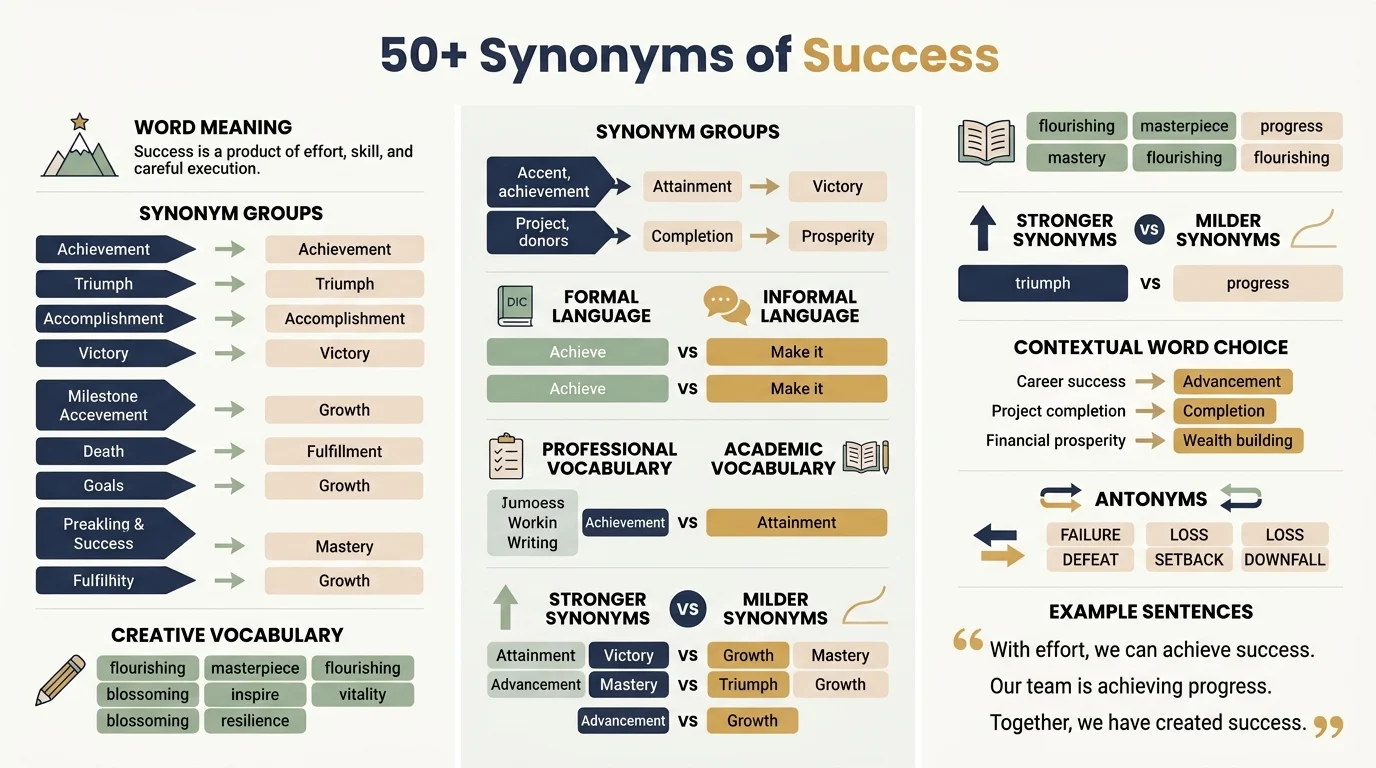
Success means achieving a desired goal, outcome, or favorable result. Its tone is generally positive and neutral, depending on context. For formal writing, use “accomplishment” or “achievement.” For casual conversation, try “win” or “victory.” Academic writing prefers “attainment” or “realization.” Professional communication works well with “prosperity” or “advancement.” Emotional writing benefits from “triumph.” Creative writing often uses “conquest” or “mastery.”
Meaning, Tone, and Context
Simple Definition
Success refers to the accomplishment of an aim, purpose, or goal. It means achieving something you set out to do.
Part of Speech
Success is primarily a noun.
Overall Tone
Success has a generally positive tone. However, its emotional intensity changes based on context and the synonyms you choose. It can feel neutral, uplifting, inspiring, or even intense.
Formality Level
Success is neutral in formality. You can use it in almost any situation, from casual conversations to formal reports. However, the synonyms of success range from very informal to highly formal.
Common Uses
Native English speakers use success in countless situations. They talk about career success, academic success, business success, personal success, and financial success. People discuss success in sports, relationships, creative projects, and personal development. The word appears in resumes, performance reviews, motivational speeches, and everyday conversations.
Word Forms
- Noun: success
- Verb: succeed (succeeds, succeeded, succeeding)
- Adjective: successful
- Adverb: successfully
- Related noun: success story
- Related adjective: unsuccessful (opposite)
When and How to Use “Success”
You should choose “success” when you want a safe, widely understood word that works in almost any context. It is clear, simple, and neutral enough to fit most situations without sounding too strong or too weak.
Here are seven realistic examples showing how native speakers use “success” in different contexts.
Professional
“Completing this project within the budget was a major success for our department.”
Academic
“The student’s success in the advanced physics course opened doors for graduate school applications.”
Workplace
“Our team’s success came from consistent communication and shared goals.”
Personal
“Running a marathon felt like a personal success after months of training.”
“I am writing to congratulate the entire staff on the success of the annual fundraising event.”
Resume
“Led a cross functional team to success in launching three products within one fiscal year.”
Social Media
“Celebrating the success of our small business’s first anniversary. Thank you to everyone who supported us.”
Best Synonyms of “Success”
No synonym is identical in every situation. Each alternative carries different emotional weight, formality, and contextual fit. Here are the best synonyms of success organized by specific writing situations.
Professional Writing
Accomplishment is the best professional synonym. It emphasizes completing tasks and achieving goals through effort.
Academic Writing
Achievement works perfectly in academic settings. It suggests measurable results and recognized excellence.
Business Communication
Prosperity communicates sustained growth and financial health in business contexts.
Casual Conversation
Win is direct and familiar for everyday discussions about positive outcomes.
Emotional Writing
Triumph expresses deep emotional satisfaction and overcoming significant challenges.
Creative Writing
Mastery suggests complete control and exceptional skill in creative contexts.
Resume Writing
Advancement signals career growth and upward movement in professional achievements.
Workplace Communication
Milestone indicates significant progress points in ongoing projects.
Stronger Meaning
Conquest implies overcoming major obstacles or defeating competitors.
Softer Meaning
Progress suggests steady forward movement without dramatic achievement.
When Not to Use “Success”
Using “success” in every situation weakens your writing. Here are cases where you should choose a more specific synonym.
When It Sounds Too General
The word “success” can feel vague in professional settings.
Incorrect: “My success at the company includes many projects.”
Better: “My accomplishments at the company include delivering twelve projects on schedule.”
The second version sounds more concrete and impressive.
When It Sounds Too Weak
Sometimes success is not strong enough to describe major achievements.
Incorrect: “The team experienced success in winning the championship.”
Better: “The team achieved victory in winning the championship.”
Victory carries more weight and excitement.
When It Sounds Too Informal
Academic writing requires more precise vocabulary.
Incorrect: “The research project was a big success.”
Better: “The research project was a notable achievement.”
Achievement sounds more academic and professional.
When It Sounds Outdated
In modern business writing, more dynamic terms work better.
Incorrect: “The company found success in the new market.”
Better: “The company gained traction in the new market.”
Traction sounds more current and business focused.
When It Sounds Too Formal
Conversational contexts call for simpler words.
Incorrect: “Congratulations on your success with the recipe.”
Better: “Congratulations on the win with the recipe.”
Win feels more natural in casual conversation.
Words Commonly Confused With “Success”
Many words relate to success but have distinct meanings. Understanding these differences helps you choose the right word.
Success vs Achievement
Difference: Achievement refers to something you have done or reached, while success is the broader state of achieving your goals.
When to Use Achievement: Use it for specific recognized accomplishments like awards, degrees, or completed projects.
Example: “Winning the scholarship was her greatest achievement.”
Success vs Accomplishment
Difference: Accomplishment emphasizes completion and effort, while success emphasizes the favorable outcome itself.
When to Use Accomplishment: Use it when you want to highlight effort, skill, and task completion.
Example: “Repairing the engine by himself was a real accomplishment.”
Success vs Victory
Difference: Victory implies defeating an opponent, while success does not require competition.
When to Use Victory: Use it in competitive contexts like sports, business deals, or political campaigns.
Example: “The debate team celebrated their victory over the rival university.”
Success vs Prosperity
Difference: Prosperity specifically means financial wealth and material success, while success is broader.
When to Use Prosperity: Use it when discussing economic growth, business profits, or financial well being.
Example: “The region experienced prosperity after the factory opened.”
Success vs Triumph
Difference: Triumph suggests overcoming great difficulty, while success can describe any positive outcome.
When to Use Triumph: Use it for emotionally powerful achievements that required overcoming major obstacles.
Example: “Returning to work after recovery was a personal triumph.”
Best Synonyms of “Success” by Context
| Context | Best Synonym | Why It Works | Example |
|---|---|---|---|
| Formal writing | Accomplishment | Sounds professional and emphasizes effort | “Her accomplishments in the field are widely recognized.” |
| Academic writing | Achievement | Suggests measurable results and excellence | “The study documented student achievements across multiple subjects.” |
| Professional communication | Advancement | Signals career growth and progress | “His advancement within the company was well deserved.” |
| Business emails | Milestone | Indicates progress points clearly | “Reaching this milestone shows our dedication.” |
| Resume writing | Attainment | Sounds formal and impressive | “Key attainments include increasing revenue by forty percent.” |
| Workplace communication | Progress | Focuses on forward movement | “We are making significant progress on the quarterly goals.” |
| Casual conversation | Win | Feels natural and familiar | “Getting the job was a big win for her.” |
| Everyday speaking | Success | Works in most casual contexts | “I hope you have success with your new business.” |
| Creative writing | Mastery | Suggests exceptional skill and control | “Her mastery of the craft took years to develop.” |
| Storytelling | Conquest | Adds drama and overcoming obstacles | “His conquest of the mountain was legendary.” |
| Emotional writing | Triumph | Expresses deep satisfaction and overcoming difficulty | “Graduating was a triumph over every obstacle.” |
| Strong emphasis | Victory | Carries strong competitive weight | “The team’s victory was decisive and complete.” |
| Mild tone | Progress | Feels gentle and ongoing | “Making progress is more important than perfection.” |
| Social media captions | Win | Short, catchy, and relatable | “Big win today! So grateful for this opportunity.” |
How to Choose the Best Synonym of “Success”
Choosing the right synonym depends on several factors. Here is a practical decision guide.
Consider Your Meaning
Think about what you actually mean. Are you describing completing a task, achieving a goal, beating competition, or growing steadily? Each meaning has a better synonym.
Consider Your Tone
Match the emotional intensity to your message. Use stronger synonyms like “triumph” for significant achievements. Use milder synonyms like “progress” for ongoing development.
Consider Your Audience
Write for your readers. Professional audiences expect formal words like “accomplishment” and “attainment.” Friends and family understand casual words like “win” and “success.”
Consider Your Purpose
Job applications need formal and impressive language. Social media posts need short and catchy words. Academic writing needs precise and measured vocabulary.
Consider Natural Usage
Choose words that sound natural in your sentence. Read your sentence aloud. If it feels awkward or forced, try a different synonym.
Real Life Examples of “Success”
These examples show how native speakers use success and its synonyms in real situations. Some examples demonstrate how replacing success with a stronger synonym improves writing.
School Example
“Completing the science fair project on time was a success for the entire class.” (Neutral)
“Completing the science fair project on time was an achievement for the entire class.” (Stronger)
College Example
“The professor praised the student’s success in the research seminar.”
“The professor praised the student’s attainment in the research seminar.”
Workplace Example
“Our department measured success by customer satisfaction scores.”
“Our department measured progress by customer satisfaction scores.”
Business Example
“The new product launch was a success for the marketing team.”
“The new product launch was a milestone for the marketing team.”
Email Example
“I wanted to congratulate you on the success of your presentation.”
“I wanted to congratulate you on the triumph of your presentation.”
Resume Example
“Successfully managed a team of fifteen employees.”
“Achieved team leadership with fifteen employees reporting directly to me.”
Conversation Example
“His success in the competition surprised everyone.”
“His win in the competition surprised everyone.”
Storytelling Example
“The character’s success came after years of struggle.”
“The character’s victory came after years of struggle.”
Blogging Example
“Building an audience takes time, but success is possible with consistency.”
“Building an audience takes time, but progress is possible with consistency.”
Social Media Example
“Celebrating success with the team today. We worked hard for this.”
“Celebrating the win with the team today. We worked hard for this.”
18 Best Synonyms of “Success”
| Synonym | Simple Meaning | Best Used For | Example Sentence |
|---|---|---|---|
| Achievement | A thing done successfully with effort and skill | Academic and professional recognition | “Her academic achievements earned her a scholarship.” |
| Accomplishment | Something completed or achieved through effort | Formal writing and resumes | “Building the community center was a great accomplishment.” |
| Attainment | Reaching a goal after effort | Formal and academic contexts | “His attainment of the highest rank was impressive.” |
| Triumph | A great victory or achievement | Emotional and dramatic writing | “Her triumph over adversity inspired everyone.” |
| Victory | Defeating an opponent or overcoming obstacles | Competitive and sports contexts | “The team’s victory was celebrated across the city.” |
| Prosperity | Wealth, success, and good fortune | Business and financial discussions | “Economic prosperity improved living standards.” |
| Advancement | Moving forward or making progress | Career and professional growth | “His advancement to manager took years of hard work.” |
| Progress | Forward or onward movement toward a goal | Everyday and ongoing situations | “We are making progress on the new building.” |
| Win | A successful outcome in a competition | Casual conversations and social media | “Getting the project approved was a huge win.” |
| Mastery | Complete control or expertise | Creative and skill based writing | “Her mastery of the piano amazed the audience.” |
| Conquest | Overcoming or gaining control | Creative and dramatic contexts | “The conquest of the summit required courage.” |
| Realization | Achieving or making something real | Philosophical and academic contexts | “The realization of his dream took many years.” |
| Fulfillment | Satisfaction from achieving goals | Personal and emotional writing | “Volunteering gave her a sense of fulfillment.” |
| Coup | A clever or successful achievement | Business and political contexts | “Landing that client was a major coup for the agency.” |
| Breakthrough | A sudden important achievement | Scientific and creative contexts | “The research led to a breakthrough in medicine.” |
| Arrival | Reaching a successful position | Professional and social contexts | “His arrival as a leader was widely anticipated.” |
| Fortune | Success accompanied by good luck | Business and general contexts | “His fortune came from smart investments.” |
| Eminence | High status or success in a field | Academic and professional contexts | “She achieved eminence in the field of neuroscience.” |
Synonyms of “Success” by Usage
Professional vs Personal Synonyms
Professional contexts demand formal and measurable words. “Accomplishment,” “achievement,” “advancement,” and “attainment” work well in workplace settings. They sound serious and impressive.
Personal contexts allow warmer and more emotional words. “Fulfillment,” “triumph,” and “win” feel more intimate and personal. They work better when discussing personal goals and relationships.
Formal vs Conversational Synonyms
Formal writing includes reports, essays, business writing, presentations, and professional emails. Use “accomplishment,” “achievement,” “attainment,” “realization,” and “eminence.”
Conversational contexts include casual emails, texting, and everyday speech. Use “win,” “victory,” “success,” and “progress.” These words feel natural and approachable.
Academic Synonyms
Academic writing requires precise and authoritative vocabulary. These synonyms sound scholarly and measured.
Achievement works for measurable outcomes. Attainment suits formal academic writing. Realization fits philosophical discussions. Eminence describes distinguished status. Advancement works for academic career progression. Breakthrough applies to research discoveries.
Professional and Business Synonyms
Business communication demands strong, confident, and specific words.
Accomplishment emphasizes task completion. Prosperity signals financial success. Advancement indicates career growth. Milestone marks significant progress. Coup describes impressive business wins. Progress shows ongoing development.
Creative and Literary Synonyms
Creative writing benefits from expressive, vivid, and emotionally charged words.
Mastery suggests exceptional skill. Conquest adds dramatic overcoming. Triumph expresses emotional victory. Fulfillment conveys deep satisfaction. Breakthrough suggests creative discovery.
Slang or Modern Synonyms
Slang for success is limited and often context specific. “Win” is widely used in casual speech. “Big dub” appears in gaming and social media. “W” has become popular in texting and online communication, standing for win. Use these only in informal settings with familiar audiences.
Strongest to Mildest Synonyms
Mild
- Progress
- Development
- Realization
Moderate
- Achievement
- Accomplishment
- Attainment
- Success
Strong
- Triumph
- Victory
- Prosperity
- Advancement
Very Strong
- Conquest
- Eminence
- Mastery
Emotional vs Neutral Synonyms
Emotional Synonyms
These words express stronger feelings. Triumph suggests deep satisfaction. Victory carries competitive excitement. Fulfillment implies personal happiness. Conquest suggests dramatic overcoming. Mastery suggests pride in skill.
Use emotional synonyms when you want to inspire, motivate, or express deep feelings. They work well in storytelling, speeches, and personal writing.
Neutral Synonyms
These words simply communicate information without strong emotion. Achievement states a fact. Accomplishment describes completion. Attainment reports reaching a goal. Progress notes forward movement. Advancement indicates forward motion.
Use neutral synonyms when you need to state facts clearly. They work well in reports, academic papers, and professional documents.
Antonyms of “Success”
| Antonym | Meaning | Example Sentence |
|---|---|---|
| Failure | Lack of success in achieving a goal | “The project ended in failure after months of work.” |
| Defeat | Losing in a competition or struggle | “The team accepted defeat with dignity.” |
| Loss | Failing to win or keep something | “The loss of the contract hurt the company.” |
| Setback | A temporary obstacle or reversal | “The funding cut was a major setback.” |
| Frustration | Feeling blocked from achieving goals | “Her frustration grew as obstacles mounted.” |
| Obstruction | Something that blocks progress | “Regulations became an obstruction to development.” |
| Inadequacy | Not having enough ability or resources | “His inadequacy in management became clear.” |
| Mediocrity | Average or low quality achievement | “They settled for mediocrity instead of excellence.” |
| Stagnation | Lack of growth or development | “Career stagnation caused her to seek new opportunities.” |
| Decline | Gradual reduction in success | “The company’s decline started after the recession.” |
| Overthrow | Removal from power or position | “The overthrow of the leadership changed everything.” |
| Hindrance | Something that delays or prevents progress | “Poor planning became a hindrance to success.” |
| Misfortune | Bad luck or unfortunate events | “A series of misfortunes derailed the project.” |
| Catastrophe | A terrible disaster or failure | “The product launch turned into a catastrophe.” |
| Disappointment | Sadness from unmet expectations | “His disappointment was clear when he didn’t get the job.” |
Comparison: “Success” vs Similar Words
Success vs Victory
Main Difference: Success can happen without competition. Victory requires defeating an opponent.
Which Is Stronger? Victory is stronger and more dramatic.
Which Is More Formal? Success is more neutral. Victory works in formal and informal contexts.
When to Use Each: Use success for general achievements. Use victory for competitive wins.
Examples:
Success: “Her success in the industry came from dedication.”
Victory: “Their victory in the championship was decisive.”
Success vs Achievement
Main Difference: Achievement focuses on specific completed tasks. Success describes the overall favorable outcome.
Which Is Stronger? Achievement often sounds more concrete. Success sounds broader.
Which Is More Formal? Both are appropriate in formal settings.
When to Use Each: Use achievement for specific accomplishments. Use success for overall favorable results.
Examples:
Success: “The company’s success exceeded expectations.”
Achievement: “Winning the contract was a major achievement.”
Success vs Accomplishment
Main Difference: Accomplishment emphasizes effort and completion. Success emphasizes favorable outcomes.
Which Is Stronger? Accomplishment carries a sense of earned reward. Success feels broader.
Which Is More Formal? Both are formal enough for professional contexts.
When to Use Each: Use accomplishment to highlight effort. Use success for general positive outcomes.
Examples:
Success: “The event was a success by all measures.”
Accomplishment: “Building the bridge was an engineering accomplishment.”
Success vs Triumph
Main Difference: Triumph implies overcoming great difficulty. Success can describe any positive outcome.
Which Is Stronger? Triumph is much stronger and more emotional.
Which Is More Formal? Triumph is appropriate in formal writing but carries strong emotion.
When to Use Each: Use triumph for emotionally charged achievements. Use success for neutral outcomes.
Examples:
Success: “The campaign was a success for the organization.”
Triumph: “Surviving the illness was a personal triumph.”
Success vs Prosperity
Main Difference: Prosperity specifically refers to wealth and financial success. Success is more general.
Which Is Stronger? Prosperity suggests sustained financial well being.
Which Is More Formal? Prosperity is formal and often used in economics.
When to Use Each: Use prosperity when discussing money and material success. Use success for all other contexts.
Examples:
Success: “Her success in academics earned her a degree.”
Prosperity: “The region’s prosperity depended on tourism.”
Success vs Progress
Main Difference: Progress is ongoing forward movement. Success is reaching a final goal.
Which Is Stronger? Success sounds more definitive. Progress sounds continuous.
Which Is More Formal? Both work in formal and informal settings.
When to Use Each: Use progress for ongoing development. Use success for completed achievements.
Examples:
Success: “Getting the job was a success.”
Progress: “We are making progress on the project.”
Common Phrases and Expressions with “Success”
Success Story
Meaning: A narrative about someone who achieved great success, often after overcoming obstacles.
Example Sentence: “The company’s success story inspired many young entrepreneurs.”
Success Rate
Meaning: The percentage of successful results in a group of attempts.
Example Sentence: “The success rate of the treatment was higher than expected.”
Nothing Succeeds Like Success
Meaning: Being successful in one area makes it easier to be successful in other areas.
Example Sentence: “After his first promotion, he quickly advanced again. Nothing succeeds like success.”
Success Is Not Final, Failure Is Not Fatal
Meaning: Success and failure are temporary states, not permanent conditions.
Example Sentence: “She reminded her team that success is not final, failure is not fatal. They kept working hard.”
Success Breeds Success
Meaning: Achieving one success often leads to more successes.
Example Sentence: “The team’s early wins built momentum. Success breeds success.”
Own Success
Meaning: Taking personal responsibility and credit for achievements.
Example Sentence: “She owned her success and refused to downplay her contributions.”
Taste of Success
Meaning: A small initial experience of achieving something successfully.
Example Sentence: “After his first taste of success, he wanted to achieve even more.”
Common Mistakes to Avoid
Choosing a Vague Synonym
Incorrect: “The project was a win for the department.” (Too casual for formal reports)
Better: “The project was an accomplishment for the department.”
Why: Accomplishment sounds more professional and concrete.
Confusing Success with Victory
Incorrect: “Her success over depression was remarkable.” (Success does not imply overcoming)
Better: “Her triumph over depression was remarkable.”
Why: Triumph suggests overcoming great difficulty.
Using Informal Synonyms in Formal Writing
Incorrect: “The research was a huge win for the scientific community.”
Better: “The research was a significant achievement for the scientific community.”
Why: Achievement sounds more academic and serious.
Selecting Overly Dramatic Synonyms
Incorrect: “I achieved a conquest over my daily exercise routine.”
Better: “I succeeded in maintaining my daily exercise routine.”
Why: Conquest sounds exaggerated for everyday tasks.
Repeating the Same Word Too Often
Incorrect: “Success requires hard work. Success takes time. Success is possible for everyone.”
Better: “Achievement requires hard work. Success takes time. Progress is possible for everyone.”
Why: Varying synonyms improves readability and engagement.
Choosing Wrong Emotional Tone
Incorrect: “The quarterly results showed triumph for the company.” (Too dramatic)
Better: “The quarterly results showed progress for the company.”
Why: Progress sounds measured and professional.
Using Slang in Professional Writing
Incorrect: “Our team got a big dub on the new campaign.”
Better: “Our team achieved a significant success with the new campaign.”
Why: Slang sounds unprofessional in business contexts.
Frequently Asked Questions
What are the best synonyms of success?
The best synonyms of success depend on your context. For formal writing, use “accomplishment” or “achievement.” For casual conversation, use “win” or “victory.” Academic writing favors “attainment” while business communication works well with “prosperity.”
What are the best formal synonyms of success?
The best formal synonyms of success include “accomplishment,” “achievement,” “attainment,” “realization,” and “eminence.” These words work well in reports, academic papers, professional documents, and business communications.
What are common informal synonyms of success?
Common informal synonyms of success include “win,” “victory,” “success,” and “progress.” These words feel natural in everyday conversations, social media posts, and casual emails.
What is another word for success in professional writing?
In professional writing, strong alternatives to success include “accomplishment,” “advancement,” “milestone,” “attainment,” and “prosperity.” These words sound confident and precise in business contexts.
What is the difference between success and achievement?
Success describes a favorable outcome or state of achieving goals. Achievement refers to a specific completed task or recognized accomplishment. Success is broader while achievement focuses on concrete results.
What is the opposite of success?
The opposite of success is “failure.” Other antonyms include “defeat,” “loss,” “setback,” “stagnation,” and “decline.” The right antonym depends on context and the type of lack of success you describe.
Conclusion
Success means achieving a desired goal, outcome, or favorable result. Understanding the synonyms of success helps you communicate more precisely and effectively in every situation. No synonym works perfectly in every context. The best choice depends on your audience, your purpose, and the tone you want to convey.
For professional writing, choose “accomplishment” or “achievement.” For casual conversation, go with “win” or “victory.” Academic writing calls for “attainment” or “realization.” Emotional contexts benefit from “triumph,” while business communication works best with “prosperity” or “advancement.”
Building your vocabulary around success related words gives you more control over your writing. The next time you write about success, think carefully about the exact meaning, tone, and audience. Choose the synonym that communicates your message most clearly and naturally.
Here is a practical tip for vocabulary improvement: keep a personal list of synonyms you encounter in professional and academic reading. Notice how writers choose different words for different contexts. Practice replacing generic words with more specific alternatives in your own writing. This small habit will significantly improve the clarity and impact of your communication.