Rich is a small word that does heavy lifting in English. It describes a billionaire, a chocolate sauce, a velvet curtain and the soil in a farmer’s field. The catch is simple: each of those jobs needs a different replacement word.
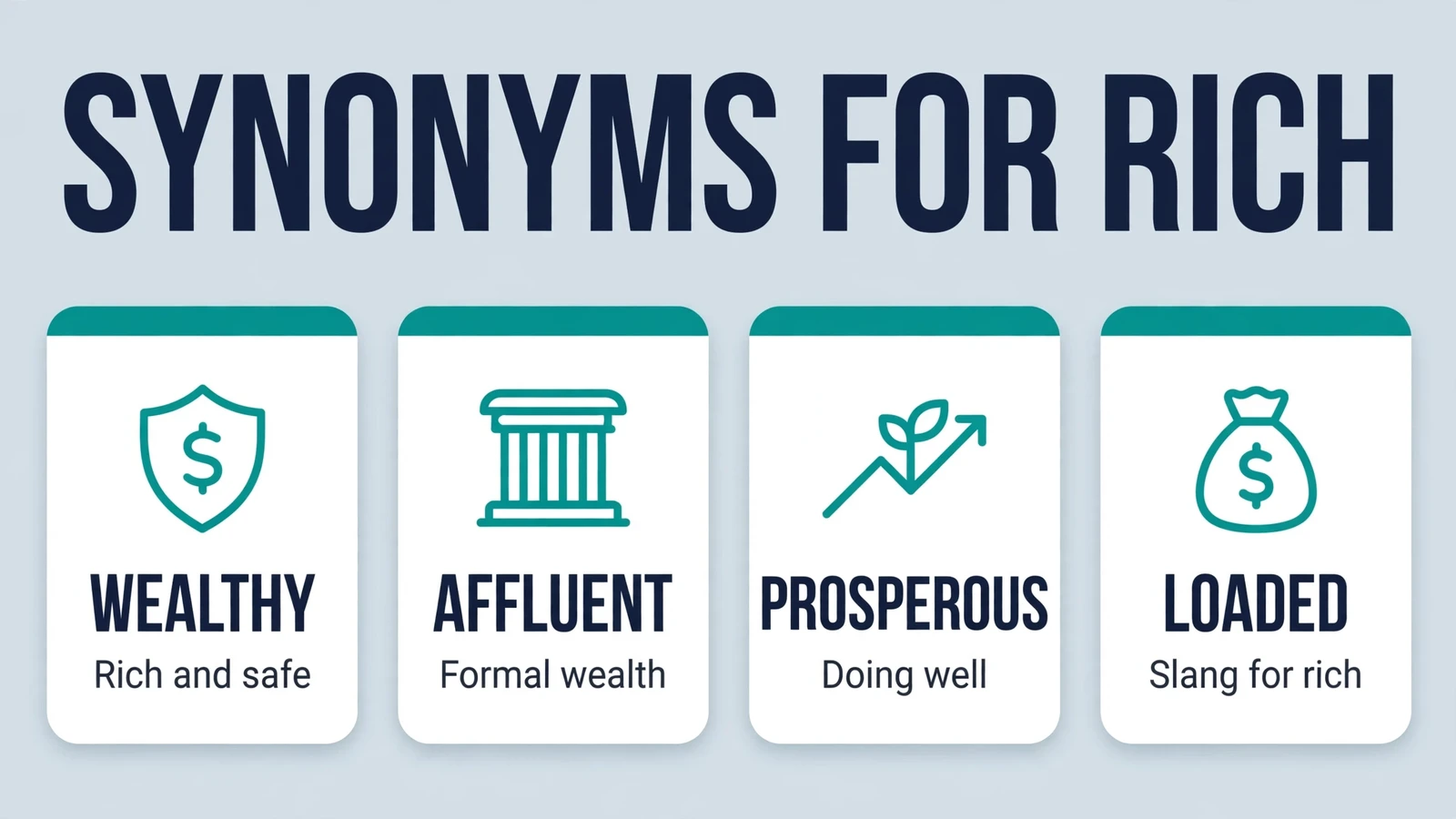
When money is the topic, the strongest synonyms for rich are wealthy, affluent and prosperous, with loaded and flush saved for casual talk. For food, writers reach for creamy, full-bodied and luscious. A rich color turns vibrant or deep, a rich voice turns resonant, and rich land turns fertile.
This guide keeps all four senses apart, so a sauce never ends up affluent and a farmer never ends up loaded by accident. Every word below was checked against major thesaurus sources, and each entry gives the tone and the best use.
Quick Reference: Top Synonyms for Rich at a Glance
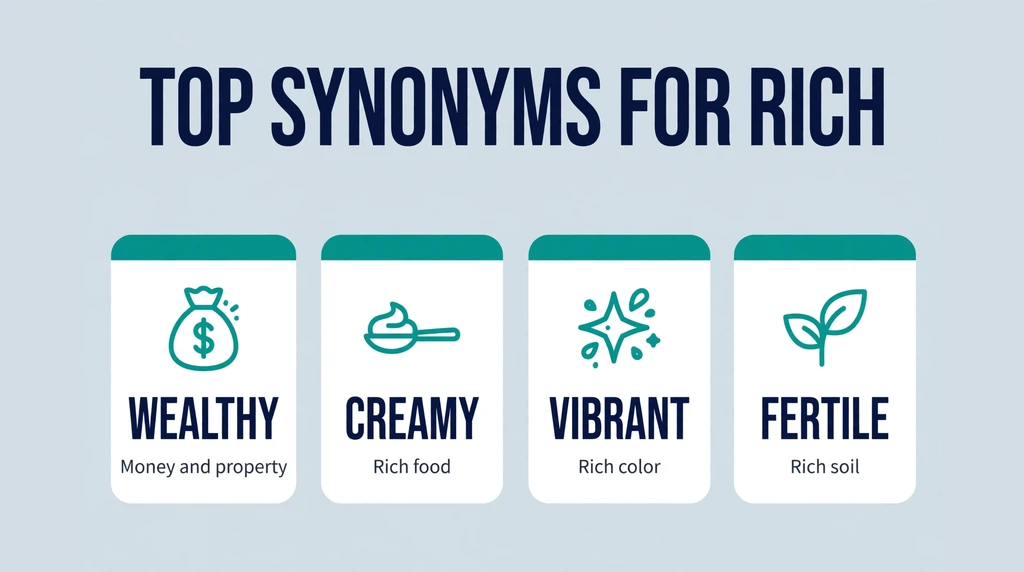
The table below covers the words readers ask for most. Notice the “describes” column first, because it keeps the senses separate. After that, the tone column tells you how formal each word sounds.
| Word | Describes | Tone / best for |
|---|---|---|
| wealthy | a person or family with money | neutral, safe everywhere |
| affluent | a person, area or society | formal, written English |
| prosperous | a business, town or family | positive, doing well |
| opulent | homes, hotels, displays of wealth | formal, lavish |
| moneyed | wealthy families and classes | formal, old-fashioned |
| well-off | a comfortable person | neutral, everyday |
| well-to-do | a comfortable background | neutral, slightly formal |
| well-heeled | a wealthy customer or client | informal |
| loaded | a very rich person | slang, casual only |
| flush | someone with cash right now | informal |
| fatty | food full of fat | factual, can sound negative |
| creamy | sauces, soups, desserts | food writing |
| full-bodied | wine, coffee, sauces | strong, full flavor |
| robust | wine, coffee, strong flavors | hearty and strong |
| luscious | sweet, rich food and fruit | richly delicious |
| succulent | juicy meat and fruit | food writing |
| savory | salty or spiced food | the opposite of sweet |
| flavorful | any full-flavored food | safe, general |
| vibrant | strong, lively color | color and design |
| intense | very strong color | color and design |
| deep | dark, strong color or sound | very versatile |
| resonant | a full, carrying voice | sound and music |
| mellow | a soft, warm voice or tone | sound and music |
| fertile | soil and land | farming and gardening |
| fruitful | land, trees, also results | slightly literary |
| prolific | crops, writers, producers | produces a lot |
| abundant | supplies and resources | neutral, plentiful |
What Does Rich Mean? One Word, Four Senses
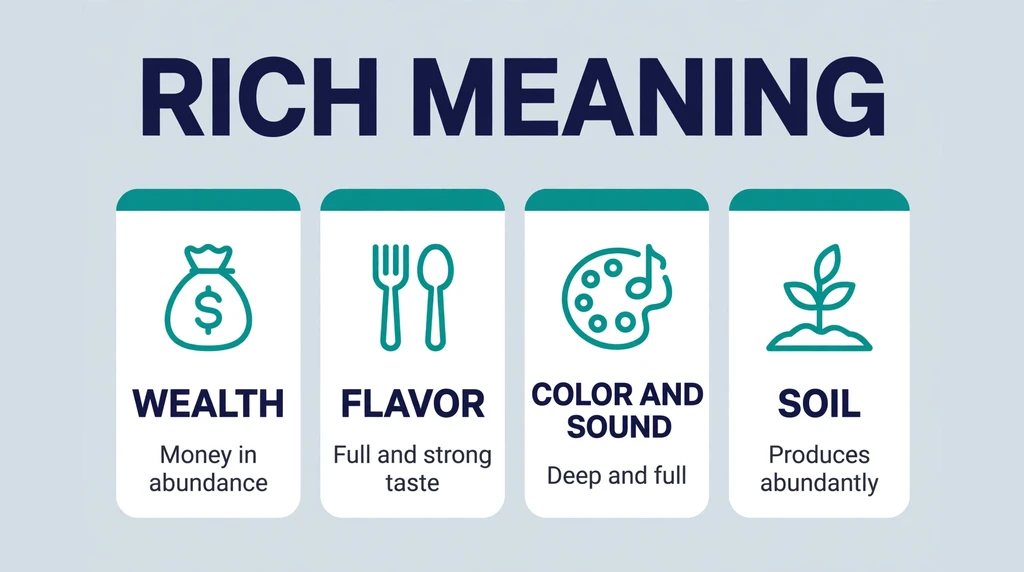
At its core, rich means having a lot of something valuable, packed in tightly. That single idea explains all four senses. A rich person has plenty of money. Rich food has plenty of fat, cream or seasoning. A rich color has plenty of pigment and depth, and rich soil has plenty of what plants need.
The word did not start with money at all. In Old English, *rice* meant strong, powerful and mighty, and it described people of high rank. Only later did it settle into its modern money meaning. That history explains why rich still feels grander than a plain word like “expensive.”
Context always tells you which sense is active. Nobody hears “a rich dessert” and pictures a cake with a bank account. Readers switch senses instantly, and good writers do the same. So the golden rule of this page is simple: pick the sense first, then pick the word.
The Four Senses in One Line Each
- Wealth: having goods, property or money in abundance (Merriam-Webster’s first sense).
- Food and flavor: containing much seasoning, fat or sugar, with an abundance of flavor.
- Color, sound and texture: intense color, a full resonant sound, splendid costly-looking material.
- Soil and resources: producing abundantly, and well supplied with something desirable.
Why Dictionaries Keep the Senses Apart
Open any major thesaurus and you will see the same discipline. Merriam-Webster numbers the senses of rich separately: first wealthy, then fatty food, then full flavor, then fertile land. Cambridge gives the money sense its own synonym group with its own examples. Collins goes furthest, printing a fresh list for every sense, from flavor to voice to color.
Editors work this way because a synonym is only true inside its sense. “Loaded” is a perfect synonym in the money list and a nonsense word in the soil list. When a website dumps forty words into one pile, half of them are quietly wrong. This guide follows the dictionaries instead, sense by sense, so every swap you make stays honest.
The “Rich In” Pattern
One grammar pattern unlocks half the word’s uses. Rich teams up with “in” to name whatever is packed inside: rich in protein, rich in iron, rich in history, rich in detail. The American Heritage Dictionary defines this use as abounding, usually followed by “in” or “with.” A countryside can be rich in beauty, and a design can be rich with color.
Writers love the pattern because it sounds precise and generous at once. Nutrition labels, travel guides and history books all lean on it. When you use it, the synonyms shift toward the abundance group later in this guide: abundant in, full of, well supplied with, and plentiful in.
“The Rich” as a Noun
Add “the” and the adjective becomes a group of people. Headlines talk about taxing the rich, and novels open inside the houses of the rich. The same trick works with several synonyms here: the wealthy, the affluent, the moneyed. Each version carries a slightly different flavor, from neutral reporting to old-world formality.
Remember that “the rich” names a class, never one person. For a single person, English switches back to the adjectives in the next section.
Synonyms for Rich People and Wealth
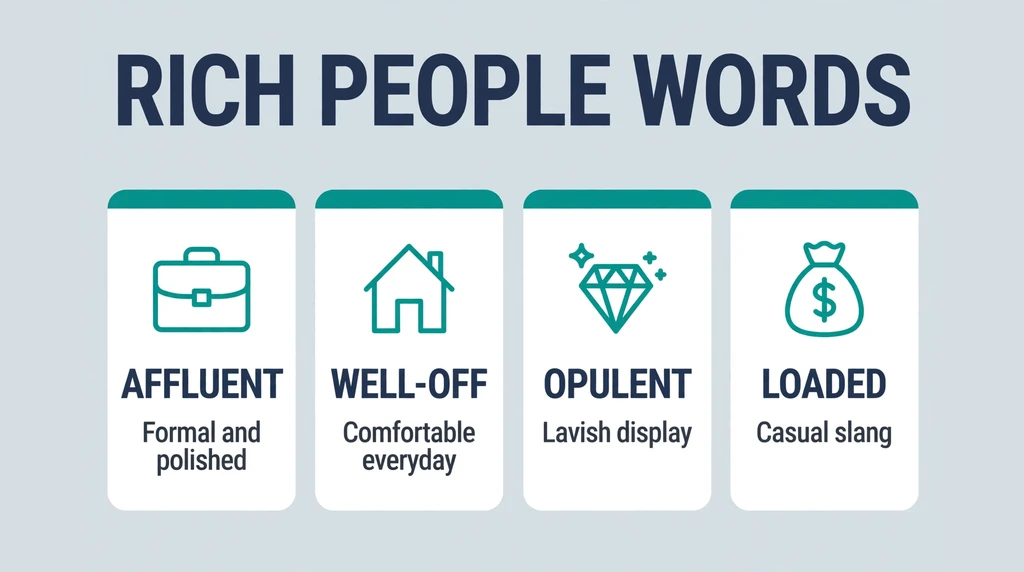
This is the sense most searchers want. The words below describe people, families, businesses and places that have real money. If your topic is land or dinner instead, skip ahead, because none of these words belong there.
Everyday Words for a Rich Person
Wealthy is the safest replacement of all. It stresses the possession of property and things of lasting value, so it suits families, landowners and investors. Example: “The wealthy landowners funded the new library.”
Well-off describes comfort more than millions. A well-off family pays its bills easily and saves without stress. Example: “After twenty years of steady work, they were quietly well-off.”
Well-to-do points at background and lifestyle. It often appears with homes, neighborhoods and upbringings. Example: “She grew up in a well-to-do suburb with wide, quiet streets.”
Prosperous adds the idea of success in motion. Businesses, towns and farmers are prosperous when their work keeps paying off. Example: “The harbor town grew prosperous on trade and fishing.”
Formal and Written Words
Affluent is the polished choice for essays, reports and news writing. Merriam-Webster notes that it suggests prosperity and increasing wealth, which is why “an affluent society” sounds so natural. Example: “Affluent districts spend more per child on private tutoring.”
Moneyed is formal and a little old-fashioned. Cambridge marks it formal, and it usually describes families, interests or classes rather than one person. Example: “The moneyed families of the coast built the first summer hotels.”
Opulent describes wealth on display. Palaces, hotels and wedding halls are opulent when every detail shows lavish spending. Merriam-Webster warns that it applies more often to things than to people. Example: “Guests stepped into an opulent lobby of marble and gold.”
Words for Rich Places, Businesses and Groups
The same words stretch beyond people. Districts, resorts, companies and clubs all borrow them, and each choice paints a slightly different picture.
An affluent district has rising incomes and expensive schools. A prosperous port or market town earns its label through trade that keeps growing. An opulent resort sells marble, gold and ceremony. A well-to-do neighborhood looks settled and comfortable rather than flashy.
Groups take the formal end of the scale. Histories speak of the moneyed classes and moneyed interests. Charities court well-heeled donors, and fundraisers quietly call them the backbone of every gala. When a whole class is meant, “the rich” or “the wealthy” as nouns do the job cleanly, as the meaning section showed.
Informal and Slang Words
Loaded is pure slang for very rich. Friends say it; bank reports never do. Example: “He sold the company at thirty and has been loaded ever since.”
Flush means full of cash right now, often after a payday or a win. Unlike wealthy, it can fade by next month. Example: “Flush after the harvest sale, he ordered new tools for the farm.”
Well-heeled is informal and often describes customers or clients. Example: “The boutique depends on well-heeled tourists in the summer season.”
Three set phrases finish the group. Rolling in it means extremely rich, said with a grin. Filthy rich goes further and can sound critical. Made of money is what parents say when children treat them like a bank. All three belong in speech and light writing only.
Synonyms for Rich Food and Flavor
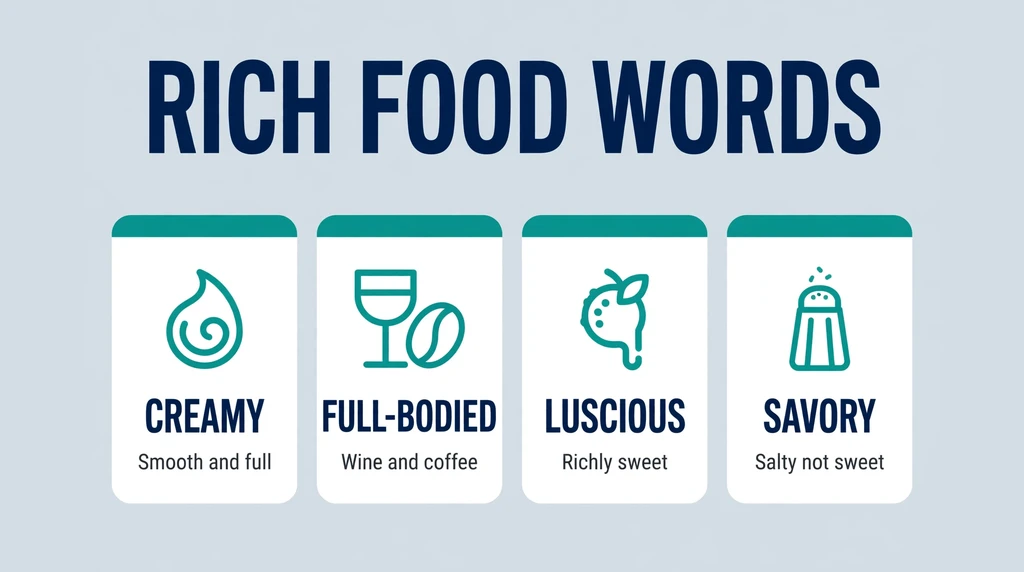
Rich food is food with plenty packed in: fat, cream, butter, eggs, sugar or seasoning. The right synonym depends on which ingredient does the work, so this section splits into three taste groups.
Cream, Butter and Fullness
Creamy is the first word for sauces, soups and desserts built on cream. It promises a smooth texture as much as a taste. Example: “The creamy soup carried the whole meal.”
Buttery names the same richness when butter leads. Pastry, sauces and sweet corn all wear it well. Example: “The buttery sauce pooled around the grilled fish.”
Fatty states the fact of fat without praise. Cooks use it for cuts of meat and fish, yet on a menu it can read as a warning. Example: “Fatty fish like salmon suits a sharp lemon sauce.”
Heavy describes food that fills you fast. A heavy dessert is delicious in small portions and hard work in large ones. Example: “After the heavy pudding, nobody wanted coffee refills.”
Full-bodied belongs to wine, coffee and rich sauces. WordNet glosses it as marked by fullness of flavor, and it signals depth rather than sweetness. Example: “A full-bodied red stood up to the grilled lamb.”
Strong and Deep Flavor
Robust is the partner of full-bodied. Merriam-Webster uses it for food and drink with an abundance of flavor, like rich wines with a meal. Example: “The robust stew needed nothing but bread.”
Flavorful is the safe, general choice. It says the taste is full and clear without naming any ingredient. Example: “Slow cooking made the broth deep and flavorful.”
Highly flavored stresses seasoning. Reach for it when spices, herbs or marinades do the heavy lifting. Example: “The highly flavored rice carried saffron and warm spices.”
Savory marks the salty, spiced side of rich. It is the natural opposite of sweet on a menu. Example: “She chose the savory tart over the sweet one.”
Spicy belongs here only when heat and spice create the richness. A spicy dish can be light, though, so check the fit before you swap. Example: “The spicy curry felt rich from coconut milk and chili.”
Rich Drinks: Wine, Coffee and Sauce
Drinks borrow the food words and give them their own habits. Wine writers live on this vocabulary, and coffee drinkers are catching up fast.
A full-bodied wine feels heavy in the mouth, with flavor that coats rather than sparkles. A robust coffee or claret tastes strong and hearty, the opposite of thin and watery. Rich itself stays popular on labels because it promises both at once.
Sauces follow the same rules. A rich gravy is heavy with fat and stock, a rich curry turns creamy with coconut milk, and a rich tomato sauce cooks down until it tastes deep and concentrated. In every case, the synonym names what the cook packed in.
Sweet, Juicy and Indulgent Tastes
Luscious describes food that feels luxurious in the mouth. Ripe peaches, chocolate desserts and creamy custards earn it easily. Example: “The luscious mango melted before she could chew.”
Succulent promises juice. It suits roast meats, ripe fruit and grilled vegetables that burst when cut. Example: “The succulent chicken rested in its own juices.”
Sweet works when sugar is the source of richness, as in cakes, syrups and dessert wines. Example: “The sweet glaze turned sticky and dark in the oven.”
Delicious and tasty are broader than rich. Every rich dessert should be delicious, yet a crisp green salad can be delicious too, with no richness at all. Both words appear in the mistakes section below for exactly that reason.
Rich Desserts and Baking
Baking shows the pattern at its clearest. A rich cake carries extra butter, eggs and sugar, which is why traditional fruitcakes and chocolate tortes earn the label. Bakers describe the crumb as dense and the flavor as deep, and both words point back to what went into the bowl.
Ganache and custard turn creamy and luscious. Caramel sauces turn sweet and heavy at the same time. When a dessert crosses into excess, honest writers switch to the warning words from the mistakes section, because richness praised too hard starts to sound like a complaint.
Synonyms for Rich Color, Sound and Texture
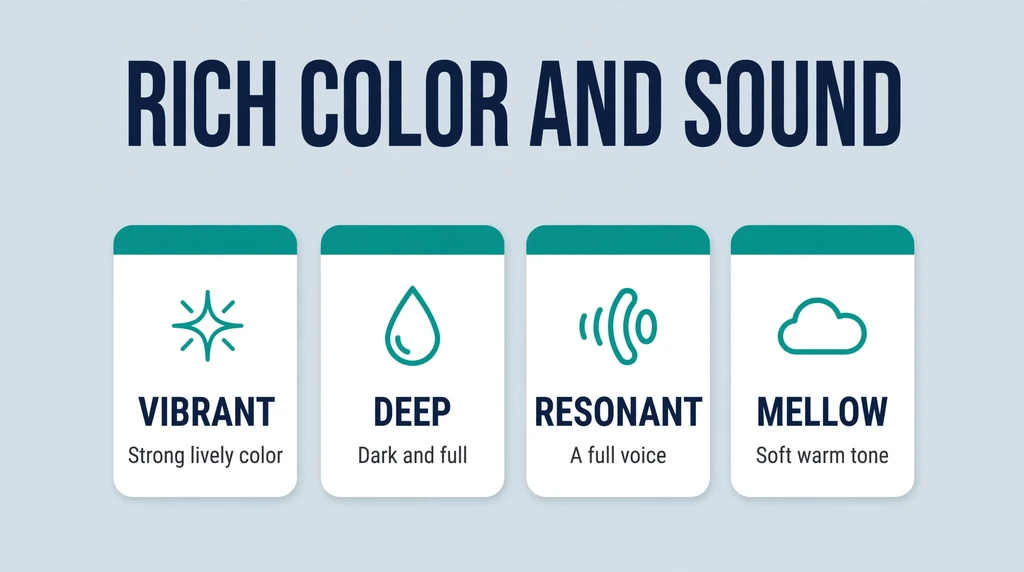
The third sense covers the senses of sight, hearing and touch. A rich red, a rich baritone and rich velvet all share one trait: intensity. Something in them is turned all the way up.
Rich Color: Deep and Alive
Vibrant is the headline word here. Collins lists it first for rich color, and it suggests energy as well as strength. Example: “The mural glowed in vibrant blues and reds.”
Intense stresses pure strength. Designers use it when a color feels almost too strong to ignore. Example: “An intense green covered the kitchen cabinets.”
Vivid adds clarity. A vivid color looks clean and sharp, not muddy. Example: “Vivid orange leaves covered the path.”
Deep is the most versatile color word of all. Deep red, deep purple and deep brown are the classic rich shades, dark and full at once. Example: “She chose a deep burgundy for the study walls.”
Strong, warm and bright complete the set. Strong color holds its own in daylight. Warm shades like gold, amber and rust feel rich because they echo wood, fire and late sun. Bright works only for lighter colors, since a shade can be bright without being deep.
Designers lean on rich colors for the same reason painters do. Deep shades make rooms feel warmer and smaller, while vibrant shades pull the eye to one chosen spot. Jewel tones, emerald, sapphire, ruby and amethyst, are the classic rich family, precisely because each one looks like a stone full of light.
Rich Sound: Full and Carrying
Resonant is the precise word for a rich voice. It means the sound is deep, clear and continues to ring. Example: “His resonant voice filled the hall without a microphone.”
Full describes tone with body. Singing teachers ask for a full voice, and orchestras praise full strings. Example: “The choir produced a full, warm sound.”
Mellow softens the picture. A mellow voice or instrument sounds warm, smooth and easy on the ear, often after years of practice or age. Example: “The old trumpet had a mellow tone.”
Deep works for sound just as it does for color, pointing at a low, full pitch. Ringing adds clarity and carry, the way a bell rings. Dulcet is the literary choice, sweet and soft, best saved for poetry and praise of singers.
One caution separates good reviews from sloppy ones: rich is not the same as loud. A thin voice can be amplified until it hurts, yet it stays thin. Richness in sound means body and resonance, the qualities a voice carries into a quiet room with no help at all.
Rich Texture and Splendid Things
Writers also call materials and rooms rich when they look costly and fine. Collins groups these words under exactly that idea. Costly and expensive state the price. Precious adds rarity, as in precious stones and metals.
Gorgeous and exquisite praise the beauty of the thing itself, from tapestries to carved doors. Superb judges the quality, and elegant adds grace and restraint. A room can be elegant without being rich, so elegant fits only when fine materials are truly present.
Rich Smells: The Quiet Fifth Sense
Dictionaries quietly grant rich one more job. The Random House dictionary defines a rich smell as strongly fragrant or pungent, as in a rich odor of leather and woodsmoke. Perfume writers lean on the same idea when they call a scent deep, warm and full.
The working words here are fragrant for the pleasant side and pungent for the powerful side. A rich aroma of roasting coffee sits between them, strong enough to fill a street yet welcome at the door. Because this sense is smaller than the big four, it gets a short section, yet leaving it out would make the map incomplete.
Synonyms for Rich Soil, Land and Resources
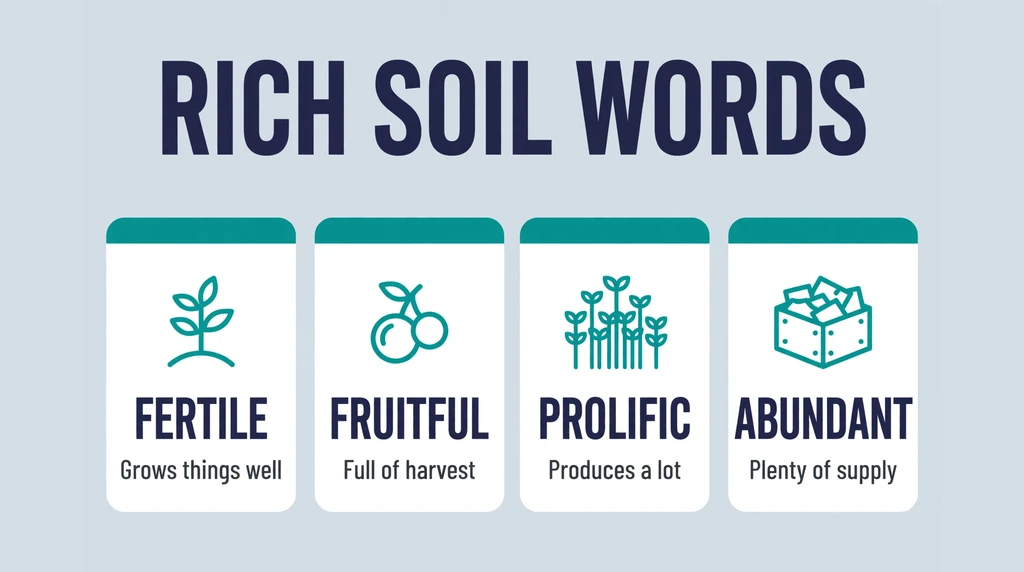
The fourth sense returns to the land. Rich soil feeds plants the way a rich patron feeds an artist: generously and in depth. Two groups live here, the land itself and the wider idea of abundance.
Fertile Land and Generous Yields
Fertile is the anchor word. Merriam-Webster uses it as the lead synonym for this sense and illustrates it with rich farmland. Example: “Fertile valleys along the river grow two crops a year.”
Fruitful suits land and trees that deliver real harvests. It also stretches to talks and efforts that produce results, which makes it a favorite in formal writing. Example: “The fruitful orchards paid for the new school roof.”
Prolific stresses amount and speed. A prolific field or garden produces again and again. Example: “Prolific tomato vines bent under their own weight.”
Productive is the practical, modern word. Farms, mines and regions are productive when they yield a lot of value. Example: “The productive seam of coal kept the town employed.”
Fecund is formal and literary, drawn from the language of scholars and poets. Luxuriant describes growth itself, thick and vigorous, as in luxuriant vegetation along a riverbank.
Abundance and Supply
Sometimes rich simply means well supplied, as in “a region rich in minerals” or “a diet rich in protein.” Abundant is the everyday word for that plenty. Example: “The coast is abundant in fish and shellfish.”
Copious is the formal upgrade, common in reports and academic writing. Ample promises more than enough, with a calm, practical tone. Plentiful is warm and everyday, while plenteous is its literary cousin. Bountiful suggests generous giving, so harvests, nature and hosts are bountiful. Finally, well-supplied and well-provided describe places and stores that lack nothing, and well-stocked does the same job for shelves, lakes and libraries.
Rich in Resources: Oil, Ore and Protein
Geography and science writing stretch this sense furthest. An oil-rich basin, a mineral-rich plateau and iron-rich soil all use rich to mean “packed with something valuable underground.” The American Heritage Dictionary records the pattern directly: abounding in natural resources, as in a rich region.
Food science does the same on the label. Protein-rich lentils, calcium-rich greens and vitamin-rich oils promise concentrated nutrition per bite. In both fields the abundance words swap in cleanly: a region abundant in copper, a diet full of protein, a coast well supplied with harbors. The sense stays the same; only the cargo changes.
How to Choose the Right Synonym for Rich
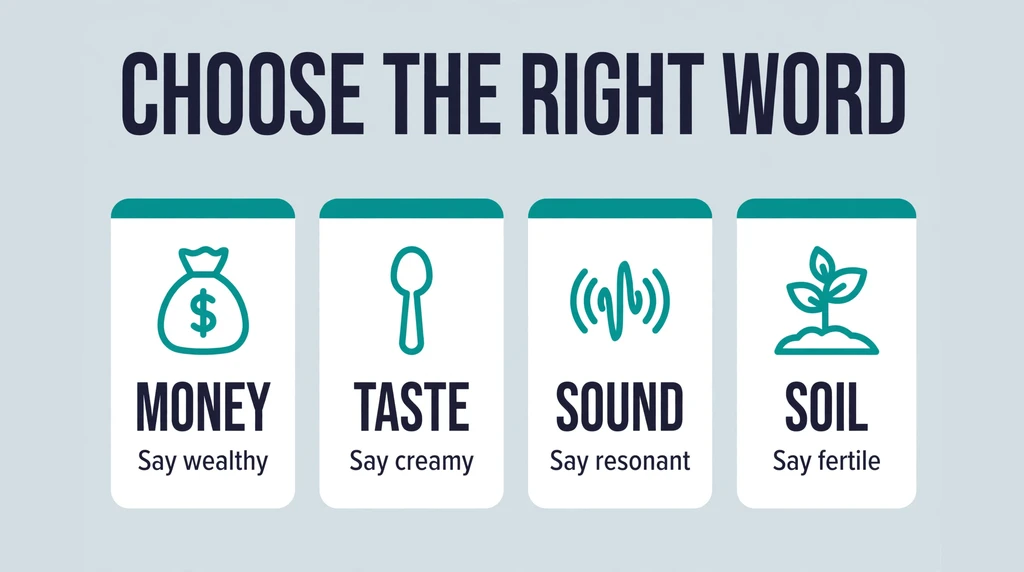
Start with the sense, always. Ask what the sentence is really about: money, taste, color, sound or soil. That one question removes most of the list at once, and it takes two seconds.
Then check the tone. A wedding toast, a tax report and a text message need three different registers. The sections above sort the words for you, yet one comparison is worth memorizing. Merriam-Webster’s Synonym Chooser separates the big four like this: rich means having more than enough for normal needs and desires. Wealthy stresses owning property and valuable things. Affluent suggests prosperity that keeps growing. Opulent points to lavish display, and it fits things more often than people.
Paired examples make the gaps obvious:
- “The wealthy family owns hotels in three countries.” Ownership is the point.
- “The hotel lobby was opulent, all marble and chandeliers.” Display is the point.
- “An affluent suburb built a second sports center.” Growing shared prosperity is the point.
- “My uncle is loaded, but you would never know it.” Slang, spoken with a smile.
The table below compresses the whole method into five everyday situations:
| Situation | Say this | Avoid this |
|---|---|---|
| A family with serious money, in a report | wealthy, affluent | loaded, flush |
| A friend who just sold a business, in chat | loaded, rolling in it | moneyed, opulent |
| A chocolate dessert on a menu | luscious, creamy | affluent, fertile |
| A singer’s deep voice in a review | resonant, full | well-off, copious |
| A valley that grows great wheat | fertile, productive | vibrant, savory |
Match the Word to the Ingredient
For food, match the ingredient. Cream points to creamy, wine points to full-bodied or robust, juice points to succulent, and sugar points to sweet or luscious. Readers taste the sentence when the word names the right source.
For land, decide between quality and quantity. Fertile praises the soil itself, while prolific and productive praise what comes out of it. If you ever feel stuck, the synonyms for powerful page is a useful detour, because rich and powerful were once the same idea in English.
Formal and Informal Synonyms for Rich
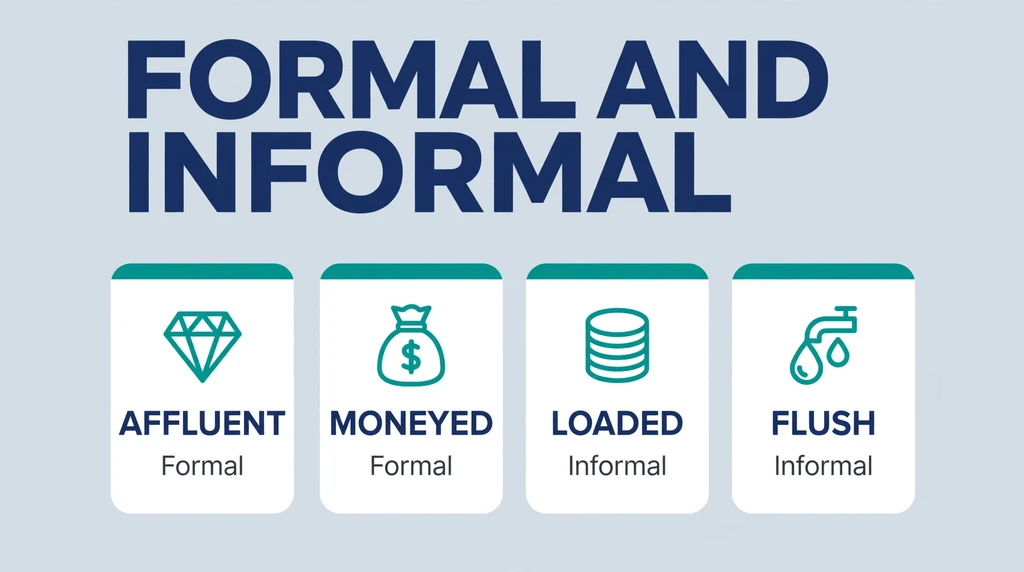
Register is where most mistakes happen. The same fact can sound like a headline, a report or a joke, purely through word choice.
Formal Choices
Formal writing favors affluent, prosperous, moneyed and opulent for wealth. Business pages describe affluent customers and prosperous regions. Moneyed appears in history and politics, as in “moneyed interests.” For the other senses, formal options include fecund for land, copious for supply, robust for flavor and dulcet for sound. These words signal education, so use them where the audience expects that signal.
Informal Choices
Speech runs on loaded, flush, well-heeled and rolling in it. Newspapers quote them, friends text them, and comedians build punchlines on them. Filthy rich adds a wink of envy or criticism. None of these belong in a loan application, a legal letter or an exam essay. For the plain middle ground, well-off and wealthy travel anywhere, which is why editors reach for them first. If money itself is your topic, the synonyms for money guide lists the cash words that pair with this page.
| Setting | Rich words that fit |
|---|---|
| Exam essay or report | affluent, prosperous, abundant, fertile |
| Newspaper or magazine | wealthy, well-off, opulent, vibrant |
| Menu or food blog | creamy, luscious, full-bodied, savory |
| Text to a friend | loaded, flush, rolling in it |
| Poem or novel | fecund, plenteous, dulcet, moneyed |
Antonyms for Rich
Opposites change with the sense, just like the synonyms do. Cambridge gives poor as the direct antonym for the money sense, and it anchors the first group below.
- Wealth: poor, impoverished, penniless, and broke in informal speech. The full picture lives on the synonyms for poor page.
- Food and flavor: bland and dull are Collins’s listed opposites for rich flavor. Plain and light join them on menus everywhere.
- Color: weak, dull and insipid oppose rich color, and pale covers the lighter end.
- Sound: thin, weak and reedy describe a voice with no richness in it.
- Soil and supply: barren and infertile oppose fertile land, while scarce, lacking and wanting oppose a rich supply.
Notice how “poor” does double duty. Poor soil and a poor family use the same word, and context alone separates them, exactly as it does for rich.
The pattern holds everywhere on this page. Every sense of rich grew its own family of friends and its own family of opposites, and the two families never mix.
Words That Are Not True Synonyms for Rich
A few common swaps go wrong, and each one fails for a different reason.
Expensive is not a person. A watch can be expensive and a dinner can be expensive, yet a man cannot. English describes his wealth instead: he is rich, wealthy or well-off. Expensive belongs to prices, not people.
Greasy and oily are rarely compliments. Both words sit near rich in thesauruses because they name fat. In real writing, though, greasy food sounds badly cooked, and oily sauces sound unpleasant. Creamy and full-bodied praise the same richness safely.
Delicious is wider than rich. A lemon sorbet can be delicious while being light and sharp. Delicious judges the pleasure; rich describes what is packed inside. Swap them only when fat, cream or deep flavor is truly present.
Better off is a comparison, not a state. Cambridge lists it near rich, yet it only says someone has more than before. A family can be better off and still far from rich.
Luxurious needs comfort, not just wealth. A luxurious hotel offers comfort and pleasure, not merely a rich owner. The word describes the experience, so it cannot replace rich for people or soil.
“A rich” is not a person. English never uses rich alone as a noun for one human being. Say “a rich man,” “a wealthy investor,” or switch to the plural group form, “one of the rich.” The same rule protects wealthy and poor: one person is never “a poor” either.
That’s Rich! The Joking Sense
One small sense hides at the end of the dictionary, and it powers a famous comeback. When someone says “That’s rich, coming from you,” rich means funny in a bitter way: amusing, ridiculous, laughable. Collins defines this use as “very amusing or ridiculous.”
The working words are funny, amusing, ridiculous, laughable and comical, with risible as the formal, literary member of the set. None of them describe money, food or land. They survive almost entirely inside that one sarcastic phrase, which is why this guide fences them off instead of mixing them into the main groups.
Frequently Asked Questions
What is the best synonym for rich?
Wealthy is the best all-purpose synonym when money is the topic. It is neutral, polite and clear in every context. Affluent wins in formal writing, while loaded wins in casual speech.
What is a fancy or formal word for rich?
Affluent and opulent are the classic formal choices. Affluent describes people, families and areas with growing prosperity. Opulent describes wealth on display, such as hotels, homes and celebrations.
What is a slang word for rich?
Loaded is the most common slang word, and flush follows close behind. Rolling in it and filthy rich are popular phrases. All of them belong in speech and informal writing only.
What is another word for rich soil?
Fertile is the standard word for rich soil. Fruitful, prolific and productive also work, and fecund is the formal, literary option. Barren and infertile are the opposites.
What are synonyms for rich food?
Creamy, full-bodied, robust, luscious and succulent lead the food list. Savory covers salty richness, while sweet and heavy cover sugar and filling portions. Greasy sounds negative, so avoid it on menus.
What is the difference between rich and wealthy?
The two words overlap almost completely. Merriam-Webster notes that rich suggests having more than enough for normal needs and desires. Wealthy stresses the ownership of property and valuable things, so it often sounds steadier and more established.
What is the opposite of rich?
Poor is the main opposite for the money sense. Rich food opposes bland or light food, rich color opposes pale or dull color, and rich soil opposes barren or infertile land.
Can rich describe a voice or a color?
Yes, and it does so every day. A rich voice is full, deep and resonant, like a trained singer’s baritone. A rich color is deep, strong and vibrant, like burgundy, emerald or royal blue.
Final Thoughts
Rich earns its place in English because it packs abundance into four letters. Its synonyms, though, refuse to travel across senses. Wealthy people, creamy sauces, vibrant colors and fertile fields each demand their own word, and choosing by sense first makes the choice easy.
Keep the big four straight, wealthy for ownership, affluent for growing prosperity, opulent for display, and rich for more than enough. Then let the topic pick the team: loaded for jokes, luscious for dessert, resonant for voices, prolific for harvests.
The habit to carry away is small and powerful. Before you swap the word, name the sense out loud: money, taste, color, sound or soil. That two-second pause prevents nearly every bad synonym choice in this word family, and it works for the next polysemous word you meet as well.
For the full reference list behind this guide, the Merriam-Webster Thesaurus entry for rich shows every sense with examples. Bookmark this page too, and the next time “rich” feels worn out, the right replacement is one quick scan away.