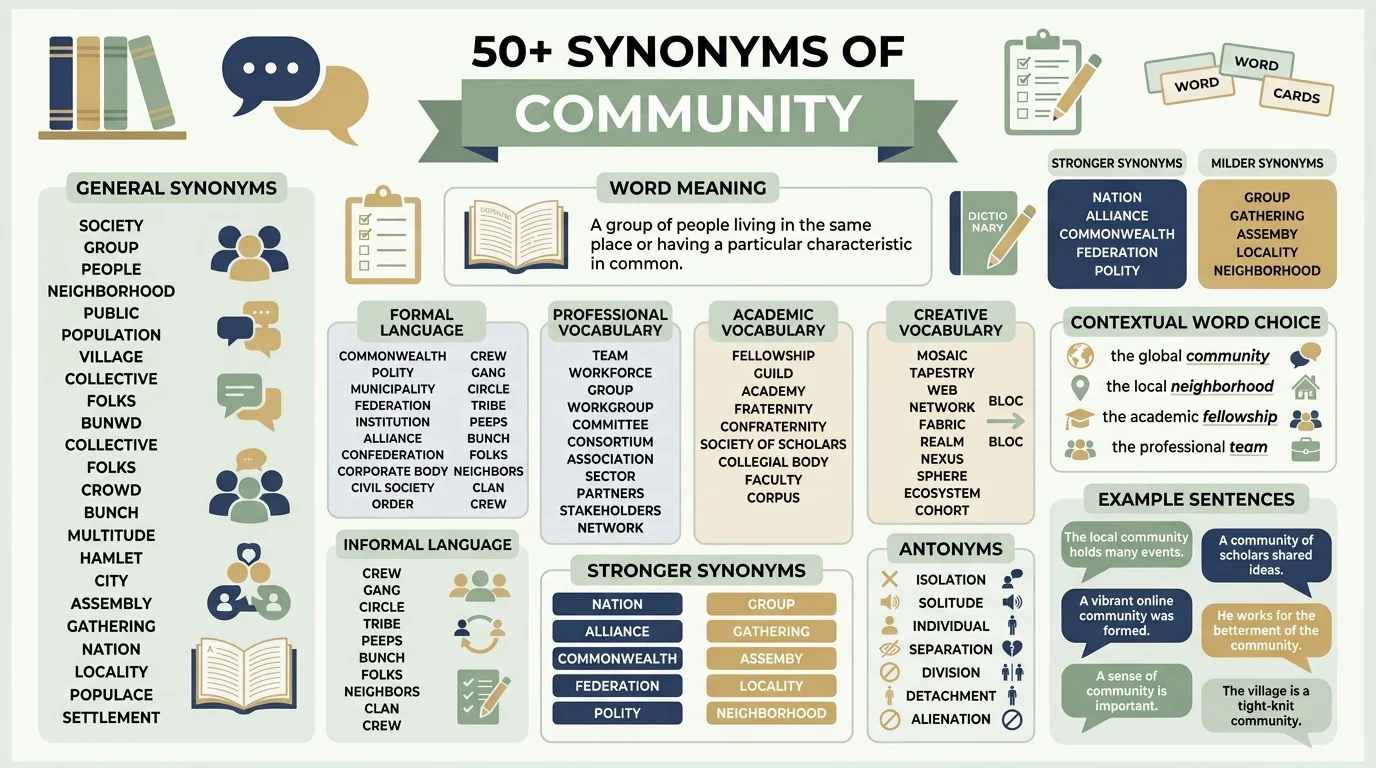
Have you ever found yourself writing an email, an essay, or a social media caption and realized you have used the word “community” four times in two paragraphs? It happens to everyone. You know what you mean, but the repetition makes your writing feel flat and uninspired. Finding the right synonyms of community can instantly make your message clearer, more professional, and more engaging. The word itself is useful, but it often lacks the precision needed for different contexts. Choosing a more specific term helps your reader understand exactly what you mean, whether you are describing a neighborhood, a professional network, or a shared interest group.
What Are the Best Synonyms of “Community”?
“Community” refers to a group of people who share a location, identity, interest, or background. For formal writing, choose “society” or “population.” For casual conversation, “neighborhood” or “circle” work well. In professional settings, “network” or “association” are stronger choices. For emotional or creative writing, “fellowship” or “brotherhood” add warmth.
Meaning, Tone, and Context
Simple Definition
A community is a group of people who live in the same area or who share common interests, values, or identities.
Part of Speech
Noun (plural: communities).
Overall Tone
Neutral. The word “community” is flexible and does not carry a strong positive or negative charge on its own. The tone depends entirely on how you use it.
Formality Level
Neutral to semi-formal. “Community” works in almost any setting, from academic papers to casual conversations. However, more formal synonyms exist for professional and academic writing.
Common Uses
Native English speakers use “community” in many ways:
- To describe a physical neighborhood or town
- To refer to a group of people with shared professions, such as the medical community
- To talk about identity groups, like the LGBTQ+ community
- To discuss online spaces, such as a gaming community
- To describe a sense of belonging or shared purpose
Word Forms
- Noun: community
- Adjective: communal
- Adverb: communally
- Related noun: communalism
- Opposite: isolation, alienation
When and How to Use “Community”
You should choose “community” when you want a general, neutral word that works in almost any situation. It is safe, clear, and widely understood. However, its strength is also its weakness. Because it is so general, it does not always communicate the specific type of group you mean. Here are seven examples showing how “community” works in different contexts.
Professional Context
Our company values giving back to the local community through volunteer programs.
Academic Context
The research examined how the scientific community responds to new discoveries.
Workplace Context
Building a strong community within our team has improved collaboration and trust.
Personal Context
I found a wonderful community of parents at my daughter’s school.
Email Context
We are reaching out to the wider community to gather feedback on our new initiative.
Resume Context
Developed outreach programs that strengthened ties between the organization and the surrounding community.
Social Media Context
Grateful for this amazing community of followers who support each other every day.
Best Synonyms of “Community”
No synonym is identical in every situation. Each alternative carries a slightly different shade of meaning, tone, and formality. Here are the best synonyms for specific contexts.
Professional Writing
Choose “network.” It emphasizes connections and relationships between people, which fits business and career contexts perfectly.
Academic Writing
Choose “society.” It sounds formal and authoritative, making it ideal for research papers and scholarly discussions.
Business Communication
Choose “association.” It implies an organized group with a shared purpose, which works well for professional organizations.
Casual Conversation
Choose “circle.” It feels friendly and personal, perfect for talking about friends or social groups.
Emotional Writing
Choose “fellowship.” It adds warmth and a sense of mutual support, which works well for inspirational or heartfelt content.
Creative Writing
Choose “brotherhood” or “sisterhood.” These words add emotional depth and imagery, making them excellent for storytelling.
Resume Writing
Choose “network” or “association.” These terms sound professional and highlight your ability to build connections.
Workplace Communication
Choose “team” or “group.” These words are direct and practical for everyday office conversations.
Stronger Meaning
Choose “collective.” It emphasizes unity and shared action, giving the word more weight.
Softer Meaning
Choose “neighborhood.” It feels warm, local, and approachable.
When Not to Use “Community”
Sometimes “community” is not the best choice. Here are situations where you should choose a more precise synonym.
When the Word Sounds Too General
If you are describing a specific professional group, “community” can feel vague.
Incorrect: I am part of the marketing community.
Better: I am part of a marketing network.
Why: “Network” suggests active connections and relationships, which is more specific than “community.”
When the Word Sounds Too Vague
If you are writing about a physical location, “community” might not give enough detail.
Incorrect: The community has many shops.
Better: The neighborhood has many shops.
Why: “Neighborhood” clearly refers to a local area, while “community” could mean many things.
When the Word Sounds Too Formal
In casual conversations, “community” can feel stiff.
Incorrect: I love my gaming community.
Better: I love my gaming crew.
Why: “Crew” sounds more natural and friendly in informal settings.
When the Word Sounds Too Weak
If you need to emphasize strong bonds or shared purpose, “community” may not be strong enough.
Incorrect: We are a community of activists.
Better: We are a collective of activists.
Why: “Collective” implies a more unified and purposeful group.
When the Word Sounds Outdated
In some contexts, “community” can feel old-fashioned. Modern alternatives like “network” often sound more current.
Words Commonly Confused With “Community”
Community vs Society
Difference: “Community” is usually smaller and more personal. “Society” is larger and more abstract.
When to Use It: Use “community” for local or interest-based groups. Use “society” for larger populations or formal structures.
Example: Our neighborhood community organized a food drive. (Community)
Example: Society as a whole benefits from education. (Society)
Community vs Neighborhood
Difference: “Neighborhood” specifically refers to a physical area where people live. “Community” can be physical or based on shared interests.
When to Use It: Use “neighborhood” when talking about a specific location. Use “community” for broader or non-geographic groups.
Example: This neighborhood has excellent schools. (Neighborhood)
Example: The online community is very supportive. (Community)
Community vs Group
Difference: “Group” is the most general term. “Community” implies more connection and shared identity.
When to Use It: Use “group” for any collection of people. Use “community” when you want to emphasize belonging.
Example: A group of students waited outside. (Group)
Example: The students formed a close-knit community. (Community)
Community vs Association
Difference: “Association” suggests a formal organization with rules and membership. “Community” is looser and more organic.
When to Use It: Use “association” for official organizations. Use “community” for informal or broader groups.
Example: She joined the local teachers’ association. (Association)
Example: She is active in the local teaching community. (Community)
Community vs Population
Difference: “Population” is a statistical term for all the people in an area. “Community” emphasizes social connections.
When to Use It: Use “population” for demographics and data. Use “community” for social and cultural discussions.
Example: The population of the city has grown rapidly. (Population)
Example: The city’s diverse community celebrates many cultures. (Community)
Community vs Public
Difference: “Public” refers to people in general. “Community” is more specific and personal.
When to Use It: Use “public” for general audiences. Use “community” for specific groups.
Example: The public is invited to attend. (Public)
Example: The local community is invited to attend. (Community)
Best Synonyms of “Community” by Context
| Context | Best Synonym | Why It Works | Example |
|---|---|---|---|
| Formal writing | Society | Sounds authoritative and academic | The research benefits society as a whole. |
| Academic writing | Population | Precise and data-focused | The study surveyed the local population. |
| Professional communication | Network | Emphasizes connections and relationships | I have built a strong professional network. |
| Business emails | Association | Sounds organized and official | The association will host the annual conference. |
| Resume writing | Network | Highlights career connections | Expanded professional network through industry events. |
| Workplace communication | Team | Direct and practical | Our team works well together. |
| Casual conversation | Circle | Friendly and personal | My circle of friends is very supportive. |
| Everyday speaking | Folks | Warm and approachable | The folks in my neighborhood are great. |
| Creative writing | Brotherhood | Adds emotional depth | The brotherhood of warriors stood united. |
| Storytelling | Fellowship | Creates a sense of shared journey | Their fellowship endured many trials. |
| Emotional writing | Kinship | Emphasizes deep connection | She felt a strong kinship with the other volunteers. |
| Strong emphasis | Collective | Implies unity and shared action | The collective voted to take action. |
| Mild tone | Neighbors | Simple and relatable | We should help our neighbors in need. |
| Social media captions | Tribe | Modern and engaging | So grateful for my tribe of supporters. |
| American English | Neighborhood | Standard US usage | The neighborhood association meets monthly. |
How to Choose the Best Synonym of “Community”
Choosing the right synonym depends on several factors. Start by thinking about your audience. Are you writing for a formal academic journal or a casual social media post? Your audience determines the level of formality you need.
Next, consider your purpose. Are you trying to describe a physical location, a professional network, or a group of friends? Each purpose calls for a different word.
Think about the emotional tone you want to convey. Do you want to sound warm and personal, or professional and distant? Words like “fellowship” and “kinship” add warmth, while “population” and “society” sound more neutral.
Consider the strength of the word. If you need to emphasize unity and shared purpose, choose “collective” or “coalition.” If you want a softer, more approachable tone, choose “neighborhood” or “circle.”
Finally, read your sentence aloud with the synonym in place. Does it sound natural? Does it communicate exactly what you mean? If it feels awkward or unclear, try a different word.
Real Life Examples of “Community”
School
The school community came together to support the fundraising event.
College
She found her community among the other art history majors.
Workplace
Our workplace community thrives on open communication and mutual respect.
Business
The business community in this city is known for its innovative spirit.
Email
We would like to thank the entire community for your generous donations.
Resume
Fostered a sense of community among remote team members through weekly check-ins.
Conversation
I really miss the community I had when I lived in that small town.
Storytelling
The village was more than a community; it was a family bound by generations of shared history.
Blogging
Building an online community takes time, but the connections are worth the effort.
Social Media
Shoutout to this incredible community for all the love and support!
18 Best Synonyms of “Community”
Synonyms of “Community” by Usage
Professional vs Personal Synonyms
In professional settings, words like network, association, and collective sound more serious and career-oriented. They suggest structure, purpose, and professional relationships.
In personal conversations, words like circle, neighbors, and folks feel warmer and more approachable. They are better for talking about friends, family, and local connections.
Formal vs Conversational Synonyms
For formal writing such as reports, essays, and business presentations, choose society, population, or public. These words sound authoritative and precise.
For casual conversations, emails to friends, and social media posts, choose neighborhood, circle, or crew. These words feel natural and friendly.
Academic Synonyms
For research papers, essays, and academic discussions, choose society, population, or polity. These words are precise and sound authoritative. They help you maintain a scholarly tone while clearly communicating your ideas.
Professional and Business Synonyms
For resumes, interviews, meetings, and client communication, choose network, association, or collective. These words project professionalism and competence. They show that you understand how to build and maintain professional relationships.
Creative and Literary Synonyms
For storytelling, fiction, poetry, and descriptive writing, choose brotherhood, fellowship, kinship, or clan. These words add emotional depth and vivid imagery. They help you create a sense of connection and belonging in your narrative.
Slang or Modern Synonyms
A popular modern synonym for community. It implies a group of people who share an identity or lifestyle. It is acceptable in casual conversation, social media, and modern marketing. Avoid it in formal academic or professional writing.
Crew is another informal synonym. It suggests a close-knit group of friends or colleagues. Use it in casual contexts but avoid it in formal settings.
Strongest to Mildest Synonyms
Mild
- Neighbors
- Locals
- Folks
Moderate
- Group
- Circle
- Network
Strong
- Association
- Collective
- Society
Very Strong
- Brotherhood
- Fellowship
- Kinship
The emotional intensity increases as you move down the scale. Mild words simply describe a group of people. Stronger words emphasize deep connection, unity, and shared purpose.
Emotional vs Neutral Synonyms
Emotional Synonyms
- Brotherhood
- Fellowship
- Kinship
- Clan
These words express strong feelings of connection, belonging, and loyalty. Use them when you want to evoke emotion or create a sense of warmth.
Neutral Synonyms
- Group
- Population
- Public
- Locality
- Network
These words simply communicate information without adding emotion. Use them when you need to be objective, professional, or factual.
Antonyms of “Community”
| Antonym | Meaning | Example Sentence |
|---|---|---|
| Isolation | Being separated from others | The isolation of rural life can be challenging. |
| Alienation | Feeling disconnected from others | The new student felt a sense of alienation. |
| Individualism | Emphasis on the individual over the group | Extreme individualism can weaken social bonds. |
| Loneliness | Sadness from being alone | Loneliness is a growing problem in modern cities. |
| Division | Separation into different groups | The division between the two communities grew wider. |
| Disconnection | Lack of connection or relationship | The disconnection between generations is concerning. |
| Separation | The act of being apart | The separation of the two groups was inevitable. |
| Fragmentation | Breaking into smaller pieces | The fragmentation of society has many causes. |
| Estrangement | Loss of close relationship | His estrangement from his family was painful. |
| Solitude | Being alone by choice | She valued her solitude and quiet time. |
| Antagonism | Active hostility or opposition | The antagonism between the groups was obvious. |
| Conflict | Serious disagreement or argument | The conflict divided the community. |
| Exclusion | The act of keeping someone out | The exclusion of certain groups is unfair. |
| Segregation | Separation based on race or group | Segregation created lasting social problems. |
| Anonymity | Being unknown or unnamed | The anonymity of city life can feel isolating. |
Comparison: “Community” vs Similar Words
Community vs Society
Main Difference
Community is smaller and more personal. Society is larger and more abstract.
Which Is Stronger?
Society is stronger in terms of scale and formal structure.
Which Is More Formal?
Society is more formal.
When to Use Each
Use community for local or interest-based groups. Use society for larger populations or formal structures.
Examples
Community: The local community organized a charity run.
Society: The policy will benefit society as a whole.
Community vs Neighborhood
Main Difference
Neighborhood specifically refers to a physical area. Community can be physical or based on shared interests.
Which Is Stronger?
Neighborhood is more specific and concrete.
Which Is More Formal?
Both are neutral, but neighborhood is more casual.
When to Use Each
Use neighborhood when talking about a specific location. Use community for broader or non-geographic groups.
Examples
Community: The online community is very active.
Neighborhood: This neighborhood has great schools.
Community vs Group
Main Difference
Group is the most general term. Community implies more connection and shared identity.
Which Is Stronger?
Community is stronger because it suggests belonging and shared values.
Which Is More Formal?
Group is more neutral and can be used in any context.
When to Use Each
Use group for any collection of people. Use community when you want to emphasize belonging.
Examples
Community: The community of artists supported each other.
Group: A group of tourists visited the museum.
Community vs Association
Main Difference
Association suggests a formal organization. Community is looser and more organic.
Which Is Stronger?
Association is stronger in terms of structure and formality.
Which Is More Formal?
Association is more formal.
When to Use Each
Use association for official organizations. Use community for informal or broader groups.
Examples
Community: The local business community is thriving.
Association: She joined the homeowners’ association.
Community vs Population
Main Difference
Population is a statistical term. Community emphasizes social connections.
Which Is Stronger?
Population is more precise and data-oriented.
Which Is More Formal?
Population is more formal and academic.
When to Use Each
Use population for demographics and data. Use community for social and cultural discussions.
Examples
Community: The community celebrated its diversity.
Population: The population of the city is 500,000.
Community vs Public
Main Difference
Public refers to people in general. Community is more specific.
Which Is Stronger?
Community is stronger because it is more focused.
Which Is More Formal?
Public is more formal and official.
When to Use Each
Use public for general audiences. Use community for specific groups.
Examples
Community: The community responded generously to the appeal.
Public: The public is welcome to attend the event.
Common Phrases and Expressions with “Community”
Community service
Meaning: Voluntary work done to help others in your local area.
Example: She completed 100 hours of community service as part of her volunteer work.
Sense of community
Meaning: The feeling of belonging and connection to a group.
Example: The neighborhood has a strong sense of community.
Community spirit
Meaning: The willingness of people in a community to help each other.
Example: The community spirit was evident at the annual fair.
Community outreach
Meaning: Efforts to connect with and support the local community.
Example: The hospital’s community outreach program provides free health screenings.
Community leader
Meaning: A person who is respected and influential within a community.
Example: The community leader organized a meeting to discuss local issues.
Community center
Meaning: A building where local people can meet and take part in activities.
Example: The community center offers classes and events for all ages.
Community college
Meaning: A local college that offers two-year degrees and vocational training.
Example: She earned her associate’s degree at the local community college.
Common Mistakes to Avoid
Choosing a Vague Synonym Instead of a Precise One
Incorrect: I am part of the writing community.
Better: I am part of a writers’ network.
Why: “Network” is more specific and suggests active professional connections.
Confusing “Community” With “Society”
Incorrect: The local society organized a cleanup.
Better: The local community organized a cleanup.
Why: “Society” is too broad for a local event. “Community” is the right scale.
Using an Informal Synonym in Formal Writing
Incorrect: The scientists published a report.
Better: The scientific community published a report.
Why: is too casual for academic writing.
Selecting an Overly Dramatic Synonym
Incorrect: We are a brotherhood of office workers.
Better: We are a team of office workers.
Why: “Brotherhood” is too emotional for a workplace context.
Repeating the Same Word Too Often
Incorrect: The community is strong. The community supports each other. The community is growing.
Better: The community is strong. Its members support each other. The network is growing.
Why: Varying your word choice makes your writing more engaging.
Choosing a Synonym With the Wrong Emotional Tone
Incorrect: The fellowship of employees met for lunch.
Better: The group of employees met for lunch.
Why: “Fellowship” sounds too formal and emotional for a casual lunch.
Using Slang in Professional Writing
Incorrect: Our crew of developers built the app.
Better: Our team of developers built the app.
Why: “Crew” is too informal for professional communication.
Frequently Asked Questions
1. What are the best synonyms of “community”?
The best synonyms depend on context. Formal writing, use “society” or “population.” For casual conversation, use “neighborhood” or “circle.” For professional settings, use “network” or “association.”
2. What are the best formal synonyms of “community”?
The best formal synonyms are “society,” “population,” “public,” and “polity.” These words sound authoritative and work well in academic papers, reports, and official documents.
3. What are common informal synonyms of “community”?
Common informal synonyms include “neighborhood,” “circle,” “folks,” “crew,” .” These words feel friendly and approachable, making them perfect for everyday conversation and social media.
4. What is another word for “community” in professional writing?
In professional writing, “network” and “association” are excellent alternatives. “Network” emphasizes professional connections, while “association” suggests an organized group with shared goals.
5. What is the difference between “community” and “society”?
“Community” is smaller and more personal, often referring to a local group or people with shared interests. “Society” is larger and more abstract, referring to an entire population or social structure.
6. What is the opposite of “community”?
The opposite of “community” is “isolation,” “alienation,” or “individualism.” These words describe being alone, disconnected, or focused on the individual rather than the group.
Conclusion
“Community” is a versatile word that describes any group of people who share a location, interest, or identity. Its flexibility makes it useful, but its generality can make your writing feel vague. The best synonyms of community depend on your context, audience, and purpose. Formal writing, choose “society” or “population.” For professional settings, choose “network” or “association.” asual conversation, choose “neighborhood” or “circle.” For emotional or creative writing, choose “fellowship” or “brotherhood.” No single synonym works perfectly in every situation. The key is to think about what you really mean and choose the word that communicates that meaning most clearly. A practical tip: before you write, ask yourself what kind of group you are describing. Is it a physical place, a professional network, or a group of friends? The answer will guide you to the right synonym.
Definitions, meanings, and usage recommendations should be verified with trusted language references before publication. Recommended sources include Cambridge Dictionary, Oxford English Dictionary, Merriam Webster, Collins Dictionary, and Britannica.
1 thought on “50+ Synonyms of Community | Meanings, Uses, Examples, and Best Alternatives”