Have you ever found yourself repeating the word “dignity” too often in a single piece of writing? You might be crafting a resume, writing an emotional speech, or composing a professional email. The word feels right, but using it over and over makes your writing sound stale.
This guide will help you find the perfect synonym for every situation. You will learn when to use formal alternatives, casual replacements, and emotionally powerful words.
What Does “Dignity” Mean?
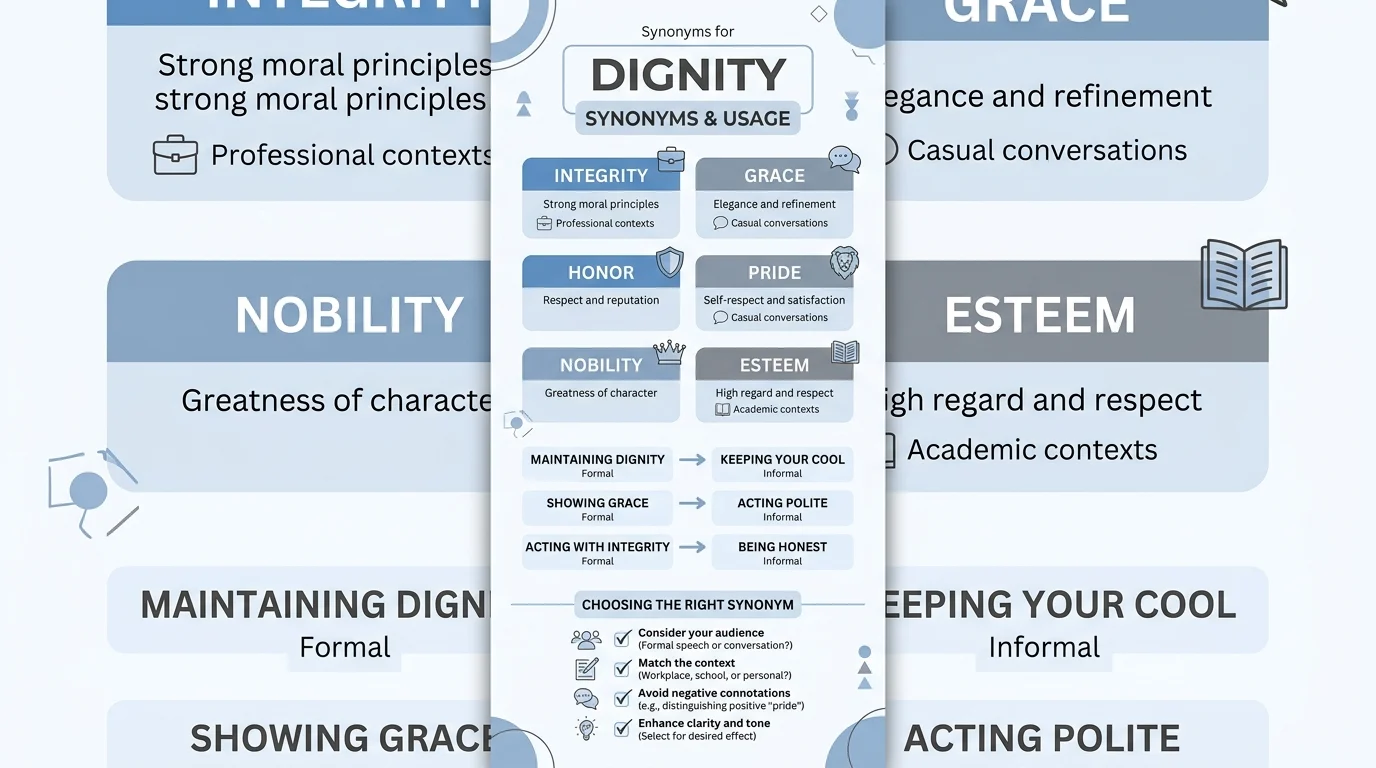
Dignity means the quality of being worthy of respect, honor, or esteem. The best synonyms depend on your context. For formal writing use “respect” or “honor.” professional settings use “integrity” or “propriety.” For emotional contexts use “pride” or “self worth.” casual conversation use “class” or “grace.” Each synonym carries its own unique tone and meaning.
Meaning, Tone and Context
Simple definition
Dignity refers to a person’s inherent worth and the state of being deserving of respect. It can describe inner qualities like self respect or outward behaviors like maintaining composure under pressure.
Part of speech
Dignity is a noun. The adjective form is “dignified.” The adverb form is “dignifiedly.” The verb form is less common but “dignify” means to give honor to something or someone.
Tone
The tone of dignity is generally positive. It conveys seriousness, respect, and moral weight. It is rarely used negatively. When it appears in a negative context, it usually describes a loss of dignity or an affront to dignity.
Formality level
Dignity is formal. It appears in academic writing, professional correspondence, legal documents, and formal speeches. You can use it in casual conversation, but it will sound quite serious and weighty.
Common use cases
People use dignity when discussing human rights, workplace conduct, personal character, aging, death, social justice, leadership, and professional behavior. It also appears in discussions about self respect, honor, and moral integrity.
Important word forms
Noun: dignity
Adjective: dignified
Verb: dignify
Adverb: dignifiedly
Opposite: indignity
When and How to Use “Dignity”
You should use dignity when you want to emphasize a person’s inherent worth or their ability to maintain self respect in challenging situations. The word carries a sense of moral gravity. It works best in serious or formal contexts.
Professional example
Our company treats every employee with dignity, regardless of their position or tenure.
Context: workplace policy statement
Personal example
She faced her illness with remarkable dignity and never complained about her suffering.
Context: emotional or personal writing
Academic example
The philosopher argued that human dignity forms the foundation of all moral rights.
Context: academic essay or research paper
Emotional example
Even after losing everything, he maintained his dignity and refused to beg for help.
Context: storytelling or creative writing
Social media example
We should all strive to treat others with dignity, both online and offline.
Context: social media caption or post
Resume example
I managed difficult client relationships with dignity and professionalism.
Context: resume bullet point
Casual example
She walked away from the argument with her dignity completely intact.
Context: conversation or informal writing
Another Word for “Dignity”
Professional writing
The best replacement is “integrity.” It suggests moral soundness and ethical strength. “Propriety” works well for workplace conduct and proper behavior.
Academic writing
“Worth” or “value” are excellent choices. They emphasize the inherent importance of human beings. “Honor” also fits well in philosophical or ethical discussions.
Casual conversation
“Class” is a modern informal alternative. “Grace” works when describing how someone handles difficult situations. Both sound natural in everyday speech.
Emotional writing
“Pride” captures the inner sense of self respect. “Self worth” emphasizes personal value. “Composure” works when describing calmness under pressure.
Creative writing
“Nobility” adds a poetic or historical feel. “Stature” suggests social or moral standing. “Splendor” works in literary contexts for grand descriptions.
Resume or workplace use
“Professionalism” is a direct replacement. “Conduct” and “decorum” work well for behavior based descriptions. “Standards” suggests maintaining high personal expectations.
Social media captions
“Grace” is perfect for inspirational posts. “Class” works for lifestyle content. “Respect” is straightforward and widely understood.
Stronger meaning
“Esteem” carries greater weight and suggests high regard from others. “Reverence” is even stronger and implies deep respect.
Softer meaning
“Decency” is more accessible and less formal. “Civility” emphasizes polite behavior in social situations.
When Not to Use “Dignity”
Dignity sounds too formal in casual conversations about everyday situations. You would not say your sandwich was made with dignity. You would not describe a casual shopping trip as a dignified experience.
The word also sounds too serious when you simply mean polite behavior. “Courtesy” or “politeness” work better for routine social interactions. Dignity implies moral weight and personal worth.
Avoid dignity when you mean personal style or fashion sense. “Elegance” or “sophistication” are more appropriate. Dignity is about character, not appearance.
Weak use
He showed dignity by holding the door for her.
Stronger alternative
He showed courtesy by holding the door for her.
Weak use
The restaurant served food with dignity.
Stronger alternative
The restaurant served food with care and professionalism.
Words Commonly Confused With “Dignity”
Dignity vs. Pride
Dignity is the inherent worth of a person. Pride is the feeling of satisfaction from one’s achievements. You can lose pride but your dignity remains intact. Pride can be negative when it becomes arrogance. Dignity is always positive.
Dignity vs. Honor
Honor is recognition from others for good deeds or character. the internal quality that makes you worthy of honor. Honor is external. Dignity is internal.
Dignity vs. Respect
Respect is a feeling of admiration or regard. the quality that deserves that respect. You show respect to someone who has dignity. You can respect a skilled athlete without considering their dignity.
Dignity vs. Integrity
Integrity is about moral consistency and honesty. Dignity is about worth and self respect. You can have integrity without dignity in a specific situation. You can have dignity without perfect integrity.
Dignity vs. Class
Class refers to social standing or style. Dignity refers to moral worth and self respect. Class can be superficial. Dignity is deeply personal and rooted in character.
Dignity vs. Composure
Composure is emotional calmness. worthiness of respect. You can have composure without dignity. You can have dignity while showing emotion.
Best Synonym by Context for “Dignity”
| Context | Best Synonym | Why It Works | Example |
|---|---|---|---|
| Formal Writing | Esteem | Communicates deep respect and admiration | The organization holds the dignity and esteem of all members as a core value. |
| Academic Writing | Worth | Emphasizes inherent value in philosophical discussions | The theory centers on the intrinsic worth of every human being. |
| Professional Business | Integrity | Highlights moral soundness and ethical behavior | She conducted business with integrity and earned lasting trust. |
| Resume or Job Search | Professionalism | Shows workplace appropriate conduct | I maintained professionalism during all client negotiations. |
| Casual Conversation | Class | Feels natural and conversational | He showed real class by admitting his mistake publicly. |
| Creative Writing | Nobility | Adds literary depth and historical resonance | The character moved through tragedy with quiet nobility. |
| Emotional Tone | Pride | Captures the personal feeling of self respect | She took pride in her work and refused to compromise. |
| Strong Intensity | Reverence | Expresses the deepest level of respect | The community showed reverence for their elder’s wisdom. |
| Soft or Moderate | Decency | Offers a gentle, approachable alternative | Everyone deserves basic decency in how they are treated. |
| Social Media Captions | Grace | Works well for inspirational content | Handle criticism with grace and keep moving forward. |
| US Usage | Dignity | Standard American English preferred term | We believe in the dignity of every person. |
| UK Usage | Dignity | Also standard British English | The institution upholds the dignity of its members. |
Which Synonym Should You Choose?
Your choice depends on what you want to emphasize. If you want to stress moral character, choose “integrity.” If you want to focus on self respect, choose “pride.” you want to highlight how others view someone, choose “esteem.”
Consider your audience. Formal writing requires words like “propriety” or “decorum.” Casual writing permits “class” or “grace.” Academic writing prefers “worth” or “value.”
Think about emotional intensity. Mild situations call for “decency” or “civility.” Powerful moments require “reverence” or “nobility.”
Look at your sentence structure. Some synonyms fit better in certain positions. “Integrity” works well as the subject of a sentence. “Grace” often appears in prepositional phrases.
Real Life Examples of “Dignity” in Sentences
School example
The teacher treated every student with dignity, recognizing their individual strengths and challenges.
Workplace example
The manager handled the layoff announcements with dignity, respecting each employee’s contributions and feelings.
Writing example
Her memoir describes how she maintained personal dignity during years of hardship and loss.
Conversation example
He walked away from the heated debate with dignity, refusing to engage in petty insults.
Social media example
Let us all remember to treat others with dignity, even when we disagree with their views.
Resume example
Demonstrated dignity and poise while managing high pressure client presentations.
Email example
We appreciate your dignified response to this challenging situation and your commitment to resolution.
Storytelling example
The old soldier faced his final days with remarkable dignity, never complaining or seeking sympathy.
15 Synonyms for “Dignity”
| Synonym | Simple Meaning | Best Used For | Example Sentence |
|---|---|---|---|
| Integrity | Moral soundness and honesty | Professional and ethical contexts | The company’s integrity kept its reputation strong during the crisis. |
| Esteem | High regard or favorable opinion | Formal writing and academic work | His esteem among colleagues grew after his honest confession. |
| Pride | Self respect and personal satisfaction | Emotional and personal contexts | She took pride in her ability to handle difficult people calmly. |
| Nobility | High moral character or excellence | Creative and literary writing | His nobility of spirit made him beloved by everyone who knew him. |
| Honor | Recognition of worth or merit | Formal and ceremonial contexts | The community bestowed honor on the veteran for his service. |
| Grace | Elegance and composure in difficult times | Social media and inspirational writing | She accepted defeat with grace and promised to try again. |
| Class | Style and sophistication | Casual and modern conversations | His class showed through in how he treated everyone equally. |
| Decency | Basic moral goodness | Everyday situations and conversations | Treating others with decency costs nothing but means everything. |
| Composure | Emotional calmness and self control | Stressful or challenging situations | He maintained his composure during the intense negotiation. |
| Propriety | Correct and proper behavior | Professional and formal contexts | The lawyer’s propriety earned respect from both clients and opponents. |
| Worth | Inherent value or importance | Academic and philosophical discussions | The worth of every person should never be questioned. |
| Stature | Level of respect gained through achievement | Professional and career contexts | Her stature in the industry came from years of consistent excellence. |
| Reverence | Deep respect and awe | Spiritual or deeply emotional contexts | The students listened with reverence to the wise professor. |
| Civility | Polite and respectful behavior | Social and community contexts | Civility in public discourse has become increasingly rare. |
| Splendor | Magnificence and grand dignity | Literary and poetic contexts | The ceremony was conducted with great splendor and formality. |
Synonym Groups and Usage Differences
Professional vs. Personal Synonyms
Professional contexts favor “integrity,” “propriety,” and “professionalism.” These words describe workplace conduct and ethical standards. Personal contexts prefer “pride,” “self worth,” and “grace.” These words describe individual character and emotional responses. The professional words focus on external behavior. The personal words focus on internal experience.
Formal vs. Conversational Synonyms
Formal writing demands “esteem,” “reverence,” and “propriety.” These words appear in academic papers, legal documents, and official speeches. Conversational settings allow “class,” “grace,” and “decency.” These words feel natural in everyday speech. Emails and texts accept both depending on the relationship with the recipient.
Academic Synonyms
Academic writing values “worth,” “value,” and “intrinsic dignity.” These terms appear in philosophy, ethics, law, and social sciences. They emphasize objective moral status. “Human dignity” is a standard academic phrase. “Moral worth” appears in ethics papers. These synonyms sound precise and scholarly.
Professional and Business Synonyms
Business contexts use “integrity,” “propriety,” and “professionalism.” These words appear in performance reviews, company policies, and leadership discussions. “Conduct” and “standards” are also appropriate. They emphasize behavior and ethical expectations. These words carry weight in corporate environments.
Creative or Literary Synonyms
Creative writing benefits from “nobility,” “splendor,” and “majesty.” These words add descriptive richness and emotional depth. “Stature” works for character descriptions. “Grandeur” suits epic or historical settings. These synonyms create imagery and set tone. They make writing more vivid and memorable.
Slang or Modern Synonyms
“Dignity” does not have many slang equivalents. “Class” is the closest modern alternative. “Swagger” is too casual and lacks the serious meaning. “Reputation” is more specific. Modern usage tends toward “grace” and “class” in casual contexts. These words are acceptable in social media and casual conversation.
Strongest vs. Weaker Synonyms
Mildest
Decency, civility, courtesy
Moderate
Grace, class, composure, pride
Strong
Honor, esteem, integrity, nobility
Strongest
Reverence, veneration, awe
Emotional vs. Neutral Synonyms
Emotional synonyms
Pride evokes personal feeling. Grace suggests beauty in action. Reverence implies deep affection. Nobility inspires admiration. These words carry strong emotional weight.
Neutral synonyms
Worth is factual and objective. Value is analytical. Propriety is behavioral. Stature is descriptive. These words state qualities without emotional coloring.
Antonyms of “Dignity”
| Antonym | Meaning | Example Sentence |
|---|---|---|
| Indignity | Humiliating treatment or loss of respect | The prisoners endured daily indignity and harsh treatment. |
| Disgrace | Loss of reputation or respect | The scandal brought disgrace to his entire family. |
| Shame | Painful feeling of humiliation | She felt shame after her dishonest actions were revealed. |
| Humiliation | Embarrassing loss of dignity | The public humiliation was difficult for him to bear. |
| Degradation | Lowering of status or quality | Poverty often leads to degradation of human dignity. |
| Dishonor | Loss of honor or respect | His betrayal brought dishonor to his name. |
| Disrespect | Lack of respect or courtesy | The disrespect shown to elders offended everyone. |
| Contempt | Feeling that someone is worthless | Her contempt for his opinions was clearly visible. |
| Worthlessness | Lack of value or importance | The manager made employees feel worthlessness through constant criticism. |
| Inferiority | Lower status or quality | His sense of inferiority prevented him from speaking up. |
| Abasement | Humiliation or degradation | The abasement of his position was hard to accept. |
| Mortification | Extreme embarrassment | The mortification of being publicly corrected haunted her. |
| Demeaning | Causing loss of dignity | The demeaning comments affected the entire team. |
| Belittlement | Making someone feel small | The belittlement of his achievements was unfair. |
| Derogation | Lessening of worth or status | The derogation of her role in the project was unjust. |
Comparison: Dignity vs. Similar Words
Dignity vs. Honor
Honor is external recognition from others. Dignity is the internal quality that deserves that recognition. Honor can be given and taken away. Dignity is inherent and cannot be lost. Honor comes from achievements. Dignity comes from being human.
Which one is stronger? Honor can be stronger in social contexts. Dignity is stronger as a moral concept.
Which one is more formal? Both are formal. Honor appears more in ceremonial language.
Example for dignity: She maintained her dignity despite the unfair criticism.
Example for honor: The award brought great honor to his family.
Dignity vs. Pride
Pride is personal satisfaction from accomplishments. Dignity is worthiness of respect regardless of accomplishments. Pride can be positive or negative. Dignity is always positive. Pride focuses on self. Dignity focuses on universal worth.
Which one is stronger? Pride can be intense. Dignity is more profound and lasting.
Which one is more formal? Dignity is more formal. Pride appears in both formal and casual contexts.
Example for dignity: He faced the setback with dignity and resolve.
Example for pride: She took pride in her artistic achievements.
Dignity vs. Integrity
Integrity is moral consistency and honesty. Dignity is worthiness of respect. Integrity is about actions. Dignity is about status. You can have integrity without being treated with dignity. You can be treated with dignity without having integrity.
Which one is stronger? Integrity is stronger for moral behavior. Dignity is stronger for human worth.
Which one is more formal? Both are formal and appropriate for professional contexts.
Example for dignity: The company respects the dignity of every employee.
Example for integrity: He demonstrated integrity by returning the lost wallet.
Dignity vs. Composure
Composure is emotional calmness. Dignity is worthiness of respect. Composure is about managing feelings. Dignity is about inherent value. You can have composure without dignity. You can have dignity while expressing emotion.
Which one is stronger? Dignity is a more significant concept. Composure is situational.
Which one is more formal? Both are formal. Composure appears more in emotional contexts.
Example for dignity: The organization upholds human dignity.
Example for composure: She maintained composure during the difficult meeting.
Dignity vs. Respect
Respect is a feeling or action toward someone. Dignity is the quality that deserves respect. You give respect. You possess dignity. Respect is external. Dignity is internal. You can respect someone without considering their dignity. You can have dignity without receiving respect.
Which one is stronger? Respect is active. Dignity is fundamental.
Which one is more formal? Both are formal. Respect is more common in everyday use.
Example for dignity: Basic human dignity must be protected.
Example for respect: He earned the respect of his colleagues.
Dignity vs. Class
Class is about social status or style. Dignity is about moral worth. Class can be superficial or inherited. Dignity is personal and earned. Class changes with social context. Dignity is universal.
Which one is stronger? Dignity carries more moral weight. Class is lighter and more casual.
Which one is more formal? Dignity is formal. Class is more casual.
Example for dignity: The policy protects the dignity of all citizens.
Example for class: She demonstrated class in how she handled the conflict.
Common Phrases and Expressions with “Dignity”
1. With dignity
Meaning: In a composed and self respecting manner.
Example sentence: She accepted the award with dignity and humble gratitude.
2. Human dignity
Meaning: The inherent worth of every person.
Example sentence: Human dignity forms the basis of our legal system.
3. Stand on your dignity
Meaning: Insist on being treated with proper respect.
Example sentence: He was willing to stand on his dignity and demand fair treatment.
4. Beneath your dignity
Meaning: Not worthy of your attention or effort.
Example sentence: He considered the gossip beneath his dignity and ignored it.
5. Preserve your dignity
Meaning: Maintain self respect in a difficult situation.
Example sentence: He tried to preserve his dignity after the embarrassing mistake.
6. Treat with dignity
Meaning: Show respect and consideration to someone.
Example sentence: All patients should be treated with dignity and compassion.
7. Dignity of labor
Meaning: The value and respect due to all types of work.
Example sentence: The organization promotes the dignity of labor for every worker.
8. Dignified silence
Meaning: Remaining quiet in a noble or self respecting way.
Example sentence: He maintained a dignified silence during the heated debate.
Common Mistakes to Avoid
Using dignity when you mean politeness
Dignity is about inherent worth. Politeness is about social manners. Dignity is deeper and more serious. A person can be polite without dignity. A person can have dignity without being polite.
Confusing dignity with arrogance
Arrogance is excessive pride. Dignity is proper self respect. Arrogance pushes others away. Dignity draws respect. Arrogance is negative. Dignity is positive.
Using casual synonyms in formal writing
“Class” and “grace” are too informal for academic papers. “Esteem” and “worth” are more appropriate. Match the synonym to the writing context. Formal situations demand formal language.
Using overly dramatic synonyms for simple situations
Saying “the reverent dignity of my morning coffee” is too dramatic. Save “reverence” for truly meaningful moments. “Decency” or “civility” work better for everyday contexts.
Repeating the same synonym too often
Variety keeps writing fresh. Use different synonyms based on the specific meaning you want to convey. Do not rely on one word. Spread your choices across the available alternatives.
Choosing a synonym with the wrong emotional tone
“Pride” can sound arrogant. “Grace” sounds elegant. “Integrity” sounds ethical. Consider the feeling you want to create. Match the synonym to the emotional effect you need.
Using slang in academic or professional writing
Avoid “class” and “swagger” in serious contexts. These words undermine credibility. Academic and professional writing demands formal vocabulary. Save informal words for casual communication.
FAQs
What is the best synonym for dignity?
The best synonym is “integrity” for professional contexts and “grace” for casual or emotional situations.
What is a formal synonym for dignity?
“Esteem” and “propriety” are excellent formal synonyms for dignity in academic and professional writing.
What is an informal synonym for dignity?
“Class” is the most common informal synonym for dignity in casual conversation.
What is another word for dignity in professional writing?
“Integrity” and “professionalism” are the best alternatives for dignity in workplace writing.
What is the difference between dignity and pride?
Dignity is inherent worth and self respect. Pride is satisfaction from personal achievements or abilities.
What is the opposite of dignity?
Indignity is the direct opposite and describes humiliation or loss of respect.
Conclusion
Dignity means the quality of being worthy of respect and honor. It is a formal, positive word used in serious contexts. The best synonyms depend on your situation. “integrity” for professional settings. Use “grace” for emotional contexts. “class” for casual conversation. Use “esteem” for formal writing. Choose synonyms based on tone, formality, and emotional intensity.
Remember that good writing uses variety. Do not rely on one word. Spread your choices across synonyms that match your meaning. Consider your audience and context. Strong vocabulary makes you sound more professional and credible. Start using these alternatives today. Your writing will become more precise, engaging, and effective.