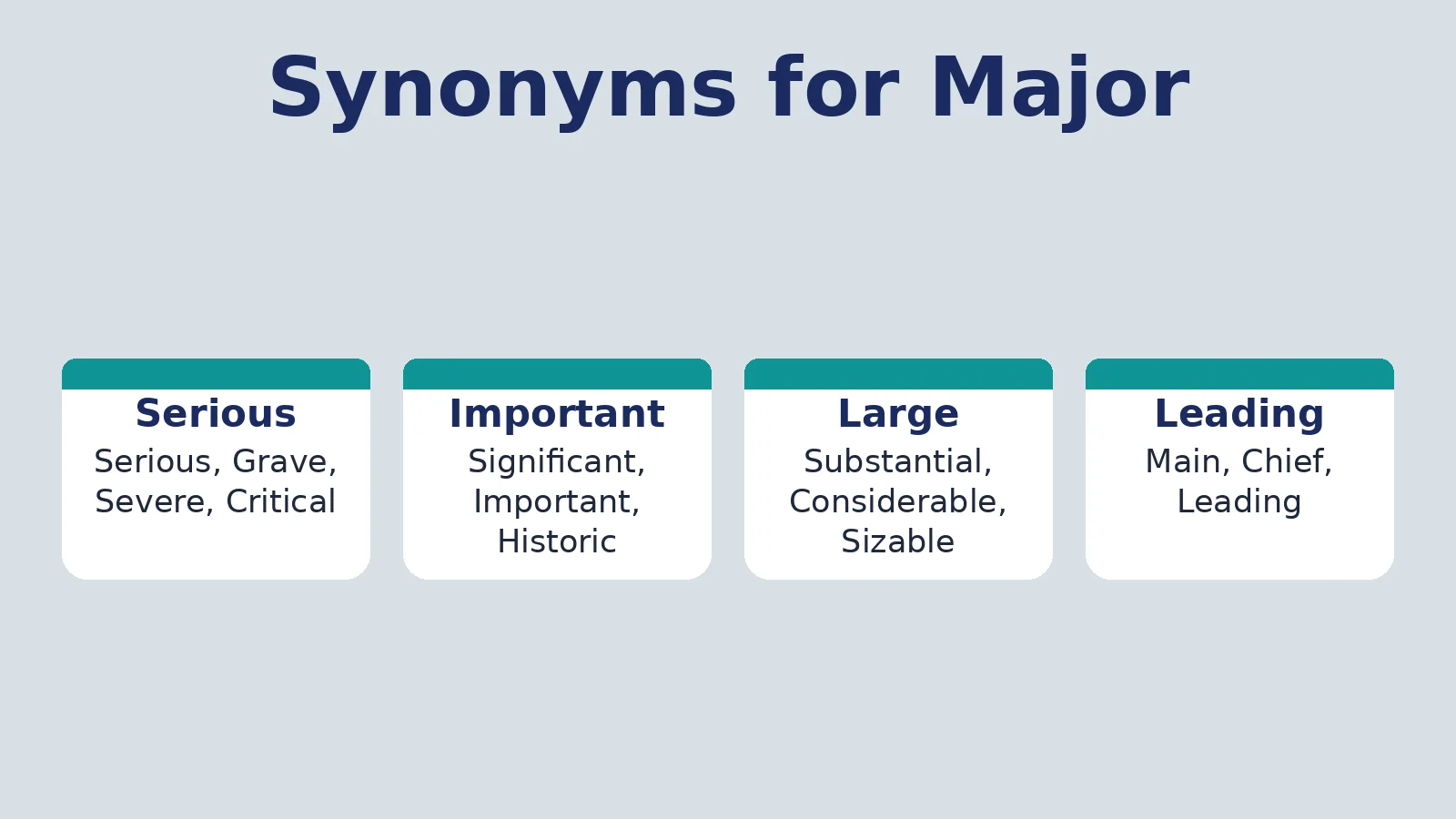
Major is the word writers grab when something feels too big for small, yet it flattens fast with overuse. English offers sharper tools for every job major does. The most useful synonyms for major are serious, significant, important, substantial, considerable, chief, and grave. Each one keeps the weight of major while naming the exact kind of weight involved.
This guide sorts more than 35 synonyms for major by seriousness, importance, and size. Every word comes with a short meaning, and the key words include example sentences. As a result, you can replace a vague major problem with the precise word your sentence actually needs, in essays, reports, news writing, and everyday speech. A few minutes with the groups below will also sharpen your ear, so the right word starts arriving on its own.
Top Synonyms for Major: Quick Reference
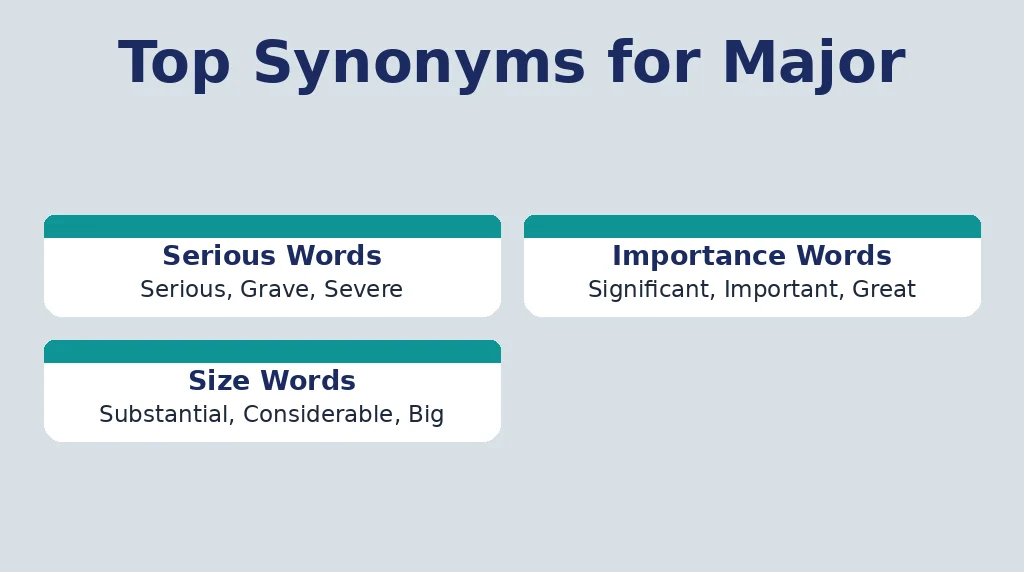
The table below covers the 26 synonyms readers reach for most often. Start here when you need one quick replacement. Later sections sort the full list into finer groups and explain where each word belongs.
| Word | Meaning in one line | Best for |
|---|---|---|
| Serious | Demanding attention, not minor | Problems, illness, matters |
| Grave | Very serious and worrying | Danger, concerns, formal |
| Severe | Very intense or harsh in effect | Damage, weather, pain |
| Critical | At a decisive or dangerous point | Condition, stage, moment |
| Crucial | Decisive, extremely important | Tests, votes, moments |
| Grievous | Very serious, formal | Loss, harm, formal writing |
| Urgent | Needing action at once | Matters, repairs, appeals |
| Weighty | Serious and important | Matters, decisions, formal |
| Important | Of great value or effect | Events, people, decisions |
| Significant | Important and worth noticing | Changes, results, amounts |
| Great | Well above average in importance | Men, works, occasions |
| Historic | Likely to be remembered in history | Votes, deals, speeches |
| Prominent | Important and well known | Figures, roles, features |
| Eminent | Famous and respected in a field | Scholars, judges, doctors |
| Of note | Worth noticing, formal phrase | Points, remarks, formal |
| Vital | Necessary for success | Roles, supplies, steps |
| Big | Large in size or amount | Everyday speech, problems |
| Substantial | Large in amount or value | Sums, parts, improvements |
| Considerable | Fairly large, measured tone | Time, effort, sums, formal |
| Sizable | Fairly large | Crowds, portions, fees |
| Large | Greater in size than usual | Shares, numbers, areas |
| Main | The central one of a set | Roles, cities, works |
| Chief | Highest in rank | Reasons, rivals, officers |
| Leading | Most important or successful | Brands, roles, experts |
| Senior | Higher in rank | Staff, officers, partners |
| Uppermost | Highest in importance, formal | Priorities, thoughts |
What Does Major Mean?
Major is a measuring word. Where main points at the leader of a set, major weighs the set itself and reports that something is large, serious, or important enough to matter. Collins gives the core definition as very serious or significant, and its second sense as main or principal. Merriam-Webster splits the word the same way: large enough in size or amount to merit attention, and having great meaning or lasting effect.
That split explains the word’s daily workload. A major problem is serious. A major change is important. A major part is large. Three different jobs hide inside one adjective, which is exactly why the word wears out. Replacing major forces you to decide which job you meant, and the sentence gets clearer the moment you decide.
Major also moonlights as a noun and a verb. An army major holds a senior rank. A college major is a student’s main field of study, and the student majors in that subject. In music, major names the brighter family of scales and keys, with minor as its opposite. Those extra senses get a short section of their own later, because their related words differ from the adjective list.
English speakers learn major as half of a pair. Major and minor arrive together in music lessons, hospital forms, and school reports, so the word carries a built-in scale: whatever is not major slides toward minor. That pairing is a gift to writers. Calling something major quietly promises that a minor version exists for comparison. Calling something the main one makes no such promise, since main marks a single peak rather than a scale. Keep the promise in mind, and you will reach for major only when a scale truly exists.
One habit is worth copying from careful writers. They treat major as a claim that needs support. A major problem should show its damage, and a major investment should show its size. When the support is missing, honest writers step down to words like notable or real. Readers who want the neighboring word family can also browse synonyms for important, since major and important share a large border.
Major Problems: Serious and Grave Synonyms
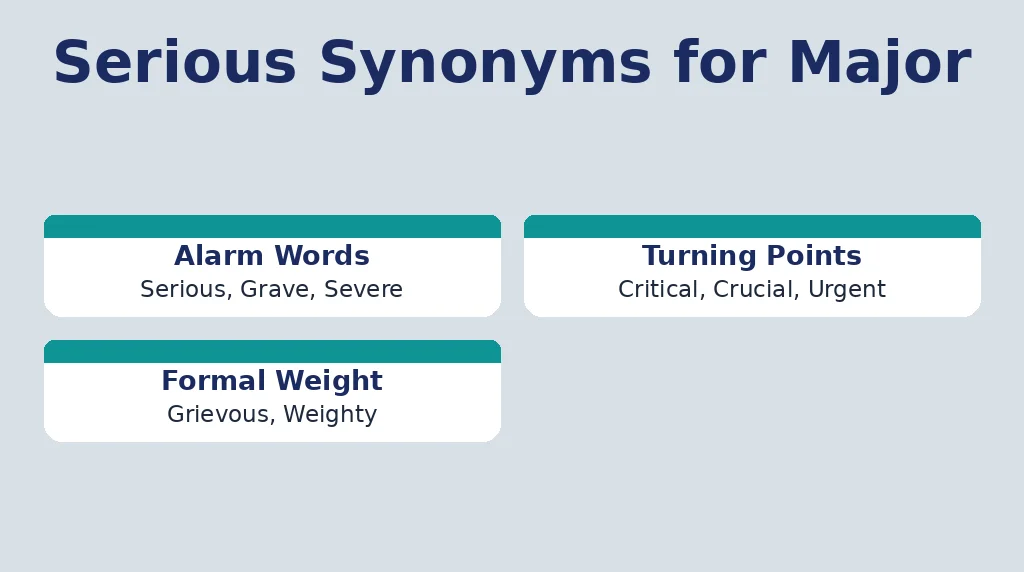
When major describes a problem, an illness, or a danger, it is really talking about seriousness. The words in this group all raise an alarm, but they ring it in different tones. Some sound clinical, some sound worried, and some sound like a headline.
- Serious: demanding attention because of possible harm. Example: The storm caused serious damage along the coast.
- Grave: very serious and worrying, with a formal tone. Example: The town faces a grave shortage of clean water.
- Severe: very intense or harsh in its effect. Example: He suffered severe burns in the fire.
- Critical: at a decisive or dangerous turning point. Example: The patient remains in critical condition.
- Crucial: decisive for the outcome, extremely important. Example: The next ten minutes are crucial for the rescue.
- Grievous: very serious, formal and heavy. Example: The flood was a grievous loss for the village.
- Urgent: needing action right now. Example: The bridge needs urgent repairs.
- Weighty: serious and full of consequence. Example: The committee debated weighty matters all day.
- Bad: the plain everyday word for this shade. Example: She caught a bad case of flu.
- Vital: so important that failure follows without it. Example: Clean water is vital after a disaster.
Two distinctions matter inside this group. First, urgent talks about time, while the rest talk about weight. An urgent problem must be handled today. A grave problem might wait a week and still be grave. Second, severe measures intensity: severe pain, severe weather, severe cuts. Serious measures consequence: a serious mistake, a serious illness, a serious talk. Swapping them at random produces odd lines, since nobody complains of a serious headache or a severe conversation.
Tone climbs across the group as well. Bad and serious belong in ordinary reports. Grave and grievous belong in speeches, obituaries, and formal warnings. A school newsletter that calls a leaking roof a grievous loss will make parents smile for the wrong reason.
Major Changes and Decisions: Important and Significant Synonyms
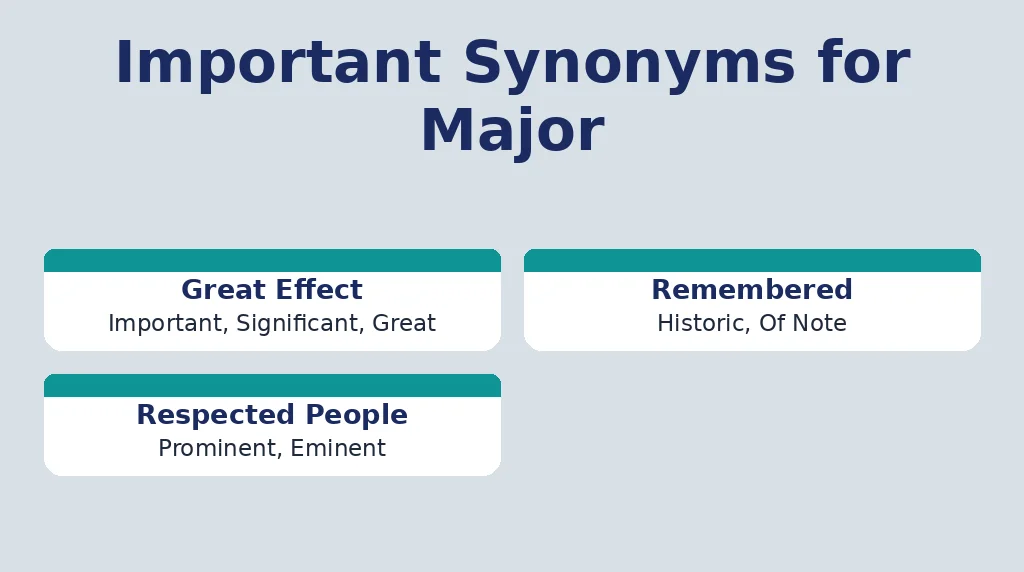
A second family of synonyms handles importance rather than danger. These words fit changes, decisions, events, and people whose actions carry weight. Cambridge groups them under having great effect or influence, and that label fits: each word says the thing will still matter later.
- Important: of great value or effect, the all-purpose choice. Example: It was an important meeting for the whole team.
- Significant: important and worth noticing, often measurable. Example: The drug showed a significant effect in trials.
- Great: well above average in importance or quality. Example: It was a great moment in the club’s history.
- Historic: important enough to be remembered in history. Example: The two leaders signed a historic agreement.
- Prominent: important and easy to notice. Example: She holds a prominent role in the party.
- Eminent: famous and respected within a field. Example: An eminent surgeon led the research team.
- Of note: worth noticing, a formal phrase. Example: He said nothing of note during the hearing.
- Big: large in importance in everyday speech. Example: Tonight is a big night for the young singer.
Watch the strength ladder here. Important is the honest middle. Significant adds a hint of evidence or scale, which is why scientists and statisticians love it. Historic is the ceiling: it promises that people will retell the event years from now. Calling a routine office decision historic drains the word for the day a real milestone arrives.
People words need their own care. Prominent describes visibility: a prominent figure is seen and quoted often. Eminent describes earned respect: an eminent judge may rarely appear on television. A person can be either, both, or neither, so pick the claim you can defend. For events and changes, significant and important remain the safest pair, and great works when warmth and praise are welcome.
Large in Amount: Big and Substantial Synonyms
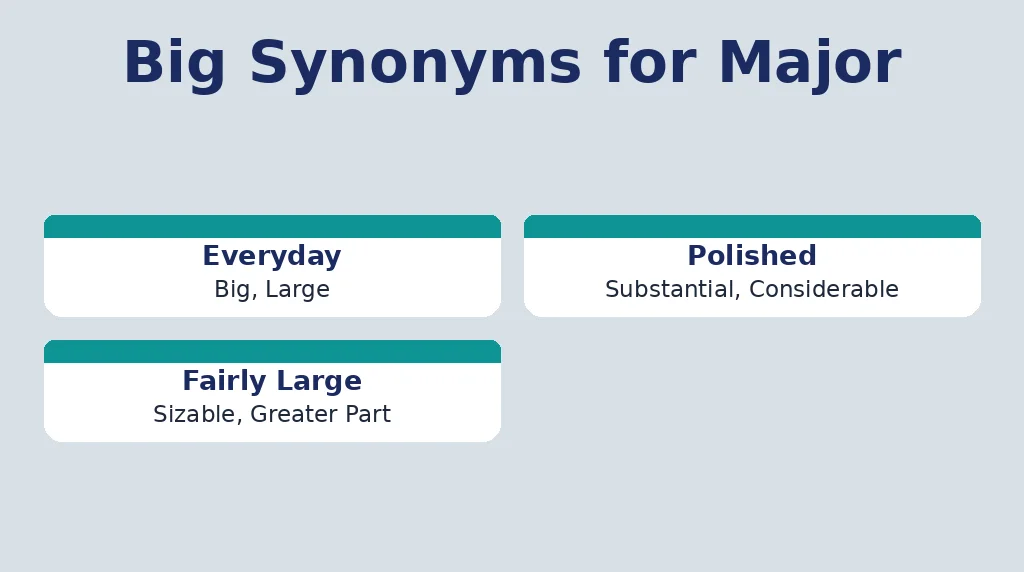
Sometimes major simply reports size. A major part of the budget, a major share of the vote, a major portion of the work: in each case the claim is about amount, not danger or fame. The words below handle that measuring job, and they range from plain speech to boardroom polish.
- Big: large in size or amount, the everyday default. Example: A big part of the cost is transport.
- Substantial: large in amount, value, or importance. Example: She won a substantial share of the vote.
- Considerable: fairly large, stated in a measured tone. Example: The repair took a considerable amount of time.
- Sizable: fairly large, a touch less formal than considerable. Example: A sizable crowd gathered outside the hall.
- Large: greater in size than usual, plain and flexible. Example: A large number of students applied this year.
- Greater: larger in amount, the comparative form. Example: A greater share now goes to savings.
- Bigger: larger in size, the informal comparative. Example: The firm took a bigger role in the project.
- Higher: greater in level or rank, for numbers and posts. Example: Prices reached a higher level this spring.
Register does most of the work in this group. Big sounds spoken and friendly. Substantial and considerable sound written and careful, so reports and grant applications reach for them. Sizable sits between the two camps and appears in both news and speech. If your sentence is only about physical size, though, none of these words is the best tool; the dedicated guide to synonyms for big sorts the pure size words on their own.
One phrase deserves special mention: the major part. It is the standard way to say most of something without using the word most: the major part of the work is done. Writers sometimes dress it up as the greater part, which says the same thing in a slightly older style. Both phrases claim more than half, so they are stronger than a large part. If the share might be under half, honesty requires large part or big part instead. Amount words look harmless, yet they carry numbers inside them, and careful readers notice when the numbers do not add up.
Comparatives deserve a warning. Greater, bigger, and higher only make sense when two amounts are being compared. A greater part implies a smaller part somewhere nearby. Dropping a comparative into a sentence with no comparison leaves readers asking the silent question: greater than what?
Main and Leading: The Principal Sense of Major
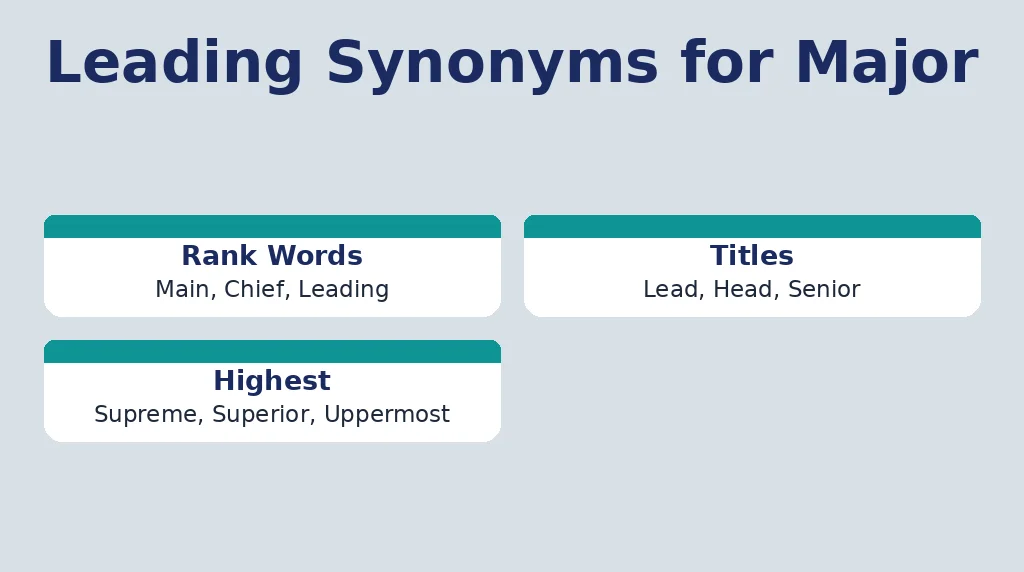
Collins lists a whole second sense of major meaning main or principal, and everyday English proves it daily. Major cities, major roads, major works, and major leagues all use major to mean the leading ones of their kind. The synonyms below serve that rank sense.
- Main: the closest match of all, the central one. Example: Paris is a main hub for European rail.
- Chief: highest in rank among a set. Example: The port is the chief harbor of the region.
- Leading: most important or most successful in a field. Example: She writes for a leading journal of medicine.
- Lead: first or main, as in the lead story of a bulletin. Example: The storm was the lead item on the news.
- Head: chief, used in titles and places. Example: The head office moved to a larger building.
- Senior: higher in rank, for people and posts. Example: A senior officer reviewed the report.
- Superior: higher in rank or standing. Example: She reported the error to a superior officer.
- Supreme: highest in authority. Example: The supreme court sits in the capital.
- Uppermost: highest in importance, formal. Example: Safety was uppermost in their minds.
This rank sense explains a common puzzle. If major can mean main, why do we say major cities but the main road? Habit, mostly. Cities, leagues, and works settled on major, while roads, entrances, and ideas settled on main. Neither choice is wrong, and neither is freely swappable. A main league sounds like a translation error, and a major entrance sounds like a very grand doorway. Learn the settled pairs as chunks, and your writing will sound native.
The sports world borrowed this rank sense and stretched it into a metaphor. A major league is the top league in American baseball, and everyday speech now calls anything first-class major league: a major-league effort, a major-league talent. The phrase praises quality rather than measuring size. Its partner, minor league, works as a gentle insult for anything second-rate. Writers outside sport should use the metaphor sparingly, since it charms once and then starts to repeat itself.
Senior and superior need people or posts to attach to. A senior partner and a superior officer make sense. A senior problem does not, because problems hold no rank. When the noun is a thing rather than a person, main, chief, and leading are the safe hands.
Major in Music, the Army and College
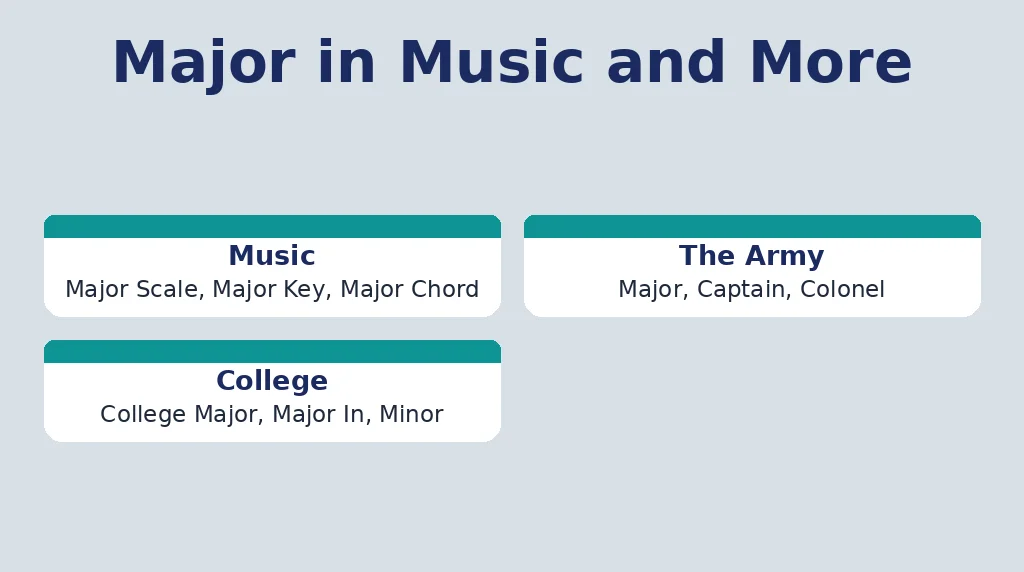
Three special worlds use major as a noun or a label, and each one pairs it with a fixed opposite or partner. Knowing these senses stops silly swaps, because none of the adjective synonyms from earlier sections can enter here.
In music, major describes a family of scales, keys, and chords. A piece in C major uses the major scale built on C, and major chords anchor most popular songs. Teachers often describe major keys as brighter and minor keys as darker or sadder. The contrast is a rule of thumb, not a law, yet it shapes how listeners hear film music every day. Minor is the only true partner word here; serious and significant cannot describe a key.
In the army and air force, a major is a person: an officer rank above captain and below lieutenant colonel. A major gives orders to captains and takes them from colonels. The rank appears in phrases like Major General, where major works as a grading word instead. No synonym replaces the rank, since ranks are names, not descriptions.
Sport uses the noun too. In golf and tennis, the majors are the handful of championships that matter most each year, and players are judged by how many majors they win. The phrase works because major already means the leading ones of a kind. A tournament outside that small circle can be rich and famous, yet it still is not a major.
In American colleges, a major is a student’s main field of study. A biology major studies biology above all other subjects, and the verb form is to major in something. The partner word is minor, a smaller second field. Cambridge lists study as the plain verb for this sense. British students do not major; they simply study or read a subject, which is why the word can confuse readers across the Atlantic.
Medicine keeps one more graded pair. Surgeons and hospitals divide operations into major and minor surgery. Major surgery is complicated and difficult work: it may open a body cavity, take hours, and need a long recovery. Minor surgery is small and quick, often done with local anesthetic in a clinic. Collins illustrates the scale with a small lump whose removal turned out to be major surgery. The lesson travels well: major grades the size of the job, not the skill of the person doing it.
Synonyms for Major in Essays, Reports and Professional Writing
School and office writing leans on major constantly, so this section maps the synonyms onto the tasks students and staff actually face. The goal is the word a marker or a manager would pick first.
In essays, significant and important carry the main load. A significant cause, an important turning point, and a major theme all promise analysis. Serious belongs with problems and consequences: a serious weakness in the argument, a serious threat to the plan. Students often write major when they mean first, and principal or main serves them better there. The principal cause of the war outranks a list of major causes, because it claims the lead rather than a share of the weight.
Reports and business writing prefer substantial and considerable for amounts. A substantial investment, a considerable delay, and a significant rise in costs all sound measured and credible. Managers distrust giant words in reports, since numbers must back every claim. Major itself survives in fixed business phrases: a major client, a major supplier, a major market. Those pairs are settled chunks, and swapping them only adds noise.
News writing splits the difference. Headlines need short, hard words, so serious and big do heavy work: serious crash, big win, major storm. The body of the story then upgrades to precise terms, naming the damage severe or the talks critical. Broadcast scripts follow the same pattern, because listeners cannot reread a sentence. When you write for the ear, keep the word short and let the facts carry the size.
Formal speeches allow the top shelf. Grave concerns, weighty decisions, and historic moments suit ceremonies and addresses. In a routine email, the same words sound overheated. Professional taste is mostly this: the plainest word that still tells the truth.
How to Choose the Right Synonym for Major
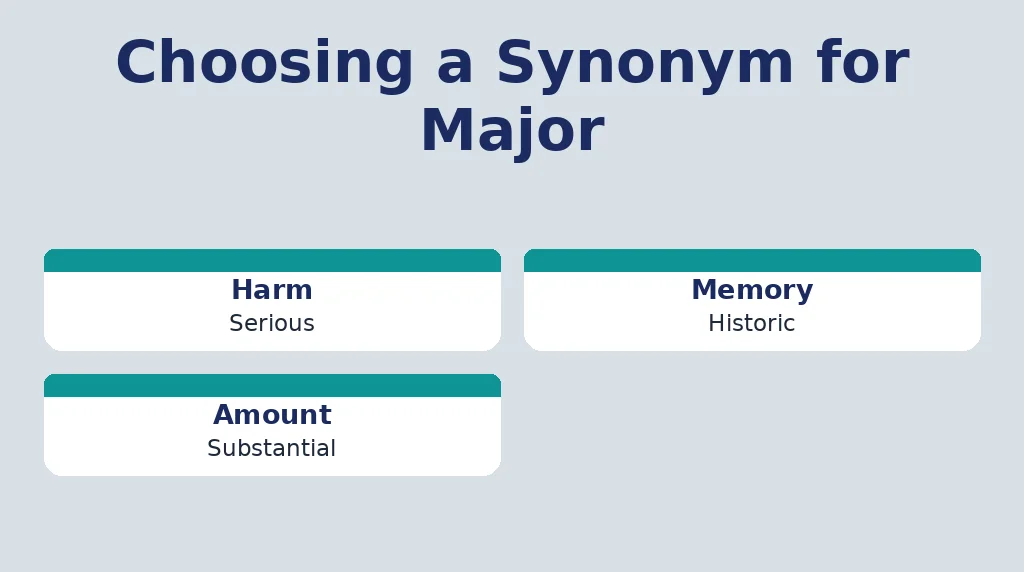
Start with one question: which job is major doing in your sentence? If the sentence reports damage or danger, open the serious group. If it reports influence or fame, open the importance group. If it reports an amount, open the size group. Sorting the job first makes the word choice almost automatic.
The closest contest is major against main. Main names the single central one: the main reason leads the list. Major names weight: a major reason is a big reason, and a list can honestly hold three of them. Writers who blur the two end up claiming one leader and three leaders at once. The companion guide to synonyms for main works through that contrast from the other side.
Major against serious is the second contest. Serious is narrower and stronger for harm: a serious injury is a medical fact. Major injury sounds like a sports headline. In careful writing about health, safety, or loss, serious usually wins. Major keeps its place for scale: a major operation, a major road closure, a major employer.
Paired examples show the gaps clearly:
- The factory is a major employer in the town. Scale is the claim here.
- The factory is the main employer in the town. Now it is the leading one.
- She suffered a serious injury in the fall. Harm, stated plainly.
- The team announced a significant signing. Noticeable and worth reporting.
- The bill passed by a substantial margin. Amount, measured with polish.
The quick picker below matches common situations to strong first choices.
| Situation | Strong first choice |
|---|---|
| A problem that causes harm | Serious |
| A change people will remember | Historic |
| A large share of money or votes | Substantial |
| A respected expert | Eminent |
| A deadline that cannot move | Critical |
| The leading city or brand | Leading |
| A formal word for a big amount | Considerable |
Example Sentences with Synonyms for Major
Seeing the words at work locks the differences in place. Each sentence below uses one synonym in its most natural home, and the note after it explains why the swap works.
- The storm left serious damage across three counties. Serious pairs with damage by habit.
- The region faces a grave water shortage this summer. Grave gives the warning a formal voice.
- The results show a significant rise in reading scores. Significant suits measured results.
- The treaty was a historic step for both nations. Historic claims a place in memory.
- A substantial part of the grant funds new labs. Substantial polishes an amount.
- The talks took a considerable amount of patience. Considerable sounds calm and written.
- She is an eminent voice in climate law. Eminent praises a respected person.
- The canal is a vital route for trade. Vital says the route cannot be lost.
- Paris and Lyon are leading centers of French design. Leading ranks cities in a field.
- The army promoted her to senior officer last spring. Senior ranks people, not things.
- Rain was uppermost in the farmers’ minds. Uppermost gives a formal lift to thoughts.
- The next quarter is critical for the young company. Critical marks a decisive stretch of time.
Swap any bold word back to major and the sentence still works. It just says less. That lost detail, a hint of harm, fame, or rank, is exactly what a good synonym buys you.
Antonyms for Major
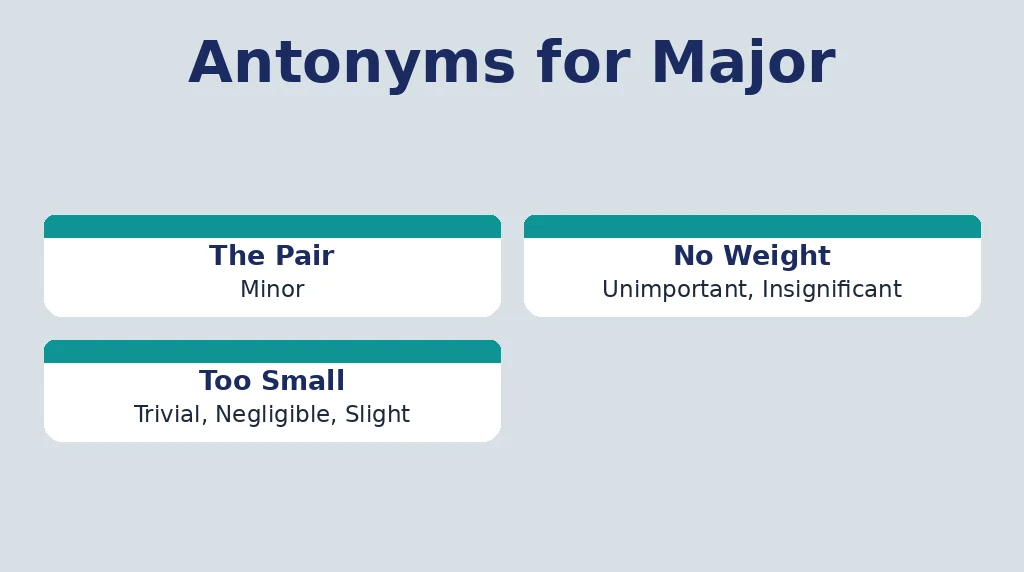
One opposite rules this word family: minor. A minor problem, a minor role, and a minor key all answer their major partners directly. Cambridge names minor as the direct antonym, and daily usage agrees, since speakers learn the pair as a single chunk.
Beyond minor, the general opposites are unimportant, insignificant, trivial, negligible, slight, small, and lesser. Each one shrinks a different quality. Unimportant and insignificant shrink influence: an insignificant detail changes nothing. Trivial shrinks worth: a trivial sum is not worth counting. Negligible shrinks measurable size to nearly zero, a favorite in science and engineering reports. Slight shrinks degree: a slight delay, a slight fever. Small shrinks plain size, and lesser shrinks rank.
Minor also leads a quiet life as a grading word far from music and medicine. Schools once sorted exams into majors and minors by weight. Drivers earn major and minor faults on a test. In each system, minor does not mean worthless; it means the smaller class of the same kind. That is the healthiest way to read the whole pair: major and minor sort things into weight classes, and neither class is an insult.
The pairing test works here as it does everywhere. If major claims weight, its antonym should remove weight. A major operation pairs with a minor operation. A major share pairs with a small share. A major figure pairs with a minor figure. When no clean pair exists, the sentence may be mixing two senses of major at once, which is a sign to rewrite rather than swap.
Common Mistakes: Words That Are Not True Synonyms for Major
Accuracy matters in a synonym guide, so this section clears up the words and forms that sneak into major lists wrongly.
Majority is the biggest trap. It is a noun meaning the greater number or amount: the majority of voters. It belongs to the same family, but it cannot do the adjective’s job. Write a major part of the budget, not a majority part, and save majority for sentences with of: the majority of the budget.
Majorly exists, but only as informal slang for very or really, as in majorly impressed. It has no place in reports, essays, or professional email. In formal writing the word is simply very, or a stronger adjective chosen with care.
Huge and enormous overshoot the claim. Major means large enough to matter, not gigantic. A major shareholder might own fifteen percent of a company: a serious stake, but nowhere near enormous. Reach for the giant words only when the size itself is the story.
Principal is a near miss in the other direction. As an adjective it matches main, the single leader, more than major, the heavyweight. The principal reason is the leading reason. A major reason is one of the big ones. Writers who treat the two as identical blur the very contrast this guide exists to teach.
Inflation is the quietest mistake of all. When every delay is a major delay and every error a major error, the word stops meaning anything, and readers start discounting the writer instead of the problem. Save major for the top of your scale. Let small problems be small, and the day a truly major one arrives, your warning will still have its force.
Eminent gets misused for events. It describes respected people, not things: an eminent scientist, never an eminent decision. For decisions and events, significant and historic carry the weight instead.
Frequently Asked Questions
What is the best synonym for major?
Serious is the best swap when major describes a problem, and significant is the best swap when it describes a change or result. For amounts, substantial is the safest polished choice. No single word covers all three jobs, which is why major wears out so fast.
What is the difference between major and main?
Main names the single central one, while major names weight or size. The main reason is the leader of the list. A major reason is a big reason, and a list can hold several. Use main for position and major for scale.
Is major stronger than important?
Usually, yes. Important is the broad, everyday word, and major adds size or seriousness on top of it. A major decision is not just important; it is important in a way that changes plans, budgets, or lives. Writers step up to major when the consequences grow.
What is the opposite of major?
Minor is the direct opposite, as in a minor problem or a minor key. For general use, unimportant, insignificant, trivial, and slight also work. The best opposite depends on which sense of major the sentence uses.
What does major mean in music?
In music, major describes a family of scales, keys, and chords, such as C major. Major keys are often described as brighter in sound, while minor keys sound darker. The word names a system, so no adjective synonym can replace it.
What is a college major?
In the United States, a major is the main subject a student studies for a degree. A history major focuses on history, and students say they major in their subject. A minor is a smaller second subject taken alongside it.
What makes surgery major or minor?
Doctors call surgery major when the procedure is large, complex, or risky, and minor when it is small and simple. Collins illustrates the point with a small lump whose removal turned out to be major surgery. The words grade the scale of the operation, not its success.
Can major be used for people?
Yes, in set ways. A major figure is a leading person, and an army major is an officer. For respected people, though, eminent and prominent are more precise, since major alone can sound like it is grading the person’s size.
Final Thoughts
Major does three jobs at once: it warns, it praises, and it measures. Once you decide which job your sentence needs, a sharper word is always waiting. Call the problem serious, the change significant, and the share substantial, and each sentence will say exactly what major only hinted at.
For an even deeper list with related words and near-synonyms, the Merriam-Webster Thesaurus entry for major is a reliable next step. Keep this guide bookmarked too, and your writing will trade one tired word for a whole set of precise ones.