Have you ever written a sentence where the word “successful” appears three times in one paragraph? You know the feeling. You reread it and realize your writing sounds repetitive and flat. This happens to everyone. Students writing essays, professionals crafting emails, and job seekers polishing resumes all face this challenge.
The word “successful” is useful, but overusing it makes your writing lose its impact. You need fresh alternatives that fit different situations. The good news is that English offers dozens of powerful synonyms for successful. Each one carries its own nuance, tone, and emotional weight. Understanding these differences will transform your communication. This guide will help you choose the perfect word for every context.
What Does “Successful” Mean?
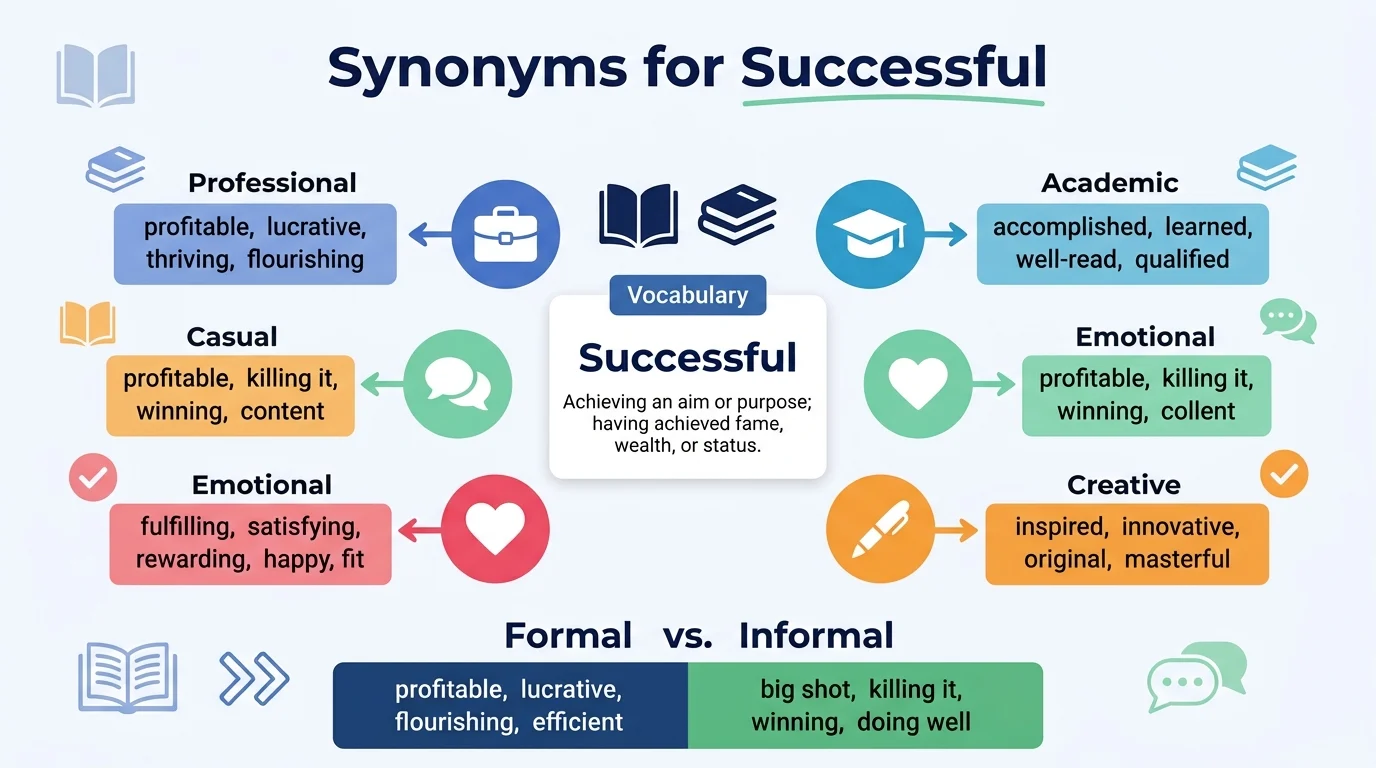
Successful means achieving a desired outcome, reaching a goal, or gaining positive results. The best synonym depends on your context. For formal writing, use “prosperous” or “triumphant.” In casual conversation, try “winning” or “thriving.” Academic work favors “effective” or “fruitful.” Professional settings benefit from “high achieving” or “prosperous.” Emotional contexts might call for “fulfilled” or “victorious.”
Meaning, Tone and Context
- Simple definition: Successful means accomplishing an aim or purpose. It describes people, projects, businesses, or actions that achieve positive results.
- Part of speech: Adjective. The noun form is “success.” The verb form is “succeed.” The adverb is “successfully.”
- Positive, negative, or neutral tone: Positive. This word carries a favorable connotation. It suggests achievement, progress, and favorable outcomes.
- Formality level: Neutral. “Successful” works in both casual and formal settings. However, specific synonyms fit better in certain contexts.
- Common use cases: You will find “successful” in career discussions, academic evaluations, business reports, personal development content, and everyday conversation about goals.
- Important word forms: Successful (adjective), success (noun), succeed (verb), successfully (adverb), unsuccessful (antonym), succeeding (adjective).
When and How to Use “Successful”
You should use “successful” when you want a clear, general term for positive results. It works well in most situations without sounding too formal or too casual. However, many contexts call for more specific alternatives.
Professional context
The marketing campaign proved successful, increasing our customer base by 40 percent over three months.
Personal context
She felt successful after completing her first marathon, even though she finished near the middle of the pack.
Academic context
The research study was successful in demonstrating the connection between sleep patterns and memory retention.
Emotional context
He finally felt successful when he stopped comparing his progress to others and focused on his own growth.
Creative context
The artist’s experimental technique proved successful, creating a texture that critics called revolutionary.
Social media context
Her small business became successful through consistent content creation and genuine audience engagement.
Resume context
Successfully managed a team of fifteen employees and increased department productivity by 25 percent.
Another Word for “Successful”
The best single replacement depends on your specific context and intended meaning.
Professional writing: “Effective” works best. It focuses on results and functionality. Example: The new strategy proved effective in reducing costs.
Academic writing: “Fruitful” suggests productivity and valuable outcomes. Example: The collaboration yielded fruitful results for both departments.
Casual conversation: “Thriving” conveys energy and ongoing positive growth. Example: His photography business is thriving this year.
Emotional writing: “Fulfilled” captures personal satisfaction. Example: She felt fulfilled by her volunteer work.
Creative writing: “Triumphant” adds dramatic weight and victory. Example: The protagonist emerged triumphant against all odds.
Resume or workplace use: “High achieving” emphasizes consistent excellence. Example: High achieving professional with a track record of exceeding targets.
Social media captions: “Winning” feels current and energetic. Example: Winning at this whole adulting thing today.
Stronger meaning: “Spectacular” suggests extraordinary achievement. Example: The product launch was spectacular.
Softer meaning: “Satisfactory” indicates adequate results without exceptional achievement. Example: The quarterly results were satisfactory.
When Not to Use “Successful”
“Successful” sounds too vague when you need specific details. It also feels weak in contexts requiring strong impact.
Too vague:
Weak: The project was successful.
Better: The project exceeded its revenue targets by 30 percent.
Too casual for formal reports:
Weak: Our company has been successful.
Better: Our company has maintained consistent growth over five consecutive quarters.
Too general for academic writing:
Weak: The experiment was successful.
Better: The experiment yielded statistically significant results.
Too weak for emotional moments:
Weak: She felt successful.
Better: She felt deeply fulfilled by her meaningful work.
Too repetitive in resumes:
Weak: Successfully managed teams. Successfully increased sales. Successfully implemented systems.
Better: Directed teams. Increased sales by 20 percent. Implemented new systems.
Words Commonly Confused With “Successful”
Successful vs. Accomplished
“Successful” focuses on achieving goals and external results. Accomplished” emphasizes developed skills and completed achievements over time. Use “accomplished” when referring to someone with many achievements in their career or life.
Successful vs. Effective
“Successful” means achieving a desired result. “Effective” means producing the intended effect efficiently. “Effective” often works better for processes, methods, and approaches.
Successful vs. Prosperous
“Successful” applies broadly to any achievement. “Prosperous” specifically relates to financial wealth and economic flourishing. Use “prosperous” for business and financial contexts.
Successful vs. Fortunate
“Successful” implies earned achievement through effort. “Fortunate” suggests luck or favorable circumstances. These words are not interchangeable despite some overlap in casual conversation.
Successful vs. Productive
“Productive” focuses on output and efficiency. “Successful” focuses on achieving goals. A productive person produces a lot. A successful person achieves their objectives.
Successful vs. Victorious
“Victorious” implies winning against opposition or competition. “Successful” does not necessarily involve competitors. Use “victorious” when defeating rivals is central to the achievement.
Best Synonym by Context for “Successful”
| Context | Best Synonym | Why It Works | Example |
|---|---|---|---|
| Formal writing | Prosperous | Conveys sustained success and growth | The prosperous enterprise expanded into three new markets. |
| Academic writing | Fruitful | Suggests valuable results and intellectual production | Their collaboration proved fruitful for the research community. |
| Professional use | Effective | Emphasizes practical results and efficiency | The new workflow proved highly effective. |
| Resume | Accomplished | Highlights achievements and developed expertise | Accomplished project manager with ten years of experience. |
| Casual conversation | Thriving | Sounds energetic and ongoing | Her online store is really thriving. |
| Creative writing | Triumphant | Adds dramatic victory and emotional weight | The rebel forces returned triumphant. |
| Emotional tone | Fulfilled | Captures personal satisfaction and meaning | She felt fulfilled by her life’s work. |
| Strong intensity | Spectacular | Suggests exceptional, impressive achievement | The performance was spectacular. |
| Soft or moderate | Satisfactory | Indicates acceptable results without overstatement | The team produced satisfactory results. |
| Social media | Winning | Feels modern and energetic | Winning at life with this new routine. |
| US usage | Succeeding | Active form emphasizing ongoing progress | The company is succeeding in a competitive market. |
Which Synonym Should You Choose?
Your choice depends on four key factors: meaning, formality, emotional intensity, and your specific situation.
Start with the exact message you want to convey. Do you want to emphasize financial wealth? Choose “prosperous.” Do you want to highlight personal satisfaction? Choose “fulfilled.” Do you want to focus on efficiency? Choose “effective.”
Consider your audience and setting. Academic papers demand precise language like “fruitful” or “productive.” Resumes benefit from strong action words like “accomplished.” Social media posts thrive with energetic words like “winning” or “thriving.”
Think about emotional intensity. “Spectacular” carries dramatic weight. “Satisfactory” feels moderate and neutral. Choose the intensity that matches your message.
Finally, test your choice in your sentence. Read it aloud. Does it sound natural? Does it convey exactly what you mean? If not, try another option.
Real Life Examples of “Successful” in Sentences
School context
Maria completed her thesis on time and received high praise from her committee. Her professor called her work a successful contribution to the field.
Workplace context
The quarterly report showed our department successfully reduced expenses while maintaining productivity. Our manager praised the team’s effective strategies.
Writing context
The author’s second novel proved even more successful than her debut. Critics called it a triumphant work of literary fiction.
Conversation context
My brother started his own landscaping company last year. He is doing really well. He has been successful in building a loyal client base.
Social media context
Three months of consistent posting and engagement helped this account grow. The successful strategy attracted thousands of new followers.
Resume context
Successfully led a cross functional team to launch a new product line. The initiative generated $2 million in revenue during the first year.
Email context
Thank you for your proposal. We believe this approach will be successful in addressing our current challenges. Let us discuss next steps.
Storytelling context
Against all predictions, the small startup outlasted its corporate competitors. Their successful model relied on personal customer relationships.
25 Synonyms for “Successful”
| Synonym | Simple Meaning | Best Used For | Example Sentence |
|---|---|---|---|
| Accomplished | Skilled with many achievements | Resumes and professional profiles | An accomplished attorney with a perfect trial record. |
| Effective | Producing intended results efficiently | Professional and technical writing | The new system proved highly effective. |
| Prosperous | Financially successful and flourishing | Business and economic contexts | The prosperous region attracted new investments. |
| Thriving | Growing and developing strongly | Casual and positive descriptions | The garden is thriving in the warm climate. |
| Fruitful | Producing good or valuable results | Academic and intellectual contexts | Their research partnership was fruitful. |
| Triumphant | Victorious against opposition | Dramatic and emotional contexts | The team emerged triumphant. |
| Victorious | Winning against competitors | Competitive and sports contexts | The victorious candidate gave a speech. |
| Fulfilled | Satisfied with achievements | Personal and emotional writing | She felt fulfilled by her career. |
| Flourishing | Growing and developing in a healthy way | Creative and descriptive contexts | The arts scene is flourishing downtown. |
| Rewarding | Providing satisfaction and benefit | Personal and career discussions | Teaching is a rewarding profession. |
| Favorable | Giving positive results | Formal and analytical contexts | The negotiations produced a favorable outcome. |
| Outstanding | Exceptionally good | Recognition and praise contexts | Her outstanding performance earned a promotion. |
| Spectacular | Impressively successful | Dramatic and enthusiastic contexts | The event was spectacular. |
| High achieving | Consistently performing well | Resumes and academic contexts | High achieving students received scholarships. |
| Winning | Gaining success or victory | Casual and motivational contexts | She has a winning attitude. |
| Gainful | Producing financial profit | Professional and employment contexts | He found gainful employment. |
| Advantageous | Beneficial and favorable | Strategic and professional contexts | The partnership was advantageous. |
| Lucrative | Producing substantial profit | Business and financial contexts | A lucrative business opportunity. |
| Beneficial | Producing good effects | General formal contexts | Regular exercise is beneficial. |
| Succeeding | In the process of achieving success | Ongoing progress descriptions | The project is succeeding. |
| Eminent | Highly successful and respected | Professional and academic contexts | An eminent scholar in the field. |
| Notable | Worthy of attention or recognition | Achievements and distinctions | A notable achievement in the industry. |
| Significant | Important and meaningful | Formal and academic contexts | The study made a significant contribution. |
| Booming | Rapidly growing and successful | Economic and business contexts | The booming tech sector created jobs. |
| Prestigious | Highly respected and successful | Recognition and status contexts | The prestigious award celebrated her work. |
Synonym Groups and Usage Differences
Professional vs. Personal Synonyms
Professional synonyms focus on measurable results, efficiency, and external recognition. Words like “effective,” “prosperous,” and “accomplished” emphasize career achievements and workplace performance. Personal synonyms focus on internal satisfaction and emotional well being. Words like “fulfilled,” “rewarding,” and “satisfied” capture how success feels on a personal level. A project can be professionally “successful” while making you feel personally “fulfilled” or the opposite.
Formal vs. Conversational Synonyms
Formal synonyms suit reports, academic papers, and professional correspondence. “Prosperous,” “fruitful,” and “advantageous” belong in serious writing. Conversational synonyms work better in everyday speech, texts, and casual emails. “Thriving,” “winning,” and “booming” sound natural in conversation. Choose “effective” for formal contexts and “winning” for casual ones.
Academic Synonyms
Academic writing rewards precision and specificity. “Fruitful” suggests productive intellectual collaboration. “Significant” indicates meaningful contribution to research. “Effective” describes methods and approaches that work. “Notable” highlights findings worth attention. “Eminent” describes respected scholars. These words sound precise and appropriate in scholarly contexts.
Professional and Business Synonyms
Business writing needs clear, action oriented language. “Effective” focuses on practical results. “Prosperous” describes financial health. “Lucrative” emphasizes profit potential. “Advantageous” suggests strategic benefit. “Productive” indicates efficient output. “Gainful” relates to profitable employment. These terms work well in emails, presentations, resumes, and reports.
Creative or Literary Synonyms
Creative writing benefits from vivid, evocative language. “Triumphant” adds dramatic victory. “Flourishing” suggests organic growth. “Spectacular” creates excitement. “Booming” brings energy. “Prestigious” conveys status and admiration. These words add color and emotion to descriptions. Use them when you want to paint a picture with your writing.
Slang or Modern Synonyms
Modern English includes energetic slang options. “Winning” feels casual and confident. “Killing it” suggests exceptional performance. “On fire” implies unstoppable success. These expressions work well in social media, casual conversation, and motivational contexts. Avoid them in formal writing, resumes, or academic papers. They sound out of place in professional settings.
Strongest vs. Weaker Synonyms
Mild to moderate: satisfactory, acceptable, adequate.
Moderate: successful, effective, productive.
Strong: prosperous, flourishing, thriving.
Stronger: triumphant, spectacular, outstanding.
Strongest: eminent, prestigious, exceptional.
Choose intensity based on your message. Use moderate words for balanced statements. Use strong words for dramatic achievements. Save the strongest words for truly exceptional situations.
Emotional vs. Neutral Synonyms
Emotional synonyms add feeling and personal connection. “Fulfilled” captures deep satisfaction. “Triumphant” conveys pride and victory. “Rewarding” suggests personal gratification. “Winning” brings enthusiasm. Neutral synonyms stay factual and objective. “Effective” states a fact. “Productive” reports output. “Successful” itself remains fairly neutral. Choose emotional words when you want to connect with readers. Choose neutral words when you need to remain objective.
Antonyms of “Successful”
| Antonym | Meaning | Example Sentence |
|---|---|---|
| Unsuccessful | Not achieving desired results | The unsuccessful venture closed after six months. |
| Failing | Not succeeding or progressing | The failing business needed immediate changes. |
| Unproductive | Not producing good results | Their unproductive meeting wasted two hours. |
| Ineffective | Not producing intended effect | The ineffective strategy was abandoned. |
| Fruitless | Producing no valuable results | The fruitless search continued for weeks. |
| Unprofitable | Not making financial gain | The unprofitable division was sold. |
| Unrewarding | Not providing satisfaction or benefit | The unrewarding job caused him to quit. |
| Unavailing | Producing no useful result | Their unavailing efforts frustrated everyone. |
| Unsatisfactory | Not meeting expectations | The unsatisfactory results required a new approach. |
| Failed | Having not succeeded | The failed experiment taught valuable lessons. |
| Floundering | Struggling without direction | The floundering company needed new leadership. |
| Failing | Losing strength or momentum | Her failing health prevented her from working. |
| Poor | Low quality or substandard | The poor performance led to consequences. |
| Losing | Not winning or achieving | The losing team accepted their defeat. |
| Unfavorable | Not giving positive results | The unfavorable conditions delayed the project. |
Comparison: Successful vs. Similar Words
Successful vs. Accomplished
Main difference: Successful focuses on achieving goals. Accomplished emphasizes developed skills and a history of achievements.
Which one is stronger: Accomplished carries more weight for personal expertise and career history.
Which one is more formal: Accomplished appears more formal and professional.
Example for successful: The marketing campaign was successful.
Example for accomplished: She is an accomplished artist with exhibitions worldwide.
Successful vs. Effective
Main difference: Successful means achieving a goal. Effective means producing the intended effect efficiently.
Which one is stronger: Effective sounds more professional and precise.
Which one is more formal: Effective works well in technical and professional writing.
Example for successful: The new product launch was successful.
Example for effective: The medication proved effective in treating symptoms.
Successful vs. Prosperous
Main difference: Successful applies to any achievement. Prosperous specifically relates to financial and economic flourishing.
Which one is stronger: Prosperous suggests greater material wealth.
Which one is more formal: Prosperous appears in formal business and economic writing.
Example for successful: The student became a successful researcher.
Example for prosperous: The prosperous region attracted many businesses.
Successful vs. Fulfilled
Main difference: Successful focuses on external achievement. Fulfilled focuses on internal satisfaction and meaning.
Which one is stronger: Fulfilled carries deeper emotional weight.
Which one is more formal: Successful is more versatile across contexts.
Example for successful: He became a successful lawyer.
Example for fulfilled: She felt fulfilled by her volunteer work.
Successful vs. Triumphant
Main difference: Successful focuses on achieving goals. Triumphant emphasizes victory over opposition.
Which one is stronger: Triumphant sounds more dramatic and emotional.
Which one is more formal: Successful is more neutral and versatile.
Example for successful: The project was successful.
Example for triumphant: The army returned triumphant after the battle.
Successful vs. Productive
Main difference: Successful focuses on achieving goals. Productive focuses on producing output.
Which one is stronger: Productive emphasizes efficiency and quantity.
Which one is more formal: Productive works well in professional contexts.
Example for successful: The partnership was successful.
Example for productive: The team had a very productive meeting.
Common Phrases and Expressions with “Successful”
1. Successful Career
Meaning: A career characterized by achievement and advancement.
Example sentence: She built a successful career in international law.
2. Successful Outcome
Meaning: A result that achieves the desired objective.
Example sentence: The negotiations led to a successful outcome for both parties.
3. Highly Successful
Meaning: Exceptionally successful or achieving great results.
Example sentence: The highly successful fundraiser exceeded its goal.
4. Successful Business
Meaning: A profitable and growing enterprise.
Example sentence: They launched a successful business from their garage.
5. Successful Life
Meaning: A life characterized by achievement and fulfillment.
Example sentence: He measured a successful life by relationships, not wealth.
6. Successful Marriage
Meaning: A lasting and fulfilling partnership.
Example sentence: Their successful marriage lasted fifty years.
7. Successful Application
Meaning: A request or proposal that achieves acceptance.
Example sentence: Her successful application earned her a scholarship.
8. Successful Completion
Meaning: Finishing a task or project with positive results.
Example sentence: The successful completion of the project impressed the client.
Common Mistakes to Avoid
- Using “successful” when a more precise synonym fits better
Instead of saying “the successful doctor,” consider “the accomplished surgeon” or “the esteemed physician.” Specific language creates clearer images. - Confusing “successful” with “fortunate”
Success requires effort and achievement. Fortune involves luck and circumstance. Someone can be fortunate without being successful. - Using “victorious” when no competition exists
“Victorius” implies defeating others. Use “successful” when achievement does not involve competition. A team can be successful without being victorious. - Overusing “successful” in resumes
Resume readers see “successful” constantly. Replace it with action verbs like “achieved,” “delivered,” “generated,” or “implemented.” - Using “prosperous” incorrectly
“Prosperous” relates to financial wealth. Do not use it for personal relationships or emotional achievements unless money is involved. - Using casual synonyms in formal writing
Avoid “winning” and “thriving” in academic papers. Choose “effective” or “fruitful” instead. - Using overly dramatic language for ordinary situations
“Spectacular” fits extraordinary achievement. “Satisfactory” works better for everyday progress. Choose intensity appropriately. - Repeating the same synonym throughout a document
Variety improves readability. Use different synonyms to keep your writing fresh and engaging. - Choosing a synonym with the wrong emotional tone
“Fulfilled” carries deep emotion. “Effective” stays neutral. Match the emotional tone to your message. - Using slang in professional communications
Avoid “killing it” or “on fire” in emails, reports, or proposals. These expressions undermine your professional credibility.
FAQs
1. What is the best synonym for successful?
The best synonym depends on your context. For formal writing, use “effective.” personal contexts, try “fulfilled.” For financial matters, choose “prosperous.”
2. What is a formal synonym for successful?
“Prosperous,” “fruitful,” and “advantageous” are excellent formal synonyms. They work well in academic and professional writing.
3. What is an informal synonym for successful?
“Thriving,” “winning,” and “booming” are informal synonyms. They work well in casual conversation and social media.
4. What is another word for successful in professional writing?
“Effective” and “accomplished” work best in professional writing. They convey competence and achievement clearly.
5. What is the difference between successful and fruitful?
Successful broadly means achieving goals. Fruitful specifically means producing valuable results, especially in academic or intellectual contexts.
6. What is the opposite of successful?
The opposite is “unsuccessful.” Other antonyms include “failing,” “unproductive,” and “ineffective” depending on context.
Conclusion
Successful means achieving positive results or reaching your goals. This guide has shown you dozens of alternatives that make your communication more precise and engaging. The right synonym depends on your context, audience, and intended meaning. Professional settings favor words like “effective” and “accomplished.” Academic writing benefits from “fruitful” and “significant.” Casual conversation welcomes “thriving” and “winning.” Emotional contexts call for “fulfilled” and “triumphant.” Strong situations need “spectacular” and “outstanding.” Moderate situations work well with “satisfactory” and “acceptable.”
The key is choosing words that match your specific message. Consider your audience. your tone. Consider the emotional intensity you want to convey. Then select the perfect synonym for your situation.
Your vocabulary is a powerful tool. Each word choice shapes how readers understand your message. By mastering synonyms for successful, you write with greater clarity, variety, and impact. You avoid repetition. You express nuance. communicate exactly what you mean.
Start applying these synonyms today. Replace “successful” with more precise alternatives in your next email, essay, or social media post. Notice how your writing becomes more engaging and effective. Your readers will appreciate the variety and clarity. Your communication will improve dramatically.