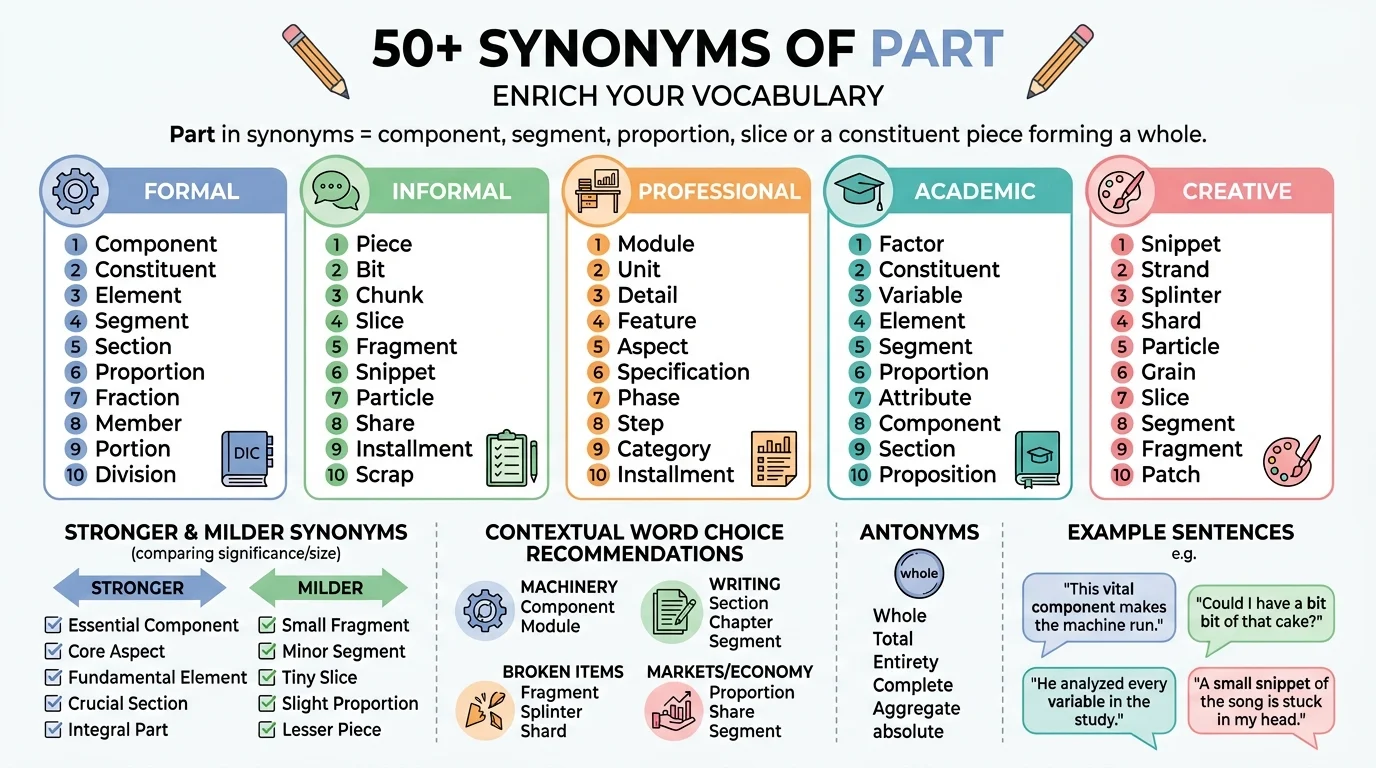
Have you ever caught yourself using the same word over and over in an email, essay, or social media post? Most writers have been there. You type “part” repeatedly, and the sentence starts to feel dull and repetitive. Whether you are drafting a business report, writing a school assignment, or crafting a resume, relying on the same word weakens your message. The good news is that there are dozens of synonyms of part that can make your writing clearer, more precise, and more engaging. Choosing the right synonym transforms a bland sentence into something that captures attention and communicates exactly what you mean. This guide will help you understand the word “part,” explore its best synonyms, and teach you how to choose the perfect word for every situation.
What Are the Best Synonyms of “Part”?
“Part” means a piece, section, or portion of a larger whole. Formal writing, use “component,” “element,” or “constituent.” Casual conversation, choose “bit,” “chunk,” or “piece.” For academic work, opt for “segment,” “section,” or “fraction.” For professional communication, “division,” “share,” or “portion” work well. The best synonym depends entirely on your context and audience.
Meaning, Tone, and Context
Simple Definition
A “part” is any piece, section, or portion that belongs to or is separated from a larger whole. It can refer to physical objects, abstract concepts, roles, or areas.
Part of Speech
- Noun: a piece or segment of something larger
- Verb: to separate or move apart
- Adverb: partly or partially
Overall Tone
Neutral. The word “part” carries no strong emotional weight. It simply communicates that something belongs to or is a piece of something else.
Formality Level
Neutral. “Part” works in formal documents, casual conversation, and everything in between. It is one of the most versatile words in English.
Common Uses
Native English speakers use “part” constantly. You will hear it in everyday conversation, business meetings, academic lectures, and creative writing. It appears in phrases like “part of the plan,” “take part,” and “for the most part.”
Word Forms
When and How to Use “Part”
Choose “part” when you need a simple, neutral word that works in almost any situation. It is the safest choice when you are unsure which synonym to use. Here are seven realistic examples showing how “part” fits different contexts.
Professional: “This project is an essential part of our annual strategy.”
Academic: “The first part of the experiment produced unexpected results.”
Workplace: “Every team member plays a part in achieving our quarterly goals.”
Personal: “My family is the most important part of my life.”
Email: “Please review the attached part of the document before our meeting.”
Resume: “As part of my role, I managed a team of twelve销售人员.”
Social Media: “This trip was the best part of my summer.”
Best Synonyms of “Part”
No synonym is identical in every situation. The right word depends on what you are describing, who you are writing for, and the tone you want to convey. Here are the best synonyms of part for specific contexts.
Professional writing: Use “component.” It sounds technical and precise, making it ideal for business and workplace communication.
Academic writing: Use “element.” It suggests a fundamental piece of a larger system or theory.
Business communication: Use “division.” It works well for organizational structures and large segments.
Casual conversation: Use “bit.” It is informal, friendly, and natural in everyday speech.
Emotional writing: Use “piece.” It carries a slightly warmer, more personal tone.
Creative writing: Use “fragment.” It suggests something broken or incomplete, adding depth and imagery.
Resume writing: Use “role” or “function.” These words emphasize your contribution and responsibilities.
Workplace communication: Use “share.” It highlights allocation or distribution.
Stronger meaning: Use “portion” or “segment.” These words imply a more defined or significant piece.
Softer meaning: Use “scrap” or “particle.” These suggest a very small or minor piece.
When Not to Use “Part”
Sometimes “part” is not the best choice. Here are situations where you should choose a more precise synonym.
When “part” sounds too general. If you are describing a specific, well-defined piece, “part” may feel vague. Instead, use “section” for organized divisions or “segment” for clearly separated pieces.
- Incorrect: “Please read the part about budgeting.”
- Better: “Please read the section about budgeting.”
When “part” sounds too informal. In highly formal documents, “part” can feel casual. Use “component” or “constituent” instead.
- Incorrect: “Trust is a part of every successful partnership.”
- Better: “Trust is a vital constituent of every successful partnership.”
When “part” sounds too weak. If you need to emphasize significance, “part” may not carry enough weight. Use “portion” or “share” to highlight allocation or importance.
- Incorrect: “She received a part of the inheritance.”
- Better: “She received a generous portion of the inheritance.”
When “part” sounds outdated. In modern business writing, “part” can feel old-fashioned. Use “component” or “element” for a contemporary tone.
Words Commonly Confused With “Part”
Many words overlap with “part” in meaning, but each has a distinct use. Here are the most commonly confused synonyms.
Part vs Portion
Difference: “Portion” emphasizes allocation or serving, often involving distribution. “Part” is the general term for any piece of a whole.
When to Use It: Use “portion” when someone receives a share or when food is involved. Use “part” for general references.
Example: “He ate a large portion of the pizza.” vs “This is the best part of the movie.”
Part vs Section
Difference: “Section” implies an organized division with clear boundaries. “Part” is more general and less structured.
When to Use It: Use “section” for documents, areas, or organized groups. Use “part” for anything else.
Example: “Please read the first section of the report.” vs “This part of the city is beautiful.”
Part vs Segment
Difference: “Segment” suggests a part that has been separated or marked out, often along natural lines of division. “Part” is broader.
When to Use It: Use “segment” for things that can be divided geometrically or conceptually. Use “part” for general references.
Example: “The market is divided into several segments.” vs “This is my favorite part of the song.”
Part vs Component
Difference: “Component” refers to a functional unit that works with others to form a larger system. “Part” is more general.
When to Use It: Use “component” for machines, systems, or technical contexts. Use “part” for everyday references.
Example: “Each component of the engine must be calibrated.” vs “This is a small part of the project.”
Part vs Element
Difference: “Element” suggests a fundamental, often abstract, part of a whole. “Part” can refer to anything.
When to Use It: Use “element” for abstract concepts or essential pieces. Use “part” for physical or general references.
Example: “Trust is an important element of any relationship.” vs “This part of the house needs repair.”
Part vs Fraction
Difference: “Fraction” refers to a numerical or mathematical part, often a small proportion. “Part” is more general.
When to Use It: Use “fraction” when discussing numbers, proportions, or small amounts. Use “part” for general references.
Example: “Only a small fraction of the cost was covered.” vs “A large part of the budget went to marketing.”
Best Synonyms of “Part” by Context
| Context | Best Synonym | Why It Works | Example |
|---|---|---|---|
| Formal writing | Component | Sounds technical and precise | “Each component of the proposal was carefully reviewed.” |
| Academic writing | Element | Suggests a fundamental piece of a theory | “This element of the study requires further analysis.” |
| Professional communication | Division | Works well for organizational segments | “She leads the international division of the company.” |
| Business emails | Portion | Emphasizes allocation or share | “A portion of the profits will be reinvested.” |
| Resume writing | Role | Highlights contribution and responsibility | “My role involved managing cross-functional teams.” |
| Workplace communication | Function | Emphasizes purpose and operation | “The function of this department is quality control.” |
| Casual conversation | Bit | Informal and natural | “I only caught a bit of what he said.” |
| Everyday speaking | Piece | Simple and widely understood | “Can I have a piece of that cake?” |
| Creative writing | Fragment | Adds depth and imagery | “She found a fragment of the ancient letter.” |
| Storytelling | Segment | Suggests a clear division in the narrative | “The final segment of the story was the most exciting.” |
| Emotional writing | Piece | Carries a warmer, personal tone | “You will always be a piece of my heart.” |
| Strong emphasis | Portion | Implies a significant or allocated share | “A large portion of the budget went to research.” |
| Mild tone | Scrap | Suggests a very small or minor piece | “He saved every scrap of information.” |
| Social media captions | Bit | Short, casual, and engaging | “Here is a bit of my weekend adventure.” |
| American English | Part | The standard, neutral choice | “This is part of the American Dream.” |
How to Choose the Best Synonym of “Part”
Choosing the right synonym of part does not have to be complicated. Ask yourself these questions before you write.
What am I describing? If you are describing a physical object, “piece” or “bit” works well. If you are describing an abstract concept, “element” or “component” is better. If you are describing an organized division, “section” or “segment” fits best.
Who is my audience? For professional or academic readers, choose formal synonyms like “component,” “element,” or “constituent.” For friends or casual readers, choose informal synonyms like “bit,” “chunk,” or “scrap.”
What tone do I want? If you want a neutral tone, stick with “part.” If you want a stronger tone, choose “portion” or “segment.” If you want a softer tone, choose “scrap” or “particle.”
How much emphasis do I need? If the piece is essential, use “component” or “element.” If the piece is minor, use “bit” or “scrap.” If the piece is allocated, use “portion” or “share.”
Does it sound natural? Read your sentence aloud. If the synonym feels forced or awkward, choose a different one. The best word is the one that sounds most natural in context.
Real Life Examples of “Part”
Here are realistic examples showing how “part” and its synonyms appear in everyday situations.
School: “The hardest part of the assignment was the research.” (Better: “The most challenging element of the assignment was the research.”)
College: “This course is part of my major requirements.” (Better: “This course is a core component of my major requirements.”)
Workplace: “Every employee plays a part in the company’s success.” (Better: “Every employee plays a vital role in the company’s success.”)
Business: “We need to review every part of the contract.” (Better: “We need to review every section of the contract.”)
Email: “I have attached the relevant part of the document.” (Better: “I have attached the relevant portion of the document.”)
Resume: “As part of my duties, I managed the budget.” (Better: “As a core function of my role, I managed the budget.”)
Conversation: “That is only part of the story.” (Better: “That is only a fragment of the story.”)
Storytelling: “The best part of the adventure was the ending.” (Better: “The most thrilling segment of the adventure was the ending.”)
Blogging: “This is an important part of the process.” (Better: “This is a critical element of the process.”)
Social Media: “This was my favorite part of the trip.” (Better: “This was my favorite piece of the entire trip.”)
18 Best Synonyms of “Part”
Synonyms of “Part” by Usage
Professional vs Personal Synonyms
In professional settings, choose words that sound precise and competent. “Component,” “element,” and “division” are excellent choices for reports, presentations, and business emails. In personal conversations, “bit,” “piece,” and “chunk” sound more natural and friendly. Avoid using overly formal synonyms with friends, and avoid casual synonyms in professional documents.
Formal vs Conversational Synonyms
For formal writing such as reports, essays, and business presentations, use “component,” “constituent,” “element,” or “division.” These words convey authority and precision. For casual conversations, texting, and social media, use “bit,” “piece,” “chunk,” or “scrap.” These words feel approachable and natural. “Part” itself works in both formal and informal contexts, making it a safe choice when you are unsure.
Academic Synonyms
In academic writing, precision matters. Use “element” for fundamental parts of a theory, “segment” for clearly defined divisions, “fraction” for numerical proportions, and “component” for parts of a system. These words sound more authoritative than “part” and demonstrate a stronger command of academic vocabulary.
Professional and Business Synonyms
For resumes, interviews, meetings, and client communication, choose synonyms that highlight your competence. “Role” emphasizes your contribution. “Function” highlights your purpose. “Division” works for organizational structures. “Component” sounds technical and precise. “Portion” is excellent for discussing allocations and shares. These words help you sound professional and capable.
Creative and Literary Synonyms
Writers and storytellers can add depth and imagery by choosing expressive synonyms. “Fragment” suggests something broken or mysterious. “Particle” evokes tiny, almost invisible pieces. “Shard” implies something sharp or broken. “Morsel” suggests a small, tempting piece. These words create vivid images and emotional resonance that “part” cannot achieve.
Slang or Modern Synonyms
There are no widely used slang synonyms for “part.” However, in informal contexts, “bit” and “chunk” are common and acceptable. Avoid using these in formal or academic writing. In modern digital communication, “piece” and “bit” are the most natural choices for social media and texting.
Strongest to Mildest Synonyms
Mild: scrap, particle, bit
Moderate: piece, chunk, slice, lump
Strong: portion, segment, section, share
Very Strong: component, element, constituent, division
The intensity scale reflects how significant or essential the part feels. “Scrap” suggests something minor or leftover, while “component” suggests something essential and functional.
Emotional vs Neutral Synonyms
Emotional Synonyms: piece (warm, personal), fragment (mysterious, incomplete), shard (sharp, painful), morsel (tempting, small)
Neutral Synonyms: part, section, segment, portion, component, element, division
Use emotional synonyms when you want to evoke feeling or imagery. Use neutral synonyms when you simply want to communicate information without adding emotional weight.
Antonyms of “Part”
| Antonym | Meaning | Example Sentence |
|---|---|---|
| Whole | The complete entity | “The whole is greater than the sum of its parts.” |
| Entirety | The complete state of something | “He read the book in its entirety.” |
| Total | The full amount | “The total cost exceeded the budget.” |
| All | Every part together | “All of the students passed the exam.” |
| Sum | The total amount | “The sum of their efforts was impressive.” |
| Aggregate | The total formed by combining parts | “The aggregate of all sales was record-breaking.” |
| Complete | Having all parts | “The complete set includes all volumes.” |
| Entire | Whole or full | “She spent the entire day working.” |
| Full | Containing all that is possible | “The full report is available online.” |
| Unity | The state of being united | “The unity of the team was remarkable.” |
| Combination | The act of combining parts | “The combination of skills made them successful.” |
| Union | The act of joining together | “The union of the two companies created a giant.” |
| Integration | The process of combining parts | “The integration of systems improved efficiency.” |
| Synthesis | The combination of parts into a whole | “The synthesis of ideas produced a new theory.” |
| Totality | The whole amount | “The totality of the evidence was overwhelming.” |
Comparison: “Part” vs Similar Words
Part vs Whole
Main Difference: “Part” refers to a piece of something, while “whole” refers to the complete entity.
Which Is Stronger? “Whole” is stronger because it represents completeness.
Which Is More Formal? Both are neutral.
When to Use Each: Use “part” when describing a piece. Use “whole” when describing everything together.
Examples:
- Part: “This is only a part of the story.”
- Whole: “The whole story is much more complicated.”
Part vs Portion
Main Difference: “Portion” emphasizes allocation or serving, while “part” is the general term.
Which Is Stronger? “Portion” is stronger because it implies a defined share.
Which Is More Formal? Both are neutral, but “portion” is slightly more formal.
When to Use Each: Use “portion” for allocated shares or food. Use “part” for general references.
Examples:
- Part: “This part of the city is beautiful.”
- Portion: “She received a generous portion of the estate.”
Part vs Section
Main Difference: “Section” implies an organized division with clear boundaries. “Part” is less structured.
Which Is Stronger? “Section” is stronger because it suggests organization.
Which Is More Formal? “Section” is more formal.
When to Use Each: Use “section” for documents, areas, or organized groups. Use “part” for general references.
Examples:
- Part: “This is the best part of the movie.”
- Section: “Please read the first section of the report.”
Part vs Component
Main Difference: “Component” refers to a functional unit of a larger system. “Part” is more general.
Which Is Stronger? “Component” is stronger because it suggests essential function.
Which Is More Formal? “Component” is more formal and technical.
When to Use Each: Use “component” for machines, systems, or technical contexts. Use “part” for everyday references.
Examples:
- Part: “This is a small part of the project.”
- Component: “Each component of the engine must be calibrated.”
Part vs Element
Main Difference: “Element” suggests a fundamental, often abstract, part. “Part” can refer to anything.
Which Is Stronger? “Element” is stronger because it implies essential nature.
Which Is More Formal? “Element” is more formal.
When to Use Each: Use “element” for abstract concepts or essential pieces. Use “part” for physical or general references.
Examples:
- Part: “This part of the house needs repair.”
- Element: “Trust is an important element of any relationship.”
Part vs Segment
Main Difference: “Segment” suggests a part separated along natural lines. “Part” is broader.
Which Is Stronger? “Segment” is stronger because it implies clear division.
Which Is More Formal? “Segment” is more formal.
When to Use Each: Use “segment” for things that can be divided geometrically or conceptually. Use “part” for general references.
Examples:
- Part: “This is my favorite part of the song.”
- Segment: “The market is divided into several segments.”
Common Phrases and Expressions with “Part”
Phrase: part of
Meaning: Belonging to or included in something.
Example Sentence: “She is part of our team.”
Phrase: take part
Meaning: Participate in something.
Example Sentence: “Everyone should take part in the discussion.”
Phrase: for the most part
Meaning: Mostly or generally.
Example Sentence: “For the most part, the project was a success.”
Phrase: play a part
Meaning: Have a role or influence in something.
Example Sentence: “Her advice played a part in my decision.”
Phrase: in part
Meaning: Partly or to some degree.
Example Sentence: “The delay was caused in part by bad weather.”
Phrase: part and parcel
Meaning: An essential or integral part.
Example Sentence: “Hard work is part and parcel of success.”
Phrase: part ways
Meaning: Separate or go in different directions.
Example Sentence: “After five years, they decided to part ways.”
Phrase: look the part
Meaning: Appear suitable for a particular role.
Example Sentence: “In his suit and tie, he certainly looked the part.”
Common Mistakes to Avoid
1: Choosing a vague synonym instead of a precise one.
- Incorrect: “This is a part of the problem.”
- Better: “This is a contributing factor to the problem.”
- Why: “Contributing factor” is more precise and explanatory.
2: Confusing “part” with “portion” in non-allocated contexts.
- Incorrect: “A portion of the problem is funding.”
- Better: “Part of the problem is funding.”
- Why: “Portion” implies allocation, which does not fit abstract problems.
3: Using an informal synonym in formal writing.
- Incorrect: “The report covers a bit of the data.”
- Better: “The report covers a portion of the data.”
- Why: “Bit” is too casual for formal reports.
4: Selecting an overly dramatic synonym.
- Incorrect: “She found a fragment of the recipe.”
- Better: “She found part of the recipe.”
- Why: “Fragment” suggests something broken, which is inappropriate for a recipe.
5: Repeating the same word too often.
- Incorrect: “The first part is important. The second part is also important.”
- Better: “The first section is important. The second component is also important.”
- Why: Varying synonyms keeps writing fresh and engaging.
6: Choosing a synonym with the wrong emotional tone.
- Incorrect: “The fragment of my childhood was happy.”
- Better: “The part of my childhood was happy.”
- Why: “Fragment” suggests something broken, which clashes with “happy.”
7: Using slang in academic or professional writing.
- Incorrect: “A chunk of the research was flawed.”
- Better: “A portion of the research was flawed.”
- Why: “Chunk” is too informal for academic writing.
Frequently Asked Questions
1. What are the best synonyms of “part”?
The best synonyms depend on context. Formal writing, use “component” or “element.” For casual conversation, use “bit” or “piece.” Academic work, use “segment” or “section.” For professional communication, use “division” or “portion.”
2. What are the best formal synonyms of “part”?
The best formal synonyms include “component,” “constituent,” “element,” “division,” and “portion.” These words sound precise and authoritative in reports, essays, and business documents.
3. What are common informal synonyms of “part”?
Common informal synonyms include “bit,” “piece,” “chunk,” “scrap,” and “lump.” These words work well in everyday conversation, texting, and social media posts.
4. What is another word for “part” in professional writing?
In professional writing, use “component” for technical contexts, “division” for organizational structures, “portion” for allocations, and “role” or “function” for contributions.
5. What is the difference between “part” and “section”?
“Part” is the general term for any piece of a whole. “Section” implies an organized division with clear boundaries, often used for documents, areas, or structured groups.
6. What is the opposite of “part”?
The most common opposites are “whole,” “entirety,” and “total.” These words refer to the complete entity rather than a piece of it.
Conclusion
“Part” is one of the most versatile words in English. It means a piece, section, or portion of a larger whole. The best synonyms of part depend on your context, audience, and tone. Formal writing, choose “component” or “element.” For casual conversation, choose “bit” or “piece.” Academic work, choose “segment” or “section.” For professional communication, choose “division” or “portion.” No synonym works perfectly in every situation, so always consider your purpose and readers. The next time you write, challenge yourself to replace a generic “part” with a more precise synonym. Your writing will become clearer, stronger, and more engaging.