Have you ever written an email, essay, or social media caption and realized you used the word “by” over and over again? You are not alone. Many writers, students, and professionals struggle with repetition. Finding strong synonyms of by can transform your writing from repetitive to refined. The word “by” appears constantly in English, yet most people never think about the alternatives available to them. Choosing the right synonym improves clarity, tone, and overall communication. This guide will help you understand what “by” means, when to use it, and which alternative fits your specific situation.
What Are the Best Synonyms of “By”?
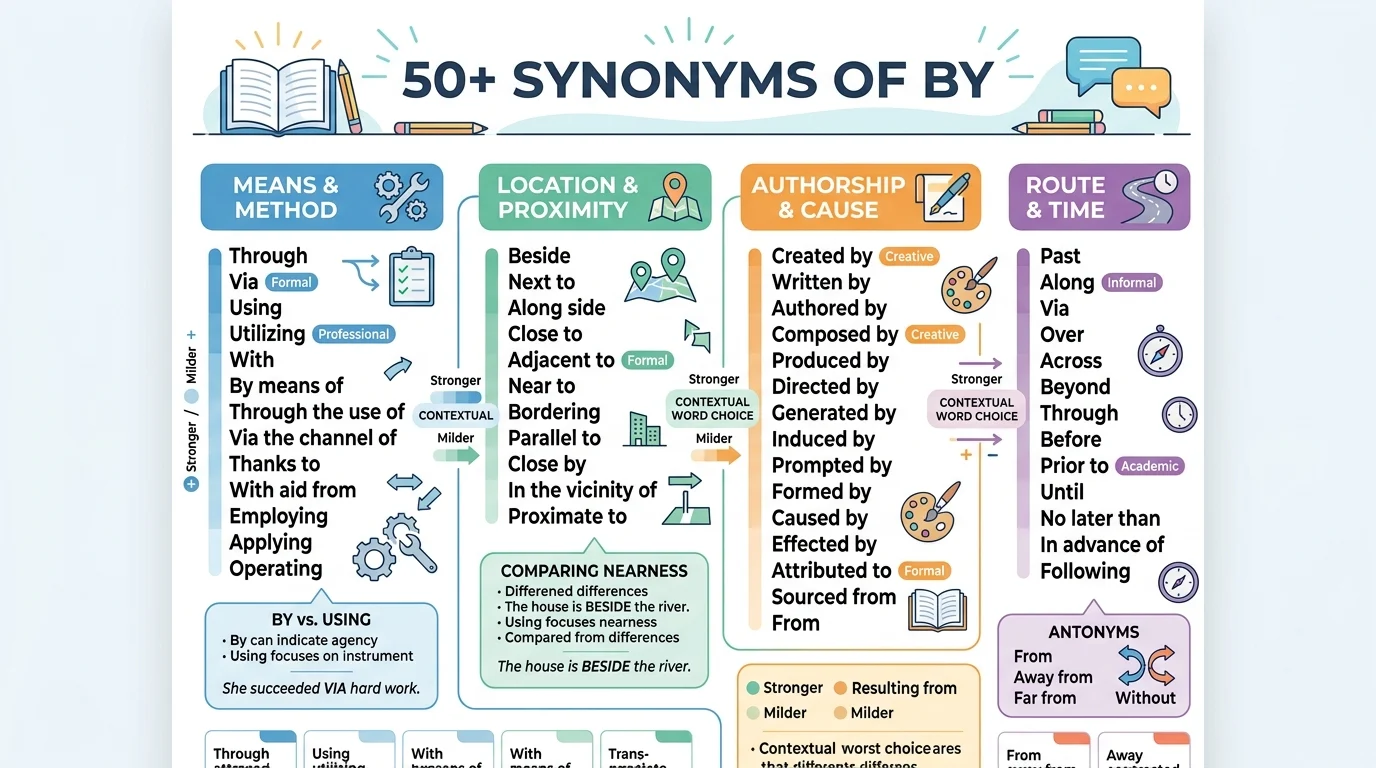
“By” is a versatile preposition and adverb that indicates proximity, agency, means, or a deadline. The best synonym depends entirely on context. Location, use “beside” or “next to.” For method, use “via” or “through.” For agency, use “through” or “with.” Deadlines, use “before” or “no later than.” Creative writing, try “alongside” or “past.” Choose based on your audience and purpose.
Meaning, Tone, and Context
Simple Definition
“By” is a small word with many jobs. As a preposition, it can mean next to something, through someone or something, not later than a certain time, or using a particular method. As an adverb, it means past or aside.
Part of Speech
Preposition and adverb.
Overall Tone
Neutral. “By” does not carry strong emotional weight. It simply communicates information.
Formality Level
Neutral to informal. While “by” appears in all types of writing, some contexts call for more precise or formal alternatives.
Common Uses
Native English speakers use “by” constantly. Use it to describe location, as in “the house by the river.” They use it to indicate the person who did something, as in “written by Shakespeare.” Use it to explain how something happened, as in “pay by credit card.” Use it to set deadlines, as in “submit by Friday.” They also use it in common phrases like “by the way” and “by accident”.
Word Forms
- Preposition: The book was written by a famous author.
- Adverb: The parade marched by.
- Related forms: nearby, passerby, bystander, byproduct
- Idiomatic phrases: by and by, by and large, by the way
When and How to Use “By”
Choose “by” when you need a simple, clear word that works in almost any situation. It is the default choice for indicating location, agency, method, and time limits. However, overusing it makes your writing feel flat. Here are seven realistic examples showing how “by” appears in different contexts.
Professional
The quarterly report was approved by the board of directors.
Academic
The data was analyzed by a team of research assistants.
Workplace
Please submit your time sheets by 5:00 PM on Friday.
Personal
I sat by the window and watched the rain fall.
Email
You can reach me by phone or by email.
Resume
Increased sales by 35 percent within the first quarter.
Social Media
Loved this book by my favorite author.
Best Synonyms of “By”
No synonym works perfectly in every situation. The right choice depends on your meaning, audience, and tone. Here are the best alternatives for common contexts.
Professional writing: “Through” works well when you want to emphasize the process or channel. “Through” suggests a pathway or intermediary.
Academic writing: “Via” sounds precise and authoritative. It indicates a specific medium or route.
Business communication: “Per” works for indicating rates or standards, as in “per our agreement.”
Casual conversation: “Next to” and “beside” sound natural and conversational.
Emotional writing: “Alongside” adds a sense of companionship or support.
Creative writing: “Past” creates movement and visual imagery.
Resume writing: “Through” emphasizes action and initiative.
Workplace communication: “No later than” sets clear expectations for deadlines.
Stronger meaning: “By means of” adds emphasis to the method or tool.
Softer meaning: “Near” feels gentler and less precise.
When Not to Use “By”
There are times when “by” is not the best choice. Recognizing these situations will improve your writing.
When the word sounds too vague
If you write “the report was sent by email,” the meaning is clear but unremarkable. “Via email” sounds slightly more professional.
When the word sounds too informal
In formal legal or academic writing, “by” can feel casual. “Through the agency of” or “by virtue of” may be more appropriate.
When the word sounds too weak
“I finished the project by working late” is fine. But “I finished the project through working late” emphasizes the effort more strongly.
When the word sounds outdated
Using “by” in phrases like “by your leave” sounds old-fashioned. Modern alternatives like “with your permission” are more natural.
When precision matters
Saying “the meeting is by Tuesday” is unclear. Does it mean before Tuesday or on Tuesday? “No later than Tuesday” removes the ambiguity.
Words Commonly Confused With “By”
By vs Beside
Main Difference: “Beside” specifically means at the side of. “By” has many more meanings.
When to Use It: Use “beside” when you want to emphasize physical side-by-side positioning.
Example: She sat beside her grandmother during the ceremony.
By vs Via
Main Difference: “Via” means through a specific route or medium. “By” is broader.
When to Use It: Use “via” in formal or technical writing when specifying a channel.
Example: The documents were transmitted via secure server.
By vs Through
Main Difference: “Through” emphasizes passing from one side to another or using an intermediary. “By” is more general.
When to Use It: Use “through” when you want to highlight the process or intermediary.
Example: We achieved success through careful planning.
By vs With
Main Difference: “By” indicates the agent or doer. “With” indicates the tool or instrument used.
When to Use It: Use “with” when focusing on the tool rather than the person.
Example: He opened the door with a key.
By vs Near
Main Difference: “Near” suggests proximity but not necessarily adjacency. “By” often implies closer proximity.
When to Use It: Use “near” when the distance is approximate rather than exact.
Example: The hotel is near the airport.
By vs Before
Main Difference: “Before” is more precise for time. “By” includes the deadline itself.
When to Use It: Use “before” when the deadline is strictly prior to a time.
Example: Arrive before 9:00 AM for the meeting.
Best Synonyms of “By” by Context
| Context | Best Synonym | Why It Works | Example |
|---|---|---|---|
| Formal writing | Through | Emphasizes process and intermediary channels | The policy was implemented through executive order |
| Academic writing | Via | Sounds precise and authoritative | The data was collected via standardized surveys |
| Professional communication | Per | Indicates standards and agreements concisely | Per company policy, all expenses must be approved |
| Business emails | By means of | Adds formality and clarity | We will process your request by means of our automated system |
| Resume writing | Through | Highlights action and initiative | Increased revenue through strategic partnerships |
| Workplace communication | No later than | Removes deadline ambiguity | Submit your proposal no later than Thursday |
| Casual conversation | Next to | Sounds natural and friendly | I live next to the coffee shop |
| Everyday speaking | Beside | Simple and widely understood | Put your bag beside the door |
| Creative writing | Alongside | Adds imagery and emotional depth | She walked alongside the ocean at sunset |
| Storytelling | Past | Creates movement and visual scenes | The train rushed past the old station |
| Emotional writing | By the side of | Conveys support and closeness | He stayed by the side of his friend |
| Strong emphasis | By virtue of | Adds formal weight to reasons | She succeeded by virtue of her dedication |
| Mild tone | Near | Feels gentle and less precise | The park is near my apartment |
| Social media captions | Via | Sounds modern and concise | Posted via my phone |
How to Choose the Best Synonym of “By”
Choosing the right synonym starts with understanding your meaning. Ask yourself what “by” is doing in your sentence.
Is it showing location? Use “beside,” “next to,” “alongside,” or “near.” “Beside” and “next to” suggest direct adjacency. “Near” suggests approximate proximity.
Is it showing who did something? Use “through” or “by means of” for formal writing. In most cases, “by” itself works perfectly.
Is it showing how something happened? Use “via” for formal or technical writing. Use “through” to emphasize process.
Is it showing a deadline? Use “no later than” for clarity. Use “before” when the deadline is strictly prior.
Is it showing movement past something? Use “past” or “along.”
Who is your audience? For professional and academic audiences, choose “via,” “through,” or “by means of.” For casual conversations, choose “beside,” “next to,” or “near.”
What is your tone? For emotional or creative writing, choose “alongside” or “by the side of.” For neutral communication, “by” itself is fine.
The goal is always clarity. Choose the word that communicates your intended message most directly.
Real Life Examples of “By”
School
The students stood by the flagpole during the morning assembly.
College
Her research paper was cited by three other scholars in the field.
Workplace
The team completed the project by working overtime for two weeks.
Business
We will deliver the order by courier service.
Email
You can update your preferences by visiting your account settings.
Resume
Improved customer satisfaction scores by 20 percent through better training.
Conversation
I will be home by dinner time.
Storytelling
The old man walked by the cemetery every evening at dusk.
Blogging
This recipe was inspired by my grandmother’s cooking.
Social Media
Loving this view by the lake.
Improved version with stronger synonyms
Instead of: “The students stood by the flagpole.”
Try: “The students stood beside the flagpole.”
Instead of: “We will deliver by courier.”
Try: “We will deliver via courier service.”
Instead of: “I will be home by dinner.”
Try: “I will be home no later than dinner.”
18 Best Synonyms of “By”
| Synonym | Simple Meaning | Best Used For | Example Sentence |
|---|---|---|---|
| Beside | At the side of | Physical location, casual writing | She sat beside me during the movie |
| Next to | Immediately adjacent | Physical location, everyday speech | The pharmacy is next to the grocery store |
| Alongside | Beside or together with | Creative and emotional writing | The children played alongside the river |
| Near | Close to but not necessarily adjacent | Casual conversation, approximate location | I live near the university campus |
| Via | Through a specific route or medium | Formal, academic, and technical writing | The results were transmitted via email |
| Through | By means of; using as an intermediary | Professional and academic writing | We succeeded through teamwork |
| Per | According to; for each | Business and professional writing | Per our discussion, we will proceed |
| Past | Beyond in position; moving beyond | Creative writing, storytelling | The runner dashed past the finish line |
| Before | Earlier than | Time references, deadlines | Arrive before the meeting starts |
| No later than | At or before a specified time | Professional deadlines, clear communication | Submit your application no later than Friday |
| By means of | Using a particular method or tool | Formal writing, emphasis on method | The data was collected by means of surveys |
| By virtue of | Because of; due to | Formal writing, emphasizing cause | She won by virtue of her experience |
| Hard by | Very close to | Literary or formal writing | The cottage stood hard by the sea |
| Along | Moving in a constant direction | Descriptive writing, directions | We walked along the beach |
| Close to | Near in distance or relationship | Everyday conversation | The restaurant is close to my office |
| Adjacent to | Next to or adjoining | Technical or formal writing | The building is adjacent to the park |
| Abreast of | Level with or alongside | Formal or technical description | The new policy is abreast of industry standards |
| Cheek by jowl | Very close together | Literary or descriptive writing | The houses stood cheek by jowl in the old village |
Synonyms of “By” by Usage
Professional vs Personal Synonyms
Professional settings prefer “through,” “via,” and “per.” These words sound competent and precise. “Through” emphasizes process. “Via” emphasizes the medium. “Per” emphasizes standards and agreements.
Personal conversations prefer “beside,” “next to,” and “near.” These words sound friendly and natural. They do not carry the formality of professional alternatives.
Formal vs Conversational Synonyms
Formal writing like reports, essays, and business documents benefits from “via,” “through,” “by means of,” and “by virtue of.” These phrases add authority and precision.
Conversational writing like emails to friends, texts, and casual social media posts works best with “beside,” “next to,” and “near.” These words feel approachable.
Academic Synonyms
For research papers, essays, and academic discussions, choose “via,” “through,” and “by means of.” “Via” sounds especially authoritative when describing research methods or data collection. “Through” works well for describing processes and analyses. These words signal precision and careful thinking.
Professional and Business Synonyms
For resumes, interviews, meetings, and client communication, choose “through,” “per,” and “via.” “Through” shows initiative and action on resumes. “Per” demonstrates knowledge of professional standards. “Via” sounds modern and competent in business emails.
Creative and Literary Synonyms
For storytelling, fiction, poetry, and speeches, choose “alongside,” “past,” “along,” and “cheek by jowl.” These words add imagery and emotion. “Alongside” suggests companionship. “Past” creates movement. “Along” provides direction. “Cheek by jowl” creates vivid imagery of closeness.
Slang or Modern Synonyms
“By” does not have widely used slang equivalents. In modern digital communication, “via” has become more common, especially in social media captions and tech writing. However, this is a stylistic preference rather than slang.
Strongest to Mildest Synonyms
Mild → Moderate → Strong → Very Strong
- Mild: Near, close to
- Moderate: Beside, next to
- Strong: Through, via
- Very Strong: By means of, by virtue of
The intensity changes based on formality and emphasis. “Near” and “close to” are gentle and approximate. “Beside” and “next to” are more precise. “Through” and “via” add professional weight. “By means of” and “by virtue of” carry formal authority.
Emotional vs Neutral Synonyms
Emotional Synonyms: “Alongside,” “by the side of,” and “cheek by jowl” express connection, support, or intimacy. Use these when you want to convey feeling.
Neutral Synonyms: “Beside,” “next to,” “near,” “through,” “via,” and “per” simply communicate information. Use these for straightforward communication.
Antonyms of “By”
| Antonym | Meaning | Example Sentence |
|---|---|---|
| Away from | At a distance from | She moved away from the window |
| Far from | At a great distance | The store is far from my house |
| Distant from | Not close | The cabin is distant from the main road |
| Beyond | On the far side | The mountains are beyond the valley |
| Past | Beyond in time or space | The deadline is past |
| After | Later than | Arrive after noon |
| Following | Coming after | Following the meeting, we will eat lunch |
| Later than | After a specified time | The package arrived later than expected |
| Without | Not using | He completed the task without help |
| In spite of | Despite | She succeeded in spite of the obstacles |
| Despite | Regardless of | They finished despite the challenges |
| Excluding | Not including | The price is $50, excluding tax |
| Apart from | Separate from | The house stands apart from the others |
| Separate from | Not together with | Keep the receipts separate from the cash |
| Independent of | Not influenced by | The decision was independent of outside pressure |
Comparison: “By” vs Similar Words
By vs Beside
Main Difference: “Beside” means at the side of and nothing else. “By” has many meanings including location, agency, method, and time.
Which Is Stronger?: Neither is stronger. They serve different purposes.
Which Is More Formal?: “Beside” is slightly more formal than “by” in location contexts.
When to Use Each: Use “beside” when you specifically mean at the side of something. Use “by” in all other contexts.
Examples
By: The book was written by a famous author.
Beside: The vase sits beside the photograph.
By vs Via
Main Difference: “Via” means through a specific route, medium, or channel. “By” is broader and can indicate method, agent, or location.
Which Is Stronger?: “Via” sounds more formal and precise.
Which Is More Formal?: “Via” is more formal and technical.
When to Use Each: Use “via” in formal, academic, or technical writing when specifying a medium. Use “by” in everyday writing.
Examples
By: I sent the package by mail.
Via: The data was transmitted via secure server.
By vs Through
Main Difference: “Through” emphasizes passing from one side to another or using an intermediary. “By” is more general.
Which Is Stronger?: “Through” can feel more active and process-oriented.
Which Is More Formal?: Both are acceptable in formal writing, but “through” often sounds more deliberate.
When to Use Each: Use “through” when you want to emphasize the process or intermediary. Use “by” for simpler statements.
Examples
By: We succeeded by working hard.
Through: We succeeded through careful planning and execution.
By vs With
Main Difference: “By” indicates the agent or doer. “With” indicates the tool or instrument used.
Which Is Stronger?: Neither. They serve different grammatical purposes.
Which Is More Formal?: Both are neutral.
When to Use Each: Use “by” for the person or force doing something. Use “with” for the tool or instrument.
Examples
By: The decision was made by the committee.
With: He wrote the letter with a pen.
By vs Near
Main Difference: “Near” suggests proximity but not necessarily adjacency. “By” often implies closer proximity.
Which Is Stronger?: “By” implies a closer relationship.
Which Is More Formal?: “Near” is slightly more formal in location contexts.
When to Use Each: Use “near” when the distance is approximate. Use “by” when you mean right next to.
Examples
By: The dog sat by its owner.
Near: The hotel is near the airport.
By vs Before
Main Difference: “Before” means earlier than. “By” includes the deadline itself.
Which Is Stronger?: “Before” is more restrictive.
Which Is More Formal?: “Before” is slightly more formal.
When to Use Each: Use “before” when the deadline is strictly prior. Use “by” when the deadline includes the specified time.
Examples
By: Submit the report by Friday. (Friday is acceptable)
Before: Submit the report before Friday. (Friday is too late)
Common Phrases and Expressions with “By”
Phrase: By the way
Meaning: Used to introduce a comment or question that is not directly related to the current topic.
Example Sentence: By the way, have you seen the new movie?
Phrase: By accident
Meaning: Happening without planning or intention.
Example Sentence: I met her by accident at the grocery store.
Phrase: By and large
Meaning: In general; on the whole.
Example Sentence: By and large, the project was a success.
Phrase: By and by
Meaning: Before long; eventually.
Example Sentence: We will reach our destination by and by.
Phrase: By the book
Meaning: Following rules and procedures exactly.
Example Sentence: The inspector checked everything by the book.
Phrase: By heart
Meaning: From memory.
Example Sentence: She knows all the lyrics by heart.
Phrase: By chance
Meaning: Without planning; accidentally.
Example Sentence: I found the perfect gift by chance.
Phrase: By no means
Meaning: Not at all; definitely not.
Example Sentence: The task is by no means impossible.
Common Mistakes to Avoid
Mistake: Choosing a vague synonym instead of a precise one
Incorrect: The data was processed by a computer.
Better: The data was processed via a computer system.
Why: “Via” emphasizes the computer as the specific medium.
Mistake: Confusing “by” with “beside”
Incorrect: The report was written beside the manager.
Better: The report was written by the manager.
Why: “Beside” means next to, not done by someone.
Mistake: Using an informal synonym in formal writing
Incorrect: We will send the package by means of FedEx.
Better: We will send the package via FedEx.
Why: “Via” sounds more professional and concise in business writing.
Mistake: Selecting an overly dramatic synonym
Incorrect: The cat sat by virtue of the window.
Better: The cat sat by the window.
Why: “By virtue of” is too formal for a simple location statement.
Mistake: Repeating the same word too often
Incorrect: The book was written by the author. It was published by the same publisher.
Better: The book was written by the author. It was published through the same publisher.
Why: Varying word choice keeps writing fresh and engaging.
Mistake: Choosing a synonym with the wrong emotional tone
Incorrect: He stood alongside his boss during the presentation.
Better: He stood beside his boss during the presentation.
Why: “Alongside” suggests partnership or equality, which may not fit a subordinate relationship.
Mistake: Using slang in academic or professional writing
Incorrect: The results were sent via the internet.
Better: The results were transmitted via the internet.
Why: “Sent via” is acceptable, but “transmitted via” sounds more academic.
Frequently Asked Questions
1. What are the best synonyms of “by”?
The best synonyms of “by” depend on context. Location, use “beside” or “next to.” Method, use “via” or “through.” For deadlines, use “before” or “no later than.” For agency, “by” itself often works best.
2. What are the best formal synonyms of “by”?
The best formal synonyms of “by” include “via,” “through,” “by means of,” and “by virtue of.” “Via” works well for specifying a medium or route. “Through” emphasizes process. “By means of” and “by virtue of” add formal weight.
3. What are common informal synonyms of “by”?
Common informal synonyms of “by” include “beside,” “next to,” “near,” and “close to.” These words sound natural in everyday conversation and casual writing. They are widely understood and feel approachable.
4. What is another word for “by” in professional writing?
In professional writing, “through,” “via,” and “per” are excellent alternatives to “by.” “Through” emphasizes action and process. “Via” sounds modern and precise. “Per” indicates standards and agreements concisely.
5. What is the difference between “by” and “via”?
“By” is broader and can indicate location, agency, method, or time. “Via” specifically means through a particular route, medium, or channel. “Via” sounds more formal and is preferred in academic and technical writing.
6. What is the opposite of “by”?
The opposite of “by” depends on the meaning. Location, opposites include “away from,” “far from,” and “distant from.” For time, opposites include “after,” “following,” and “later than.” For method, “without” can serve as an opposite.
Conclusion
“By” is a small but mighty word that appears constantly in English. It indicates location, agency, method, and time. While “by” works in almost any situation, overusing it makes writing feel repetitive and flat. The best synonyms of “by” depend entirely on context. “Beside” or “next to” for location. Use “via” or “through” for method and process. Use “before” or “no later than” for deadlines. “Alongside” for emotional and creative writing. No synonym works perfectly in every situation. The key is choosing the word that communicates your intended message most clearly to your specific audience. A practical vocabulary tip is to read your writing aloud. If you hear “by” too often, try replacing it with a more precise alternative. Your writing will become clearer, stronger, and more engaging.