Have you ever written an email, essay, or social media caption where you kept using the word “goal” over and over? It happens to everyone. You want to describe what you are working toward, but repeating the same word makes your writing feel flat and uninspired.
The English language offers many rich alternatives for “goal.” Each synonym carries its own shade of meaning, tone, and emotional weight. Choosing the right word can transform your message from ordinary to compelling.
This guide will help you master every synonym for “goal.” You will learn which words work best in professional settings, which ones add emotional depth, and which ones are perfect for casual conversations. By the end, you will never struggle to find the right word again.
What Does “Goal” Mean?
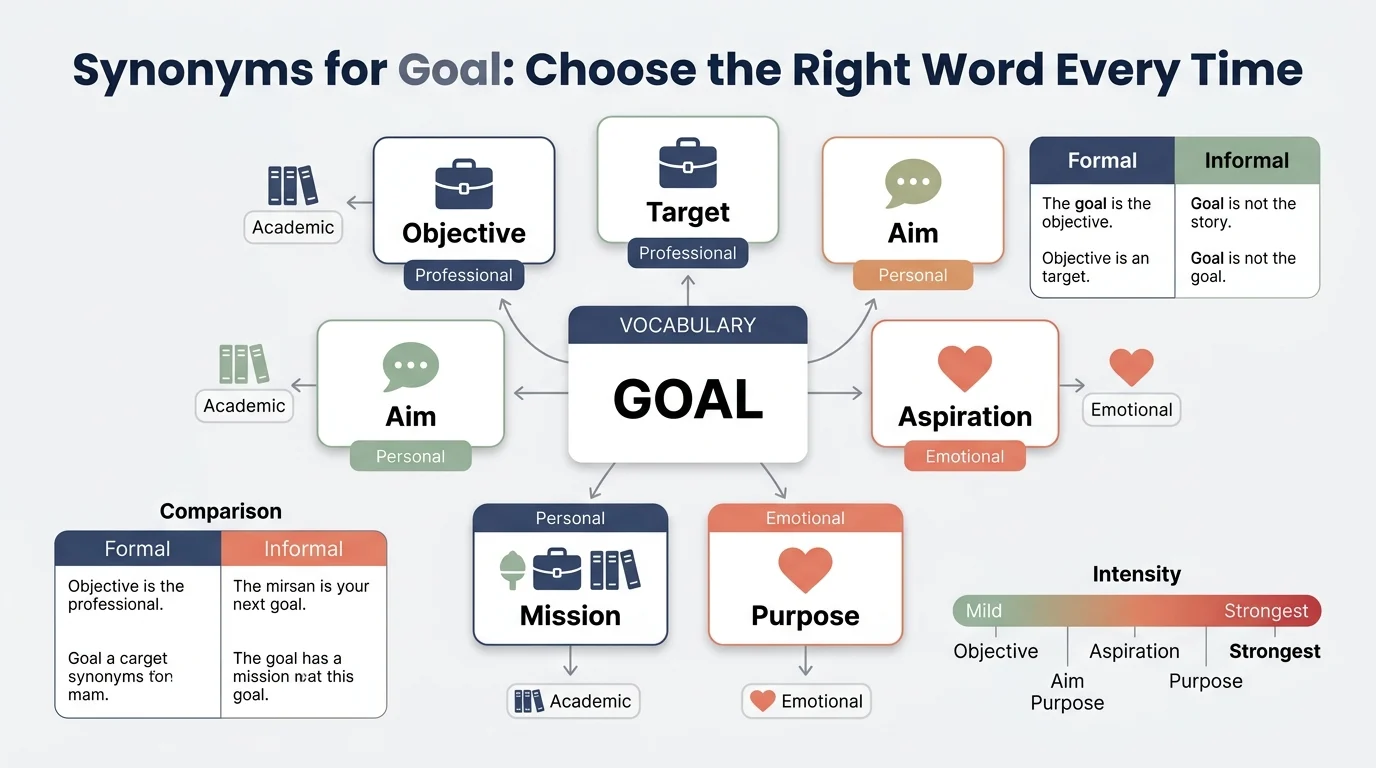
A goal is something you aim to achieve through effort and planning. The best synonyms depend on your context. Use “objective” for professional writing, “target” for measurable outcomes, “ambition” for personal drive, “aim” for general direction, and “aspiration” for long term dreams. Each alternative offers a distinct nuance.
Meaning, Tone and Context
Simple Definition
A goal is a desired result or purpose that requires action and commitment to attain.
Part of Speech
Noun. The word “goal” functions as a noun in sentences.
Tone
Neutral. The word “goal” carries a balanced tone that fits almost any situation without adding extra emotional weight.
Formality Level
Moderately formal. You can use “goal” in casual conversation, academic papers, business reports, and personal writing. It is a safe choice for almost any context.
Common Use Cases
You will encounter “goal” in professional planning, personal development, academic assignments, fitness tracking, career progression, and everyday conversations about the future.
Important Word Forms
The word “goal” has several related forms. The adjective form is “goal oriented.” You can also use “goal setting” as a noun phrase. The opposite of a goal is often “aimlessness” or “pointlessness.”
When and How to Use “Goal”
You should use “goal” when you want to describe a specific outcome you are working toward. The word works well in almost every situation because it is clear and familiar to all audiences.
Here are realistic examples with labeled contexts:
Professional
Our team set a clear goal to increase quarterly sales by 15 percent.
Personal
My personal goal this year is to read one book per month.
Academic
The research project has a primary goal of identifying new treatment methods.
Emotional
Her goal of finding inner peace guided every decision she made.
Creative
The artist’s goal was to capture the feeling of renewal in her paintings.
Social Media
My fitness goal is to run a marathon by the end of the year.
Email
Please review the attached document and confirm the goal for our upcoming meeting.
Resume
Achieved the goal of streamlining office operations and reducing waste by 20 percent.
Another Word for “Goal”
The best single replacement for “goal” depends entirely on your situation. Here are direct suggestions for different contexts:
Professional writing
Use “objective” when you need a formal, precise word for workplace goals.
Academic writing
Use “aim” to describe the purpose of a study or research paper.
Casual conversation
Use “target” when you want a straightforward, relatable word.
Emotional writing
Use “aspiration” to convey heartfelt dreams and long term desires.
Creative writing
Use “purpose” to add depth and philosophical meaning to your narrative.
Resume or workplace use
Use “achievement” to describe completed goals that demonstrate success.
Social media captions
Use “milestone” to celebrate progress and small wins.
Stronger meaning
Use “mission” when you want to convey a powerful, driving sense of purpose.
Softer meaning
Use “wish” when you want to express a gentle desire without pressure or commitment.
When Not to Use “Goal”
The word “goal” can sound too vague in certain situations. It often lacks the precision needed in professional reports or academic research.
Consider this example:
Vague: Our goal is to improve customer satisfaction.
Better: Our objective is to reduce customer complaint response time to under two hours.
The word “goal” also feels too casual in formal documents like grant proposals or legal contracts. In those contexts, words like “objective” or “intent” carry more authority.
Avoid using “goal” in emotional writing when you want to convey deep longing or passion. Words like “aspiration” or “calling” create stronger emotional connections.
Do not use “goal” repeatedly in the same paragraph. Vary your vocabulary with precise synonyms to keep your writing fresh and engaging.
Words Commonly Confused With “Goal”
Several related words often get mixed up with “goal.” Understanding the differences will help you choose the right word every time.
Goal vs. Objective
A goal is a broad desired outcome. An objective is a specific, measurable step toward that goal. Objectives are more concrete and actionable.
Goal vs. Aim
Aim suggests direction or intention. It feels slightly less formal than “goal” and often describes a general purpose rather than a specific outcome.
Goal vs. Target
A target implies a precise, often numerical achievement. It carries a sense of measurement and accountability that “goal” does not always convey.
Goal vs. Ambition
Ambition suggests personal drive and desire for success. It has a stronger emotional and motivational tone than the neutral “goal.”
Goal vs. Purpose
Purpose refers to the reason something exists or is done. It is broader and more philosophical than a specific “goal.”
Goal vs. Aspiration
Aspiration describes a long term hope or dream. It feels more personal and emotional than a standard “goal.”
Goal vs. Mission
A mission is a significant, often life defining purpose. It carries more weight and importance than a typical “goal.”
Best Synonym by Context for “Goal”
| Context | Best Synonym | Why It Works | Example |
|---|---|---|---|
| Formal Writing | Objective | Provides precision and authority | The committee established a clear objective for the fiscal year. |
| Academic Writing | Aim | Indicates research direction | The study’s primary aim was to examine behavioral patterns. |
| Professional Use | Target | Emphasizes measurable outcomes | We set a sales target of 50,000 units per quarter. |
| Resume Writing | Achievement | Highlights completed success | Surpassed the achievement of increasing revenue by 30 percent. |
| Casual Conversation | Target | Feels natural and relatable | My target is to save enough for a vacation this summer. |
| Creative Writing | Purpose | Adds philosophical depth | Her purpose guided her through every challenge she faced. |
| Emotional Tone | Aspiration | Conveys heartfelt desire | His aspiration to help others drove his career choices. |
| Strong Intensity | Mission | Suggests powerful commitment | Their mission was to change lives through education. |
| Soft or Moderate | Aim | Feels gentle and flexible | Her aim was simply to enjoy the journey. |
| Social Media Captions | Milestone | Celebrates progress and wins | This promotion is a major milestone in my career. |
| US Usage | Goal | Universally understood and accepted | Setting a goal is the first step to achievement. |
Which Synonym Should You Choose?
Choosing the right synonym for “goal” depends on several factors. Start by considering the meaning you want to convey. Are you describing a specific measurable outcome or a broad desire?
Next, think about formality. Professional and academic settings require more precise words like “objective” or “target.” Casual conversations allow for simpler words like “aim” or “target.”
Consider emotional intensity. Words like “aspiration” and “mission” carry strong emotional weight. Words like “aim” and “target” feel neutral and factual.
Think about your audience. A business report demands professional language. A personal journal allows for emotional words. A social media post needs relatable, engaging vocabulary.
Finally, examine your sentence structure. Some synonyms work better with certain verbs. You “set” a goal or objective. “achieve” a target. You “pursue” an aspiration. Match your word choice to the action in your sentence.
Real Life Examples of “Goal” in Sentences
These examples show how “goal” and its synonyms appear in everyday situations.
School
Her educational goal was to graduate with honors in biology.
Workplace
The department’s primary objective was to reduce operational costs.
Writing
The author’s aim was to create a story that resonated with young adults.
Conversation
My target is to finish this project before the deadline.
Social Media
Running my first 5K was a huge milestone this month.
Resume
Achieved the goal of expanding the client base by 25 percent.
Email
Let us define our objective for this week’s client presentation.
Storytelling
His mission to protect endangered species became his life’s work.
25 Synonyms for “Goal”
| Synonym | Simple Meaning | Best Used For | Example Sentence |
|---|---|---|---|
| Objective | A specific, measurable aim | Professional and academic writing | The team defined a clear objective for the new product launch. |
| Target | A precise outcome or number | Business and personal planning | Our target is to close 30 new accounts this quarter. |
| Aim | General direction or intention | Everyday conversation and writing | His aim was to improve his public speaking skills. |
| Ambition | Strong personal drive to succeed | Emotional and motivational contexts | Her ambition pushed her to apply for the leadership role. |
| Aspiration | A long term hope or dream | Personal and heartfelt writing | His aspiration to become a doctor motivated his studies. |
| Mission | A significant, purpose driven aim | Powerful and committed contexts | The nonprofit’s mission is to provide clean water to communities. |
| Purpose | The reason for existence or action | Philosophical and creative writing | Her purpose in life was to help others heal. |
| Intent | A deliberate plan or purpose | Legal and formal documents | The intent of the policy was to protect employee rights. |
| Design | A carefully planned purpose | Formal and strategic contexts | The design of the program was to increase student engagement. |
| End | A final aim or outcome | Philosophical and literary writing | The end of his efforts was a more peaceful community. |
| Object | A specific purpose or focus | Slightly formal or technical contexts | The object of the exercise was to improve teamwork. |
| Destination | A final point of achievement | Creative and motivational writing | Her destination was financial independence. |
| Mark | A standard to reach or exceed | Personal and casual contexts | He set a mark of 10,000 steps per day. |
| Plan | A detailed intention or scheme | Everyday conversation and writing | The plan was to open a new branch next year. |
| Intention | A commitment to act | Formal and professional contexts | The company stated its intention to expand globally. |
| Dream | A strongly desired future state | Emotional and inspirational contexts | Her dream was to publish a bestselling novel. |
| Hope | A positive expectation for the future | Gentle and personal contexts | His hope was to reconnect with old friends. |
| Wish | A desire without firm commitment | Soft and casual contexts | Her wish was to travel the world someday. |
| Calling | A strong inner sense of purpose | Deeply personal and spiritual contexts | Teaching was not just a job but her true calling. |
| Quest | A determined search or pursuit | Creative and adventurous contexts | His quest for knowledge took him to distant countries. |
| Undertaking | A formal project or task | Professional and formal contexts | The new undertaking required significant resources. |
| Venture | A risky or bold project | Business and entrepreneurial contexts | Their latest venture focused on sustainable technology. |
| Pursuit | An activity of striving toward something | Professional and personal contexts | The pursuit of excellence guided their daily work. |
| Enterprise | A purposeful and complex project | Formal and business contexts | The enterprise aimed to revolutionize healthcare. |
| Destination | The final point of a journey | Creative and metaphorical contexts | Financial freedom was the destination he sought. |
Synonym Groups and Usage Differences
Professional vs. Personal Synonyms
Professional synonyms like “objective,” “target,” and “plan” work best in workplace settings. These words sound precise and action oriented. They help teams align on measurable outcomes.
Personal synonyms like “dream,” “hope,” and “aspiration” belong in personal reflection and emotional conversations. These words carry warmth and individual meaning. They connect with readers on a deeper level.
Formal vs. Conversational Synonyms
Formal synonyms include “objective,” “intent,” “design,” and “undertaking.” These words appear in reports, academic papers, and official documents. They convey authority and precision.
Conversational synonyms include “target,” “aim,” and “plan.” These words feel natural in everyday speech. They are easy to understand and relatable for any audience.
Academic Synonyms
Academic writing demands precision and clarity. Use “objective” to describe research goals. “aim” to state the purpose of a study. Use “intent” to explain the rationale behind research design. These words sound scholarly and deliberate.
Professional and Business Synonyms
Business communication favors words like “target,” “objective,” “plan,” and “venture.” These words emphasize measurable outcomes and strategic thinking. They work well in meetings, proposals, and performance reviews.
Creative or Literary Synonyms
Creative writing benefits from vivid, evocative words. Use “quest,” “destination,” “calling,” and “purpose” to add narrative depth. These words create imagery and emotional resonance in stories and poetry.
Strongest vs. Weaker Synonyms
An intensity scale from mild to strongest:
Mild: Wish, hope, aim
Moderate: Goal, target, plan
Strong: Ambition, mission, aspiration
Strongest: Calling, quest, purpose
Choose based on how much emotional force you want to convey.
Emotional vs. Neutral Synonyms
Emotional synonyms include “aspiration,” “dream,” “hope,” and “calling.” These words connect with feelings and personal values. They inspire and motivate.
Neutral synonyms include “objective,” “target,” “plan,” and “intent.” These words stay factual and professional. They work best in objective reporting and business contexts.
Antonyms of “Goal”
| Antonym | Meaning | Example Sentence |
|---|---|---|
| Aimlessness | Lack of purpose or direction | His aimlessness after graduation worried his parents. |
| Pointlessness | Absence of meaningful purpose | The pointlessness of the task frustrated the team. |
| Indifference | Lack of interest or concern | Her indifference to the project goals was concerning. |
| Purposelessness | Without clear direction | The purposelessness of the meeting wasted everyone’s time. |
| Aimlessness | Wandering without intent | His aimlessness made it hard to plan for the future. |
| Chaos | Complete disorder and confusion | Chaos replaced the team’s careful planning. |
| Randomness | Lack of deliberate order | The randomness of his actions made success unlikely. |
| Inaction | Failure to take action | Inaction prevented them from achieving their objectives. |
| Stagnation | State of no growth or movement | Stagnation set in when the company lost its vision. |
| Idleness | State of being inactive | His idleness kept him from reaching his potential. |
| Triviality | Lack of importance or significance | The triviality of his concerns distracted from real progress. |
| Frivolity | Lack of serious purpose | Her frivolity made it hard to take her goals seriously. |
| Drifting | Moving without direction | Drifting through life left him feeling unfulfilled. |
| Neglect | Failure to care for or pursue | Neglect of his ambitions led to regret. |
| Meaninglessness | Absence of significance | The meaninglessness of his work caused him to quit. |
Comparison: “Goal” vs. Similar Words
Goal vs. Objective
The main difference is specificity. A goal is broad and general. An objective is specific and measurable.
“Objective” is stronger in professional contexts. It implies concrete steps and quantifiable results.
“Goal” is more versatile and works in almost any situation.
Example for goal: My goal is to become a better writer.
Example for objective: My objective is to complete one article per week.
Goal vs. Target
“Target” implies a precise number or metric. “Goal” is more general and flexible.
“Target” is stronger when you need accountability. “Goal” feels more motivational and open ended.
“Target” is more formal in business settings. “Goal” works in personal and casual contexts.
Example for goal: My goal is to improve my health.
Example for target: My target is to lose 10 pounds this month.
Goal vs. Aim
“Aim” suggests general direction. “Goal” implies a specific outcome.
“Aim” is slightly more formal than “goal” in academic writing.
“Goal” is more common in everyday conversation.
Example for goal: My goal is to finish my degree.
Example for aim: My aim is to pursue a career in medicine.
Goal vs. Ambition
“Ambition” carries strong personal drive. “Goal” is neutral and factual.
“Ambition” is more emotional and motivational. “Goal” is practical and straightforward.
“Ambition” often describes long term desires. “Goal” works for short term and long term objectives.
Example for goal: My goal is to earn a promotion.
Example for ambition: My ambition is to become a company executive.
Goal vs. Purpose
“Purpose” refers to the reason something exists. “Goal” refers to what you want to achieve.
“Purpose” is broader and more philosophical. “Goal” is narrower and more action oriented.
“Purpose” provides meaning and direction. “Goal” provides a specific target.
Example for goal: My goal is to finish this project.
Example for purpose: My purpose is to create meaningful change in my field.
Goal vs. Aspiration
“Aspiration” is a long term, heartfelt dream. “Goal” is a practical target.
“Aspiration” feels more personal and emotional. “Goal” feels more neutral and achievable.
“Aspiration” often requires years of effort. “Goal” can be accomplished in weeks or months.
Example for goal: My goal is to save 5,000 dollars.
Example for aspiration: My aspiration is to live a life of purpose and impact.
Common Phrases and Expressions with “Goal”
1. Set a goal
Meaning: To establish a specific objective you want to achieve.
Example sentence: She decided to set a goal of running three times per week.
2. Achieve a goal
Meaning: To successfully reach a desired outcome.
Example sentence: After months of effort, he finally achieved his goal of learning Spanish.
3. Work toward a goal
Meaning: To make steady progress on an objective.
Example sentence: The team continued to work toward their goal despite many obstacles.
4. Long term goal
Meaning: An objective that requires extended time to accomplish.
Example sentence: His long term goal was to own his own business.
5. Short term goal
Meaning: An objective that can be accomplished in a short time.
Example sentence: Her short term goal was to finish the report by Friday.
6. Reach a goal
Meaning: To attain or achieve a specific objective.
Example sentence: The company reached its goal of expanding into three new markets.
7. Career goal
Meaning: A professional objective related to job advancement.
Example sentence: Her career goal was to become a creative director.
8. Goal oriented
Meaning: Focused on achieving objectives and staying productive.
Example sentence: He was a goal oriented manager who inspired his entire department.
Common Mistakes to Avoid
1. Using “goal” when a more precise synonym works better
Many writers default to “goal” in every situation. This creates vague and unengaging writing.
Weak: Our goal is to serve customers.
Better: Our mission is to deliver exceptional customer experiences.
2. Confusing “goal” with “objective” in professional settings
Using “goal” when you mean “objective” can make your writing sound imprecise.
Incorrect: Our goal is to increase sales by 10 percent.
Correct: Our objective is to increase sales by 10 percent.
3. Using a casual synonym in formal writing
Words like “wish” and “hope” sound out of place in academic papers or business reports.
Informal: The wish of the study is to explore behavior patterns.
Formal: The aim of the study is to explore behavior patterns.
4. Using an overly dramatic synonym for a simple situation
Using “mission” to describe a small task sounds exaggerated and unnatural.
Overly dramatic: My mission is to clean my room today.
Natural: My goal is to clean my room today.
5. Repeating the same synonym too often
Repeating “goal” in every sentence makes your writing monotonous.
Repetitive: My goal is to exercise. My goal is to eat better. My goal is to sleep more.
Improved: My goal is to exercise. My aim is to eat better. My target is to sleep more.
6. Choosing a synonym with the wrong emotional tone
Using “aspiration” for a small weekly task sounds overly sentimental.
Incorrect: My aspiration is to go grocery shopping today.
Correct: My goal is to go grocery shopping today.
7. Using slang in academic or professional writing
Slang synonyms sound unprofessional in serious contexts.
Incorrect: Our aim is to nail this project.
Correct: Our objective is to complete this project successfully.
FAQs
What is the best synonym for goal?
The best synonym depends on context. Use “objective” for professional writing, “target” for measurable outcomes, and “aspiration” for personal dreams.
What is a formal synonym for goal?
Objective” is the most common formal synonym. “Intent” and “design” also work well in formal contexts like legal and academic writing.
What is an informal synonym for goal?
“Target” works well in casual conversation. “Aim” and “plan” are also informal and easy to understand in everyday language.
What is another word for goal in professional writing?
“Objective,” “target,” and “plan” are excellent professional alternatives. These words sound precise and action oriented in workplace communication.
What is the difference between goal and objective?
A goal is a broad desired outcome. An objective is a specific, measurable step toward that goal. Objectives are more concrete and actionable.
What is the opposite of goal?
“Aimlessness” and “purposelessness” are direct opposites. “Inaction” and “stagnation” also represent the lack of forward movement.
Conclusion
The word “goal” is a versatile and useful term, but English offers many rich alternatives. The best synonym depends on your context, audience, and emotional tone.
For professional writing, choose “objective” or “target.” personal reflection, use “aspiration” or “dream.” creative work, try “purpose” or “quest.” For everyday conversation, “aim” and “plan” work perfectly.
Remember to vary your vocabulary and choose words that match your message. A precise synonym makes your writing clearer, more engaging, and more memorable.
Start practicing today. Replace one “goal” in your next email, essay, or caption with a more specific synonym. You will notice the difference immediately.