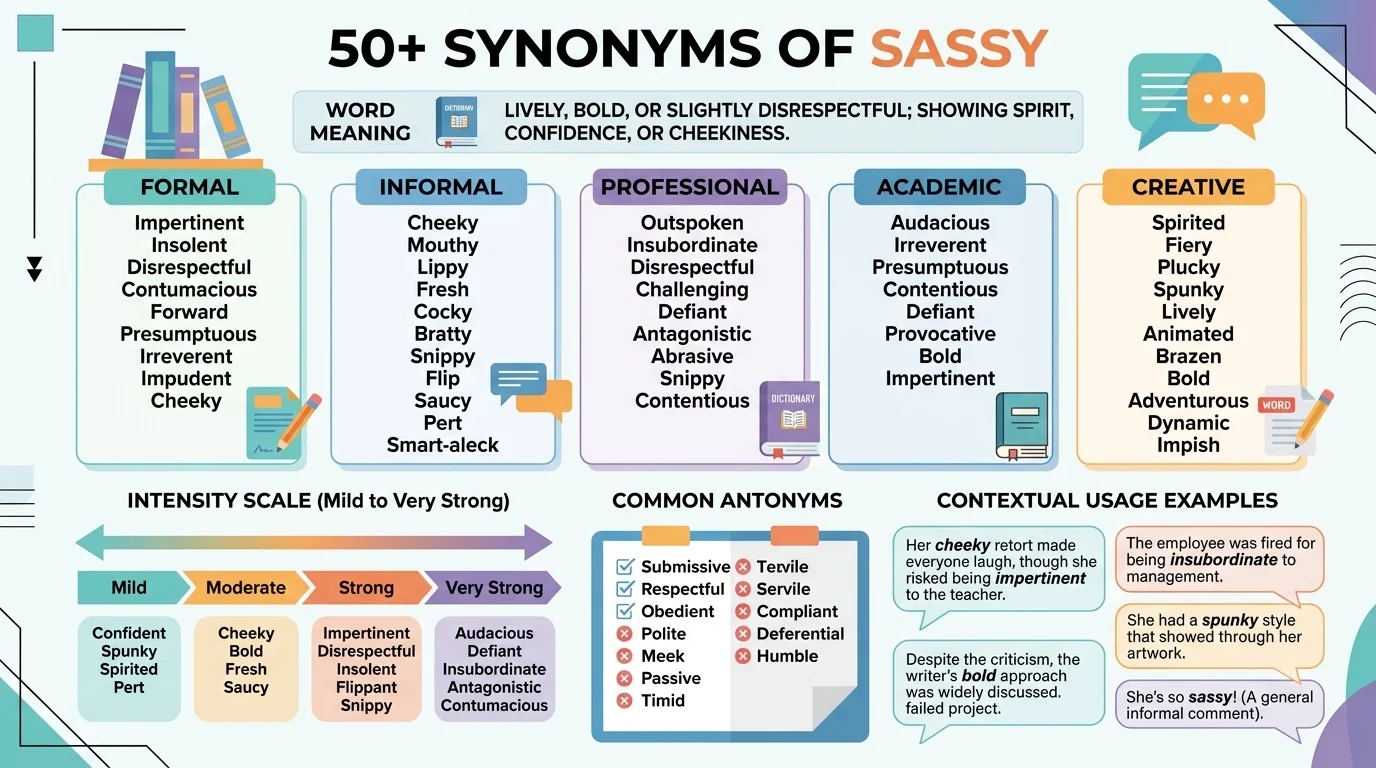
Have you ever caught yourself using the same word repeatedly in an email, a social media caption, or a school essay? You know the word you want, but you cannot find the right alternative to match the exact tone you need. Maybe you are describing a character in a story, a colleague’s remark, or your own playful response. This happens to everyone. Choosing the right synonym is not just about avoiding repetition. It is about communicating clearly and matching your tone to your audience. If you are looking for strong synonyms of sassy, this guide will help you find the perfect word for every situation.
What Are the Best Synonyms of “Sassy”?
“Sassy” describes someone who is boldly spirited, cheeky, or impudent, often in a playful way. Formal writing, choose “impertinent” or “insolent.” For casual conversation, use “cheeky” or “feisty.” Professional settings, “bold” or “direct” work better. For creative writing, try “vivacious” or “spirited.”
Meaning, Tone, and Context
Simple Definition
“Sassy” is an adjective that describes a person who is lively, bold, and full of spirit, often in a way that is cheeky or slightly disrespectful. It can also refer to someone who talks back or makes impudent remarks. In American English, “sassy” is an informal word that carries a playful or spirited tone.
Part of Speech
Adjective. Comparative: sassier. Superlative: sassiest.
Overall Tone
The tone of “sassy” depends entirely on context. It can be positive, neutral, or negative.
- Positive: Lively, confident, spirited, and full of energy.
- Neutral: Bold or cheeky without strong judgment.
- Negative: Rude, disrespectful, or impudent.
Formality Level
Informal. “Sassy” is primarily used in casual conversation and American English. It is not suitable for formal reports, academic papers, or legal documents.
Common Uses
Native English speakers use “sassy” in several ways:
- Describing a child who talks back to parents or teachers.
- Describing a confident, stylish person, especially a woman.
- Describing a witty or playful remark.
- Describing fashionable clothing or accessories.
- Referring to a spirited or rebellious attitude.
Word Forms
When and How to Use “Sassy”
Choose “sassy” when you want to describe someone who is bold, spirited, and slightly cheeky in an informal setting. It works best in casual conversations, creative writing, and social media. It adds personality and energy to your description. However, avoid using it in formal or professional writing where a more neutral or respectful tone is required.
Here are seven realistic examples showing how “sassy” is used in different contexts.
Professional (Informal Team Setting):
“During the brainstorming session, Maria gave a sassy but insightful response that got everyone laughing.”
Academic (Describing a Character):
“The protagonist in the novel is a sassy teenager who challenges every authority figure she meets.”
Workplace (Casual Feedback):
“His sassy comments during the meeting kept the mood light, even when discussing difficult topics.”
Personal (Describing a Friend):
“My best friend is so sassy; she always has a clever comeback for everything.”
Email (Friendly):
“Thanks for your sassy note—it made my day!”
Resume (Only if appropriate for a creative role):
“Known for my sassy yet professional communication style in client presentations.”
Social Media:
“Feeling extra sassy today. Watch out, world!”
Best Synonyms of “Sassy”
No synonym is identical in every situation. The best choice depends on your audience, tone, and purpose. Here are the best synonyms of sassy for specific contexts.
Professional writing: “Direct.” It conveys boldness without the negative connotations of rudeness.
Academic writing: “Impertinent.” It is formal and precise, describing a lack of respect for authority.
Business communication: “Assertive.” It suggests confidence and clarity without being disrespectful.
Casual conversation: “Cheeky.” It captures the playful, slightly bold spirit of sassy.
Emotional writing: “Feisty.” It adds energy and a fighting spirit.
Creative writing: “Vivacious.” It conveys liveliness and charm.
Resume writing: “Confident.” It highlights self-assurance in a professional way.
Workplace communication: “Bold.” It is neutral and acceptable in most work settings.
Stronger meaning: “Insolent.” It carries a much stronger tone of disrespect.
Softer meaning: “Spirited.” It emphasizes energy without the edge of rudeness.
When Not to Use “Sassy”
There are situations where “sassy” is not the best choice.
Too informal for formal documents. Using “sassy” in a formal report or academic paper can make your writing sound unprofessional. Instead, use “impertinent” or “disrespectful.” For example, instead of “The defendant made a sassy remark to the judge,” write “The defendant made an impertinent remark to the judge.”
Too negative when you mean confidence. If you want to praise someone’s confidence, “sassy” might sound like you are calling them rude. Use “confident” or “self-assured” instead. Instead of “She is a sassy leader,” try “She is a confident leader.”
Too weak when you mean serious disrespect. If someone has been truly rude or offensive, “sassy” is too mild. Use “insolent” or “disrespectful.” Instead of “His sassy behavior got him fired,” write “His insolent behavior got him fired.”
Outdated in some professional circles. While “sassy” is still common in casual speech, some older professionals may view it as childish or disrespectful. Choose “bold” or “direct” in workplace emails.
Words Commonly Confused With “Sassy”
Sassy vs Saucy
Difference: “Saucy” often carries a sexual or flirtatious innuendo, while “sassy” does not.
When to Use It: Use “saucy” when describing something flirtatious or risqué. Use “sassy” for boldness without sexual overtones.
Example (Sassy): “She gave a sassy reply to his question.”
Example (Saucy): “She wore a saucy red dress to the party.”
Sassy vs Cheeky
Difference: “Cheeky” is the British English equivalent of “sassy”. Both mean playfully rude, but “cheeky” is more common in the UK.
When to Use It: Use “cheeky” if your audience is British or if you want a slightly softer, more playful tone.
Example (Sassy): “Don’t get sassy with me, young lady!”
Example (Cheeky): “He made a cheeky comment about her new haircut.”
Sassy vs Impudent
Difference: “Impudent” is more formal and carries a stronger tone of disrespect. “Sassy” is informal and often playful.
When to Use It: Use “impudent” in formal writing or when describing serious disrespect. Use “sassy” in casual conversation.
Example (Sassy): “The sassy child rolled her eyes at her mother.”
Example (Impudent): “The impudent student refused to follow the teacher’s instructions.”
Sassy vs Bold
Difference: “Bold” is neutral and simply means showing courage or confidence. “Sassy” adds an element of cheekiness or disrespect.
When to Use It: Use “bold” in professional settings. Use “sassy” when you want to emphasize playful rudeness.
Example (Sassy): “Her sassy attitude annoyed her boss.”
Example (Bold): “Her bold decision impressed everyone in the room.”
Sassy vs Feisty
Difference: “Feisty” emphasizes energy, determination, and a fighting spirit. “Sassy” emphasizes cheeky talk and attitude.
When to Use It: Use “feisty” to describe someone who is spirited and determined. Use “sassy” for someone who is playfully rude.
Example (Sassy): “The sassy waitress made a joke about the customer’s order.”
Example (Feisty): “The feisty old woman refused to give up her seat.”
Sassy vs Insolent
Difference: “Insolent” is much stronger and more formal. It describes serious, disrespectful behavior toward someone in authority. “Sassy” is lighter and often amusing.
When to Use It: Use “insolent” for serious disrespect in formal contexts. Use “sassy” for playful rudeness in casual settings.
Example (Sassy): “The sassy teenager talked back to her parents.”
Example (Insolent): “The insolent employee openly defied the CEO.”
Best Synonyms of “Sassy” by Context
| Context | Best Synonym | Why It Works | Example |
|---|---|---|---|
| Formal writing | Impertinent | Formal and precise; describes lack of respect | “The witness made an impertinent remark to the judge.” |
| Academic writing | Insolent | Formal; emphasizes disrespect toward authority | “The study examined how insolent behavior affects classroom dynamics.” |
| Professional communication | Direct | Neutral and professional; conveys boldness without rudeness | “She gave a direct response to the client’s question.” |
| Business emails | Assertive | Confident and clear; appropriate for professional tone | “Please be assertive in your follow-up email.” |
| Resume writing | Confident | Highlights self-assurance in a positive way | “Confident communicator with experience in client relations.” |
| Workplace communication | Bold | Neutral and acceptable in most work settings | “His bold idea transformed the project.” |
| Casual conversation | Cheeky | Playful and lighthearted; captures the spirit of sassy | “That was a cheeky thing to say!” |
| Everyday speaking | Spunky | Energetic and positive; emphasizes liveliness | “She has a spunky personality.” |
| Creative writing | Vivacious | Expressive and charming; adds flair to descriptions | “The vivacious heroine charmed everyone she met.” |
| Storytelling | Spirited | Conveys energy and determination | “The spirited young knight refused to back down.” |
| Emotional writing | Feisty | Adds emotional intensity and fighting spirit | “Her feisty response silenced the critics.” |
| Strong emphasis | Brazen | Very strong; implies boldness without shame | “He made a brazen attempt to take credit for her work.” |
| Mild tone | Lively | Emphasizes energy without any negative edge | “The lively discussion continued for hours.” |
| Social media captions | Sassy | Works perfectly in casual, fun posts | “Feeling sassy and loving it.” |
| American English | Sassy | The standard term in the US | “Don’t get sassy with me.” |
How to Choose the Best Synonym of “Sassy”
Choosing the right synonym comes down to understanding your audience and your purpose. Here is a practical decision guide.
Consider your audience. Are you writing for a professor, a boss, a friend, or social media followers? Formal audiences require formal synonyms like “impertinent” or “insolent.” Casual audiences welcome “cheeky” or “feisty.”
Consider your tone. Do you want to sound playful, critical, or neutral? “Cheeky” is playful. “Insolent” is critical. “Bold” is neutral.
Consider emotional strength. How strong do you want your description to be? “Lively” is mild. “Brazen” is very strong. Choose the intensity that matches your message.
Consider your purpose. Are you praising someone’s confidence or criticizing their rudeness? Use “confident” for praise. Use “impudent” for criticism.
Say it out loud. Read your sentence with each synonym. Choose the one that sounds most natural and accurate for your situation.
Real Life Examples of “Sassy”
School: “The sassy student constantly interrupted the teacher with witty remarks.”
College: “Her sassy comments during the seminar made the discussion more engaging.”
Workplace: “His sassy attitude toward the new policy did not go over well with management.”
Business: “The CEO appreciated her sassy yet professional approach to negotiations.”
Email (Friendly): “Thanks for your sassy reply—it brightened my morning!”
Resume (Creative Field): “Known for bringing a sassy, energetic voice to brand storytelling.”
Conversation: “My sister is so sassy; she always has the last word.”
Storytelling: “The sassy heroine refused to follow the rules and carved her own path.”
Blogging: “If you want to add some sassy flair to your writing, try these tips.”
Social Media: “New haircut, new attitude. Feeling extra sassy today.”
18 Best Synonyms of “Sassy”
Synonyms of “Sassy” by Usage
Professional vs Personal Synonyms
Professional (Workplace, Business): Use “direct,” “assertive,” “bold,” or “confident.” These words convey strength without the negative connotations of rudeness. They are appropriate for emails, meetings, and performance reviews.
Personal (Friends, Family, Social Media): Use “cheeky,” “feisty,” “spunky,” or “vivacious.” These words are playful and positive. They work well in casual conversations and social media posts.
Formal vs Conversational Synonyms
Formal (Reports, Essays, Business Writing, Presentations): Use “impertinent,” “insolent,” “impudent,” or “disrespectful.” These words are precise and appropriate for serious contexts.
Conversational (Casual Talks, Texting, Social Media): Use “cheeky,” “fresh,” “smart-alecky,” or “mouthy.” These words are informal and match everyday speech.
Academic Synonyms
For research papers, essays, and academic discussions, choose precise and formal vocabulary. “Impertinent” is ideal for describing a lack of respect toward authority. “Insolent” works well when emphasizing serious disrespect. “Disrespectful” is a clear, academic choice. These words sound authoritative and maintain a formal tone.
Professional and Business Synonyms
For resumes, interviews, meetings, and client communication, choose words that convey confidence without negativity. “Assertive” shows confidence and clarity. “Direct” suggests honesty and efficiency. “Bold” indicates courage and innovation. “Confident” highlights self-assurance. These words are appropriate for professional settings and leave a positive impression.
Creative and Literary Synonyms
For storytelling, fiction, poetry, and speeches, choose expressive words that add emotion and imagery. “Vivacious” adds charm and energy. “Spirited” conveys determination. “Feisty” brings a fighting spirit. “Piquant” adds a stimulating, provocative edge. “Audacious” suggests bold risk-taking. These words enrich your writing and captivate your audience.
Slang or Modern Synonyms
“Sassy” itself is informal. Modern slang alternatives include (extremely bold or harsh), “extra” (over-the-top), and “shady” (slightly dishonest or critical). These are acceptable in casual conversation and social media but should be avoided in formal or professional writing.
Strongest to Mildest Synonyms
Mild:
- Lively
- Spirited
- Spunky
Moderate:
- Bold
- Cheeky
- Feisty
- Vivacious
Strong:
- Impertinent
- Impudent
- Brash
- Audacious
Very Strong:
- Insolent
- Brazen
- Flippant
The emotional intensity increases as you move down the scale. Choose milder words for positive or neutral descriptions. Choose stronger words for criticism or strong emphasis.
Emotional vs Neutral Synonyms
Emotional Synonyms (Express Stronger Feelings):
- Feisty (fighting spirit)
- Brazen (shameless boldness)
- Insolent (serious disrespect)
- Vivacious (charming energy)
- Audacious (bold risk-taking)
These words carry strong emotional weight. Use them when you want to evoke a specific feeling in your reader.
Neutral Synonyms (Communicate Without Added Emotion):
- Bold
- Direct
- Confident
- Lively
- Spirited
These words simply communicate information. Use them in professional settings or when you want to avoid sounding judgmental.
Antonyms of “Sassy”
Comparison: “Sassy” vs Similar Words
Sassy vs Cheeky
Main Difference: “Cheeky” is the British English equivalent of “sassy”. Both mean playfully rude, but “cheeky” is softer and more common in the UK.
Which Is Stronger? “Sassy” can be slightly stronger in American English.
Which Is More Formal? Neither is formal. Both are informal.
When to Use Each: Use “cheeky” for a British audience or a softer tone. Use “sassy” for an American audience or a bolder tone.
Examples:
- Sassy: “Don’t get sassy with me, young lady!”
- Cheeky: “He made a cheeky comment about her new haircut.”
Sassy vs Saucy
Main Difference: “Saucy” often implies sexual or flirtatious innuendo. “Sassy” does not.
Which Is Stronger? “Saucy” can be stronger in its flirtatious connotation.
Which Is More Formal? Both are informal.
When to Use Each: Use “saucy” for flirtatious or risqué descriptions. Use “sassy” for boldness without sexual overtones.
Examples:
- Sassy: “She gave a sassy reply to his question.”
- Saucy: “She wore a saucy red dress to the party.”
Sassy vs Bold
Main Difference: “Bold” is neutral and simply means showing courage or confidence. “Sassy” adds an element of cheekiness or disrespect.
Which Is Stronger? “Sassy” is stronger in its implication of rudeness.
Which Is More Formal? “Bold” is more formal and acceptable in professional settings.
When to Use Each: Use “bold” in professional or neutral contexts. Use “sassy” when you want to emphasize playful rudeness.
Examples:
- Sassy: “Her sassy attitude annoyed her boss.”
- Bold: “Her bold decision impressed everyone.”
Sassy vs Impudent
Main Difference: “Impudent” is more formal and carries a stronger tone of disrespect. “Sassy” is informal and often playful.
Which Is Stronger? “Impudent” is stronger and more serious.
Which Is More Formal? “Impudent” is formal. “Sassy” is informal.
When to Use Each: Use “impudent” in formal writing or for serious disrespect. Use “sassy” in casual conversation.
Examples:
- Sassy: “The sassy child rolled her eyes.”
- Impudent: “The impudent student refused to follow instructions.”
Sassy vs Feisty
Main Difference: “Feisty” emphasizes energy, determination, and a fighting spirit. “Sassy” emphasizes cheeky talk and attitude.
Which Is Stronger? “Feisty” is stronger in its implication of determination and energy.
Which Is More Formal? Both are informal.
When to Use Each: Use “feisty” to describe someone who is spirited and determined. Use “sassy” for someone who is playfully rude.
Examples:
- Sassy: “The sassy waitress made a joke.”
- Feisty: “The feisty old woman refused to give up her seat.”
Sassy vs Insolent
Main Difference: “Insolent” is much stronger and more formal. It describes serious, disrespectful behavior toward authority. “Sassy” is lighter and often amusing.
Which Is Stronger? “Insolent” is significantly stronger.
Which Is More Formal? “Insolent” is formal. “Sassy” is informal.
When to Use Each: Use “insolent” for serious disrespect in formal contexts. Use “sassy” for playful rudeness in casual settings.
Examples:
- Sassy: “The sassy teenager talked back to her parents.”
- Insolent: “The insolent employee openly defied the CEO.”
Common Phrases and Expressions with “Sassy”
Don’t get sassy with me.
- Meaning: A warning telling someone not to be rude or disrespectful.
- Example: “Don’t get sassy with me, young lady. Go to your room.”
Sassy pants.
- Meaning: A playful nickname for someone who is being cheeky or bold.
- Example: “Look who’s wearing their sassy pants today!”
Sassy and classy.
- Meaning: A phrase describing someone who is both bold and elegant.
- Example: “Her style is sassy and classy at the same time.”
Fat and sassy.
- Meaning: Happy, healthy, and content.
- Example: “The cat is fat and sassy after all those treats.”
Sassy attitude.
- Meaning: A bold, cheeky, or disrespectful demeanor.
- Example: “Her sassy attitude got her into trouble with the teacher.”
Sassy remark.
Common Mistakes to Avoid
Choosing a vague synonym instead of a precise one.
- Incorrect: “She has a sassy personality.” (Too vague)
- Better: “She has a feisty personality.” (More precise and energetic)
- Why: “Feisty” adds a specific meaning of determination and energy that “sassy” alone does not convey.
Confusing “sassy” with “saucy.”
- Incorrect: “She gave a saucy reply to her boss.” (Could imply flirtation)
- Better: “She gave a sassy reply to her boss.” (Implies boldness without flirtation)
- Why: “Saucy” has sexual overtones that “sassy” does not.
Using an informal synonym in formal writing.
- Incorrect: “The witness made a cheeky remark to the judge.” (Too informal)
- Better: “The witness made an impertinent remark to the judge.” (Formal and precise)
- Why: “Cheeky” is too casual for a courtroom setting.
Selecting an overly dramatic synonym.
- Incorrect: “He made an insolent comment about the weather.” (Too strong)
- Better: “He made a bold comment about the weather.” (More appropriate)
- Why: “Insolent” implies serious disrespect, which is too strong for a casual comment about weather.
Repeating the same word too often.
- Incorrect: “She is sassy. Her sassy remarks are funny. I love her sassy attitude.”
- Better: “She is sassy. Her cheeky remarks are funny. I love her bold attitude.”
- Why: Varying your word choice makes your writing more engaging.
Choosing a synonym with the wrong emotional tone.
- Incorrect: “The vivacious child refused to eat her vegetables.” (Wrong tone)
- Better: “The stubborn child refused to eat her vegetables.” (More accurate)
- Why: “Vivacious” means lively and charming, not stubborn.
Using slang in academic or professional writing.
- Incorrect: “The CEO’s response shocked everyone.” (Too informal)
- Better: “The CEO’s blunt response shocked everyone.” (More professional)
- Why: It is slang and inappropriate for professional contexts.
Frequently Asked Questions
What are the best synonyms of “sassy”?
The best synonyms depend on context. Formal writing, use “impertinent” or “insolent.” For casual conversation, use “cheeky” or “feisty.” For professional settings, use “bold” or “direct.”
What are the best formal synonyms of “sassy”?
The best formal synonyms are “impertinent,” “insolent,” and “impudent.” These words are precise and appropriate for academic papers, reports, and professional correspondence.
What are common informal synonyms of “sassy”?
Common informal synonyms include “cheeky,” “feisty,” “spunky,” “fresh,” and “smart-alecky.” These words are playful and work well in casual conversation and social media.
What is another word for “sassy” in professional writing?
In professional writing, use “direct,” “assertive,” “bold,” or “confident.” These words convey strength and clarity without the negative connotations of rudeness.
What is the difference between “sassy” and “cheeky”?
“Sassy” is the American English term for playful rudeness. “Cheeky” is the British English equivalent. Both mean the same thing, but “cheeky” is softer and more common in the UK.
What is the opposite of “sassy”?
The opposites of “sassy” include “polite,” “respectful,” “timid,” “modest,” and “humble”. These words describe people who are well-mannered, shy, or lacking in boldness.
Conclusion
“Sassy” is a versatile word that describes someone who is bold, spirited, and often playfully rude. Its meaning can be positive, neutral, or negative depending on the context. The best synonym depends on your audience, tone, and purpose. Formal writing, choose “impertinent” or “insolent.” For casual conversation, choose “cheeky” or “feisty.” For professional settings, choose “bold” or “direct.” Remember that no synonym works perfectly in every situation. Always choose the word that communicates your intended message most clearly to your specific audience. The next time you need synonyms of sassy, refer back to this guide and pick the word that fits your context perfectly.
Definitions, meanings, and usage recommendations should be verified with trusted language references before publication. Recommended sources include Cambridge Dictionary, Oxford English Dictionary, Merriam Webster, Collins Dictionary, and Britannica.