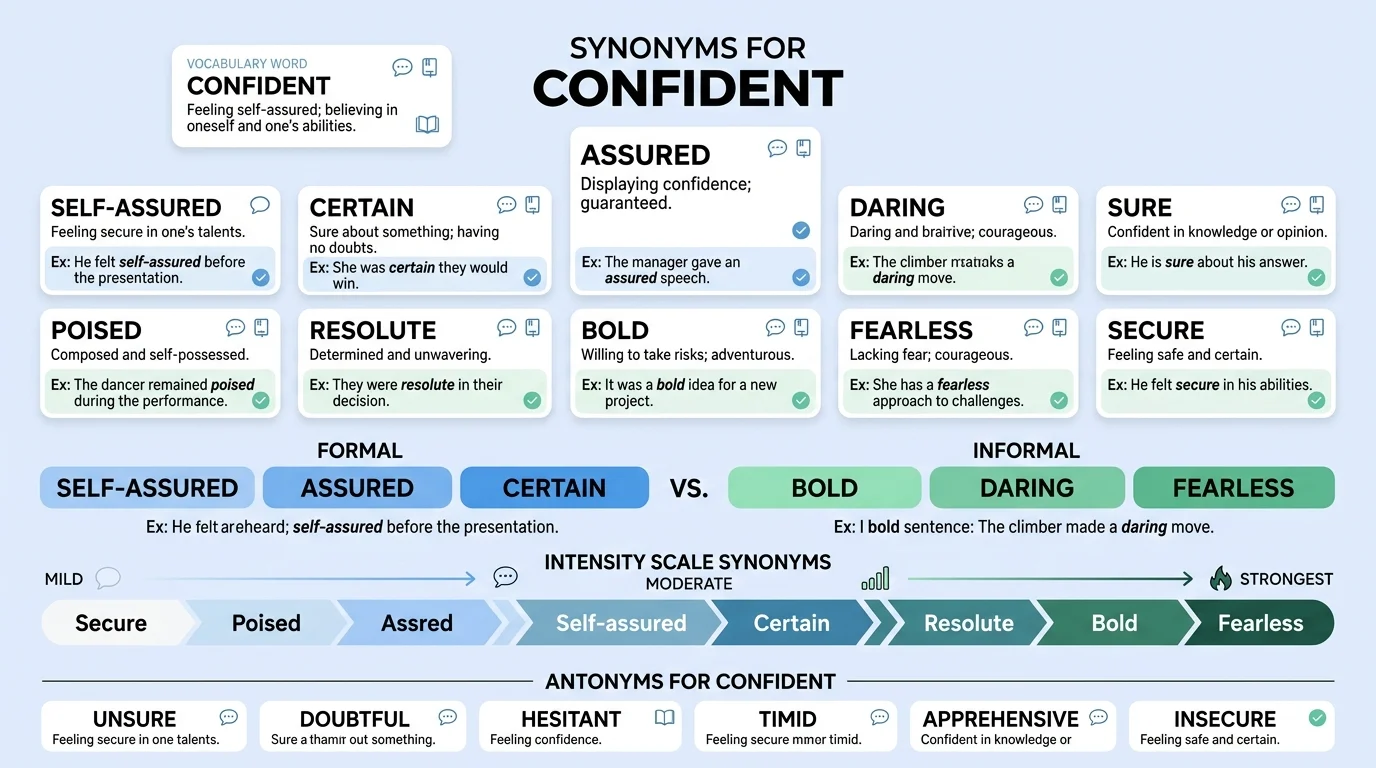
Do you find yourself using the word “confident” over and over again in your emails, essays, or conversations? It happens to everyone. You write a professional message and realize you have used “confident” three times in two paragraphs. Your speech feels repetitive.
Your writing lacks variety. This guide solves that problem. You will learn exactly which synonym to use in every situation. Whether you are writing a resume, preparing a presentation, or simply trying to sound more natural in English, the right word choice makes a significant difference. Let us explore the full spectrum of words that express confidence.
Quick Answer: What Does “Confident” Mean?
Confident means feeling or showing certainty about your abilities, qualities, or judgment. The best synonyms depend on your context. For formal writing, use “assured” or “self assured.” For casual conversation, try “sure” or “positive.” In professional settings, “poised” and “decisive” work well. For creative writing, “unwavering” and “resolute” add depth. Each synonym carries a slightly different shade of meaning.
Meaning, Tone and Context
- Simple definition: Confident describes a state of being certain about your own abilities or about a particular outcome.
- Part of speech: This is primarily an adjective. The noun form is “confidence.” The adverb form is “confidently.”
- Positive, negative, or neutral tone: This word has a positive tone overall. It suggests strength, capability, and self belief.
- Formality level: It sits comfortably in the middle. You can use it in both formal and informal settings without sounding out of place.
- Common use cases: People use this word in professional emails, job interviews, personal conversations, academic writing, and self descriptions.
- Important word forms: The adjective “confident,” the noun “confidence,” the adverb “confidently,” and the opposite adjective “unconfident” all appear frequently.
When and How to Use “Confident”
Use confident when you want to express certainty about yourself, another person, or an outcome. This word works best when you have genuine reason to believe in success. Overusing it can make you sound arrogant, so reserve it for moments of real assurance.
Professional context
After months of preparation, I feel confident about leading this project to success.
Personal context
She felt confident enough to share her artwork with the world for the first time.
Academic context
The researcher remained confident that the data would support her hypothesis.
Emotional context
His supportive words made me feel more confident about my decision.
Creative context
The character walked into the room with a confident stride that commanded attention.
Social media context
Feeling confident and ready to take on new challenges this year.
Resume context
Confident communicator with experience presenting to executive level audiences.
Another Word for “Confident”
Here are the best single replacements for “confident” based on your specific context. Each synonym changes the tone and nuance of your message.
Professional writing
“Assured” works perfectly in professional contexts. It suggests quiet certainty without boastfulness.
Academic writing
“Convinced” shows intellectual certainty based on evidence and reasoning.
Casual conversation
“Sure” feels natural and relaxed in everyday speech with friends and family.
Emotional writing
“Self assured” carries emotional weight and suggests inner peace with oneself.
Creative writing
“Undaunted” adds literary flair and suggests confidence in the face of challenges.
Resume or workplace use
“Decisive” highlights action oriented confidence that employers value highly.
Social media captions
“Empowered” connects with modern audiences and suggests personal growth.
Stronger meaning
“Unshakeable” conveys absolute certainty that nothing can disturb.
Softer meaning
“Positive” offers a gentler expression of confidence without sounding too strong.
When Not to Use “Confident”
Do not use confident when you only have a guess or a hope. Using this word for uncertain situations makes you sound unrealistic or dishonest.
Vague usage
Weak: I am confident the meeting might go well.
Better: I am optimistic that the meeting will go well.
Too casual for formal reports
Weak: We are confident the data looks good.
Better: The data substantiates our position.
Overstated emotion
Weak: I am confident my cat is the best pet in the world.
Better: I believe my cat is the best pet in the world.
Generalization
Weak: Confident people always succeed.
Better: Self assured individuals often navigate challenges effectively.
Words Commonly Confused With “Confident”
Several words share similarities with “confident” but carry distinct meanings. Understanding these differences prevents embarrassing errors.
Confident vs. Arrogant
Confident means believing in your abilities realistically. Arrogant means having an exaggerated sense of your importance. Confident people inspire others. Arrogant people annoy others. Use confident for genuine self belief. Use arrogant for excessive pride.
Confident vs. Certain
Confident relates to belief in yourself or an outcome. Certain relates to absolute knowledge or fact. You can be confident about a sports team winning. You can be certain that water freezes at 32 degrees Fahrenheit. Confident allows for some doubt. Certain does not.
Confident vs. Secure
Confident focuses on your abilities in specific situations. Secure focuses on your overall emotional stability. A person can be confident in public speaking but insecure about relationships. Secure suggests deeper, longer lasting self acceptance.
Confident vs. Bold
Confident suggests inner belief. Bold suggests outward action. A confident person knows they can succeed. A bold person takes risks regardless of success. Bold emphasizes behavior while confident emphasizes mindset.
Confident vs. Brave
Confident focuses on belief in success. Brave focuses on facing fear. You can be brave without being confident about the outcome. Firefighters show bravery. They may or may not feel confident about every rescue.
Confident vs. Self Esteem
Confidence relates to specific abilities. Self esteem relates to overall self worth. You can have low self esteem but feel confident about cooking. You can have high self esteem but feel unconfident about public speaking.
Best Synonym by Context for “Confident”
| Context | Best Synonym | Why It Works | Example |
|---|---|---|---|
| Formal writing | Assured | Sounds professional and measured | The board presented an assured strategy for growth. |
| Academic writing | Convinced | Shows evidence based certainty | Researchers remain convinced of the correlation. |
| Professional business | Decisive | Emphasizes action and leadership | Her decisive leadership guided the team through uncertainty. |
| Resume writing | Poised | Suggests composure under pressure | Poised professional with crisis management experience. |
| Casual conversation | Sure | Feels natural and unpretentious | I am sure we can finish this by Friday. |
| Creative writing | Resolute | Adds literary depth and determination | He remained resolute despite the obstacles before him. |
| Emotional tone | Self assured | Suggests inner peace and acceptance | She seemed self assured in a way that inspired others. |
| Strong intensity | Unshakeable | Conveys absolute, unbreakable certainty | His unshakeable faith in the team motivated everyone. |
| Soft moderate tone | Positive | Offers gentle optimism without overstatement | I feel positive about our chances of success. |
| Social media captions | Empowered | Connects with modern, aspirational audiences | Empowered and ready for whatever comes next. |
| Job interview | Self possessed | Shows emotional control and maturity | He appeared self possessed throughout the difficult interview. |
| Public speaking | Composed | Suggests calm confidence in front of others | The speaker remained composed despite technical difficulties. |
Which Synonym Should You Choose?
Choosing the right synonym for confident depends on four key factors.
First, consider your audience. Formal writing demands words like “assured” or “convinced.” Casual conversations allow for “sure” or “positive.” Professional settings benefit from “decisive” or “composed.”
Second, examine your emotional intensity. Do you want to express mild optimism or absolute certainty? Use “positive” for lighter situations. Use “unshakeable” for maximum conviction.
Third, think about the subject. Are you describing yourself, another person, or an outcome? Self assured works for personal descriptions. Convinced works for beliefs about external events.
Fourth, evaluate your sentence structure. Some synonyms fit better in certain grammatical positions. “Composed” works well before a noun. “Self assured” appears more naturally after a linking verb.
Real Life Examples of “Confident” in Sentences
These examples show you how to use “confident” and its synonyms across various real world situations.
School context
Maria felt confident about her history exam after studying for three weeks straight.
Workplace context
The project manager appeared decisively confident when presenting the quarterly results.
Writing context
His confident prose style made complex topics accessible to general readers.
Conversation context
I am confident you will love this restaurant. Their pasta is exceptional.
Social media context
Starting this new chapter with a confident heart and an open mind.
Resume context
Confident negotiator with a track record of closing million dollar deals.
Email context
I feel confident that our team can deliver this project ahead of schedule.
Storytelling context
The young knight walked forward with a confident step that belied his nervous stomach.
25 Synonyms for “Confident”
| Synonym | Simple Meaning | Best Used For | Example Sentence |
|---|---|---|---|
| Assured | Certain and calm | Professional writing | Her assured response calmed everyone in the room. |
| Self assured | Confident in yourself | Personal descriptions | He carried himself with a self assured grace. |
| Decisive | Able to make decisions quickly | Leadership contexts | The decisive manager resolved the conflict immediately. |
| Positive | Having a favorable certainty | Casual and moderate use | I am positive we will win this game. |
| Convinced | Fully persuaded or sure | Academic and belief contexts | She remained convinced of her theory’s validity. |
| Poised | Gracefully composed | Professional settings | The poised executive handled the press conference beautifully. |
| Resolute | Firmly determined | Creative and serious writing | His resolute refusal to give up inspired his teammates. |
| Composed | Calm and controlled | Public speaking | The composed teacher managed the chaotic classroom effectively. |
| Unshakeable | Impossible to disturb | Strong conviction | Her unshakeable belief in justice motivated her career. |
| Empowered | Given confidence and power | Social media and modern contexts | The workshop made participants feel empowered and capable. |
| Self possessed | In control of emotions | Formal descriptions | He remained self possessed during the entire negotiation. |
| Undaunted | Not discouraged | Creative writing | The undaunted explorer continued through the storm. |
| Fearless | Without fear | Strong emotional contexts | Her fearless approach to life inspired many people. |
| Courageous | Brave in facing difficulty | Moral and ethical contexts | The courageous whistleblower spoke truth to power. |
| Sure | Certain without doubt | Everyday conversation | I am sure this plan will work perfectly. |
| Optimistic | Hopeful and confident | Forward looking situations | She felt optimistic about the company’s future. |
| Bold | Willing to take risks | Action oriented contexts | His bold strategy transformed the struggling business. |
| Spirited | Full of energy and confidence | Lively descriptions | The spirited debate enlivened the entire conference. |
| Daring | Bold and adventurous | Creative and exciting contexts | The daring entrepreneur launched three companies before age thirty. |
| Intrepid | Fearlessly adventurous | Literary and dramatic writing | The intrepid journalist reported from war zones. |
| Dauntless | Unable to be intimidated | Inspirational contexts | Her dauntless spirit carried her through every challenge. |
| Valiant | Possessing courage | Heroic and narrative contexts | The valiant soldier received a medal for bravery. |
| Plucky | Having determined courage | Informal and endearing contexts | The plucky underdog surprised everyone with her victory. |
| Audacious | Recklessly bold | Strong, dramatic contexts | His audacious plan shocked even his closest allies. |
| Trusting | Believing in reliability | Relationship and faith contexts | She felt trusting of her partner’s judgment. |
Synonym Groups and Usage Differences
Professional vs. Personal Synonyms
Professional synonyms include “assured,” “decisive,” and “composed.” These words suggest competence and control in work settings. Personal synonyms include “self assured,” “positive,” and “sure.” These words feel warmer and more intimate. Use professional synonyms in emails and presentations. Use personal synonyms with friends and family.
Formal vs. Conversational Synonyms
Formal synonyms like “convinced,” “resolute,” and “self possessed” belong in academic papers and official documents. Conversational synonyms such as “sure,” “positive,” and “bold” fit everyday speech. Avoid overly formal words in casual texts. Avoid casual words in research papers.
Academic Synonyms
“Convinced” appears frequently in scholarly writing. It suggests conclusions drawn from evidence. “Assured” works in theoretical discussions. “Resolute” appears in philosophical and political writing. These words carry intellectual weight. They signal careful reasoning rather than emotional reaction.
Professional and Business Synonyms
“Decisive” stands out as the top business synonym. It connects confidence to action and results. “Poised” suggests grace under pressure. “Composed” signals emotional intelligence. These words appear in performance reviews, job descriptions, and leadership assessments. They emphasize competence and reliability.
Creative or Literary Synonyms
“Undaunted” adds dramatic flair to narratives. “Resolute” creates a sense of unwavering purpose. “Intrepid” conjures images of adventure and exploration. “Valiant” evokes heroism and nobility. These words enrich storytelling and descriptive writing. They paint vivid pictures for readers.
Strongest vs. Weaker Synonyms
Mild synonyms include “positive,” “sure,” and “optimistic.” These express confidence without intensity. Moderate synonyms include “assured,” “self assured,” and “composed.” These suggest steady, reliable confidence. Strong synonyms include “unshakeable,” “resolute,” and “undaunted.” These convey absolute, unbreakable certainty. Use mild words for casual situations. Use strong words for dramatic moments.
Emotional vs. Neutral Synonyms
Emotional synonyms include “empowered,” “courageous,” and “spirited.” These words carry feelings of inspiration and motivation. Neutral synonyms include “convinced,” “certain,” and “decisive.” These focus on facts and logic rather than feelings. Choose based on your audience and purpose. Academic writing prefers neutral options. Personal writing benefits from emotional choices.
Antonyms of “Confident”
| Antonym | Meaning | Example Sentence |
|---|---|---|
| Uncertain | Lacking definite knowledge | She felt uncertain about her career direction. |
| Insecure | Lacking confidence in yourself | His insecure behavior made colleagues uncomfortable. |
| Doubtful | Feeling uncertainty | I remain doubtful about the project’s success. |
| Hesitant | Pausing due to uncertainty | The hesitant speaker stumbled over her words. |
| Timid | Lacking courage or confidence | His timid approach held back the team’s progress. |
| Diffident | Modest or shy from lack of confidence | The diffident student rarely participated in class. |
| Apprehensive | Anxious about the future | She felt apprehensive about the job interview. |
| Nervous | Easily agitated or worried | The nervous performer forgot his lines. |
| Unassured | Without confidence or certainty | His unassured tone undermined the presentation. |
| Self doubting | Lacking belief in yourself | The self doubting writer struggled to finish her novel. |
| Wavering | Showing indecision | His wavering commitment frustrated the team. |
| Tentative | Not certain or fixed | She made a tentative suggestion during the meeting. |
| Shy | Nervous in social situations | The shy new employee avoided eye contact. |
| Bashful | Easily embarrassed | His bashful smile revealed his discomfort. |
| Meek | Too submissive | The meek response failed to convince anyone. |
Comparison: Confident vs. Similar Words
Confident vs. Arrogant
Confidence stems from genuine ability. Arrogance stems from exaggerated self importance. A confident person listens to others. An arrogant person dismisses others. Confident people inspire trust. Arrogant people create resentment.
Confident example: She confidently presented her ideas and welcomed feedback.
Arrogant example: He arrogantly dismissed everyone else’s contributions.
Confident vs. Certain
Confidence relates to belief and self assurance. Certainty relates to absolute knowledge. You can be confident in your team’s ability without being certain they will win. Certainty leaves no room for doubt. Confidence accepts the possibility of being wrong.
Confident example: I am confident our proposal will be well received.
Certain example: I am certain that water boils at 212 degrees Fahrenheit.
Confident vs. Secure
Confident focuses on specific abilities. Secure focuses on overall emotional foundation. A confident speaker may still have relationship insecurities. A secure person maintains stability across life areas. Security is broader and deeper than confidence.
Confident example: He felt confident about his technical skills.
Secure example: She felt secure in her position at the company.
Confident vs. Bold
Confidence is internal. Boldness is external. A confident person believes in success. A bold person acts despite risk. Boldness often accompanies confidence, but the two can exist separately. You can be bold without feeling confident.
Confident example: She was confident her plan would work.
Bold example: He boldly launched the product without market testing.
Confident vs. Brave
Confidence involves belief in success. Bravery involves facing fear. A brave person acts even when expecting failure. A confident person acts expecting success. Bravery requires more emotional strength.
Confident example: She felt confident about her performance.
Brave example: He was brave to speak up despite his fear.
Confident vs. Optimistic
Confidence focuses on present ability. Optimism focuses on future outcomes. You can be confident about current skills and pessimistic about future results. Both words share positive energy but apply to different time frames.
Confident example: I am confident in my presentation skills.
Optimistic example: I am optimistic about the company’s future growth.
Common Phrases and Expressions with “Confident”
1. Confident in your abilities
Meaning: Trusting your own skills and judgment.
Example: After years of practice, she felt confident in her abilities as a surgeon.
2. Confident about the outcome
Meaning: Believing a specific result will happen.
Example: The coach felt confident about the outcome of the championship game.
3. Confident stride
Meaning: Walking in a way that shows self assurance.
Example: He entered the room with a confident stride that commanded attention.
4. Confident smile
Meaning: A smile that expresses self belief and ease.
Example: Her confident smile put nervous clients at ease.
5. Confident prediction
Meaning: A forecast made with certainty.
Example: The analyst made a confident prediction about market trends.
6. Confident tone
Meaning: A way of speaking that conveys certainty.
Example: His confident tone convinced the board to approve the budget.
7. Confident decision
Meaning: A choice made without hesitation.
Example: The CEO made a confident decision to expand into European markets.
8. Confident expectation
Meaning: The strong belief that something will happen.
Example: The team had a confident expectation of winning the contract.
Common Mistakes to Avoid
1. Using confident when you mean arrogant
Confidence is attractive. Arrogance is off putting. Saying “I am confident I am better than everyone” sounds arrogant. Saying “I am confident in my skills” sounds professional. Check your phrasing to avoid sounding boastful.
2. Confusing confident with certain
You can be confident without absolute certainty. Use certain only for facts that cannot be questioned. Use confident for beliefs that allow some margin of error. This distinction matters in academic and professional writing.
3. Using a casual synonym in formal writing
“S sure” and “positive” feel too casual for business reports. Use “assured” and “convinced” for professional documents. The wrong synonym can undermine your credibility.
4. Using an overly dramatic synonym for simple situations
Saying “I am unshakeably confident about my coffee order” sounds ridiculous. Save strong words like “unshakeable” and “undaunted” for serious matters. Mild situations need mild synonyms.
5. Repeating the same word too often
Using “confident” five times in one paragraph feels repetitive. Vary your word choice. Use “assured” once, “positive” once, and “decisive” once. Variety keeps readers engaged.
6. Choosing a synonym with the wrong emotional tone
“Bold” sounds aggressive. “Self assured” sounds calm. Match the emotional tone to your message. A customer service email needs warm confidence. A competitor analysis needs cool confidence. Read your sentence aloud to test the feeling.
7. Using slang in academic or professional writing
Words like “amped” or “geared up” do not belong in serious writing. Save casual expressions for social media. Use established synonyms for formal contexts.
FAQs
What is the best synonym for confident?
“Assured” is the most versatile synonym for confident. It works in formal and professional contexts while maintaining clarity. For casual settings, “sure” serves as an excellent alternative.
What is a formal synonym for confident?
“Assured” and “convinced” are excellent formal synonyms. “Self possessed” also works in very formal writing. These words appear frequently in academic papers and professional reports.
What is an informal synonym for confident?
Sure” and “positive” are the most common informal synonyms. “Bold” also works in casual conversation. These words fit everyday speech and friendly writing.
What is another word for confident in professional writing?
“Decisive” and “poised” are professional favorites. “Assured” and “composed” also perform well in workplace settings. These words suggest leadership and emotional control.
What is the difference between confident and arrogant?
Confidence comes from genuine ability. Arrogance comes from exaggerated self importance. Confident people welcome feedback. Arrogant people reject criticism. Confidence inspires. Arrogance repels.
What is the opposite of confident?
“Uncertain” is the direct opposite of confident. “Insecure” and “doubtful” also serve as antonyms. “Timid” and “hesitant” describe lack of confidence in specific situations.
Conclusion
The word “confident” serves as a versatile foundation for expressing certainty and self belief. However, relying on a single word limits your expression. Professional communication requires precision. Academic writing demands exactitude. Creative work benefits from variety. The synonyms in this guide equip you to match your language to every situation. Remember to consider your audience, your emotional intensity, and your purpose before choosing a word. Practice using “assured” in formal emails. Try “sure” in casual conversations. Experiment with “resolute” in creative projects. Your vocabulary will expand. Writing will improve. Your confidence in choosing the right word will grow with each use.