You are writing an important email to your boss. Want to praise a team member’s performance. You type “great job.” Delete it. You type “awesome job.” It still feels too casual and vague. You stare at the screen. You know there is a better word, but you cannot find it.
This happens to everyone. Students, professionals, and writers often overuse the word “awesome.” It becomes a verbal crutch. You rely on it for everything from describing a sunset to praising a coworker. The word loses its impact. Your writing and speaking suffer as a result.
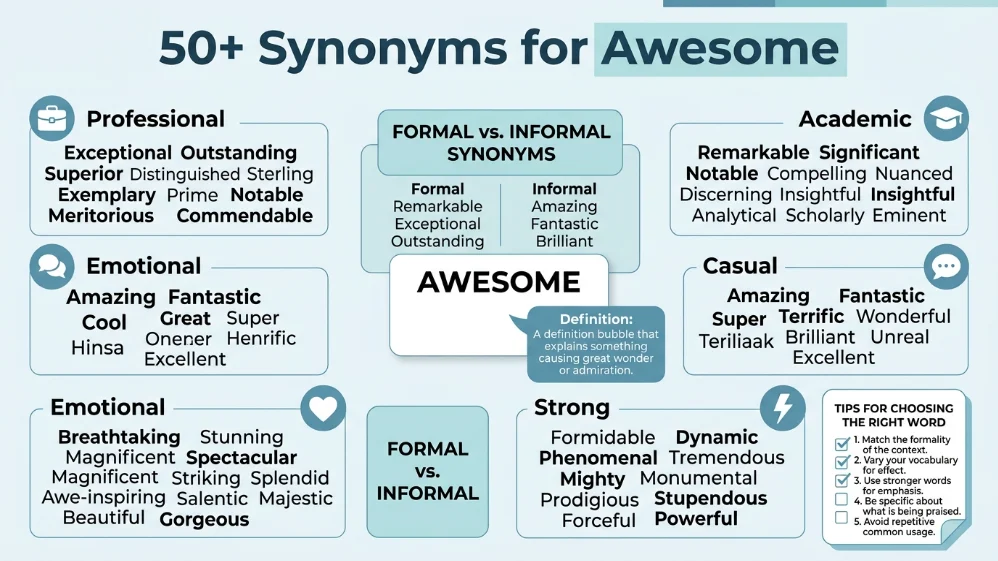
This guide solves that problem. You will learn over 50 synonyms for awesome. Understand the exact meaning of each one. You will know when to use them in professional, academic, and casual settings. Your vocabulary will expand. Your communication will become more precise and powerful.
What Does “Awesome” Mean?
Awesome means something that inspires awe, admiration, or wonder. It can describe something extremely good or impressive. The best synonyms depend on your context. Formal writing, use “impressive” or “remarkable.”
For casual conversation, use “amazing” or “fantastic.” Emotional impact, use “breathtaking” or “stunning.” For professional settings, use “exceptional” or “outstanding.”
Meaning, Tone and Context
1. Simple Definition
Awesome describes something that causes feelings of great admiration, respect, or even fear. It can also mean extremely pleasant, enjoyable, or likable.
2. Part of Speech
Awesome is primarily an adjective. It can also function as an interjection in informal speech, like saying “Awesome!” in response to good news.
3. Positive, Negative, or Neutral Tone
Awesome has a positive tone. However, in its original sense of “inspiring awe,” it can carry a neutral or even slightly intimidating tone. For example, “an awesome responsibility” feels serious and weighty, not purely cheerful.
4. Formality Level
Awesome is informal in most modern usage. Its original meaning, “inspiring awe,” is more formal. You can use it formally when describing power, beauty, or responsibility. You should avoid the casual “extremely good” meaning in academic papers or official reports.
5. Common Use Cases
You will hear awesome in everyday conversation, social media captions, and casual emails. People use it to describe experiences, people, performances, and objects. It is one of the most common positive adjectives in American English.
6. Important Word Forms
The noun form is “awesomeness.” The adverb form is “awesomely.” Both are informal. Use them sparingly in professional writing.
When and How to Use “Awesome”
Use “awesome” when you want to express genuine enthusiasm in a casual setting. It works well in spoken English and informal writing. Avoid it in formal documents, academic essays, or professional reports where precision matters.
1. Professional Context (Informal Email)
“The client was impressed with your presentation. You did an awesome job explaining the data.”
2. Personal Context
“We had an awesome time at the beach yesterday. The weather was perfect.”
3. Academic Context (Informal Discussion)
“The professor’s lecture on quantum physics was awesome. I finally understand the concept.”
4. Emotional Context
“Seeing my daughter take her first steps was an awesome moment. I will never forget it.”
5. Creative Context
“The artist created an awesome mural that covers the entire side of the building.”
6. Social Media Context
“Just finished my first marathon. Feeling awesome right now! #runner”
7. Resume Context (Use with Caution)
“Developed an awesome marketing campaign that increased sales by 30 percent.” (Better: “Developed an exceptional marketing campaign…”)
Another Word for “Awesome”
The best single replacement depends entirely on your context and meaning. Here are the top alternatives for different situations.
1. Professional Writing: Exceptional
“Exceptional” communicates high quality without being too casual. It is perfect for performance reviews and business communications.
2. Academic Writing: Remarkable
“Remarkable” suggests something worthy of notice. It is precise and maintains a formal tone suitable for essays and research papers.
3. Casual Conversation: Amazing
“Amazing” is the most natural replacement in everyday speech. It carries the same enthusiasm as awesome but feels slightly more neutral.
4. Emotional Writing: Breathtaking
“Breathtaking” conveys deep emotional impact. Use it for describing beautiful scenes, powerful performances, or moving experiences.
5. Creative Writing: Stunning
“Stunning” adds visual and sensory appeal. It works well in descriptive writing, poetry, and storytelling.
6. Resume or Workplace: Outstanding
“Outstanding” signals top-tier performance. It is a strong, professional synonym that recruiters and managers respect.
7. Social Media Captions: Incredible
“Incredible” feels modern and energetic. It performs well in short, punchy social media content.
8. Stronger Meaning: Formidable
“Formidable” suggests something that inspires fear or respect through strength. It is much stronger than awesome.
9. Softer Meaning: Pleasant
“Pleasant” is a mild, neutral alternative. Use it when you want to express approval without strong emotion.
When Not to Use “Awesome”
Avoid “awesome” in formal academic writing. Professors and researchers expect precise, objective language. “Awesome” sounds too emotional and subjective.
Do not use “awesome” in official business reports. It undermines your professionalism. Your stakeholders want data and analysis, not casual enthusiasm.
Avoid “awesome” when describing negative or serious situations. The word has a positive connotation. Using it inappropriately can seem insensitive or tone-deaf.
Example of a Weak Sentence:
“The quarterly results were awesome.”
Improved with a More Precise Synonym:
“The quarterly results exceeded our projections by 15 percent.” (Factual and professional)
Another Improved Version:
“The quarterly results were impressive and demonstrated strong growth.” (Professional and descriptive)
Words Commonly Confused With “Awesome”
Awesome vs. Amazing
“Amazing” means causing great surprise or wonder. It is slightly more neutral than awesome. “Awesome” often implies “cool” or “excellent” in addition to impressiveness.
Awesome vs. Incredible
Incredible” means difficult to believe. It suggests something so extraordinary that it seems unreal. “Awesome” does not carry this element of disbelief.
Awesome vs. Fantastic
“Fantastic” means extraordinarily good. It is more imaginative and whimsical than awesome. Use it for creative or playful contexts.
Awesome vs. Wonderful
“Wonderful” means inspiring delight or admiration. It has a warmer, more emotional tone than awesome. It sounds gentler and more heartfelt.
Awesome vs. Awe-Inspiring
“Awe-inspiring” is the formal version of awesome’s original meaning. It describes something that fills you with awe and reverence. It is much more serious and grand.
Awesome vs. Impressive
“Impressive” means evoking admiration through size, quality, or skill. It is more objective and less emotional than awesome. It is the safest choice for professional contexts.
Best Synonym by Context for “Awesome”
| Context | Best Synonym | Why It Works | Example |
|---|---|---|---|
| Formal Writing | Remarkable | Maintains professionalism while expressing high quality | The study produced remarkable results. |
| Academic Writing | Significant | Conveys importance without emotional language | The findings have significant implications. |
| Professional or Business | Exceptional | Signals top performance in a corporate setting | She demonstrated exceptional leadership skills. |
| Resume or Workplace | Outstanding | Highlights achievement in a way recruiters value | Achieved outstanding sales growth in Q3. |
| Casual Conversation | Amazing | Natural, friendly, and widely understood | That movie was amazing! |
| Creative Writing | Stunning | Adds vivid imagery and sensory appeal | The sunset painted a stunning canvas across the sky. |
| Emotional Tone | Breathtaking | Captures deep feelings and powerful moments | The view from the mountaintop was breathtaking. |
| Strong Intensity | Formidable | Suggests power and strength that commands respect | The team faced a formidable challenge. |
| Soft or Moderate Tone | Pleasant | Expresses approval without excessive enthusiasm | We had a pleasant evening together. |
| Social Media Captions | Incredible | Energetic and shareable for digital content | Just had an incredible workout! 💪 |
| US Usage | Awesome | The standard American English choice for casual praise | That’s awesome, dude! |
| UK Usage | Brilliant | Commonly used in British English for the same context | That’s brilliant news! |
Which Synonym Should You Choose?
Start by identifying your audience. Are you writing for a professor, a boss, a friend, or a social media follower? Your choice of synonym should match their expectations.
Consider your formality level. Formal writing demands words like “remarkable” and “exceptional.” Casual writing allows for “amazing” and “fantastic.” Never mix the two inappropriately.
Think about emotional intensity. Do you want to express mild approval or overwhelming admiration? Choose “pleasant” for mild situations. Choose “breathtaking” for powerful emotions.
Evaluate your sentence context. A business report needs objective language. A personal story benefits from emotional words. Match your synonym to the purpose of your writing.
Avoid overused synonyms. Words like “amazing” and “incredible” are also common. Sometimes the best choice is a less frequent word like “phenomenal” or “extraordinary.
Real Life Examples of “Awesome” in Sentences
School Context
“The science fair projects were remarkable this year. Every student demonstrated creativity and hard work.”
Workplace Context
“Our team delivered exceptional results on the merger. The client was extremely satisfied with our work.”
Writing Context
“The author’s prose is stunning. Each sentence flows beautifully into the next.”
Conversation Context
“We went to that new restaurant downtown. The food was incredible, and the service was fantastic.”
Social Media Context
“Just booked my dream vacation. Feeling absolutely phenomenal right now! ✈️”
Resume Context
“Implemented a new inventory system that reduced costs by 20 percent. This achievement was recognized by senior management.”
Email Context
“Thank you for your outstanding contribution to the project. Your expertise made a significant difference.”
Storytelling Context
“The old castle stood on the cliff. Its towering walls were formidable against the crashing waves. It was a breathtaking sight.”
25 Synonyms for “Awesome”
| Synonym | Simple Meaning | Best Used For | Example Sentence |
|---|---|---|---|
| Amazing | Causing great surprise or wonder | General use, everyday conversation | The magician’s tricks were amazing to watch. |
| Incredible | Difficult to believe; extraordinary | Emphasizing disbelief or awe | She has an incredible memory for details. |
| Fantastic | Imaginative or extraordinarily good | Creative or playful contexts | We had a fantastic time at the amusement park. |
| Stunning | Extremely impressive or attractive | Visual or sensory descriptions | The bride looked stunning in her wedding dress. |
| Breathtaking | So beautiful or remarkable it takes your breath away | Emotional or awe-inspiring moments | The Grand Canyon is absolutely breathtaking. |
| Remarkable | Worthy of attention; unusual | Formal writing, academic contexts | The discovery was a remarkable achievement. |
| Exceptional | Unusually good; outstanding | Professional and business writing | She is an exceptional candidate for the position. |
| Outstanding | Exceptionally good; prominent | Resumes, performance reviews | He made an outstanding contribution to the team. |
| Impressive | Evoking admiration through size or skill | Objective descriptions, professional use | The presentation was impressive and well-organized. |
| Formidable | Inspiring fear or respect through strength | Strong intensity, serious situations | The company faced a formidable competitor. |
| Phenomenal | Remarkable or exceptional; extraordinary | Emphasizing extreme quality | The singer gave a phenomenal performance. |
| Spectacular | Beautiful in a dramatic and eye-catching way | Visual events, grand experiences | The fireworks display was spectacular. |
| Magnificent | Impressively beautiful, elaborate, or grand | Grandeur, formal praise | The palace was a magnificent work of architecture. |
| Awe-Inspiring | Causing feelings of awe and reverence | Formal, serious, or spiritual contexts | The cathedral’s architecture is awe-inspiring. |
| Extraordinary | Very unusual or remarkable | Emphasizing uniqueness | She has an extraordinary talent for music. |
| Marvelous | Causing great wonder; extraordinary | Slightly old-fashioned but warm praise | We had a marvelous vacation in Italy. |
| Superb | Excellent; of the highest quality | Formal or semi-formal praise | The food at that restaurant is superb. |
| Terrific | Extremely good; excellent | Casual, enthusiastic praise | You look terrific in that outfit. |
| Fabulous | Extraordinary; almost unbelievable | Playful, enthusiastic contexts | She threw a fabulous party last weekend. |
| Splendid | Magnificent; very impressive | Formal or old-fashioned praise | The team did a splendid job on the project. |
| Majestic | Having or showing impressive beauty | Describing nature, buildings, or leaders | The mountains looked majestic in the morning light. |
| Prodigious | Remarkably or impressively great in size or degree | Formal, emphasizing scale | The project required a prodigious amount of effort. |
| Sensational | Causing great public interest or excitement | Media, entertainment, dramatic events | The news caused a sensational reaction. |
| Grand | Magnificent and imposing in appearance | Describing scale, events, or plans | They have grand ambitions for the company. |
| Exquisite | Extremely beautiful and delicate | Describing art, craftsmanship, or details | The jewelry was exquisite and finely crafted. |
Synonym Groups and Usage Differences
Professional vs. Personal Synonyms
Professional synonyms focus on competence and results. Words like “exceptional,” “outstanding,” and “impressive” highlight performance. Personal synonyms emphasize feelings and experiences. Words like “amazing,” “fantastic,” and “wonderful” express emotional reactions. Choose professional words for work. Choose personal words for friends and family.
Formal vs. Conversational Synonyms
Formal synonyms belong in reports, essays, and speeches. Use “remarkable,” “extraordinary,” and “awe-inspiring.” These words carry weight and authority. Conversational synonyms work in texts, casual emails, and everyday talk. Use “awesome,” “great,” and “terrific.” These words feel natural and friendly.
Academic Synonyms
Academic writing demands precision and objectivity. “Significant” indicates importance without emotion. “Notable” suggests something worth mentioning. “Substantial” describes size or degree. These words help you sound credible and scholarly. Avoid “awesome” and its casual alternatives in research papers.
Professional and Business Synonyms
Business communication values clarity and professionalism. “Exceptional” signals high quality. “Outstanding” highlights achievement. “Impressive” acknowledges skill. Use these words in emails, presentations, and performance reviews. They make you sound competent and serious.
Creative or Literary Synonyms
Creative writing benefits from vivid, descriptive language. “Stunning” creates visual impact. “Breathtaking” evokes strong emotion. “Majestic” suggests grandeur. These words add depth and imagery to your writing. They help readers see and feel what you describe.
Slang or Modern Synonyms
Modern slang evolves quickly. Words like “lit,” “fire,” and “dope” are popular among younger speakers. Use them only in very casual contexts with appropriate audiences. Avoid them in professional or academic writing. They can make you sound out of touch or unprofessional.
Strongest vs. Weaker Synonyms
Intensity scale from mildest to strongest:
- Pleasant (mild approval)
- Nice (basic approval)
- Good (standard positive)
- Great (enthusiastic)
- Excellent (strong approval)
- Outstanding (very strong)
- Phenomenal (extremely strong)
- Breathtaking (overwhelming)
- Formidable (powerful and intense)
Emotional vs. Neutral Synonyms
Emotional synonyms add feeling and warmth. “Wonderful” conveys happiness. “Breathtaking” conveys awe. “Magnificent” conveys admiration. Neutral synonyms stay factual. “Impressive” states a fact. “Significant” states importance. “Notable” states recognition. Choose based on whether you want to inform or move your reader.
Antonyms of “Awesome”
| Antonym | Meaning | Example Sentence |
|---|---|---|
| Ordinary | Not special or different | The meal was ordinary, nothing to write home about. |
| Unimpressive | Not evoking admiration | His performance was unimpressive and forgettable. |
| Mediocre | Of only moderate quality | The movie received mediocre reviews from critics. |
| Poor | Below standard in quality | The service at that restaurant is poor. |
| Weak | Lacking power or strength | The argument was weak and unconvincing. |
| Bad | Of poor quality | The weather was bad all weekend. |
| Disgusting | Extremely unpleasant | The smell in the room was disgusting. |
| Terrible | Extremely bad or serious | The team had a terrible season this year. |
| Awful | Very bad or unpleasant | I had an awful day at work. |
| Boring | Not interesting or exciting | The lecture was boring and put me to sleep. |
| Unremarkable | Not worthy of notice | The building was unremarkable and easy to miss. |
| Insignificant | Too small or unimportant to be worth considering | The changes were insignificant and made no difference. |
| Minor | Lesser in importance or seriousness | It was only a minor issue, easily fixed. |
| Forgettable | Not worth remembering | The song was forgettable and quickly faded from memory. |
| Dull | Lacking interest or excitement | The party was dull, and we left early. |
Comparison: Awesome vs. Similar Words
Awesome vs. Amazing
“Amazing” means causing great surprise or wonder. Awesome” can mean the same but also implies “cool” or “excellent.” “Amazing” is slightly more neutral and less slangy.
Which is stronger: Both are similar in intensity.
Which is more formal: Amazing is slightly more formal.
Example with Awesome: “That concert was awesome!”
Example with Amazing: “That concert was amazing!”
Awesome vs. Incredible
“Incredible” means difficult to believe. It suggests something so extraordinary that it seems unreal. “Awesome” does not carry this element of disbelief.
Which is stronger: Incredible is slightly stronger.
Which is more formal: Incredible is more formal.
Example with Awesome: “She is an awesome singer.”
Example with Incredible: “She has an incredible voice.”
Awesome vs. Fantastic
“Fantastic” means extraordinarily good. It has a more imaginative and whimsical feel. “Awesome” is more grounded in admiration and respect.
Which is stronger: Both are similarly strong.
Which is more formal: Fantastic is slightly more formal.
Example with Awesome: “We had an awesome vacation.”
Example with Fantastic: “We had a fantastic vacation.”
Awesome vs. Wonderful
“Wonderful” means inspiring delight or admiration. It has a warmer, more emotional tone. “Awesome” can feel more casual and cooler in comparison.
Which is stronger: Wonderful feels more heartfelt.
Which is more formal: Wonderful is more formal.
Example with Awesome: “The news is awesome!”
Example with Wonderful: “The news is wonderful!”
Awesome vs. Awe-Inspiring
“Awe-inspiring” is the formal, literal version of awesome’s original meaning. It describes something that fills you with awe and reverence.
Which is stronger: Awe-inspiring is much stronger and more serious.
Which is more formal: Awe-inspiring is highly formal.
Example with Awesome: “The view is awesome.”
Example with Awe-Inspiring: “The view is awe-inspiring.”
Awesome vs. Impressive
“Impressive” means evoking admiration through size, quality, or skill. It is more objective and less emotional than awesome. It is the safest choice for professional contexts.
Which is stronger: Impressive feels more measured and factual.
Which is more formal: Impressive is more formal.
Example with Awesome: “His presentation was awesome.”
Example with Impressive: “His presentation was impressive.”
Common Phrases and Expressions with “Awesome”
1. “Awesome sauce”
Meaning: A playful, informal way to say something is excellent. Popular in casual American speech.
Example sentence: “You got us tickets to the game? Awesome sauce!”
2. “Totally awesome”
Meaning: An emphatic way to express strong approval. Common in casual conversation.
Example sentence: “The new superhero movie is totally awesome.”
3. “Awesome job”
Meaning: Praise for someone’s work or performance. Used in professional and casual contexts.
Example sentence: “You did an awesome job on that report.”
4. “Awesome power”
Meaning: The ability to cause great effect, often in a serious or intimidating context.
Example sentence: “The hurricane demonstrated the awesome power of nature.”
5. “Awesome responsibility”
Meaning: A duty that is serious and carries significant consequences.
Example sentence: “As a doctor, she has an awesome responsibility to her patients.”
6. “Awesome sight”
Meaning: A view or image that inspires wonder and admiration.
Example sentence: “The Great Wall of China is an awesome sight.”
7. “Awesome experience”
Meaning: An event or activity that was extremely enjoyable or memorable.
Example sentence: “Skydiving was an awesome experience that I will never forget.”
8. “Awesome news”
Meaning: Information that is very positive and welcome.
Example sentence: “You got the promotion? That’s awesome news!”
Common Mistakes to Avoid
1. Using “awesome” when a more precise synonym is better
“Awesome” is vague. It can mean anything from “good” to “extraordinary.” Choose a word that matches your exact meaning. Use “exceptional” for high quality. Use “breathtaking” for emotional impact.
2. Confusing “awesome” with “awe-inspiring”
These are not interchangeable. “Awesome” is casual praise. “Awe-inspiring” describes something that fills you with reverent wonder. Do not say a sandwich is awe-inspiring. Do not say a cathedral is awesome in casual conversation.
3. Using a casual synonym in formal writing
“Awesome,” “amazing,” and “fantastic” are too casual for academic papers and official reports. Choose “remarkable,” “significant,” or “notable” instead. Your credibility depends on word choice.
4. Using an overly dramatic synonym for a simple situation
Do not call a routine meeting “breathtaking.” Do not call a simple meal “magnificent.” Exaggeration weakens your writing. Save powerful words for truly powerful experiences.
5. Repeating the same word too often
Variety is essential in good writing. If you use “amazing” three times in one paragraph, your writing becomes monotonous. Use the synonym tables in this guide to find fresh alternatives.
6. Choosing a synonym with the wrong emotional tone
“Formidable” carries weight and seriousness. Do not use it for a fun experience. “Wonderful” is warm and gentle. Do not use it for a business report. Match the emotional tone to your subject and audience.
7. Using slang in academic or professional writing
Slang like “lit,” “fire,” and “dope” have no place in formal communication. They undermine your professionalism. Save them for social media and casual conversations with friends.
FAQs
1. What is the best synonym for awesome?
The best synonym depends on context. Use “exceptional” for professional writing, “amazing” for casual conversation, and “breathtaking” for emotional impact.
2. What is a formal synonym for awesome?
“Remarkable,” “extraordinary,” and “awe-inspiring” are formal synonyms for awesome. They maintain professionalism while expressing admiration.
3. What is an informal synonym for awesome?
“Amazing,” “fantastic,” and “terrific” are informal synonyms for awesome. They work well in everyday conversation and casual writing.
4. What is another word for awesome in professional writing?
“Exceptional,” “outstanding,” and “impressive” are excellent choices for professional writing. They communicate high quality without being too casual.
5. What is the difference between awesome and amazing?
“Awesome” often implies “cool” or “excellent” in addition to impressiveness. “Amazing” is slightly more neutral and focuses on causing surprise or wonder.
6. What is the opposite of awesome?
The opposite of awesome includes “ordinary,” “unimpressive,” “mediocre,” and “poor.” These words describe things that are not special or admirable.
Conclusion
“Awesome” is a versatile word with two distinct meanings. It can describe something that inspires awe, or it can simply mean extremely good. The best synonyms for awesome depend entirely on your context, audience, and intended tone.
Professional settings call for words like “exceptional” and “outstanding.” Academic writing benefits from “remarkable” and “significant.” Casual conversation welcomes “amazing” and “fantastic.” Emotional moments deserve “breathtaking” and “stunning.”
The key to effective vocabulary is precision. Choose words that match your exact meaning. Avoid overused and vague terms. Match your tone to your audience. Your communication will become clearer, more powerful, and more memorable.
Start using these synonyms today. Replace one “awesome” with a more precise word. Notice how your writing improves. Your readers will appreciate the clarity and professionalism.