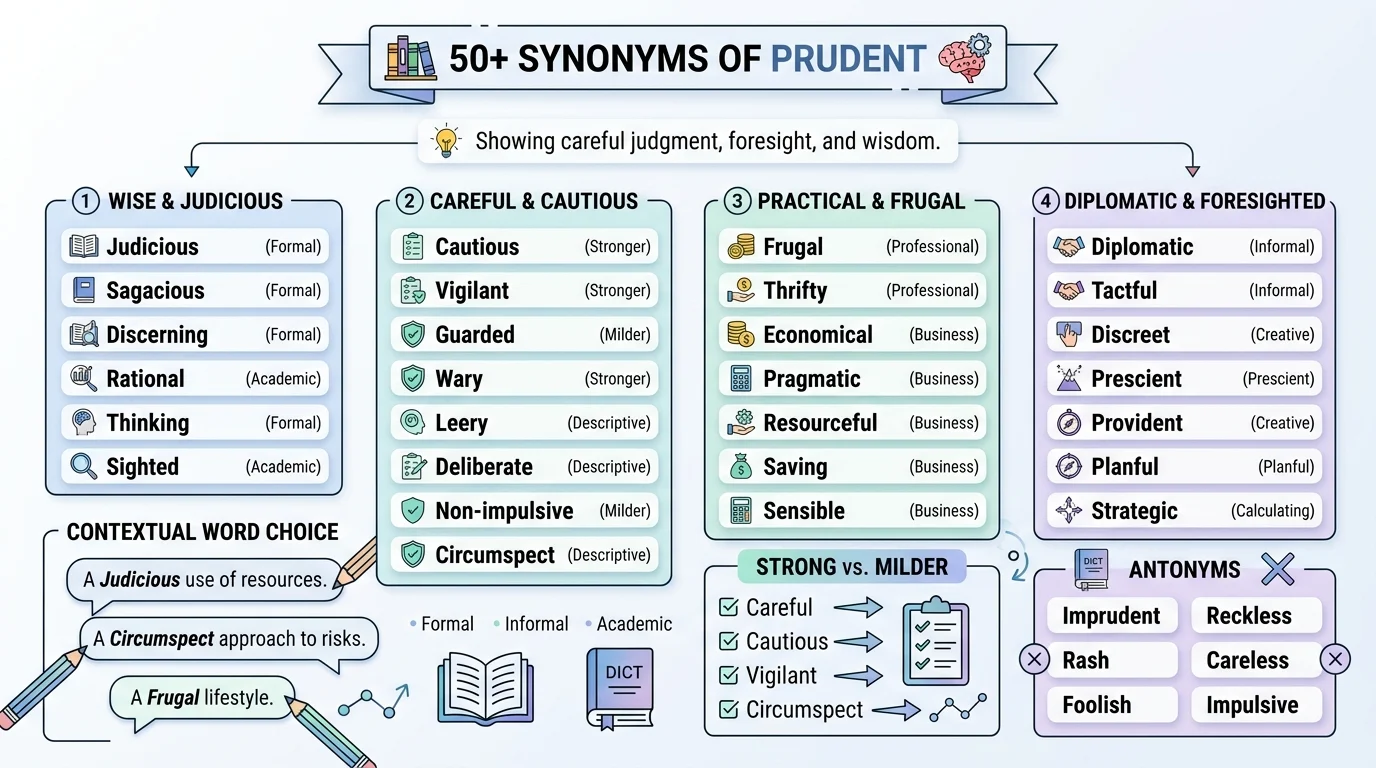
Have you ever found yourself writing an email, an essay, or a social media caption and realized you have used the word “prudent” three times in two paragraphs? You know the word fits, but repeating it makes your writing feel flat and uninspired. Whether you are drafting a business report, polishing a college application essay, or simply trying to sound more articulate in a conversation, finding the perfect alternative can elevate your communication instantly. This guide explores the best synonyms of prudent, breaking down exactly which word to use and when.
What Are the Best Synonyms of “Prudent”?
Prudent means acting with careful thought, good judgment, and foresight to avoid unnecessary risks. The best synonym depends on your context. For formal writing, choose “judicious.” For everyday conversation, “sensible” works perfectly. In professional settings, “circumspect” or “canny” are excellent choices. For academic work, “sagacious” adds authority, while “wise” remains a strong, versatile option for most situations.
Meaning, Tone, and Context
Simple Definition
Prudent describes someone who is careful and sensible, marked by sound judgment in practical matters. A prudent person thinks before acting, considers potential consequences, and plans for the future.
Part of Speech
Adjective
Overall Tone
Positive and neutral. Being called prudent is almost always a compliment. It suggests responsibility, level-headedness, and maturity.
Formality Level
Formal. “Prudent” is a sophisticated word commonly found in academic essays, business reports, and professional correspondence. In casual conversation, native speakers often reach for simpler alternatives like “sensible” or “smart.”
Common Uses
Native English speakers use “prudent” to describe financial decisions, management styles, legal advice, health precautions, and any situation requiring careful planning. You will frequently encounter it in news articles about economics, government policy, and business strategy.
Word Forms
- Noun: prudence
- Adverb: prudently
- Related Forms: prudential (adjective)
- Opposite Form: imprudent
When and How to Use “Prudent”
Choose “prudent” when you want to emphasize careful judgment combined with practical wisdom. It works best in formal contexts where you are discussing decisions, plans, or advice.
Professional:
The committee made a prudent decision to delay the product launch until quality issues were resolved.
Academic:
It is prudent for researchers to replicate their findings before drawing definitive conclusions.
Workplace:
Our CFO is known for her prudent management of the company’s investment portfolio.
Personal:
Saving three months of living expenses before quitting my job felt like a prudent move.
Email:
Given the current market volatility, it would be prudent to review our budget projections more conservatively.
Resume:
Known for prudent financial planning that reduced departmental overhead by 15% without sacrificing quality.
Social Media:
A prudent traveler always buys travel insurance before an international trip. #TravelTips
Best Synonyms of “Prudent”
No two synonyms are identical in every situation. The right word depends on your audience, purpose, and the specific shade of meaning you want to convey.
Professional Writing
Judicious is the best choice. It emphasizes sound judgment and wise decision-making in professional and legal contexts.
Academic Writing
Sagacious adds an authoritative, scholarly tone. It suggests deep wisdom and keen discernment.
Business Communication
Canny works well. It implies shrewdness and practical intelligence, especially in financial or commercial matters.
Casual Conversation
Sensible is the natural choice. It is familiar, easy to understand, and widely used in everyday speech.
Emotional Writing
Wise carries warmth and emotional weight. It suggests experience and deep understanding of people and situations.
Creative Writing
Circumspect adds a layer of caution and careful observation, perfect for character description.
Resume Writing
Discerning highlights good judgment and the ability to make excellent choices.
Workplace Communication
Politic suggests tact and strategic awareness, ideal for navigating office dynamics.
Stronger Meaning
Vigilant emphasizes watchfulness and alertness to potential dangers.
Softer Meaning
Careful is milder and more general, suitable for everyday situations where extreme caution is not required.
When Not to Use “Prudent”
When the Word Sounds Too Formal
In casual texts or friendly emails, “prudent” can sound stiff and overly serious.
- Less effective: “It would be prudent to grab some coffee before the meeting.”
- Better: “Let’s grab some coffee before the meeting.” (or “sensible” if you must emphasize the reasoning)
When the Word Sounds Too Vague
Sometimes “prudent” is too general. If you need to describe specific actions, choose a more precise word.
- Less effective: “She took prudent steps.”
- Better: “She took cautious steps.” (if avoiding danger) or “She took strategic steps.” (if planning ahead)
When the Word Is Too Weak
For situations requiring extreme alertness or life-saving measures, “prudent” may not convey enough urgency.
- Less effective: “It is prudent to check the brakes regularly.”
- Better: “It is essential to check the brakes regularly.”
When the Word Is Too Strong
For minor decisions, “prudent” can feel exaggerated.
- Less effective: “I made a prudent choice to wear a jacket.”
- Better: “I made a sensible choice to wear a jacket.”
Words Commonly Confused With “Prudent”
Prudent vs. Cautious
Difference: “Cautious” focuses on avoiding danger or error in the moment. “Prudent” includes long-term foresight and practical wisdom.
When to Use It: Use “cautious” when describing immediate, protective actions.
Example (Cautious): “She was cautious when crossing the icy street.”
Prudent vs. Wise
Difference: “Wise” suggests deep experience and understanding of people and situations. “Prudent” is more about practical, calculated decision-making.
When to Use It: Use “wise” when referring to someone with great life experience or moral insight.
Example (Wise): “My grandmother gave me wise advice about relationships.”
Prudent vs. Judicious
Difference: “Judicious” stresses the capacity to reach fair, well-considered decisions. “Prudent” emphasizes restraint and discretion.
When to Use It: Use “judicious” in legal, academic, or formal decision-making contexts.
Example (Judicious): “The judge made a judicious ruling based on all the evidence.”
Prudent vs. Sensible
Difference: “Sensible” is broader and more everyday. “Prudent” is more formal and implies planning for the future.
When to Use It: Use “sensible” in everyday conversation and informal writing.
Example (Sensible): “Wearing a helmet while biking is sensible.”
Prudent vs. Discreet
Difference: “Discreet” emphasizes being careful not to attract attention or cause embarrassment. “Prudent” is broader, covering all types of careful judgment.
When to Use It: Use “discreet” when discussing privacy, confidentiality, or social tact.
Example (Discreet): “Please be discreet about the surprise party plans.”
Prudent vs. Thrifty
Difference: “Thrifty” specifically relates to money and being economical. “Prudent” can apply to any decision, not just financial ones.
When to Use It: Use “thrifty” when describing careful spending habits.
Example (Thrifty): “My thrifty grandmother never wasted a single penny.”
Best Synonyms of “Prudent” by Context
| Context | Best Synonym | Why It Works | Example |
|---|---|---|---|
| Formal writing | Judicious | Emphasizes sound, well-reasoned judgment | “The board made a judicious decision.” |
| Academic writing | Sagacious | Adds scholarly authority and depth | “The sagacious professor mentored many students.” |
| Professional communication | Canny | Suggests shrewd, practical intelligence | “Her canny negotiation saved the deal.” |
| Business emails | Politic | Implies strategic, tactful awareness | “It was politic to acknowledge the client’s concerns.” |
| Resume writing | Discerning | Highlights excellent judgment and taste | “Discerning leader with a track record of smart hires.” |
| Workplace communication | Circumspect | Emphasizes careful observation and caution | “Stay circumspect when discussing the merger.” |
| Casual conversation | Sensible | Familiar, easy to understand, natural | “That’s a sensible way to handle it.” |
| Everyday speaking | Smart | Informal and widely understood | “That was a smart move.” |
| Creative writing | Wary | Adds a sense of alertness and suspicion | “The wary detective examined the scene.” |
| Storytelling | Sage | Evokes wisdom and experience | “The sage old man offered his counsel.” |
| Emotional writing | Wise | Warm, experienced, and deeply thoughtful | “Her wise words comforted everyone.” |
| Strong emphasis | Vigilant | Conveys intense watchfulness and alertness | “Remain vigilant against cyber threats.” |
| Mild tone | Careful | Simple, mild, and universally understood | “Be careful with that glass.” |
| Social media captions | Smart | Short, catchy, and relatable | “Smart choice. #Winning” |
How to Choose the Best Synonym of “Prudent”
Choosing the right synonym starts with asking yourself a few simple questions.
Who is your audience?
For a boss, client, or professor, choose formal words like “judicious” or “circumspect.” For friends or family, pick “sensible” or “smart.”
What is your purpose?
Are you giving advice, describing a person, or making a recommendation? Each purpose calls for a slightly different word. Advice often works well with “sensible.” Describing someone might call for “wise” or “discerning.”
What emotional tone do you want?
Do you want to sound warm and experienced? Choose “wise.” Do you want to sound alert and protective? Choose “vigilant.” Do you want to sound neutral and factual? Choose “sensible.”
How strong should the meaning be?
For mild caution, use “careful.” Moderate caution with good judgment, use “prudent” or “sensible.” For intense watchfulness, use “vigilant” or “circumspect.”
Does it sound natural?
Read your sentence aloud. If the synonym feels forced or overly formal, try a simpler word. Natural-sounding language always communicates more effectively.
Real Life Examples of “Prudent”
School
It is prudent to start studying for final exams at least two weeks in advance.
College
The prudent student diversifies her course load to balance challenging and manageable classes.
Workplace
Our team took a prudent approach to the new software rollout, testing it with a small group first.
Business
The CEO’s prudent cost-cutting measures kept the company profitable during the economic downturn.
I think it would be prudent to schedule a follow-up meeting to address any remaining questions.
Resume (Improved)
Instead of: “Made prudent financial decisions.”
Write: “Executed judicious financial strategies that increased annual returns by 12%.”
Conversation
“It seemed prudent to wait for the rain to stop before heading out.”
Storytelling
The old sailor was known for his prudent nature, always checking the weather before setting sail.
Blogging
A prudent blogger fact-checks every source before publishing to maintain credibility.
Social Media
Prudent parents teach their kids about online safety early. #ParentingTips
18 Best Synonyms of “Prudent”
Synonyms of “Prudent” by Usage
Professional vs Personal Synonyms
In the workplace, choose judicious, canny, or circumspect to sound polished and competent. In personal conversations, sensible and smart feel more natural and approachable.
Formal vs Conversational Synonyms
For reports, essays, and business writing, use judicious, sagacious, or provident. For casual conversations and texts, use sensible, careful, or smart. “Prudent” itself is formal, so swapping it for a conversational synonym can make your writing feel warmer.
Academic Synonyms
Sagacious, judicious, and discerning are excellent for research papers, essays, and academic discussions. They sound authoritative and demonstrate vocabulary sophistication.
Professional and Business Synonyms
Canny, shrewd, and politic are powerful choices for resumes, interviews, and client communications. They convey strategic thinking and practical intelligence.
Creative and Literary Synonyms
Circumspect, sage, and wary add depth and emotion to storytelling and descriptive writing. They help paint vivid pictures of characters and situations.
Slang or Modern Synonyms
There are no widely accepted slang synonyms for “prudent.” In very informal contexts, smart or on the ball can convey a similar idea, but these should be avoided in formal or professional writing.
Strongest to Mildest Synonyms
Mild: careful, sensible, smart
Moderate: prudent, wise, discreet, thrifty
Strong: judicious, circumspect, canny, discerning
Very Strong: sagacious, vigilant, provident, farsighted
Emotional vs Neutral Synonyms
Emotional Synonyms: wise, sage, discerning (these carry warmth, experience, and depth of feeling)
Neutral Synonyms: sensible, careful, judicious (these simply communicate good judgment without added emotion)
Antonyms of “Prudent”
| Antonym | Meaning | Example Sentence |
|---|---|---|
| Imprudent | Not careful or wise | “It was imprudent to spend the entire budget in one month.” |
| Reckless | Without care for consequences | “His reckless driving caused the accident.” |
| Careless | Not paying enough attention | “A careless error ruined the entire project.” |
| Foolish | Lacking good sense | “It was foolish to ignore the warning signs.” |
| Rash | Acting without thinking | “A rash decision led to unnecessary losses.” |
| Impulsive | Acting on sudden urges | “Her impulsive purchase emptied her savings.” |
| Incautious | Not careful | “Incautious investors lost everything in the crash.” |
| Indiscreet | Not careful in what you say or do | “An indiscreet comment damaged his reputation.” |
| Hasty | Done too quickly | “A hasty conclusion overlooked key evidence.” |
| Thoughtless | Not considering others | “His thoughtless remark offended everyone.” |
| Irresponsible | Not showing care for consequences | “Irresponsible spending led to bankruptcy.” |
| Negligent | Failing to take proper care | “Negligent supervision caused the accident.” |
| Unwise | Not showing good judgment | “It was unwise to travel during the storm.” |
| Injudicious | Lacking good judgment | “The injudicious decision cost the company millions.” |
| Improvident | Not providing for the future | “Improvident spending left her with no retirement savings.” |
Comparison: “Prudent” vs Similar Words
Prudent vs Wise
Main Difference: “Wise” suggests deep life experience and understanding of human nature. “Prudent” focuses on practical, calculated judgment in specific situations.
Which Is Stronger?: “Wise” is stronger in terms of overall life wisdom.
Which Is More Formal?: “Prudent” is more formal.
When to Use Each: Use “wise” for life advice and moral insight. Use “prudent” for practical decisions and planning.
Examples
Prudent: “It was prudent to save money for emergencies.”
Wise: “My grandfather gave me wise advice about choosing a career.”
Prudent vs Judicious
Main Difference: “Judicious” emphasizes the ability to make fair, well-reasoned decisions. “Prudent” emphasizes caution and restraint.
Which Is Stronger?: “Judicious” is stronger in the sense of authoritative decision-making.
Which Is More Formal?: Both are formal, but “judicious” is especially common in legal and academic contexts.
When to Use Each: Use “judicious” when describing official or authoritative decisions. Use “prudent” for personal or everyday careful choices.
Examples
Prudent: “She took a prudent approach to investing.”
Judicious: “The judge made a judicious ruling based on the evidence.”
Prudent vs Cautious
Main Difference: “Cautious” focuses on avoiding immediate danger or error. “Prudent” includes long-term foresight and planning.
Which Is Stronger?: “Prudent” is stronger because it includes both caution and wisdom.
Which Is More Formal?: “Prudent” is more formal.
When to Use Each: Use “cautious” for immediate safety situations. Use “prudent” for strategic planning.
Examples
Prudent: “Prudent families save for college education years in advance.”
Cautious: “Be cautious when crossing the street.”
Prudent vs Sensible
Main Difference: “Sensible” is broader and more everyday. “Prudent” is more formal and implies forward-thinking.
Which Is Stronger?: “Prudent” is stronger in terms of formality and foresight.
Which Is More Formal?: “Prudent” is more formal.
When to Use Each: Use “sensible” in everyday conversation. Use “prudent” in professional or academic writing.
Examples
Prudent: “The prudent manager diversified the company’s investments.”
Sensible: “Wearing a helmet while biking is sensible.”
Prudent vs Discreet
Main Difference: “Discreet” is specifically about being careful not to attract attention or cause embarrassment. “Prudent” covers all types of careful judgment.
Which Is Stronger?: “Prudent” is broader and more comprehensive.
Which Is More Formal?: Both are formal, but “discreet” is more specific.
When to Use Each: Use “discreet” when discussing privacy or confidentiality. Use “prudent” for general careful decision-making.
Examples
Prudent: “It was prudent to review the contract carefully.”
Discreet: “Please be discreet about the surprise party.”
Prudent vs Thrifty
Main Difference: “Thrifty” specifically relates to money and being economical. “Prudent” applies to any type of decision.
Which Is Stronger?: “Prudent” is broader and more versatile.
Which Is More Formal?: Both are formal, but “thrifty” is more specific to finance.
When to Use Each: Use “thrifty” only when discussing money. Use “prudent” for all other careful decisions.
Examples
Prudent: “It was prudent to wait before making a final decision.”
Thrifty: “She is a thrifty shopper who always uses coupons.”
Common Phrases and Expressions with “Prudent”
Prudent course of action
Meaning: The most sensible and careful way to proceed.
Example Sentence: “Given the weather forecast, the prudent course of action was to cancel the outdoor event.”
Prudent decision
Meaning: A decision made with careful thought and good judgment.
Example Sentence: “Buying insurance for the rental car was a prudent decision.”
Prudent approach
Meaning: A method or strategy that emphasizes caution and good judgment.
Example Sentence: “The company took a prudent approach to expansion, opening only one new store per year.”
Prudent management
Meaning: Oversight and leadership characterized by careful planning and risk avoidance.
Example Sentence: “The nonprofit’s prudent management ensured its survival through the economic downturn.”
Prudent saving
Meaning: Setting aside money carefully for future needs.
Example Sentence: “Prudent saving over decades allowed her to retire comfortably.”
Prudent investor
Meaning: Someone who invests money with careful consideration of risks.
Example Sentence: “A prudent investor diversifies their portfolio to minimize risk.”
Prudent advice
Meaning: Guidance that is wise and cautious.
Example Sentence: “He always listened to her prudent advice before making big decisions.”
Common Mistakes to Avoid
1: Choosing a Vague Synonym Instead of a Precise One
Incorrect: “The manager made a good decision.”
Better: “The manager made a judicious decision.”
Why: “Good” is too vague. “Judicious” conveys sound, well-reasoned judgment.
2: Confusing “Prudent” with “Cautious”
Incorrect: “She was prudent about crossing the street.”
Better: “She was cautious about crossing the street.”
Why: Crossing the street is an immediate safety concern, so “cautious” is more precise. “Prudent” implies longer-term planning.
3: Using an Informal Synonym in Formal Writing
Incorrect: “The committee made a smart choice.”
Better: “The committee made a judicious choice.”
Why: “Smart” is informal. “Judicious” is appropriate for formal reports and academic papers.
4: Selecting an Overly Dramatic Synonym
Incorrect: “It was vigilant to bring an umbrella.”
Better: “It was sensible to bring an umbrella.”
Why: “Vigilant” implies watchfulness against serious threats. Bringing an umbrella is a minor, sensible precaution.
5: Repeating the Same Word Too Often
Incorrect: “The prudent manager made a prudent decision after prudent consideration.”
Better: “The judicious manager made a sensible decision after careful consideration.”
Why: Varying your word choices makes your writing more engaging and professional.
6: Choosing a Synonym with the Wrong Emotional Tone
Incorrect: “Her prudent words comforted the grieving family.”
Better: “Her wise words comforted the grieving family.”
Why: “Prudent” sounds calculated and practical. “Wise” carries warmth and emotional depth, which is more appropriate for comforting someone.
7: Using Slang in Academic or Professional Writing
Incorrect: “The researcher took a savvy approach to the experiment.”
Better: “The researcher took a judicious approach to the experiment.”
Why: “Savvy” is informal. “Judicious” is the correct academic choice.
Frequently Asked Questions
1. What are the best synonyms of “prudent”?
The best synonyms depend on your context. Formal writing, use “judicious.” For everyday conversation, use “sensible.” For professional settings, “canny” or “circumspect” work well. “Wise” is a strong, versatile option for most situations.
2. What are the best formal synonyms of “prudent”?
Excellent formal synonyms include “judicious,” “sagacious,” “circumspect,” and “discerning.” These words are appropriate for academic papers, business reports, legal documents, and professional correspondence.
3. What are common informal synonyms of “prudent”?
In casual conversation, native speakers often use “sensible,” “smart,” or “careful” instead of “prudent.” These words are easier to understand and sound more natural in everyday speech.
4. What is another word for “prudent” in professional writing?
In professional writing, “judicious” is an excellent choice. It emphasizes sound, well-reasoned judgment. “Canny” and “shrewd” are also strong options for business and financial contexts.
5. What is the difference between “prudent” and “wise”?
“Wise” suggests deep life experience and understanding of people and situations. “Prudent” focuses on practical, calculated judgment in specific situations. Use “wise” for life advice and moral insight. Use “prudent” for practical decisions and planning.
6. What is the opposite of “prudent”?
The most direct opposite is “imprudent,” meaning not careful or wise. Other antonyms include “reckless,” “careless,” “foolish,” “rash,” and “impulsive”.
Conclusion
Prudent is a powerful word that describes careful, sensible decision-making with an eye toward the future. It conveys responsibility, good judgment, and practical wisdom. The best synonym depends entirely on your context, audience, and purpose. Formal writing, choose “judicious.” For everyday conversation, pick “sensible.” For professional settings, “canny” or “circumspect” are excellent alternatives. Remember that no synonym works perfectly in every situation. The most effective communicators choose words based on tone, audience, and the specific shade of meaning they want to convey. The next time you reach for “prudent,” pause and consider whether a more precise synonym might serve you better. Your writing will become clearer, more engaging, and more impactful as a result.